Not economic for Australia to invest in unproven, high-risk, fossil fuel technologies
 University of NSW Study Pushes for Renewable Energy Over Coal http://au.ibtimes.com/articles/504152/20130906/university-nsw-study-pushes-renewable-energy-over.htm#.UivWvNJwonE By Vittorio Hernandez | September 6, 2013 4:07 PM EST
It would make more economic sense for Australia to pursue renewable energy rather than continue the use of coal, despite the possible availability of carbon capture and storage technology, according to a study by the University of New South Wales The basis of their study is a modeling, using a range of fossil fuel scenarios with carbon capture and storage compared with 100 per cent renewable electricity scenario based on commercially available wind, solar and biomass technologies.
The researchers then used 2010 hourly electricity demand and solar and wind data to determine the proper technology mixes for each scenario to balance demand and supply of electricity with the aim of having the same reliability as the current Australian National Electricity Market.
Prices were based on government estimates of different generation technologies and fuels in 2030, plus possible future carbon prices and carbon capture and storage prices.
“The research confirms that policies pursuing very high penetrations of renewable electricity, based on commercially available technologies, offer a reliable, affordable and low risk way to dramatically cut emissions in the electricity sector,” Business Spectator quoted University of NSW Associate Professor Mark Diesendorf of the Institute of Environmental Studies, one of the co-authors of the study.
The report concluded that it is not necessary to invest in new, expensive, unproven, high-risk, fossil fuel technologies. It added that reaching the rapid and deep cuts to greenhouse gas emissions necessary to avoid dangerous global warming is expected to be more difficult in the fields of transportation and agriculture than the electricity sector.
The role of Bob Carr, Australia’s Foreign Minister, in NOT helping Julian Assange
 Mr Assange is the lead WikiLeaks Party candidate for a Senate seat in Victoria. Since June, 2012, he has resided at Ecuador’s London embassy where he was granted political asylum on the grounds that he is at risk of extradition to the US.
Carr accused of meddling in Assange case http://www.watoday.com.au/federal-politics/federal-election-2013/carr-accused-of-meddling-in-assange-case-20130905-2t847.html#ixzz2e8ycDLrt September 6, 2013 Philip Dorling Australian diplomats in Washington immediately stopped reporting to Canberra on the trial of WikiLeaks source Chelsea Manning, formerly known as Bradley Manning, after Foreign Minister Bob Carr declared he would not allow ”over-servicing” of Julian Assange’s consular case.
Australian diplomatic cables released under freedom of information law reveal that the Australian embassy in Washington reported on the first two days of US Army Private Manning’s two-month trial, which began on June 3, and highlighted numerous references to Mr Assange, who has been targeted by US law enforcement and intelligence agencies in a long-running espionage investigation.
However, a response by the Department of Foreign Affairs and Trade to a freedom of information application by Fairfax Media shows that the Washington embassy stopped reporting on the Manning trial after Senator Carr told a Senate estimates hearing on June 6 that the WikiLeaks publisher’s case ”doesn’t affect Australian interests”. Continue reading
Speak out against wind power – urges Gina Rinehart, Australia’s richest woman
Rinehart calls for action against wind power BY:SARAH-JANE TASKER The Australian September 06, 2013 AUSTRALIA’S richest woman — Gina Rinehart — has urged people to speak out against wind power and for the country to address its debt by getting non-violent prisoners to pay to avoid jail and for governments to sell their art and decor.
Ms Rinehart, in her latest article in Australian Resources and Investment magazine, used a conversation she had with a Dutch cab driver to lead her argument about concerns around the use of renewable energy……http://www.theaustralian.com.au/news/nation/rinehart-calls-for-action-against-wind-power/story-e6frg6nf-1226712611162
National pressure growing in Australia against Muckaty radioactive waste plan
 Dump under the pump: Pressure grows against Muckaty radioactive waste plan. Territory trade unions, medicos and environmentalists have been joined by their national counterparts in a call to end a planned radioactive waste dump in the NT.
 The groups have placed an advertisement (attached) in the Tennant and District Times today to highlight their concerns over federal plans to dump radioactive waste on Aboriginal land at Muckaty, north of Tennant Creek and their commitment to continuing campaigning on the dump plan after this Saturday’s federal election.
Warren Mundine – Tony Abbott’s Unelected Aboriginal Man for Australia
 many Aboriginal people in the NT remain unconvinced of the elegance, and legitimacy of Mundine’s manifesto.
Maurie Ryan, Chair of the NT’s Central Land Council questions the LNP’s anointment of Mundine as head of the Indigenous Advisory Council.
The members of the [Central] Land Council find it unacceptable that policy affecting them may be dictated by somebody who doesn’t understand the issues affecting them. Unfortunately Mr Mundine seems to be unaware of the significant changes made in recent years and he needs to update his knowledge of the current situation in the Northern Territory
 Abbott wins the election on this Saturday, Warren Mundine will most likely become the most powerful Aboriginal person in the country. He will lead the Abbott’s Indigenous Advisory Council, an as yet vague entity that will be unelected and, in the minds of many, an unrepresentative body providing Abbott with high-level policy advice in his “Prime Minister for Indigenous Affairs” morph.
Australian wind power a record in August
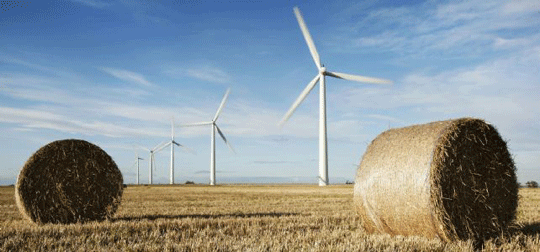 August A Record Month For Aussie Wind Power by Energy Matters, 5 Sept 13 South Australia, Victoria, Tasmania and New South Wales all broke records for wind power generation during August.
Helped along by blustery conditions during the week beginning August 11; the amount of power generated during the month was enough to power 155,000 homes for an entire year says the Clean Energy Council (CEC).
In South Australia, wind power provided just under 40 percent of the state’s electricity needs for the entire month.
“South Australia’s wind farms produced the lion’s share of the country’s wind power in August, but the new Macarthur Wind Farm in western Victoria is the largest in the Southern Hemisphere and provided a huge clean energy boost,” said CEC Policy Director Russell Marsh.
“These recent statistics add to results published by the Australian Energy Market Operator last week which showed that more than a quarter of South Australia’s power came from wind power over the last financial year.”…… http://www.energymatters.com.au/index.php?main_page=news_article&article_id=3925
Australia’s inevitable path away from fossil fuels investment
Dim future for coal as renewables rise, research finds SMH, September 4, 2013 Peter Hannam Carbon economy editor, Australia’s energy industry is on an inevitable path away from fossil fuels and further investment in the sector, particularly in coal, would be very risky, according to research by UNSW.
New analysis comparing the likely costs of pursuing 100 per cent renewable energy for the power sector by 2030 against a range of coal and gas options found a shift to commercially available clean energy would be cost-effective and relatively low-risk.
The tragedy is that superannuation and other funds have invested in this industry
The research assumptions included a price on carbon emissions of at least $56 per tonne by 2030, as modelled by the Australian Treasury, and estimated a range of costs for capturing and storing emissions from coal or gas-fired power plants underground………
“We think that whatever the year-to-year politics in Australia, in the long run there will be quite high prices for carbon around the world inevitably,” Professor Diesendorf said.
The research builds on earlier work, including from the Australian Energy Market Operator, which found Australia could shift towards 100 per cent renewable energy for its power sector for a similar cost of using fossil fuels without undermining reliability.
The modelling assumed wind would provide about 46 per cent of energy to the power sector, with concentrated solar thermal power 21 per cent, solar photovoltaics 20 per cent, and the remainder sourced from biofuels and hydropower. The risks of sticking with fossil fuels included being tied to nascent carbon capture and storage technology and being exposed to gas prices that are expected to rise steeply in the future.
“There is no need to invest in new, expensive, unproven, high-risk, fossil-fuel technologies,” Professor Diesendorf said……..
UNSW’s Professor Diesendorf predicted further investments in the coal industry would be risky as the local and international economy faces up to a more carbon-constrained future.
“A lot of that could be dramatically stranded assets in the future,” he said. “The tragedy is that superannuation and other funds have invested in this industry.”
Indigenous Land Under Attack through ILUA Indigenous Land Use Agreement
 Australia: ILUA Indigenous Land Use Agreement Equals Indigenous Land Under Attack http://indigenouspeoplesissues.com/index.php?option=com_content&view=article&id=17864:australia-ilua-indigenous-land-use-agreement-equals-indigenous-land-under-attack&catid=24&Itemid=57 Native Title lawyers and anthropologists are deceiving claimants of their true Native Title rights and interests Michael Anderson said from Goodooga on July 2:2013
Liberal candidate for Hume, Angus Taylor, tipped to fight against renewable energy
 Controversial wind farm gets clean bill of health SMH, September 3, 2013 Peter Hannam “……….Opposition hopes Lyn Jarvis, a member of the Bodangora Wind Turbine Awareness Group, said her community group remains opposed to the wind farm despite the NSW Health and Planning Assessment Commission’s findings.
Ms Jarvis said the commission had ignored an independent noise assessment by Steven Cooper, an acoustics technician that found the wind turbines would be harmful.
“It’s fallen on deaf ears,” she said. “We had 94 per cent of the submissions against the development.”
The group is pinning its hopes on the election of Liberal candidate for Hume, Angus Taylor, to help lead a pushback against renewable energy, particularly wind farms.
“Hopefully, he will pull the renewable energy credits and it won’t get built – or any wind farms won’t get built in inappropriate places,” Ms Jarvis said. http://www.smh.com.au/business/carbon-economy/controversial-wind-farm-gets-clean-bill-of-health-20130903-2t1u2.html#ixzz2dxXonk7R
Solar farm in ACT will be up and running in 2014, funding secured
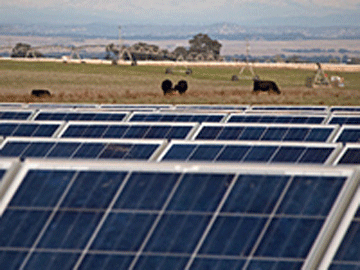 Royalla Solar Farm Secures Cash http://www.energymatters.com.au/index.php?main_page=news_article&article_id=3923 4 Sept 13 The parties involved with the ACT’s Royalla Solar Farm have secured financial backing via ANZ and National Australia Bank.
The FRV Royalla Solar Farm will be constructed 23 kilometres south of Canberra’s centre. Approximately 83,000 solar panels at the facility will generate enough electricity to supply the power needs of around 4,500 homes.
Clean Energy Council Chief Executive David Green has congratulated the companies involved with securing the backing.
“The financial backing is obviously welcome news for both FRV (Fotowatio Renewable Ventures) and Acciona who are working together to deliver the project,” he said. “The ACT Government’s Solar Auction has been a game-changer in supporting this new form of renewable energy at the lowest cost to consumers.”
Construction of the plant is due to be completed in 2014. Continue reading
Ethics and Politics in Australia. about climate change
 Australia’s political climate: Three numbers ignored in this election Byron Smith ABC RELIGION AND ETHICS 3 SEP 2013. The national discussion concerning climate change in Australia has some curious blind spots. Despite having featured prominently in Australian federal politics ever since Prime Minister Kevin Rudd declared it to be “the great moral challenge of our generation” back in August 2007, at no point in the public debate have three crucial numbers been highlighted by either side of the political divide. Continue reading
Research shows Australia’s record heat linked to human activity
 Humans behind record Australian heat, research shows (good graphs) SMH September 3, 2013 David Karoly and Sophie Lewis It’s official, the past 12 months have been the hottest in Australia for more than a hundred years.
Temperatures averaged across Australia between September 2012 and August 2013 were hotter than any year since good records began in 1910. The previous record was held by the 12-month period from February 2005 to January 2006.
The new record follows a suite of broken records following last year’s “angry summer”, including the hottest summer since records began. New weather records are being set all the time. Sometimes these are record cold temperatures, but more often in recent times these have been record hot temperatures. A common question is what is the human role, if any, in these records compared with natural variations of weather and climate?
The link between global warming and human causes has been firmly established over the last two decades. Continue reading
New South Wales Health and Planning Commission find wind farm no risk to health
Controversial wind farm gets clean bill of health SMH, September 3, 2013 Peter Hannam Carbon economy editor A controversial $200 million wind farm that divided a local community and drew opposition from a nearby maximum security jail has secured planning approval to proceed.
Infigen Energy’s 33 turbine wind farm planned for Bodangora, near Dubbo in central NSW, was approved by the state’s Planning Assessment Commission late last week with the ruling only made public on Monday.
In a potential setback to opposition at other proposed wind farm sites, the commission dismissed community concerns that noise from the turbines would affect their health. The commission said NSW Health “was very clear in its advice” that “there is no published scientific evidence to link wind turbines with adverse health effects”.
The commission’s findings are “an important precedent” for the state, said Simon Chapman, a professor of public health at the University of Sydney. They add to almost 20 other official reports, such as from the Victorian government in May, that examined wind farms and health, he said.
“All of them are consistent in saying that there is no good evidence that wind turbines directly cause health effects,” Professor Chapman said. The NSW government has been considering draft guidelines for wind farms for about two years, including rules for a two-kilometre setback. Such a range is applied in Victoria and claimed by the wind energy industry to be among the toughest anywhere.
Frank Boland, Infigen’s senior development manager for the 100-megawatt project, welcomed the commission’s ruling for the Bodangora site.
“It not only gives us comfort but also should give comfort to anyone who did have health concerns about the project,” Mr Boland said. “We don’t see any causal link between wind turbines and health, full stop.”
The NSW Health statement “is relevant to other states as well”, Mr Boland said, adding that its ruling could help secure planning approval for a similar-sized wind farm planned by Infigen at Flyers Creek, south of Orange, and for projects elsewhere…….. http://www.smh.com.au/business/carbon-economy/controversial-wind-farm-gets-clean-bill-of-health-20130903-2t1u2.html#ixzz2dxXonk7R
Glut of uranium to continue – market forecast is dire, especially for Paladin
 Japan’s nuclear energy intentions are the swing factor at present. … if Japan does not start turning back on more reactors, Japanese uranium stockpiles will continue to hit the market to pay for increased fossil fuel imports. Nor is it helping at present that the US is also talking about turning off reactors.
Meanwhile, traders and speculators stuck with material and producers suffering cash flow problems are ever more desperate to offload material.
No rush to buy uranium, 9 News Finance by FN Arena 2 Sept 13, The spot market for uranium was never of much interest until the big surge took prices up well over US$100/lb in 2006. In that era, legacy contract obligations at much lower prices impacted on the earnings potential of the large and long-established players, such as Energy Resources of Australia in Australian terms, while new kids on the block, such as Paladin Energy relished the opportunity to secure contracts at more spot-aligned pricing.
Fast forward to the post-Fukushima era of 2013 and the tables have turned. Those noughties contract obligations have largely run off and the uranium price is wallowing in the depths. Lower cost, long-established producers such as BHP Billiton can at least bungle along (ERA has had its own specific production issues) while the high-cost later entrants are struggling to stay afloat. Paladin is the classic example. Continue reading
Aborignal elders’ knowledge – the key to a sustainable Australia?
While we cannot go back to pre-European cultures because the society and the land has changed forever, we can now learn to respectfully take some of the knowledge our ‘elders’ have acquired over generations, and combine this with our modern methods of farming and land care.
This way, we may be able to forge new ways of caring for our precious land in more sustainable ways.
Respecting the elders of our land can help rehabilitate the environment Press Service International for Christian Today Australia – Mark Tronson Press Service International for Christian Today Australia – Mark Tronson Monday, 2 September 2013,The Bible exhorts us to respect our elders. It starts right near the beginning with fifth (sometimes regarded as the fourth) of the Ten Commandments (Exodus 20 verses 1-17 and re-told in Deuteronomy 5 verses 4-21): “Honour your father and your mother, that your days may be long in the land that the LORD your God is giving you.”
Who are our Australian ‘elders’?
I was thinking about this when watching some of the episodes of the TV series ‘First Footprints’. A summary of this program can be found at: www.kimberleyfoundation.org.au
Aborigines, over time, developed land-management strategies that worked for them. They did not leave the land in its original pristine state, no human society has ever done that, but they learnt to manage the land and climate in the 200 or more different areas of Australia to maintain their food sources over many, many generations. Is our modern European land management strategy achieving this same result?
1 This month
17 October, Free Public Talk on Nuclear Issues in South Australia
David Noonan will speak on public interest concerns over the new Roxby Downs Indenture Act 2026 on BHP copper-uranium mining and ore processing in SA, and on how AUKUS may face SA with a High-Level nuclear waste agenda.
Dr Jim Green will discuss international developments in the field of nuclear power including ‘small modular reactors’ and Generation 4 ‘advanced’ nuclear reactor concepts.


Help Aunty Sue Protect Her Land and Sacred Sites From Destructive Rocket Testing.
.

Australians deserve the truth
about
AUKUS – https://aukuspublicinquiry.com/

PETITION – To: Prime Minister Anthony Albanese and the Australian Labor Government

of the week – Australians for War Powers Reform (AWPR)
To see nuclear-related stories in greater depth and intensity

