South Australia’s drop in electricity consumption partly due to solar panels
 Solar Panels Reducing South Australia’s Electricity Consumption by Energy Matters, 2 Sept 13, Expected growth in energy consumption in South Australia over the next decade has been lowered; thanks in part to solar PV.
The 2013 South Australian Electricity Report (SAER), prepared by the Australian Energy Market Operator (AEMO), says the state’s annual energy consumption was 13,330 gigawatt hours (GWh) in 2012-13; down by 42 GWh compared to 2011-12.
Looking ahead, electricity consumption is forecast to decrease by 0.1% per year over the 10-year outlook period……. http://www.energymatters.com.au/index.php?main_page=news_article&article_id=3919
Ashurst, Paladin, attack this website with legal threats. Reply from Ashurst
Among other things, the Ashurst letter accused the anti-nuclear campaigner of imputing that Mr Walker was ‘’insensitive’’.
 In any case, these kinds of threats to muzzle free speech are on the rise. At a time when the mainstream media is under pressure from falling revenues, lawyers are threatening and shutting down websites around the country at an alarming clip.
Anti-nuke campaigner braces for legal blast, The Age, December 19, 2012 Michael West Ashurst is at it again.
Acting on instructions from its clients, the big law firm last month was threatening a farmer who had the hide to express his opinion on electricity prices.
This month it has been instructed to threaten a 75-year old pensioner who has spoken out against the alleged exploitation of African workers by an Australian uranium miner. Noel Christina Macpherson Wauchope, who runs the website www.antinuclear.net under the name Christina Macpherson, told Business Day she was not in a position to hire lawyers.
“I think they must have thought AntiNuclear Australia was a big organisation, but it is just me,” she said. She was particularly worried that the letter of demand said “STRICTLY CONFIDENTIAL NOT TO BE PUBLISHED” until we explained that there was no legal basis for expecting confidentiality from somebody who simply bobbed out of the blue with a bunch of threats and told you to keep quiet about it.
If you already had some kind of confidential or contractual arrangement with the other party, it might be different…… The price of Noel Wauchope’s concern for the people Karonga was a long and intimidating letter of demand from Ashurst on behalf of the uranium company Paladin Energy and its general manager of international affairs, Greg Walker. If she did not comply with these demands, warned Ashurst, she would face court action.
Curiously, big companies with more than 10 employees are not permitted to sue for defamation yet the concerns notice sent to Noel Wauchope complains about defamation of Paladin.
…… the Ashurst defamation partner responsible for the letter was unavailable for comment….. and did not respond to
questions. Neither did Ashurst’s public relations department. Paladin chief executive John Borshoff said he was unaware of the
letter. “I’m not aware about a 75-year old lady,” said Borshoff, “All I know is that these NGOs (Non-Government Organisations) and they are
absolutely maligning us, and we sent them legal letters”.
Neither was Borshoff aware that Paladin was unable to sue for defamation……
Among other things, the Ashurst letter accused the anti-nuclear campaigner of imputing that Mr Walker was ‘’insensitive’’.
In any case, these kinds of threats to muzzle free speech are on the rise. At a time when the mainstream media is under pressure from falling revenues, lawyers are threatening and shutting down websites around the country at an alarming clip.Read more: http://www.theage.com.au/business/antinuke-campaigner-braces-for-legal-blast-20121219-2bm74.html#ixzz2FeGIYe9h
 Legal Firm Ashurst replies to the article above
27 August 2013
Dear Ms Wauchope
Thank you for giving me ths opportunity to respond to the article which you have posted on your websites. I trust that you will post this letter with equal prominence. Fairfax is no longer publishing it, has accepted that I and Ashurst acted ethically and competently at all times, and has withdrawn and apologised for the suggestions in the article to the contrary.
Your article contains a number of errors and says a number of false and damaging things about me. In particular, when I sent you the letter on 10th December 2012, I had no way of knowing who you were, as we were sending it to you as a domain name registrant. Your site appeared to be published by an organisation. Further, I at all times acted in accordance wit proper legal practise, and my professional obligations to my client.
I hope that you will rethink your decision to continue to publish incorrect and harmful allegations about me.
Kind regards
Ashurst lawyer
Editor’s note: I don’t understand why Fairfax withdrew the article from their online publication, as I thought that the article was true. I understand that the journalist who wrote that article stands by the story and has not accepted the claims made by Ashurst’.
Paladin’s boss John Borschoff rails against ”diabolical” state of uranium market
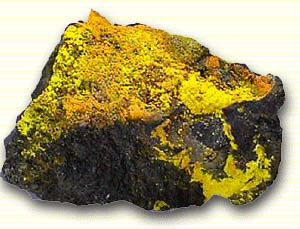
 Paladin managing director John Borshoff could do little on Friday but launch yet another speech about how unreasonably low the uranium price has been, labelling it ”diabolical”, ”extremely depressed” and ”of great concern
Paladin still paying price of uranium freeze August 31, 2013 SMH, Peter Ker Resources reporter Two years after Fukushima, nuclear energy companies remain troubled. The first year after the Fukushima disaster was always going to be tough for the uranium sector, but few would have thought the second year would be even worse.
The spot price for uranium hit eight-year lows this week, and now stands 30 per cent lower than a year ago, when the industry was supposedly at its nadir.
Most of the Japanese nuclear power stations that were turned off after the deadly tsunami of March 2011 remain idle, and the prospect of new demand emerging in developing countries such as China has yet to eventuate.
While all uranium stocks have suffered over the past 30 months, few companies epitomise the struggles of the sector more than Paladin Energy, which has almost been decimated since it was fetching $5 a share on the day before the Fukushima tragedy. Continue reading
South Australia on track to lead the world in renewable energy use
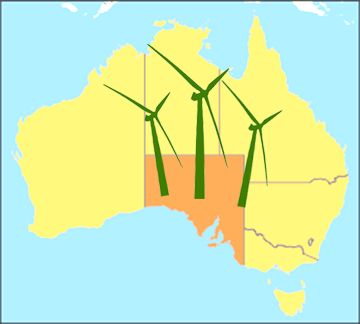

it would make South Australia the most advanced industrialised economy in the world in the adoption of variable renewables, and a test case for the incorporation of such energy sources into a broader grid.
South Australia heads to 50% renewables within a decade, (excellent graphs) http://reneweconomy.com.au/2013/south-australia-heads-to-50-renewables-within-a-decade-21296 REneweconomy By Giles Parkinson on 2 September 2013 Already, one in five houses in South Australia has rooftop solar PV, and a new AEMO document predicts this could treble by 2022. With wind already supplying 27% of power, and new wind farms coming on, the state will likely have 50% of wind and solar within 10 years.
The state of South Australia is emerging as one the leading regions in the world in the take-up of variable renewable energy sources such as wind energy and rooftop solar PV, and could be the first industrial economy to reach 50 per cent variable renewable generation.
According to figures included in a report by the Australian Energy Market Operator, that could happen well within a decade. That would make it the most advanced industrialised economy in the world in the adoption of variable renewables.
In a special report on the state released late last week, AEMO noted that 31 per cent of the state’s energy consumption was met by wind and solar in 2012/13, with more than 1,250MW of large scale wind farms, and a further 400MW of solar PV installed on one out of every five homes in the state. Continue reading
Australia’s old coal power stations refitted as renewable energy plants
Old power stations fired-up by renewable energy http://www.businessspectator.com.au/news/2013/9/2/renewable-energy/old-power-stations-fired-renewable-energy By a staff reporter , 2 Sept 13, The Australian Renewable Energy Agency has contracted Parsons Brinckerhoff to examine the potential for use of renewable energy by existing fossil fuel power stations through hybridisation in Australia. For example coal-fired power stations can burn biomass material such as wood in conjunction with coal. Also it is possible for solar thermal mirrors to heat water for steam turbines in conjunction with gas or coal.
The study will assess 100MW or larger fossil fuel plants that are grid connected. The study evaluates all applicable plants for resource and technology suitability and fatal flaws. The potential plants will then be subjected to a multi-criteria assessment process to see if there are any characteristics that rule out renewable hybridisation and to identify the total expected opportunity of hybridisation.
ARENA will host a workshop on 26 September to gather views from stakeholders on important challenges, opportunities and issues related to hybridisation. To register for the workshop see:https://arena-hybridworkshop.eventbrite.com.au/.
ARENA anticipates using the report findings as an input in the design of any potential strategic initiative in this area.
In Northern Territory electorate, Greens, Labor and Coalition candidates all oppose nuclear waste dump

 Solomon candidates against nuclear dump Bigpond News, August 30, 2013 Labor, the coalition and the Australian Greens rarely agree on anything, but the three candidates for Solomon are united in their opposition of a proposed nuclear waste dump in the Northern Territory.
At a community forum hosted by the ABC in Darwin on Friday, the candidates also debated marriage equality, voluntary euthanasia, housing affordability, hospitals, and schools funding.
Country Liberal Party incumbent Natasha Griggs, who holds the seat by a thin 1.7 per cent margin, said she crossed the floor on the nuclear issue to stand up for Territorians.
Greens candidate Todd Williams said: ‘The NT is viewed as easy and open and that can be foisted upon to store nuclear waste … against the wishes of traditional owners.’…….. http://bigpondnews.com/articles/Election-2013/2013/08/30/Solomon_candidates_against_nuclear_dump_901529.html
Paladin Energy’s John Borschoff puts a brave face on uranium market’s disaster
‘Price hikes will be severe’ And uranium’s rise will come sooner, not later, says Paladin’s John Borshoff Resource Clips, by Greg Klein, 31 Aug 13,
With uranium selling well under $40, “no one will or can move forward with growth, never mind maintaining current production,” said Paladin Energy TSX:PDN managing director/CEO John Borshoff. While summarizing his company’s fiscal 2013 he expressed incredulity about the uranium market’s “absolute absurdity” of low prices despite looming shortages.
He also predicted a dramatic change, emphasizing “the price can only go up sooner than some think.
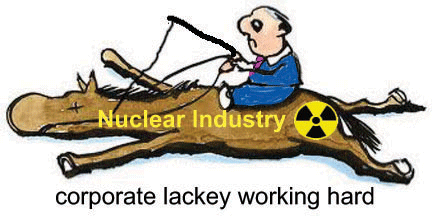
”…… Addressing a conference call from his Western Australia office on August 30 (August 29 in the Western Hemisphere), Borshoff acknowledged “an extremely challenging year, what with the uranium price falling from about $50 in July 2012 to $35 this month and currently sitting on an eight-year low.”
He attributed this month’s fall in share value to the uranium price, a general weakness in world markets “still waiting by and large for Japanese nuclear re-starts post-Fukushima” and uncertainty about the sale of a minority interest in Paladin’s Langer Heinrich mine in Namibia…….
There’s absolutely no incentive for miners or juniors to develop anything today in anticipation of this shortage. This time around, prices will have to rise and stay there on a sustained basis before the time of the shortfall for the developers to commit, and the end user needs to realize this fact.”
Borshoff said new development will remain stalled “until a price of at least $70 or higher is reached to galvanize some action. It’s only at this price level, and above, that sufficient capital for new development can be raised.”…… http://resourceclips.com/2013/08/29/%E2%80%98price-hikes-will-be-severe%E2%80%99/
Uranium miner Paladin’s financial loss twice as bad this year as last year
 Struggling Paladin records $471m loss Canberra Times, August 30, 2013 Peter Ker Uranium miner Paladin has more than doubled last year’s losses with a $US420.9 million ($471.2 million) net loss for the 2013 financial year.
Despite increasing production and improving revenue, low uranium prices continue to take a toll on the company, prompting $US335.9 million worth of asset write downs.
Shares in Paladin last traded at 53 cents, meaning the stock has almost been decimated – in the literal sense of the word – since the Fukushima nuclear crisis destroyed confidence in the sector…… The Singaporean Government’s investment corporation is now the company’s biggest shareholder.
Paladin boss John Borshoff acknowledged that the recent failure to sell a stake in the company’s flagship mine was the major disappointment of the year, http://www.canberratimes.com.au/business/earnings-season/struggling-paladin-records-471m-loss-20130830-2sulp.html#ixzz2dZwCtmc0
Australia’s clean solar energy revolution is well underway
 It’s in everyone’s interest to generate as much renewable energy as possible – except existing power providers that rely on burning coal or gas
Money trail backs the clean energy revolution, SMH, Ben Cubby, Peter Hannam 31 Aug 13 Across Australia, thousands of rooftops have been turned into solar-power money generators. Here’s a bright idea: what if, instead of paying for solar panels to keep your electricity bills down, you asked a solar company to put them on your roof for free, then paid them back with excess energy that you didn’t need?
What we are seeing is a transition from high carbon to a low carbon system.
If that sounds fanciful, bear in mind that a decade ago there were just a few hundred working solar-powered home in the country, run mostly at significant personal expense by enthusiasts. By the end of last year, 936,810 solar systems were installed, and the number cruised past 1 million earlier this year.
Slowly but surely, renewable energy is eating into the business model of the fossil-fuel-burning energy generators. Those in the industry liken it to the effect the internet is having on publishing: disrupting revenue, overturning tradition and, literally, tilting the balance of power in favour of the customer, rather than big corporations. Continue reading
Tasmania’s Labor and Liberal vote down Greens’ plan for moratorium on fracking
 Greens lose vote to introduce a moratorium on fracking MATT SMITH MERCURY AUGUST 29, 2013THE Tasmanian Greens’ push for a moratorium on the mining practice of fracking has been voted down by Labor and the Liberals. Greens MP Tim Morris said his party would continue to work with concerned landowners, businesses and communities to protect the best interests of Tasmania’s environmental and economic future…… HTTP://WWW.THEMERCURY.COM.AU/NEWS/TASMANIA/GREENS-LOSE-VOTE-TO-INTRODUCE-A-MORATORIUM-ON-FRACKING/STORY-FNJ4F7K1-1226706169520
New meter to monitor risk of cancer-causing UV radiation
UV meter warns of sunburn risk http://au.news.yahoo.com/thewest/a/-/breaking/18714833/uv-meter-warns-of-sunburn-risk/ Phoebe Wearne, The West Australian August 30, 2013, The Cancer Council WA wants public UV index meters installed in school playgrounds and at popular beaches, parks and sporting grounds to warn of sunburn and skin cancer risks.
Australia’s first public UV index meter, which measures solar radiation intensity every minute, was switched on at Deep Water Point in Mt Pleasant this week. The solar-powered meter is on a 4m nautical-themed sculpture by renowned Perth artist Tony Jones, whose best known works are the sculptures Eliza in Crawley and that of CY O’Connor near Fremantle.
Cancer Council WA SunSmart manager Mark Strickland said the real-time UV index meter, which only recently became possible with new technology, would show when the UV level was above three – the level when people are advised to protect themselves from the sun.

Mr Strickland said it was important people were aware of the UV level because it was not linked to the sun’s heat and people could not see or feel UV radiation. “We hope people will find it a useful reminder to know when they really should be protecting themselves from UV and are at risk of sunburn and skin cancer,” he said.
“People tend to make the false correlation that they need to protect themselves from the sun when it’s hot, but it doesn’t work that way.”
The Deep Water Point sculpture was funded with $20,000 from the City of Melville.
Mr Strickland hoped other councils, schools and businesses with outdoor staff would express an interest in installing the UV meters in public open spaces, playgrounds and workplaces. He wants people to plan their day around the highest risk from UV radiation once they have the information to do so. “We hope people who are in the area will see the signs over a period of time and realise UV is not always correlated with heat,” Mr Strickland said.
“If people know the UV is really going to be cranking in the middle of the day we hope they might move their outdoor activities to earlier or later in the day when the UV level will be lower.”Melville deputy mayor Duncan Macphail said public health and safety was a priority for the city and it supported Cancer Council efforts to educate people.
Australian government urged to act on energy efficiency – Australian Council of Social Service
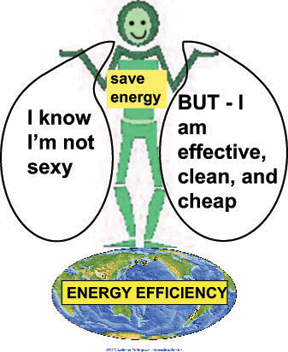 Australian social service council urges government action on energy efficiency http://www.renewableenergymagazine.com/article/australian-social-service-council-urges-government-action-20130829 Renewable Energy Magazine 30 Aug 13 The Australian Council of Social Service is calling for urgent government action on affordable energy for low income households according to a new report.
The report, entitled Energy Efficiency and People on Low Incomes, identifies measures to empower households to become active participants in controlling their energy use as well as becoming more involved in the energy market and reducing energy costs.
“Energy efficiency should be a key policy response to address the impacts of rising energy prices, yet we’ve heard little mention of it in the current political debates about cost of living pressures and energy affordability” said Andrea Pape, ACOSS Senior Policy Officer. “ACOSS advocates an energy efficiency policy agenda which includes direct investment in building and fixture upgrades as well as incentives to stimulate private landlord investment in energy efficiency measures.”
Ms Pape added that the policy proposals are designed to improve energy efficiency in low income households including both private rental and social housing. Investment will improve affordability, climate resilience and health outcomes for current and future occupants.
People on low incomes in Australia, as in many other countries around the world, are especially prone to the burden of energy price rises but they lack the capital investment required to upgrade the energy efficiency of their homes and are also more likely to own inefficient appliances. This has resulted in a lower incidence of measures such as insulation in low income housing and tenanted properties. While government programmes have been beneficial, they also need to be complemented by measures that deliver energy efficiency over the long term, particularly with regard to building and fixture upgrades.
“Targeted retrofits of the worst performing social housing where health, climate and hardship risks are greatest should be a high priority” continued Ms Pape. “We know that those most at risk from heatwaves are low income people, the elderly and people living with disabilities or health issues. We need to build the safety and resilience of our housing stock, and we need to start with the most vulnerable households first. This is a sensible approach in the current fiscal environment and we urge all sides of politics to commit to action on this important front.”
ACOSS proposals include the introduction of landlord tax incentives for energy efficiency measures in rental properties, the introduction of energy efficiency standards for rental properties along with mandatory disclosure of energy and water efficiency of all properties at point of sale, additional funding for targeted retrofits for the worst performing and highest risk social housing stock and financial support to help low income households afford the up-front costs of energy efficiency upgrades.
Further information: Australian Council of Social Service (ACOSS)
Asserting Australia’s First Nations Sovereignty into Governance
“The argument is twofold.
• Firstly, the question of jurisdiction and the right of the Shire tocharge rates from Euahlayi living within their own territory, as the
Euahlayi Peoples’ are now asserting their pre-existing and continuing statehood under our Law and custom.
• The second point of contention is that the Brewarrina Shire Council, like all other shire councils in Australia, have and are being paid by the
Commonwealth government of Australia, allegedly ‘illegally’, for their Aboriginal population, under a 1975 funding agreement between the
Commonwealth government and the Local Government Association of Australia.
This makes every Aboriginal man, woman and child legal tender and a commodity for shire councils throughout Australia, with no accountability.
Rates Case back on track Sovereign Union of First Nations and Peoples in Australia www.sovereignunion.mobi 30 August 2013
Contact Michael Anderson 0427 292 492
Convenor of the Euahlayi Nation and the Sovereign Union of Aboriginal
Nations and Peoples
ghillar29@gmail.com
www.sovereignunion.mobi
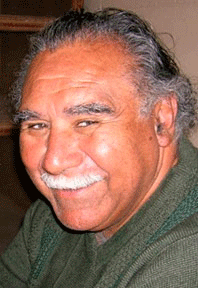 Michael Anderson said from Sydney today: “The Rates Case in the NSW Magistrates Court in Sydney is a contest on the question of sovereignty and what law now applies to the land.”
Anderson pointed out to the court that, in respect the Euahlayi Nation, there is now an active legal dispute on the question of jurisdiction.
When appearing before the Chief Magistrate in the Downing Centre, Anderson pointed out that correspondence has now been entered into between the Queen and the Euahlayi government.
“In 2010 the Euahlayi requested that Queen Elizabeth II investigate whether British or Australian records have deeds of cession by the Peoples
of the Euahlayi, or any formal British Admiralty declarations of war against the Peoples of the Euahlayi. Queen Elizabeth referred our request
to her Australian representative, Governor-General, Mrs Quentin Bryce, who responded on 12 October 2010, under the signature of Mark Fraser OAM, Deputy Official Secretary to the Governor-General. He confirmed that no such documents exist. Mark Fraser wrote on 12 October 2010: Continue reading
Radio: Adelaide the hub of military industrial intelligence nuclear complex
The issue isn’t nuclear power. The issue is processing uranium for nuclear power that then can be used for defence
You have to understand this in terms of in terms of Adelaide, -it’s a military industrial intelligence complex
Simons is connected to the University College of London but basically he’s a front man for business interests, We can clearly question what he is doing given the fact that he’s getting funding from indirect corporate sources.

 AUDIO: https://radio.adelaide.edu.au/nuclear-power-in-south-australia-a-golden-age/ Nuclear Power in South Australia – a golden age? Radio Adelaide 23 Aug 13 Chris Komorek spoke with Dr David Palmer from Flinders University to explore the changing landscape. Produced by Ian Newton. TRANSCRIPT by Christina Macpherson
Chris Komorek As the uranium debate heats up, so does the destroyed reactor in Fukushima, Japan.The International Energy Policy Institute at the University College London’s Adelaide campus is advocating a ramped up nuclear industry here in South Australia. We’re joined by Dr David Palmer from Flinders University.
Australia’s third force gathers strength: Christine Milne and The Greens
Inside the Greens circus, minus Bob and the freaks CRIKEY GUY RUNDLE | AUG 28, 2013 The Greens are still slightly in awe that they are a real, live party, as the Green tide rolls on….
Gripping the lectern, clad in a jacket as green as a rainforest or a roulette baize, Greens leader Christine Milne is in full flight, but stops for the laugh. Reminds herself, perhaps, to stop for the laugh. “I know, but it’s true …” Then she ploughs on. She looks Margaret Thatcher, she looks like your schoolteacher, she looks like a church lady, most ungreen, her delivery is wooden, reserved, there’s something held back, but she’s wowing the crowd, a couple of hundred Greens, come in from Canberra and the backblocks, all the senators and Adam Bandt people looking at them with “wow, there’s quite a lot of us, we’re kinda of a real party”, and a few enthusiasts/tragics flown in from the event.
Her speech on Saturday at the Greens’ national campaign launch is hard-edged, upfront political, and eschews a lot of the more spiritual themes that former leader Bob Brown might have put in. She announces refugee treatment inquiries, a Clean Air Act, a party whip vote on equal marriage; every time, rolling back Labor’s welfare cuts, bang, bang, bang, and you get a picture of her parliamentary style: no-nonsense and forthright………

Indeed, it’s a new Greens style of sorts, fitting with the fact that they are, in some ways, the new natural party of government, not now, not even soon, but sometime, when more of the world looks like Canberra — if it doesn’t all end up looking like Fallujah — and knowledge production has so infused so much of the overall system that social classes have been substantially transformed. That gives the new Greens not only a seriousness, a demeanour that has no special pleading about it, but also, of all things, a mild born-to-rule mien, a new class sheen. ….
Formidable, and with a party at as good a level of support as it’s ever been, she seems ready for whatever may come on Threatened Species Day, September 7. http://www.crikey.com.au/2013/08/28/rundle-inside-the-greens-circus-minus-bob-and-the-freaks/
1 This month
17 October, Free Public Talk on Nuclear Issues in South Australia
David Noonan will speak on public interest concerns over the new Roxby Downs Indenture Act 2026 on BHP copper-uranium mining and ore processing in SA, and on how AUKUS may face SA with a High-Level nuclear waste agenda.
Dr Jim Green will discuss international developments in the field of nuclear power including ‘small modular reactors’ and Generation 4 ‘advanced’ nuclear reactor concepts.


Help Aunty Sue Protect Her Land and Sacred Sites From Destructive Rocket Testing.
.

Australians deserve the truth
about
AUKUS – https://aukuspublicinquiry.com/

PETITION – To: Prime Minister Anthony Albanese and the Australian Labor Government

of the week – Australians for War Powers Reform (AWPR)
To see nuclear-related stories in greater depth and intensity

