Australia’s media economic writers bought by Rupert Murdoch
 We really must talk about Murdoch’s tame economists http://www.independentaustralia.net/2013/politics/we-really-must-talk-about-murdochs-tame-economists/ 28 Aug 13 In Australia, to bludgeon his readers and viewers into believing the opposite of the truth, Murdoch has a battery of high profile economists fudging the numbers, says Alan Austin. THE WEAPONRY in Rupert Murdoch’s global arsenal includes paying corrupt police, illegal phone-tapping, fabricating malicious stories, lying to official inquiries and a range of other criminal activities.
In Australia, to bludgeon his readers and viewers into believing the opposite of the truth, Murdoch deploys other heavy artillery, including a battery of credentialled economists. Continue reading
Australia’s low return high-risk uranium industry a part of global nuclear weaponry

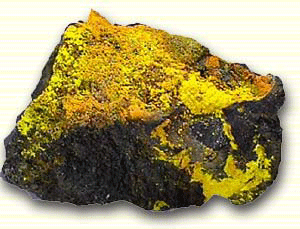 Time to stop the (uranium) boats, SMH, Dave Sweeney, 28 Aug 13, “…….. Time after time the uranium industry promises big but delivers little. It contributes less than 0.3 per cent of export revenue and account for 0.015 per cent of Australian jobs.
The most recent independent assessment Australia’s uranium industry – a 2003 Senate inquiry – found the sector characterised by underperformance and non-compliance and urged changes to protect the environment and its inhabitants from “serious or irreversible damage”.
Sadly, in the decade since then little has changed, even though the need to manage radioactive materials over extremely long periods with specific security and proliferation issues make uranium mining fundamentally different from other types of mining.
Uranium mining remains a contested and contaminating industrial activity that poses serious and continuing problems – now and long into the future – and continues to lack community consent and a social licence.
But Australia can – and must – do better than this.
We are a rich nation blessed with a skilled workforce and abundant renewable energy resources. Instead of literally fuelling disaster we should be leading the world in clear and sustainable energy technology and generation.
Two decades ago nuclear power provided around 17 per cent of the world’s electricity, today it is close to 10 per cent. In China, Germany and Japan – three of the world’s four largest economies – renewable energy sources generate more power than nuclear reactors.
In France, a favourite of the atomic lobby, the share value of state utility EDF, the world’s largest nuclear operator, has fallen 85 per cent over the past five years.
Talk of domestic nuclear power is fanciful but Australia is a major global nuclear player by virtue of the uranium we sell to other countries and we now need a genuine debate about our role in fuelling this trade.
As home to around 35 per cent of the world’s uranium, the decisions we make here count and – like the waste – they count for a very long time. That is why Hawke’s call for Australia to become the world’s nuclear waste dump is way off the mark. http://www.smh.com.au/comment/time-to-stop-the-uranium-boats-20130827-2snau.html#ixzz2dIOX2ZZw
Australia’s hypocrisy on the South Pacific Nuclear Free Zone Treaty
 Declassified documents from the National Archives of Australia, including the 1985 Cabinet minute about the SPNFZ Treaty, show clearly that Australia designed the treaty to protect US interests in the Pacific, including the deployment of nuclear-armed warships and the testing of nuclear missiles.
Hayden’s cabinet submission includes details of Australian negotiating positions in the final months before the treaty was signed:
(iii) Australia oppose the inclusion in the draft SPNFZ Treaty of a ban on missile tests.
(iv) Australia oppose the inclusion in the draft SPNFZ Treaty of a ban on the facilitation of the stationing of nuclear weapons,
Delaying the nuclear-free zone in the Pacific, Inside story, 27 Aug 13 As Pacific leaders gather this week in the Marshall Islands, the United States continues to delay ratification of the South Pacific Nuclear Free Zone Treaty. Using previously classified documents Nic Maclellan recounts a history of opposition to a nuclear free Pacific, and a reminder that Australia could be breaching the treaty
AT THE height of the nuclear arms race between the United States and Soviet Union, a treaty to create a South Pacific Nuclear Free Zone, or SPNFZ, was opened for signature on Hiroshima Day, 6 August 1985, at the Pacific Islands Forum meeting in Rarotonga. Twenty-eight years after it was signed on that day by Australia, New Zealand and island nations, the United States still hasn’t ratified its protocols, Continue reading
ICAN calls on universities, Future Fund, to stop investing in nuclear weapons,

A lot of Australians would be shocked to learn that the Future Fund has more than A$130 million invested in companies that manufacture nuclear arms.
“It’s easy to imagine that Australia is not involved in the global nuclear weapons trade, but with the Future Fund’s investments in nuclear weapons companies and the Federal Governments intentions to export uranium to India and other nuclear weapons states, it most certainly is,” ICAN Australia’s Outreach Coordinator, Gem Romuld, told IDN.
ICAN AUSTRALIA SHOWS THE WAY TO ABOLISH NUKES BY NEENA BHANDARI | IDN-INDEPTH NEWSANALYSIS, 28 AUG 13, SYDNEY (IDN)
“………..The Future Fund ICAN is calling on universities to develop ethical investment policies that exclude nuclear weapons companies both from their direct investments and their investments through fund managers. An Australian Government investment fund, The Future Fund, currently invests A$227 million in nuclear weapons companies.
A petition with 14,000 signatures was delivered in August 2013 to the Fund’s board members and ICAN members visited the Fund’s head office in Melbourne on Hiroshima Day (August 6) and Nagasaki Day (August 9), demanding that it divests from nuclear weapons companies.
Wright said, “The Fund has divested from companies involved in the production of other inhumane weapons such as cluster munitions and landmines. They recently excluded tobacco companies from their investments in response to public pressure, so we are optimistic that we can also convince them to exclude nuclear weapons companies.” Continue reading
International Campaign to Abolish Nuclear Weapons (ICAN) gathers strength, especially among the young
Students across the world are participating in the campaign. Earlier this year, students from Gisborne Secondary College in Victoria (Australia) made 1000 paper cranes and delivered them to the parliamentary secretary to Australian prime minister, calling for ban on nuclear weapons.
The school’s Japanese language teacher, Noriko Ikaga, has been taking Years 10 and 11 students to Japan every alternate year. “It has become a tradition to make 1000 paper cranes when we visit the Hiroshima Peace Memorial Museum. This year, the students also folded another 6000 paper cranes for the kids affected by the Fukushima nuclear disaster,” Ikaga told IDN.
With Australia going to polls on September 7, these students are hoping that future leaders will take Australia’s nuclear obligations seriously.
ICAN AUSTRALIA SHOWS THE WAY TO ABOLISH NUKES BY NEENA BHANDARI | IDN-INDEPTH NEWSANALYSIS, 28 AUG 13, SYDNEY (IDN) – Even as the nuclear-armed countries continue to amass new warheads and build and modernise ballistic missiles, bombers and submarines to launch them, the campaign for nuclear abolition is growing from strength to strength.
International Campaign to Abolish Nuclear Weapons’ (ICAN) Paper Cranes Project – symbolizing support for nuclear disarmament – is urging governments to begin negotiations on a global treaty banning nuclear weapons this year. More than 190,000 paper cranes have already been delivered to world leaders, and messages of support have been received from the Secretary-General of the United Nations and amongst others national leaders of Australia, Afghanistan, Greece, Kazakhstan, the Marshall Islands, Mozambique, Slovenia and Switzerland. Continue reading
Time for Australia to manage its own radioactive wastes, not import others’
In October 2011 the Department of Foreign Affairs and Trade confirmed that not only was Australian uranium sold to the inept electric utility TEPCO, but it was Australian yellowcake that was inside the reactor complex when it failed.
The two major parties have ignored repeated calls – including from the UN Secretary General – for a post-Fukushima review of Australia’s high-risk, low-return uranium industry.
Time to stop the (uranium) boats, SMH, Dave Sweeney, 28 Aug 13, SMH, August 27, 2013 Former Prime Minister Bob Hawke gained some airtime in the crowded pre-election public arena with his well-worn call for Australia to host the world’s radioactive waste. In the shadow of Fukushima it would be appropriate for the mantra of “stop the boats” to apply to those departing Darwin and Adelaide carrying uranium oxide, risk and radiation.
At the very least we need all our politicians to commit to a comprehensive and public review of the costs and consequences of Australia’s controversial uranium trade.
While it’s unlikely that many politicians will be enthused by the idea ahead of an election, it is timely to raise serious questions about the issue of radioactive waste in Australia. Not to open the door to more from overseas but rather to talk about how we might responsibly manage our own. Continue reading
Australia very much involved in nuclear deterrence, and nuclear weapons worldwide
 ICAN AUSTRALIA SHOWS THE WAY TO ABOLISH NUKES BY NEENA BHANDARI | IDN-INDEPTH NEWSANALYSIS, 28 AUG 13, SYDNEY (IDN)
“……..Doctrine of extended nuclear deterrence While Australia doesn’t have any nuclear weapons, it subscribes to the doctrine of extended nuclear deterrence under the United States alliance. The supposed protection afforded by the US nuclear weapons is seen as key to Australia’s national security. It also has almost 40 per cent of the world’s known uranium reserves and supplies 19 per cent of the world market.
All of Australia’s uranium is exported, including to countries who continue to produce nuclear weapons. TheAustralian Conservation Fund has consistently opposed uranium mining and worked to highlight the threats it poses to the environment, sensitive ecosystems, Indigenous cultures and local communities.
In May this year, ICAN Australia launched a booklet entitled Disarmament Double-Speak assessing Australia’s record on nuclear weapons, its continuing support for the United States extended nuclear deterrence, its resistance to a global ban on nuclear weapons, the inadequacy of safeguards on uranium exports and investments in nuclear arms companies.
Today, there are at least 20,000 nuclear weapons worldwide, around 3,000 of them on launch-ready alert. The potential power of these would roughly equate to 150,000 Hiroshima bombs. Sixty- eight years on since the atomic bombs were dropped on Hiroshima and Nagasaki, the need to develop a legally binding tool to prohibit and ultimately eliminate nuclear weapons is more than ever before. [IDN-InDepthNews – August 27, 2013] The writer’s previous articles on IDN: http://www.indepthnews.info/index.php/search?searchword=Neena%20Bhandari&ordering=newest&searchphrase=all
2013 IDN-InDepthNews | Analysis That Matters http://www.indepthnews.info/index.php/global-issues/1742-ican-australia-shows-the-way-to-abolish-nukes
June 2014 date for Muckaty nuclear waste dump plan court hearing

 Date set for court fight over Muckaty nuclear waste dump http://www.abc.net.au/news/2013-08-26/court-date-set-for-nuclear-waste-dump-fight/4912730 26 Aug 2013, A date has been set in the Federal Court case of Aboriginal traditional owners fighting plans to use their land as a nuclear waste dump.
The site on Muckaty Station near Tennant Creek in the Northern Territory is the Federal Government’s preferred site for Australia’s first radioactive waste facility. Beyond Nuclear Initiative spokeswoman Natalie Wasley says the month-long trial has been listed for June 2014.
“After eight years that’s a big relief for traditional owners and the community who have had this nuclear cloud hanging over their heads,” she said.
She says submissions being made this week will determine whether pre-trial evidence needs to be taken. Ms Wasley says those involved are hoping the trial would be held near the proposed site.
“It’s very important for people that they give the best evidence possible, and of course that it’s close to the site that’s being discussed,” she said.
Crippling losses for US nuclear weapons company’s uranium mine in Australia
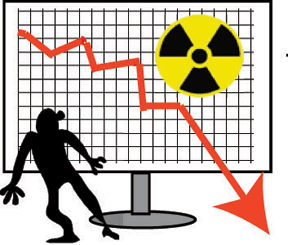 Fukushima fallout for uranium stings Heathgate Resources Financial Review, SIMON EVANS, 26 Aug 13 Heathgate Resources, the owner of the Beverley uranium mine in northern South Australia, has suffered losses totalling a whopping $60 million over the past two years.
Heathgate has operated Beverley since 2000, but has been hit hard in its past two financial years by a plunge in global uranium prices.Beverley is one of four uranium mines in Australia, and Heathgate is also involved in the nearby Four Mile uranium project, set to become the nation’s fifth uranium mine as regulatory approvals move a step closer.
Uranium prices fell by more than 50 per cent after the meltdown at the Fukushima nuclear plant in Japan in March 2011, and have failed to recover . Heathgate Resources made a loss of $34.5 million in calendar 2012 according to its latest financial statements lodged with the Australian Securities and Investments Commission.
This followed a loss of $25.6 million in 2011.
Heathgate’s total revenue in calendar 2012 was $59 million, according to its financial statements, a substantial slump from the 2011 when total revenue was $84.6 million.
Heathgate president Craig Bartels declined to comment on the results and the operating performance.
Heathgate is owned by the US-based global nuclear giant General Atomics, as is one of Heathgate’s stablemates, Quasar Resources, which holds a 75 per cent stake in the Four Mile project. The other 25 per cent of Four Mile is owned by ASX-listed Alliance Resources, but the two groups are still involved in court action over past disagreements about how best to develop the resource…… http://www.afr.com/p/australia2-0/fukushima_fallout_for_uranium_stings_7q6Q2t7EXWB2IaLsOu5w0L
Wind power bonanza from windy weather in South Australia, NSW, and Tasmania
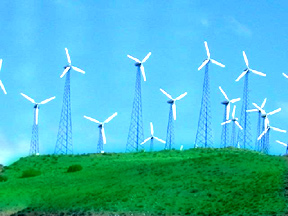 Blustery Weather Generated A Wind Power Bonanza http://www.energymatters.com.au/index.php?main_page=news_article&article_id=3907 25 Aug 13, Wind farms in Australia’s National Electricity Market cranked a record amount of power for the week beginning August 11.
During the period, 47% of South Australia’s power was supplied by the wind and Victoria’s wind farms contributed 10% to that state’s electricity needs. Tasmania and New South Wales had their second and third highest levels of wind power generation respectively.
While the blustery conditions caused havoc for emergency services, it’s an ill wind that blows nobody any good as they say.
“The positive was the large amount of clean energy that was produced by the wind farms on Australia’s southern coastline, breaking records for the amount of wind power generated in a single week in South Australia and Victoria,” said Clean Energy Council Policy Director Russell Marsh.
“What this shows is that wind power is working. It generates very useful amounts of power and also helps farmers who host wind turbines by providing them with income.” Mr. Marsh says based on data sourced from the Australian Electricity Market Operator (AEMO); wind power provided a record 7.6 per cent of all power generated across the entire National Electricity Market during that week; the equivalent of supplying more than 2.3 million homes.
Under normal conditions, South Australia’s wind farms contribute about one quarter of the state’s total electricity production. In 2011/12, wind generationblew past coal to become the second largest source of electricity in South Australia. The state, which has around 40% of Australia’s installed wind capacity, reached its target of generating 20% of electricity from renewable energy in 2011.
South Australia now has its sights set on producing one third of its electricity from renewable sources by 2020. Like its previous target, that is expected to be met well ahead of schedule.
Why is old Has-Been Hawke pushing the (illegal) nuclear waste importing plan?
 Greens condemn plan to turn Australia into the world’s nuclear waste dump Australian Greens spokesperson on nuclear policy, Senator Scott Ludlam. 24 August 2013. The Greens have strongly rejected the proposal by former Labor Prime Minister Bob Hawke to turn Australia into a dump for the world’s nuclear waste.
Greens spokesperson Senator Scott Ludlam said the plan was “the worst imaginable way to raise revenue”.
“What Mr. Hawke is proposing is criminal activity. The Parliament passed Greens amendments last year to prohibit the importation of nuclear waste.

“Mr Hawke seems to think the way to fill the Budget hole is to fill a hole in Australia with the world’s nuclear waste. The Labor Party and the Coalition must rule out this dangerous proposal immediately.
“Having seen both the Howard and Rudd-Gillard Governments make an absolute mess of trying to force a dump for Australian nuclear waste on Tenant Creek in the Northern Territory, heaven help us if they were trying to deal with nuclear waste from around the world as well.
“The question is – is Mr Hawke expressing this view as a hobby or as an earner on the side? If he has any commercial interests in a waste management company he should make that clear now
Greens leader Christine Milne shows strength in difficult election situation

Monash University’s Paul Strangio says that now, more than a year after succeeding Brown, Milne has established her identity as the party’s political leader………
After Julia Gillard’s demise, Milne is also the only female national political leader. She notes that the two big parties are now led by married men, each with three children, both of whom go to church on Sunday. ”People who have difficulty with women in leadership are quite satisfied now that the stars are aligned and everything’s back as it should be,” says Milne. ”That’s a tragedy in Australia because women in leadership have a lot to offer.”
Her leadership of the Greens, she explains, is therefore also about making it easier for the next generation of women to lead
Tenacious Milne walks the thin green line SMH, Shane Green Associate Editor of The Age 24 Aug 13 Christine Milne takes her seat for another flight on the campaign trail. Behind is a woman about her age with her elderly mother. As the flight progresses, the younger woman taps Milne on the shoulder and passes a note, written by her mother.
”You’ve got my vote, Christine,” it reads, instantly providing Milne the personal fillip that is intended. Yet its true significance becomes apparent only when the elderly woman gets up to make her way to the toilet. She is struggling, obviously battling a debilitating physical disease. The note of support would have taken half the flight to write.
The Greens leader is deeply touched. It’s a powerful and poignant reminder of the responsibility we place on those who seek to lead us, and the importance of delivering. In an era of pervasive cynicism about politics and politicians, this is a telling moment.
”I’ve always stood up for what I’ve believed in regardless of whether it’s popular or not. And it means a great deal when you have a very elderly person saying to you, I’m going to vote for you,” says Milne. ”All that investment of trust from someone like that really matters.”…….
These kids are great, she says, but her party has supporters across the generations. Among the youthful enthusiasts are two greyer heads, for boomers have also come to the aid of the party.
All of which will be needed in an election that will not only be a fight for survival for Bandt, made all the harder by the Liberal decision to preference Labor above the Greens. It will also be the first big electoral test for the Greens under Milne’s leadership. Continue reading
Bob Hawke sees $$$$s in nuclear waste importing for Australia
Hawke drops a nuclear-tinged poll bombshell SMH, August 24, 2013 Susan Wyndham If anyone is looking for a policy to liven up the election campaign, Bob Hawke has an idea: make Australia the repository of the world’s nuclear waste.”It’s a no-brainer,” he says. ”If you’ve got the safest geological sites in the world, why haven’t you got the moral responsibility to make them available?”
Mr Hawke has made the argument before, and it’s the one issue he raises when asked if he has achieved all he hoped for in the 22 years since he was prime minister.
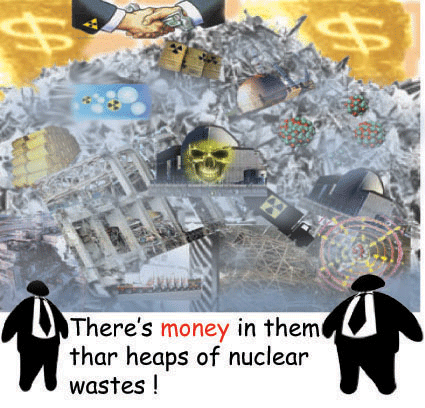
”It could change the whole economic future of this country,” he says ”We have the world’s safest geological sites in the Northern Territory and north-west Western Australia. We could make the world a safer place and totally change our fiscal position by creating an enormous continuing source of income, then you’d apply some of that income to environmental and Aboriginal causes. But no one’s got the guts.”……….http://www.smh.com.au/national/hawke-drops-a-nucleartinged-poll-bombshell-20130823-2sh7p.html#ixzz2cujX6dn5
Australian government study finds renewable energy economically viable
 Greens leader Christine Milne described it as ”astonishing” that the government appeared to bury both the ”stunning” study and its summary findings.
”It puts a wrecking ball through claims by the Coalition and Labor that we can’t go a lot harder and set a 90 per cent target by 2030,” Senator Milne said. The operator should expand its study and release the modelling. ”Further work is required to factor in some costs and the many benefits of renewable energy that this first study ignored,” Senator Milne said
Renewable energy study tips viable reality by 2030 The Age, August 24, 2013 Peter Hannam Carbon economy editor Renewable energy such as wind, solar and hydro power could supply electricity at prices comparable to fossil fuels by  2030, according to a study commissioned by the federal government.
Modelling by the Australian Energy Market Operator shows that 100 per cent of power from clean energy would be technically viable by 2030 – although with a price tag ranging from $219 billion to $252 billion.
But a Community Summary of the report published this month without fanfare by the government has rekindled debate by stating that 100 per cent renewable power may cost no more than fossil fuels.
Based on the operator’s study and other modelling by Treasury, the CSIRO and the University of New South Wales, the summary concluded: ”Indicative wholesale electricity prices generally fall within a reasonably narrow range of around $100-$130 per megawatt-hour in 2030, and around $110-$150 per MWh in 2050
Consumers, who have seen electricity prices rise about 70 per cent over the past four years, may find the price trajectory – whether based on renewable energy or not – surprising. NSW and Victoria now have wholesale power prices of just under $60 per MWh. Still, the findings have cheered clean energy advocates, not least because curbing carbon emissions from the power sector – accounting for about 35 per cent of Australia’s total – would make big inroads in meeting climate change goals.
”It’s kind of incredible that we haven’t modelled (a 100 per cent goal) before now, given that the costs are basically the same,” said Jenny Riesz, a research associate at the UNSW’s centre for energy and environmental markets.
Dr Riesz is part of a UNSW team now examining the potential for additional benefits from a transition to much more renewable energy. Continue reading
Wind power could prove to be an economic boom for Cloncurry, Queensland
The project, expected to cost the sire $8 to $9 million dollars, already has support from local miner CuDeco and three potential pilot program sites will be tested over the next few weeks.
 Wind power the future for Cloncurry Yes 2 renewables, n August 23, 2013 by martanieczyporuk Even in the far reaches of Australia, the benefits of wind energy are gaining interest among communities. The small town of Cloncurry can see a big future in wind. The North West Starreports on the Mayor’s proposal: ….
Friends of the Earth Australia renewable projects coordinator Leigh Ewbank said the ‘visionary’ idea could see the shire follow in the footsteps of a small French village that increased their budget from $573,000 to $3.29 million after installing 11 wind turbines.
“Income generated by a wind farm in the small French village of Afrons has resulted in a five-fold increase in the town’s budget,” he said. Continue reading
1 This month
17 October, Free Public Talk on Nuclear Issues in South Australia
David Noonan will speak on public interest concerns over the new Roxby Downs Indenture Act 2026 on BHP copper-uranium mining and ore processing in SA, and on how AUKUS may face SA with a High-Level nuclear waste agenda.
Dr Jim Green will discuss international developments in the field of nuclear power including ‘small modular reactors’ and Generation 4 ‘advanced’ nuclear reactor concepts.


Help Aunty Sue Protect Her Land and Sacred Sites From Destructive Rocket Testing.
.

Australians deserve the truth
about
AUKUS – https://aukuspublicinquiry.com/

PETITION – To: Prime Minister Anthony Albanese and the Australian Labor Government

of the week – Australians for War Powers Reform (AWPR)
To see nuclear-related stories in greater depth and intensity

