Toro Energy and Mega Uranium making a big mistake in acquiring Lake Maitland

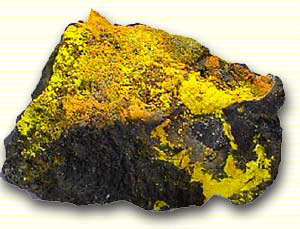 Toro’s mega mistake Mia Pepper – Conservation Council of WA 12 August 2013 WA uranium hopeful Toro Energy’s acquisition of Lake Maitland, another small calcrete uranium deposit in a sensitive Lake system, is based more on optimism and need rather than any measured assessment of the deeply depressed uranium price and nuclear sector said the CCWA today.
The acquisition between Toro and Mega Uranium does little to change the fundamental constraints facing each company and may well be Toro’s mega mistake.
It is a further sign of the difficulties facing junior uranium companies in a time of falling commodity prices and rising costs. Toro and Mega may share big dreams but they do not have big capacity, experience or dollars.
Toro cannot begin construction at Wiluna and do not have final and formal approval to mine at Wiluna. Instead the company has a conditional Federal approval that involving 35 conditions and requires further assessment from the Federal Minister.
The conditional nature of the approval prohibits Toro Energy from clearing vegetation or using heavy machinery for breaking ground for mining or infrastructure. Toro must also complete a mine closure plan for both State and Federal level assessment.
A recent independent economic analysis of the Wiluna project (attached) found that:
The Wiluna project’s lack of scale and high sensitivity to changes in operating or capital costs means our estimate of its position on the mine production cost curve is perilously high. The project would be highly vulnerable under our model, in the event of sustained lower long-term contract prices in the next decade. On both a cash and total economic cost basis our model suggests Wiluna is a high cost project that will struggle to compete against either existing mines or most greenfield and brownfield projects. For the full report: http://www.ecolarge.com/work/osos-sobre
Western Australia: Liberals rebel against govt reneging on solar energy deal
Liberal rebellion on solar heats up, The West, Gareth Parker and Daniel Mercer, The West Australian August 12, 2013, 2 Colin Barnett is facing a backbench revolt over the State Government’s decision to halve its rooftop solar panel subsidy, with a pair of Liberal MPs accusing the Government of lacking integrity.
The growing rebellion came as a letter from Synergy sent in 2011 emerged as a key piece of evidence in any potential legal fight over
the changes. The letter – sent soon after the Government cut the tariff in a previous revision to the scheme – says that customers entitled to the
40 cent payment would get it “for the full term of your 10-year contract”.
Government MPs have been flooded with complaints from irate voters about the decision to cut to the so-called solar feed-in tariff from
40 cents to 20 cents, with the issue spilling over to the Federal election campaign as a vote turn-er against Liberal candidates.
Maverick Hillarys MLA Rob Johnson threatened to cross the floor for the first time in his 20-year career to vote against the measure,
while Southern River MLA Peter Abetz said the Government had acted unethically.
Mr Johnson said the Government was acting with a “lack of integrity” by reneging on a deal with 75,000 solar panel owners in a bid to save
$51.2 million over the next four years. Continue reading
Western Australian government’s solar rate cuts will be fought by Labor
WA Labor promise fight over solar rate cut http://www.heraldsun.com.au/news/breaking-news/wa-labor-promise-fight-over-solar-rate-cut/story-fni0xqi4-1226695095998 AAP AUGUST 11, 2013 WEST Australian opposition leader Mark McGowan has promised to “take on” Premier Colin Barnett after the state government reneged on a 10-year undertaking for households that feed in solar power to the grid.
Mr McGowan tweeted on Sunday: “Anyone unhappy with Mr Barnett ripping up their families solar contract should come to parliament at 2.45pm Tuesday where we will take him on.” It follows Thursday’s state budget in which Treasurer Troy Buswell announced that the government would halve the residential solar feed-in tariff rate to save $51 million.
The state government believes it is safe from legal action over the decision, despite many householders expressing their outrage on talkback radio.The program, introduced in 2009, was such a success that the Liberal government had to admit in 2011 the take-up cap had been breached, costing about $46 million more than planned.
The Sustainable Energy Association says more than 75,000 WA households will be affected. Mr McGowan described the solar backflip as another “broken promise” from the Barnett government.
New obstacles to Tasmania’s solar industry
New Building Codes Threaten Tasmania’s Solar Industry http://www.energymatters.com.au/index.php?main_page=news_article&article_id=3883 12 Aug 13 Additional and pointless red tape threatens the solar industry in Tasmania say the Greens. The Tasmanian Greens have called for the Minister for Workplace Standards to review proposed new building codes for solar installations that it says would increase the cost of installing solar – and ultimately lead to job losses in the industry.
Greens Energy Spokesperson Kim Booth MP says the proposed new regulations will see Councils requiring planning fees and an accredited builder to install a solar panel system – even though solar installations are already required to be engineered, installed and inspected according to Australian Standards.
The additional costs could add 25% – 100% on to the contracted value of solar installation.
Mr. Booth says the industry is concerned only accredited builders will be legally permitted to perform installs, while suitably accredited solar installation experts are “driven off the site.”
“Ultimately, pointless red tape drives the price up for consumers and potentially drives companies out of business, something that the Property Council and the HIA should reflect on given their role in wrapping the building industry up in worthless over regulation.” The solar industry in Tasmania is facing a number challenges; including an uncertain future for the state’s feed in tariff. However, for households that install solar power systems before January 1, 2014, Tasmania’s government has proposed to keep the state’s 1:1 feed in tariff in place until 2017 – making the best time to go solar in Tasmania likely right now.
According to solar solutions provider Energy Matters, a good quality 3kW solar panel system installed in the Apple Isle can return a financial benefit of approximately $890 a year.
More than 12,500 households in Tasmania have already installed solar PV systems. In doing so, these households have not only slashed their own power bills, but have also generated employment, diversified electricity generation and allowed increased export of the state’s hydropower to mainland states; providing additional revenue for Tasmania.
Warren Mundine , nuclear lobby’s Aboriginal spin doctor, enters election campaign
Christina Macpheson, 10 August 13, Australia’s uranium-nuclear lobby must be ecstatic. After all that Aboriginal opposition to their mines, and their nuclear waste dump plans, now their very own Aboriginal stooge has stepped in. Warren Mundine, former National President of the Labor Party, has well and truly jumped political party ship, to head a new Liberal party indigenous advisory council .
Warren Mundine has an impressive pro nuclear record. He has been promoting the nuclear industry , praising nuclear energy,saying that it is necessary for nuclear medicine. Most alarming of all, Mundine advocates the “full nuclear cycle”. That means Australia not only having nuclear power, but taking in nuclear waste from overseas countries.
Mundine’s nuclear lobbying activities have been documented on this website several times. He was appointed by Queensland Premier Newman to the uranium implementation committee. He is co-convener of the Australian Uranium Association’s Indigenous Dialogue Group,

There’ll be a few Aboriginal people who will,not be happy with Mundine’s latest effort. He’s been slammed in the past by Noongar anti-nuclear activist, Marianne McKay of the West Australian Nuclear Free Alliance.
Warren Mundine is a Director of the Australian Uranium Association
Australia’s Silex laser uranium technology – a Faustian bargain
 The global implications are profound according to the American physicists’ society and non-proliferation groups who fear the
Silex technology will promote the spread of nuclear weapons.
DAVID BRADBURY, FRONTLINE FILMS: The long-term repercussions of it is that we’re going to have more uranium being enriched around the
planet, it’s going to lead to a mountain of nuclear waste for which we have not created any solution to be able to store it safely and so in
so doing it’s going to create a nightmare for present and future generations to deal with.
Nuclear Enrichment Revolution Meets Weapon Fears James M. Acton ABC TV/RADIO BROADCAST AUGUST 1, 2013 An Australian
nuclear physicist has developed a new enrichment process and been granted approval by US regulators to develop it commercially, despite fears it could promote the proliferation of nuclear weapons. Carnegie’s James Acton talks to Australia’s ABC News.
LEIGH SALES: Two years after the disastrous meltdown of the Fukushima power plant, the Japanese people are still dealing with the fall-out
and the debate over nuclear energy is as polarised as ever. In Australia, proponents of nuclear power are stepping up their efforts
to win support. One Australian physicist has developed a revolutionary new enrichment process which has been given the go-ahead by regulators in the United States to the alarm of anti-nuclear activists. Greg Hoy reports.
GREG HOY, REPORTER: Inside Australia’s top-secret nuclear facility, Lucas Heights, in Sydney, a ground-breaking development is under way.
Australian nuclear physicist Dr Michael Goldsworthy and his company Silex are refining top-secret laser technology. While filming the real
lasers is prohibited, this technology will revolutionise enrichment of uranium for the world’s nuclear power plants, slashing costs and the
scale of production……..
TV REPORTER: Earlier this week the GE Hitachi facility in Castlemaine received federal approval to enrich uranium using laser technology,
but what exactly does that mean and what are the implications to our community? Continue reading
Senator Ludlam asks awkward questions on Wiluna uranium mine project
 WILUNA URANIUM PROJECT – MINE CLOSURE PLAN http://www.greens.org.au/wiluna-uranium-project-mine-closure-plan Senate Standing Committee on Environment and Communications
Legislation Committee Answers to questions on notice Sustainability, Environment, Water, Population and Communities portfolio
Budget Estimates, May 2013
Topic: Wiluna uranium project – mine closure plan
Senator Ludlam asked: But how much work around mine closure had been assessed by the minister? Presumably, something must have been done or he would not have had the confidence to give this thing the tick, even a conditional tick?
Ms Jones: Through the assessment process there were assessment documentation in draft and final form. Supplementary information was sought by the minister from the proponent on issues that cut across this matter. To give a succinct response, I would probably have to take that on notice and come back to you, Senator.
Senator LUDLAM: Maybe if you could, yes. I am interested in the degree to which the approval conditions side is open-ended. Does it have any lapse date at all, or is this an approval in eternity? If the company comes back in 20 years, will it be live, or does it have a lapse date?
Answer:
The proposed action was assessed by the Western Australian Environment Protection Authority under the bilateral agreement between the Commonwealth and Western Australian Government. The State assessment report addressed the issue of mine closure, including assessment of an Environmental Management Strategy for Mine Closure and Rehabilitation provided by the proponent. The Minister considered the State assessment report. The Minister also sought further information from the proponent in relation to the long-term integrity of the tailings storage facility, which was reviewed by the Supervising Scientist Division, Geoscience Australia and the Australian Radiation Protection and Nuclear Safety Agency.
The approval is valid until 31 March 2043. Condition 2 of the approval states that if, at any time after five years from the date of this approval, the person taking the action has not commenced the action, then the person taking the action must not commence the action without the written agreement of the Minister.
Aboriginal Cultural Landscape Rangers for Tasmania
Federal funds secure Tasmanian Aboriginal rangers to care for land http://www.abc.net.au/news/2013-08-09/federal-funds-secure-tasmanian-aboriginal-rangers/4875112?section=tas Aug 9, 2013 The Federal Government has allocated almost one million dollars funding for Tasmanian indigenous rangers.
The $980,000 would be provided over three years to the Environment Department to help traditional custodians care for their land.
The money comes from an existing program. The Federal Environment Minister, Mark Butler, says the new Aboriginal Cultural Landscape Rangers would hit the ground next year.
“To ensure that there are indigenous employment opportunities connected to those values but also that there is the maximum opportunity possible to have those values explained to the broader Australian opportunity,” he said.
Cutting Renewable Energy target would make customers pay more
 Cut to renewable target would cost power consumers http://www.businessspectator.com.au/news/2013/8/9/renewable-energy/cut-renewable-target-would-cost-power-consumers By a staff reporter 9 Aug, Bloomberg New Energy Finance has released a study finding that cutting the Large-scale Renewable Energy Target to levels recommended by some energy retailers would increase costs to consumers by $1.3 billion.
The study analyses the effects of reducing the target from the current legislation of 41,000GWh down to 27,000GWh, which Origin Energy and Energy Australia have advocated would be consistent with 20% of Australia’s like electricity demand in 2020.
It finds that while there would be savings from retailers having to buy less renewable energy certificates, this is outweighed by an increase across all electricity sold in the wholesale market of $5 per megawatt-hour. This is because extra renewable energy supply tends to depress the overall electricity market price because of its low operating costs.
In addition Bloomberg believe that if the government were to cut the target this would heighten financiers perceptions of investment risk leading to a finance premium of 0.75%. This would increase the cost of the remaining renewable energy projects required to meet the reduced the target.
Solar energy in Australia heading for big commercial applications?
 Solar PV projects can be rolled out within months, not years. The experience from the Australian residential solar sector illustrates that solar PV can scaled-up very quickly. While grid connection is a more involved process for commercial rooftop solar than residential, each system involves tens of kilowatts instead of just two or three. So it seems reasonable to expect that if the market conditions are conducive, there would be no physical constraints to commercial solar rolling out a few hundred megawatts in 2014, and a gigawatt in 2015.
There would still be a need for new wind farm development under such scenario, but it would buy time for wind farm projects to scale-up, and ensure enough supply to meet the Renewable Energy Target.
Market could blindside Origin and Energy Australia Climate Spectator Tristan Edis 9 Aug, “……So far Origin Energy and Energy Australia have been holding out on signing onto long-term power purchase agreements for wind farms, because they’re hoping the Coalition will water down the level of the Renewable Energy Target. AGL has also put a halt to further development concerned that it might come true.
This can create a self-fulfilling phenomenon, because waiting to develop projects makes the target more difficult to achieve. This then encourages government to intervene to water down the target.
However there’s some interesting wrinkles that could mean solar becomes a bigger player in the large-scale renewable energy target, producing substantial numbers of large-scale renewable energy certificates known as LGCs.
1) Non-traditional buyers for renewable energy certificates may emerge and the price will rise……..
2) Commercial rooftop solar developers will begin producing LGCs……..
3) Finance products are emerging to support commercial solar………… Continue reading
New solar energy company opens in Sydney
 China’s quiet achiever makes mark on energy’s new frontier SMH, August 10, 2013 Peter Hannam Carbon economy editor “…….Yingli Green Energy, has knocked Suntech off its rank as the world’s biggest producer of solar photovoltaic panels and its breakneck growth – along with an array of other Chinese firms – has driven PV prices down by about three-quarters in four years.
“He’s China’s Richard Branson,” said Daman Cole, commercial director of Yingli Solar, speaking of his boss at the opening of the company’s Australian office this week in Sydney……..
The opening of the Sydney office is also part of Yingli’s search for new markets. The company aims to grab 10 per cent of the Australian market within a couple of years, with a focus on commercial customers. Orders secured include a 1.25-megawatt deal to supply the panels for 30 buildings for the City of Sydney worth $3.4 million, while it has also signed a distribution pact with L&H Group, a major electrical wholesaler in Australia and New Zealand.
Solar-powered smartphone batteries and broader “energy solutions” with customers are expected to feature in the future…… http://www.smh.com.au/business/chinas-quiet-achiever-makes-mark-on-energys-new-frontier-20130809-2rn5n.html
For Western Australia’s Toro Energy uranium project, the outlook may be terminal
 Nuclear not worth digging or dealing http://ccwa.org.au/blogs/nuclear-not-worth-digging-or-dealing#.UgWPQ9Jwo6I August 9th 2013 by Mia.Pepper Article published in the Kalgoorlie Miner 9th August 2013
At this week’s Diggers and Dealers, low commodity price and high production costs have been a focus of attention for the entire minerals sector. While, overall, Australia’s mining sector shows signs of resilience, there is one mineral whose outlook may be terminal.
There are five significant recent events that have occurred recently that send a clear message about the future of the uranium sector and the wider nuclear industry. The uranium price dropped to US$34.50lb. Energy Resources of Australia, the operator of the Ranger uranium mine in Kakadu, announced a $54 million loss. Perth –based uranium miner Paladin Energy failed to sell a stake in its Langer Heinrich mine in Namibia. French nuclear giant EDF announced its exit from nuclear power in the US and Duke Energy cancelled two proposed reactors in Florida.
These incidents are neither isolated nor unrelated – they are significant indicators about the health of nuclear industry. Continue reading
King Island shows the way towards 100% renewable energy

“The way these technologies are being used and integrated is world-leading and another example of the clever solutions to real-world problems that have been developed in Tasmania and can be exported globally.”
100% renewables: The King Island example, Business Spectator Laurie Guevara-Stone 9 Aug 13, Halfway between Tasmania and mainland Australia, in the heart of the Bass Strait, is rugged, windswept King Island. With a population of just under 2,000 and an area of just over 400 square miles, tiny King Island is becoming a big leader in electricity generation, demonstrating that a high-renewables future is possible.
King Island, and especially greater Tasmania, face many challenges due to climate change including water availability, flooding of coastal settlements, a rise of bushfires, and decreased agriculture and aquaculture industries. Although Australia’s contribution to global greenhouse gas emissions is small – and Tasmania’s even smaller, largely due to singificant amounts of hydro – the island has a goal of reducing carbon emissions by 60 per cent from 1990 levels by 2050.
Tasmania is on track to meet that target, thanks in part to lessons learned and the success at King Island. King Island is providing a significant demonstration of the potential opportunities for Tasmania through its King Island Renewable Energy Integration Project (KIREIP). Initiated by the government-owned electricity provider,Hydro Tasmania, KIREIP’s goal is to not only reduce dependence on fossil fuels, but also to help constrain power prices on the island. Continue reading
Australia’s world-leading initiatives on climate policy

Australia is part of a growing number of key regions and countries acting to reduce their GHG emissions—including the EU, United States, and China. As Australia gears up for its federal election later this year, the country has the opportunity to set a powerful example for other nations by moving forward with ambitious mitigation strategies and making efforts to strengthen them. As Australia has learned from other countries’ experiences in setting up market mechanisms for carbon reduction, the international community should continue to keep an eye on the Australian experience, track its performance, and build on its successes.
3 Key Initiatives From Australia’s Climate Change Policy Http://Insights.Wri.Org/News/2013/08/3-Key-Initiatives-Australia%E2%80%99s-Climate-Change-Policy#Sthash.ORj7bvdO.Dpuf by Olivia Kember and Thomas Damassa on August 8, 2013 This piece was co-written with Jenna Blumenthal, an intern with WRI’s Climate and Energy Program. Australia is a major nation to watch when it comes to curbing climate change. The country made an international commitment to reduce its GHG emissions by 5 to 25 percent from 2000 levels by 2020. How Australia achieves these reductions can provide lessons on how other countries around the world can pursue their own climate change mitigation plans. WRI’s Open Climate Network and Australia’s The Climate Institute (TCI) recently analyzed Australia’s climate change plan, which includes a mix of policies to reduce emissions (check out the working paper here). We found that three initiatives stand out in terms of their potential to significantly reduce GHG emissions: a carbon pricing mechanism, a Renewable Energy Target (RET), and the Carbon Farming Initiative (CFI).
1) The Carbon Pricing Mechanism
The carbon pricing mechanism is the primary instrument for meeting Australia’s emissions reduction goals. Established by the federal Clean Energy Act 2011, the carbon price is applied to roughly 60 percent of the country’s emissions. Set as a fixed fee per metric ton for the first few years of operation (around $A 23-25), the mechanism will shortly transform into a cap-and-trade system linked to the European Union emissions trading scheme (ETS) and, to a lesser extent, the Kyoto Clean Development Mechanism. The government recently advanced the date of this transition from 2015 to 2014;experts do not expect this to have a material impact on Australia’s ability to achieve its target. Government revenue from selling carbon permits will be invested in clean energy and low-carbon technologies. Revenue from the carbon pricing mechanism will also be provided as compensation to households for possible increases in the cost of goods and services as a result of the carbon price.
It is widely expected that the price on carbon permits in Australia will be influenced by permit prices in the larger European market, and hence, by policy developments in the EU rather than in Australia. This is likely to affect the degree to which emissions reductions are achieved in Australia. For example, low prices in the EU trading scheme could encourage polluters in Australia to purchase EU permits instead of reducing their emissions domestically. On the other hand, if the Australian government were to aim higher than the minimum 5 percent target, it can do this without affecting the permit price. Given that international permit prices are projected to remain fairly low for the rest of the decade, Australia could achieve the top of its current target range for very little extra cost.
2) The Renewable Energy Target
The federally mandated Renewable Energy Target is the principal driver of investment in renewable energy in Australia. The Large-Scale Renewable Energy Target (LRET) requires utilties to generate 41,000 gigawatt hours (GWh) from renewable sources by 2020. The Small-Scale Renewable Energy Scheme (SRES) targets households and is expected to account for at least 4,000 GWh by 2020. The RET has mobilized $A 18 billion in renewable energy investments since 2001. It contributed to an additional 3.5 percent of renewable electricity generation in 2011, and projections show that the RET could help renewables gain more than 20 percent of the market share. Government estimates indicate that the RET is likely to reduce annual emissions by nearly 30 Mt CO₂e, which would be equivalent to 6 percent of net emissions in 2020 under the 5 percent target and 7 percent under the 25 percent target. Continue reading
Hypocrisy of Foreign Minister Carr: Australia DOES have the power to help Julian Assange

Australia could seek an assurance from Sweden that following the completion of all Swedish legal proceedings that Assange would be deported to Australia. This would be an entirely appropriate outcome for an Australian citizen who has been subject to extradition to a foreign country.
If the Gillard government was able to obtain these diplomatic assurances, which are consistent with international law, then Assange would face his accusers in Sweden and not face the prospect of onward extradition to the United States.
How Australia can end the Assange stalemate The Drum Australia can help Julian Assange negotiate his legal problems while remaining consistent with the norms of international law and with the level of assistance that would be offered to other Australians, writes Donald Rothwell. …….. the UK has indicated that it does not recognise Ecuador’s granting of asylum and if Assange were to leave the Embassy he is liable to arrest and extradition to Sweden.
Ecuador revealed in mid-August – as the Assange matter reached a pivotal point- that Britain had threatened to rely on its Diplomatic and Consular Premises Act and revoke the Ecuadorian Embassy’s diplomatic protection so as to enter and seize Assange.
This threat was extraordinary and without modern precedence and it was unsurprising that the Ecuadorian Government responded with such fury. British Foreign Secretary William Hague has now downplayed any suggestion that the Ecuadorian Embassy will be raided, and emphasised Britain will act consistently with international law.
Nevertheless, Hague and the British government have made it clear that they have a legal obligation to Sweden to extradite Assange and that they will continue to seek his arrest for breach of his bail conditions……..
Australia has been remarkably silent on some of these recent developments. Throughout the year Assange has been highly critical of what he claims has been a lack of support from the Australian government, but Foreign Minister Bob Carr insists that Assange has received more consular assistance than any other Australian in similar circumstances.
The reality is that Australia can still play a proactive, and perhaps even pivotal role, in seeking to bring about a resolution to the current stalemate. Continue reading
1 This month
17 October, Free Public Talk on Nuclear Issues in South Australia
David Noonan will speak on public interest concerns over the new Roxby Downs Indenture Act 2026 on BHP copper-uranium mining and ore processing in SA, and on how AUKUS may face SA with a High-Level nuclear waste agenda.
Dr Jim Green will discuss international developments in the field of nuclear power including ‘small modular reactors’ and Generation 4 ‘advanced’ nuclear reactor concepts.


Help Aunty Sue Protect Her Land and Sacred Sites From Destructive Rocket Testing.
.

Australians deserve the truth
about
AUKUS – https://aukuspublicinquiry.com/

PETITION – To: Prime Minister Anthony Albanese and the Australian Labor Government

of the week – Australians for War Powers Reform (AWPR)
To see nuclear-related stories in greater depth and intensity

