Australian buildings can go gas free, AND halve their energy use
Aust buildings could halve energy use in decade – gas free http://reneweconomy.com.au/2013/aust-buildings-could-halve-energy-use-in-decade-gas-free-81837 By Sophie Vorrath on 6 August 2013 A nationwide plan to transform Australia’s existing building stock into models of energy efficiency and renewable power generation has found that residential and commercial energy use could be cut in half, and could reach zero emissions from their operations, within 10 years.
Launched on Tuesday, the The Zero Carbon Australia Buildings Plan – a joint effort from climate think-tank Beyond Zero Emissions and The University of Melbourne Energy Institute – sets out a strategy to retrofit Australia’s buildings, to reduce energy bills, generate renewable energy, increase comfort levels, and make workplaces more productive.
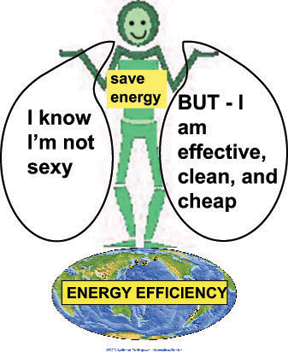
The plan finds the residential building sector would be able to achieve a 53 per cent energy use reduction overall, with some typical home categories seeing over 70 per cent reduction. Commercial buildings are estimated to be able to reduce energy use by 44 per cent overall.
A key element of the plan involves buildings going gas-free, with gas appliances deemed “too inefficient and polluting” compared to modern electric appliances which can replace them – namely heat pumps, or split-system airconditioners, as they are more commonly known. Continue reading
Australia’s solar energy revolution in outer suburbs
Solar revolution led by outer suburbs, SBS World News, 5 AUG 2013, Households across the country are putting solar panels on their roofs at a rate that has exceeded all expectations, By Tim Flannery
 Households across the country are putting solar panels on their roofs at a rate that has exceeded all expectations. This year we hit 1 million rooftops with photovoltaic (PV) solar panels, up from just 8,000 in 2007. This means that a staggering 2.6 million Australians, 11% of the population, are now using the sun to power their homes.
The solar energy revolution is being led in suburbs and towns like Dubbo and Campbelltown in NSW, Bundaberg in Queensland, Hoppers Crossing in Melbourne, and Mandurah in Western Australia. This increase is being driven by ordinary Australians. It is the modest outer metropolitan suburbs across the country, with high concentrations of mortgages, which show the greatest uptake.
The cost of installing a PV panel today is less than a quarter of what it was in 2002. The decision to install solar panels is no longer just about global responsibility – it makes financial sense. As global momentum for solar continues to grow, the technology is advancing and manufacturing is being up-scaled in countries like China. Together these factors are rapidly driving down costs, making solar increasingly competitive even without subsidies. Businesses are watching the drop in technology costs keenly as payback periods become increasingly cost competitive.
Smart investors are realising that this trend is here to stay and that the future of energy is renewable. …. http://www.sbs.com.au/news/article/1796353/Comment-Solar-revolution-led-by-outer-suburbs
Outrage – the favoured tactic of the anti wind energy crowd

In concert with pseudoscientific assertions, outrage and emotion seem to be integral in driving the skewed perception that wind farms are a risk to health.
A focus on rousing anger has been at the heart of the anti-wind movement for some time. New York anti-wind activist Calvin Luther Martin wrote in 2009 that wind farm opponents should “screw concerned and start getting angry and defiant.”
The same philosophy has been deployed by the anonymously run blog ‘Stop These Things’. Replete with direct vilification of individuals in the wind industry (including myself), death threats, threats of violence and comparisons to genocidal regimes, the anonymous author/s attempt to inspire anger and aggression.
Facts out, wind outrage in Climate Spectator Ketan Joshi 6 Aug 13, Recently, I relayed the tale of a man angrily questioning the health effects of wind farms, and proceeding to smoke a cigarette: two risks that he seemed to react to with odd disparity. In that piece, I explored some of the reasons why it can be quite natural for us to adopt pseudoscience, when it’s predicated on fear and uncertainty.
But that’s only part of the chain of events that has led to ‘Wind Turbine Syndrome’ consuming much of the oxygen of public discourse around wind energy. Community, control and risk perception also play a big role in the genesis of authentic health fears, based on fabricated science.
Technologies designed to meet our ravenous demand for electricity have historically spurred an undercurrent of nervousness in those that live near them………….
In late May, ABC’s ‘Background Briefing’ ran a story on the purported health impacts of wind energy, and a 200-turbine development proposed for the small community of King Island, off the coast of Tasmania. Simon Chapman, Professor in Public Health at Sydney University, states during the story that 17 evidence reviews (recently updated to 19) all reach a similar conclusion: the likelihood that wind farms have direct health impacts on human physiology, through inaudible low-frequency noise emissions, is close to nil.
Despite a conspicuous lack of supporting scientific evidence, opposition to wind farms is regularly predicated on the belief that the health risks are high. Anecdotal reports of health impacts are collated and dispersed by anti-wind groups such as the Waubra Foundation. When the CEO of the Waubra Foundation, Sarah Laurie, visited the King Island community, she informed residents that “Yes, wind turbines do cause adverse health effects” and linked wind energy to autistic behaviour.
Labelling an illusory causal link as established medical truth is not the only technique utilised by anti-wind groups to inspire opposition to wind farms. Continue reading
Australian solar households generate over $2 million in electricity, daily
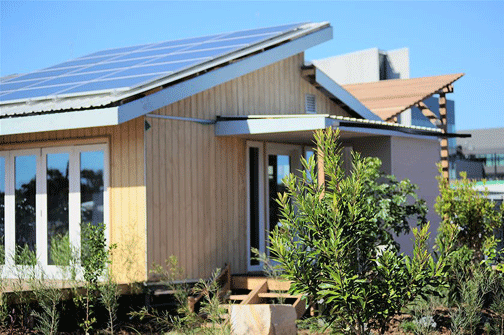 Climate Commission Lauds Solar Power http://www.energymatters.com.au/index.php?main_page=news_article&article_id=3874 6 Aug 13, Solar power in Australia is a ‘revolution that nobody saw coming’ says the Climate Commission in its latest report, The Critical Decade – Australia’s Future: Solar Energy.
‘Nobody’ is probably over-generalising. There are many Australians who understood its potential; however, ‘nobody’ could probably be more accurately applied to Big Energy and the fossil fuel industry. It’s certainly taken those sectors by surprise; having morphed from a mildly amusing novelty to an irritation, to a serious disruption to the energy status quo.
The Climate Commission report states it was only 4 years ago the Australian Bureau of Agricultural and Resource Economics estimated it would take at least a decade for Australia’s solar capacity to reach a stage where it would be able generate 3,500,000 megawatt hours annually. We reached that point this year; thanks to the early adopters who kicked off the revolution, government support and a massive reduction in the price of solar equipment.
With over 1 million solar panel systems installed; around 11% of our population now live in a solar household. In April this year, we estimated Australian solar households to be generating $2 million plus in electricity daily. The Climate Commission report states around a third of all solar PV systems in Australia were installed in 2012 and during last year, approximately 3.4 million tonnes of emissions were avoided. 70% of all new electricity generation capacity installed in Australia in 2012 was solar PV.
Rather than revealing anything new, the Climate Commission’s report gives an overall summary of where we’ve been, where we are and where we might head as a solar nation; providing an overview of the technology and issues, plus a range of interesting statistics gathered from various sources.
For example, while our 2012 figures are stunning and despite having vastly superior solar resources, Australia installed less than a third of the solar capacity that Germany did last year. On sunny days, solar PV now accounts for up to 35% of electricity consumed in Germany.
For new arrivals to the solar party or others wanting a handy guide to refer to for fairly current facts and figures, The Critical Decade – Australia’s Future: Solar Energy (PDF) is recommended reading.
AUDIO: Commentary on Energy Minister’s visit to planned nuclear waste dump area
 AUDIO Federal minister visits Muckaty Station http://caama.com.au/wp-content/uploads/2013/08/Lauren-Mellor-Penny-Phillips.mp3 http://caama.com.au/federal-minister-visits-muckaty-station
Yesterday, Federal Minister for Resources and Energy, Gary Gray met with Traditional Owners at the proposed nuclear waste facility at Muckaty Station, near Tennant Creek.
This is the first time a federal minister has visited the site and met with Traditional Owners at Muckaty.
Traditional Owner Penny Phillips welcomed the minister’s visit, but says the people were not invited to the meeting between the minister and Northern Land Council.
“I was happy for him to come, I went to Canberra and invited him to come but the Northern Land Council mob didn’t tell us he was coming to Muckaty, so we ended up going.”
Also in Muckaty was anti-nuclear campaigner Lauren Mellor, from the Environment Centre NT, who on behalf of the Traditional Owners put forth a new approach.
“There is a new approach, which is a national commission into radio active waste management options, that looks at all options, not just a remote dump site and investigates the best and safest way to actually manage Australia’s stock piles of waste.”
Listen below to the extended comments from Penny Phillips and Lauren Mellor.
South Australia’s renewable energy success, despite planned cutbacks in solar feed-in tariff
SA’s love affair with renewables isn’t just solar-focused; the state also has the largest wind power capacity in the nation. According to the Australian Energy Market Operator, approximately 29% of South Australia’s electricity came from renewable energy sources in 2012.
South Australia Solar Feed In Tariff Countdown http://www.energymatters.com.au/index.php?main_page=news_article&article_id=3872 5 Aug 13, South Australia’s feed in tariff will be slashed for new applications soon. To avoid the inevitable applications rush; households intending going solar may want to make a move now.
South Australia’s current solar feed in tariff for surplus exported electricity is comprised of two parts- a retailer contribution of 9.8c and a 16 cent component paid by SA Power Networks. Continue reading
Dick Smith got his nuclear energy costs wrong
Nuclear is the most expensive option when you take into account the external factors, followed by coal and coal seam gas. These external factors include devastating effects on health, agricultural output, land degradation, acid rain and the ability for us to feed ourselves, and of course in the case of the fossil fuels, climate change.
Already, in India and China renewables are either the cheapest form of new generation, wind is beating fossil fuels in Brazil and elsewhere. Even in Australia, wind and solar are considered the cheapest option for new capacity.
 Dick Smith wrong on energy costs – renewables are cheapest http://reneweconomy.com.au/2013/dick-smith-wrong-on-energy-costs-renewables-are-cheapest-34249 By Matthew Wright on 2 August 2013
I am from Energy security think-tank Zero Emissions and I wrote the Zero Carbon Australia Stationary Energy Plan which is briefly showcased during the film.
The stationary energy plan, the first of its kind to show that Australia could run on 100% renewable energy a combination of wind power, rooftop solar photovoltaic, and solar thermal with storage (featured in the film), along with a huge “mining” effort to find energy efficiency in housing, commerce and industry. It was a landmark that helped caused the Australian Energy Market Operator (AEMO), the organisation that runs Australia’s electricity supply, to write and publish this year its own plan and validate much of our work.
Whether you care about climate change or not, we’re moving rapidly away from coal because domestic and international banks, including the World Bank, will no longer invest in coal fired power. And a shift to gas would involve the burning of coal seam gas, due to a massive upswing in demand in Asia especially Japan the cost of gas here is becoming prohibitive. Continue reading
Paladin uranium miner’s troubles in Africa – near to going down the gurgler?
 Paladin shares plummet after mine sale cancelled Proactive Investors, by Fiona MacDonald 2 August 13, Paladin Energy’ s (TSE:PDN) (ASX:PDN) stock lost 15 cents on the Toronto Stock Exchange Friday from prior close of 92 cents to fall more than 16 per cent on the back of the news that the uranium miner had terminated negotiations with all parties for the sale of a minority interest in the Langer Heinrich Mine.
The announcement, released after the close of North American trading Thursday night, sparked intraday trading that saw share prices dip as low as 65 cents, marking a new bottom for the Subiaco, Australia-headquartered miner’s 52 week range.
The mine, located in Malawi in southern Africa, is owned 100 per cent by Paladin and was taken off the table as a result of low uranium prices – a legacy of the disaster at Japan’s Fukushima-Daiichi atomic power plant after the 2011 earthquake and tsunami — undercutting the company’s chances of collecting the pay day it had in mind….. It is a long fall for the miner, which was trading at $1.00 per share as recently as a week ago. http://www.proactiveinvestors.com/companies/news/46789/paladin-shares-plummet-after-mine-sale-cancelled-46789.html
Trading of Paladin uranium stock halted as its share price nosedives
 Shares of uranium miner Paladin dive after cancelled sale Reuters, Aug. 02 2013, Shares of Australian uranium miner Paladin Energy Ltd. fell as much as 29 per cent in Toronto on Friday after the company cancelled plans for now to sell a minority interest in an African mine, and instead raised funds through a private placement of shares. Paladin said it ended negotiations with a potential investor on Thursday and all other parties for a stake in its Langer Heinrich mine in Namibia. The company said it was unlikely to get the price it wanted because of low uranium prices….. Trading of Paladin stock was halted in both Canada and Australia on Thursday, pending news.
Paladin’s stock was down 28 per cent, or 26 Canadian cents to 66 Canadian cents in early trading on the Toronto Stock Exchange. http://www.theglobeandmail.com/report-on-business/industry-news/energy-and-resources/shares-of-uranium-miner-paladin-dive-after-cancelled-sale/article13572589/
Bad news for Paladin Energy in drastically low uranium price
Paladin cancels uranium mine sale Yahoo 7 Finance, 2 Aug 13 Paladin Energy has scrapped the sale of a stake in its flagship African uranium mine after it failed to attract a high enough bid.
The Australian listed company instead will use a shareholder diluting $88 million capital raising to reduce about $US670 million ($A753.95 million) of debt.Paladin had been negotiating with two nuclear power companies to sell a 15 to 20 per cent stake in its Langer Heinrich mine in Namibia.
In late June, managing director John Borshoff maintained a sale would go ahead.
But the global uranium market is still depressed more than two years since Japan’s Fukushima nuclear disaster, and the spot price is at seven-and-a-half-year lows of about $US35 a pound……….
It said it would wait until prices lifted before going to the market to sell again. A uranium price of at least $US70 a pound was needed, it said.
In other bad news for Paladin, the company said it expected to have to write down the value of assets including its other producing mine, Kayelekera in Malawi, by $US180 million ($A202.55 million).
The capital raising involves the equivalent of 15 per cent of its stock being issued to private institutions.
The company’s shares went into a trading halt on Thursday at $1. http://au.finance.yahoo.com/news/paladin-cancels-uranium-mine-sale-023213073.html
Australians saving money by going solar
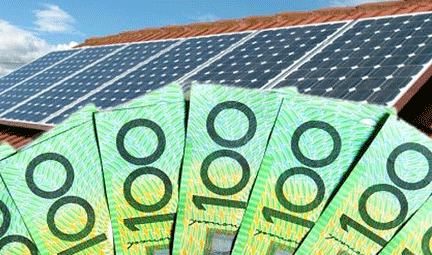 Going Solar Now Cheaper Than A Daily Cup Of Coffee http://www.energymatters.com.au/index.php?main_page=news_article&article_id=3865 31 July 13 Australian solar solutions provider Energy Matters is currently offering fully installed 3kW solar panel systems from under $3 a day; with no up-front payment required.
With Energy Matters’ Save As You Go Solar initiative and depending on installation location; repayments are as little as $20.55 week for a 3kW system that can return a financial benefit of up to $1,215 year – meaning the amount saved on electricity bills can be more than the repayments.
After the payment period, electricity produced by the system is essentially free. Continue reading
Australian Silex laser technology brings danger of nuclear weapons proliferation
DAVID BRADBURY: I went to the children’s hospital in Basra, I went to the General Hospital in Fallujah where there was a baby being born with a twisted cleft palette, spin bifida, with organs that were displaced in its body and the likelihood of autism according to the English-speaking doctor who’s been through this nightmare for the last 10 or 15 years. They can’t cope with it.
Even advocates of nuclear energy like Paul Barratt are concerned about the increasing use of depleted uranium munitions.
PAUL BARRATT: It is a toxic metal. It’ll be there in the environment, kids playing in the dust, people growing vegies, who knows. There is controversy about the extent of the health effects, but there seems to be good reason to believe there are long-term genetic effects, birth defects and what have you.
 http://www.abc.net.au/7.30/content/2013/s3816411.htm Australian Broadcasting Corporation Nuclear enrichment revolution meets weapon fears Broadcast: 01/08/2013 Reporter: Greg Hoy An Australian nuclear physicist has developed a new enrichment process and been granted approval by US regulators to develop it commercially, despite fears it could promote the proliferation of nuclear weapons.
Transcript……………..
TV REPORTER: Earlier this week the GE Hitachi facility in Castlemaine received federal approval to enrich uranium using laser technology, but what exactly does that mean and what are the implications to our community?
GREG HOY: The global implications are profound according to the American physicists’ society and non-proliferation groups who fear the Silex technology will promote the spread of nuclear weapons. Continue reading
Malawi losing $millions due to its poor uranium deal with Paladin Energy
Malawian dies on duty at Kayelekera Uranium Mine in Karonga, By Nyasa Times Reporter July 31, 2013
| “………The tragic incident has cast a shadow over the company which is already facing mounting criticism following reports the country was losing out from the favourable tax regime agreed with the company by the former administration of late President Bingu wa Mutharika. |
Last week, the United Nations’ Special Rapporteur on the Right to Food, Olivier de Schutter, also reiterated that Malawi was losing out due to tax incentives given to Paladin……..
As a result of tax incentives, one estimate suggests that Malawi may lose between US$ 205 million and US$ 281 million over the 13 years of the project.
But the current government of Joyce Banda has indicated it has started negotiations with the company to have the agreement reviewed. http://www.nyasatimes.com/2013/07/31/malawian-dies-on-duty-at-kayelekera-uranium-mine-in-karonga/
Australian company Paladin’s uranium contract with Malawi -the “worst possible swindle”

 Malawi gov’t and Paladin: Act on Kayelekera uranium raw deal now! By Veronica Maele-Magombe Nyasa Times, By Veronica Maele-Magombe July 30, 2013 Since last week’s stinging observation by UnitedNations (UN) Special Raportuer on the Right to Food Olivier De Schutter regarding Malawi’s Kayelekera Uranium Mine deal, two elusive culprits remain pretty much intact in their hard shells. It is as if the country’s most guarded contract between government and Australiancompany, Paladin Africa Ltd has not been unravelled as the worst possible swindle. Continue reading
Low demand, low prices, poor outlook, as Ranger uranium mine loses $54 million
 ERA boss steps down amid bleak short-term outlook The Motley Fool by Owen Raskiewicz, Thursday, August 1, 2013 Energy Resources Australia (ASX: ERA) chief executive, Rob Atkinson, has quit his position after nearly five years at the helm of the Rio Tinto (ASX: RIO) subsidiary.
ERA has struggled with massively reduced demand and prices for the past seven years. In the wake of the Fukushima nuclear disaster in
Japan, the spot price of uranium hit a low of slightly less than $US 40 per pound, its lowest point in seven-and-a-half years but it’s not
getting better…….
The one positive ERA shareholders can take away from a difficult short-term outlook is the knowledge that few new producers will come online in the near future. There was no dividend declared by ERA…
1 This month
17 October, Free Public Talk on Nuclear Issues in South Australia
David Noonan will speak on public interest concerns over the new Roxby Downs Indenture Act 2026 on BHP copper-uranium mining and ore processing in SA, and on how AUKUS may face SA with a High-Level nuclear waste agenda.
Dr Jim Green will discuss international developments in the field of nuclear power including ‘small modular reactors’ and Generation 4 ‘advanced’ nuclear reactor concepts.


Help Aunty Sue Protect Her Land and Sacred Sites From Destructive Rocket Testing.
.

Australians deserve the truth
about
AUKUS – https://aukuspublicinquiry.com/

PETITION – To: Prime Minister Anthony Albanese and the Australian Labor Government

of the week – Australians for War Powers Reform (AWPR)
To see nuclear-related stories in greater depth and intensity

