Australia is big on nuclear disarmament talk, but bad on nuclear disarmament action
Australia is good at talking the talk. Yet when it comes to taking action, Australia’s governments have fallen far short of their heroic rhetoric.
The 2009 Lowy Institute poll report stated that seventy-five per cent of Australians “somewhat” or “strongly” agree that “global nuclear disarmament should be a top priority for the Australian government”.
On Australia Day in 2012, nearly eight hundred Order of Australia recipients – including former prime ministers, governors-general, foreign affairs and defence ministers, premiers, governors, High Court justices and chiefs of the armed forces – called on the government to adopt a nuclear weapon-free defence posture and work towards a nuclear weapons convention.
If we want to play a proactive role on disarmament, Australia should end its hypocritical reliance on US nuclear armaments by renouncing extended nuclear deterrence.
 AUSTRALIA’S NUCLEAR DISARMAMENT HYPOCRISY , Right Now, BY DAVID DONALDSON 4 July 13 On the face of it, Australia is a great advocate for global peace and disarmament efforts. It played a proactive role on banning chemical weapons, giving its name to the Australia Group of countries aimed at preventing the spread of chemical weapons. The Keating government created the Canberra Commission on the Elimination of Nuclear Weapons, which illustrated the necessity – and possibility – of complete nuclear disarmament.
In the same vein, the Rudd government initiated the widely cited joint Australian-Japanese International Commission on Nuclear Non-Proliferation and Disarmament (ICNND), whose report argued that nuclear weapons are “the most inhumane weapons ever conceived, inherently indiscriminate in those they kill and maim, and with an impact deadly for decades.”
In 2008 Kevin Rudd declared that “we must be committed to the ultimate objective of a nuclear weapons free world.” At diplomatic meetings, Australia says it wants a reduced role for nuclear weapons in military doctrines, and that it believes that nuclear weapons states “need to do more to reduce and ultimately eliminate all types of nuclear weapons.” Continue reading
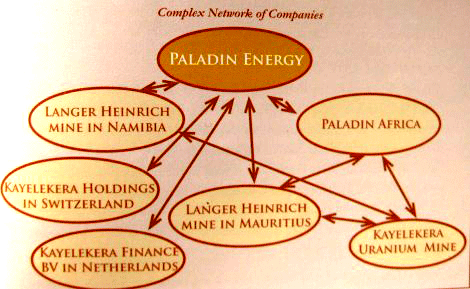
More trouble hits Australian uranium company Paladin’s African empire
Some of the issues pertain to female worker’s miscarriages; [CEO] Duvenhage’s apparent failure to engage with the union; the company’s reluctance to give workers a “single cent” for an annual increment; unfair performance bonuses; nepotism and corruption.
Australian-based Paladin Energy Ltd. (TSE:PDN) owns 100% interest in the mine.
Protests hit second largest uranium mine in Namibia http://www.mining.com/protests-hit-second-largest-uranium-mine-in-namibia-85919/ Vladimir Basov | July 2, 2013 About 300 workers, including mine staff and contractor employees, picketed at Langer Heinrich Uranium (LHU) mine last Thursday over pay and working conditions, The Namibian reported.
Workers and media were barred from the minesite where the demonstration was supposed to take place although the protesters had organized the peaceful demonstration at the beginning of last week and had announced it to the mine’s management.
As a result, all day shift buses were forced to stop inside the concession area where workers then had to disembark – about five kilometres away from the actual site. To their dismay, the protesters were forced to picket at the concession area. The Mineworkers Union of Namibia (MUN) branch executives felt that the mine’s management snubbed what it termed a legal and democratic action. Continue reading
World Meteorological Organisation’s critical report on Climate Change


The WMO says droughts affect more people than any other kind of natural disaster because of their large scale and long duration. The decade saw droughts across the world, with some of the longest and most severe in Australia (2002 and other years),
Clear upward trend’ in global temperatures: WMO ABC News, ALEX KIRBY, 5 July 13, In the first decade of this century extreme weather, global temperatures and sea level all continued a trend in a “clearly upward direction”, says a new report from the World Meteorological Organisation.
If you think the world is warming and the weather getting nastier, you’re right, according to the United Nations agency committed to understanding weather and climate.
The World Meteorological Organisation says the planet “experienced unprecedented high-impact climate extremes” in the ten years from 2001 to 2010, the warmest decade since the start of modern measurements in 1850.
Those ten years also continued an extended period of accelerating global warming, with more national temperature records reported broken than in any previous decade. Sea levels rose about twice as fast as the trend in the last century.
A WMO report, The Global Climate 2001-2010: A Decade of Climate Extremes, analyses global and regional temperatures and precipitation, and extreme weather such as the heat waves in Europe and Russia, Hurricane Katrina in the US, tropical cyclone Nargis in Myanmar, droughts in the Amazon basin, Australia and East Africa, and floods in Pakistan. Continue reading
A public health challenge to Australia’s use of medical ionising radiation
We’ve known about the risks of radiation for some time, but these three studies quantify the risks. Essentially, they show that relatively low doses of ionising radiation, previously considered ‘safe’ can translate into excess cancer cases.
We believe that these findings call for a change in imaging practice. First, ionising radiation should be a consideration for the referring doctor when deciding whether a patient needs a scan (and if so, what type). Second, imaging techniques and machines that reduce ionising radiation doses should always be used. Finally, government funding models must be reviewed to ensure there are no inappropriate incentives towards a radiating scan.
For example, in Australia, if a young patient presents to a GP with low back pain and the GP orders a scan, Medicare would fund a CT scan but not a magnetic resonance imaging (MRI), even though this may be a safer alternative in terms of radiation.
The body of evidence is growing. We need to start translating evidence into practice
 The risks of ionising radiation: three new studies and their impact on imaging in sports medicine http://www.clinicalsportsmedicine.com/the-risks-of-ionising-radiation-three-new-studies-and-their-impact-on-imaging-in-sports-medicine-jessica-orchard-and-john-orchard~ Jessica Orchard and John Orchard 2 July 13, In 2012, two major studies were published about the risks of ionising radiation from imaging. Pearce and colleagues’ study in The Lancet examined the excess risk of leukaemia and brain tumours for children and adolescents exposed to computed tomography (CT) scans. They found that children exposed to cumulative doses of 50mGy (3-5 CTs) may have triple the risk of leukaemia, and doses of 60mGy may have almost triple the risk of brain tumours.[1] In addition, the Pijpe and colleagues’ GEN-RAD-RISK paper in theBMJ[2] study showed that women such as Angelina Joliewho carry a specific mutation associated with breast cancer (BRCA1/2), and who were exposed to diagnostic radiation before the age of thirty, had almost twice the risk of breast cancer (with a dose-response pattern). This study involved lower doses, which we have previously considered fairly ‘safe’ (e.g. 4mGy from a single mammogram or shoulder X-ray).
On the basis of these studies, we wrote a blog post and started writing an editorial for theBritish Journal of Sports Medicine. While we were in the final stages of preparing the editorial,[3] a third study was published. The Matthews et al Australian data linkage study,[4] with an enormous cohort (11 million) showed that the adjusted overall cancer incidence for young people exposed to a CT scan was twenty-four percent greater than for those who were not exposed.
That is, one in every 1800 scans resulted in an excess cancer case. As the mean follow up time was only 9.5 years (relatively short in relation to the time taken to develop cancer), this suggests the true lifetime risk may be much higher. We await with interest the relative risk in older people to see whether the risks for the young also apply to those in middle age. Continue reading
The reality of Australia’s sorry history on nuclear disarmament policy
 AUSTRALIA’S NUCLEAR DISARMAMENT HYPOCRISY , Right Now, BY DAVID DONALDSON 4 July 13 “……..The Australian government’s submission also noted that extended deterrence has “removed the need for Australia to consider more significant and expensive defence options” – defence-speak for Australia developing its own nukes. Linking Australia’s decision not to develop nuclear weapons – a position to which it is bound by international law – to extended nuclear deterrence amounts to little more than an absurd threat to the Americans not to remove a guarantee that has never been publicly acknowledged.
Such statements demonstrate the lack of real commitment by the Federal Government to disarmament, and have no doubt made Obama’s stated desire to reduce the number of nuclear weapons in the world that little bit harder. Faced with an inevitably sceptical Pentagon and obstructive allies like Australia, the soaring anti-nuclear rhetoric of Obama’s 2009 Prague Speech has brought few results.
More recently, Australia refused to sign on to an 80-nation statement on the humanitarian impact of nuclear weapons at the 2013 Nuclear Non-Proliferation Treaty Preparatory Committee. The statement sought to address the fact that, in spite of the widely acknowledged catastrophic effects of any use of nuclear weapons, such concerns have “not been at the core of nuclear disarmament and nuclear non-proliferation deliberations for many years.”
While more than 150 countries have expressed support for a treaty banning nuclear weapons under international law – based on similar conventions on landmines and cluster munitions – the Australian government is not among them.
Moreover, the Future Fund continues to invest in nuclear weapons companies, despite having agreed to divest from tobacco, cluster munitions and landmines companies……. HTTP://RIGHTNOW.ORG.AU/WRITING-CAT/ARTICLE/AUSTRALIAS-NUCLEAR-DISARMAMENT-HYPOCRISY/
Western Australians stand to benefit with employment from tourism, rather than mining
 Tourism is a much more important job provider than is mining. And – it must be noted – mining is transient – and usually leaves a nasty looking degraded environment, and a dying town, when it ends. Tourism goes on, can go hand in hand with environmental conservation, and provide ongoing employment.
Tourism a jobs winner http://au.news.yahoo.com/thewest/a/-/wa/17874412/tourism-a-jobs-winner/ Yolanda Zaw, 5 July 13, Tourism will overtake mining and construction as one of the biggest employers in WA, according to statistics to be released today. Tourism accounts for 7 per cent of all jobs in the State, just behind mining with 8 per cent, construction 10 per cent and health care and social assistance, the top employer with 11 per cent.
Tourism Council chief executive Evan Hall said tourism would become more important to the WA economy as the resources boom slowed.
“The trend is for tourism jobs to grow as mining jobs decline,” he said. “With the lower Australian dollar, cheaper hotel rates and more flights to Perth, WA can win back the leisure tourists we lost over the last few years.”
Mr Hall said in all other States tourism employed more people than mining. Continue reading
Hypocrisy ! Australian Pipeline Industry Association wants GAS to be treated as RENEWABLE ENERGY
Gas sector wants access to renewable energy support Climate Spectator, By a staff reporter 5 July 13 The Australian Pipeline Industry Association has called for gas suppliers to be able to access government support currently available to renewable energy.
In a policy document released today they suggest government establish a technology-neutral energy investment program, allowing renewables, clean coal, gas and any low-emission technologies to compete for investment funds……http://www.businessspectator.com.au/news/2013/7/5/renewable-energy/gas-sector-wants-access-renewable-energy-support
Bonanza for John Borshoff. boss of Australian uranium mining company
 Paladin boss earnings increase while Kayelekera cut jobs http://www.nyasatimes.com/2013/02/14/paladin-boss-gets-massive-pay-hike-after-malawi-job-cuts/ By Nyasa Times Reporter February 14, 2013 Despite uranium miner, Paladin Energy limited claiming that its Malawi operations in the northern district of Karonga at Kayelekera are operating on massive losses and that world uranium prices are low, the company’s managing director John Borshoff elected to cash in his leave entitlementment, Nyasa Times has established.
Paladin’s annual report reveals that despite Borshoff honouring a promise to cut his salary by 25% between November 2011 and November 2012 – a promise he extended to June 2013, the CEO was able to boost his remuneration after a review of annual leave entitlements thereby pocketing a 52% rise in earnings. The review focused on annual and long-service leave in a bid to cut Paladin’s liabilities, and Borshoff responded by cashing out 220 days of leave.The transaction approaved by the remuneration Committee and the board netted Borshoff $1,717,000 and helped increase his remuneration to $3,464,000, from $2.26 million in 2012.
The uranium miner recently retrenched 110 staff from its Kayelekera mine in Malawi in an austerity drive which others commentators fault Boshoff for excercising his right to cash in the leave entitlement when local staff just had their calls for a 66 per cent pay rise rejected.
”Its total mockery to the Malawian workers at Kayelekera who were retrenched but have not had their benefits yet. These people are suffering. That’s a wake-up call to Malawi Government that Paladin is making profits despite plunge in prices” Karonga Business Community Chairperson Wavisanga Silungwe said in a statement made available to Nyasa Times.
“While production has gone up, the uranium price has not; hence Kayelekera continues to operate at a loss. We had warned government that this situation was unsustainable and would lead to job losses unless the uranium price improved, which it has not,” said Paladin’s (African) Ltd General Manager, international affairs, Greg Walker.
Walker said the staff reduction is in “response to economic pressures on the company caused by the continuing depressed uranium price” Borshoff’s contract with Paladin has one year left, and provides him with three months’ long-service leave for every five years of service. He is entitled to two years of double base salary when he retires or has his employment terminated.
|
|
Australian Government helps Tonga change from costly diesel to cheaper solar energy
ADB And Australian Government Helping Tonga Go Solar, http://www.energymatters.com.au/index.php?main_page=news_article&article_id=3823 4 July 13 The Asian Development Bank (ADB) and the Australia Government are kicking in to fund the construction and installation of solar power systems on nine of Tonga’s outer islands.
Tonga is comprised of 176 islands scattered over 700,000 square kilometres of the southern Pacific Ocean and is home to 103,000 people. Tonga currently depends on expensive and polluting imported diesel for 90% of its electricity generation. In some areas, the cost of electricity can be as high as 74 cents per kilowatt hour.
The Outer Islands Renewable Energy Project will help to change that by funding solar power systems on Eua, Vava’u and Ha’apai, along with four outer islands in the Ha’apai group as well as on Niuatoputapu and Niuafo’ou. The solar arrays will be connected to state and community owned power distribution networks on most of the target islands.
ADB will provide a $2 million (currency unknown at the time of publishing) grant from its concessional Asian Development Fund, while the Australian Agency for International Development (AUSAid) will provide a $4.5 million grant, to be administered by ADB.
The Government of Tonga will contribute $300,000 equivalent; for a total investment cost of $6.8 million.
The total installation will be reasonably small; around 1.25 megawatts capacity, but it will reduce diesel imports by an estimated 0.48 million litres a year. A litre of diesel generates approximately 2.6 kilograms of carbon emissions; so the project will offset around 1,248 tonnes of CO2 a year.
The Outer Islands Renewable Energy Project will be executed by Tonga’s Ministry of Finance and National Planning and will be implemented over 6 years with an estimated completion date of December 2019. Consultants will provide training on the operation and maintenance of the facilities along with management services that will extend for at least 5 years after completion of the training.
Tonga’s interest in solar goes beyond cheap electricity – the multiple effects of climate change pose a significant threat to the nation
Australia’s hidden atomic health and death toll
 A powerful manuscript entitled “The Black Mist and its Aftermath — Oral Histories by Lallie Lennon” (2010) was submitted to the South Australian and federal governments as well as to the International Atomic Energy Agency
Now aged in her 80s, Lallie has never had her health issues properly investigated, much less received any compensation. She continues to suffer from the beta burn-related skin condition to this day.
Professor Sir Ernest Titterton, the duplicitous architect of nuclear testing in Australia, typified the official contempt for survivors when he dismissed the Black Mist event as a “scare campaign”.
More recently, the ultra-right wing Herald Sun columnist Andrew Bolt has repeated this line.
Australian atomic massacre still ignored http://www.greenleft.org.au/node/54394, June 29, 2013 By David T. Rowlands Nearly 60 years have passed since Totem 1, a British nuclear test in the Australian desert, was recklessly conducted in unfavourable meteorological conditions.
Nuclear testing of any sort, even in the most “controlled” of circumstances, is inherently abusive, a crime against the environment and humanity for countless generations to come. Yet the effects of Totem 1 were particularly bad, even by the warped standards of the era.
The mushroom cloud did not behave in the way it was supposed to. Instead of rising uniformly, part of it spread laterally, causing fallout to roll menacingly at ground level over a remote yet still populated corner of South Australia, sowing injury, illness and death in its wake.
The number of casualties is unknown because the secretive and unaccountable nuclear establishment has always declined to investigate the full impact of its own criminal negligence. But it has been suggested by investigators that perhaps 50 short-term Aboriginal fatalities resulted.
In addition to those who died, many others were exposed to harmful levels of radiation. The long-term health effects on these individuals have never been charted — but anecdotal reports of high cancer rates and horrendous birth defects in isolated “downwinder” communities have circulated.
At the time of the tests, it was well known by authorities that communities of Aboriginal people were close by. Yet the official attitude was that the concerns of a “handful of natives” could not be allowed to interfere with the “interests” of the British Commonwealth. Continue reading
Another wind farm for New South Wales’ Upper Lachlan
 Plans for Upper Lachlan windfarm http://www.abc.net.au/news/2013-07-01/plans-for-upper-lachlan-windfarm/4790626 Natalie Whiting Jul 1, 2013 There are plans to set up another wind farm in the Upper Lachlan Shire Council area. Newtricity is proposing to build up to 40 turbines at the proposed Biala Wind Farm, outside Crookwell.
The 30 million dollar project would be spread over two adjacent sites. Two options have been identified to connect the windfarm to an existing electricity terminal.Newtricity says it could connect to the existing Goulburn to Yass transmission line or to the line being used by the near by Gullen Range wind farm, which is being constructed.
The development would also involve building a substation and control buildings on site.The company’s submitted its proposal and its preliminary environmental assessment to the Department of Planning.
Solar energy in Victoria continues to soar
 Victoria’s Solar Electricity Production Soars http://www.energymatters.com.au/index.php?main_page=news_article&article_id=3819, 2 July 13 Solar energy supplied 550 gigawatt-hours to Victoria in 2012 – 14 per cent of all renewable electricity – says the Clean Energy Council.
The CEC recently released its Renewable Energy in Victoria 2012 report; which provides an overview of Victoria’s electricity generation from renewable energy sources last year.
According to the report, the 550 gigawatt-hours figure was more than double solar’s contribution in 2011; which was 225 gigawatt-hours. In 2009, output was just 18 gigawatt-hours.
Installed solar panel capacity in 2012 in Victoria jumped from 270 megawatts to 418 megawatts. This was due to the uptake of home solar power, which accounted for all but 1 megawatt of installed capacity.
Uptake was spurred on by rapidly ballooning domestic power bills – and with more electricity price rises on the way; solar will likely continue to see solid gains.
While commercial solar installations were still a bit player last year, the CEC says low solar panel prices may see further uptake by the commercial sector during 2013.
The other renewable energy technology that saw significant increases in capacity and production last year was wind power. In 2012, Victoria’s wind farms generated 1674 gigawatt-hours, of clean electricity; up from 1280 gigawatt-hours in 2011.
The state’s 11 commercial wind farms over 1 MW in capacity generated enough electricity last year to provide the power needs of over 230,000 average Australian homes. Wind energy accounted for more than 27 per cent of Victoria’s renewable electricity generation capacity last year.
The report states Victoria’s installed renewable energy capacity has almost tripled since 2000, increasing from 668 megawatts to more than 1860 megawatts by the end of last year.
Victoria’s total renewable energy electricity generation was 3825 gigawatt-hours, in 2012; an increase of 874 gigawatt-hours, or nearly 30 per cent more than in 2011. The Renewable Energy in Victoria 2012 report was created with assistance from Sustainability Victoria. The full report can be downloaded here (PDF).
Productivity Commission agrees: solar energy not the cause of high electricity prices
 Productivity Commission Says ‘Go West’ For Solar http://www.energymatters.com.au/index.php?main_page=news_article&article_id=3818 2 July 13, The Productivity Commission’s Electricity Network Regulatory Frameworks final inquiry report laments that not enough small scale solar power systems have been installed facing west.
The report states average electricity prices across Australia have risen by 70 per cent in real terms from June 2007 to December 2012 – but doesn’t point the finger at solar. It acknowledges what has been known for years; network costs in most states are the main culprit and offers a series of recommendations for addressing the issues. Continue reading
Victorian Electricity Distributors quietly move to sabotage new home solar installations
Electricity Distributors Cast Shadow over Solar 1 July 13, Victorian Electricity Distributors have quietly introduced new hurdles to the installation of grid connected solar systems. CitiPower and Powercor have both introduced a pre-approval process and criteria which are likely to result in many customers’ applications to install grid connected solar systems being rejected.
NECA Victoria Executive Director, Philip Green said “these criteria are likely to result in many rural customers being unable to connect to the grid while in urban areas customers will have their applications knocked back on the basis that there are too many existing solar systems in their area.”
“Your neighbours may all have grid connected solar, however the electricity distributors can knock you back – it seems to be a matter of first in, best dressed” said Mr Green. “In addition, these policies appear designed to hamper the spread of solar into the commercial and industrial sectors.”
The distributors justify their policies on the basis that grid connected solar has effects on power quality and network integrity issues.
“The community has suffered massive increases in electricity prices over recent years with much of this increase going to upgrade (some would say gold plate) the network” said Mr Green. “Unsurprisingly many consumers are looking to mitigate the high cost of electricity by installing solar and yet they’re being told that can’t connect to the network that they’ve helped pay to upgrade.”
“Distributors should not be at liberty to proceed and introduce restrictive policies that
will impede the community’s best efforts to help reduce its impact upon the environment,” said Mr Green.
The policies have not been widely communicated to either the community or sellers and installers of solar systems meaning that some customers who enter into sales contracts may never be able to conn ect to the grid. NECA also understand that other electricity distributors are likely to introduce similar policies.
Only last year, the Victorian Competition and Efficiency Commission released its Inquiry into Feed-in Tariffs & Barriers to Distributed Generation Final Report Power from the People. Neither this report nor the Victorian Government’s response to it canvassed or proposed policies like these. “We call upon the Victorian Government to intervene” said Mr Green.
–
Australia’s “Northern Territory Intervention” trashed the reputation of Aboriginals on behalf of mining industries
 Government had made it clear that it wished to re-engage itself more directly in the control of community land through leasing options as well as to open up Aboriginal land for development and mining purposes.
The plan was to empty the homelands, and this has not changed. However, it was recognised that achieving this would be politically fraught – it would need to be accomplished in a manner that would not off-side mainstream Australia. Removing Aboriginal people from their land and taking control over their communities would need to be presented in a way that Australians would believe it to be to Aboriginal advantage, whatever the tactics.
So began the campaign to discredit the people and to publicly stigmatise Aboriginal men of the Northern Territory
And even in 2009 when the CEO of the Australian Crime Commission, John Lawler, reported that his investigation had shown there were no organised paedophile rings operating in the NT, no formal apology was ever made to the Aboriginal men and their families who were brutally shamed by the false claims.
Sixth Anniversary of the Northern Territory Intervention – Striking the Wrong Note Lateral Love Australia‘concerned Australians’ Michele Harris, 21 June 13 Aboriginal advocate Olga Havnen, in her Lowitja O’Donoghue oration has asked a critical question. She asks what has been the psychological impact of the Intervention on Aboriginal people of the Northern Territory. It is surprising that so little attention has been given to this critical, yet in some ways tenuous, link before now.
Even before the Intervention began in June 2007, government had long planned a new approach to the ‘management’ of Aboriginal people in the Northern Territory. It was no longer part of government thinking that self-determination and Aboriginal control over land could be allowed to continue. These were the Whitlam notions of 1975 and they were no longer acceptable.
Early inklings of change occurred in 2004 with the management of grants being transferred from communities to Government’s newly established Indigenous Co-ordination Centres. More ominous were the Amendments of 2006 to the Aboriginal Land Rights Act and the memoranda of agreements that followed. Government had made it clear that it wished to re-engage itself more directly in the control of community land through leasing options as well as to open up Aboriginal land for development and mining purposes. Continue reading
1 This month
17 October, Free Public Talk on Nuclear Issues in South Australia
David Noonan will speak on public interest concerns over the new Roxby Downs Indenture Act 2026 on BHP copper-uranium mining and ore processing in SA, and on how AUKUS may face SA with a High-Level nuclear waste agenda.
Dr Jim Green will discuss international developments in the field of nuclear power including ‘small modular reactors’ and Generation 4 ‘advanced’ nuclear reactor concepts.


Help Aunty Sue Protect Her Land and Sacred Sites From Destructive Rocket Testing.
.

Australians deserve the truth
about
AUKUS – https://aukuspublicinquiry.com/

PETITION – To: Prime Minister Anthony Albanese and the Australian Labor Government

of the week – Australians for War Powers Reform (AWPR)
To see nuclear-related stories in greater depth and intensity

