Tony Abbott keen to rush coal development, stifle renewable energy
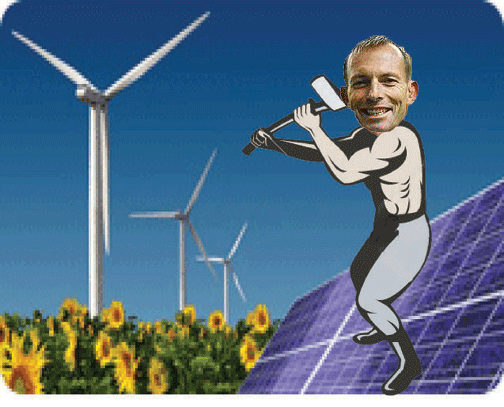
 Abbott to fast-track coal mines, in competition for ideas REneweconomy By Giles Parkinson on 1 July 2013 Tony Abbott has given his clearest indication yet that he intends to fast-track approval for large thermal coal mining projects, saying his new “one stop” shop for environmental approvals will ensure quick decisions on project approvals.
Abbott’s move, along with his party’s policy platform that has effectively suspended most investment in large scale renewables, comes as newly restored Prime Minister Kevin Rudd seeks to take the wind out of Abbott’s sails by proposing a more rapid transition to a (low) market price for carbon, as first foreshadowed on this website last Thursday morning, and the Greens push for even more ambition – proposing a 90 per cent renewables target by 2030.
Australia’s electricity demand falls, as more direct solar systems established
Demand forecasts slashed again as consumers turn to solar REneweconomy, By Giles Parkinson on 28 June 2013 The Australian Energy Market Operator has again slashed its demand forecasts for the coming year and over the coming decade, as households and business turn increasingly to rooftop solar PV, and as energy efficiency efforts also take bite.
The latest AEMO National Electricity Forecasting Report – released on Friday – cited rooftop solar and energy efficiency regulations in buildings as the main reasons cutting its forecast demand across the National Electricity Market (which includes all states except WA and Northern Territory) for 2013/14 by 2.4 per cent. Lower than expected industrial demand also played a role.
This comes a year after AEMO slashed its forecasts for 2012/13 by nearly 10 per cent. As it is, demand for 2012/13 looks to have come in 1.1 per cent below event that forecast…….
One of the reasons for the revised estimates is that AEMO has introduced new modeling techniques, including those that better recognize the impact of solar and energy efficiency. Up to two years ago, it relied heavily on forecasts given to it by state-owned network operators, who had a self-interest to give bullish demand forecasts because it would justify greater infrastructure investment and bigger profits for the networks.
Consumers are now paying heavily for those forecasts, and for network assets that may not have been required. But those same network operators, along with other incumbent generators and retailers, are now likely to use the pared down forecasts for their own benefit, this time by resuming their campaign to have the renewable energy target diluted, or even removed…..
ncreased use of solar PV, where consumers generate some, or even a large part of their own energy needs, and increased energy efficiency (which also reduces demand), are two of the central planks of policy measures taken by the US and China to reduce their emissions. It is also part of the central policy recommendations of the International Energy Agency. http://reneweconomy.com.au/2013/demand-forecasts-slashed-again-as-consumers-turn-to-solar-78062
Confusion about New South Wales Government’s attitude to nuclear power and uranium mining
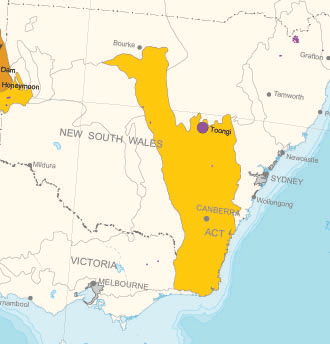 In May, the minister’s office said evaluation of the expressions of interest were due to begin, with an announcement of the successful applicants due “mid-year”.
It’s far from clear, but presumably the announcement – which must be imminent – will not only tell us which companies have applied to explore uranium, but also where they want to do so. (at left, areas recommended for uranium exploration)
[NSW Premier -] “The Uranium Mining and Nuclear Facilities (Prohibitions) Act 1986 continues to prohibit the construction of nuclear generation facilities in this state,” a spokesman told Fairfax Media when approached about the response.
“There has been and will be no change in the NSW government’s position on that.”
Nuclear act is still a minefield http://www.brisbanetimes.com.au/comment/nuclear-act-is-still-a-minefield-20130628-2p2cm.html#ixzz2XfneLben June 29, 2013 Sean Nicholls Sydney Morning Herald State Political Editor More than a year after the heat generated by last year’s announcement that the NSW government would overturn a 25-year ban on uranium exploration, things have gone a little quiet – publicly at least.
Premier Barry O’Farrell declared the move would help boost the state economy, particularly in light of the federal government decision to allow export of uranium to India. As expected, it was met with furious opposition from environment groups. Greenpeace labelled it “obscene”.
But while O’Farrell talked up the decision as a potential economic boost, he insisted his government was “not about to rush into mining uranium until we have carried out the necessary environmental and exploration checks and have had a mature and sensible discussion about utilising this resource”. Continue reading
Australia’s Clean Energy Finance Corporation launches investment, but Coalition opposes it
 The Coalition has vowed to axe the CEFC, along with the carbon price.
It has also written to the corporation saying any contracts it signs will not be honoured by the Coalition if it forms government.
Clean Energy $100m deal gets Coalition cold shoulder http://www.theage.com.au/environment/clean-energy-100m-deal-gets-coalition-cold-shoulder-20130628-2p2q9.html#ixzz2XgCLAQWO June 29, 2013 Tom Arup Environment editor, The Age Australia’s Clean Energy Finance Corporation has launched its first investment, committing to a joint $100 million energy efficiency loan program with the Commonwealth Bank.
The deal sets up a stand-off with the Coalition which has vowed not to honour any contracts signed by the $10 billion corporation if it wins office later in the year.
The corporation’s chief executive, Oliver Yates, said on Friday it would co-finance loans for medium-sized businesses for energy efficiency projects such as energy saving lighting, solar panels, and cogeneration and trigeneration plants.
The CEFC and the Commonwealth Bank will each chip in $50 million to the program, which will hand out loans between $500,000 to $5 million. It builds on an existing scheme put in place by another government agency, Low Carbon Australia – now folded into the CEFC – which has so far delivered $10.2 million to projects in manufacturing firms.
The CEFC is also working on a number of other larger deals, and it is understood some could be introduced as early as next week. It is reportedly negotiating to help New Zealand company Meridian Energy increase its debt in the massive Victorian Macarthur wind farm with a $100 million-plus loan, before it sells its share in the project. Continue reading
“Plutonium Pollyanna” – a review of film “Pandora’s Promise”
Finally (as Beyond Nuclear and other watchdog groups have noted), relying on nuclear power to mitigate CO2-driven climate change is unaffordable and impractical since it would require putting a new reactor online every two weeks……
Ultimately, Pandora’s Promise comes across as a well-executed but disingenuous exercise in special pleading. Instead of devoting 89 minutes to honestly and fully assessing the pros and cons of renewable technologies alongside the risks and benefits of new, untried nuclear power systems,Pandora’s Promise promotes a narrow agenda. As a result, the film winds up as little more than a tunnel-vision exercise in “plutonium Pollyannaism.”
 Another Take on Pandora’s Promise EARTH ISLAND JOURNAL BY GAR SMITH – JUNE 28, 2013 Pro-nuclear power film obscures as much as it reveals You’ve got to give the producers of Pandora’s Promise credit for gumption. It takes a lot of chutzpah to release a pro-nuclear polemic in the wake of the triple meltdown in Fukushima, Japan. The film also suffered the ignominy of opening the same week that the owners of California’s troubled San Onofre Nuclear Generating Station announced the permanent shutdown of the facility’s two crippled reactors. Even the film’s title takes a bit of nerve; it was Pandora’s Box, after all, that unleashed a host of once-contained evils into the world.
So, given the extensive history of nuclear mishaps and near-catastrophes, how do the producers of Pandora’s Promise manage to spin their counter-narrative of a “safe, green” nuclear future? Basically by: (1) at first accepting the criticisms of traditional nuclear power and then (2) arguing that the solution lies in “new, improved” nuclear reactors. Like a smart defense attorney, director Robert Stone begins by admitting all of the defendant’s worst foibles up front, thereby depriving the prosecution of an opportunity to score points by revealing these issues later…….
The filmmakers pronounce the radioactive contamination “infinitesimal” and proclaim there has been “no evidence of medical consequences.” No citations are offered to support this positive conclusion. The fact that 40 percent of Fukushima’s evacuated children have subsequently developed thyroid abnormalities goes unmentioned.
Where Are the “Anti-nuclear Environmental Leaders”? Continue reading
Green light for USA military bases in Australia
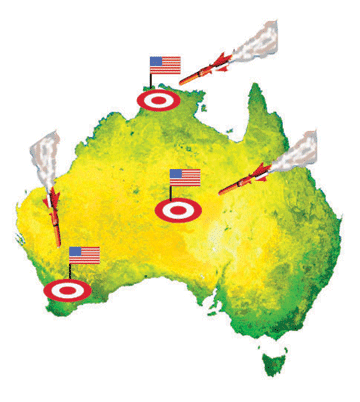 Stephen Smith gives tick to joint US-Aust bases From:THE AUSTRALIAN, AAP June 26, 2013 THE federal government has again expressed its support for the presence of US defence bases on Australian soil, declaring they offer access to intelligence unavailable elsewhere…….
Australia currently hosts two facilities – Pine Gap, commissioned in 1967 and the Joint Geological and Geophysical Research station, both of which are near Alice Springs.
Pine Gap collects intelligence data for the US and Australia and provide ballistic missile early warning information.
Australia’s recent “angry summer” was most likely caused by climate change
Manmade Emissions Led to the Heat Wave That Baked Australia Motherboard, By Jason Koebler, 27 June 13 Scientists are 90 percent sure this year’s Australian heat wave couldn’t have happened without manmade influence. Photo: CIA
Surprise, surprise: The record-breaking heat wave that plagued Australia earlier this year with temperatures that reached up to 121 degrees was almost certainly caused by humans, according to a new study.
The study, published in Geophysical Research Letters by scientists at the University of Melbourne and Australia’s ARC Centre of Excellence for Climate Systems Science, highlights how humans have heightened drought effects on the continent. According to the authors, “human contribution to the increased odds of Australian summer extremes like 2013 was substantial, while natural climate variations alone, including El Niño Southern Oscillation, are unlikely to explain the record temperature.”

The so-called “angry summer” was easily the hottest on record, with temperatures hitting more than 27 degrees above average in some parts of the country during the first week of January. When it was happening, meteorologists with the Australian government said that though “Australia has always experienced heat waves … the event affecting much of inland Australia has definitely not been typical.”…..”The model experiments also show that these types of extreme Australian summers will become more severe and more frequent in the future, with further global warming,” she said. “Extreme summers occur 8 times more frequently in the climate model simulations that include human influences, such as greenhouse gases, compared to the climate model simulations with only natural climate variations.” http://motherboard.vice.com/blog/manmade-emissions-led-to-the-heat-wave-that-baked-australia-1#ixzz2XZtGQ5uR
New New South Wales wind farm at Gullen Range
 EnergyAustralia signs PPA for Gullen Range wind farm REneweconomy, By Sophie Vorrath on 27 June 2013EnergyAustralia has signed a Power Purchase Agreement with the China-based developer of a 165.5MW wind farm in NSW, to buy electricity and renewable energy credits generated by the 73-turbine project.
The Australian utility announced its latest PPA for Goldwind Australia’s Gullen Range wind farm on Thursday, hot on the heels of news that Boco Rock – another NSW wind farm EnergyAustralia is supporting through a PPA – has reached financial close.
Xinjiang Goldwind Science & Technology Co – China’s largest wind turbine manufacturer, and second largest globally – will use a mix of its 1.5MW and 2.5MW permanent magnet direct drive (PMDD) turbine technology for the Gullen Range project; the company’s largest outside China and the first in Australia to use Goldwind’s “next generation” 2.5MW turbine.
Gullen Range, located in the NSW Southern Tablelands, is currently under construction, with the first export of electricity generated by the wind farm slated for late 2013.
EnergyAustralia’s group executive manager of energy markets, Mark Collette, said this latest PPA was strong evidence of the utility’s intention to pursue investment in renewable energy in order to meet the its obligations under the federal government’s Renewable Energy Target……http://reneweconomy.com.au/2013/energyaustralia-ppa-wind-farm-75104
Renewable energy power generation no more expensive than gas
“A mix of large-scale renewable energy generation, including solar and wind, together with consumer action to use power more efficiently, will deliver the most resilient Australian power market by 2035,”
New UQ research sheds light on coal seam gas versus renewable energy http://www.uq.edu.au/news/?article=26404 A shift from coal-fired to gas-fired power generation will not significantly lower carbon dioxide emissions, new research by the Global Change Institute at The University of Queensland has found.
“The findings contradict a widely-held view that renewable energy is too expensive compared to fossil fuels, and too unreliable to be a major component of Australia’s future energy generation by 2035,” he said.
“There is no justification for the claim that a high proportion of energy sourced from renewables will drive up wholesale costs, in comparison to a power system heavily dependent on coal seam gas,” Professor Foster said.
This finding comes as the Australian government deepens its commitment to developing coal seam gas resources in order to supply lucrative export markets and transition domestic power generation. Continue reading
Australian uranium company Paladin having more troubles, as share price falls
 Uranium producer Paladin’s shares slide after stake sale delay BY:BARRY FITZGERALD The Australian June 27, 2013 SHARES in African uranium producer Paladin have been pulled back to near 52-week lows because of a delay in a planned debt-reducing sale of a minority equity position in the group’s flagship Langer Heinrich operation in Namibia.
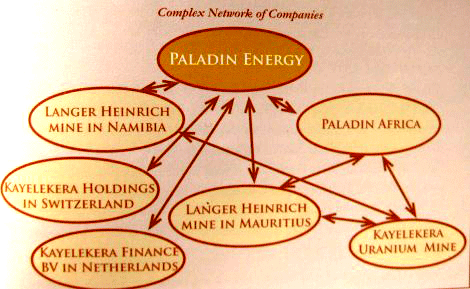
It had been hoped that Paladin would make inroads into its $US740 million debt pile by making the sale the news of which pushed the shares from an April low of 70c to more than $1 a share in late May. But recent concerns that the previously advised June 30 target date would not be met have sent the shares lower.
The concerns were well placed, with Paladin saying yesterday that the planned sale had been delayed until mid-to-late August. Paladin shares closed 6c, or 6.8 per cent, lower at 82c.
The fall came despite Paladin managing director John Borshoff remaining confident a sale will be achieved. The planned deal is with two unnamed nuclear groups……http://www.theaustralian.com.au/business/mining-energy/uranium-producer-paladins-shares-slide-after-stake-sale-delay/story-e6frg9df-1226670445221
Australia’s wind generation is cost effective, says International Energy Agency
Renewable energy use gaining worldwide:IEA http://www.theaustralian.com.au/business/breaking-news/renewable-energy-use-gaining-worldwideiea/story-e6frg90f-1226670621465 AAP June 27, 2013 RENEWABLES like solar and wind power represent the fastest-growing source of energy generation and will make up a quarter of the global power mix by 2018, the International Energy Agency IEA says.
The IEA said that in 2016 renewable energy will overtake natural gas as a power source and will be twice that of nuclear, and second only to coal as a source of power.
The growth of renewables has been bolstered by increased competitiveness with conventional energy.
It is “a bright spot in an otherwise bleak assessment of global progress towards a cleaner and more diversified energy mix,” said IEA Executive Director Maria van der Hoeven.
The report listed Australia as one of several countries where renewable energy was becoming more competitive.
It said Australian wind generation is cost-effective next to new coal and gas-fired plants with carbon pricing. Continue reading
Australia’s opposition Liberal Coalition in confusion about climate change

 Green energy helps reduce power bills, study finds June 25, 2013 The Age Peter Hannam Carbon economy editor “…….Maurice Newman, the chairman of the opposition’s proposed business advisory council, wants the target dumped because he does not accept climate change science and says renewable energy is pushing up prices.
Liberal senator Chris Bach and Nationals senator Ron Boswell spoke at an anti-wind farm rally in Canberra last week.
Senator Boswell said aid to the wind and solar energy sector was “fraudulent” and that leader Tony Abbott would face mounting pressure to alter the legislation.
Coalition climate action spokesman Greg Hunt said last week that the Coalition continued to back the policy.
“We support the Renewable Energy Target and we support the 20 per cent,” he said…..”.http://www.theage.com.au/business/carbon-economy/green-energy-helps-reduce-power-bills-study-finds-20130625-2ou3e.html#ixzz2XMBA2zNU
Anti wind farm lobby has not given up, on King Island wind project
Clean Energy Council policy director Russell Marsh said scaremongering by groups such as the “deceptively-named” Australian Environment Foundation created stress and division in the communities they claimed to be helping.
“There are more than 200,000 wind turbines at wind farms all over the world, many of them much closer to people’s houses than is possible under Australia’s strict planning regulations,” Mr Marsh said.
 Wind farm issue smolders The Mercury HELEN KEMPTON | June 26, 2013 THE mood on King Island is still tense as residents mull over news Hydro Tasmania will move on to the next stage of its proposal to build a 200-turbine wind farm.
Mayor Greg Barratt said the community was still fiercely divided on the issue and he did not expect that division to ease any time soon.
Hydro Tasmania expects it will take two years to conduct a feasibility study into its $2 billion wind project, which will need outside investment. Cr Barratt said he hoped the community could come back together as it learned more about the project.
“I encourage people to quieten down and take a deep breath and see what the feasibility study brings,” he said “I understand the ‘no’ people are very disappointed that the study is going on despite Hydro Tasmania not quite achieving the 60 per cent support they were seeking.”
A poll of residents and off-island property owners on whether Hydro Tasmania should take the project to the feasibility stage showed 58.77 per cent were in support. The company’s board decided that was close enough to proceed.
More than 400 people who were eligible to have their say did not bother…………….. Continue reading
Retransfer of Australian obligated plutonium to Australia’s major uranium market, Japan

 Australia-Euratom Nuclear Safeguards: Plutonium Retransfers …..The Agreement will enter into force when Australia notifies the Delegation to the European Commission that all domestic requirements necessary to give effect to the Agreement have been satisfied…. Department of Foreign Affairs and Trade – Australian Government 01/06/2013 | Press release distributed by noodls http://www.noodls.com/view/2FBAFE516E5E78B9F15B62CBEB136F9A32994CC7
Australia and the European Atomic Energy Community (Euratom) exchanged diplomatic notes in Canberra on 28 May 1998 as the first step towards bringing into force an Agreement under which Australia will – subject to certain conditions – broaden its consent for the return from the European Union to Japan of Australian obligated plutonium following the reprocessing of Japanese spent fuel in Europe. The European Union is an important provider of nuclear fuel cycle services for countries purchasing Australian uranium and Japan is a major market for Australian uranium exports. Continue reading
Australia benefits from Clean Energy Finance Corporation
The Opposition has said it will not honour contracts written by the corporation, discouraging companies from investing in projects reliant upon those contracts. Although Yates acknowledges that this is possible, he suggests that this would be an unusual precedent that could threaten the attractiveness of any government contract in future
 Can we do without a clean energy finance bank? SBS WORLD NEWS, 25 JUN 2013, SOURCE: THE CONVERSATION Jenny Riesz asks how an Abbott Government would make sure Australia brings to market the diverse ranges of renewable technologies needed to transform our energy sector. The Opposition has clearly stated its intention to remove the Clean Energy Finance Corporation if it takes government at the next election. Will the Coalition introduce another mechanism to take its place? How will an Abbott Government make sure Australia brings to market the diverse range of renewable technologies we need to transform our energy sector?…….
The corporation does not provide grants. It is designed like a “green bank”, providing loans for clean energy projects. Loans must be ultimately paid back, and the corporation is expected to make a return over the investment portfolio. Dividends will be paid to ARENA. The intention is to provide an ongoing, self-supporting scheme that keeps producing renewable technologies over the long term without being a drain on taxpayers.
The corporation is required to co-finance projects with the private sector so that support does not displace private investment. Schemes of this sort have been or are being established around the world (such as the UK Green Investment Bank and the US Green Bank), and in Australia (such as the Low Carbon Australia fund, which achieved a private investment ratio of 13:1). Continue reading
1 This month
17 October, Free Public Talk on Nuclear Issues in South Australia
David Noonan will speak on public interest concerns over the new Roxby Downs Indenture Act 2026 on BHP copper-uranium mining and ore processing in SA, and on how AUKUS may face SA with a High-Level nuclear waste agenda.
Dr Jim Green will discuss international developments in the field of nuclear power including ‘small modular reactors’ and Generation 4 ‘advanced’ nuclear reactor concepts.


Help Aunty Sue Protect Her Land and Sacred Sites From Destructive Rocket Testing.
.

Australians deserve the truth
about
AUKUS – https://aukuspublicinquiry.com/

PETITION – To: Prime Minister Anthony Albanese and the Australian Labor Government

of the week – Australians for War Powers Reform (AWPR)
To see nuclear-related stories in greater depth and intensity

