Australian Security Policy Institute – funded by weapons corporations, and federal govt – drumming up the frenzy for war with China
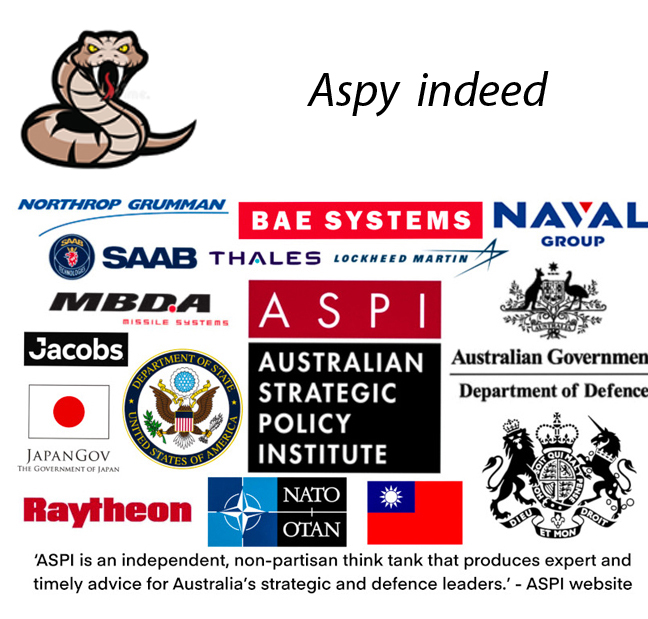
Guns still point to China: Ukraine a backdrop for national security panic merchants https://www.michaelwest.com.au/guns-still-point-to-china-ukraine-a-backdrop-for-national-security-panic-merchants/, Michael West Media, By Marcus Reubenstein, March 4, 2022
After a two-decade wait, Australia’s ”defence and strategic policy think tank” ASPI finally has a new war, one that will be a financial boon for its murky weapons maker backers. Backed also by Scott Morrison and Peter Dutton, this “independent” think tank is a key player in drumming up a pre-election China threat, writes Marcus Reubenstein.
The Australian Strategic Policy Institute (ASPI) is busy not so much with a conflict on the other side of the globe but finding a way to spin the misery of the people of Ukraine into anti-China propaganda. It’s just the kind of propaganda Scott Morrison wants, and the prime minister clearly thinks he needs, in the run up to a likely May federal election.
For years ASPI has suckled at the teat of the weapons industry; but far and away the most generous of ASPI’s benefactors is the Morrison government.
That makes sense because ASPI is not an independent research group. It is an Australian Commonwealth company, which reports directly to Defence Minister Peter Dutton and the appointment of its executive director must be ratified by cabinet.
When Morrison replaced Malcolm Turnbull as prime minister in 2018, ASPI was receiving around $1.6 million in annual government contracts over and above its core Defence Department funding of $3.5 million.
Faced with the real prospect of losing the 2019 election, Morrison and then defence minister Christopher Pyne changed the funding agreement to lock in $4 million of Defence funding for each year over five years.
What both ASPI and the government failed to mention was the Morrison government was about to embark on a gargantuan funding top-up strategy through the awarding of numerous government contracts.
Department of Finance figures show ASPI was awarded $9,497,783.88 in Commonwealth contracts in the 2020-2021 financial y
The 500 per cent increase in Commonwealth contracts awarded to a group parroting, and amplifying, the key national security message of the Morrison government suggests ASPI has been politically shifted from strategists to propagandists.
Prior to a detailed examination of ASPI’s funding sources published by Michael West Media in 2020, there had been zero disclosure as to the level of funding ASPI received from its benefactors.
These amounts are not insubstantial; in total ASPI has generated more than $100 million in revenue.
With a light shining on its finances ASPI now discloses the payments it gets from its funders. Outside Australia, that is principally a handful of foreign governments, weapons makers, and tech companies with a vested interest in crippling China’s rise as a global technology provider.
Buried on page 152 of the latest ASPI annual report is the claim that it received $2,620,978.73 in funding from government contracts. This does not reconcile with the Department of Finance’s figure of almost $9.5 million.
According to the Department of Finance, ASPI racked up 25 Commonwealth contracts while ASPI claims the figure is 21 contracts. ASPI’s accounts are audited by the Australian National Audit Office and there is no suggestion of impropriety in its reporting of income.
Three substantial contracts, two from Defence and one from the Department of Foreign Affairs, were multi-year agreements totalling $8,969,783.80. For reporting purposes, it appears there’s no requirement for disclosure of these specific payments in that reporting period.
One oddity is a contract of $1.5 million (CN3757203) awarded to ASPI in March 2021. Outside Defence, it is far and away the biggest single Commonwealth contract ever awarded to ASPI, yet there is not a single mention of it in the 2020-2021 annual report.
Transparency has never been ASPI’s strong suit.
Putin, payments and propaganda
No sooner had Prime Minister Scott Morrison announced Australian taxpayers were doling out $70 million to NATO for weapons to be sent to Ukraine, the Australian Strategic Policy Institute (ASPI) jumped in with its comprehensive analysis.
n line with its constant drone of “independence” from Canberra policy thought, ASPI challenged the wisdom of Defence Department policy. However, the main tenet of its criticism was that the Australian government has not bought enough missiles.
And who makes the shoulder-launched anti-tank Javelin missiles, en “kangaroo” route to Kyiv? Long-time ASPI sponsors Lockheed Martin and Raytheon.
The latter for years was the world’s biggest manufacturer of child-killing cluster munitions. Though they stopped making them in 2016, Raytheon cluster bombs have been stockpiled and reportedly are still being launched on civilian targets in the forgotten war in Yemen.
Raytheon is no longer an ASPI sponsor but there was zero disclosure in the ASPI missile piece that it took money from Raytheon between 2013 and 2019. Annual reports reveal Lockheed Martin – which makes the dud F-35 Strike Fighters which have soaked up billions in Defence spending – has been pouring money into ASPI’s coffers for the past 18 years.
ASPI presumably justified its non-disclosure of these sponsors because it had not identified they manufactured the Javelin missile in the report.
In late January, independent US website In These Times reported the CEO’s of Raytheon and Lockheed Martin both “boasted” on conference calls with Wall Street analyst that conflict between Russia and Ukraine was a “boom for business.”
One analyst reported Raytheon CEO Greg Hayes had said, in reply to a question about arming US allies: “Obviously we have some defensive weapons systems that we could supply which could be helpful, like the patriot missile system”. While commenting on rising geopolitical tensions, including both Ukraine and China, he said: “I fully expect we’re going to see some [financial] benefit from it.”
Spike in spruiking
When ASPI criticises Australia’s armed forces for the purchase of one type of weapons system it usually suggests an alternative — often the alternative just happens to be made by an ASPI sponsor.
In this case, ASPI’s Marcus Hellyer argued Australia’s shoulder-launched Javelin missile largesse had missed the mark. According to Hellyer, Australia has the wrong missile; instead we should be armed with Israeli-built Spike missiles, which were ordered two years ago by the ADF. There’s no sign of them yet.
And who makes the Spike? Another ASPI sponsor, Rafael. ASPI did disclose this at the end its article, in rather meek terms, that Rafael had hosted a workshop for the think tank in the previous year.
One thing ASPI has consistently never publicly discussed is the money its weapons industry sponsors get from the Australian government. In its 2018-19 annual report, ASPI boasted that it facilitates access to highly placed government officials for its sponsors. Between ASPI’s establishment and 2020, its sponsors collected more than $80 billion in Defence Department contracts.
ASPI’s China syndrome
ASPI’s analysts have been all over this latest conflict running two familiar lines: Western nations need more weapons and China is the real threat.
On February 24, ASPI executive director Peter Jennings, who is a columnist at Murdoch’s The Australian, wrote an opinion piece in which he asserts “China wins from this conflict.” Clearly there are geopolitical ramifications for China that will concern Australia, but to effectively put China front and centre in an eastern European conflict is straight out of the ASPI playbook.
In that same article Jennings argued that the failure of the Afghan military forces against the Taliban boiled down to one crucial factor — a lack of military hardware.
Imagine the price tag on hardware needed to fight a war with China that some of our politicians and security establishment as apparently salivating for.
The Kimba nuclear waste dump was NEVER about the supply of nuclear medicine.
Kazzi Jai Fight to Stop a nuclear waste dump in the Flinders Ranges 4 Mar 22, https://www.facebook.com/groups/941313402573199

“Time is running out, but we’re not going away. Our community is committed to our part in providing surety of supply for nuclear medicine provision for the benefit of every Australian, who, on average, will use nuclear medicine at least once in their lifetime.
The irony that neither federal nor state governments can provide our town and our community with base-level GP and emergency medical access is, quite frankly, unforgiveable and unacceptable to our community…..”* Mayor Dean Johnson opening remarks…
Wow!! So the “promises” are disappearing now Mayor Johnson??
Here’s a heads up – The Nuclear Waste Dump was NEVER about surety of supple of nuclear medicine!!!
Matt Canavan said so…ANSTO said so….DIIS said so – NEVER ABOUT SURETY OF NUCLEAR MEDICINE!
*Transcript excerpt from “General practitioner and related primary health services to outer metropolitan, rural and regional Australians” – Senate Inquiry Whyalla Session March 1st 2022
Caitlin Johnstone: Freedom & Democracy Via Censorship. Australian government and media join in

You’d think a free society would have no objection to people trying to learn about the other side of a war in which NATO powers very plainly had a hand in starting. By Caitlin Johnstone 4 Mar 22, Consortium News
CaitlinJohnstone.com Kremlin-backed media outlets have been banned throughout the European Union, both on television and on apps and online platforms. RT has lost its Sky TV slot in the U.K., where the outlet is also blocked on YouTube.
Australian TV providers SBS and Foxtel have dropped RT, and the federal government is putting pressure on social media platforms to block Russian media in Australia.
In the Czech Republic, Slovakia and Latvia, speaking in support of the Russian invasion of Ukraine will get you years in prison.
Twitter, historically the last of the major online platforms to jump on any new internet censorship escalation, is now actively minimizing the number of people who see Russian media content, saying that it is “reducing the content’s visibility” and “taking steps to significantly reduce the circulation of this content on Twitter.” This is exactly what I speculated might emerge after former Twitter CEO Jack Dorsey resigned in November, due to previous comments supporting the tactic of censorship-by-algorithm by his successor Parag Agrawal.
Twitter is also placing warnings labels on all Russia-backed media and delivering a pop-up message informing you that you are committing wrongthink if you try to share or even “like” a post linking to such outlets on the platform. It has also placed the label “Russia state-affiliated media” on every tweet made by the personal accounts of employees of those platforms, baselessly giving the impression that the dissident opinions tweeted by those accounts are paid Kremlin content and not simply their own legitimate perspectives. Some are complaining that this new label has led to online harassment amid the post-9/11-like anti-Russia hysteria that’s currently turning western brains into clam chowder
(Many Tweets quoted here)
This is all on top of all the other drastic escalations in censorship which came roaring in at the beginning of the Ukraine war, and I personally find it a bit scary how fast it’s all happening, how fine people are with it, and how much worse it seems likely to get.
Others agree.
“The purge of RT and other Russian media outlets in the US and Europe is 100% censorship,” tweets journalist Michael Tracey. “Go ahead and argue it’s justified, but at least don’t be a coward and admit you are advocating censorship.”
“The western world believes that it has a monopoly on what constitutes ‘political truth’ and that their ideological worldview is the only correct, valid and authoritative one,” writer and analyst Tom Fowdy observed. “They preach freedom of speech and the press to other countries, but exempt themselves from it.”
And I can’t help but find it odd that the fight for freedom and democracy should require such copious amounts of censorship. You’d think a free society would have no objection to people trying to learn the other side of the debate about a war which NATO powers very plainly had a hand in starting, rather than being forced to consume only Western mass media narratives which tell us this is happening exclusively because Russian President Vladimir Putin is evil and Hitlery and hates freedom…………..
It makes you wonder if we have foolishly consented to a reality where the most powerful people in the world get to control the information people consume in order to shut down dissent against a murderous and oppressive globe-spanning oligarchic empire.
And it kind of makes you wonder, as we watch the same empire that just destroyed Iraq, Libya, Syria and Yemen being entrusted to carefully navigate extremely delicate nuclear brinkmanship escalations without ending the world, if we might perhaps be better off with a lot more dissent, rather than a lot less. https://consortiumnews.com/2022/03/03/caitlin-johnstone-freedom-democracy-via-censorship/
Uranium miner BHP under criticism for guzzling precious artesian water, and for not keeping its word to Aboriginal native title holders
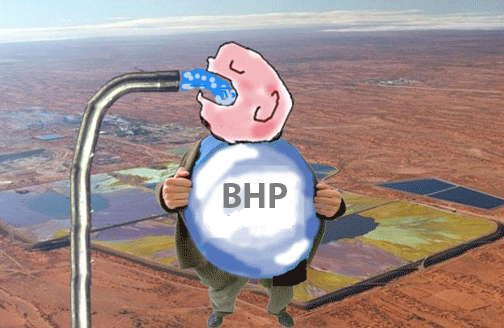
Environment campaigner and consultant David Noonan, who provided submissions to the Juukan Inquiry, is sceptical of the desalination plant announcement.
Mr Noonan says even if it was built, BHP could be taking GAB water until the end of the decade. He wants to hear a formal commitment about alternative water sources.
Why BHP is facing a minefield, CHRIS MITCHELL, Adelaide Now, 4 Mar 22,
AUSTRALIA’S biggest company and the world’s secondbiggest miner, BHP, may disappoint conservationists and Aboriginal native title holders who had hoped for commitments to reform of heritage issues and underground water use at its Olympic Dam mine before the March 19 state election BHP, the Big Australian, with market capitalisation of $230bn, paid the state government royalties of $136m last year. Its Olympic Dam project 560km north of Adelaide is South Australia’s largest mining venture and the world’s biggest uranium mine, a global top-four copper mine and producer of gold and lead. BHP is powerful in SA.
Premier Steven Marshall is Aboriginal Affairs Minister but it would be fair to say native title holders do not wield the sort of power in Adelaide that big miners do.
Yet BHP has flagged some changes to the way it operates that could reduce its own power over its own asset.
Under the 1982 Roxby Downs (Indenture Ratification) Act signed with former mine owner Western Mining, BHP, which bought the mine in 2005, has almost unprecedented powers over resources and water within its 12,000sq km Stuart Shelf exploration lease.
BHP has been criticised by conservation groups and Aboriginal interests in last year’s report into rival Rio Tinto’s destruction of Juukan Gorge in Western Australia. The report includes criticism from the Arabana tribe of the mine’s heavy reliance on water from the Great Artesian Basin (GAB), and particularly from the so-called “Mound Springs” Aboriginal heritage sites north of the mine.
On February 15, The Advertiser revealed BHP would back a new $15m study, partly funded by state and federal governments, into a Spencer Gulf desalination plant to pump water to SA’s northern mines. But BHP is still far short of publicly committing to end its use of GAB water.
Conservationists say BHP is trying to control the water agenda, to maintain its privileges under the Indenture Act. But some hope it will be pragmatic enough to cut water demand from the GAB if it eventually decides to proceed with its Oak Dam copper-gold-uranium mine 65km southeast of Olympic.
Asked last week if BHP was formally committed to ending GAB water use, a spokesman said: “We continuously monitor and publicly report our water draw under a program approved by the SA government.”
BHP is not just under pressure for environmental reasons.
It is in discussion with three native title groups about the Olympic Dam Agreement it settled in 2008 with the Kokatha, Barngarla and Kuyani.
Of these, only the Kokatha have been granted formal native title over parts of BHP’s Stuart Shelf.
BHP’s problem now is how to balance the very valuable 40-year-old legal rights it has under the indenture with rights found in a native title determination in favour of the Kokatha in 2014……….
The Kokatha fought a long, 18-year battle to win their native title in 2014. Kokatha directors say dealing with BHP on the ODA before and after their native title court win has been challenging.
At this point, they are not receiving mining royalties and are unhappy with employment opportunities for Kokatha people.
Michael Turner, a former Kokatha director and current adviser on the Kokatha Native Title Compensation Settlement and Kokatha Charitable trusts, says he has been dealing with BHP for much of his adult life.
At this point, they are not receiving mining royalties and are unhappy with employment opportunities for Kokatha people………
negotiations on BHP’s Olympic Dam Agreement had been disappointing.
“We have been calling for a review of the ODA for many years and it has constantly been deferred,” he said.
“They’re refusing to move forward. It would be great if BHP could keep to its word and respect the wishes of the Kokatha people and review the ODA for the benefit of generations to come.”…………….
The final report into the May 24, 2020 destruction by Australia’s second-biggest miner, Rio Tinto, of the Juukan Caves in Western Australia’s Pilbara was released in October. In it, Arabana chair Brenda Underwood says: “Unfortunately, our springs are disappearing. The cause … is water taken from the GAB by BHP’s mine at Roxby Downs.”
BHP and the state government believe the springs remain healthy but environmentalists fear a possible expansion to the Oak Dam could take daily GAB water use well beyond 50 million litres a day. BHP says it is averaging 34 million litres a day.
Environment campaigner and consultant David Noonan, who provided submissions to the Juukan Inquiry, is sceptical of the desalination plant announcement.
Mr Noonan says even if it was built, BHP could be taking GAB water until the end of the decade. He wants to hear a formal commitment about alternative water sources.
BHP’s Aboriginal engagement team is mindful expectations have changed across the industry since Juukan and BHP will need to be seen to be engaging seriously with traditional owners. Some believe an ODA negotiated before the Kokatha achieved native title should be written off and a new agreement established………………………………………
 | |||
Perth could be the first city in the world to be nuclear bombed, in the (unlikely)event of Putin deciding on a show of nuclear strebgth
| |||

Frightening graphic reveals the horrific carnage a nuclear bomb would cause in Australia’s biggest cities – as Vladimir Putin’s nuclear sabre-rattling sparks global fears
- President Putin has put his military on ‘nuclear alert’ over war in Ukraine
- Such an attack would cause mass devastation and prove a point to the west
- However experts say it’s highly unlikely Putin will want to start a nuclear war
By KEVIN AIRS FOR DAILY MAIL AUSTRALIA, 3 Msr 22, A devastating Russian nuclear missile nicknamed ‘Satan’ could flatten every major Australian city if it’s unleashed in the very unlikely event of all-out nuclear war, experts have warned…………………………….
Curtin University nuclear expert Victor Abramowicz …..
‘Using battlefield nuclear weapons would be an unmitigated disaster for Ukraine, but you’d need multiple steps for that to lead to missiles flying at Washington and Moscow”. ‘
Bizarrely though, Perth in Western Australia could be the first place in the world to be targeted if Putin tries to prove a point and frighten the west into thinking a bigger city could be on the cards next.
NATO generals have war-gamed various situations to pinpoint where Russia may target if it was ever to lash out in a bid to get the West to buckle to its demands.
And bombing Perth – because of its remoteness from nearby civilisation – emerged as a terrifying possibility.
They feared Russia may nuke Perth as a show of power and determination while still avoiding engaging the US in mutually-assured nuclear Armageddon.
Despite potentially killing up to half a million in the nuclear bombing, future effects would be limited, with the radiation fallout confined to the vast desert outback. …………
If Perth was specifically targeted by one of the Satan missiles, the effects would be devastating
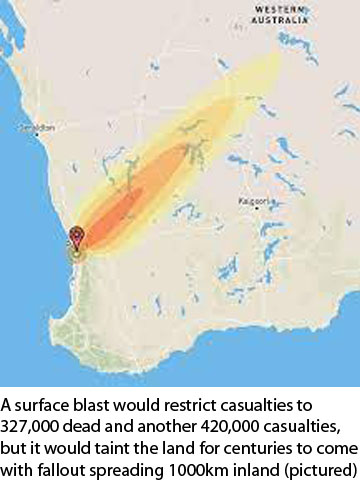
If the Satan warheads explode in a 10MT airburst over Perth, modelling by Nukemap predicts 505,000 fatalities instantly, with another 575,000 injured.
A surface blast would restrict casualties to 327,000 dead and another 420,000 casualties, but it would taint the land for centuries to come with fallout spreading 1000km inland…………….. https://www.dailymail.co.uk/news/article-10562917/Russia-Ukraine-war-happen-nuclear-bomb-dropped-Australia.html
A nuclear bomb on Sydney would mean umimaginable carnage
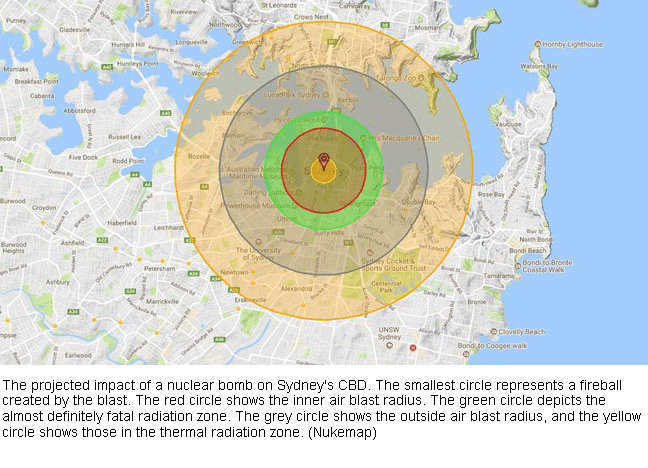
Frightening graphic reveals the horrific carnage a nuclear bomb would cause in Australia’s biggest cities – as Vladimir Putin’s nuclear sabre-rattling sparks global fears, By KEVIN AIRS FOR DAILY MAIL AUSTRALIA, 3 Mar 22, ”……………………But if the attack was to target Sydney or Melbourne, the carnage would be almost unimaginable.
Almost a million would die instantly in a 5km fireball which would engulf Sydney city centre, turning the inner-west, CBD and Eastern Suburbs to ash.
Buildings would be crushed to dust from Homebush to Collaroy to Cronulla.
If the airburst happened over Parramatta, the devastation would be even greater. The entire greater Sydney area from Penrith to Richmond to Palm Beach to Camden and the Royal National Park would be ablaze.
Anyone in the city left alive after the nuclear fireball and initial blast would be suffering third degree radiation burns all over their body, with many losing limbs.
The only saving grace might be that all their nerve-endings would probably be burnt away and they’d feel little to no pain.
Further out and windows in the Illawarra and Central Coast would be blown out by the blast, inflicting maiming injuries on locals, many of whom would be standing by a window to watch the distant explosion.
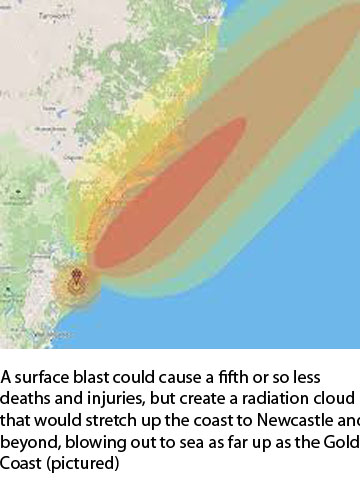
A surface blast could cause a fifth or so fewer deaths and injuries, but create a radiation cloud that would stretch up the coast to Newcastle and beyond, blowing out to sea as far up as the Gold Coast.
‘There’s no doubt that any large-scale nuclear weapons use would be quite catastrophic,’ Australian National University Professor Stephan Fruehling told the I’ve Got News For You podcast.
If you have a nuclear weapon that’s exploded on the ground, you’re looking at a very significant fallout plume and local contamination, which is essentially dangerous because of the radiotoxicity and contaminating water supplies and food chains.’

In Melbourne, a similar airburst explosion would instantly destroy everywhere around the CBD including Docklands, South and East Melbourne and Carlton in a deadly fireball.
More than 900,000 would die in a blink of an eye with another 1.3 million injured.
Everything from Sunshine West to Box Hill and north to Broadmeadows would be flattened in a 30km-wide blast range.
Everyone from Orangefields to Boronia to Whalan would be burnt to a crisp, with windows blown out and property damaged 85km from the epicentre, stretching from Frankston to Bacchus Marsh to Wallan.
A surface explosion would reduce the death total by a couple of hundred thousand, but the radiation cloud would stretch across Victoria, over Albany and Canberra and reach Sydney and Newcastle…………… https://www.dailymail.co.uk/news/article-10562917/Russia-Ukraine-war-happen-nuclear-bomb-dropped-Australia.html
While Scott Morrison froths against Putin, Australia rushes to become a top weapons seller to the world
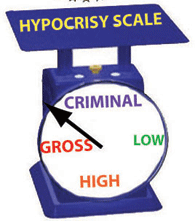
Australian leaders would sound less hypocritical and less vulnerable to criticism if they displayed a consistent interest in in peace, in social justice, in principles of non-violence and were enthusiastic champions of universal human rights.
To challenge Putin avoid Australian aggression https://johnmenadue.com/to-challenge-putin-avoid-australian-aggression/ By Stuart Rees, Mar 2, 2022 Australia’s determination to become the 10th most successful (up from 20th) manufacturer and exporter of arms adds ammunition to the argument that we have no explicit policy for peace.
Scott Morrison frothing about Putin can be replaced by some acknowledgement of our part in a world order gone wrong.
In response to Russia’s invasion of Ukraine, the Australian Prime Minister fumes about aggression that will not be allowed and the raft of government sanctions that will be imposed. In defence of democracy, he says, Australia’s sanctions policy is in lock step with other peace living nations, but there’s something bogus with these claims.
If your country has been a consistent and enthusiastic champion of peace, of non violence and of principles of world order nurtured by respect for human rights, then it would be plausible to challenge chronic abusers of international law. But television images of Scott Morrison frothing about the new iron curtain encircling Ukraine, would look more convincing against a backdrop of radical changes in Australia’s domestic and foreign policies.
A start could easily be made by adopting the Uluru statement and giving Indigenous people due recognition in the constitution. A genuine effort to repudiate the past and build a new future.
That initiative needs to be followed immediately by ceasing our unfathomably evil conduct towards asylum seekers and the special sadism reserved to reject refugees’ appeals to be reunited with their families. The trifecta in these cruelty stakes concerns the political bullies’ brave determination to prevent the Sri Lankan family and their little girls from returning to Bilolea.
Continue readingAustralia ‘in the climate cross-hairs’: new IPCC report outlines dramatic escalation of climate crisis
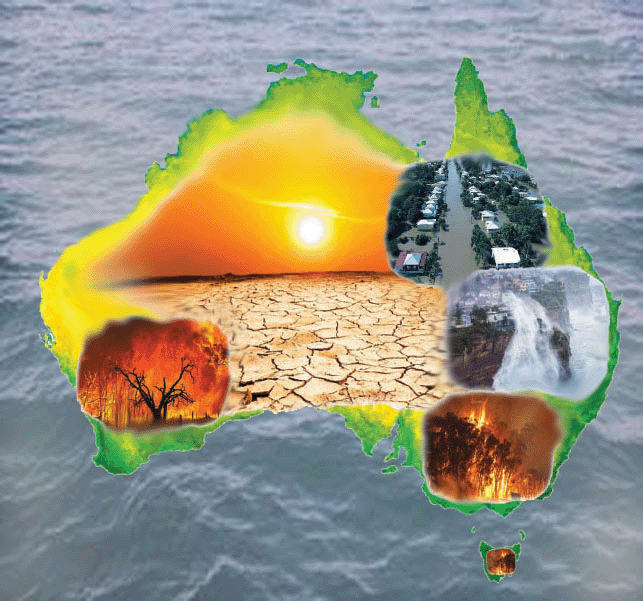
THE RELEASE of the IPCC’s Sixth Assessment Report has clearly shown the clock is ticking on climate, with impacts rapidly accelerating around the globe and Australia is squarely in the cross-hairs.
The report, compiled by almost 300 scientists across 67 countries, clearly spells out that climate change is already dramatically altering ecosystems, affecting our physical and mental health, water security and food production, cities and infrastructure, and more.
Serious risks to Australia include irreversible loss of coral reefs, loss of alpine species, collapse of forests in southern Australia, loss of kelp forests, sea-level rise, an increase in severe fire weather days and a dramatic increase in fatal heatwaves.
The central message of the IPCC report is clear: governments must rally to drastically cut emissions and cease the extraction and burning of fossil fuels this decade. Every fraction of a degree of warming saved, will be counted in lives saved.
Professor Will Steffen, former IPCC report author, Climate Councillor, climate change expert and ANU Emeritus Professor said:
“For most Australians, this report is long, technical and at times dry. But its message is anything but. We are being harmed by climate change now, and the future is potentially terrifying.”
”We are seeing climate change play out in real time with unprecedented rainfall and flooding taking a horrible toll on communities in QLD and NSW. These events will only get worse if we don’t act now to reduce emissions.”
Climate Council’s Director of Research Dr Simon Bradshaw said:
“Australia is one of the most vulnerable developed countries in the world. Right now, communities in Southeast Queensland and Northern NSW are being pummelled by extraordinarily intense rainfall and flooding. These communities have hardly had time to recover from past disasters and again they’re facing profound heartbreak and loss.”
“Increasingly, we see that communities are being hit with one disaster after another, like drought followed by fire, followed by flood. The compounding effect of these disasters is taking a heavy toll.
“The report is very clear: any further delay in global action will miss the brief and closing window to secure a liveable future.”
Climate Councillor, former IPCC author and Distinguished Professor of Biology at Macquarie University, Professor Lesley Hughes said:
“Right now, inadequate global action means the Earth is heading towards catastrophic warming of over 2°C. Governments must slash emissions this decade and rapidly transition away from burning fossil fuels.
If all countries copied Australia’s dangerously weak response, we would be headed for warming in excess of 3°C – far beyond anything it is possible to adapt to.”
Greg Mullins, Climate Councillor, former Commissioner, Fire and Rescue NSW and founder of Emergency Leaders for Climate Action (ELCA) said:
“The latest IPCC report spells out a frightening fire future that demands we cut our emissions swiftly and urgently this decade.”
“It is offensive to me, other firefighters and Australians dealing with climate change, that we are not only the worst climate performer out of all developed countries but we have a federal government that is actively making the problem worse by funding new fossil fuel developments.”
Nicki Hutley, Climate Councillor, leading economist and former Partner at Deloitte Access Economics said:
“The IPCC report makes it clear that Australia’s economy faces significant and growing economic challenges due to climate change. However, it is also clear that urgent emission reductions through renewable energy and new clean industries could see us avoid the worst financial shocks and bring about incredible economic opportunities, especially for our regions.”
“Anyone who thinks climate action is “not a race” has obviously not read this report. The first movers in the new industrial revolution will take first, second and third prize. Sadly for Australia, the Morrison Government is moving at a snail’s pace.”
Cheryl Durrant, Climate Councillor and former director of preparedness and mobilisation at the Australian Department of Defence said:
“Climate change is already undermining the security of Australia and our region. Threats to food and water security, to health, and to critical supply chains, are escalating fast. More and more people are at risk of displacement. If our government cares about the safety and security of our region and beyond, then it must get serious about tackling the climate crisis.”
Dr Kate Charlesworth, Climate Councillor and public health physician said:
“The IPCC report shows that the climate crisis is a health crisis. What we do in the next decade will be measured in Australian lives. Failing to act will mean many more lives lost from dangerous heat, drought, floods and bushfires.”
For interviews please contact Brianna Hudson on 0455 238 875 or Jane Gardner on 0438 130 905.
The Climate Council is Australia’s leading community-funded climate change communications organisation. We provide authoritative, expert and evidence-based advice on climate change to journalists, policymakers, and the wider Australian community.
For further information, go to: climatecouncil.org.au
Or follow us on social media: facebook.com/climatecouncil and twitter.com/climatecouncil
Australians issued stark warning to change or risk, The Australian way of life could soon be at risk if greater action is not taken to stop one thing, according to a new report.

News.com.au 8 Feb 22, Courtney Gould Australians may soon be unable to play sports outside if temperatures continue to rise, experts have warned.
It’s just one of the grim scenarios coming out of the release of the latest cycle of reporting from the UN-backed Intergovernmental Panel on Climate Change (IPCC).
The report, released in the shadow of major flooding across Queensland and NSW, said while actions to reduce climate risks had increased worldwide, they fell well short of what was required.
“Successful adaptation requires urgent, more ambitious and accelerated action and, at the same time, rapid and deep cuts in greenhouse gas emissions,” the report said.
But as action stalls, many species – including human beings – are reaching their limits in their ability to adapt to climate change.
Report co-author and IPCC vice chair Mark Howden said coral reefs were just one well-documented example.
However, he warned Australians could soon also be reaching their own physiological limits.
“Our bodies can cope with hot, hot temperatures outside up to a point,” Professor Howden said.
“But then we can’t do that without some sort of active cooling. If you get very high temperatures and humidity, you either have to pull back on your exercise or you overheat.
……….. …… Professor Howden said a major concern was how emissions would track as the world bounced back from Covid.
But he conceded that while the government knew exactly what it needed to do, it was a matter of political will.
“Climate change is here. In Australia it’s mostly negative, and it really matters to pretty much everything we value here in Australia,” Professor Howden said.
“Listen to the people … 90 per cent of Australians want more action on climate change.
“If there was any other issue that had 90 per cent of people wanting more action on it, you’d have the politicians running for the policy development process immediately.
“Yet we don’t see that … climate change should not be a political issue.”
Australia’s rushed nuclear submarine plan- irrelevant, as China’s technology will outpace it.
Australia’s hasty nuclear submarine plan to be outpaced by China’s development: experts, Global Times, By Liu Xuanzun and Leng Shumei: Feb 08, 2022 In an attempt to contain China, Australian Defense Minister recently said that Australia could get the first nuclear submarine under the framework of AUKUS before 2038. However, Chinese military experts said on Tuesday that this delivery schedule is too hasty and China’s rapid development during this period will outpace the Australian one……………..
When the AUKUS agreement was announced, an 18-month process was launched by all members to figure out the best way to deliver Australia nuclear submarines, according to the report by the Sydney Morning Herald.
“From a technological perspective, it is possible that Australia could get its first nuclear submarine by 2038 since the US and the UK are indeed capable of building this kind of submarine,” Zhang Junshe, a senior research fellow at the Naval Research Academy of the People’s Liberation Army, told the Global Times on Tuesday.
However, the question remains on exactly what kind of nuclear submarine Australia will get.
If, for example, the US is willing to sell its off-the-rack Virginia-class submarine or transfer its technology and production lines to Australia, then, 2038 is possible. But, if the three countries are thinking about a customized or a completely new submarine, which is more likely in this case due to the high sensitivity of this kind of military hardware, it will likely take longer, analysts said.
“2038 sounds hasty to design and build a new nuclear submarine for a country with no experience, even with technology transfer,” a Chinese military expert who requested to remain anonymous told the Global Times on Tuesday.
Australia is not a nuclear power and the plan by the US and the UK to grant Australia nuclear-powered submarines increases the risks of nuclear proliferation and an arms race, experts said.
“From a political point of view, the three countries would also have to face the pressure from the international community to meet that schedule,” Zhang said, adding that “even if Australia does get the nuclear submarine, it will not be such a big threat to China, since war cannot be won with just one or two types of weapons.”
“2038 sounds hasty to design and build a new nuclear submarine for a country with no experience, even with technology transfer,” a Chinese military expert who requested to remain anonymous told the Global Times on Tuesday.
Australia is not a nuclear power and the plan by the US and the UK to grant Australia nuclear-powered submarines increases the risks of nuclear proliferation and an arms race, experts said.
“From a political point of view, the three countries would also have to face the pressure from the international community to meet that schedule,” Zhang said, adding that “even if Australia does get the nuclear submarine, it will not be such a big threat to China, since war cannot be won with just one or two types of weapons.”…………………………..
China did not militarize the South China Sea, as all Chinese presence in the region serves only to safeguard national sovereignty and territorial integrity, the expert said, noting that countries from outside of the region like the US, which have been sending warships and warplanes, are the real ones responsible for the militarization in the South China Sea.
UN warns Australia in danger of increased wildfires
Independent Australia By Sue Arnold | 28 February 2022,
By Sue Arnold | 28 February 2022, Australia can expect an increase in catastrophic wildfires according to a recently released UN report entitled Spreading like wildfire: The rising threat of extraordinary landscape fires.
Wildfires are now a global issue, with predictions of exponential increases as a result of climate change, poor land-use planning and a lack of focus on mitigation strategies.
The report makes from grim reading. Over 50 experts from research institutions, government agencies and international organisations from around the globe contributed to the report.
No estimate has been made of the economic cost of wildfires by governments. A U.S. study mentioned in the UN report estimates that the annual economic burden of wildfire to be between $71.1 billion–$347.8 billion (AU$98.3 billion–$480.8 billion).
Costs to human lives exposed to wildfire smoke are growing exponentially. The Lancet journal estimates the annual mortality as a result of exposure resulted in 30,000 deaths across 43 countries.
According to the UN study, the extreme weather conditions that were potentially a leading cause of the Australian wildfires in 2019/2020 were shown to be 30 per cent more likely to have occurred because of climate change.
Scientists involved predict that by the end of the century, the probability of wildfires like the 2019/2020 fires will likely increase by 31-59 per cent in a given year……………………………
Australia is very similar to the U.S. in that most of the spending goes on helicopters, firefighters, efforts to put out the fires. It’s often not a good use of resources; other integrated management approaches can be more successful. ………….
IA asked Professor Baker to comment on the many studies which indicate logging of forests raises the risk of more wildfires:
‘When you log, you reduce resilience.’
Plantations are a focus of the report. Victoria and South Australia have significant numbers of eucalypt plantations, many burned incinerating thousands of animals. According to the fire experts, the increased availability of fuel and extensive continuous areas allows fire to spread rapidly and unconstrained. Accumulation of flammable fuels in monoculture plantations, plus extended droughts due to climate change, generate increasingly frequent conditions to high intensity forest fires………………
The International Association of Wildland Fire will hold a Fire and climate: issues and futures conference in Melbourne in June 2022 focused on better preparation and response to ‘this formidable challenge in the new decade’ https://independentaustralia.net/environment/environment-display/un-warns-australia-in-danger-of-increased-wildfires,16098
Ukraine war – a boon for Morrison to campaign on fear and war with China?

This changes everything, from the world stage to polling booths far from the fatal steppes, MICHAEL SWEST MEDIA, By Mark Sawyer, February 25, 2022 As the world watches in horror the Russian assault on Ukraine, it seems crass to discuss what it means for a little election in faraway Australia. But local political operators in the big parties and the small will be doing nothing else this weekend, writes Mark Sawyer.
The Russian invasion of Ukraine is a disaster for more than 40 million people, a threat to Europe, a challenge to the US and a catastrophe for the world.
It’s hard to imagine that Vladimir Putin’s war, while just about as far away from Australia as any world event could be, would have no bearing on the thoughts of voters in the expected May election. And it’s clear we were already gearing for a security election. The Coalition has installed one of its head-kickers, Peter Dutton, in the Defence post and his warnings are as much about the dangers of a Labor government as any foreign foe.
The government has stooped to describing Labor leader Anthony Albanese as China’s preferred Australian leader and deputy Labor leader Richard Marles as the Manchurian candidate. (A term now synonymous with being a traitor in the service of China, but its provenance is from a book and film about US soldiers brainwashed during the Korean War to become assassins back home). Memories of former senator Sam Dastyari’s dalliance with Chinese interests remain fresh enough for the government to exploit.
Opponents of the Morrison government will be wondering whether the Coalition will be saved by a military crisis. Labor fears being robbed of victory. Both sides will be thinking of the same election: 2001.
Khaki elections, Australian style: est 1914
In fact khaki elections have not always been bad for Labor. In 1914 Andrew Fisher won the federal election held just a month after the outbreak of the Great War. He pledged Australia would ”stand beside the mother country [Britain] to help and defend her to the last man and the last shilling”. A year later, an exhausted Fisher handed over to Billy Hughes, who tried to introduce conscription……………….
Billy Hughes, [originally Labou) styled as ”the Little Digger”, became the personification of the Australian war effort. In 1917 he won a decisive victory, and another one in 1919, fresh on the back of his participation in the postwar treaty negotiations.In 1943 Labor under John Curtin won a thumping vote of confidence for its handling of the most serious threat to the nation in white history. (The negative role of militant unions on the home front is a less storied aspect of Labor history.)…………………………………………………………………..
The last word should go to Calwell again. Remember, this speech was made in 1965:
| The government justifies its action on the ground of Chinese expansionist aggression. And yet this same government is willing to continue and expand trade in strategic materials with China. We are selling wheat, wool and steel to China. The wheat is used to feed the armies of China. The wool is used to clothe the armies of China. The steel is used to equip the armies of China. Yet the government which is willing to encourage this trade is the same government which now sends Australian troops, in the words of the Prime Minister, to prevent ” the downward thrust of China “. The government may be able to square its conscience on this matter, but this is logically and morally impossible.https://www.michaelwest.com.au/ukraine-attack-changes-everything-including-australian-election/ |
Remembering the success of the nuclear-free movement at Muckaty in Australia’s Northern Territory
The Commons Social Change Library Nuclear Fuel Cycle watch Jim Green, 24 FEb 22, https://www.facebook.com/groups/1021186047913052
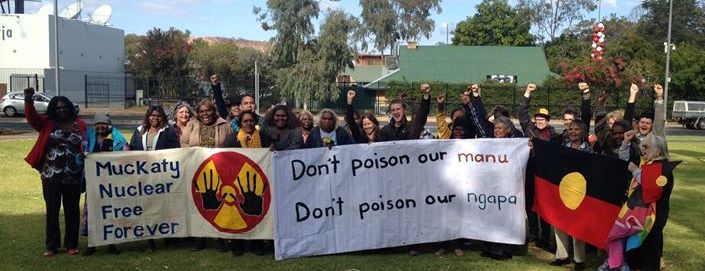
To mark the first anniversary of the official announcement of Muckaty in the Northern Territory as the site for a proposed national radioactive waste dump, members of Friends of the Earth ACE (Anti-nuclear and Clean Energy) Collective toured part of the ALP Energy and Resources Minister Martin Ferguson’s Batman electorate in search of an alternative dumping ground.
This was one of many protests against the project and it would take another three years of concerted campaigning by the Muckaty community and supporters to overturn the government’s decision. For his part Ferguson rapidly transitioned from mining minister to mining lobbyist, taking up a role as the chair of peak group the Australian Petroleum Production and Exploration Association within six months of retirement from parliament.
To learn more about creative activism visit- https://commonslibrary.org/creative-activism-101-an…/
Nuclear and politics – intertwined- theme for March 2022

”Manna from Heaven” – #ScottyFromMarketing rejoices- as the happy news broke of war in Ukraine. Just as Scotty had promised up to $171 Billion of tax-payers’ money – for nuclear submarines of no conceivable use for Australian monitoring or defence, comes this wonderful new preoccupation. Russia into Ukraine – next thing China into Taiwan – what could be better?
Such immediate threats to Australia! We all know that Russia and China are itching to militarily attack Australia,- don’t we? Or do we? Wot the heck!
FEAR and DEFENCE – what beautiful new themes for the coming Australian election!
1 This month


Help Aunty Sue Protect Her Land and Sacred Sites From Destructive Rocket Testing.
.

Australians deserve the truth
about
AUKUS – https://aukuspublicinquiry.com/

PETITION – To: Prime Minister Anthony Albanese and the Australian Labor Government

of the week – Australians for War Powers Reform (AWPR)
To see nuclear-related stories in greater depth and intensity

