Community solar energy gathering pace in Australia
 Community solar may be next big thing in Australia renewables REneweconomy. By Giles Parkinson 22 May 2013 The momentum for a big push into community solar projects appears to be gathering pace, with several different organisations planning public launches in the next month, and suggestions that several dozen projects could be built on NSW rooftops in coming years.
Among plans revealed this week are the launch of a community solar network Farming the Sun in the northern Rivers region, to be followed soon by similar groups in New England and the Riverina. This is the work of community energy advocate Embark and Starfish Enterprises, which has identified 7 different projects of at least 80kW that could be commissioned in the next 18 months.
A Newcastle community group has also emerged with a plan to launch a “crowd-funding model – similar to that used successfully by Mosaic in the US – to develop projects in its region. Meanwhile, a new organisation known as the Community Power Agency was launched on Wednesday to help the development of community energy projects.
The announcements come as news circulates that the NSW government’s Office of Environment and Heritage has approved funding for up to 9 groups to either conduct feasibility studies into their business models, or provide funds for the groundwork for particular projects.
Community ownership of renewable projects has yet to take off in Australia, even if in countries like Germany it accounts for around half of renewables investments.
Australia has two community-owned wind farms – the Hepburn Wind project near Daylesford in Victoria and in Denmark, near Albany in WA- but community owned solar projects are tipped to be a compelling proposition because of plunging cost of solar and their ability to compete with retail prices rather than wholesale prices.
Farming the Sun Project director Adam Blakester, of Starfish Enterprises, said the business model for the community projects his consortium is proposing is similar to that of the 400kW community solar project announced late last year for the Lend Lease development in Sydney’s Darling Harbour….. http://reneweconomy.com.au/2013/community-groups-look-to-crowd-funding-rooftop-solar-86008
Australian businesses rapidly taking up solar energy
 Commercial Solar Electricity ‘Cheaper Than Buying From The Grid’ http://www.energymatters.com.au/index.php?main_page=news_article&article_id=3754 22 May 13
According to an article on The Australian, the economics of solar have improved so much in recent years, commercial solar is being installed without major subsidies.
Quoting figures from AGL, The Australian states the number of commercial scale solar installations has jumped from 550 in the first four months in 2012 to 1,460 in the same period this year. Continue reading
Toro Energy flogging a nearly dead uranium horse?
Claims Toro’s uranium project may struggle May 20, 2013 http://www.abc.net.au/news/2013-05-20/claims-toro27s-uranium-project-not-financially-viable/4700982 An economist is warning that the first proposed uranium mine in Western Australia may struggle to get off the ground.
The comments are made in a report, commissioned by Greens Senator Scott Ludlam and environmental groups, into the viability of Toro Energy’s proposed Wiluna project.
The study by ‘Economics at Large’ indicates the project’s profitability relies on a number of sensitive factors. The paper’s author, Roderick Campbell, says Toro may struggle to make the project viable.
“The Wiluna project sits very high on the cost curve of global uranium projects,” he said. “It’s difficult to see why any of the major uranium players would invest in this project when there’s a lot of cheaper projects out there.”
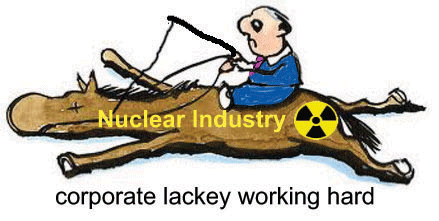 Toro has released a statement saying the Wiluna project has won WA and Federal Government environmental approval to proceed after a rigorous three and a half year assessment process. It says, as a result, there is significant market interest from international energy utilities and global resource investors in the Wiluna project.
Senator Ludlam claims the project will just manage to be financially viable if Toro can avoid clean-up and decommissioning costs.He says Toro has not submitted a costed mine closure plan and the numbers are against the company when the cost of the clean-up is factored in.
Toro is yet to respond to that particular claim.
Busting the anti solar myths of the Energy Supply Association of Australia (ESAA)
 ESAA Attack On Solar Households ‘Riddled With Myths’ http://www.energymatters.com.au/index.php?main_page=news_article&article_id=3750 21 May 13 A discussion paper recently published by the Energy Supply Association of Australia (ESAA) has been shot down by industry commentators. Adding to the Clean Energy Council’s comment that Big Energy is ‘clutching at straws‘ in its attempts to demonise solar households; others have weighed in on the issue.
Business Spectator’s Tristan Edis has commentedthat following the ESAA’s logic; any household that implements any sort of energy efficiency strategy would be viewed in ESAA’s eyes as ‘avoiding network charges’ through lowering their electricity bill. This could include non-solar households installing LED lighting, insulation – or even turning off lights when not in a room.
Mr. Edis also points out solar is a bit player in network upgrade spending and it was the rise of the air-conditioner that was used by network businesses to justify billions of dollars of additional network infrastructure expenditure; some of which has been labeled as ‘gold-plating‘.
“The ESAA’s demonisation of solar is a bit like a guy that just ran over your dog with a semi-trailer truck, who points the finger at the bicycle following afterwards that clipped the dog’s tail before it died.”
The role of air-conditioning is also pointed out by RenewEconomy’s Giles Parkinson; who states using the ESAA’s own figures, the costs ‘avoided’ by solar households is just one eleventh of the cross-subsidy paid by households with no air conditioning for those who do – yet the ESAA has not recommended air-conditioned households be hit with higher fixed tariffs to pay for network extensions.
“What seems inevitable however is that the industry will one day soon need to change its business model or face the same decline as fixed priced telephony or printed photos. They are fast approaching their Kodak moment,” says Mr. Parkinson; who mentions the role home energy storage systems may play in the future if Big Energy continues treating solar households as second-class citizens.
The ESAA’s focus on costs and little mention of benefits solar households bring that will outweigh those costs seems to indicate Big Energy is still yet to grasp the reality that solar households play an important role in Australia’s affordable clean energy future – and that ignorance runs the risk of ultimately negatively impacting all Australian households.
Yvonne Margarula’s continued fight against uranium mining on her people’s land
Fifteen years on and still no mine at Jabiluka
Sunday May 19th marks fifteen years since Yvonne Margarula – Senior Traditional Owner of the Mirarr clan – was arrested for ‘trespassing’ on her traditional land at Jabiluka.
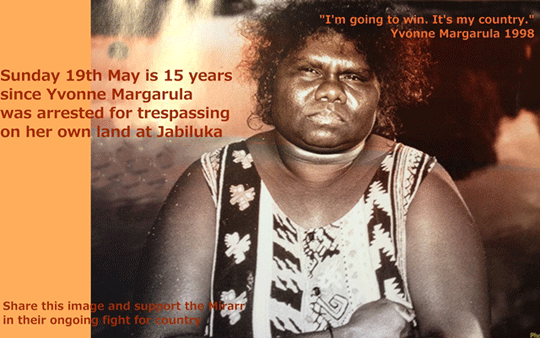
In the early hours of May 19th 1998 Yvonne Margarula was arrested along three other Aboriginal people – Jacqui Katona, Christine Christophersen and Reuben Nango – on the Jabiluka mineral lease. The highly controversial proposed Jabiluka uranium mine was under construction at the time of the arrests but development of the mine was eventually halted as a result of the campaign lead by Ms Margarula.
Ms Margarula argued that her protest against the Jabiluka uranium mine was “traditional action taking a modern form” and that her long standing opposition to the mine was fulfilling her duties as a Traditional Owner. However, in an extraordinary court ruling Ms Margarula was found guilty of trespassing on her own land and after appeal was fined $500.
Yvonne’s arrest took place on a shipping container which was the property of the mining company and she was aware of the fact that she may be arrested. This combination of factors was enough to see tens of thousands of years of living culture and connection with land overruled by the imposition of an unwanted mining project. Amidst significant publicity surrounding this ludicrous legal situation, Yvonne’s fine was anonymously paid and legal history was made.
Fifteen years ago Yvonne Margarula stood on her country and said no to unwanted mining just as her father said no to unwanted mining on Mirarr country at Ranger fifteen years before that. The efforts of the Mirarr to protect their country and culture continue. Please support the Mirarr in their continued fight to ensure responsibility at Ranger and to permanently protect Jabiluka.
Toro economic report – uncovering the uranium industry bull
20 May 13, West Australia’s first planned uranium mine has been put under the spotlight and found lacking in a detailed new economic  analysis.
The viability of Toro Energy’s Wiluna uranium proposal has been examined by the independent economic consultancy Economists at Large in a report jointly commissioned by the Anti-Nuclear Alliance of WA and the office of WA Senator Scott Ludlam.
“It is time for Toro to come clean on the full costs of the Wiluna project”, said ANAWA member Mia Pepper. “Toro’s mine closure plans and costs require particular attention as the project’s viability rests on these.”
“In 2013 ERA – the operator of the Ranger uranium mine in Kakadu – estimated closure costs at $640 million. Even if you half that and half that again for this small low grade project, mine closure estimates are still around $150 million – we are yet to hear full details from Toro about this cost.”
The report outlines that for Toro to achieve a positive Net Present Value would require the convergence of a range of external scenarios including low mine closure costs, structural changes in the long term uranium contract price, a drop in Australian exchange rates, cost easing in the mining sector and better efficiency in mining, milling and recovery rates so the project proceeds on time, within budget and without technical snags. The chance of all these factors occurring is very low.
“The Toro project represents risk at every stage”, said Mia Pepper. “It is a risk to the environment at Lake Way, a risk to shareholders and investors and a risk to WA tax payers. This report confirms that the economics of the project are volatile and uncertain – however it is certain that the project will remain strongly contested”.
“From people taking action on country – like the seventy committed people walking through the region in opposition to uranium mining right now – to sounding the alarm in the board room, this flawed mine plan will be contested. The Toro Energy plan has never made sense and this report shows that it also won’t make dollars”.
The author of the report, Roderick Campbell, economist with Economist at Large, is available for comment on 0438503249.
Photovoltaic colar cell printing – just like printing on a T shirt – an Australian first!
“We’re using the same techniques that you would use if you were screen printing an image on to a T-Shirt,” he says.
 VIDEO Printing Australia’s Largest Solar Cells http://cleantechnica.com/2013/05/19/printing-australias-largest-solar-cells/#I2hPrL1dDL6WTXwD.99 20 May 13, Scientists have produced the largest flexible, plastic solar cells in Australia – 10 times the size of what they were previously able to – thanks to a new solar cell printer that has been installed at CSIRO. The printer has allowed researchers from the Victorian Organic Solar Cell Consortium (VICOSC) – a collaboration between CSIRO, The University of Melbourne, Monash University and industry partners – to print organic photovoltaic cells the size of an A3 sheet of paper.
According to CSIRO materials scientist Dr Scott Watkins, printing cells on such a large scale opens up a huge range of possibilities for pilot applications.
“There are so many things we can do with cells this size,” he says. “We can set them into advertising signage, powering lights and other interactive elements. We can even embed them into laptop cases to provide backup power for the machine inside.”….. Continue reading
Lack of health regulation for workers in Australia’s overseas uranium mines?
 Comment on article Man loses sight due to Kayelekera radiation rshaba , 20 May 13, Does this mean that Paladin does not offer protective clothing including protective glasses to its employees? This is a no-brainer for someone dealing with radioactive substance business. I am shocked! It seems Paladin is taking advantage in people’s ignorance by not investing in appropriate protection especially for its front-line employees doing the “dirty” work. I could understand if it were a Chinese or Indian based company,
BUT Australian & Canadian based, my foot! Where are the government regulators? This should be a basic issue on their “checklist”: no protection and insurance cover for front-line staff, no business, simple and straight forward. The problem is that once someone has been exposed to radioactivity then whoever or whatever they come into contact with, will indirectly be exposed to radioactivity. Does the Government run regular radioactive on water, foods etc around the area? http://www.bnltimes.com/index.php/sunday-times/headlines/national/15108-man-loses-sight-due-to-kayelekera-radiation

Paladin Energy blames sub-contractor for poor working conditions at Kayelekera uranium mine
 Man loses sight due to Kayelekera radiation, SUNDAY TIMES, 19 MAY 2013 KAREN MSISKA It is all doom and gloom for a Kayelekera Uranium Mine ex-employee who has lost his sight, his job and any means of eking out a leaving to fend for his extended family.
On July 7, 2010, Abraham Siliwonde started working as a labourer at [Australian] Paladin Africa’s Kayelekera Mine in Karonga bubbling with hope that he would use the remuneration to improve living standards in his household.
But less than three years later, the 31-year-old, along with his six children and five wards from his deceased relatives, is a mere dependent on a small banana business his wife conducts at Karonga town market.
He lost sight in July 2012 and medical examinations have linked his condition, uveitis or inflammation of the uvea – the part of the eye that contains the iris and ciliary body and choroid – to exposure to radioactive chemicals.
Uranium ore is known to be highly radioactive.”In February 2012, I was moved to spotting. This is where one stands and guides the dumpers on where to drop the uranium ore from the pit as it is set to get into the crusher, the first point in uranium processing,” said Siliwonde on Friday.
“I was guiding dumpers carrying high grade uranium ore; the other grades are low and medium. I could feel intense heat from lumps of uranium ore and the next day I would be passing yellowish urine and feeling malarial symptoms.” He said regardless of the gear one puts on while at spotting, they feel the heat being emitted by the uranium ore, stressing “the situation is worsened by supervisors who keep people there longer than more productive.”
He said he was drafted into driving dumpers in January 2012 but by July, he had lost his vision and instead of working, he was a continuous visitor to health facilities seeking to restore his vision. “After a series of visits to the mine clinic at Kayelekera, I was referred to Karonga district hospital where I was further referred to Mzuzu central hospital on 30 November 2012,” he added.
“At Mzuzu Central Hospital, they asked whether I had an eye operation before because they said my eyes had cracks. I underwent strenuous tests but after telling them the environment I was working in, they identified exposure to radiation as the possible cause and referred me to Kamuzu Central Hospital.”
According to medical documents The Sunday Times has seen, Siliwonde’s reference to Kamuzu Central Hospital’s Lions Sight First Eye Hospital was “to determine if patient’s condition may indeed be due to uranium dust exposure.” His situation was not improving even with spectacles. A reference report dated April 15, 2013 indicates that Siliwonde’s acuity (sharpness of vision) for both eyes had slightly improved to 6/36 from 6/60.
A report signed by Dr J Msosa, Chief Ophthalmologist at Lions Sight First Eye hospital, confirms exposure to radiation as the possible cause.
Part of the report reads: “The vitritis (posterior uveitis) may indeed be due to exposure to radiation. It is well known that all radioactive substances can cause radiation retinopathy which appears like posterior uveitis………
“The only source of income is a small banana business my wife conducts. It’s a pity that the situation at Kayelekera is not closely monitored. A lot of people are suffering because they are exposed to radioactive dust blowing from the pit area since the surface is not kept wet as per agreement.”
However, Paladin officials pushed the bucket to one of their contractors. In response to an emailed questionnaire, Paladin Energy Limited’s General Manager – International Affairs, Greg Walker, said Siliwonde was employed by one of their contractors at the mine. He added that the issue has not been brought to Paladin’s attention……http://www.bnltimes.com/index.php/sunday-times/headlines/national/15108-man-loses-sight-due-to-kayelekera-radiation
Huge write-down in value of Paladin’s Kayelekera uranium mine
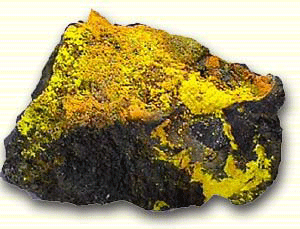 Kayelekera value cut over weak spot prices THE DAILY TIMES , 17 MAY 2013 THOM KHANJE Australian-uranium miner, Paladin Energy, has slashed a further US$45 million from the value of its Kayelekera Mine in Karonga as poor spot prices of uranium continue to negatively affect its earnings from the mine.
Following the write-down, the mine is now valued at only USid=”mce_marker”40.8 million, down from over US$200 million nine months ago.
 In its financial report for nine months to March 31 released this week, Paladin blamed continued poor uranium prices for the losses.
The spot uranium price, which has been in the doldrums since the 2011 Fukishima nuclear disaster, went down to a three-year low of US$40.75 a pound by the beginning of this week.
Paladin has since reported an overall net loss of US$247.7 million for the nine months, a sharp drop from the USid=”mce_marker”37.7 million net loss for the similar previous period…….
The falling uranium price and reduced production levels at both the Kayelekera and Langer Heinrich Mine in Namibia during the first quarter of 2013 compared to the previous three months, have also led to a fall in Paladin’s stock market value….. http://www.bnltimes.com/index.php/daily-times/headlines/business/15096-kayelekera-value-cut-over-weak-spot-prices
90% decline in share price for uranium producers ERA, Paladin Energy , and Bannerman Resources
 Coal, uranium and gold stocks among the hardest hit as good times end BY:ROBIN BROMBY The Australian May 20, 2013 “…… Among those hardest hit are coal, uranium and gold. The base metal stocks don’t seem to have suffered to quite the same degree, although few stocks have come off less than about 60 per cent.
Among those with declines of more than 90 per cent since their peak are leading uranium stocks. In their case, their peak was back in 2007. Producer Energy Resources of Australia (ERA) has come down from $18.92 then to $1.04 now. Paladin Energy (PDN) hit $10.80 back in 2007 and now sits at 94c. Bannerman Resources (BMN) with its Namibia project was a star back then at a high of $4.14, now at 5.8c…..”
Australian Renewable Energy Agency (ARENA) funds Victoria’s revolutionary solar cell printing technology
The Victorian Organic Solar Cell Consortium is a collaborative effort between CSIRO, The University of Melbourne, Monash University, BlueScope Steel, Robert Bosch SEA, Innovia Films and Innovia Security and is supported by the Victorian State Government and the federally funded Australian Renewable Energy Agency (ARENA).
 VIDEO Next Generation Solar Cell Printer In Australia http://www.energymatters.com.au/index.php?main_page=news_article&article_id=3747 20 May 13 A new solar cell printer installed at CSIRO in Clayton, Victoria is now cranking out A3-sized flexible solar cells.
The $200,000 printer is the next stage in the evolution of solar cell printing in Australia. In just three years, researchers from the Victorian Organic Solar Cell Consortium (VICOSC) have progressed from making cells the size of a fingernail to cells that are now 30cm wide.
Using semiconducting inks, the cells are printed on thin flexible plastic or steel at a rate of up to ten metres per minute or one large cell every two seconds. Current studies have shown stable outdoor performance beyond six months and the consortium anticipates lifetimes of several years will be achievable soon. Current module power output from printed devices is 10-50W per square metre; but over 80W has been achieved on small lab-scale devices.
The technology doesn’t have to be a competitor when it comes to traditional silicon based solar panels. Thin film solar can be used to enhance the efficiency of standard solar panels as the different types of cells capture light from different parts of the solar spectrum.
The researchers have a grand vision for their printed solar cell technology.
“Eventually we see these being laminated to windows that line skyscrapers,” says VICOSC project coordinator and University of Melbourne researcher Dr David Jones. “By printing directly to materials like steel, we’ll also be able to embed cells onto roofing materials.”
A screen printing line is also being installed at nearby Monash University and combined will see Clayton Manufacturing and Materials Precinct one of the largest organic solar cell printing facilities on the planet.
The Victorian Organic Solar Cell Consortium is a collaborative effort between CSIRO, The University of Melbourne, Monash University, BlueScope Steel, Robert Bosch SEA, Innovia Films and Innovia Security and is supported by the Victorian State Government and the federally funded Australian Renewable Energy Agency (ARENA).
Declarations of Aboriginal Independence advanced at Brisbane Treaty Talks
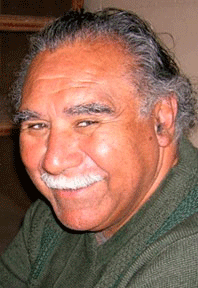 Declarations of Independence advanced at Brisbane Treaty Talks, 20 May 13 Michael Anderson, Convenor of the Sovereign Union of First Nations and Peoples in Australia, said from Brisbane today:
“Having attended a two-day Brisbane Treaty Talks conference and workshops on the continuing sovereignty of Aboriginal and Torres Strait Islander Peoples, I can say that the meeting was one of the best meetings on a single national issue that I have attended for many years.
“Clearly the people are now asking the pertinent questions relating to a process of asserting their continuing sovereignty as individual Nations.
“They expressed their great admiration for the steps taken by the Murrawarri Republic and are now seeking further advice in relation to the processes that were adopted by the Murrawarri People to take this revolutionary action. The participants agreed unanimously to investigate the processes adopted by the Murrawarri Republic and will now make all efforts to follow the same or similar path.
“The participants of the conference and workshops know in their own hearts that this is what their Elders passed have been seeking to achieve. The people are saying that now they need to make a greater effort to achieve what the Murrawarri have. (For those who were unable to attend, the Treaty Talks were webcast live.)
“A number of considerations that were made that will be followed by another meeting in five weeks time, when we will further investigate domestic and legal positions that establish the legal foundation of our own statehood under international.
“Again this meeting will be open to all people considering these actions including non-Aboriginal supporters. The suggested date and venue is:
22 – 23 June 2013
Murri School,
1277 Beaudesert Road,
Acacia Ridge, Brisbane Continue reading
Australia’s power utilities blaming home solar, conveniently forgetting subsidy for air-conditioning
 Utilities want higher charges to shade business model from solar, REneweconomy, By Giles Parkinson 20 May 2013The electricity supply industry has resumed and intensified its efforts to change the tariff system for rooftop solar households, in a bid to protect revenues that are falling and their business models that are eroding because more customers are producing their own electricity.
A new discussion paper was released this weekend, “exclusively” to News Ltd newspapers which enthusiastically took up the chance to demonise the cost of renewables once again.
The upshot of the paper is that households with rooftop solar are “avoiding” network costs, and these in turn are being passed on to other users, which the electricity supply industry says are mostly less wealthy households.
The ESAA estimated the current total of “avoided” costs at $340 million, or around $30 per household.
To put this into context, this sum is – according to the ESAA’s own data – just one eleventh of the cross-subsidy paid by households with no air conditioning.….. Does the ESAA suggest that air conditioning households should be hit with higher fixed tariffs to pay for network extensions? No, of course not, because the increased use of air conditioners adds to the revenue pool of the electricity industry, and they want to get a return on their grid investment.
The use of solar, however, detracts from the incumbents because rooftop solar households draw less electricity from the grid – leading to the now well documented “death spiral.”
The ESAA wants to arrest this spiral by lifting fixed charges or introducing tariffs for solar households to maintain the revenue pool and protect its business model. This has already begun in several states, and to make itself look like an innocent bystander, the industry has brought the violins to play a song of woe on behalf of the least well off. But this is not about protecting less wealthy households, it is about protecting the business model of the utilities.
What seems inevitable however is that the industry will one day soon need to change its business model of face the same decline as fixed priced telephony or printed photos. They are fast approaching their Kodak moment……
Solar is causing problems for traditional utilities because it is taking revenue away from the day-time peaks. Extending rooftop solar’s reach into the early evening, and combining it with smart technology, would remove the evening peak as well – and with even more revenue from the incumbent generators, network providers and retailers. But it would certainly reduce costs for customers……. http://reneweconomy.com.au/2013/utilities-want-higher-charges-to-shade-business-model-from-solar-92600?utm_source=RE+Daily+Newsletter&utm_campaign=fc04820a93-Daily_update5_19_2013&utm_medium=email&utm_term=0_46a1943223-fc04820a93-15813513
Australia to cop it most in Climate Change
Predictions Australia will be hardest hit by climate change http://www.abc.net.au/news/2013-05-17/predictions-australia-will-be-hardest-hit-by-climate-change/4695718 A national conference on mining and coal seam gas in the Hunter Valley this weekend will hear the world is past the point of preventing climate change.
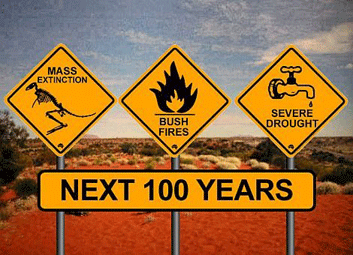
Community leaders and experts in energy policy, health and renewables are gathering for the three day forum in Kurri Kurri this weekend.
Ian Dunlop is a former senior Executive of Royal Dutch Shell and a former chair of the Australian Coal Association. He says the coal industry has known since the 1980’s climate concerns will limit its primacy.
He says the world has already left it too late to prevent the onset of major climate change, pointing to the ominous milestone reached in the last week that saw the atmospheric concentration for carbon dioxide surpassing levels not seen in millions of years. The conference will hear from community groups that have successfully opposed coal and CSG developments in NSW, Queensland and the United States.
Mr Dunlop, who’s now with the Association for the study of Peak Oil and Gas, says Australia will be one of the hardest hit by a rise in global temperatures.
“I mean this is what people don’t seam to get, you cannot continue to operate businesses of any kind in a world where the average temperature has gone up 4 degrees, it’s just not feasible for people to work in those conditions,” he said.
“We’re one of the driest continents on the earth and the effects on Australia will be more severe than elsewhere.”
Mr Dunlop says climate change will also have a negative impact on Australia’s agricultural industry.
“The much longer term problems of the sustainability of things like agriculture because if we keep on going where we’re going large parts of the country are either going to be moving back into deserts or alternatively they’ll end up subject to extreme flooding and conditions that aren’t particularly conducive to agriculture anyway,” he said.
1 This month
17 October, Free Public Talk on Nuclear Issues in South Australia
David Noonan will speak on public interest concerns over the new Roxby Downs Indenture Act 2026 on BHP copper-uranium mining and ore processing in SA, and on how AUKUS may face SA with a High-Level nuclear waste agenda.
Dr Jim Green will discuss international developments in the field of nuclear power including ‘small modular reactors’ and Generation 4 ‘advanced’ nuclear reactor concepts.


Help Aunty Sue Protect Her Land and Sacred Sites From Destructive Rocket Testing.
.

Australians deserve the truth
about
AUKUS – https://aukuspublicinquiry.com/

PETITION – To: Prime Minister Anthony Albanese and the Australian Labor Government

of the week – Australians for War Powers Reform (AWPR)
To see nuclear-related stories in greater depth and intensity

