Abbott’s carbon tax policy doesn’t make sense – report finds
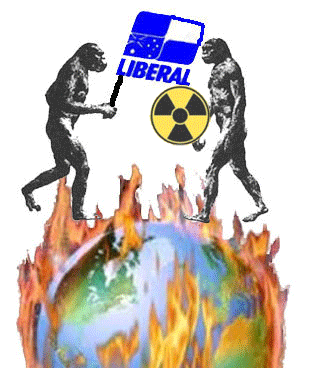 Report says Coalition carbon tax policy doesn’t add up http://www.miningaustralia.com.au/news/report-says-coalition-carbon-tax-policy-doesn-t-ad 3 April, 2013 Matt McDonald According to modelling by research group RepuTex, scrapping the carbon tax without implementing other industry changes would put a stop to investment in Australia’s renewable energy sector.
As SMH reports, if the Coalition wins the next election it plans to cut the carbon tax and retain the renewable energy target (RET).RepuTex’s associate director of research, Bret Harper says that the existence of the carbon tax is what makes renewable energy a viable investment option.
Without the tax $23 per tonne carbon price and the renewable energy certificate of about $32 per megawatt-hour, renewable energy is just not a realistic investment option.
“The carbon price is linked to the renewable energy target. For those who support the RET but not the carbon price, there’s a gap in the logic there,” Harper said.
Harper says that, given that the federal government has left the RET at 41,000 gigawatt-hours of electricity each year from 2020, between 2014 and 2020 the nation will need to increase its renewable energy capacity by about three times as much as it has in the past ten years.
So, if a future coalition government were to repeal the carbon tax it would also need to substantially increase the value of the renewable energy certificate to meet this ambitious RET. But as it stands, Coalition policy is to repeal the tax but leave other market conditions unchanged. “The existing scheme has a penalty price, which is effectively a price cap. If you remove the support of the carbon price but you don’t adjust the cap, then you will not see the renewable projects being built,” Harper said.
If Abbott scrapped carbon tax – a minefield of court action would follow!
 Scrapping green bank would incur ‘huge cost’April 3, 2013 The Age Heath Aston Political reporter Tony Abbott’s ”pledge in blood” to scrap the carbon tax and dismantle the agency ploughing billions of dollars into renewable energy projects will cost taxpayers more in compensation and legal costs than the financial benefit of abolishing the system, it is claimed.
A report by law firm Norton Rose has highlighted the minefield of court action that would result from any move to wind up the Clean Energy Finance Corporation. The corporation, which has $10 billion to spend on renewables and energy efficiency programs over five years, is preparing to sign off on a first tranche of multi-year contracts to begin on July 1.
The Coalition has promised to abolish the corporation and tear up the contracts if it wins power in September.
The report found an Abbott government would be forced to retain the corporation or replace it with a new agency to oversee contracts it could not break. The opposition has not revealed exactly how it will abolish the clean energy contracts but has warned the industry that it intends to do so.
…… A spokeswoman for the Clean Energy Finance Corporation said it was obliged under legislation to push ahead with making investment decisions.
Wiluna uranium scheme means high risk, no reward for Western Australia
 Burke’s blunder on Wiluna uranium scheme 2 April 2013. The Australian Greens strongly condemned today’s decision of Federal Environment Minister Tony Burke to allow the mining of uranium in Wiluna, Western Australia.
The Greens nuclear policy spokesperson, Senator for Western Australia Scott Ludlam, (left) said the approval showed Labor could not be trusted to protect the environment or public health.
“Today marks the beginning of the campaign to stop Toro, and the Greens will remain a strong voice to prevent the expansion of uranium mining around Australia. With the government’s abandonment of environmental protection, the Greens will target the investment community to ensure that investors continue to shun this unwanted industry.
“While the Minister has placed 36 conditions on the approval, there is simply no safe way to mine uranium on a lake bed that floods. This is a rookie company with no operating mines. The WA Government got it badly wrong and the Federal Government just blew its chance to fix this mess.
“Under new mine closure guidelines, Toro has to find 100% of the mine closure cost, around $150 million, before it has raised the $300 million to open it. With uranium prices plummeting by more than two thirds since its peak in 2007, it is highly unlikely that Toro can open, maintain and close a mine abiding by the necessary conditions and environmental standards.
“150 nuclear power plants are scheduled for closure without replacement in Europe alone. Toro’s business case is based on wildly unrealistic assumptions, including the projection that the US dollar will suddenly strengthen against the Australian dollar. Tony Burke is placing our environment and public health at huge risk for precious little prospective reward.
“Australian uranium was in the four reactors of Fukushima Daiichi nuclear plant in Japan. After more than two years, large areas of Japan are toxic and 160,000 people remain evacuated from their homes. It is time Australians got out of this industry.”
Fossil fuel lobby- Liberal Party- Institute of Public Affairs’ plan to stop action on climate change

Moran’s document should be seen as a “chilling preview” of what was to come under a future Liberal government
The IPA’s plans to abolish climate change action in Australia Independent Australia 26 March 13 A LEADING Australian free-market think tank with close ties to the country’s conservative Liberal Party has revealed its plan for climate change – abolish it.
Aside from the current Labor-led government’s mud-wrestling over its leadership, all opinion polls point to a landslide victory for the Tony Abbott-led Liberal Party at the next election, which has been set for September.
The Institute of Public Affairs, a leading promoter of climate science denial and misrepresentation, has revealed its recommendations for the next government in a document outlining budget cuts. The plan was written by Alan Moran, director of the think tank’s deregulation unit.

The document made the pages of The Australian newspaper but the report did not mention the document’s detailed plans to obliterate all climate change functions in the country’s public sector. In one section the document outlines the think tank’s recommendations for public sector departments. In delaing with the future of the “Climate Change and Energy Efficiency” department, Moran writes simply: “Abolish”.
Pretty much every other federal government function to administer climate change policy, research global warming, ensure sustainable development or support renewable energy gets chopped under Moran’s plan. Many publicly-funded research programs and agencies are either chopped entirely or cut to the bone.
As well as abolishing the country’s climate change department, the IPA plan would also scrap the Australian Renewable Energy Agency and cut research into sustainable development and climate change carried out in the Department of Agriculture, Fisheries and Forestry (the IPA plan also suggested a departmental branch responsible for plain packaging legislation should also be abolished, not surprising given that British American Tobacco has been a recent funder of the IPA). Continue reading
Very little economic benefit to Queensland, in uranium mining
 NGOs release alternative report to Uranium Implementation Committee
Queensland Nuclear Free Alliance March 18, 2013
High Risk – Low Returns: the case against uranium mining in Queensland is the NGO and civil society response to the LNPs undemocratic decision to go ahead with uranium mining in our state.
Read the report http://qnfa.files.wordpress.com/2013/03/180313highcost-lowreturn-uinqld.pdf
In October 2012 the LNP government broke its clear commitment not to allow uranium mining in Queensland. This commitment was the position of the LNP at the March 2012 state election and was reaffirmed after they took office. In the absence of open, inclusive and evidence based policy making the Newman LNP government has set up the Uranium Implementation Committee. The Committee has not sought broad community input and has not been asked to assess the arguments for and against uranium mining in Queensland. The Committee’s mandate is the far narrower task of recommending how uranium mining should be managed, not whether it should occur.
Why should Queensland forego the economic benefits of uranium mining when some other states permit uranium mines? In a nutshell, it is because the economic benefits are grossly overstated and are outweighed by the wide-ranging environmental, public health and weapons proliferation problems and risks.
Uranium accounted for 0.19 per cent of Australia’s export revenue in 2011/12 (the last available figures). By the most generous estimate, uranium accounts for 0.015% of all jobs in Australia. For Queensland, there is the additional limitation that the state has around just 2% of Australia’s uranium resources. Clearly, the industry has no capacity to deliver significant economic or employment benefits.
Instead of acknowledging the extremely limited economic potential of uranium mining in Queensland the LNP state government, the Australian Uranium Association and the Queensland Resources Council have continued a pattern of extravagant and unsubstantiated claims regarding jobs, revenue and royalties. Enthusiasm is no substitute for evidence and limited sectoral self-interest is not the same as the public interest. Continue reading
Is the Gillard government now downgrading climate change?
 The Climate Change Department’s staff once numbered above 1,000. It is now down to “approximately 620 with 50 contract staff” and, according to Senate Estimates from October last year, “employee staff numbers are steadily declining”… with no more Climate Change Department, there will no longer be a Climate Change secretary.
“how can the minister overseeing the big mining companies turn around and manage renewable energy?”
New-look Climate Change Department: What’s ahead? ABC News, By environment reporter Sarah Clarke, Mar 27, 2013
After last week’s spill that never happened and in a week described by the Prime Minister as “appalling”, it was on the cards that those who stuck by Julia Gillard would be rewarded.
But with the new ministries unveiled and extra portfolios being taken on by some, you have to ask, are they being rewarded or overloaded?
Climate Change Minister Greg Combet has been a staunch supporter of the Prime Minister and that has now translated to a number of extra titles and a huge portfolio.
As Fairfax’s Tony Wright put it, imagine the letterhead on that one; the “Department of Industry, Innovation, Climate Change, Science, Research and Tertiary Education”. It is a mouthful by any standards.
And what does this mean for what was the Department of Climate Change and Energy Efficiency? It is now being squeezed under the umbrella of the Industry Department, while the Energy Efficiency component is being shifted to the Department of Resources, Energy and Tourism. Continue reading
A note of optimism: Australia’s renewable energy initiatives are being kept.
 New-look Climate Change Department: What’s ahead? ABC News,
By environment reporter Sarah Clarke Mar 27, 2013 “………Which agencies are safe? A spokesman from Mr Combet’s office says the “Clean Energy Regulator, Clean Energy Finance Corporation and the Australian Renewable Energy Agency (ARENA)” are all clear.
The Clean Energy Regulator will remain independent with the newly-merged Climate Change Industry, Innovation, Science, Research and Tertiary Education portfolio.
The Clean Energy Finance Corporation is an independent agency within Treasury. That too won’t change.
ARENA is independent within the Resources, Energy and Tourism portfolio. That too continues as is.
But can Climate Change and Industry work together? The Climate Institute thinks so.
“It’s not illogical to have Climate Change, Industry and Innovation under one umbrella,” chief executive John Connor said.
Mr Connor says what matters is that climate change is taken seriously across all of government and across all portfolios.http://www.abc.net.au/news/2013-03-27/climate-marriage3a-will-it-work3f/4595794
Shakeups in the Assange legal case
 to publicly discuss the case.
 “If an Australian High Court judge came out and spoke on a case the court expected or was likely to judge, it would be regarded as absolutely outrageous,” he told Fairfax media.
WikiLeaks characterized the judge’s lecture as part of the Swedish government campaign against Assange, following Swedish Foreign Minister Carl Bildt’s recent visit to Australia.
“The head of Swedish Supreme Court campaigning on a case they expect to judge with $ from the embassy in the run up to an election,” the group wrote on Twitter.
Assange legal shakeup: Prosecutor walks, Supreme Court judge to speak out on case RT March 28, 2013 The lead Swedish prosecutor pursuing sexual assault charges against WikiLeaks founder Julian Assange is no longer handling the case, media reports revealed. Her departure comes as a top Swedish judge is set to speak publicly on the ‘Assange affair.’ Continue reading
New Energy Minister Gray – dubious credentials on climate change
Political moves in Australia’s renewable energy landscape, PV Magazine 25 MARCH 2013 BY: JONATHAN GIFFORD, A cabinet reshuffle in Australia results in the Department of Climate Change merging with Industry and a new Energy Minister. In the states of Queensland and Western Australia, electricity price policies remain a subject for debate.
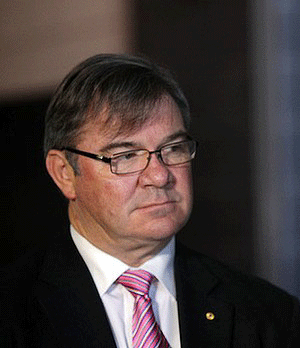 With renewable energy becoming an increasingly contentious issue in Australian politics, former oil and gas industry advisor Gary Gray has been appointed Australia’s new Energy Minister in a cabinet reshuffle. As a part of the changes, the Climate Change Department will be merged with the Industry Department, however minister Greg Combet will remain in charge of the portfolio.
Australian green business website Climate Spectator observed earlier today that not bringing the energy and climate change portfolios together represented a missed opportunity. It also pointed out that new energy minister Gray has dubious credentials when it comes to climate change.
“Gary Gray was one of the founders of the Lavoisier Institute, a group that has probably done more than any to spread misinformation about the science of global warming in Australia. According to The Age (newspaper), in 1993 Gray said the evidence linking human activity to climate change was ‘pop science’.”…..
The government has shown support for renewables in other ways and last week it committed to maintaining its Renewable Energy Target (RET) for 2020, a move that was welcomed by the photovoltaic and renewable energy industries…… http://www.pv-magazine.com/news/details/beitrag/political-moves-in-australias-renewable-energy-landscape_100010677/#ixzz2OxVmPPeE
Queensland’s way of slowing down solar rooftop energy
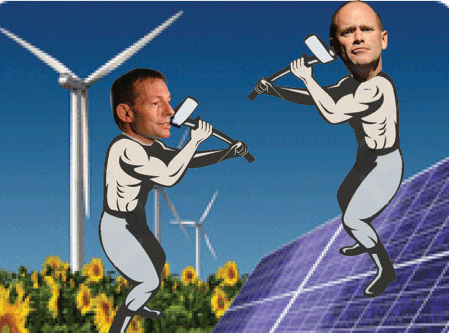 Political moves in Australia’s renewable energy landscape, PV Magazine 25 MARCH 2013 BY: JONATHAN GIFFORD, “……….In the state of Queensland, where over 1 GW of photovoltaics is expected to have been installed when its Feed In Tariff expires on July 10, a report into the electricity market has suggested new pricing structures for households installing a photovoltaic array……
The report recommended that a price of AUD0.0755/kWh be paid for electricity fed back into the grid from photovoltaic arrays, in south east Queensland, in 2013/14. It also found that compulsory minimum FITs were not required, and left the possibility of “gross FITs” open. Gross Feed In Tariffs have been vigorously opposed by the solar and renewable energy industry as they essentially prevent the self-consumption of electricity from a rooftop array.
In areas outside of the major population centers in the state, the Competition Authority report recommends the monopoly utility pay between AUD0.08 – AUD0.14/kWh for solar electricity from households.
The report has been criticized by supporters of renewable energy, because it does not take into account the advantages and savings that additional photovoltaic capacity adds, but rather assesses it only as a cost. These advantages include the reduction of wholesale electricity prices – the “merit order effect” – and a reduction of demand in peak times.
The report was also illustrative of some of the potential obstacles the solar industry may face in the future in Australia. The Queensland Department of Energy Supply and Water proposed to the Competition Authority that a limit be introduced to the amount of electricity that could quality for a FIT from each household and even the right of utilities to refuse solar connections http://www.pv-magazine.com/news/details/beitrag/political-moves-in-australias-renewable-energy-landscape_100010677/#ixzz2OxVmPPeE
Uranium lobby’s King is Dead: Long Live the King
 ” I am, and always have been an enthusiast for the uranium industry.”
” if the industry is to be embraced by the Australian public, it must continue to work hard to pursue public  education.”
“the Australian uranium industry has a positive future ahead of it.”
Christina Macpherson 28 March 13. There was brief jubilation as Prime Minister Julia Gillard sacked
Martin Ferguson from the Resources and Energy Ministry. After all, who could be more dismissive and insensitive to Australia’s Aboriginal people than Ferguson, in his fervour to place a nuclear waste dump on their land?
And perhaps, perhaps, the new Minister, Gary Gray, will be more willing to consider their rights.
However, does the new man sees his portfolio as really about Australia’s energy resources – including solar, wind, tidal? Martin Ferguson certainly didn’t.
Furthermore, Gray has Tourism lumped into his portfolio. Can we hope that he will stick up for the rights of Australia’s tourism industry – say – concerning the Great Barrier Reef – and the plan to export uranium through it?
I don’t think so. Read Gary Gray’s response to the Fukushima nuclear disaster- an all out push for uranium mining!
Gary Gray’s speech to Australian Uranium Conference 2011 Perth 21 July 2011
Introduction
It’s my pleasure to be here today speaking in the place of the Minister for Resources and Energy at this important event for the uranium sector.
Martin and I are staunch supporters of your industry and I know he would have welcomed the opportunity to address this gathering.
Now in its seventh year this conference brings industry together again to engage on the latest business, technical and policy developments.
Unquestionably, it has been a difficult year for uranium.
But despite this we believe in uranium mining and in its future. Continue reading
Thousands petition NSW Parliament to oppose uranium exploration and mining
 27 March 13, NSW Parliament today received a petition of over 2,000 people opposing uranium exploration and mining in NSW and calling on the government to maintain the ban on uranium mining and to hold an open and transparent inquiry into uranium mining in NSW. Greens MP and uranium spokesperson Jamie Parker said:
 “The petitioners have told the Liberal government loud and clear: uranium exploration and mining must not be allowed in NSW.
“This is a hugely damaging industry with a long and well-documented history of safety breaches, dangerous leaks and failed attempts at rehabilitation.
“Labor and Liberal governments in Australia are legislating to allow uranium exploration and mining, placing local communities at risk while increasing the threat of nuclear proliferation and disasters overseas.
“This is even more alarming considering Federal Labor’s decision to export uranium to India, a country which has not signed the nuclear non-proliferation treaty.
“Exploration inevitably leads to mining and all the dangers and health hazards that involves – we must stop this damaging industry now, before it expands even further.
“We should be working toward a clean energy future and investing in renewables, instead of fostering this dangerous and unnecessary industry which will leave a lasting radioactive legacy for future generations.” Mr Parker said.
The facts on Australia’s potential for rooftop solar energy
 Rooftop Solar Could Supply 134% Of Australian Residential Power Needs (includes excellent table illustrating Australia’s rooftop potential and costs) http://www.energymatters.com.au/index.php?main_page=news_article&article_id=3660 27 March 2013: Australians feeling the pinch from high electricity prices have an economical alternative, and if every suitable rooftop in Australia was turned into a solar power station, the amount of energy generated would supply more than 134.8% of the country’s residential electricity needs.
Not only would the installation of solar on every roof be a boon for jobs, the cost of the electricity being generated would be reduced to a mere 7 cents per kWh. This potential new pricing point is in total contrast to what Australians are currently paying; up to 40 cents per kilowatt-hour (kWh)1 in some parts of the country, which is predicted to continue climbing. Continue reading
Commercial solar panel leasing takes off in South Australia
 Energy Matters’ Australian First For Commercial Solar Leasing http://www.energymatters.com.au/index.php?main_page=news_article&article_id=3657 28 March 13 National solar solutions provider Energy Matter has announced a commercial solar leasing program offering South Australian businesses the opportunity to install a solar power system with zero up front costs.
The announcement was made at the recent formal unveiling of Ullrich Aluminium’s latest solar installation; a 30kW commercial system at their Pooraka, South Australia facility. Continue reading
New minister should bring fresh approach to radioactive waste debacle
New Energy Minister Gary Gray 25 March 2013. The departure of Martin Ferguson from the Cabinet presents a circuit breaker for the Federal Government to progress a real solution for Australia’s radioactive waste problem, the Greens said today.
“If responsibility for the waste site is to remain with Mr Gary Gray’s portfolio, he should immediately move to drop the campaign to dump the waste at Muckaty Station,” said Australian Greens spokesperson on nuclear policy Senator Scott Ludlam.
“Rather than Mr Ferguson’s coercive approach, which is years behind schedule and embroiled in a Federal Court action, Mr Gray should take up the Greens proposal for anindependent commission with the technical expertise to find a world’s best standard solution for Australia’s inventory of radioactive waste.
“The job of building an appropriate facility and finding an appropriate site for dealing with the country’s radioactive waste material clearly belongs in the science portfolio – currently held by Mr Greg Combet. The Government now has a chance to fix that mistake.
“The Greens will work with any minister who is willing to make a clean break with the terrible debacle left behind by Martin
Ferguson.”

1 This month
17 October, Free Public Talk on Nuclear Issues in South Australia
David Noonan will speak on public interest concerns over the new Roxby Downs Indenture Act 2026 on BHP copper-uranium mining and ore processing in SA, and on how AUKUS may face SA with a High-Level nuclear waste agenda.
Dr Jim Green will discuss international developments in the field of nuclear power including ‘small modular reactors’ and Generation 4 ‘advanced’ nuclear reactor concepts.


Help Aunty Sue Protect Her Land and Sacred Sites From Destructive Rocket Testing.
.

Australians deserve the truth
about
AUKUS – https://aukuspublicinquiry.com/

PETITION – To: Prime Minister Anthony Albanese and the Australian Labor Government

of the week – Australians for War Powers Reform (AWPR)
To see nuclear-related stories in greater depth and intensity

