Julian Assange brings fresh vision into Australia’s threatened democracy
 That Assange’s Wikileaks movement is growing a political arm in
Australia is a logical step. There is no party in this country which
unambiguously believes that we need to roll back the surveillance
state. Greens Senator Scott Ludlam from Western Australia has been a
champion of this issue but he is too often a lone voice in the Senate.
The Wikileaks Party and Julian Assange are filling a gap in the
political ideas marketplace in Australia. Its fresh approach to
policy making and to democratic values is compelling.
Running the Assange Senate campaign like racing into cold surf on hot
day https://australiansforhonestpolitics.wordpress.com/2013/04/05/running-the-assange-senate-campaign-like-racing-into-cold-surf-on-hot-day/
Greg Barns April 5, 2013
Julian Assange has been treated appallingly by the Gillard government,
and the Tony Abbott led Opposition for that matter. But Mr Assange’ s
Wikileaks and its underpinning philosophies of both blowing open the
world of secrecy that permeates bureaucracies and the political
masters they serve – and reducing the footprint of the state in the
lives of individuals in a democracy – are highly attractive. Continue reading
Anti nuclear group at Olympic Dam, challenges BHP on uranium mining
Activists check in on Olympic Dam http://www.roxbydownssun.com.au/story/1408767/activists-check-in-on-olympic-dam/?cs=1503 By Ifereimi Nadore April 4, 2013, BHP Billiton has been told to take some responsibility by stopping the sale of uranium to other countries, especially those that have nuclear energy plants.
The message was relayed to a management team based at the Olympic Dam mine this week by a 30 member anti-nuclear resistance movement group, the Friends of the Earth (Australia) which had been touring all of the uranium mines in South Australia.
The group, which is represented by various nationalities from India, Vietnam, Europe and Australia shared its concerns to the BHP Billiton management team and requested it to discontinue selling uranium to safeguard the environment and its population.
A particular case of interest which the group highlighted was the Fukushima disaster in Japan, which the group said was plagued by safety breaches, scandals, cover-ups and inadequate regulations.
Group leader and national nuclear campaigner Doctor Jim Green said the educational trip also gave the group the chance to see the uranium deposits at Olympic Dam and other uranium mines in South Australia. He said BHP Billiton had maintained that the selling of uranium had received the approval of the federal government.
“We are asking [BHP] to stop selling it and take some responsibilities,” he said. He said the group’s request to also visit the tailing dams had been turned down. Dr Green said the trip also provided the members the opportunity to talk to the indigenous landowners about the effect of uranium mining and what it could do to the environment.
The group’s next stop will the uranium mine in Beverly South, Australia.
Wollongong’s revolutionary “solar renewal house”
A Photovoltaic Thermal Air System creates heat in winter while in summer the system creates cool air through the night. In winter the thermal storage allows the system to store heat during the day and then release this to the home at night. In summer the reverse occurs.
Solar renewal in the suburbs http://www.theaustralian.com.au/news/features/solar-renewal-in-the-suburbs/story-e6frg8io-1226611687319 BY:STEPHEN BROOK :The Australian April 05,
A QUIET design revolution is taking place in the streets of Wollongong which, if successful, could change the shape of the construction industry and our suburban landscape at the same time.
A team of 30 students from the University of Wollongong and the adjacent TAFE Illawarra, schooled in the disciplines of engineering, architecture, creative design, construction and marketing, supported by a network from industry and academia, are close to realising their dream – the transformation of the humblest of domestic dwellings, the fibro home, into an energy- efficient house of world class.
Just how world class will become apparent in August when the project – dubbed the Illawarra Flame – is displayed on the world stage.

The Illawarra Flame has won a place in the finals of the Solar Decathlon, one of the world’s biggest renewable energy competitions, scheduled to take place in August in the city of Datong, in northern China. Continue reading
Western Australia’s asbestos town – a prelude to uranium towns?
WA GOVERNMENT TO MOVE LAST RESIDENTS FROM ASBESTOS TOWN ABC Radio National 3 April 2013 By:Catherine Van Extel The West Australian Government is looking to move a group of residents who continue to live in the deadly asbestos mining town of Wittenoom, in the Pilbara region of Western Australia. But while there are moves to finally clean up the toxic site, many continue to face the legacy of their time spent growing up in or visiting the notorious town.

The 1990 Midnight Oil song ‘Blue Sky Mine’ was inspired by Wittenoom and its deadly mining industry. It’s estimated that more than 20,000 people lived at Wittenoom before the mine closed in 1966.
Asbestos-related diseases have killed more than 2000 former workers and family members of Wittenoom, a death toll that continues to rise.
In 2007, the state government withdrew Wittenoom’s town status—disconnecting services like water and electricity—but a small group of residents stayed. Now the government wants them out in order to remediate the contaminated site. Continue reading
Toro Energy’s uranium to be moved through Northern Territory and South Australia
New mine to ship uranium through NT, SAhttp://www.skynews.com.au/businessnews/article.aspx?id=860386 April 4, 2013 A new West Australian mine will likely ship uranium concentrate through two other states.
The federal government on Tuesday approved Toro Energy’s $269 million Wiluna uranium project, 30km south of the Wiluna township and about 960km northeast of Perth.
Toro managing director Vanessa Guthrie says shipping is likely to start from 2015 using existing rail lines between South Australia and the Northern Territory.
‘We would take it to Port Adelaide then rail through to Darwin as currently happens with the other co-shippers,’ she told ABC Radio.
The Wiluna mine will become Australia’s sixth producer of uranium and the first in Western Australia.
Rapid growth in Australia’s home solar systems
1,000,000+ Rooftop Solar Power Systems Installed In Australia http://www.energymatters.com.au/index.php?main_page=news_article&article_id=3674 5 April 13 More than one million solar panel systems have been installed on the rooftops of homes and businesses throughout the nation. According to a Sydney Morning Herald article, the milestone was passed last month states an analysis by SunWiz Consulting; which found 1,011,478 systems had been installed by the end of March. This figure does not include solar hot water systems.
It wasn’t that long ago the 1 million mark seemed like a pipe dream – in 2001 only 118 Australian homes had solar panels installed. Continue reading
Australia’s big power retailers against renewable energy
Renewables future at mercy of big power retailers The Age, April 2, 2013 Peter Hannam Carbon economy editor A “buyer’s strike” by two of Australia’s biggest electricity retailers is potentially stalling growth in the renewable energy industry just two weeks after the government gave its backing for the sector, a big renewable energy supplier said.
Andrew Richards, executive manager of corporate affairs at Pacific Hydro, said EnergyAustralia and Origin Energy, which control more than half the national electricity market, had halted the signing of long-term power purchase agreements with wind and other renewable energy suppliers, in effect blocking developers from securing loans for new projects.
“For whatever reason, they’re just not contracting,” Mr Richards said. “Unless they start contracting, you just simply can’t get the finance – particularly non-recourse project finance – to build these projects.”
Last month, the government agreed to leave the renewable energy target largely unchanged after its latest biennial review. Under the policy, large-scale generators must supply 41,000 gigawatt-hours of renewable energy annually by 2020……http://www.businessday.com.au/business/carbon-economy/renewables-future-at-mercy-of-big-power-retailers-20130402-2h4ki.html
An Indian’s message to South Australia – leave uranium in the ground!
 “Please leave the uranium underground” , Roxby Downs Sun April 4, 2013, Indian national Bhargavi Dilipkumar has a message for BHP Billiton; to leave uranium underground for it has done more than enough damage to the environment.
Bhargavi visited Roxby Downs this week with Friends of the Earth Australia to receive a first hand experience of what uranium mining was all about and be the voice of India protesting the uranium trade between the two countries.
She said she had been part of the people’s movement that is strongly opposing the building of an atomic power plant to be built at the southern part of India.
Bhargavi is an anti nuclear activitist from India who strongly believes that BHP Billiton should shelve its uranium export program and be responsible for the safety of the environment and million of lives back home.
She visited the Olympic Dam mine and tried to persuade BHP Billiton management to have a heart for the people of India who will suffer long term consequences if the atomic power plant was allowed to go ahead.
“Please leave the uranium underground,” she said.
“Don’t mine it because its destroying lives.”
Similar sentiments were expressed by German nationals Danda Petter and Miriam Ribbeck who had been part of a nation-wide protest to stop the construction of a nuclear plant at Freiburg.
Vietnamese national Hai Levan said having seen the damage caused in Japan he would “fight to the death” to stop the building of a nuclear energy plant in South Central Vietnam.
“We can’t continue chopping down trees because it will cause flooding and harm our environment,” he said .http://www.roxbydownssun.com.au/story/1408776/please-leave-the-uranium-underground/?cs=1503
Discontent in Malawi over Australian uranium company Paladin’s mining deal
There is growing belief among some sections of the society that Malawi is losing out on the Kayerekera mining and have since called on the government to renegotiate the deal.
Leader of Malawi’s opposition People’s Transformation Party (Petra) Kamuzu Chibambo — who is also a prominent lawyer— said unless the deal were renegotiated, Malawi would continue to lose out in the mining sector and called upon all Malawians to galvanise their voices to press government to enter into negotiation with the miners.
Paladin has MK3.9bn environmental bond for Malawi uranium mine -Walker, Nyasa Times, 3 April 13, Australian Miner Paladin Energy Limited, operators of the Kayerekera Uranium Mine in Karonga district have a US$10 million Environmental Performance Bond with two commercial banks in Malawi to among other things cater for rehabilitation costs for signs of default during and after mine life.
“Paladin has a MWK 3.9 Billion (US$10 Million) Performance Bond in place to satisfy the environmental obligations of Clause 18.14(a). This comprises a US$ 5 Million Performance Bond with Standard Bank Limited and US$ 5 Million Performance Bond with Nedbank Malawi Limited,” Paladin General Manager for International Affairs Greg Walker toldNyasa Times in an email response.
The bond, in the form of irrevocable letters of credit, will deal with issues like water and environment contamination and the eventual clean up.
A letter of credit is a letter from a bank guaranteeing that a buyer’s payment to a seller will be received on time and for the correct amount. In the event that the buyer is unable to make payment on the purchase, the bank will be required to cover the full or remaining amount of the purchase.
The bond further obliges the company to sensitize people on the potential dangers associated with radioactive substances and prevention procedures. Continue reading
Western uranium mining companies not liked by some Malawians
 Paladin has MK3.9bn environmental bond for Malawi uranium mine -Walker Nyasa Times
April 3, 2013 “…... Nach Sale Says: Ngoma, you cannot take away the fact that western investors are highly exploitative and their governments hypocritical. They talk about the the mathematics and accounts of investment but at the end of the day they benefit more and their governments take that same money and give us as aid.
Impossible job of Western Australian uranium mine – given to Vanessa Guthrie?
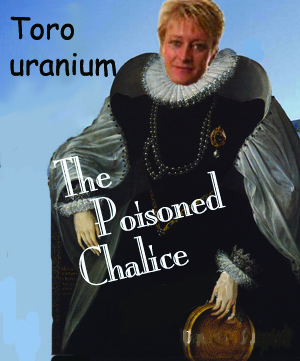
Women call shots at U-miner Nick Butterly Canberra, The West Australian April 3, 2013,
Dr Guthrie is managing director of Toro and Dr Smyth is its non-executive chairman.
Dr Guthrie acknowledged it was unusual for a miner to have both a female chief executive and a chairman…..
Dr Smyth said the fact a mining company headed by two women was succeeding showed how the resources industry was changing and stereotypes were being broken down. http://au.news.yahoo.com/thewest/a/-/wa/16515070/women-call-shots-at-u-miner/
Christina’s comment – “Oh yeah! – more like the stereotype of giving the impossible jobs to women!”
Tony Abbott would abolish the Climate Commission, sack Professor Tim Flannery
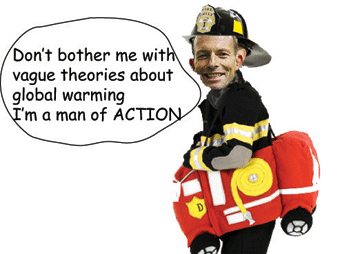 A Climate Commission report released on Wednesday examined links between Australia’s extreme weather and human-induced climate change. It found natural events were being influenced by climate change, because greenhouse gases are accumulating and trapping extra energy in the Earth’s atmosphere and oceans.
”When the carbon tax goes, all of those bureaucracies will go and I suspect we might find that the particular position you refer to goes with them,” Mr Abbott told Macquarie Radio on Wednesday. Continue reading
Australia now in a state of permanent climate change, say scientists
 Top scientists agree climate has changed for good The nation’s top climate scientists and science bodies have for the first time endorsed a major report that says Australia’s climate has shifted permanently in some cases.
The peer-reviewed assessment notes that there is “strong consensus” around this central finding, and in some cases the weather has changed for good.http://www.abc.net.au/news/2013-04-03/scientist-endorse-report-that-says-climate-has-shifted/4606372
(Link provided to the Climate Commission’s latest report: The Critical Decade: Extreme Weather)
Solar energy plant for Broken Hill approved by New South Wales govt
$200m Broken Hill solar plant approved ABC News By Eugene Boisvert Apr 2, 2013 A $200 million solar power station for the far west has been recommended for approval by the NSW Government.
Electricity company AGL is planning to build the plant at Rob Day Station south-west of Broken Hill.AGL has indicated there will be 150 jobs in construction and four ongoing positions once the solar power plant is operational at the end of 2015.
The company has agreed to environmental conditions the state has imposed in approving the solar power station….. AGL is also planning to build a wind farm near Silverton. It has not yet been approved for construction.
Both have been named major projects by the NSW Government. http://www.abc.net.au/news/2013-04-02/24200m-solar-plant-approved-by-state-government/4604438
Fully renewable energy is a practical option for Australia
Switch to fully renewable energy within reach: report, SMH, 3 April 13, 2013 – Peter Hannam Carbon economy editor Australia’s main electricity market could source all of its electricity from renewable energy with the help of a carbon price of as low as $50 a tonne, according to research at the University of NSW.
The researchers found currently available renewable energy technologies such as wind and concentrated solar thermal power could displace all fossil-fuelled power plants in the National Electricity Market, according to a peer-reviewed paper published in the international Energy Policy journal.
It would cost us a bit but it would be quite affordable Continue reading
1 This month
17 October, Free Public Talk on Nuclear Issues in South Australia
David Noonan will speak on public interest concerns over the new Roxby Downs Indenture Act 2026 on BHP copper-uranium mining and ore processing in SA, and on how AUKUS may face SA with a High-Level nuclear waste agenda.
Dr Jim Green will discuss international developments in the field of nuclear power including ‘small modular reactors’ and Generation 4 ‘advanced’ nuclear reactor concepts.


Help Aunty Sue Protect Her Land and Sacred Sites From Destructive Rocket Testing.
.

Australians deserve the truth
about
AUKUS – https://aukuspublicinquiry.com/

PETITION – To: Prime Minister Anthony Albanese and the Australian Labor Government

of the week – Australians for War Powers Reform (AWPR)
To see nuclear-related stories in greater depth and intensity

