The imminent decline of Australia’s coal export industry
CLP Holdings, the Hong Kong based company that is one of the largest power companies in Asia, said it wouldn’t invest any more money in coal-fired generation in India following the disastrous results of its latest 1,200MW investment…… It will focus entirely, it says, on renewables such as wind and solar from now on in India.
 Fossil fuels put on notice – the party is about to end REneweconomy, By Giles Parkinson 4 March 2013 The Australian and the global fossil fuel industry have been given stark warnings by two heavyweights of the international finance sector that their future will not just be constrained by political decisions to limit emissions, but by the lack of, or the high cost, of finance.
The first warning comes from Deutsche Bank, which says that China’s use of thermal coal is likely to peak within a few years, and by 2017 it could become a net exporter of thermal coal rather than a large importer. This, says Deutsche Bank, is likely to have a significant impact on coal prices.
The implications for the Australian coal sector, and its massive expansion plans in ports, mines and rail infrastructure in Queensland and NSW – led by the likes of Gina Rinehart and Clive Palmer – is that the long term price of thermal coal will not be sufficient to make these investments profitable. They could, in fact, become the acts of the greatest futility if they go ahead.
The second warning comes from leading credit ratings agency Standard & Poor’s, which in a report released on Monday predicts credit downgrades and negative outlooks in the oil sector because of the potential carbon constraints driven by global climate change policies. Continue reading
A warning that electromagnetic radiation, also, may be a cancer causer,
The World Health Organisation’s International Agency for Research on Cancer has classified radiofrequency electromagnetic fields as “possibly carcinogenic to humans”.
Parents urged to limit children’s use of mobiles, cordless phone under new health warningshttp://www.adelaidenow.com.au/technology/parents-urged-to-limit-childrens-use-of-mobiles-cordless-phone-under-new-health-warnings/story-fn7bfu22-1226589473040 Natasha Bita, National Social Editor March 03, 2013 PARENTS should limit kids’ use of mobile and cordless phones, Australia’s radiation watchdog recommends in new health advice.
The Federal Government’s Australian Radiation Protection and Nuclear Safety Agency (ARPANSA) also suggests that baby monitors be kept a metre away from cots, to minimise any electromagnetic emissions.
“Due to the lack of scientific evidence on mobile and cordless phone use by children, ARPANSA recommends that parents encourage their children to limit their exposure,” the agency states in its first “fact sheet” for consumers to reduce exposure from wireless devices including mobile phones.Doctors yesterday agreed with the regulator’s advice, in light of children’s fixation with tablets and smartphones.
Nearly one in four of Australia’s nine-year-olds and at least 75 per cent of high school students own a mobile phone, the latest Australian Bureau of Statistics data shows.
Australian Medical Association president Steve Hambleton said that while the health risks were low, it was best that children did not hold mobile phones directly to their ears.
“With children’s growing brains, you do want to reduce exposure,” he said.”Even putting your thumb between your ear and the phone can reduce radiation.” Continue reading
Solar air conditioning is the answer for Australians affected by extreme hot weather
 Grandparents Carking It In The Heat? Install Renewable Energy!, Clean Technica March 1, 2013 Ronald Brakels
World temperatures are rising, resulting in increasing mortality from heat stress. Or to put it another way, more people are dropping dead because it’s too damn hot. Unfortunately this is nothing new in Australia. Dropping dead from damn hotness has always been popular in these parts. Here in South Australia about 75 people currently die from it each year.
Other people building wind turbines or installing solar on their roofs can push down electricity prices for everyone and help prevent old people from dying when it’s too damn hot, but an excellent way to keep down electricity prices for the elderly is to put solar panels on the roofs of any old people whom you’d like to see continue to shuffle around on this mortal coil.
Rooftop solar is especially good for powering air conditioners as it produces the most electricity on hot, cloudless, summer days. It is particularly good for air conditioning when it faces west, or partially west, as then it can produce plenty of power all through the afternoon. It will produce less electricity when it’s cloudy, but it’s not so hot when it’s cloudy, so that’s not a real problem. And sure, it can still be hot after the sun goes down, but that’s not such a big deal if the house is already cool. No one is likely to die from it being too damn hot if they turn off their air conditioner at sunset.
For most Australians the feed-in tariff for new solar is now about 8 cents a kilowatt-hour. This means it will cost a person with a couple of kilowatts or more of rooftop solar perhaps 18 cents an hour to run a room air conditioner in a heat wave. Considering that ice-cream cones can cost $7.50 here, that’s a pretty good deal and only the most price sensitive of Australians would be too cheap to turn on the air conditioner at that cost.
Marcia Langton’s pro mining lectures raise questions about corporate funding of university lecturers
 Langton failed to disclose mining company funding The Age, Gina McColl 2 March 13, LEADING environmentalists have criticised the ABC and Professor Marcia Langton after revelations her recent ABC Boyer Lectures, in which she praised the mining industry’s role in the emergence of an Aboriginal middle class and delivered a broadside against the green movement, drew on research partially funded by big mining companies.
Santos contributed $45,000, Woodside $30,000, and the federal government’s Indigenous Affairs Department $300,000 to a four-year research project led by Professor Langton into economic empowerment in indigenous communities.
Rio Tinto contributed an undisclosed sum to the $480,000 project, while Marnda Mia, a company that represents local indigenous communities in deals with Rio, offered non-cash support.
Scientist and former Australian of the year Tim Flannery, whom Professor Langton accused in one lecture of racism, said the lectures ”take on a different light” since the big resource companies’ contribution was highlighted by website Crikey. Professor Flannery said the views expressed were consistent with those of the mining industry in their criticism of environmentalists and advocacy of indigenous development and mining expansion going hand in hand.
”This goes to the heart of the credibility of the Boyer Lecture series,” he said. ”There should be requirements for disclosure of this sort of thing and they should be abided by.”
While detailed on the University of Melbourne website, where Professor Langton is foundation chair of Australian indigenous studies, the industry funding was not disclosed to listeners when the lectures were delivered in the ABC’s Brisbane studios late last year, broadcast on Radio National or extracted in Fairfax Media……. an academic with experience researching the Western Australian mining regions said the commercialisation of research did raise questions about independence.
Dr Sarah Holcombe, at the Australian National University, said access to staff and mine sites are controlled by the companies, and that accommodation outside of their mining camps is often non-existent.
Australia’s shame – the wrong done to Maralinga’s soldiers and Aboriginal communities
 That 8000 of our men could be placed so close to ground zero seems impossible to believe. That we as a nation have refused to compensate these men is bad enough; that we won’t even grant them full access to health benefits is just plain staggering.
You will not be surprised to learn that cancer rates are 23 per cent higher in these men than in the rest of the population. Their children have higher rates of cancer as well. Deformities, miscarriages and the like are too easy to find among their families.
These men were put in harm’s way by the Australian government
We must right the wrong of Maralinga BY:GRAHAM RICHARDSON The Australian March 01, 2013 THERE was never much chance that Bob Menzies would knock back a request from the government of Britain. The future Lord Warden of the Cinque Ports was an Anglophile of the highest order.
In the early 1950s, when the old country requested that a stretch of Australia should be set aside to allow the Brits to explode nuclear bombs, Menzies was only too eager to please. A few bombs were tested on Montebello Island off Western Australia, but the area was pretty small and when more territory was sought, Maralinga was chosen.
It must have been an easy choice at the time. A long way from anywhere, no population to speak of apart from a few Aborigines who could easily be moved on, inhospitable desert unfit for living creatures apart from lizards, snakes and witchetty grubs – no doubt his view was that this would be uncontroversial, and he was right.
As Australia recovered from the aftermath of World War II there were bigger things to worry about than Maralinga. In fact, Menzies thought so little of all this that he acceded to the request without even putting it to his cabinet. Continue reading
Fall in the value of Queensland’s uranium resources – a non viable industry
 Five sizing up uranium
John McCarthy
Courier Mail 1/3/13
QUEENSLAND’S uranium resource has been estimated at 40,000 tonnes, with five companies expected to vie to be the first to develop it.
AREVA Resources Australia, Paladin Energy and its associate Summit Resources, Laramide Resources and Mega Uranium are in the mix, according to the Australian Uranium Association.
But the resource estimate has led to environmentalists claiming the industry is nowhere near as viable as the Government and the industry had previously claimed.
The Australian Conservation Foundation said that estimate would be worth only $3.36 billion on current spot prices, 75 per cent lower than the industry’s previous estimate of $18 billion.
‘‘In the case of Queensland, claims made about in-situ resources need to factor in the technically difficult – and therefore uncertain and potentially expensive – nature of a number of these deposits,’’ the ACF’s Dave Sweeney said.
‘‘Obviously there is a vast chasm between the two figures of $18 billion figure and $3.36 billion – the October 2012 figure is 5.4 times higher than the February 2013 figure.
‘‘Put another way, the value of Queensland’s uranium resource has fallen by $14.64 billion in the short space of four months.
‘‘If this pattern continues, the value of Queensland’s uranium resource will fall to zero in March 2013.’’
However, only about 10 per cent of the uranium market is on the spot price with the rest negotiated in long-term contracts that differ widely from the current market price.
The ACF is pushing the debate towards a comparison of the industry’s viability against its potential impact and have made a submission to the State Government’s implementation committee headed by Paul Bell which will report in March…
Christine Milne explodes Greg Hunt’s Liberal Coalition sham climate change action plan
 Treasury has said that: “Direct Action measures alone cannot do the job without imposing significant economic and budget costs…Moreover, many of the direct action measures cannot be scaled up to achieve significant levels of abatement, and for those that can be scaled up, the cost per tonne of abatement would rise rapidly.
The Coalition cannot hide from the fact that Direct Action is a slogan, not a policy. It’s time that they were called out on it.”
 Why Greg Hunt’s Direct Action policy is a sham http://reneweconomy.com.au/2013/why-greg-hunts-direct-action-policy-is-a-sham-77552 By Christine Milne on 28 February 2013
“Let’s consider Mr Hunt’s Direct Action Plan. It’s a sham.
“This week the Coalition has been all over the shop. From “we will compensate businesses” from Joe Hockey and “we will not compensate businesses” from Tony Abbott and “we will impose penalties” from Abbott and “we don’t expect to” from Mr Hunt.
The world is on a trajectory of 4 degrees of warming. The fact that Direct Action cannot be scaled up, is only intended to reduce emissions by 5% and cannot effectively achieve more is its overwhelming and fundamental failure. Who in their right mind thinks that such a weak target in any way reflects the science?
At a time when we have IMF boss Christine Lagarde saying, “Unless we take action on climate change future generations will be roasted, toasted fried and grilled” to try to suggest that an Australian target of just -5% by 2020 is acceptable is a lie. As the rest of the world move towards a legally binding global treaty and the second commitment period of the Kyoto Protocol, such a lax target will become untenable and indefensible.

To the detail of the plan, it is in essence a massive ‘competitive grant programme’ which seeks to reduce emissions by companies putting in ‘tenders’ for actions that reduce greenhouse gas emissions and the government then paying those companies which submit the lowest bids (per tonne of abatement).
There are numerous fundamental problems, many of which, while widely understood are rarely discussed. For example:
1) The Coalition expects more than 60% of the abatement to come from soil carbon – but the science to back this up is not yet solid, so this abatement would not be recognised in international treaties. That’s a showstopper. Continue reading
Australia’s Liberal Coalition not likely to repeal carbon tax – “Abbott proof fence” around it
 Libs carbon tax repeal ‘unlikely’
http://au.news.yahoo.com/thewest/a/-/wa/16259527/libs-carbon-tax-repeal-unlikely/
Andrew Probyn Federal Political Editor, The West Australian February
28, 2013, International and domestic investors in Australia are being
told there is only a one-in-three chance that Opposition Leader Tony
Abbott will be able to fulfil his “pledge in blood” to dump the carbon
tax.
In a briefing note sent to clients yesterday, Bloomberg Finance said
the Government had built a secure “Abbott-proof fence” around its
carbon tax legislation. Continue reading
Native title laws should shift the onus of proof away from Aboriginal claimants
 PM missed native title chance: Keating, BY:BRIDGET CORMACK The Australian February 25, 2013
 PAUL Keating says the Gillard government has lost an opportunity to make a vital amendment to Native Title laws that would shift the onus of proof away from indigenous claimants.
The former prime minister, who ushered in Australia’s first Native Title laws two decades ago, said the government should have seized the chance to change the laws to make it easier for Aborigines to win rights to their traditional lands. Mr Keating gave a rousing speech yesterday on North Stradbroke Island, 30km south east from Brisbane, where he urged the Quandamooka people to make the most of their hard won land rights, recognised after 16 years of negotiations in an agreement endorsed by the Federal Court in 2011.
While theirs was a victory, he said, the Native Title process was still “far too slow” and the law desperately needed to be given the long-mooted amendment so Aboriginal claimants no longer have to prove a continuous association with their land. “I think the current government has lost the opportunity now to make the amendment,” Mr Keating said. “It would pass the Senate with the Greens and the Independents.”
Mr Keating said the test for proving continuity relied on “written traditions” and was at odds with the “oral traditions” of Aboriginal people.
On the 20th anniversary of the Mabo decision last year the government proposed landmark changes to Native Title laws, including a definition for “good faith” negotiations and allowing historical extinguishment of native title in national parks to be disregarded.
The bill did not reverse the onus of proof. Continue reading
A Sustainable Energy Future for Western Australia
 Creating a sustainable energy future for Western Australia http://www.infolink.com.au/c/Sustainable-Energy-Association-of-Australia/Creating-a-sustainable-energy-future-for-Western-Australia-n2501656 1 March 2013, The Sustainable Energy Association of Australia promotes the development and adoption of renewable energy, energy efficiency and sustainable energy technologies and services.
SEA released its policy position recently, ahead of the Western Australian State Election on 09 March 2013.
The policy document ‘Creating a sustainable energy future for Western Australia’ draws on the substantive views of SEA members who were surveyed on what they would like to see from the next State Government.
Five key recommendations: Continue reading
Australian Uranium Association knows that uranium mining for Queensland is not a goer
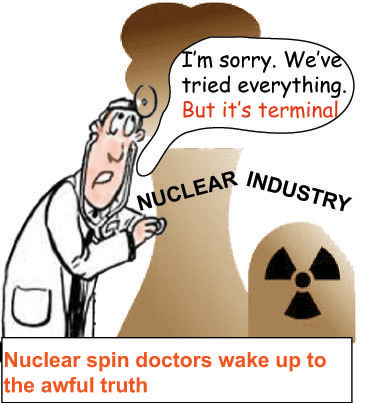 The Australian Uranium Association’s website recently published an article “Uranium Mining – an opportunity for Queensland” talking up, as one would expect, the potential for uranium mining n Queensland.
And yet, and yet –
included in this article –
“The uranium industry in Queensland will likely be a moderately sized industry developed over a lengthy period, with the potential to make a valuable contribution to the diversity and prospects of the Queensland economy and to employment, including regional employment.
Queensland’s uranium endowment is about 2% of Australia’s endowment. Queensland contains upwards of 40,000 tonnes of reasonably assured and inferred resources.”
Jim Green of Friends of the Earth, points out – That amount of uranium would fetch less than $4 billion at the current rate for Oz U sales (around $87,000 / t U3O8), and contrasts sharply with the AUA’s claim last year that the known uranium resource in Queensland, using projected prices and exchange rates, is valued at around $18 billion. The $4 billion figure is of little relevance since the uranium price is too low for any mines to be viable in Queensland
As Australians reduce electricity use, Energy Australia gears up to fight renewable energy?
EnergyAustralia says one key focus of the coming year will be the managing the implications of reducing growth in energy demand,
Its other key focus, it says, will be on “policy advocacy”
 Australian energy utilities buffeted by winds of change, REneweconomy By Giles Parkinson 26 February 2013 The winds of change in the energy industry has struck at the heart of the earnings of another of the country’s big three utilities, EnergyAustralia, which has reported a 42 per cent slump in profits as a result of the changing dynamics in the sector – lower wholesale prices, greater uptake of solar, and other decentralised generation, and lower consumption from energy efficiency.
It may seem ironic that in a year when consumer electricity prices jumped so sharply that Australia’s biggest energy utilities should suffer such sharp falls in profit. But the other big trend to weigh on EnergyAustralia’s earnings was a cost-conscious public, who are either reducing consumption or producing it themselves, through rooftop solar. Continue reading
Greens MP Kate Faehrmann invited, but sidelined at Kemps Creek radioactive waste meeting, while ALP dominated
 Despite being invited to address the meeting, NSW Greens MLC Cate Faehrmann was told at the last minute that she would not be seated on the stage and would only get to speak at the start of discussion time.
She raised the proposal of shifting the waste to the Lucas Heights nuclear reactor site, and said that if the federal Labor government wanted to, they could step in now to make this a reality through an amendment to national laws.Despite a number of people in the crowd pressing the speakers to address this idea, all preferred to side step it.
Labor MPs hijack local outrage over uranium dump plan http://www.greenleft.org.au/node/53403, February 22, 2013 By Fred Fuentes Angry residents from Kemps Creek and surrounding neighbourhoods packed the local sports and bowling club auditorium on February 18 to protest against the state government’s plan to dump radioactive waste in the area.
The NSW Liberal government is proposing to shift 5800 tonnes of soil from an area in Hunters Hill, where a uranium ore processing plant once stood, to the Kemps Creek SITA dump site.
Cancer clusters have been detected in Hunters Hill, which have been linked to the contamination left behind at the former plant site.
The amount of community concern against the project was shown by the more than 3000 submissions against the proposal over the past two months.
The meeting was addressed by three federal politicians and a councillor from Penrith, all from the ALP. Continue reading
How the Australian government betrayed Servicemen affected by Pacific and Maralinga nuclear tests
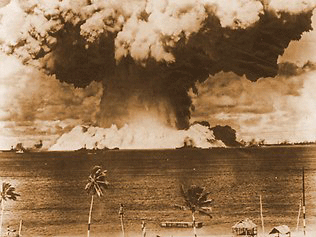
With the enthusiastic connivance of the Australian Government (more precisely, prime minister Robert Menzies, who bypassed his cabinet), the British detonated about a dozen nukes in our backyard. More than 8000 servicemen were involved in the tests and the measures for their safety were perfunctory at best and criminal at worst.
‘Death ash’ rains on betrayed men, Courier Mail Terry Sweetman , The Sunday Mail (Qld) February 24, 2013
ONE of the great ironies of history is that the Japanese fishing boat that took 23 men into the fiery breath of America’s first hydrogen bomb was called the Lucky Dragon No 5.
That was on March 1, 1954, which is ancient history to most Australians, but there is a tragic echo right here and right now.
Lucky Dragon was fishing off Bikini Atoll, outside the declared danger zone, when the Castle Bravo thermonuclear device was detonated.
Oops. The blast was about twice as powerful as the boffins had calculated and the Lucky Dragon was showered with radioactive dust, which the Japanese poetically called death ash.
Soon the fishermen began to suffer nausea, pain and skin inflammation and, in September, radio operator Kuboyama Aikichi died.
It was a shocking incident but more shocking was the initial cover-up and official disinformation. Continue reading
The uranium market is a dead cat, even in China, for the foreseeable future
 It’s now clear that the “nuclear renaissance” is dead in the US.
The situation in Europe, and of course in Japan, is even worse. Again, and despite the absence of cheap gas, the economics simply don’t stack up
[China’s] plans for renewables have been steadily upgraded, China’s nuclear plans were scaled back substantially after Fukushima…. the establishment of a track record of safe construction and operation in China will take at least a decade, which means that any global renaissance won’t start delivering benefits until after 2030.
the current decline looks set to continue for a long time. Unless new mines are profitable at prices of $40/tonne or less, they will probably be uneconomic.
Uranium exports: bonanza or bust? http://johnquiggin.com/2013/02/23/uranium-exports-bonanza-or-bust/ February 23rd, 2013 John Quiggin Note: The usual sitewide ban on discussions of nuclear power is lifted, for this post only
Queensland’s ban on uranium mining was lifted last year, and a committee is due to report soon on the conditions under which mining might be restarted. As recently as a year ago, the prospects for uranium exports looked bright, despite the Fukushima disaster. In March last year, the Bureau of Resource and Energy Economics predicted “prices close to $100 a pound between now and 2015, rising to $124 in 2016 and $141.6 in 2017, in constant 2011-12 Australian dollars.”
In reality, however, the price has fallen to $US43/pound in early 2013 and looks set to decline further. Looking ahead, the future of nuclear power looks bleaker than at any time since the industry began. Continue reading
1 This month.
20 September –National Day of Action in Melbourne on the International Day of Peace



Help Aunty Sue Protect Her Land and Sacred Sites From Destructive Rocket Testing.
.

Australians deserve the truth
about
AUKUS – https://aukuspublicinquiry.com/


PETITION – To: Prime Minister Anthony Albanese and the Australian Labor Government

of the week – Australians for War Powers Reform (AWPR)
To see nuclear-related stories in greater depth and intensity
 Antinuclear