Ancient Aboriginal art treasures threatened by uranium mining
After years of drilling, Canadian-based mining company Cameco has reported the find in the Wellington Range, where the thousands of Aboriginal artworks adorning cliffs and caves include a painting of the extinct dog-like creature, the thylacine, made in a style that is at least 15,000 years old.
“The importance of this art site is that it’s like a library,” Ronald Lamilami, a traditional Aboriginal landowner in western Arnhem Land and a custodian for the art, told The Global Mail, which on Friday published a detailed feature and map of the rock-art sites at risk nationwide. Lamilami said he fears if mining goes ahead, the works of his ancestors will be damaged…….
The rainbow serpent, fish, kangaroos and other creatures are painted in traditional “X-ray” style and the world’s only known indigenous rock-art stencils depicting whole birds are silhouetted on a cave wall, ……http://www.guardian.co.uk/environment/2013/mar/08/australian-uranium-discovery-art
Toro Energy’s Wiluna uranium project is looking very vulnerable and unceratin
 WA Should Leave Its Uranium In The GroundNew Matilda By Dave Sweeney, 6 March 13, “…….Toro Energy — a small and unproven uranium company — is seeking to open WA’s first uranium mine near Wiluna in the East Murchison region, around 600 kilometres north of Kalgoorlie. Toro has no proven corporate mining experience, and their costly and controversial project and is facing strong community, political and civil society opposition.
Toro Energy’s major shareholder, OZ Minerals, has described Toro as “a tiny company” and a “non-core asset” and Toro is facing severe financial constraints. The proposed Wiluna uranium mine is on the Lake Way arid zone lake system which includes mulga and acacia shrub land and sand dunes and spinifex plains. It is also home to a number of unique and endemic groundwater dependent plants and animals.
Despite attracting over 2000 formal public objections, state government support has seen the mine fast tracked through the state environmental approval process.
Even so, Toro’s hopes to have the project approved ahead of the state election have now stalled. Federal environment Minister Tony Burke has extended his decision-making time and requested further information on how the mine would impact on precious regional water resources and manage its radioactive mine wastes.
Given the clear policy difference between the two major political parties on whether the uranium trade has any place in the West, this lack of full and final state and federal approval means the Toro project is even more vulnerable and uncertain…… Continue reading
Good riddance to Ted Baillieu, Victoria’s anti renewable energy Premier
The anti-wind campaign was viewed very much as “Ted’s show”, to the point where other government ministers would pass off their responsibility: It’s not my call, it’s Ted’s”
New Premier Dennis Napthine knows the wind industry and many Victorian wind jobs and has a track record of standing up for local manufacturing in the wind industry, and seeking to protect it from foreign imports.
“I think we can expect a more rational approach to wind industry, and more broadly renewable energy policy, whereas Ted Baillieu appeared to have a personal vendetta against renewable energy,” Wakeham said. Environment Victoria has a scorecard on Baillieu’s record on the environment and clean energy.
Why Baillieu’s exit could be good news for wind energy, REneweconomy By Giles Parkinson 7 March 2013 It is deeply 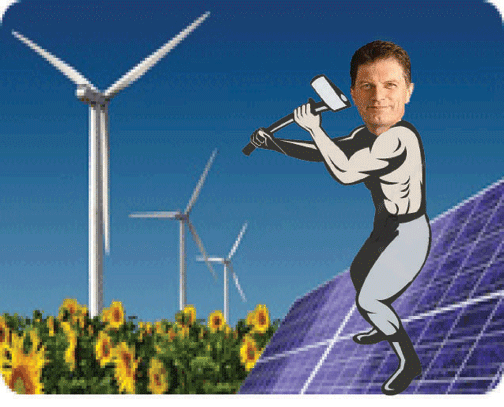 ironic that on the very day that Ted Baillieu made his shock decision to resign as Premier of Victoria, the latest economic data showed the state had officially entered a recession: the man who had turned his back on the burgeoning clean energy industry had left the state with a shrinking economy.
It’s a moot point whether embracing the wind industry would have kept Victoria out of recession – although Friends of the Earth estimates Baillieu’s anti-wind decisions cost around $887 million in lost or stalled investment, and the 650 direct jobs and a further 1,400 indirect jobs lost in the process would have been useful for a state suffering the highest unemployment rate in the country.
But Baillieu’s opposition to wind is a parable for our times. Economies are changing, whether politicians like it or not, or believe in climate change or not. The clean energy transition is a global phenomenon that has been embraced by nearly every company not dependent on fossil fuels, and is recognised as such by the leaders of the major economies – US, China, Japan and Germany.
Ideological opposition and the bestowing of favours to some rich landowners may stop a few turbines, but it is nothing more than just pissing into the wind. Baillieu was so entrenched in the past he even favoured digging up half the state and exporting the brown coal reserves. As Deutsche Bank pointed out this week, economies like China will likely soon not want our black coal, let alone the more polluting brown mud found in Victoria. Continue reading
Global warming is changing New South Wales south east region
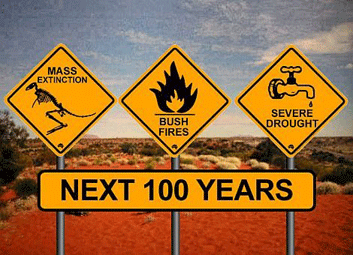 Region’s weather changing http://www.abc.net.au/news/2013-03-05/region27s-weather-changing/4554482 Mar 5, 2013 A climate change expert says the New South Wales south east is becoming hotter and drier due to global warming. Climate Change Commissioner, Professor Lesley Hughes, will be in Bega next week to conduct a question and answer session on the effects of changing weather patterns.
Prof. Hughes says the region is in the midst of a long-term dry period that saw a 13-year drought and bushfires. She says there has been a one degree temperature increase in the last century with the alpine areas showing the greatest effect.
“In the terrestrial environment on land the alpine environment is probably is the most vulnerable eco-system to climate change,” Prof. Hughes said. “Our mountains in Australia are fairly short by world standards. Plants and animals can move up hill to stay in cooler climates but because our mountains are very short they don’t have very far to go.”
Prof. Hughes says the rise in temperature is being reflected among fauna and flora, and in ocean changes. “Over the last century for example in Australia we have had just a little bit under a degree of mean annual temperature rise but we are seeing plants and animals all over the place both in Australia and the rest of the world actually responding to that.
“In our marine life we are seeing lots of species moving further to the south.”
The fluoride issue and why it is important
 The anti nuclear movement is a very broad collection of scientists, doctors, and ordinary concerned citizens. The main focus of concern for many of us is the scientifically proven fact that ionising radiation damages cells, bringing about genetic mutations, embryonic deformities and cancer
I really deplore the way in which anti fluoride campaigners often want to connect up the two campaigns.
Fluoridation of water is the most proven public health measure, effective in protecting teeth, and without side effects. In areas where fluoride is naturally present in high proportions, people have strong teeth, but they may have a mottled appearance, and that’s all.
Yet in Australia, especially in some rural areas in Victoria, the anti fluoride mob have for decades been on the bandwagon – claiming all sorts of preposterous ill effects from fluoride. This campaign was rampant back in the 1970s , led by right wing extremist Eric Butler, with his “League of Rights”
The anti nuclear movement has a strong scientific basis. and no connection with right wing conspiracy groups.
Fluoride cuts tooth decay for all age groups, University of Adelaide study finds http://www.adelaidenow.com.au/news/south-australia/fluoride-cuts-tooth-decay-for-all-age-groups-university-of-adelaide-study-finds/story-e6frea83-1226590762881HealthReporter Jordanna Schriever
adelaidenow March 05, 2013
- Tory Shepherd: When anti-scientists attack fluoride http://www.adelaidenow.com.au/news/opinion/tory-shepherd-when-anti-scientists-go-on-the-attack/story-fn34ojzj-1226590190515
- Something toxic in MP Ann Bressington’s fluoride claim FLUORIDE cuts tooth decay in adults of all ages, a University of Adelaide-led international study has found. http://www.adelaidenow.com.au/news/opinion/something-toxic-in-mp-ann-bressingtons-fluoride-claim/story-fn34ojzj-1226587983885
- The world-first population-level study has uncovered the strongest evidence for adding fluoride to water.Director of the university’s Australian Research Centre for Population Oral Health, Professor Kaye Roberts-Thomson, said the results added to already established evidence that fluoride in drinking water benefits the dental health of children.
- “By looking right across the Australian population, we now have good evidence that fluoride in drinking water is effective in preventing tooth decay in adults,” Prof Roberts-Thomson said.The study looked at data from a random sample of 3800 Australians aged 15 and over.”We’ve known for some time that fluoridated drinking water can prevent tooth decay in children, but this is the first time that research has conclusively shown this in an adult population.”
- The researchers found adults with more than a 75 per cent lifetime exposure to water fluoridation have up to a 30 per cent reduction in tooth decay compared with those with less than 25 per cent lifetime exposure.”Those people who have had longer exposure to fluoride in water obviously will have the greater benefit. However, and this is an important aspect of the study, even those people who were born before water fluoridation existed have since received some benefit in their lifetimes,” Prof Roberts-Thomson said.
Hunter Region in New South Wales ready to change towards renewable energy
 The Hunter is poised for energy innovation , Newcastle Herald, By Dr
Alan Broadfoot March 5, 2013 “….The Hunter generates over 60per
cent of the state’s electricity and is the largest regional economy in
Australia, with outputs last year totalling almost $37billion.
The region’s willingness for change is part of a growing push to
diversify and expand on our strengths.
Recent developments with hybrid power generation and renewable energy
show this transformative approach in the region. Continue reading
Robin Chapple and Kado Muir for Western Australian Senate!
 A Vote for Robin Chapple is a Vote for Kado Muir http://www.kadomuir.com/post/44538974329/a-vote-for-robin-chapple-is-a-vote-for-kado-muir#disqus_thread In this State election I am running as a number two candidate to Robin Chapple for the vast upper house electorate of Mining and Pastoral. The Mining and Pastoral region encompasses an area of 2,280,730 km2, stretching from the sea cliffs of the Great Australian Bight to the monsoon forests of the Kimberley. The region contains five electoral districts – Eyre, Kalgoorlie , Kimberley, Northwest and Pilbara.Robin has been representing the Greens in the Upper House for the last four years; during that time he has been a strong voice for Aboriginal Heritage and Nuclear Free campaigns. In fact it is largely due to Robin that Aboriginal Heritage Act has not been changed to make it easier for developers to destroy Aboriginal Sites!
Robin commented on the processes around Lake Disappointment in his AHA review document, Robin also visited Lake Disappointment via the canning stock route with Glen Cooke, Curtis Taylor and the Martu rangers. Robin also visited the Yantakutji waterhole – where Cameco propose to take water for Kintyre and asked personally 69 sets of questions in the Legislative Council of parliament on how the government was failing to protect Aboriginal Heritage during 2009-2012 Looking after country is important for many Aboriginal people in our Mining and Pastoral electorate. I am running to support Robin in this election campaign, and if enough people *Vote 1 for Robin Chapple* I might also get enough votes to be elected along with him. Robin must be doing something right because he’s been preferenced last by all the major political parties on the How to Vote card. We both need everyone in our electorate to Vote 1 for the Greens, Robin Chapple and Kado Muir.
Wind farms benefiting rural areas
 Wind farms beneficial: Clean Energy Council http://www.abc.net.au/rural/news/content/201303/s3702991.htm According to recent research conducted by the Clean Energy Council, wind farming has reportedly generated more than $4 billion in investment in Australia since its introduction.
Much of this investment has been in rural and regional towns. Continue reading
Western Australia- Aboriginal and Community use radio to inform about uranium mining
 Active Radio – not Radioactive http://nuclearfree.wordpress.com/2013/02/22/active-radio-not-radioactive/ Aboriginal and comunity representatives have today launched a state wide radio campaign highlighting the risks posed by uranium mining in WA. www.votenuclearfreewa.org
The campaign features a series of advertisements to be played on radio stations from the Kimberley to Kalgoorlie ahead of the March 9 state election that describe planned uranium mining as ‘today’s asbestos’ and condemn the use of Royalty for Regions subsidies to private uranium projects. The ads have been produced by the West Australian Nuclear Free Alliance, a network of Aboriginal, environment and public health representatives and organisations concerned about the long lasting and negative impacts of uranium mining on communities and country.
The ads are set to run on commercial, community and Indigenous radio stations across the Kimberley’s, Goldfield’s and the Pilbara.
“WA has an abundance of clean energy resources and resourceful people, our future is renewable not radioactive,” said WANFA spokesperson Mia Pepper.
“The Liberal and National Party’s plans for uranium mining have been flying under the radar so we have decided to put the issue on the airwaves.” Continue reading
Global warming already having its impact on Australia
It is highly likely that extreme hot weather will become more frequent and severe in Australia over the coming decades. Australia’s angry summer shows that climate change is already adversely affecting Australians.
Angry summer shaped by a shifting climate, http://theconversation.edu.au/angry-summer-shaped-by-a-shifting-climate-12580 The Conversation, Will Steffen, Australian Climate Commissioner, Executive Director of the ANU Climate Change Institute at Australian National University March 4 13 The hottest summer on record. The hottest month on record. The hottest day ever recorded for the whole of Australia. Heatwaves, bushfires, record rainfall and floods – extreme events across the land. This was the angry summer.
The Climate Commission’s latest report, The Angry Summer, assesses the events of this summer and the influence of climate change on them. Continue reading
Tony Abbott out to destroy Australia’s progress in climate change action
 Australian climate outlook remains bleak with Tony Abbott out for revenge, Guardian UK by Alexander White 25 February 13 Australian elections on 14 September threaten a rollback of years of climate change progress. The time to act is now In Australia, decades of hard-fought conservation gains are at risk of being wiped out after 14 September. That’s when the incumbent Labor government faces oblivion at the federal election, at the hands of the conservative Liberal Party.
For environment groups and climate campaigners, things have never looked bleaker.
This is despite the introduction of a carbon price, billions of dollars for clean energy projects, a landmark extension of marine national parks, and recent news that carbon emissions from the world’s largest per- capita emitter have actually reduced.
Unfortunately, conservation and climate change have not been a national priority since the controversial introduction of the carbon price. In Australia, the Labor minority government, supported by the Greens , passed historic carbon-pricing legislation that charged polluters for their emissions.
At that time, the five or so largest environment groups, supported by the Australian Council of Trade Unions, ran a public awareness campaign – “Say Yes” – to raise support for the carbon price.
Since then, the conservative opposition, led by climate change denying Tony Abbott and supported by extreme elements in the Murdoch-owned press, has waged a relentless campaign against the carbon price.
The fear is that Abbott’s climate denialism, coupled with a desire to get even with groups who opposed him, will see environment groups targeted……The USA now has a revitalised climate movement. A new generation of activists, many of whom also campaigned alongside Obama 2012 organisers, continues their struggle to stop one of the most dangerous oil projects in the world.
In Australia, environment groups fearing the wrath of Tony Abbott, whose position on climate change matches the likes of Sarah Palin or Rick Santorum, must mobilise rather than remaining a small target.
The posture of this new breed of US climate activist is more assertive and aware of the great risks of doing nothing. And they have finally realised that to win, to have influence in the halls of power, you must have a willing, engaged constituency in the community – who are willing to take action….http://www.guardian.co.uk/environment/blog/2013/feb/25/australia-climate-elections-new-strategy?fb=native
THE AUSTRALIAN’s Graham Lloyd misled readers on the truth about global warming
it does not accurately represent Pachauri’s thoughts on the subject – namely that as discussed in this post, global surface temperatures have plateaued (though over the past decade, not 17 years), and that this in no way disproves global warming.
To hear what Pachauri actually thinks about global warming without first passing through The Australian’s filter, you can listen to interviews with him on Radio Australia and ABC News. Also see a similar debunking of this myth by The Australian Climate Commission.
 Did Murdoch’s The Australian Misrepresent IPCC Chair Pachauri on Global Warming? 25 February 2013 by dana1981 As we have discussed many times at Skeptical Science, although the warming of global surface air temperatures has slowed over the past decade due to a preponderance of La Niña events, the rate of heat accumulation on Earth has not slowed at all. In fact over the past 15 years, the planet has accumulated more heat than during the previous 15 years (Figure 1). That’s global warming.
Unfortunately many people (often even including climate scientists) mistakenly equate the warming of global surface air temperatures with global warming. That is simply inaccurate. Approximately 90% of global warming goes into heating the oceans.
So the reality is that global warming continues unabated. Despite this reality, an article by Graham Lloyd in The Australian (paywalled) claims that the chairman of the Intergovernmental Panel on Climate Change (IPCC), Rajendra Pachauri agreed that there has been a 17-year pause in global temperature rises. Unfortunately we don’t know exactly what Pachauri said on the subject, because Lloyd did not quote him directly (which is a red flag). Continue reading
Liberal candidate Angus Taylor, and noisy anti wind minority, are out of step with majority support for wind farms
 Angus Taylor, the Liberal candidate for the safe Liberal-held seat of Hume, which covers much of the district targeted by wind energy companies, including Mr Prell’s Crookwell property, has issued a policy paper challenging the renewable energy target, or RET
 Wind farm opponents in minority: proponent, Canberra Times, March 4, 2013John Thistleton
Grazier Charlie Prell says a noisy minority opposed to wind farms in the Canberra region does not represent more than 70 per cent of people in his shire who support them.
He chaired a meeting of 100 farmers, lawyers and earth-moving contractors at Yass last week with the aim of forming a landholders’ network to foster wind and solar farms. Continue reading
New solar panel safety regulations
New Solar Panel Fire Rating Regulations in Australia http://www.energymatters.com.au/index.php?main_page=news_article&article_id=3612 27 Feb 13 From July 16 this year, all makes and models of solar panels installed in Australia will need to have passed a new fire safety test. Continue reading
“Buyer Beware”: need for research in buying solar panels
From July 16 this year, all makes and models of solar panels installed in Australia will need to have passed a new fire safety test.
Energy Matters also offers a popular Solar Power Consumers Guide; a free 23 page electronic publication designed to help consumers select the right solar power system for their needs and avoid some of the potential pitfalls.
Consumer Affairs On Solar : ‘You Get What You Pay For’ http://www.energymatters.com.au/index.php?main_page=news_article&article_id=3620 4 March 13, Shoddy solar products are in the headlines again after a major solar company went into voluntary administration last week and news other companies are in the spotlight for issues relating to quality.
According to AdelaideNow, two “significant” companies with a presence in South Australia have been called into compulsory conciliation meetings after a number of complaints relating to workmanship and materials.
“People get what they pay for … people need to do their research,” said Consumer Affairs Commissioner Paul White, who noted some cases of relatively low-quality inverters and panels being installed. Continue reading
1 This month.
20 September –National Day of Action in Melbourne on the International Day of Peace



Help Aunty Sue Protect Her Land and Sacred Sites From Destructive Rocket Testing.
.

Australians deserve the truth
about
AUKUS – https://aukuspublicinquiry.com/
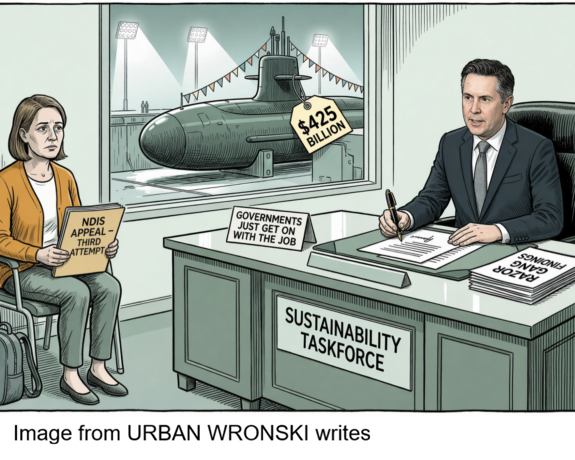

PETITION – To: Prime Minister Anthony Albanese and the Australian Labor Government

of the week – Australians for War Powers Reform (AWPR)
To see nuclear-related stories in greater depth and intensity
 Antinuclear