Murdoch press – THE AUSTRALIAN – caught out on climate change error
 The Australian corrects the record on climate change Crikey, CATHY ALEXANDER | JAN 17, 2013
The national broadsheet has issued a correction for a recent story which claimed rising sea levels were “not linked to warming”. Read what was in the story, and what was wrong with it, here.
The Australian has issued a rare correction on climate change, for a story which claimed rising sea levels were “not linked to warming”.
The story, which appeared under an “exclusive” tag on Tuesday and was written by environment editor Graham Lloyd, was based on a recent scientific paper in the Journal of Climate. Lloyd wrote that “the latest science on sea level rises has found no link to global warming”.
Crikey read the research paper, looked into Lloyd’s three articles on the subject, and highlighted inaccuracies in the way the research was presented(read Crikey’s stories here and here). A correction appeared in The Australiantoday, and the original story has been taken down….
The Australian has been criticised in the past for running stories which some perceive as misrepresenting the science on anthropogenic climate change, but it has rarely issued corrections on its climate change stories.http://www.crikey.com.au/2013/01/17/the-australian-corrects-the-record-on-climate-change/
Mining companies turn to solar power, to cut costs
perhaps the most important news from an Australian perspective has been the move by mining companies to adopt solar technologies to reduce their dependence on fossil fuels, particularly diesel, and to keep a lid on their soaring energy costs.
The development of off-grid solar projects, particularly with remote and mining communities, is expected to be a central theme of the newly established Australian Renewable Energy Agency
a “huge opportunity” in the replacement of expensive diesel, both in remote and off-grid areas, and the fringe-of-grid areas
 Miners embrace solar power – as a cost saving measure REneweconomy, By Giles Parkinson 18 January 2013 The New Year is barely more than two weeks old, and already solar is grabbing headlines: China has confirmed it expects to install 10GW of solar in 2013, a development that would take its total installed capacity close to 50GW by 2015, and well beyond the most optimistic forecasts of 100GW by 2020 if the growth rate continues to expand.
Elsewhere, the Middle East expects to intall 3GW of solar by 2015, the state of New York has announced a$1.5 billion extension to its solar program, France doubled its solar targets to 1GW, India is about to tender 1GW of projects, Warren Buffett has invested another $2.5 billion in solar projects, Italy and Spain have set new solar generation records, and Germany increased its solar production by 45 per cent after adding another 7.3GW of capacity. Continue reading
Australia’s potential for concentrated thermal solar power
 Around 40% of Australian renewable energy could be generated by wind farms but the real key to success would be the enormous empty landscape of the interior with the high levels of solar power it receives.
An example of suitable technology is the Gemasolar power station in Spain which is a 19.9MW plant expected to generate 110 GWh per year. The plant’s molten storage tank allows for independent electrical generation for up to 15 hours. Although solar power in Australia could be produced from solar PV arrays on buildings, most of the country’s solar power could come from concentrated solar power (CSP) plants similar to that in Spain.
A 100% renewable energy grid could create at least 80,000 jobs during construction and 45,000 in operation. 30,000 jobs would also be created in manufacturing assuming half the plant was made in Australia itself.
Australia could be self-sufficient in renewable energy within 10 years http://www.renewableenergymagazine.com/article/australia-could-be-selfsufficient-in-renewable-energy-20130117 Robin Whitlock, 17 January 2013 A new report published by the Energy Research Institute of the University of Melbourne finds that existing renewable energy could wean the country off fossil fuels
Australia is currently the world’s largest exporter of coal and also has one of the highest global greenhouse gas emissions rates per capita. The country has, until fairly recently, been particularly obstinate in its resistance to tackling climate change. The University of Melbourne report says that with the right political will Australia’s enormous renewable potential could be harnessed within a decade, creating thousands of new jobs and making the country carbon neutral. Continue reading
Australian Greens not all in agreement with Jonathan Moylan’s Whitehaven Coal stunt
 Greens at odds over Whitehaven stunt, The Age, 17 Jan 13
The Australian Greens are split over a hoax that temporarily wiped $300 million off the value of Whitehaven Coal. The Greens leader, Christine Milne, has said the action was part of a long history of civil disobedience. Her colleague Lee Rhiannon congratulated the activist Jonathan Moylan, who issued a bogus press release purporting to be from ANZ Bank cancelling a loan facility. But another Greens senator, Sarah Hanson-Young, said the stunt was not something she would encourage. She told Sky News: ”I wouldn’t be encouraging people to go willy-nilly and taking this type of action. I understand why it was taken, I understand the frustrations but don’t encourage others to do it.” Another Greens senator, Peter Whish-Wilson, told The Australian Financial Review he would not have taken such action or congratulated Mr Moylan for it.
http://www.theage.com.au/national/greens-at-odds-over-whitehaven-stunt-20130117-2cw44.html
Australia to get secret tests of UK’s killer drone aircraft
Drones have become a mainstay of warfare but are shrouded in secrecy. The US, ramping up its drone program under President Barack Obama, has used them against “kill list” targets in place such as Pakistan, Yemen and Somalia.
Britain’s Taranis tests Australia appealed because it contains a lot of wide open spaces with next to no electromagnetic signals. He believed the tests would take place around Woomera in South Australia…..
It is estimated about 3000 people have been killed in US drone strikes, including hundreds of civilians

$190 million drone coming to Australia, The Age Asher Moses, January 16, 2013 An unmanned British stealth drone that can fly faster than the speed of sound and go undetected by radar will soon have its first test flight in Australia.
The £125 million ($190 million) Taranis, named after the Celtic god of thunder, can attack targets across continents, automatically dodge missiles and other efforts to bring it down and independently identify targets. It can refuel in mid-air and carry weapons including laser guided bombs and missiles.
Designed to avoid having to put human lives at risk (?) Continue reading
How Australia hypocritically bought UAE’s vote to get a seat on UN Security Council
 Two news items here and, two below these, show the depth of hypocrisy of the Austrakian government and its unelected Foreign Minister, Bob Carr. We might well ask why Carr was parachuted into that position. He now presides over hypocrisies such as this one – the way in which United Arab Emirates was bribed into voting for Australia for the seat on the UN Security Council.
First Australia promises to lift its foreign aid, then agrees to sell uranium to UAE. Having secured the seat on the UN Security Council, Australia proceeds to cut back the foreign aid. But we’re still going to sell uranium to UAE – that’s OK. And, maybe later, when the Australian public can be won over, why, Mr Carr might be happy to arrange the take back of UAE’s nuclear wastes? – Christina Macpherson
Cynical politics drive cuts to overseas aid By TIM COSTELLO and JACK de GROOT Dec. 20, 2012, THE federal government has dropped a bombshell on poor communities in developing countries, just in time for Christmas.
UAE to back Australia’s bid for UN Security Council seat, The National, Awad Mustafa Aug 3, 2012 ABU DHABI , The UAE will back Australia’s bid for a seat on the United Nations Security Council this autumn, the Foreign Minister Sheikh Abdullah bin Zayed has confirmed.
Bob Carr arranges uranium sales to UAE, but not ready YET to take back their nuclear wastes
 Australia to supply UAE nuclear fuel but will not take radioactive waste, The National April Yee Aug 1, 2012 ABU DHABI // Australia has opened the door to supplying the UAE with nuclear fuel but has ruled out taking back the radioactive waste it generates…… we’re happy to make a big commitment to providing them with energy security,” the Australian foreign minister Bob Carr said yesterday.
Australia has the world’s biggest uranium reserves, nearly a quarter of the global supply, and is expected to be one of the main suppliers for the UAE’s nuclear power plant.
The Minister of Foreign Affairs, Sheikh Abdullah, signed a nuclear cooperation agreement with Mr Carr last night allowing for such nuclear trade as Abu Dhabi prepares to award a major contract for 15 years’ worth of uranium. But fuel leasing, in which the supplier takes back the spent fuel, is off the cards for now in Australia, which also bans nuclear plants at home.”Public opinion in Australia would be resolutely opposed to taking back nuclear waste,” said Mr Carr. “That’s a very big step, and there wouldn’t be public support for it.”
When Abu Dhabi outlined its plans to build the Arab world’s first nuclear power plant in 2008, it had hoped that some supplier nations would be willing to take back the waste. Continue reading
Australia’s uranium fuel deal with United Arab Emirates (UAE)
ABU DHABI // UAE-Australian relations have been moving from strength to strength helped by the recent nuclear-fuel deal, according to the Australian parliamentary secretary for foreign affairs, The Nation, Richard Marles. 16 Jan 13
Mr Marles said that the UAE nuclear cooperation agreement signed in July last year had given a “considerable boost to the Uranium industry in Australia……The Australian secretary added that the UAE was Australia’s base of operations for all its Middle East military operations. “The UAE is our most important partner in the region. Our defence operations in the Middle East are all coordinated out of Dubai, including operations in Iraq, Afghanistan as well as our counter piracy work,” he said.: http://www.thenational.ae/news/uae-news/uae-australia-nuclear-fuel-deal-boosts-ties#ixzz2ICw1zAOe
Story of David Bradbury’s nuclear/uranium journey on film
A first wave of David Bradbury’s critically acclaimed filmography is now available for immediate streaming video on ScreenZone.tv:
http://www.screenzone.tv/products/jabiluka
 http://www.screenzone.tv/products/hard-rain
http://www.screenzone.tv/products/public-enemy
http://www.screenzone.tv/products/blowin-in-the-wind
ON THE FRONTLINE: A ScreenZone interview with David Bradbury, 15 Jan 13 “……DB: My current film examines the three stages of the nuclear film cycle on a very personal level. It started when I met an aboriginal woman called Isabelle Dingamah (sic) about four years ago, and I started to film her story. She is one of the traditional custodians of the land at Roxby [Downs]. As a little girl she’d had the British atom bomb dropped on her and her family when she was 18-months-old. It’s kind of Shakespearian.
It’s unfolded organically, which is how I make my documentaries, and filmed as I go. Continue reading
Solar panel rating system for Australia
Australia To Have Its Own Solar Panel Rating System http://www.energymatters.com.au/index.php?main_page=news_article&article_id=3552, 16 Jan 13,
The Clean Energy Council (CEC), Australian Solar Institute (ASI) and Australian Photovoltaic Association (APVA) have partnered to develop a climate-based solar panel performance and module rating system. Continue reading
ERA still planning an underground uranium mine for Northern Territory Ranger site
ERA beings approvals process for Ranger 3 Deeps uranium mine http://www. miningaustralia.com.au/news/era-beings-approvals-process-for-ranger-3-deeps-ur 16 January, 2013 Cole Latimer
Energy Resources of Australia has formally begun its statutory approvals process for the proposed Ranger 3 Deeps underground uranium mine.
It today lodged a referral with the Commonwealth Department of Sustainability, Environment, Water, Population and Communities (SEWPaC) as well as with the Northern Territory government.
It comes after the miner was accused of expanding said operations without environmental assessments.
ERA is investing around $120 million to construct an exploration decline to define its existing resource.
Construction of the decline began in May last year, with closed space drilling scheduled to commence in quarter three of this year.
The miner has also allocated an additional $57 million for a prefeasibility study into the development of an underground mine.
In Malawi Australian uranium company Paladin accused of poor corporate responsibility
Paladin, Malawi given 14 days to renegotiate uranium deal, by Charles Kufa, Nyasa Times, 14 Jan 13, Malawi’s opposition Peoples Transformation Party (Petra) has added its voice to the concerns raised by African Forum and Network on Debt and Development (AFRODAD) that the government of Malawi had made a bad choice of project given the absence of transparency and accountability in the deal.
PETRA president Kamuzo Chibambo tol d reporters in Blantyre on Monday that his party has given Paladin and President Joyce Banda’s administration 14 days to explain why the uranium mining deal can’t be renegotiated for the benefit of Malawians……
He demanded that the government should renegotiate for at least a 40% stake and selling rights in the next 14 days…..
He also asked the government to tell measures it has put in place to avoid pollution seeping into Lake Malawi…..
A representative of the CSOs Moses Mkandawire said “We would like paladin to declare all what it has sold. The government also should declare all what it has received from the uranium project since it started.
He said that they had also performed poorly in the area of corporate responsibility.
As CSOs he said, another deal should be made possible for the benefit of Malawians who are the real owners of the resources. http://www.nyasatimes.com/malawi/2013/01/14/paladin-malawi-govt-given-14-day-ultimatum-to-renegotiate-uranium-deal/
Queensland’s Premier Newman shows his ignorance about climate science
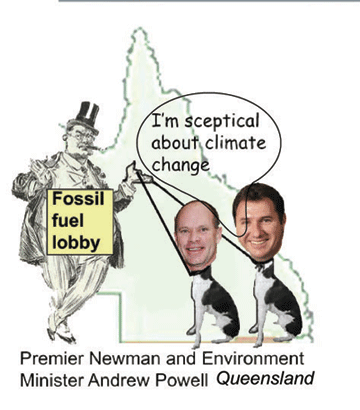 Climate change talk ‘convenient’: Newman THE AUSTRALIAN AAP January 14, 2013 Qld premier Campbell Newman (R) says it’s “convenient” to blame climate change for the bushfires. Source: AAP
THE Queensland premier says it’s “very convenient” to blame climate change for conditions that have always occurred in Australia. Campbell Newman made the comment after federal Nationals Leader Warren Truss said it was “utterly simplistic” to draw a link between climate change and Australia’s recent heatwave and bushfire crisis.
But last week, the federal government’s Climate Commission said the heatwave and bushfires had been exacerbated by global warming.
On Monday, Mr Newman was asked if he believed there was a link between the bushfires, the heatwave and climate change.
“It’s very convenient to blame things that have happened in this country for millennia on climate change,” he replied…….
“I believe we can leave to the experts to make the debate about whether that’s the case….
“The Climate Commission says climate change is making heatwaves more frequent and making it more likely they will stay for longer,” The Australian Conservation Foundation spokesman Tony Mohr said in a statement. “The same body of climate experts expects extreme fire danger days to rise more than 15 per cent in most of eastern Australia.” http://www.theaustralian.com.au/news/breaking-news/climate-change-talk-convenient-newman/story-fn3dxiwe-1226553573449
See these videos – rising sea levels – effect on Australia’s coastal cities
 (VIDEOS) Rising seas may put $300b of property at risk: scientists http://www.abc.net.au/news/2013-01-
 14/how-will-rising-seas-impact-australia/4460688 Jan 14, 2013
How is climate change expected to impact on different parts of Australia? This is the first of a five-part series in which environment reporter Sarah Clarke sets out to provide answers. Climate scientists are urging Australian authorities – and residents – to prepare for rising sea levels that could put about $300 billion worth of commercial property, infrastructure and homes at risk.
The United Nations’ chief science body will meet in Hobart tomorrow for the latest round of talks before the release of its fifth major climate paper in September.
More than three-quarters of Australians live near the ocean, and Alan Stokes from the National Sea Change Taskforce says sea-level rises will challenge many Australians’ beachfront lifestyles.
View sea-level rise maps
The Federal Government has developed a series of initial sea-level rise maps to show climate change’s potential impact in key urban areas.
You can explore maps for the following regions:
Rising sea levels are making Australia’s coastal groundwater salty
 Do you want salt with that? http://www.abc.net.au/rural/sa/content/2013/01/s3669334.htm By Nikolai Beilharz, 14 January 2013 Farmers are being warned not to draw too much fresh water out of coastal aquifers, because they could become inundated with salt water.
The National Centre for Groundwater Research and Training says that two thirds of groundwater aquifers in Australia are at moderate to high risk of saltwater intrusion.
Associate professor at Flinders University Adrian Werner, says it’s a growing problem that has the potential to get worse.

1 This month.
20 September –National Day of Action in Melbourne on the International Day of Peace



Help Aunty Sue Protect Her Land and Sacred Sites From Destructive Rocket Testing.
.

Australians deserve the truth
about
AUKUS – https://aukuspublicinquiry.com/

PETITION – To: Prime Minister Anthony Albanese and the Australian Labor Government

of the week – Australians for War Powers Reform (AWPR)
To see nuclear-related stories in greater depth and intensity
 Antinuclear