Australia’s Liberal Party supporting Senate attack on wind farms
 Research program required into potential health effects of wind farms BY: ANNABEL HEPWORTH The Australian December 20, THE federal Coalition yesterday revealed it would back a proposed crackdown on noise from wind farms.
In a surprise development, the opposition’s energy spokesman Ian Macfarlane confirmed broad support for a bill introduced by independent senator Nick Xenophon and Democratic Labor Party counterpart John Madigan that would stop wind farms that exceeded normal background noise by more than 10 decibels. subscribers only
http://www.theaustralian.com.au/national-affairs/climate/research-program-required-into-potential-health-effects-of-wind-farms/story-e6frg6xf-1226540720864
Surprise, surprise, the Murdoch press pushes Climate Change Denialism
 Biased newspaper reporting on the carbon pricing mechanism, The Conversation, By David Karoly, Christian Slattery, Kathryn Townley and Kerrie Haria Adams from University of Melbourne.) 18 Dec 12,
The Australian print media have been criticised for inaccurately reporting the carbon pricing mechanism (CPM), and in some instances for actively campaigning against the Gillard government. Research from the Australian Centre for Independent Journalism, before the start of the carbon price, reinforced these claims. It found an overwhelmingly negative coverage of the carbon price by News Limited papers in a study of ten national newspapers.
Following the introduction of the carbon price, an undergraduate research team from the University of Melbourne has confirmed these findings in an analysis of The Age, Herald Sun and The Australian.
We found that these newspapers are contributing to an uninformed and inadequate public debate on the carbon price and Australian climate change policy…….
The carbon price follows logic set out in the Stern Review. It advocates for investment in climate change mitigation now, to ensure continued economic prosperity and minimise later economic costs from climate change impacts or delayed climate change mitigation.
Not only was this fundamental argument barely mentioned, discussion of climate science was almost non-existent. This is critical to public perceptions of the carbon price, as without reinforcing the motivations for introducing such a policy, readers are less likely to believe it is necessary….
the overall media coverage does not discuss the need for action on climate change, nor does it balance the short-term economic costs against long-term gains. http://theconversation.edu.au/biased-newspaper-reporting-on-the-carbon-pricing-mechanism-11373
Mixed reactions to Climate Change Authority’s Renewable Energy Target review report
Even given these major issues, Australia’s solar trade bodies have generally welcomed the final report; perhaps taking a “it could have been worse” approach – particularly given the coal lobby reportedly pushed to gut the Renewable Energy Target right up until the last possible moment.
Australia’s Solar Coaster To Continue? http://www.energymatters.com.au/index.php?main_page=news_article&article_id=3521 20 Dec 12, by Energy Matters It appears the spiel ‘the best time to buy solar is always now’ could remain true for prospective home solar power system purchasers in the time ahead.
As mentioned yesterday, the Climate Change Authority’s Renewable Energy Target review report contained recommendations for commercial and residential solar that if implemented will ensure a degree of uncertainty for the sector for years to come.
A gradual phase-out of the Small-scale Renewable Energy Scheme (SRES) and also what the CCA refers to as an “emergency brake”; whereby the level of subsidisation can be further reduced, have been suggested.
The suggested phase-out aspect wouldn’t kick in until 2017, but if Australia’s solar subsidy history has demonstrated anything, it’s that when tools are in place to remove support for small-scale solar, they are used – and often prematurely. Continue reading
Last ditch effort by coal industry to destroy Australia’s Renewable Energy Target (RET)
“Without the RET you wouldn’t really see wind development …or any renewable energy being developed,”
 Coal industry in last-minute push against renewable energy goal, SMH December 19, 2012 Peter Hannam
Carbon economy editor Coal miners have launched a last-minute lobbying bid against the extension of the Renewable Energy Target (RET), releasing a study challenging the policy’s effectiveness.
The independent Climate Change Authority is due to reveal its final recommendations on the RET review at 10am AEDT this morning, in a decision likely to be closely watched by the electricity industry.
The authority’s draft report in October backed the retention of the current settings even though renewable energy sources such as wind and solar power are on course to exceed the goal of 20 per cent of total generation by 2020, arguing changes to the policy would create uncertainty for investors in the sector…… The ACA earlier called for the RET to be removed, with existing rights to be “grandfathered” or compensated, in its submission to the CCA’s review.
The coal industry’s complaint echoes calls from large fossil-fuel based electricity generators, many of which are struggling to remain profitable as weaker-than-expected power demand has sent wholesale electricity prices tumbling.
RET backing The renewable energy industry, meanwhile, remains confident the CCA will recommend leaving the key goals of the RET unchanged, particularly the target of sourcing 41,000 gigawatt hours a year by 2020 from large-scale sources.
“Given what CCA said in the draft report, we’re not expecting significant changes” to the large-scale renewable energy target, said Russell Marsh, policy director of the Clean Energy Council. Continue reading
Toro Energy’s new female leadership now landed with government rebuff for uranium project
 No green light for Toro uranium mine, The Age, December 18, 2012 – Peter Ker Resources reporter Uranium aspirant Toro Energy has been dealt a blow on the eve of the Christmas break, with Environment Minister Tony Burke refusing toapprove the company’s plans for Australia’s next uranium mine at Wiluna.
While Mr Burke has not rejected the proposal, he has not approved it today as many in the market had expected.
Instead he has told Toro that more information on certain matters is required before the mine – located in Western Australia’s harsh interior – can proceed. Mr Burke has extended the deadline for a decision to be made to March 31, 2013, but has also indicated he may give his ruling earlier than that…..
While the market may not have expected a delay to approvals for the Wiluna mine, environment groups had been confidently predicting for some time that Toro had not done enough to satisfy the approval conditions.
A recent consultant’s report commissioned by the Conservation Council of Western Australia predicted that certain measures around storage of tailings were not adequate to meet federal approval. Council spokeswoman Mia Pepper said Mr Burke’s decision was prudent and responsible.
”The Toro project is ill-conceived,” she said. Australian Conservation Foundation spokesman Dave Sweeney said Toro
was a small company that would struggle to raise the funds needed to get the Wiluna project off the ground.
Toro will have a change of leadership in February when Mr Hall steps down and is replaced by Dr Vanessa Guthrie.
That transition has already made headlines for making Toro what is believed to be the only ASX company with an-all female leadership,given that its chairman is Erica Smyth.
http://www.theage.com.au/business/mining-and-resources/no-green-light-for-toro-uranium-mine-20121218-2bku9.html#ixzz2FWbwfzw7
Commercial solar power will further reduce Australia’s demand for fossil fuel electricty
 Hot Tips For Australia In 2013 — Energy Storage, Big Solar, Clean Technica December 18, 2012 Giles Parkinson“…… Dr Saddler ( Hugh Saddler, principal consultant in the climate change business unit of Pitt & Sherry) said. “There’s also been a dramatic increase in residential use of small-scale reverse cycle air-conditioners, whichhave become very much more efficient in recent years.”
Using electricity demand in 2008-09 as the base, annual demand to the end of November 2012 has seen an 11 per cent fall in Victoria, 8 per cent in NSW, with smaller drops in other states.
“Changes in demand of electricity on this scale are unprecedented in the entire 120-year history of the electricity supply industry in Australia,” the Pitt & Sherry report said.
The rapid spread of solar photovoltaic panels is also beginning to erode demand, although the full impact may not be felt until more companies rather than homes install the technology, he said. Commercial power demand typically matches solar PV output more closely than residential use.
Solar boost
Meanwhile, one of Australia’s biggest PV installers, Mark Group, has begun offering additional solar payments to foster demand even as state governments roll back feed-in tariffs. Earlier this year, Victoria cut its feed-in tariff from 25¢ per
kilowatt-hour to 8¢. Mark Group, along with retailer Diamond Energy, has lifted that rate to 33¢, with plans to roll out similar programs in NSW, Queensland and South Australia next year.
A surge in Chinese PV production has seen the cost of panels drop from $1.80 to 65¢ per kilowatt capacity in the past two years. “We’re not that far from operating without subsidies,” Rob Grant, chief executive of Mark Group’s Australian operations, said. “The biggest uptake is going to commercial.” : http://www.smh.com.au/business/carbon-economy/emissions-sink-as-consumers-turn-off-coal-20121217-2bj3t.html#ixzz2FS0PZJzR
Business leaders ahead of Australian government on renewable energy for 2013
Hot Tips For Australia In 2013 — Energy Storage, Big Solar, Clean Technica December 18, 2012 Giles Parkinson RenewEconomy passed around the hat this past week for a few ideas on what would be big in 2013 in clean energy in Australia. What emerged was a couple of key themes – the continued proliferation of solar PV and the growing interest in energy storage. And it might just be the year that big solar (solar thermal) makes its mark.
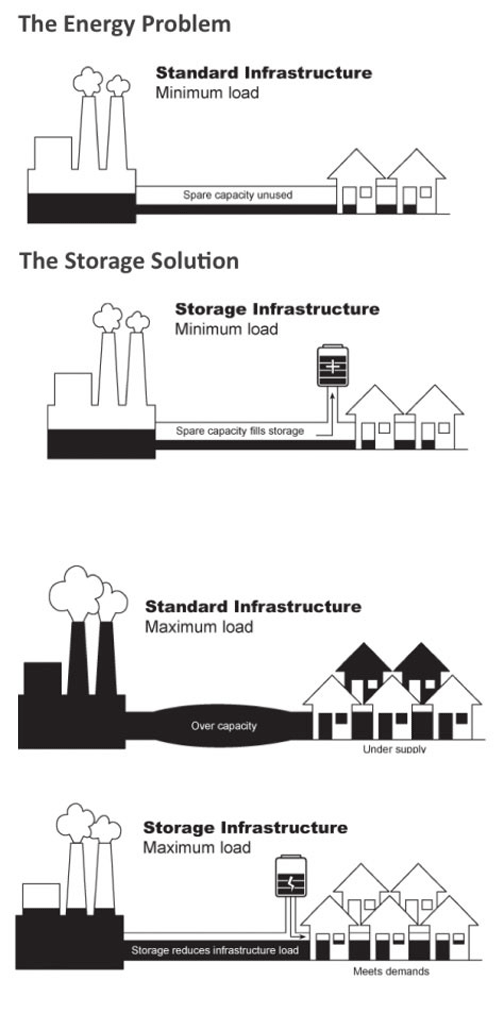
“Watch solar thermal for a vision of what is likely to become the more dominant technology five to 10 years from now,” said one executive. There is certainly much interest – internationally, many countries are throwing billions at the technology, and it is thought that ARENA and/or the CEFC may finally find a way to make it work here too.
Battery storage was another popular choice. Many hinted at their own plans to introduce storage technologies at the commercial, industrial, and residential level. As one said: Everyone seems to think you need a lot of storage to make a difference, but this is not necessarily the case. Many households now use less than 5 kWh per day, so even 1-2 kWh
of storage could allow them to manage a large proportion of their peak demand.”
This could be done with ultra-capacitors, lithium-ion, or the CSIRO developed ultrabattery, which recently won the contract for the King Island renewables integration project, and has signed a deal with the largest lead acid battery manufacturer in the world.
The most depressing tip for 2013 was the prediction that regulators and governments will again fail to keep up with the pace of change, “leading to a complex, backward looking and confusing market picture dominated by the status quo and the powerful voices of incumbent players”, as one executive put it.
Here’s what the executives said in their own words:……… Read more at http://cleantechnica.com/2012/12/18/hot-tips-for-australia-in-2013-energy-storage-big-solar/#9GW7xQZjsFeMTM7L.99
Australia’s Donna Mulhearn takes up the forgotten cause of Fallujah’s deformed babies
 Iraq: Crimes against Humanity. The Babies Will Haunt Us By Kelley B. Vlahos Global Research, December 18, 2012 antiwar.com It was like walking through a nightmare: drifting in an out of hospital rooms, down the long hallways, her contact with shock-ravaged Iraqi parents interrupted only by glimpses of their physically deformed and terminally sick babies who in many cases, would never see the outside of Fallujah’s main hospital, ever.
Then, the more than vague sense that she must apologize. The words thick like molasses were hard to form. “I felt inadequate,” said Donna Mulhearn. “What was so hard was, what do you say to these people other than saying sorry, which I said over and over again. You just wanted to offer more.”
Donna Mulhearn is a name we need to remember, as she is one of a small but dedicated group of citizen activists who, after most of us have said the long goodbye to Iraq in the rear-view mirror, are taking on the environmental and humanitarian legacy of the Iraq War as a personal cause. Continue reading
Dramatic fall in greenhouse gases, as Australians, especially Victorians. use less coal-fired power
Yallourn was operating at just 56 per cent last month even after it announced it was mothballing one of its four units.
Emissions sink as consumers turn off coal, SMH, Peter Hannam, December 17, 2012 Carbon economy editor Weak demand for electricity across eastern mainland states has sparked a “dramatic fall” in greenhouse gas emissions from Australia’s power stations, the latest review of data by consultants Pitt & Sherry has found.
While demand for base-load electricity from black coal-fired power stations has been in retreat for about three years, the decline has extended in recent months to two of Victoria’s emissions-intensive brown coal-fired plants, Hazelwood and Yallourn. Changes in demand of electricity on this scale are unprecedented in the entire 120-year history of the electricity supply industry in Australia Continue reading
Australian government refuses Toro ‘s Wiluna uranium project, requires further scrutiny
Peak state and national environment groups today welcomed the Federal Environment Minister’s increased scrutiny of WA’s first planned uranium mine – Toro Energy’s Wiluna project.
The Australian Conservation Foundation and the Conservation Council of Western Australia described Tony Burke’s refusal to approve the Toro Wiluna uranium project and to require further project detail as prudent and responsible.
“The Toro project is ill-conceived and the WA assessment has been dangerously deficient,” said CCWA campaigner Mia Pepper.
“The WA Government has broken its promise of a world’s best practice uranium industry and has failed to meet national standards. “Premier Barnett and the WA Government now urgently need to re-examine the environmental assessment process in WA and hold a comprehensive public inquiry into uranium mining.” Continue reading
Lynas in Malaysian court tomorrow over its confused and contradictory radioactive wastes plans
 Lynas will be in court in Malaysia on 19 December. The Save Malaysia Stop Lynas (SMSL) campaigners
  will be appealing against the Kuantan High Court decision to lift its stay on the company being able to exercise its rights to proceed under the temporary licence.
The toxic waste that’s not in Australia’s backyard http://aliran.com/11005.html 18 Dec 12, Australian-owned company Lynas is quietly shipping rare earth to a processing plant in Malaysia – without a firm plan in place to dispose of dangerous radioactive waste. Wendy Bacon reports.
 If a manufacturing plant involving radioactive materials moved into your community, one of the first things you would ask is, “what’s going to happen to the waste?”
This is exactly how residents of Kuantan on Malaysia’s east coast reacted when the Australian company Lynas announced plans to build Lamp, the world’s biggest rare earth processing plant in their area.
Several years later, they have no clear answer. Indeed last week, while the plant that will use concentrate imported from Lynas’s rare earth mine at Mount Weld in Western Australia was finally ramping up for production, the Malaysian government and the company were in direct conflict about what would happen to the waste. Continue reading
Australian uranium miners jubilant at Japan’s election results
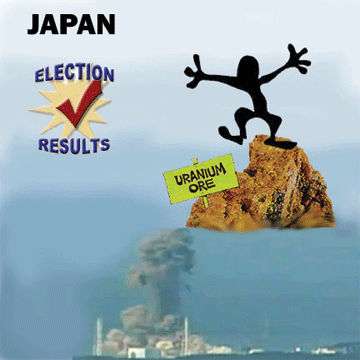 Producers bullish on Japanese demand The Age, December 18, 2012 Paddy Manning Greg Hall, managing director of junior Toro Energy, said Japan had been spending an additional $US100 million a day on extra coal, oil and gas, which represented a ”very, very high cost”.
After the weekend’s election, he said the country now had the political will to restart its reactors. A new independent safety
authority would be in place by April and Japan’s nuclear power capacity would be restored through 2013-15……..
Paladin Energy chief John Borshoff predicted Germany, too, would eventually return to the nuclear power fold. ”Germany can’t survive on a no-nuclear basis with all the countries…. Mr Borshoff said it was impossible for Japan to do without 27 per cent of its electricity-generating capacity.
”We’ve been working on the basis the nuclear programs will resume in some modified form. Germany have set
an irreversible path but I believe in eight-10 years they’ll be back on the drawing board.”
UBS resources analyst Glyn Lawcock welcomed the Japanese news saying it had been a ”torrid” 18 months for uranium markets since the closure of the Fukushima Daiichi reactor after last year’s Japanese earthquake and tsunami.
New South Wales’ toxic radioactive waste by another name is still toxic radioactive waste
But the new plan involves reclassifying most of the contaminated earth as ”restricted solid waste”, allowing it to be trucked to Kemps Creek.
 The Labor MP for Auburn, Barbara Perry, told Parliament in June that the move to reclassify the contaminated earth as restricted but non-hazardous was ”clever spin”.
Based on a series of tests by ANSTO, government and independent scientists, the detection of some hazardous radioactive material seems likely.
Uranium smelter’s legacy moves on, SMH December 16, 2012 Ben Cubby THE controversial clean-up of a radioactive site in Hunters Hill is set to begin early next year, with any hazardous waste to be moved from the harbourside suburb to Lidcombe, the NSW government says.
The contaminated properties in Nelson Parade – once the site of a uranium smelter – have been a thorn in the side of residents and governments for nearly a century.
After years of denials from successive governments about the extent of the contamination, the clean-up will now be extended to include suspected radioactive hot spots in neighbouring backyards and at the harbour foreshore.
The Premier, Barry O’Farrell, all but ruled out dumping the contaminated dirt at a Kemps Creek waste facility in western Sydney last year, in the face of protests from Penrith residents and councillors. Continue reading
Native Title rejected by Githabul because it will further coal seam gas mining
Ms Gloria Williams spokeswoman of Githabul said that the Native Title agreement is being wrongly used to allow coal seam gas interests into the region.
Aboriginal people reject Native Title over coal seam gas http://www.coalguru.com/australia/aboriginal_people_reject_native_title_over_coal_seam_gas/6062 17 Dec 12, ABC News cited members of the Githabul people as saying that the coal seam gas issue is forcing them to reject their Native Title claim.
An application by the New South Wales Aboriginal Land Council for gas prospecting in the Tweed and Byron Shires, includes areas covered by the Githabul Native Title claim of 2007. The claim is more than 6000 square kilometer in size. Continue reading
Windy Flinders Island aims for 100% renewable energy
 Flinders Island’s windy future http://www.abc.net.au/news/2012-12-16/flinders-island27s-windy-future/4430334 Dec 16, 2012 Flinders Island in Bass Strait plans to produce all its power from renewable energy sources.
The plan to put up three or four wind turbines and a mini hydro storage system would cost up to $25 million.
A privately-run turbine is already producing 25 per cent of the island’s energy.
Flinders Island Council general manager Raoul Harper said residents wanted to make that 100 per cent. “Being in the top five wind resource areas on the planet the concept of continuing to burn diesel to power the island does seem absurdreally,” he said.
In the long run Mr Harper said the project would be cost effective because the government would no longer need to pay Hydro Tasmania $3 million a year to supply diesel. The council is seeking Federal Government funding through its new
renewable energy agency.

1 This month.
20 September –National Day of Action in Melbourne on the International Day of Peace



Help Aunty Sue Protect Her Land and Sacred Sites From Destructive Rocket Testing.
.

Australians deserve the truth
about
AUKUS – https://aukuspublicinquiry.com/


PETITION – To: Prime Minister Anthony Albanese and the Australian Labor Government

of the week – Australians for War Powers Reform (AWPR)
To see nuclear-related stories in greater depth and intensity
 Antinuclear