Queenslanders vulnerable to UV radiation – new solariums banned
 New solariums to be banned in Queensland, Brisbane Times, December 16, 2012 Bridie Jabour “….. CEO Cancer Council Queensland Professor Jeff Dunn congratulated the Newman Government on the move but said he would like to see a total ban on solariums in the next three years….. Professor Dunn said the government had confirmed earlier this week they will move toward a total ban on solariums.
‘‘Queensland has the highest rates of skin cancer in the world – more than 2600 people across the state are diagnosed with melanoma each year, yet it remains the single most preventable cancer,’’ he said. ‘‘A ban on solariums will eliminate potentially deadly skin cancers linked to sunbed use, no doubt saving the lives of thousands of Queenslanders.’’
In his announcement Mr Springborg said sun-beds and stand-up tanning machines that use exposure to ultraviolet radiation were dangerous. ‘‘People who use a solarium before the age of 35 have a 75% greater risk of melanoma,’’ he said.
He said evidence of growing community awareness of the risks posed by solarium use was abundant. http://www.brisbanetimes.com.au/queensland/new-solariums-to-be-banned-in-queensland-20121216-2bh6t.html#ixzz2FKubxb1U
New South Wales losing investment and jobs, as State govt prolongs anti wind farm rules
“There’s $10 billion worth of investment sitting in the pipeline waiting to find out what Brad Hazzard is going to do with their
future.
“Four thousand jobs, 17 million tonnes a year cut from the state’s greenhouse gas emissions, waiting to see what the O’Farrell Government will do.”
 Guidelines wait blows against NSW wind farms http://www.abc.net.au/news/2012-12-14/guidelines-wait-blows-against-nsw-windfarms/4427964 Dec 14, 2012 The Clean Energy Council says a delay in finalising new guidelines for
wind farms in New South Wales is forcing investors to look to other states for opportunities.
It is a year since the New South Wales Government put draft guidelines out for community consultation.
A spokesman for Planning Minister Brad Hazzard says the policy is still being finalised. In the meantime, no new wind farms have been approved.
The Clean Energy Council’s policy director, Russell Marsh, says that is sending investment elsewhere. Continue reading
Malawi govt was urged to get a better deal from Australian uranium miner Paladin
Malawi told to renegotiate Paladin uranium deal http://en.starafrica.com/news/malawi-told-to-renegotiate-paladin-uranium-deal.html December 7, 2012 The African Forum and Network on Debt and Development (AFRODAD) Executive Director Collins Magalasi told journalists in the capital Lilongwe on Friday that the government of Malawi had made a bad choice of project given the absence of transparency and accountability in the deal.
“Government needs to look back at the contract and renegotiate for a better deal which can benefit the nation including the communities where the project takes place” he said. He therefore urged Malawi MPs and civil society organisations (CSOs) to take up the issue and bring pressure to bear on the government to return to the negotiating table.
A representative of the CSOs Moses Mkandawire said they are ready to take up the issue to government to renegotiate for a better deal with the Paladin Company.
“We would like Paladin to declare all what it has sold. The government should also declare all what it has received from the uranium project since it started” he said, adding that the company has paid little in terms of royalties to the state.
He said they had also performed poorly in the area of corporate social responsibility. As CSOs, he said, another deal should be made possible for the benefit of Malawians who are the real owners of the resources.
Queensland coast could get WEEKLY king tides, with climate change sea level rise
 Climate change tipped to bring more king tides ABC News Dec 14, 2012 A Queensland academic says extreme weather events, like this week’s king tides, could become more common as a result of climate change.
The biggest tides of the year are expected to peak this morning, reaching 5.7 metres at Port Alma, 4.7 metres at Yeppoon and 4.6 metres at Gladstone.
Professor Rodger Tomlinson, from the coastal research unit at Griffith University, says king tides could occur weekly in the future. “Some research has been done by our colleagues in the CSIRO sort of indicating that these kind of events that we now see twice a year, under the sea level rise projections for 2,100, we might be … seeing those sort of weekly,” he said.
“It’s that kind of increase in the frequency of those events under sea level rise.”
Authorities say they are not expecting any properties along the central Capricorn Coast to be badly affected by inundation during this morning’s high tide……http://www.abc.net.au/news/2012-12-14/climate-change-tipped-to-bring-more-king-tides/4427970
Utterly useless Christmas presents are helping to trash the planet
The fatuity of the products is matched by the profundity of the impacts. Rare materials, complex electronics, the energy needed for manufacture and transport are extracted and refined and combined into compounds of utter pointlessness. When you take account of the fossil fuels whose use we commission in other countries, manufacturing and consumption are responsible for more than half of our carbon dioxide
This is pathological consumption: a world-consuming epidemic of collective madness, rendered so normal by advertising and by the media that we scarcely notice what has happened to us.This boom has not happened by accident.
When every conceivable want and need has been met (among those who have disposable money), growth depends on selling the utterly useless.
 Trashing the planet for a talking piggy bank http://www.theage.com.au/opinion/society-and-culture/trashing-the-planet-for-a-talking-piggy-bank-20121212-2b9vh.html#ixzz2F4vYvlY2 December 13, 2012 George Monbiot There’s nothing they need, nothing they don’t own already, nothing they even want. So you buy them a solar-powered waving queen; a silver-plated ice cream tub-holder; a ”hilarious” inflatable Zimmer frame; a confection of plastic and electronics called Terry the Swearing Turtle; or – and somehow I find this significant – a Scratch Off World Map.
They seem amusing on the first day of Christmas, daft on the second, embarrassing on the third. By the 12th day of Christmas they’re in landfill. For 30 seconds of dubious entertainment, or a hedonic stimulus that lasts no longer than a nicotine hit, we commission the use of materials whose impacts will ramify for generations.
Researching her film The Story of Stuff, Annie Leonard discovered that, of the materials flowing through the consumer economy, only 1 per cent remain in use six months after sale. Even the goods we might have expected to hold on to are soon condemned to destruction through either planned obsolescence (wearing out or breaking quickly) or perceived obsolescence (becoming unfashionable).
But many of the products we buy, especially for Christmas, cannot become obsolescent. The term implies a loss of utility, but they had no utility in the first place. An electronic drum-machine T-shirt; a Darth Vader talking piggy bank; an ear-shaped iPhone case; an individual beer can chiller; an electronic wine breather; a sonic screwdriver remote control; bacon toothpaste; a dancing dog. No one is expected to use them, or even look at them, after Christmas day. They are designed to elicit thanks, perhaps a snigger or two, and then be thrown away. Continue reading
Malaysian MP explains why Malaysians are opposing the Lynas rare earths plant
Why should we allow anything less in terms of safety standards than Australia? Does the BN government feel that the Australian Government is being too fussy? Or that Malaysians can take more radiation than the Australians?
The Anti-Lynas movement: Are we being unreasonable? – Jeyakumar Devaraj, The Malaysian Insider , 13 Dec 12 Dr Jeyakumar Devaraj is a PSM central committee member and MP for Sungai Siput.“……..Vastly Differing Standards First, a brief overview of the industrial process of separating the rare earths from the rest of the ore.
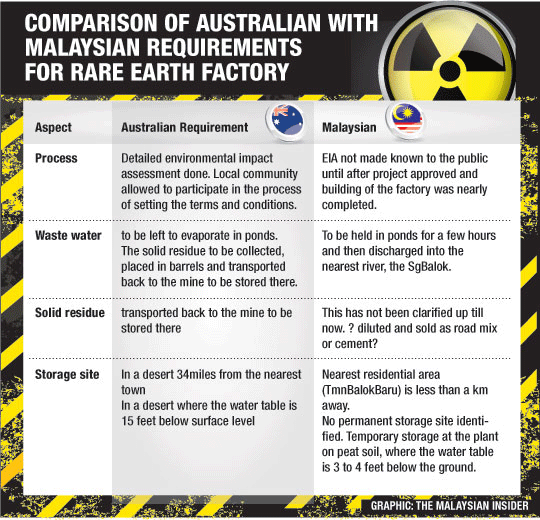
Lynas actually has the license to operate a refining plant in Australia itself. Lynas acquired this license upon buying over Aston, the company that owned the mine in Mount Weld. In the mid 1990s, Ashton applied for a license to refine the ore, and in the process of consultations with the public in the region, agreed to a set of specific performances. If Lynas wants to use the refining license that came with the purchase of Ashton, it is committed to observing all the procedures agreed to by Ashton earlier.The table below compares requirements that Lynas would have to observe in Australia with the requirements for it in Malaysia.
The government has said in Parliament that Lynas is keen on operating a plant here because the total cost in Malaysia is only 30 per cent of the cost of refining the ore in Australia! (Despite the fact that it has to be transported from Mount Weld to Freemantle Port, loaded on ships and then brought some 4000 km to Kuantan for refining!) That means safety precautions in Malaysia are so much more lax than those required in Australia.
This point alone makes me uncomfortable. Continue reading
Concern that Australian aid money is going to support Australian mining firms in Africa
AID MONEY USED TO SUPPORT MINING CSR PROJECTS http://acan.org.au/2012/10/aid-money-used-to-support-mining-csr-projects/ A group of Australian and international civil society groups, lead primarily by AID/WATCH, have written an open letter to Foreign Minister, Bob Carr, expressing concern that Australian aid money is supporting the CSR initiatives of Australian mining firms, particularly in Africa.
The Foreign Minister recently announced at a mining conference that funds from the Development Assistance Program (DAP), administered by the Department of Foreign Affairs and Trade (DFAT) but financed by AusAID (Australia’s state foreign aid agency), are being used to co-finance (with various mining companies) the community projects used by mining companies to garner their ‘social license to operate’.
The civil society groups have raised concerns in their letter that mining is not an effective approach to spurring community development – noting that actually mining tends to harm the lives of people in developing countries rather than improve it, a phenomenon commonly referred to as the ‘resource curse’. The letter also alleged that some recipients of the aid money are not reputable, noting the Paladin corporation has been linked to corruption in Malawi.
The signatories of the letter urged the Australian Government to revise their approach to delivering aid for the purpose of supporting mining as a means of community development. There has been no response from DFAT or Minister Carr’s office.
Lawyers acting for Paladin have been in contact with AID/WATCH. Their correspondence laid out that AID/WATCH’s letter potentially damaged the reputation Paladin’s CEO and the company overall. Paladin demanded the withdraw of the letter from Aid/Watch’s site, commit in writing to never publishing similar statements in the future and publish a letter prominently on their site apologizing to Paladin and their CEO. The lawyers noted that should AID/WATCH fail to abide by the terms “Paladin and John Borshoff reserve their rights in this matter”.
The threats made in the letter are hollow since Australian law does not provide to corporations a cause of action to sue for defamation, and John Borshoff was not named in the letter to the Foreign Minister. However, AID/WATCH has since removed the letter from their site, but it can be accessed on Mines & Communities website here. http://www.minesandcommunities.org/article.php?a=11978&l=1
Malawi group calls off its anti-Paladin protest – what is going on?
Malawi group gets Paladin’s K0.9 million to publicize aborted protest … The Maravi Post-14/11/2012 Malawi group gets Paladin’s K0.9 million to publicize aborted … MZUZU–Paladin (Africa) Limited has provided funds amounting to K900, 000 … subscribers only
Paladin accuser recants threat allegation; Kyungu’s point man ... The Maravi Post-26/11/2012 MZUZU–Karonga Youth for Justice and Development (KYJD) has recanted the allegation made against Paladin (Africa) Limited, owners of … subscribers only http://www.maravipost.com/malawi-news/society/2331-paladin-accuser-recants-threat-allegation-kyungu%E2%80%99s-point-man-praises-mining-firm.html
Malawi call for Paladin uranium company to “walk the talk” on transparency and accountability
Wake up call for Paladin, The Times Group, 27 nov 12 A few weeks ago, I published on this column a letter I sent to Paladin Energy’s Managing Director John Borshoff in which I complained about the company’s lack of respect for Malawians through their non-responsiveness to media queries from Malawi.
A few weeks ago, some two courageous community groups in Karonga, where Paladin Africa operates the Kayelekera Uranium Mine, organised protests against the company’s unfulfilled social responsibility promises as well as its failure to support local businesses and farmers through its preference for imported items for its food and other provisions.
To put the record straight, Kayelekera is an important project in the country which every Malawian should be proud of as it is significant not only for job creation, government revenue contribution and foreign currency earnings but also as a flagship foreign direct investment in the country which can encourage other international corporations to consider investing in Malawi.
However, the perception about the company among Malawians is not positive not because the people just don’t like the investment but because of the way management of the company has conducted itself since their establishment.
Despite their profile as an established company from a developed and democratic country, Australia, where corporation operates based on acceptable corporate governance principles such as transparency and accountability, Paladin Energy’s image in Malawi is that of a closed, secretive, agrarian and mysterious giant that has ring-fenced itself as a foreign island within Malawi.
For example, apart from employees and senior government officials, which other Malawians can claim to have set their foot in the Kayelekera Mine complex in Karonga?…..
The protest which failed to take place against the company a few weeks ago should serve as a wake-up call to the company about the intense negativity of its business among Malawians.
Their stated commitment to uphold transparency and accountability about the Kayelekera Uranium Mine is not enough. They need to demonstrate that actively and walk the talk. Otherwise, they should expect more resentment and civil action in the coming years as Malawians are no longer a passive society that sits back and watch helplessly when other people are exploiting their resources over their heads in the name of foreign investment. Thumbs down Paladin Energy. http://www.bnltimes.com/index.php/daily-times/headlines/opinion/12628-carlsberg-paladin-limbe-police-subject-of-the-thumb
Australian Solar Thermal Research Initiative (ASTRI) aims to bring down the cost of Solar Thermal Power
CSIRO to lead push to bring cost of CSP to 10c/kWh REneweconomy, By Giles Parkinson on 13 December 2012 The CSIRO is to lead a major new research initiative in solar thermal (concentrating solar power, or CSP) technologies that will aim to reduce the cost of the technology to between 9c and 12c a kilowatt hour, and be able to compete with fossil fuels – possibly as early as 2016.
The Australian Solar Thermal Research Initiative (ASTRI) was unveiled today, delivering $35 million of funding from the Australian Solar Institute and the Australian Renewable Energy Agency, as part of an $87 million research program that will also draw on money from the private sector. The program brings together Australian and US research institutions, with United States research collaborators and with leading international and Australian CSP companies. Continue reading
Australia’s funding for solar research would be better spent on building solar thermal
Solar Funding Evokes Mixed Reactions, by Energy Matters, 13 Dec 12 $83.5 million for solar research funding as part of the United States- Australia Solar Energy Collaboration (USASEC) was announced by Minister for Resources and Energy Martin Ferguson on Thursday……
While the announcement was generally well received by supporters of renewable energy, not everyone was happy.
Climate think-tank Beyond Zero Emissions labeled the funding a “diversion”.
“While Australia is limiting its large-scale solar energy sector to research, other countries are going ahead and building it – and learning more in the process,” said BZE’s Matthew Wright.
“If Martin Ferguson really supported large scale solar energy, he would have us build it now.”

Beyond Zero Emissions is one of the driving forces behind the push to have Australia’s first large solar-thermal plants with energy storage built at Port Augusta in South Australia.
Early this year, the group released ‘Repowering Port Augusta‘; a blueprint for replacing South Australia’s emissions intensive Northern and Playford B brown coal-fired power stations with wind power and solar energy facilities. http://www.energymatters.com.au/index.php?main_page=news_article&article_id=3514
Lynas accused of deceiving Malaysian authorities on radioactive wastes
However the Temporary Operating License approved on 7/2/2012 allows Lynas to start operations even before they present their proposed plan for comprehensive management of the solid waste – the TOL only requires them to submit the waste management plan within 10 months of starting operations!!
Ten months have passed, and a safe permanent depository has yet to be identified and agreed upon by all parties. Instead Lynas is still talking of rendering the waste “safe”. Continue reading
Australian govt promotes uranium industry – regardless of safety and weapons proliferation issues
Australian governments and uranium companies could help to break the vicious cycle by making uranium exports conditional on adequate safety standards and proper regulation – but they don’t.
Even more troubling is the willingness of successive Australian governments to turn a blind eye to weapons proliferation concerns in North Asia.
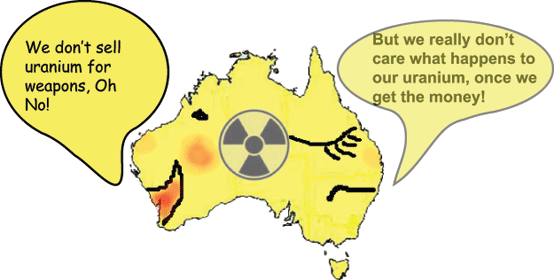
How can we trust nuclear, if we can’t trust its operators? http://www.thepunch.com.au/articles/how-can-we-trust-nuclear-if-we-cant-trust-its-operators/ by Jim Green 13 DEC Whether it’s nuclear safety or weapons proliferation, the federal government (and the Opposition and the mining companies) can be safely relied upon to exacerbate problems with irresponsible uranium export policies.
Widespread safety breaches and proliferation concerns in North Asia are recent manifestations of the problem. In May, five
engineers were charged with covering up a potentially dangerous power failure at South Korea’s Kori-I reactor which led to a rapid rise in the reactor core temperature. Continue reading
Australian rare earths company Lynas may lose its Malaysian operating license over the radioactive waste issue
Four Malaysian cabinet MPs (responsible for trade, science, natural resources and health) have now released a joint statement, saying the temporary licence granted to Lynas requires it to remove “all the residue” from the plant out of the country.
They also warned that if Lynas does not comply, the Government can suspend or revoke the licence and order it “to immediately cease operation”.
 Malaysia orders Lynas to ship out waste http://www.abc.net.au/news/2012-12-11/an-malaysia-orders-lynas-to-ship-out-waste/4422084 Dec 11, 2012 . Australian mining company Lynas and its plans to process rare earths in Pahang state have caused local communities and environmental groups to raise concerns over the management of radioactive byproduct waste
Malaysia has ordered the Australian miner Lynas Corp. to ship out all the waste from its new rare earths plant, because of environmental and health concerns. Continue reading
ERA shuts down its open cut Ranger uranium mine
 Open cut operations cease at Ranger uranium mine, Australian Mining 11 December, 2012 Cole Latimer Energy Resources of Australia’s Ranger uranium mine has finally stopped open cut mining, after three decades of operation.
It comes as the mine further explores its underground Ranger 3 Deeps project after receiving approvals for a prefeasibility study earlier this year.
ERA is now backfilling its Three Deeps pit after it extracted the last of the ore from Pit 3 in the last week of November, several weeks ahead of schedule, the company says….
1 This month.
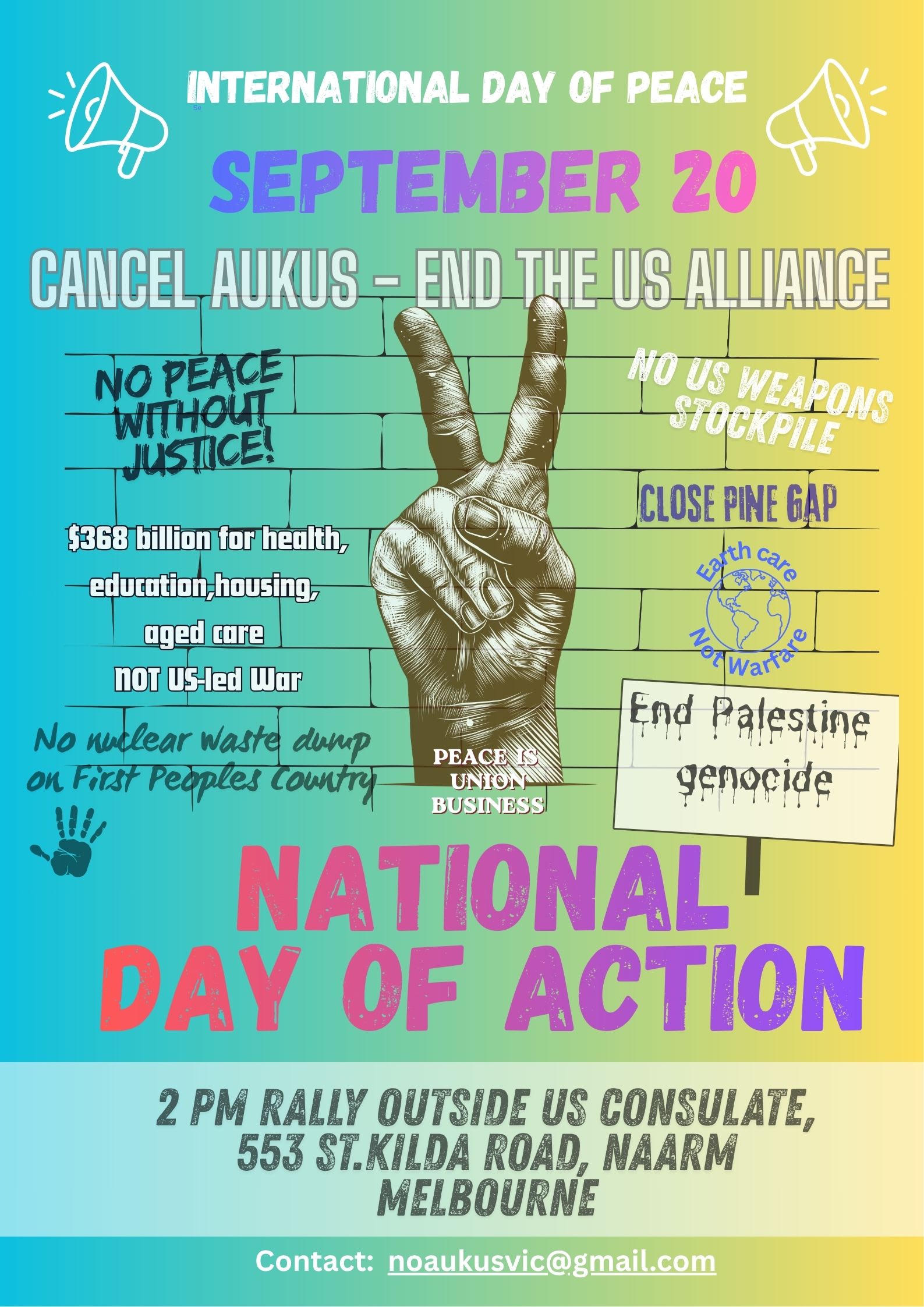
20 September –National Day of Action in Melbourne on the International Day of Peace


Help Aunty Sue Protect Her Land and Sacred Sites From Destructive Rocket Testing.
.

Australians deserve the truth
about
AUKUS – https://aukuspublicinquiry.com/


PETITION – To: Prime Minister Anthony Albanese and the Australian Labor Government

of the week – Australians for War Powers Reform (AWPR)
To see nuclear-related stories in greater depth and intensity
 Antinuclear