Russia receives first shipment of uranium from Australia
The deliveries are being made under the agreement on nuclear cooperation for peaceful purposes signed by President Vladimir Putin and then-Prime Minister John Howard in Sydney in 2007.
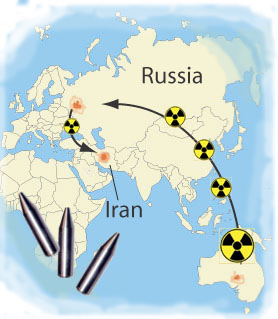
Russia receives first uranium shipment from Australia http://www.panarmenian.net/eng/news/136667/
December 10, 2012 PanARMENIAN.Net – Russia has received the first shipment of uranium from Australia under a 2007 bilateral nuclear cooperation agreement, a spokesman for Russian uranium enrichment concern Siberian Chemical
Combine said, according to RIA Novosti. Continue reading
Australia steps up investment into solar power research projects
Australia takes a shine to solar energy research
http://www.brisbanetimes.com.au/business/carbon-economy/australia-takes-a-shine-to-solar-energy-research-20121212-2bajc.html#ixzz2ExSaP4LQ December 12, 2012 Peter Hannam Carbon economy editor The Gillard government will step up its investment in joint solar energy research with the US, using additional funds from its new $2.2 billion renewable energy agency. Continue reading
South Melbourne’s community owned large solar project
Community solar projects allow people who cannot install solar panels on their own homes for whatever reason to directly participate in the solar revolution.
Community funded solar projects have already been successfully rolled out in the UK and the USA. Closer to home, the communities of Hepburn Springs and Daylesford in Victoria raised $13.5 Million to build the Hepburn Community Wind Park; winner of the 2012 World Wind Energy Award.
Australia’s First Community Owned Large Scale Solar Project http://www.energymatters.com.au/index.php?main_page=news_article&article_id=3513 12 DECEMBER, 2012 | A new community project aims to cover South Melbourne Market’s new roof with solar panels. 150 solar panels have already been installed, funded by Port Phillip Council.

LIVE (Locals Into Victoria’s Environment) wants to cover the remaining 95% of the rooftop with solar (around 3,000 panels) via community investment. “Currently we think a Co-operative structure for LIVE Community Power best matches the principles to which we aspire,” states the group’s web site.
The group envisions selling around 1,000 shares at $1,000 each to the community. Electricity generated by the installation would be sold and provide a return to shareholders. Continue reading
Do not be taken in by the lies in the pro nuclear Zero Carbon Option report
 This report emanates from Australia’s top nuclear lobby group. Their web titles are Decarbonise South Australia, and Brave New Climate.
Based in South Australia, and with Barry Brook as their prime spokesman, they pose as Climate Change activist sites. But , after you’ve got through all that worthy climate and renewable energy stuff – comes the real message – nuclear power for Australia (and the world)
Below some points from the Zero Carbon Options report. Do not be taken in by these lies
“Capacity Factor: Renewables – 30%. Nuclear – 85%
>
>Job Creation: Renewables – 360 permanent jobs, 1300 jobs in construction.
>Nuclear – 520 permanent jobs, 1600 jobs in construction.
>
>Lifespan: Renewables – 25 years. Nuclear – 60 years.
>
>Cost: Renewables – $8.1 billion. Nuclear – $4.8 billion
>The Zero Carbon Options report, amongst other things, seriously questions why BZE ignores the option of nuclear power if their aim is to decarbonise Australia.
Some on the left also include the demand of “100% renewable energy” in their day to day campaigns. The Zero Carbon Options team, amongst others, have warned that relying on only one form of technology to produce zero carbon power is unwise, and could even be irresponsible. “ – Christina Macpherson 12 Dec 12,
Confusion about Australian company Lynas’ plans for managing radioactive wastes
Hello, didn’t Lynas say wastes to be exported? Malaysiakini Dec 10, 2012
‘Now is the time to ask the court to suspend the TOL because AELB has said that they will enforce Lynas pledge to export the waste.’
Wastes won’t be exported out of Malaysia, says Lynas
Odin: Lynas Malaysia managing director Mashal Ahmad, you have been reported to have said no residues from your plant would be exported out of Malaysia, as your company needed to abide by international conventions that prohibit the export of hazardous wastes to other countries.
This means that the residues which your plant will produce are toxic. All this while, however, we have been told that the residues would be safe to humans and the environment.
Does this not mean that your company, and those outside it but who support your operations, have been lying? Continue reading
Some Malaysians not happy with Lynas’ tax free status
Hello, didn’t Lynas say wastes to be exported? Malaysiakini Dec 10, 2012 Xabiso: Do the people know about the 12-year tax free incentive gifted to this foreign company listed in Australia? Why am I not surprise that they are keeping the toxic waste in Lynas?
I remember someone giving an assurance last time that the waste will be exported back to Australia. We are talking about the toxic waste from processing rare earth, not the raw material (if the raw material is radioactive, Australian can’t even send it to Malaysia).
Before plant operation – apa pun boleh (everything can be done). After start-up – dah tunjuk belang (show true colours). http://www.malaysiakini.com/news/216281
Radioactive wastes to be exported from Malaysia, according to Lynas’ Temporary Operating Licence
Hello, didn’t Lynas say wastes to be exported? Malaysiakini Dec 10, 2012 Blogsmith: Now is the time to ask the court to suspend the temporary operating licence because AELB DG has said that they will enforce Lynas’ pledge to export the waste.
From this Malaysiakini report: Atomic Energy Licensing Board (AELB) director-general Raja Abdul Aziz Raja Adnan has clarified that the regulatory body will enforce Lynas’ pledge to export all its waste in the form of commercial products overseas.
“The management and removal of residue is an integral part of the Temporary Operating Licence (TOL) conditions and agreements and is permanently documented in the licence document issued to Lynas on Sept 5, 2012.
“Issue of removal of residue being non-binding for Lynas, does not arise. It is legally binding and AELB will enforce it.” http://www.malaysiakini.com/news/216281
Malaysia as dumping ground for radioactive wastes? Lynas’ Malaysian tax holiday
Hello, didn’t Lynas say wastes to be exported? Malaysiakini Dec 10, 2012 Kgen: What cheaper production cost? What about the cost of transporting the earth from Australia to Malaysia? Most of the processes are automated so labour cost does not factor significantly in the production cost.
Does the 12-year tax holiday, lax environmental standards and an authoritarian regime which can impose its will on the people have anything to do with the choice of location?http://www.malaysiakini.com/news/216281
Hello, didn’t Lynas say wastes to be exported? Malaysiakini Dec 10, 2012 Not Confused: So, the waste from the Lynas plant cannot be exported from Malaysia because it is hazardous, as defined under the international convention.
I had refrained from commenting on this issue as I felt that too many professionals, supposedly with some integrity, had reported and clearly stated that there was no risk to any Malaysians from the operation of the plant.
However, it is now confirmed that the waste from the plant will indeed be toxic so will have to be “disposed of” in Malaysia.
This seems like Malaysia is being used as a dumping ground simply because operating costs here are less and we have a corrupt government which is presumably being paid handsomely for licensing their operations. http://www.malaysiakini.com/news/216281
Confronting Lynas about Radioactive Waste from rare earths processing
Hello, didn’t Lynas say wastes to be exported? Malaysiakini Dec 10, 2012 Onyourtoes: What happened to the undertaking that the waste will be exported or moved out of country? Here, you can see that Lynas has negated its responsibility even before full scale production has begun.
Why do they keep saying the waste is harmless when there is so much control and restriction over the movement of this residue across borders?
The Lynas MD thinks it is a big deal for the company to spend a few million ringgit to counter anti-Lynas allegations and to install two “unnecessary” radioactive detection monitoring systems to rebut the allegation.
Look, the money spent was for you to assure us that the processes and movements of this material are safe. It is not for you to counter anti-Lynas allegations.
You better get the notion right in your moronic head. Given your attitude, I don’t think we can be assured of your promises and assurance over the long term.
We have no confidence that the regulatory authorities will stay vigilant, too. It is better you get out. http://www.malaysiakini.com/news/216281
Unanimous decision of Labor Northern Territory branch opposing Muckaty nuclear waste dump plan
 The ALP conference endorse the motion that-
1. The Barkly ALP Sub Branch sternly opposes the establishment of a Nuclear Waste Storage Facility at Muckaty NT
1.A the Barkly sub branch opposes the Australian Government capacity to override the Northern Territory Legislation regarding establishing a Nuclear Waste Management facility in the NT.
1.B Rejects any legislation which would continue to target a site on the Muckaty land trust or any other site in Australia, for a nuclear waste dump that is not based on recognised science and international best practices.
1.C Notes the recent application by ANSTO for reprocessed spent fuel waste to return to the Lucas Heights facility in Sydney and acknowledges this as an opportunity to review radioactive waste management in Australia by conducting an independent and comprehensive public commission into all aspects of radioactive waste transport, storage and management in Australia.
New members joining Northern Territory’s Labor Party, in reaction against Federal nuclear waste dump plan
ALP NT president Matthew Gardiner says Labor needs to rebuild after its loss in this year’s Territory election.
 “We probably have more members now than we ever had before because people are actually responding and reacting to some of the decisions made by the current Government.
NT Labor draws line in sand on nuclear waste dump http://www.abc.net.au/news/2012-12-10/nt-alp-on-nuclear-waste-dump/4418778?section=nt By Allyson Horn, 10 Dec 12, The Northern Territory branch of the Australian Labor Party has passed a resolution against the construction of a radioactive waste facility at Muckaty Station near Tennant Creek. Continue reading
We’ve been conned into working harder and longer – consumerism!
One analysis at the University of Melbourne sought to discover the reasons why people are increasingly compelled to work more than 50 hours a week.
The correct answer was consumerism. It was the “work-and-spend” trap, an endless cycle characterised by the desire for higher living standards, linked with greater levels of debt that can only be managed by working longer and harder.
 A frenzy of consumerism http://www.theage.com.au/small-business/blogs/work-in-progress/a-frenzy-of-consumerism-20121207-2ayut.html#ixzz2EgEa2wIK The Age, December 7, 2012 James Adonis There was something quite tragic about .. the Black Friday stampedes in the US, the likes of which are bound to be repeated here in Australia on Boxing Day. It’s tasteless consumerism to the max, turning ordinary people into ravenous and mindless shoppers, with flow-on effects in the workplace.
But first, let’s go back to 1929. In an article written for Nation’s Business magazine, Charles Kettering – a director of General Motors Research – opined on the need for companies to keep consumers dissatisfied. The moment people are happy with what they have, “almost immediately hard times would be upon us”, he wrote.
And so it is that marketers persevere with advertising to convince us we’re not sexy enough, popular enough, smart enough, or (whatever) enough, unless we purchase what they’re selling. Continue reading
Methane from Coal Seam Gas has a big impact on global warming
 CSG worries hinge on timing of climate change, ABC News 10 Dec 12 by Wendy Carlisle for Background Briefing An expert in public policy says the debate over whether coal seam gas is cleaner than coal depends on the timeframe used to measure emissions.
According to a scientific paper by US academic Nathan Hultman, coal seam gas is 56 per cent cleaner than coal over a 100-year time frame, but when compared to coal over 20 years it is less than 20 per cent cleaner. Professor Hultman,  from the school of public policy at the University of Maryland, says using the “most extreme assumptions”, coal seam gas is actually dirtier than coal over a 20-year time frame.
He told Radio National’s Background Briefing the choice of timescale was a “value judgment” and “depended on when you thought the real problem of climate change was going to bite”.
“The reason you would be worried about methane in particular over a 20-year time horizon is if you are thinking we are on the verge of a kind of tipping point in climate change right now,” he said.
“If you really think right now we are very close to melting the ice caps or pushing the climate from a moderately steady state into a kind of bad outcome where you’ve got runaway climate change.”
According to the Intergovernmental Panel on Climate Change, the global warming impact of greenhouse gases can be measured across three different times frames: 20 years, 100 years or 500 years.
Each is valid and chosen by atmospheric scientists depending on what scientific point they wish to highlight.
Coal seam gas is mostly methane – a powerful greenhouse gas that has a relatively short life span.
This means that over a 20-year time frame, coal seam gas has a much higher global warming impact than if it is measured over 100 years……. . http://www.abc.net.au/news/2012-12-09/background-briefing-coal-seam-gas/4416808
Australia overestimates the cost of Concentrated Solar Power: Saudi Arabia and Qatar race ahead with CSP
Australia has proved unable to construct the right incentives – or political will – to construct CSP plants, and most other developments are occurring in China, South Africa and India.
last week IRENA released an assessment that suggested CSP costs per could be around $140-$180 a megawatt-hour in areas of the best solar resources – such as the Gulf states and Australia, and technologies such as solar towers have the greatest potential for further cost reductions. (That is around half the recent cost assessment of Australia’s Bureau of Resource and Energy Economics).

Gulf riches could supercharge concentrated solar, REneweconomy, By Giles Parkinson 10 December 2012 The concentrated solar power (CSP) sector is expected to finally spring to life – and begin its long-awaited journey down the cost curve – as the oil and gas-rich Gulf nations deploy their massive sovereign wealth in solar technologies.
At the climate change talks in Doha, both Saudi Arabia and the host country Qatar reinforced their intentions to invest tens of billions of dollars into large-scale CSP – which includes solar thermal and concentrated solar PV technologies. The biggest oil and gas exporters in the world want to become, well, the Saudi Arabia and Qatar of the solar industry too. Continue reading
“Fugitive emissions” – not measured – greenhouse gases from coal seam gas
the sources, and perhaps also the volumes, of fugitive methane releases may differ from those associated with conventional gas production, and that consequently different approaches to the measurement of fugitive emissions may be required.”
CSG worries hinge on timing of climate change, ABC News 10 Dec 12 by Wendy Carlisle for Background Briefing “……..Fugitive emissions Professor Hultman’s paper was cited by the oil and gas lobby group APPEA in their submission to the Federal Government’s review into the way in which fugitive emissions from coal seam gas are measured.
APPEA has consistently said coal seam gas is 70 per cent cleaner than coal.
But in September the Government released a report which found that the absence of published information about fugitive emissions – greenhouse gases that leak into the atmosphere during the extraction process – was a matter of “public policy concern”. Continue reading
1 This month


Help Aunty Sue Protect Her Land and Sacred Sites From Destructive Rocket Testing.
.

Australians deserve the truth
about
AUKUS – https://aukuspublicinquiry.com/

PETITION – To: Prime Minister Anthony Albanese and the Australian Labor Government

of the week – Australians for War Powers Reform (AWPR)
To see nuclear-related stories in greater depth and intensity
 Antinuclear