The Australian Energy Market Operator (AEMO) finds Australia is “Saudi Arabia” of renewable energy
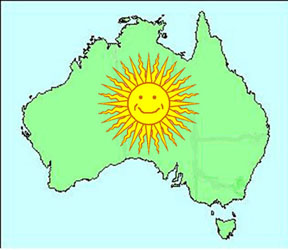 The Australian Energy Market Operator (AEMO), the body charged with running the nation’s energy supply, has modelled the feasibility of switching to 100 per cent renewable electricity generation by 2030 and 2050. This week, AEMO buried its findings in its monthly Energy Update.
AEMO isn’t due to release its draft report on the study until next March. By the end of the year, the government will already have released its Energy White Paper to chart future energy policies for years to come.
More crucial for the renewable energy sector, though, may be the release of the government’s review into the Renewable Energy Target (RET), perhaps within weeks.
Renewables: Australia’s a land of plenty SMH October 26, 2012 Peter Hannam Carbon economy editor When feisty UN climate change chief Christiana Figueres swept into Sydney this week, she mocked suggestions Australia is alone in cutting greenhouse gas emissions.
“Nothing could be further from reality,” Ms Figueres told the Lowy Institute. Rather than excoriate the government for holding out on signing up for the second round of the Kyoto Protocol to set emission targets, the diminutive diplomat instead stressed how the country was “blessed” with renewable energy resources the envy of much of the world.
While many nations were keen to tap such resources in order to improve health and lower carbon emissions, the real appeal, she said, was economic: “None of them is trying to save the planet. They’re doing it because it’s in their national interest and that’s the most important motivator.”
But for national interest to be rightly understood — and acted upon — it helps if the population is aware of what’s possible. Continue reading
Senator Ludlam to question India’s Ambassador on the arrest of David Bradbury
 Australian filmmaker detained in India while investigating nuclear industry Australian Greens Senator Scott Ludlam. 26 October 2012. Australian documentary maker David Bradbury was detained by police late yesterday in Tamil Nadu while investigating the Indian nuclear industry.
Greens nuclear policy spokesperson Senator Scott Ludlam said the arrest was only the latest in a series of moves to suppress criticism of India’s notorious nuclear sector.
“Mr Bradbury was approaching Idinthakarai, a village that has been subjected to severe police repression in response to anti-nuclear protests, when he was detained and taken to Radhapuram Police Station. He has since been released. I will be raising the matter with the Indian Ambassador today. Continue reading
Police stop Australian film-maker from entering Kudankulam anti nuclear protest area
 Australian filmmaker prevented from entering Kudankulam 25 Oct 12http://www.dnaindia.com/india/report_australian-filmmaker-prevented-
 from-entering-kudankulam_1756187 , Oct 25, 2012, Three persons from Australia were today prevented from entering Idinthakarai, the epicentre of protests by People’s Movement Against Nuclear Energy leading the stir against Kudankulam Nuclear Power Plant in Tirunelveli district, police said.
Filmmaker David Bradbury along with his wife and son arrived in India on tourist visas and were about to enter Idinthankarai from Kanyakumari district this morning when police stopped them near Radhapuram police station, they said.
“After interrogations, the three were made to go back, since prohibitory orders were in place,” an officer said.
The PMANE has been leading protests against the plant for over a year citing safety concerns.
Commissioning of the first unit of the Indo-Russian project was originally scheduled for December last year, but has been delayed due to the protest.
India: police deny they detained Australian David Bardbury
 Australian filmmaker detained, let off http://www.thehindu.com/news/states/tamil-nadu/australian-filmmaker-detained-let-off/article4031884.ece , 26 Oct 12, David Bradbury, a documentary filmmaker from Australia, was said to have been detained by the police at Kamanaeri village, near Thomas Mandapam, on his way to Idinthakarai village on Thursday evening Police, however, denied any such incident.
A local resident said a foreign national was intercepted by the police at Kamanaeri while he was on his way to Idinthakarai, the hub of the anti-nuclear protest. He was later taken to the Radhapuram police station and let off after some time. However, he was not allowed to proceed to Idinthakarai.
The Deputy Superintendent of Police, Valliyoor, K. N. Stanley Jones, denied that any foreigner was detained at the Radhapuram police station.
M. Pushparayan, a leader of the People’s Movement Against Nuclear Energy (PMANE), which spearheads the protest, said he had no knowledge of a filmmaker by that name planning to come to Idinthakarai.
Queensland Premier Newman admits uranium not necessarily a job provider
 No evidence jobs flow from uranium mining ABC News By Eric Tlozek, 26 Oct 12, Queensland Premier Campbell Newman admits the State Government has no economic modelling or studies to show lifting a ban on uranium mining will create jobs or investment in the state.
In announcing the lifting of the ban this week, Mr Newman said the decision was partially prompted by Prime Minister Julia Gillard’s recent support for uranium sales to India…
.. Mr Newman says the State Government has no modelling to show the industry will create jobs or increase investment in regional areas. He says the proposal was put to Cabinet after just one meeting with the Mines Minister.
Uranium has not been mined in Queensland since the closure of the Mary Kathleen mine in the state’s north-west in 1982.
http://www.abc.net.au/news/2012-10-25/no-evidence-jobs-flow-from-uranium-mining/4333390?section=qld
Small scale solar power racing ahead in Australia
 The full report: “Benefits of the Renewable Energy Target to Australia’s Energy Markets and Economy” can be viewed here (PDF).
$21.1 Billion Small Scale Solar Power Investment In Australia By 2020 http://www.energymatters.com.au/index.php?main_page=news_article&article_id=3440, by Energy Matters, 26 Oct 12, An independent report shows Australia’s 20 per cent Renewable Energy Target (RET) has generated $18.5 billion in investment overall so far, with potentially many billions more to be invested – if the policy is left unchanged.
Released by the Clean Energy Council, the report shows Australia’s Renewable Energy Target has resulted in a reduction of fossil-fuel base power generation since it was introduced since 2001 and has also assisted in reining in wholesale electricity prices.
“The report shows that, if left unchanged, the Renewable Energy Target will result in 12 per cent less coal-fired generation and 13 per cent less gas-fired generation between now and 2030, with no reliability or security of supply issues identified,” said CEC Chief Executive David Green. Continue reading
Campbell Newman’s next move – get rid of Nuclear Facilities Prohibition Act.?
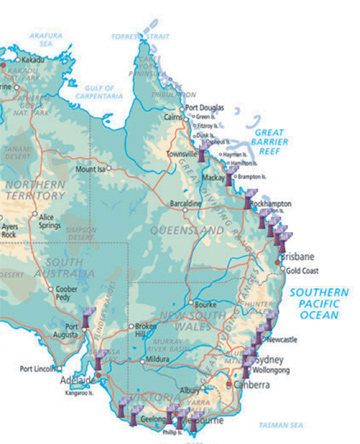 Qld opposition fears nuclear power plants, new.com.au by: Marty Silk October 24, 2012 THE Queensland opposition says allowing uranium mining in the state will eventually lead to a nuclear power industry. Premier Campbell Newman announced on Monday the state would lift a decades-old uranium mining ban, despite saying before the March election the Liberal National Party had no plans to allow it.
Deputy Opposition Leader Tim Mulherin said he fears Mr Newman, like some of his federal counterparts, wants to build nuclear power plants in Queensland. “He’s proved his word on the nuclear industry is worthless,” Mr Mulherin told reporters. He said if the coalition were to win the federal election next year, it would be “a recipe for nuclear power
plants in our state and all the risks they pose”. Nationals Senator Barnaby Joyce’s pro-nuclear power stance should
worry all Queenslanders, he said.
Mr Mulherin said the only thing standing in the Newman government’s way of introducing nuclear power is the Nuclear Facilities Prohibition Act.
The act, introduced by the former Labor state government in 2007, requires a federal plebiscite to allow nuclear power plants. “But if the Newman government repeals the act, our state is wide open to the plans of Senator Joyce and others in the LNP pushing us down the nuclear path,” Mr Mulherin said……
Bans at both levels of government have prevented uranium mining in Queensland since 1982, when the Mary Kathleen mine, near Mount Isa, ceased production.
http://www.news.com.au/breaking-news/national/uranium-mining-no-greater-risk-qld-govt/story-e6frfku9-1226502416198#ixzz2AKgTBMPw
Time for Australia to sign up to the new Kyoto Protocol
 Sign on now, UN climate chief says October 25, 2012 THE United Nations climate chief has called on Australia to sign up to a new round of the greenhouse-gas-limiting Kyoto Protocol, saying it already has significant clean-energy
policies in place.
EU likely to exceed Kyoto carbon-cut target
”From a national perspective it wouldn’t change that much what Australia is already doing,” the head of the UN Framework Convention on Climate Change, Christiana Figueres, said in Sydney. ”It would send a very clear message internationally that what Australia is doing at a national level is actually contributing to global interests.”
The comments by Ms Figueres come as the government weighs joining the federal opposition in backing a second round of the 1997 climate treaty. The current period of the Kyoto Protocol, under which most developed nations pledged to limit their greenhouse gas emissions, lapses at the end of the year. Continue reading
Queensland Premier’s risky choice to go for uranium, not for sunshine
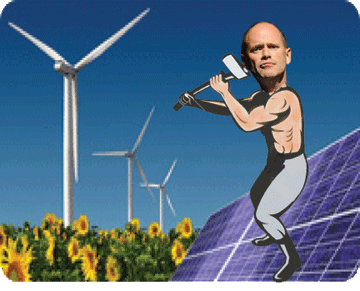 The Premier should remember that community trust is a finite resource.
The risks of uranium last far longer than a politician’s promise. Attempts to introduce uranium mining in Queensland will be actively contested.
Queensland, especially regional Queensland, is perfectly positioned to become a world leader in the globe’s fastest growing energy sector – renewable energy. Queensland has some of the world’s best solar and wind resources. There is no need to open the door to an industry like uranium which is unsafe, unwelcome and under-performing.
Uranium decision takes the cake http://www.theaustralian.com.au/news/uranium-decision-takes-the-cake/story-e6frg6n6-1226502563991 BY: DON HENRY From: The Courier-Mail October 25, 2012 WHEN Premier Campbell Newman wrote to me two weeks ago saying his Government had no plans to approve the development of uranium mining, I took the letter at face value.
So I was as surprised as other Queenslanders when Newman announced on Monday at noon that he would overturn the popular and long-standing state ban on mining the nuclear fuel
.
I realise the Premier has been under a lot of pressure to reverse the state’s prudent position on uranium. The Australian Uranium Association, the Queensland Resources Council and some of the multinational mining companies that hope to make big profits from digging up uranium and shipping it overseas have lobbied hard.
But there are some very strong reasons Queenslanders should keep our uranium in the ground. Uranium is not like other minerals. Continue reading
Australia’s $billions in investment, due to Renewable Energy Target
 Clean energy target drives billions in investment SMH, October 25, 2012 Tom Arup AUSTRALIA’s 20 per cent renewable energy target has helped spark $18.5 billion in new clean energy investment since its inception – and will drive another $8.8 billion to 2030 – an economic analysis commissioned by the industry’s peak body has found.
The modelling to be released today by the Clean Energy Council also says Australia would have failed to meet its greenhouse gas targets under the United Nations Kyoto Protocol without the target in place. Continue reading
Aw gee shucks when I say “No” to nuclear, I mean “Yes” – Martin Ferguson
 Ferguson says no to nuclear power THE AUSTRALIAN AAP October 24 The Australian government remains opposed to nuclear power, Resources Minister Martin Ferguson says. RESOURCES Minister Martin Ferguson has ruled out Australia pursuing nuclear energy as an increasing number of states open the door to uranium mining.
Queensland Premier Campbell Newman on Monday reneged on an election commitment to uphold a 30-year ban on uranium mining in his state, saying Mr Ferguson’s urging and the federal government’s moves to sell uranium to India prompted his decision.
Mr Ferguson told the National Carbon Capture Storage (CCS) Conference in Perth on Tuesday that a wide range of clean energy technologies including CCS would be part of the nation’s future, but not nuclear power, which was expected to fall in cost.
“The Australian government has basically said we are committed to all potential forms of clean energy from an innovative point of view, other than nuclear, which is a proven clean energy technology,” he told reporters…..
http://www.theaustralian.com.au/news/breaking-news/ferguson-says-no-to-nuclear-power/story-fn3dxiwe-1226501691026
Queensland’s scandalous uranium history: a bad idea to start it again
 Queensland Forgets Its Uranium History http://newmatilda.com/2012/10/24/queensland-forgets-its-uranium-history Jim Green, New Matilda, 24 Oct 2012 The Queensland Government is unwise to reverse the ban against uranium mining and there is no stronger reason than the industry’s sordid track record in the state.
French company Minatome undertook trial mining at Ben Lomond, near Townsville, in the early 1980s. Federal MP Bob Katter spoke at length about Ben Lomond in Parliament on 1 November 2005. He noted that Minatome initially denied reports of a radioactive spill, but then changed its story and claimed that the spill posed no risk and did not reach the water system from which 210,000 people drank.
 Bob Katter’s version of the story is on Hansard: “For the next two or three weeks they held out with that story. Further evidence was produced in which they admitted that it had been a dangerous level. Yes, it was about 10,000 times higher than what the health agencies in Australia regarded as an acceptable level. After six weeks, we got rid of lie number two. I think it was at about week 8 or week 12 when, as a state member of parliament, I insisted upon going up to the site. Just before I went up to the site, the company admitted — remember, it was not just the company but also the agency set up by the government to protect us who were telling lies — that the spill had reached the creek which ran into the Burdekin River, which provided the drinking water for 210,000 people. We had been told three sets of lies over a period of three months.”
 Queensland’s other misadventure with uranium was the Mary Kathleen mine in western Queensland. In the mid-1970s, a whistleblower from Mary Kathleen Uranium Mining leaked documents which revealed the existence of a global uranium cartel leading to protracted international scandals and fines totalling hundreds of millions of dollars.
The leaked documents also revealed evidence of shoddy environmental practices at Mary Kathleen; close surveillance of environmental organisations; the close relationship between then-ACTU President Bob Hawke and the chairman of uranium miner Conzinc Riotinto Australia; and advice from government officials about how companies could circumvent non-proliferation treaties in order to sell uranium to countries that had not signed the Nuclear Non-Proliferation Treaty.
One million litres of radioactive liquid were released in February 1984 from Mary Kathleen’s evaporation ponds during a wet spell. Even now, 30 years after the mine’s closure, there is ongoing seepage of saline, metal and radionuclide-rich waters from tailings, as well as low-level uptake of heavy metals and radionuclides into vegetation.
Bob Katter’s son, state MP Rob Katter, claims that uranium mining represents a potential $20 billion export industry for Queensland which could generate 2600 jobs. The simple facts are that uranium accounts for just 0.2 per cent of Australia’s export revenue ($610 million in 2010-11) and less than 0.02 per cent of Australian jobs (1760 jobs including mining, exploration and regulation). Queensland is home to just 3 per cent of Australia’s uranium resources.
Rob Katter claims that Queenslanders support uranium mining but he provides no evidence. The latest poll reported in the Courier Mail in November 2008, found that 47 per cent of Queenslanders oppose uranium mining compared to 45 per cent in support. Two-thirds of Queenslanders oppose uranium sales to nuclear weapons states. A majority of Australians believe that the “safeguards” system, which aims to prevent nuclear weapons proliferation, is ineffective.
Before the last state election, the Queensland Liberal National Party said it had no intention of reversing the ban against uranium mining. Campbell Newman’s LNP Government ought to take its new position to the next state election. Better still, a referendum could be held on the question of uranium mining when Queenslanders next go to the polls.
The uranium industry has no capacity to deliver serious economic benefits to Queensland but, if given the chance, it will create more long-term environmental and public health hazards such as Ben Lomond and Mary Kathleen.
Queensland farmers not keen on uranium mines in their back yard
Uranium mining rethink sparks Qld farmland fears, ABC News, By Chrissy Arthur 24 Oct 12 Rural lobby group AgForce says it has concerns about the impact of uranium mining on Queensland farms. The State Government will lift a long-standing ban on uranium mining, saying it will generate investment and jobs.
However, some landholders and conservationists have expressed concern about the environmental impact and the possibility of toxic mine spills. AgForce president Brent Finlay says landholder concerns will need to be considered.
“All of those issues concern us and that is why it has to be done properly if it is done,” he said.
“We have to work with landholders, we understand that no landholder wants any mine in their backyard – it puts pressure on agriculture. “If these developments do go ahead, the impacts on the environment and the community are very important and they have to be managed and if there are spills, they need to be cleaned up.”
A Gulf of Carpentaria mayor says local government leaders will also pressure the Queensland Government to ensure environmental safeguards are in place for any uranium developments…
CSIRO mapping Australia’s wealth of solar energy
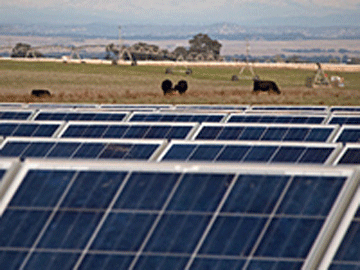 Solar mapping to shed light on rich resource , SMH, October 24, 2012 Peter Hannam We may be a nation of sun-worshippers but when it comes to forecasting where the sun shines longest, Australia’s energy authorities are stuck in the dark ages.
The CSIRO is hoping to fill that information void with a lot more riding on it than the best place to get that tan. Energy energy suppliers – current and future – need the data to predict how much solar electricity is likely to flow through the nation’s power grids.
For potential developers of large-scale solar power plants, radiation records are needed to bolster investment certainty as they try to secure finance from bankers or government agencies. The real urgency for hard numbers, though, is coming from the rapid take-up of solar photovoltaic (PV) panels, with the total now approaching 900,000 across the country. Continue reading
Australia’s extradition laws – creeping loss of civil liberties
 a new form of economic imperialism, with the long arm of the Government using criminal enforcement powers to enforce commercial interests at the behest of corporations and their lobbyists. It’s about power.
As recently amended, Australia’s extradition laws enable a person to be extradited for minor offences
extradition is not precluded if the person faces cruel, inhuman or degrading treatment or punishment that is not severe enough to amount to torture.
What is to become of individuals who engage in non-violent political protest on the internet?
The tentacles of extradition, Online opinion By Kellie Tranter -, 23 October 2012 Being hailed as “incredibly brave” to stand up to the United States, UK home secretary Theresa May has halted the extradition of British computer hacker Gary McKinnon because of medical reports warning that McKinnon – who was first indicted by a federal grand jury in Virginia in November 2002 –would kill himself if he was sent to stand trial in the United States. But unanswered questions remain about the nature of political extradition cases more generally.
In 2007 former NSW Chief Judge in Equity, Justice Peter Young, highlighted in the Australian Law Journal ‘the bizarre fact that people are being extradited to the US to face criminal charges when they have never been to the US and the alleged act occurred wholly outside the US.’
Justice Young’s comments were raised in the context of the case of Hew Griffiths, an Australian who was the first person in the world to be extradited and criminally prosecuted in the United States for copyright infringement. .. Continue reading
1 This month


Help Aunty Sue Protect Her Land and Sacred Sites From Destructive Rocket Testing.
.

Australians deserve the truth
about
AUKUS – https://aukuspublicinquiry.com/

PETITION – To: Prime Minister Anthony Albanese and the Australian Labor Government

of the week – Australians for War Powers Reform (AWPR)
To see nuclear-related stories in greater depth and intensity
 Antinuclear