Call to Aboriginal land councils to avoid uranium
 Aboriginal land councils urged to avoid uranium http://www.abc.net.au/news/2012-10-23/aboriginal-land-councils-urged-to-avoid-uranium/4328580/?site=indigenous&topic=latest Eugene Boisvert 23, 2012 An environmental activist says Aboriginal land councils may apply for permits to explore for uranium because they now don’t have to give permission for exploration on their land.
Natalie Wasley from the Beyond Nuclear Initiative is organising a protest next month, when expressions of interest for the permits close.
The far west is believed to be rich in uranium. Ms Wasley says exploration will inevitably lead to mining, and that the Broken Hill Aboriginal Land Council should have to give permission for mining activity to happen on their land.
“Unfortunately when the exploration laws changed they actually altered the Aboriginal Land Rights Act to say that local councils don’t have to give consent for exploration to go ahead,” she said. “This is a very retrograde move and something that should be very strongly opposed.” Natalie Wasley from the Beyond Nuclear Initiative says it is unclear
who has applied for the licences, but she believes Aboriginal Land Councils will apply.
“I believe there’s been an expression of interest put in but we’re not sure who’s actually made applications until the application period closes on the 13th of November,” she said.
“There’ll be a rally outside Parliament House on that day where lots of different organisations are sending representatives to say that we don’t want any exploration licences to be granted. The ABC has attempted to contact the Broken Hill Aboriginal Land Council for comment.
Senators John Madigan and Nick Xenophon move to stop wind farms
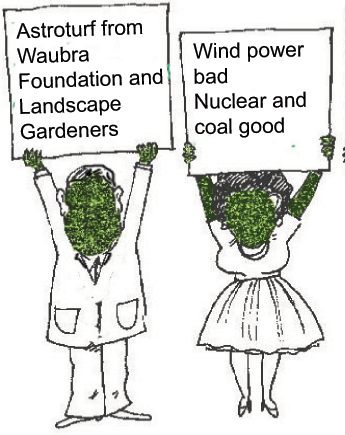 In July 2010, the National Health and Medical Research Council found that there is no published scientific evidence to support adverse effects of wind turbines on health.
Given their currently significant, and potentially enormous, contribution to reducing Australia’s greenhouse gas emissions, wind farms should not be held guilty until proven otherwise.
Wind farms: guilty until proven otherwise? http://www.climatespectator.com.au/commentary/wind-farms-guilty-until-proven-otherwise, 22 Oct 2012 Albert Yu Recent reports show that coal-fired power stations are finding it difficult to operate in the new market environment with falling electricity demand, a carbon price and the renewable energy target. Meanwhile, as noted by the Productivity Commission last week, wind generation is an “increasingly important source of power” in the National Electricity Market, highlighted by news of the first turbines turning at Australia’s largest wind farm to date, the 420 MW Macarthur wind farm.
As reported on Climate Spectator last month, wind power has allowed South Australia to transform itself from almost entirely being an importer of power from Victoria to being an exporter during high wind periods, whilst significantly reducing the state’s carbon emissions.
On the other hand, sitting before the Senate is the Renewable Energy (Electricity) Amendment (Excessive Noise from Wind Farms ) Bill 2012, introduced on June 28 by Senators John Madigan and Nick Xenophon to (in Senator Madigan’s words) “ensure we do not see any expansion in the number of wind farm refugees.” Continue reading
Australia’s Small-scale Renewable Energy Scheme (SRES) needs to be kept
Australian Solar Council Goes Into Bat For Home Solar Support by Energy Matters, 22 Oct 12, “……..The Australian Solar Council has firmly rejected the call by the Productivity Commission to abolish the Small-scale Renewable Energy Scheme (SRES).
“We all know that many more Australians want to install solar panels and solar hot water, but the upfront cost of these systems remains a significant barrier. That is why the SRES is so important and must be continued,” says John Grimes,Australian Solar Council Chief Executive.
“Demand for solar PV has reduced significantly since the solar multiplier was reduced on 1 July, and there are no signs that demand is picking up. The last thing the solar industry needs is more uncertainty.”
The Australian Solar Council is seeking direction and reassurance that the SRES and associated mechanisms are not under threat.
Mr. Grimes says his organisation endorses the view of Giles Parkinson of RenewEconomy who wrote recently that “until organisations such as the Productivity Commission get their mind around solar PV…then we cannot rely on them to make sensible recommendations”.
Under the current timetable, the Solar Credits multiplier is not due to be phased out until July 1 next year. If the Commissions draft recommendations were implemented, that could be brought forward to as early as towards the end of this year. http://www.energymatters.com.au/index.php?main_page=news_article&article_id=3435
Australia’s pathetically weak role in the international Comprehensive Nuclear-Test-Ban Treaty (CTBT )
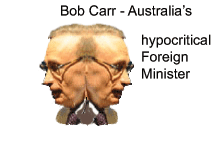 Australia’s Foreign Minister Bob Carr makes much of weak treaties like this one. I would trust Bob Carr about as far as I could throw him. Carr is an enthusiastic member of Australia’s pro nuclear elite. He is adept at publicising seemingly effective nuclear disarmament moves – but when you look at them properly moves like this much vaunted strengthening of the Comprehensive Nuclear-Test-Ban Treaty (CTBT ) – are really hypocritical sops to those of us who are anxious about nuclear weapons – Christina Macpherson
AUSTRALIA-NZ PACT FALLS SHORT OF ABOLISHING NUKES IDN-InDepthNews – October 21, 2012 By Neena Bhandari SYDNEY – Australia and New Zealand have entered into a scientific and technical cooperation agreement to strengthen detection of nuclear explosions under the framework of the international Comprehensive Nuclear-Test-Ban Treaty (CTBT ) and work together to promote a permanent and effective ban on nuclear weapon tests….. The move would see Australian Radiation Protection and Nuclear Safety Agency and Geoscience Australia working more closely with New Zealand’s Environmental Science and Research (ESR) to enhance their capabilities to detect nuclear explosions……
‘Move quickly to a Nuclear Weapons Convention’
But Chairman of the Mayors for Peace Foundation and former expert advisor to the Hiroshima Peace Culture Foundation , Steve Leeper, feels countries like Australia that have signed and ratified the CTBT should be doing far more than talking about a new framework.
“It makes it look like the two countries are doing something about nuclear weapons when what they are really doing is refusing to support the nuclear weapons convention. Continue reading
Gillard government takes its orders from USA – uranium to India
Gillard is helping to destabilise the sub-continent by fuelling a dangerous arms race involving India’s rivals, China and Pakistan.
The Labor government’s about face on uranium sales to India under Gillard was carried out on Washington’s orders. In November 2011, the US ambassador to Australia, Jeffrey Bleich, publicly called on Canberra to “sort out” its issues with India, as the US had done when it resolved the “thorny point” of uranium sales through the 2008 nuclear deal that exempted India from the Nuclear Non-Proliferation Treaty (NPT)

Australian PM visit to India bolsters new “strategic partnership” WSWS, By Patrick O’Connor 20 October 2012 Australian Prime Minister Julia Gillard’s three-day trip to India this week was aimed at deepening military, diplomatic, and economic ties between the two countries.
Washington has encouraged the closer relations as part of its aggressive drive to undermine the influence of China in the Indo-Pacific region. Gillard met with Prime Minister Manmohan Singh on Wednesday. High on the agenda was progress towards Australian uranium sales to India, Continue reading
Western Australian Labor party’s weak opposition to uranium mining
Uranium mine: ‘more than the issues we’ll lock on to’ Green Left , October 20, 2012 By Alex BainbridgeTwenty-four hours after telling the world that “people need to start showing some respect for the environment they live in”, WA environment minister Bill Marmion showed what he meant by that statement by approving Western Australia’s first uranium mine The October 9 decision gives state approval to Toro Energy for its Wiluna uranium mine. The mine still requires approval from the federal Labor government, but the state approval is considered to be a major hurdles passed.
The state Labor opposition tries to walk both sides of the street, claiming it is opposed to uranium mining but promising not to close down any mines approved by the current government. This stance contrasts with the policy WA Labor had under its previous leader and is a marker of the shift to the right under Mark McGowan.
Socialist Alliance candidate for Willagee Sam Wainwright said this is a mistaken policy. “Labor should be threatening to reverse approval for the mine and promising to utilise every democratic means possible – including the power of the people – to avoid paying a cent in compensation.
“At the moment, Labor is just giving comfort to the uranium industry and promising to give them a toe-hold to maintain their existence – just as the Bob Hawke government did in 1983 with their ‘Three mines policy’…… Anti-Nuclear Alliance of WA spokesperson, Marcus Atkinson told Green Left Weekly that after protesting at Toro, the group moved to state parliament where they were joined by Manufacturing Workers Union state secretary Steve McCartney who spoke against the approval.
Other speakers included former Greens senator Jo Vallentine and anti-nuclear campaigner Mia Pepper.
ANAWA is planning to contest the mines development in every possible way, including a possible legal challenge….. http://www.greenleft.org.au/node/52565
Australia: electricity demand is falling, and power companies are lying about this
 Farmer finds facts lost in transmission. The Age October 22, 2012, Michael West Four months ago – on hearing of a proposal to run giant transmission lines through his property – a farmer from the NSW north coast, Bruce Robertson, delved into the claims the power companies had been making about electricity prices. He found they were untrue.
Four days ago, the Productivity Commission corroborated what Robertson had been saying all along. That is, escalating power bills were principally the upshot of over-investment in electricity networks; not the carbon tax, not rising consumption.
”Demand is falling, not rising,” Robertson says. ”This basic premise is factually incorrect.”…… ”It is often said that if you lie long enough and loud enough, then the lies become the accepted truth,” Robertson says.
”And so it is with Grid Australia, in their submission to the Senate inquiry into electricity prices. Many of the statements made to the Senate inquiry are purely and simply fabrications.”…..
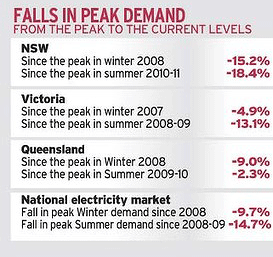 Demand for electricity had been falling since 2008 in Victoria, NSW and Queensland at roughly 1 per cent a year, despite forecast rises of 2.2 per cent a year.
Demand is now 10 per cent below where the industry forecast it would be four years ago. Mild weather, changing consumer behaviour and rising costs have all been factors in this, Robertson says.
In July, as ”gold-plating” started to become a buzzword in Canberra, Robertson launched into numerical detail of how the industry figures had been inflated and distorted…..
Peak demand was falling. Recent figures from the Australian Energy Regulator show the clear change in trend since 2008-09. Peak demand for both summer and winter demands in the national electricity market are on the wane.
In NSW, the largest market in the NEM, peak demand has veritably collapsed. ”The fall in peak in winter since 2008 has been 15 per cent and the fall in the summer peak since 2010-11 has been 18 per cent. This collapse has seen peak demands fall to levels not seen for a decade,” Robertson says.
Despite the hard numbers, we still have a ”he said, she said” debate. ”The only place that peak demand is rising is in the minds of electricity industry executives,” Robertson says……
The essence of the problem of rising power prices is the structure of the industry and its regulation. Continue reading
Falling demand for electricity results in halting New South Wales coal fired power station
 Fossil Fuel Power – Another One Bites The Dust, by Energy Matters, 21 Oct AGL Energy Limited (AGL) announced on Friday the suspension of the first stage of its 1,000 MW Dalton power station in New South Wales. According to a very brief statement from the company, economic viability of the project had been under review for several months due to market conditions…
… The rising demand hasn’t happened – in fact, quite the opposite. According to a report from REC Agents Association (RAA) earlier this year, over the last three years electricity consumption in the eastern states’ National Electricity Market (NEM) had dropped by 3.2 % (6,565 GWh); with over half that reduction attributable to hundreds of thousands of solar hot water and rooftop solar panel installations, along with energy efficiency initiatives.
According to a Sydney Morning Herald article, electricity industry sources estimated more than 10 per cent of electricity demand in NSW was supplied by rooftop solar power systems during much of the daylight hours earlier last week.
The Dalton power station suspension adds to a continually growing scrap heap of gas and coal-fired projects around Australia. Elsewhere in New South Wales, the end of coal fired generation at Munmorah power station has been confirmed. In Queensland, Stanwell Corporation Limited is taking two units at its Tarong facility in Queensland offline soon and last week, it was announced some of Victoria’s Yallourn Power Station’s generation capacity would be mothballed. http://www.energymatters.com.au/index.php?main_page=news_article&article_id=3432
Don’t miss this excellent radio interview on the future of nuclear power

 Nuclear Energy Raises More Questions http://blogs.abc.net.au/nsw/2012/10/nuclear-energy-raises-more-questions.html ABC Radio 702 Sydney. Tim Holt interviews Derek Abbott, Professor of Electrical Engineering at the University of Adelaide, raises some very interesting practical considerations that will affect the future of this alternative source. 17/10/2012

PROF ABBOTT – Very hard to say how much nuclear industry is going ahead. Nuclear power – Some countries going ahead some countries pulling back. Not all so rosy in India.They are planning 60 nuclear stations. But In Tamil district 10,000 villagers demonstrating against local nuclear reactor, going on hunger strikes. Indian forces had to put out 4,000 security forces to control this problem. Needed large security force there.
My view is no. Nuclear power at the most could achieve only a very small slice of global energy pie. Can’t even supply half of the world’s needs.
Uranium gradually runs out – ore becomes more crude, harder to find uranium, and mining costs more. That’s one problem
Other problem actual metal you make the nuclear power stations out of / Nuclear power station isn’t just concrete and steel. Metals in nuclear power station – lots of exotic rare metals.Excessive energy given out, Prone to cracking, these exotic metals needed to prevent cracking are quite rare. Growth rate in consumption of these rare metals is huge , because used also in many modern technologies. Faster growth rate in consumption of these metals than the growth rate in oil. Likely to run out, even without nuclear. When would these metals run out? Add nuclear to the equation put on line hundreds of new nuclear stations.- eat into these rare metals and depleting them at a faster rate.
Problem with nuclear power – everything becomes non recyclable. What do you do with the nuclear station – you bury it for 10,000 years. Those metals become radioactive and you can’t re-use them. So – reducing world’s elemental diversity, supply of these rare metals.How many nuclear reactors would we need to supply all our energy needs from nuclear power? Something like 15,000 nuclear power stations to power the world presently. Completely unfeasible to scale up to some sort of nuclear utopia. We have problems with 430 reactors now.
Get any map of any country of the world – draw 100 dots on map as to where you could possibly put a new nuclear power station. Hard to put 10 nuclear power stations, let alone 100. Need to be away from populations, near water, where you won’t get lawsuits. USA would need 4000 nuclear stations – hard put to find 100 spots.
Yes, we should still research nuclear fusion. But to make that leap to a commercial fusion reactor- a big thing.But nowhere near commercial. Still the problems – high energy neutrons will crack the metal – same problems of rare metals – metals recycling problems again.
Renewables so relatively cheap and easy to lay on. Can build a modular solar farm using curved mirrors that focus sunlight . Mirror 10 metres in diameter – get 300-400 degrees Centigrade Can super heat water and run a steam turbine.- can set up in desert place relatively easily.
Sadly Australia has not taken bull by the horns. There are solar thermal projects in Australia. ANU in Canberra have had solar project for along time. Australia needs to take up solar. So much desert – the ideal country for solar.
Theoretically, If you powered an area size of Canberra with solar mirrors. – enough to power the whole of Australia.
Sun is a nuclear fusion reactor – it’s the obvious one to turn to.
Going back to your question about why Australia has not embraced solar power – Economics the reason and what we can afford to do. – we have a relatively small population. We are getting wakeup calls now with the changing climate. The rime is ripe now for Australia to change this

Grim future for Australia’s uranium industry, falling demand, falling prices
Adding to the miners’ woes, uranium prices continue to fall, from US$73 a pound in March 2011, to around US$43 currently. That’s lower than the cash cost of production at Paladin’s Kayelekera mine in Malawi, giving the miner a decent sized headache.
Nuclear Fallout Hurts Uranium Miners , 9 News, by Mike King, The Motley Fool, October 19, 2012 The world continues to feel the impact of the Fukushima nuclear disaster. The disaster in Japan in 2011 has left 48 of Japan’s nuclear reactors sitting idle, awaiting government approval to resume operations, with just 2 restarted. In mid-September, the Japanese government approved a new energy plan which included reducing the nation’s reliance on nuclear energy substantially.
Following the Fukushima accident, Germany immediately shut 8 of its reactors, and plans to close its remaining 9 reactors by 2022.
The impact is being felt by uranium miners globally.
Paladin Energy Ltd (ASX: PDN) recently stated that annual demand for uranium has fallen, as the future of nuclear energy was cast into doubt. The world’s largest uranium producer, Canada’s Cameco, has also forecast lower sales and highlighted doubts about the take-up of nuclear power in future. Continue reading
Ducking and weaving about India’s nuclear safety – Australian Safeguards and Non-Proliferation Office (ASNO)
Senator LUDLAM: …. Are you aware of the recent report by their Auditor-General that absolutely slams the industry?
Mr Shannon: Yes.
Senator LUDLAM: ……. if you are not convinced-as the Indian Auditor-General certainly isn’t-that those plants are being run to anything like world’s best practice, a sales agreement would not occur?
Ms Bird: These are all issues which will be worked through during the negotiating practice process.
 http://scott-ludlam.greensmps.org.au/content/estimates/australian-safeguards-and-non-proliferation-office-asno Australian Safeguards and Non-Proliferation Office (ASNO) 18 Oct 2012 | Scott Ludlam Supplementary Senate Estimates – Foreign Affairs Defence and Trade Committee – 18 October 2012 “Dr Kalish is the acting DG of ASNO……
Senator LUDLAM: … Can you tell us officially, from the point of view of ASNO, what the status is of the bilateral safeguards agreement with India?….
Dr Kalish: Negotiation has not commenced on that treaty.
Senator LUDLAM: Well, it has been announced to the entire planet that there will be an agreement. So ASNO has not yet begun work on any such agreement?
Dr Kalish: I believe what was announced was that negotiations would commence on an agreement.
Senator LUDLAM: Can you just sketch for us the process by which those negotiations will be conducted?
Mr Shannon:….. The agreement has been reached to start the negotiations, which was last night, our time. Advice is being
assembled for ministers to consider the mandate. …. We think it will take some time, maybe a year or two. We do not have a feel for it yet
Senator LUDLAM: It sounds like a big announcement has been made but actually there is nothing at all in terms of how these negotiations will progress or, from an Australian side, who the lead organisation will be, who our negotiators will be.
Mr Shannon: No. Those things have not yet been finally decided…… Continue reading
Australia’s uniquely beautiful cuttlefish in need of protection
 Christina’s note: The cancelling of BHP’s plan for a mega uranium mine at Olympic Dam has had one bit of very good “fallouT – in that they now probabaly won’t want the desalination plant at Spencer Gulf. That would have alomost certainly resulted in the extinction of this unique and beautiful animal, which depends on the delicate balance of salt and fresh water for its breeding area
More protection urged for cuttlefish http://www.abc.net.au/news/2012-10-19/more-protection-urged-for-cuttlefish/4323270 Oct 19, 2012 Greens MP Mark Parnell is urging an immediate listing of the giant
Australian cuttlefish as a protected species. Some Whyalla locals say cuttlefish numbers in upper Spencer Gulf fell
from an annual aggregation of about 200,000 to about 6,000 for the most recent breeding season. Research is yet to pinpoint a cause.
Mr Parnell said even if over-fishing was not the cause, there would be no harm in giving the cuttlefish more protection.
“There are some simple actions they can take – protect these fish under state law, seek their protection under federal law and put in place an emergency recovery plan that involves all the best science, and not just throw your hands up in despair and say ‘Well they’re disappearing and there’s nothing we can do about it’,” he said.
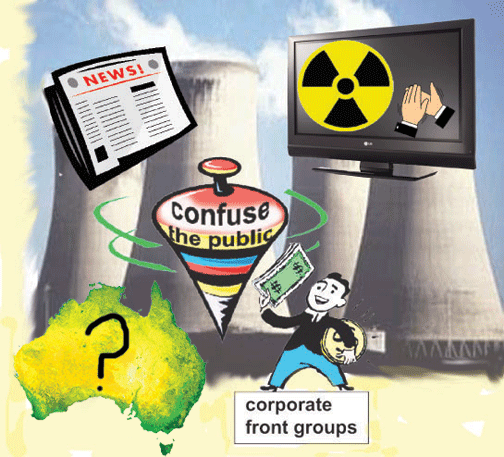
Australian media more interested in Julia Gillard’s shoes, than in the dangerous uranium deal with India
 The opening up of nuclear trade with India — first by the US in 2008 and most recently by Australia — has broader implications. It fundamentally changes the proliferation equation for other countries.
The most dangerous lie peddled by industry and by the Australian and Indian governments is that India has a strong track record of nuclear non-proliferation.
The Gillard government has no intention of seriously addressing any of the proliferation, safety, security and regulatory problems, nor does it care about the repression and murder of peaceful citizen protesters in India.
India’s Abysmal Nuclear Record, By Jim Green, New Matilda, 18/10/12 http://newmatilda.com/2012/10/18/indias-abysmal-nuclear-track-record
While the media focuses on Julia Gillard’s stumbles, India’s clunker of a nuclear industry stays unexamined. But hey, what’s a bit of nuclear proliferation between friends? Jim Green from Friends of the Earth on the South Asian nuclear arms race
According to Gemma Bailey, writing in the Australian Financial Review, Prime Minister Gillard has a cunning plan. She will ensure that Australia’s uranium supply treaty with India contains strict conditions on the safe use of the nuclear fuel. The plan, we’re told, “is intended to neutralise opponents who highlight that India has not signed the Nuclear Non-Proliferation Treaty.”
If only that were true. Here’s Gillard’s real plan: trot out tired old lines about strict conditions and hope that journalists will regurgitate them without question. For the most part, it works. A number of media organisations have run an Associated Press piece which asserts as fact that Australia “sells uranium only … under strict conditions”. Michelle Grattan has twice used her Fairfax column to remind us about John Howard’s cricketing abilities, but she remains silent about the weapons proliferation issues at stake with the uranium deal.
Fairfax’s National Times ran what was essentially a propaganda piece by Professor Amitabh Mattoo from the Canberra-funded Australia India Institute. And the day before Labor’s National Conference debated uranium sales to India last year, the Sydney Morning Herald published a column by the Lowy Institute’s Rory Medcalf downplaying the risk of proliferation. The Lowy Institute — which prominently lists uranium miner BHP Billiton as a funding partner — refused to run a critique of Medcalf’s column on its blog.
 At stake is the nuclear arms race in South Asia and broader, global nuclear proliferation concerns. As Ron Walker, a retired Australian diplomat and former Chair of the Board of the International Atomic Energy Agency (IAEA), said last year: “I am horrified that the media have not explained the enormity of this proposal.”
India is at least as culpable as its neighbours in fanning the nuclear arms race in South Asia.
CEO dismisses Japanese nuclear disaster to promote Alice Springs uranium mine
CEO dismisses Japanese nuclear disaster to promote Alice Springs uranium mine The Public Health Association of Australia (PHAA) says comments attributed to Paladin CEO John Borshoff on the Angela Pamela uranium deposit are disingenuous and insulting to people still suffering from the effects of the Fukushima disaster in Japan.
“Claims that Fukushima is behind us are a gross insult to the intelligence of the public here in Australia and completely misrepresent the situation in Japan. In Japan the ongoing problems from the reactor disasters are far from in a state of ‘clear air’ – the real and political fallout is ongoing,” was the response today from PHAA Spokesperson Clive Rosewarne on reports that the exploration company Paladin was keeping the uranium deposit at Angela Pamela (around 25kms south of Alice Springs) on its proposed projects list.
“Comments attributed to Paladin CEO John Borshoff in the NT News and on ABC News look like a desperate attempt to talk up an industry to investors who are rightly looking to place their money on better investment options. The price of uranium continues to fall amid growing international rejection of nuclear power by the public and their governments.”
In July this year the Japanese Nuclear Accident Independent Investigation Commission reported most of the 150,000 evacuees ‘continue to face grave concerns, including the health effects of radiation exposure, displacement, the dissolution of families, disruption of their lives and lifestyles and the contamination of vast areas of the environment.’ And that ‘There is no foreseeable end to the decontamination and restoration activities that are essential for rebuilding communities.’ http://naiic.go.jp/en
“The Angela Pamela deposit has been soundly rejected as an option on the doorstep of Alice Springs,” said Mr Rosewarne. In recent NT elections anti-uranium candidates polled strongly – often against the general NT voting trend. He continued, “People in Alice Springs don’t want this project both for its impact locally and because of the events at Fukushima.”
Preliminary modelling undertaken by PHAA shows that prevailing winds would pose a risk of contamination to residents in the local vicinity, particularly those in the jail, the Joint Defence Facility (Pine Gap) and rural areas.
“Given the right wind and weather conditions, failure of dust suppression and tailings management at any Angela Pamela mine means people around Alice Springs are at a low but still significant risk of dust exposure. Workers at the Brewer Industrial Estate, prisoners and officers at the Correctional Facility, staff at the Joint Defence Facility at Pine Gap and residents of the Iwupataka Homelands face this risk. In Alice Springs itself, workers and tourists at the airport and residents at Amoonguna are at lower risk. The Ilparlpa subdivision carries an intermediate risk. Grazing cattle and station workers in the surrounding country would always be at some risk,” concludes Dr Peter Tait author of the study.
With their joint venture partner having taken a step back, Paladin CEO Borshoff’s description of the Angela Pamela deposit as a ‘key project’ may reflect more upon his personal attachment to the deposit (he was involved in the early exploration of the site in the 1970-80’s) rather than on the economic or social reality facing the project,” concluded Mr Rosewarne.
For further information/comment Clive Rosewarne, Spokesperson for PHAA Ecology and Environment Special Interest Group: 0487 282 303
Dr Adi Paterson of Australian Nuclear Science and Technology Organisation upset at being called a lying shit
 Nuclear agency boss emotional as whistleblower taunts http://www.cootamundraherald.com.au/story/405017/nuclear-agency-boss-emotional-as-whistleblower-taunts/?cs=12 By Bianca Hall THE head of Australia’s nuclear agency briefly broke down at a dramatic Senate estimates hearing yesterday, after an angry whistleblower accused him of covering up a serious incident in which workers were splashed with radioactive material.
Australian Nuclear Science and Technology Organisation chief executive Adrian Paterson was comforted by Senators and staff, and refused to leave the room until the man had left the building.
Listening to Mr Paterson give evidence was former ANSTO worker and whistleblower David Reid, who worked at the facility for almost 30 years, including years as his colleagues’ occupational health and safety representative.”You’re a liar,” Mr Reid growled when Mr Paterson finished telling the inquiry he did not believe the incident had occurred.
”You’ve fabricated the findings, covered up safety incidents … you guys covered it over. You’re a lying piece of shit.”
Mr Reid later told The Age he had been sacked after bringing claims of the incident to management. ”It’s trashed my life; I’ve just been obsessed with it. My marriage fell apart, and I lost my house and I’m living in a caravan. But I can’t let it go.”
KPMG conducted the most recent investigation into the incident, reporting in June that many current and former ANSTO employees had ”imprecise at best” recollections of the incident. But it found the regulator – the Australian Radiation Protection and Nuclear Safety Agency – failed to properly investigate the matter and neither its interim, nor final inspection reports, ”sufficiently examined allegations that a contamination incident … occurred”.
Greens Senator Scott Ludlam called for ANSTO to apologise to Mr Reid. ”I think what has to happen from here, Mr Reid is clearly owed an apology, but the regulator is going to have to step up.”
1 This month


Help Aunty Sue Protect Her Land and Sacred Sites From Destructive Rocket Testing.
.

Australians deserve the truth
about
AUKUS – https://aukuspublicinquiry.com/

PETITION – To: Prime Minister Anthony Albanese and the Australian Labor Government

of the week – Australians for War Powers Reform (AWPR)
To see nuclear-related stories in greater depth and intensity
 Antinuclear