How nuclear lobbyists like Barry Brook trivialise the health impacts of ionising radiation
 Nuclear sector seeks to regain trust after Fukushima, Paul Langley’s NUclear History Blog, Sep 13, 2012“……..March 11 was an error,” said Ric Perez, president and chief operating officer of Westinghouse, also a leading nuclear company and majority-owned by Japan’s Toshiba.
…….Earlier this year, the was a public meeting held at the Walkerville Hall. Barry Brook of Adelaide University, passed around little sealed plastic bags containing uranium ore to the gathered crowd. Perfectly safe he said. True enough at the level of radiological laboratory Barry. People measured the gamma dose emitted by the ore, the gamma penetrating, largely unattenuated, the little plastic bags. The alpha radiation was not measured. It presents only as a severe internal hazard if taken into the body.
Barry, how many little plastic bags, glued to the shattered Fukushima reactors, will it take to seal the inside the reactors the radionuclides which have been venting and leaking from them since March 2011?
A rough number will do. What the hell were you thinking? That a broken reactor complex is anything remotely like a rad lab, the main aim of which is to keep its radioactive sources sealed?
A rad lab and a broken rank of reactors are two very different things Barry. So what was your point?
The idea of the myth of progress is to enable a false claim that present “mistakes” are not actually mere repeats of the deliberate crimes of the past.
That is why, sometimes, “progress” is indeed a myth.
Sometimes, the nuclear victims of the earlier nuclear escapades had children. And those children often remember precisely what happened to their parents, and sometimes, to themselves, as a result of nuclear “mistakes”.
The children of Fukushima will retain their memories for a long time, and will perhaps pass onto their children their recollections of what Mr Perez calls an “error”.
http://nuclearhistory.wordpress.com/2012/09/13/fukushima-was-mistake-wetinghouse-chief-boy-he-thinks-its-still-1954/
Renewed lobbying for uranium mining in Queensland
 Federal Resources Minister Martin Ferguson, in a speech to the uranium industry in June, called on Queensland to lift the ban. “The Australian Government urges Queensland to take the next step and to also remove its ban on uranium mining
LNP silent on uranium mining front Gympie Times, Daniel Burdon, APN Newsdesk | 13th September 2012 A RENEWED push by the state resources lobby to reopen Queensland to uranium mining has been met with silence by the Newman Government. Continue reading
Importance of keeping Australia’s Renewable Energy Target unchanged
Australia’s Renewable Energy Target – Stability Crucial http://www.energymatters.com.au/index.php?main_page=news_article&article_id=3381 by Energy Matters, 14 Sept 12, Flip flops isn’t just an American term for a popular form of Aussie footwear; it also describes our country’s approach to renewable energy at times – and to our detriment.
The Federal Government’s Climate Change Authority is currently undertaking a review of Australia’s Renewable Energy Target, currently set at 20 per cent of Australia’s energy to be gained from renewable sources by 2020. The Clean Energy Council has called for the Federal Government to ensure the Renewable Energy Target remains unchanged, stating that it was crucial to promoting investment, driving job creation and continuing to push down costs for consumers. “The Renewable Energy Target is the single most important policy measure for the entire Australian renewables sector,” said Clean Energy Council Chief Executive David Green.
“Any changes to the Renewable Energy Target will shatter this stability and remove investor confidence in clean energy, negating the industry’s ability to support Australia’s shift to clean energy sources and to reduce energy costs for consumers in the long-term. The fact a review is even being held is already contributing to uncertainty in the market.”
The CEC believes alterations to policy could damage returns on investments already made and consequently, Australia’s reputation with regard to energy infrastructure investment.
The organisation states the Renewable Energy Target has generated around $18.5 billion of investment and thousands of jobs, seen 1.7 million home solar power and solar hot water systems installed and resulted in the equivalent of more than 2.1 million households being powered by large scale renewables to date.
“To date, it has also been the single largest carbon abatement scheme in Australia and without it Australia would not have achieved its emissions reductions target under the Kyoto Protocol,” says Mr. Green.
Left untouched, current policies would see a further $30 billion in investment and a total reduction of 380 million tonnes in carbon emissions over the life of the scheme.
“The cost of the Renewable Energy Target contributes just 7 per cent to the average Australian electricity bill, and this is forecast to drop to just 4 per cent by 2020 – with even greater potential savings as we all become smarter about how we use our energy.”
Submissions in response to an initial issues paper released by the Climate Change Authority are due today. The Clean Energy Council’s submission can be viewed here .
Queensland leads in war against solar energy
War against solar: pricing regulator favours gross tariffs, REneweconomy, By Giles Parkinson on 14 September 2012 The Queensland pricing regulator says it favours the introduction of a gross feed in tariff in the state, in a move that the solar industry say would be devastating for the rooftop solar PV market…..
They argue it effectively reduces competition in the industry, and potentially removes one of the key solutions to the overloading of grids. Numerous independent studies have underlined the important role that solar PV could help in meeting peak demand, but this is rarely acknowledged by the utilities, who are more concerned about protecting revenues by growing their assets. The move comes just months after the Queensland Government slashed its net feed in tariff. Queensland had been the fastest growing state for solar PV, accounting for 40 per cent of national installations by some count.
The introduction of gross tariffs would also likely kill off the emerging commercial-scale solar PV market in Australia. Commercial scale solar is considered one of the most effective options for reducing peak demand because the output from the rooftop or ground mounted panels corresponds with usage by commercial users.
However, Australian solar companies have also expressed fears that the suspension of grants under the Federal government’s $800 million Clean Technology Investment Program for manufacturing groups could threaten many projects, just as the industry was getting started.
The head of one NSW company, who requested anonymity, said he had 15 proposals on the drawing board, ranging in size from 30kW systems to up to 1MW for customers including manufacturers, processors, retailers, and vineyards.
He said if the funding was withdrawn, only a couple of smaller projects were likely to go ahead. That’s because larger commercial customers had the buying power to negotiate lower electricity prices – of around 16c-18c/kWh (instead of 30ckW/h or more) from the utilities which were effectively cross subsidized by other users. RenewEconomy highlighted the other issues surrounding commercial solar in this piece earlier this week, Why new solar tariffs coud drive a man to diesel”….
The situation in Australis is not unique. In the US, for instance, the solar industry is facing similar issues, as highlighted in this piece on Greentech Media this week – where they flagged a potential installation of 75GW of solar PV in the country by the end of the decade – 15 times its current capacity – and massive resistance from utilities.
In Australia, the utilities have become concerned because of recent forecasts that suggest up to 18GW of solar PV could be installed in the country over the next few decades. Some private forecasts suggest that could happen within a decade.
As David Crane, the head of leading US energy generator NRG, said earlier this year, solar PV represents the biggest threat to the conventional energy industry in half a century. In the Greentech Media piece, the solar companies said utilities in the US were so powerful they acted as “a fourth arm of government” and won’t give up easily. Professor Ross Garnaut has commented on the extent of regulatory capture in the Australian industry, hence the ability to “gold plate” networks and extract huge compensation packages for the carbon price. http://reneweconomy.com.au/2012/war-against-solar-pricing-regulator-favours-gross-tariffs-23984
Lies and coverups about radiation, from Maralinga to Fukushima
In 1953, Lallie Lennon was engulfed by a bomb fallout cloud. She became ill. She still suffers painful scars, though they have improved. From 1952 she began asking for a diagnosis. She asked throughout the 1950s, the 1960s, the 1970s. Not until the 1980s did she get an answer.
And then, the Young Doctors ignored radiation as a factor. They brushed aside her mention of the fallout which caused her health to decline and which caused her suffering. She is not the only one.
Nuclear sector seeks to regain trust after Fukushima< Paul Langley’s Nuclear History Blog, Sep 13, 2012
“……..Over the last year and a half I have watched world nuclear authorities act increasingly in the same manner as the British nuclear authorities acted in Australia. They lied about the amount and impact of fallout. They lied about the extent of contamination residue on land and in water and food.
They lied about casualities, they lied about and with held diagnosis for decades, they with held hospital records, they claim to have lost ALL of the Maraling nuclear test health records.
They claim radiation affected no nuclear veteran, even at the same time as they admit that nuclear veterans suffer 23% higher risk of disease. They are perplexed, in public about this. Even today, the land which British authorities claimed was perfectly clean,remains, forever, banned from permanent human use. Yet Aboriginal people, whose land it is, know very well that the game they catch up there may well British radionuclides in its flesh…… Continue reading
Australia’s mainstream media mindlessly regurgitates Uranium SA’s media release
 The Australian media mindlessly regurgitates corporate media releases. Yesterday’s Herald Sun provided a glowing account of Uranium SA’s Annual Report, by its chairman Alice McCleary. But – did any mainstream media look into that report, and its claims?
I was fascinated by Alice McCleary’s mention of “stripped of emotion” – nuclear processes are 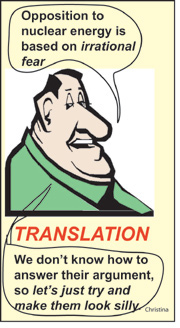 environmentally OK etc. . That is the traditional nuclear spin way of answering any claims of danger, environmental damage, health damage, nuclear weapons risk and so on. Nuclear’s opponents are “emotional” “not rational” – so no need to answer their arguments.
Then she goes on to “Generation IV nuclear reactors which consume 100% of the energy in the uranium fuel, plus the depleted uranium from the enrichment process”. What Is she talking about? There are at least 6 different types of “Generation IV nuclear reactors’ – all still in the design stage. They all use uranium in lesser quantities only. In the case of the much-touted Thorium reactor, uranium is used in small amounts to set off the fission process. But really thorium reactors are being touted as a “welcome” alternative to uranium powered ones.
Anyway, the whole promotion for most the Gen IV reactors is to use up the world’s embarrassing piles of plutonium as fuel – hardly a recipe for expanded uranium mining.
The optimism of the report is in fact, in contrast to the reality of the uranium industry’s prospects. Even BHP’s cancelling of expansion of Olympic Dam has not helped the uranium industry’s market forecast. Paladin Energy made a huge loss on uranium , as did ERA last year.
“Stripped of emotion” Uranium SA’s chairman Alice McCleary wins Furphy Of The Year award
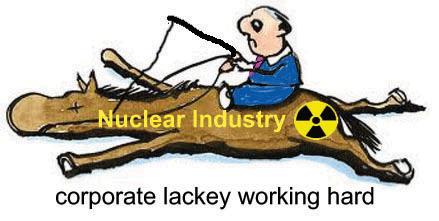 Uranium SA’s Annual Report 12 Sept 12, Alice McCleary, Chairman , “…..As all shareholders will be aware, 2012 continued to be challenging [that’s the understatement of the year!] for small companies. However, the Board maintains its great confidence [amazing!] in the future prospects of UraniumSA ….
Uranium is used for energy generation in proven and safe industrial processes that – stripped of emotion – have lower environmental footprints and higher sustainability than any competing established technology
Generation IV nuclear reactors are now being developed which consume 100% of the energy in the uranium
fuel, plus the depleted uranium from the enrichment process
These are exciting developments. As the world moves away from carbonintensive energy sources, uranium’s benefits will become more and more obvious to all….”
Malaysian protest against Lynas rare earths plant – not going away, in fact – it’s the reverse
 “The world will witness one of the biggest civil disobedience events in this nation”
Mr Ibrahim has demanded that Australians ”hear the frustrations of Malaysians” over the project.
First Weld war looms – Malaysians mobilise to fight Lynas plant, The Age, September 
 13, 2012 Lindsay Murdoch ACTIVISTS are planning a multi-pronged attack to try to stop the Australian miner Lynas Corp opening a rare earths
processing plant in Malaysia.
Opposition parties, led by Anwar Ibrahim, are also planning to make the $230 million plant a key issue of the country’s national elections, which must be held by April next year. They have vowed to shut the plant if they oust the government. Continue reading
Darwin City Council worried about Muckaty nuclear waste dump plan
 Darwin council concerned about nuke dump safety http://www.abc.net.au/news/2012-09-12/darwin-council-seeks-safety-assurances-over-nuke-dump/4257828?section=nt Kristy O’Brien The Darwin City Council wants to know what safety systems would be in place for transporting waste from the proposed Muckaty Station nuclear dump near Tennant Creek.
The council has weighed into the debate about Australia’s first nuclear waste dump which is expected to be built at Muckaty Station. Councillors want the Local Government Association of the Northern Territory (LGANT) to seek advice about risk management systems for transporting nuclear waste.
Lord Mayor Katrina Fong Lim says the waste would be taken to Muckaty Station on Northern Territory roads, railways or through the Darwin Port. “It is actually about the risk management of how it could go,” she said.
The council also wants LGANT to press the Federal Government for an inquiry into whether Muckaty Station is an appropriate place to store nuclear waste.
Queensland’s Premier Newman turning that State into renewable energy backwater
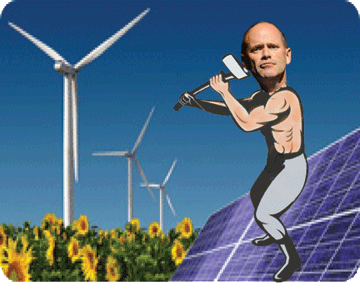 Queensland – Solar Star One Day, Renewables Wasteland The Next, by Energy Matters, 13 Sept 12, “……Campbell Newman appears to have decided Queensland should become a clean energy and climate change backwater in terms of further progress from this point forward.
Queensland’s recent budget was a climate change and renewable energy related massacre. Numerous programs are to be axed – some of which had been previously announced:
– Solar Flagships project.
– Queensland Climate Change Fund
– Queensland Renewable Energy Fund
– Queensland Smart Energy Savings Fund
– Solar Initiatives Package
– Waste Avoidance and Resources Efficiency Fund
– Local Government Sustainable Future Fund
– Climate Smart Home Service
– Solar Hot Water Rebate Scheme
– Solar Atlas
– Cloncurry Solar Thermal Trial Site Remediation
– Bright Thing Campaign
– Renewable Energy Industry Development Plan
– Climate Smart Business Service
– Sustainable Energy Innovation Fund
– EcoBiz program….
Further analysis of the impact of Queensland’s horror budget in relation to climate change and renewable energy initiatives can be viewed on RenewEconomy.
Australia’s shame – our uranium fuelled Fukushima
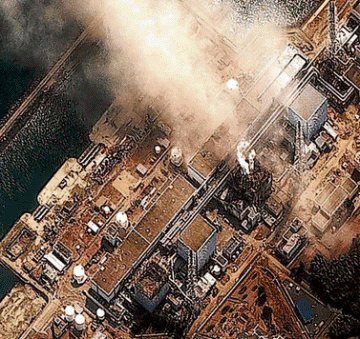 Australian uranium is now radioactive fallout that is contaminating Japan and beyond — but the response of the Australian government, Australian uranium producers and their industry association has been profoundly and shamefully deficient. Prime Minister Gillard speaks of business as usual, Resources Minister Martin Ferguson talks of the ‘unfortunate incident’ and the more bullish of the uranium miners have called the crisis a ‘sideshow’.
Fukushima and Australia’s uranium shame INDEPENDENT AUSTRALIA 11 September 2012 marked 18 months since the Fukushima crisis began. Dave Sweeney has just been to the radiation exclusion zone and is horrified by what he’s seen.
The signs that all is not as it was or should be start gently enough: weeds appear in fields, the roadside vegetation covers signs and structures and there are few people about. The country looks peaceful, green and sleepy — then the radiation monitor two seats away wakes up and starts clicking…..
Fukushima means ‘fortunate island’ ― but the region’s luck melted down alongside the reactor. Over 150,000 people cannot return to their homes and last September a United Nation’s special report detailed some of the massive impacts: ‘hundreds of billions of dollars of property damage’, ‘serious radioactive contamination of water, agriculture , fisheries’ and ‘grave stress and mental trauma’ to a swathe of people. Lives have been utterly disrupted and altered and the Fukushima nuclear accident was and remains a profound environmental and social tragedy…….
An earnest teacher is happy that the local school has re-opened, but sad that while once around two hundred and fifty kids used to attend, now there are sixteen. The local Mayor picks up the theme stating ‘we have very few young people or children’. Radiation hits hardest at growing cells and many parents are understandably concerned and have moved. The old remain and, in the absence of the young, the old look older. Continue reading
Sneaking nuclear power into NSW the Thorium way?
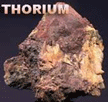 Citizens’ jury puts nuclear on the table http://m.smh.com.au/environment/energy-smart/citizens-jury-puts-nuclear-on-the-table-20120910-25ol6.html SMH, SEAN NICHOLLS September 11, 2012 A ”CITIZENS’ JURY” has recommended the government start a discussion about nuclear power stations in NSW as an issue that ”should not be dismissed”.
The jury of about 25 people from Sydney was one of two invited by the Parliament’s public accounts committee to participate in an inquiry into alternative energy. The other was from the New England area.
The juries were chosen by the New Democracy Foundation whose members include the chairman of Infrastructure NSW, Nick Greiner, and the former premier of Western Australia Geoff Gallop. Its founder is the executive director of Transfield Holdings, Luca Belgiorno-Nettis.
The Sydney jury’s report, released yesterday, urges the government to initiate ”informed public discussion” into ”emerging nuclear technologies” such as thorium as an energy source. ”The unanimous view of the jury was that the proposed issue of nuclear power generation should not be dismissed,” the recommendation – one of five – says.

”A minority view (10 per cent) supported starting deployment in the immediate future. While this view was not shared, the jury was in agreement that the topic should be discussed in greater detail withthe Australian public.”
The government is preparing to proclaim legislation that will overturn a 26-year ban on uranium exploration.
The Energy Minister, Chris Hartcher, and the Premier, Barry O’Farrell, have been at pains to deflect opposition claims that this could lead to nuclear power.
Mr Hartcher has previously said the decision was not about providing an alternative energy source to electricity generation. Unlike uranium, there is no ban on exploration or mining of thorium in NSW.
In its report, the New England jury said the community had no confidence in uranium-based power. But it also said the same applied to coal seam gas and neither should be pursued until that improved.
In an awkward recommendation for the government, it says the electricity distribution businesses, or ”poles and wires”, should be kept in public ownership. Mr O’Farrell has ruled out selling the poles and wires this term but has left the door open to taking it to the next election to raise infrastructure funds.
The chairman of the public accounts committee, Jonathan O’Dea, said the reports, which will be included in the committee’s final report, would be discussed on Thursday. A spokeswoman for Mr Hartcher said he would await the final report
before considering any recommendations.
History of Australian children exposed to nuclear radiation
Australian Map of Nuclear Sites, Overview Jim Green Sept 2012
Some of the recurring patterns in Australia’s nuclear history are discussed here under the following headings: children exposed to radiation; racism; struggle; unresolved radioactive contamination issues; deceit; whistleblowers; secrecy; rhetoric versus reality; lessons not learnt; and surveillance, intimidation, and police brutality.
Children exposed to radiation
Due to the lack of fencing, the contaminated Port Pirie Uranium Treatment Complex site was used as a playground by children for a number of years. The situation was rectified only after a six-year community campaign.
After mining at Rum Jungle in the NT ceased, part of the area was converted to a lake. As a crocodile-free water body in the Darwin region, the site became popular despite the radioactivity.
In November 2010, the Rum Jungle South Recreation Reserve was closed due to low-level radiation in the area. The Department of Resources advised the local council to shut down the reserve as a precautionary measure.
In 2012, damage to a security gate allowed children to enter a contaminated site near Kalgoorlie. More than 5,000 tonnes of tailings from the Yeelirrie uranium deposit, near Wiluna, were buried there in the 1980s. BHP Billiton said it would improve security.
In a 1997 report, WMC admitted leaving the contaminated trial uranium mine at Yeelirrie, WA, exposed to the public with inadequate fencing and warning signs for more than 10 years. A spokesperson for WMC said a 1995 inspection revealed the problems and also admitted that the company could have known about the problems as early as 1992. WMC said there was inadequate signage warning against swimming in a dam at the site, which was found to be about 30 times above World Health Organisation radiation safety standards and admitted that people used the dam for “recreational” purposes including swimming.
Children and adults alike have been exposed to radiation from the contaminated uranium processing site at Hunters Hill in Sydney (and children are more susceptible to radiation-induced cancers due to their growing bodies). Only in recent years has the contamination come to light after decades of deceit and obfuscation. The NSW Health Commissioncovered up the dangers of Hunters Hill. An internal memo in 1977 told staff to “stall and be non-committal” when responding to queries. Residents were told there was “no logical reason” to carry out radiation or health tests even though the NSW government knew that there were compelling reasons to do so.
A similar attitude has been displayed towards people living near the Lucas Heights research reactor. An internal 1998 federal Department of Industry, Science and Resources briefing document, obtained under Freedom of Information legislation, warns government officials: “Be careful in terms of health impacts − don’t really want a detailed study done of the health of Sutherland residents.”
Another incident with child safety concerns occurred in May 1997 when a radioactive source was stolen from an ANSTO promotional display at Menai High School. An ANSTO spokesperson said the source could be handled “quite safely but shouldn’t be for long periods.” The radioactive source was never recovered.
In the 1950s, the British-Australian nuclear cabal suppressed research demonstrating the contamination of grazing sheep and cattle with strontium-90 from nuclear bomb tests in Australia. Whistleblower Hedley Marston warned that proof of widespread contamination would be found “in the bones of children”. The nuclear cabal and the Australian government initiated a testing program in 1957, but it was done in secret using stolen body partsfrom dead babies, still-borns and infants.
The Advertiser conspicuously failed to inform residents of Adelaide of the plume of radioactivity which contaminated the city after the bungled nuclear bomb test of 11 October 1956. The Advertiser did however run a story in 1957 titled ‘Radioactive Children Are Brilliant’ − a baseless theory from a British psychiatrist linking strontium 90 to ‘brilliant’ children……….. http://australianmap.net/overview/
Australia to be part of ASEAN discussion on nuclear power for the region
ASEAN ministers explore nuclear power as a long-term option 11 September 2012 http://www.channelnewsasia.com/stories/southeastasia/view/1225292/1/.html SINGAPORE: Ministers from the member countries of the Association of Southeast Asian Nations (ASEAN) will explore nuclear power as a long-term option for the region’s energy needs when they meet on Wednesday, 12 September at the 30th ASEAN Ministers on Energy Meeting (AMEM) in Phnom Penh, Cambodia.
Singapore’s Ministry of Trade and Industry (MTI) said they will discuss collective efforts to develop ASEAN’s nuclear safety
capabilities, as well as a coordinated approach on regional nuclear emergency preparedness and response mechanisms with international partners.
As with previous years, the ASEAN ministers will be joined by their key energy Dialogue Partners and International Organisations, namely Australia, New Zealand, India, China, Japan, Korea, Russia, the US and the International Energy Agency (IEA). Continue reading
Yeah, why not have Australia fuel Pakistan’s nuclear bombs, as well as India’s?
Australia willing to help Pak combat energy crisis, Pakistan Observer, Amanullah Khan, 9 Sept 12. Karachi—Australian High Commissioner Peter Heyward has said there are certain technical requirements to ensure that nuclear capability would be used for domestic energy need and not for military purpose and if Pakistan fulfills such condition Australia may think of exporting uranium to Pakistan…. Speaking on the occasion Mian Abrar Ahmad , President, Karachi Chamber of Commerce and Industry said Pakistan needs to build civil nuclear capability to meet its energy requirements since ours is an energy hungry country……. http://pakobserver.net/detailnews.asp?id=173330
1 This month


Help Aunty Sue Protect Her Land and Sacred Sites From Destructive Rocket Testing.
.

Australians deserve the truth
about
AUKUS – https://aukuspublicinquiry.com/

PETITION – To: Prime Minister Anthony Albanese and the Australian Labor Government

of the week – Australians for War Powers Reform (AWPR)
To see nuclear-related stories in greater depth and intensity
 Antinuclear