South Australia: uranium licence agreement scrapped by BHP
BHP scraps Olympic Dam licence deal THE AUSTRALIAN, BY: ROBB M. STEWART From: Dow Jones Newswires September 10, 2012 BHP Billiton has scrapped plans to buy a basket of exploration licenses in the region of its Olympic Dam copper and uranium mine in South Australia after it last month shelved a $US30 billion plan to greatly expand the operation.
Exploration firm Tasman Resources said today that it had received a notice from BHP terminating conditional contracts that would have seen BHP buy five exploration licenses and one license application for the
Stuart Shelf region, which hosts the Olympic Dam deposit.
Tasman in mid-June had said BHP had agreed to buy the licenses in a $3 million deal subject to several conditions. It at the time said the land contains several targets that are thought to be deep and relatively high risk and therefore more suited to companies with larger exploration budgets…… http://www.theaustralian.com.au/business/
Nuclear lobby gets to APEC
 APEC Leaders Safe Use of Nuclear Energy Power Industry News 9 Sept 12, Asia-Pacific leaders wrapped up two days of their summit talks on Sunday with an agreement to ensure the safe use of nuclear energy and a renewed commitment to forestalling protectionism. Leaders of the 21 member economies of the Asia-Pacific Economic Cooperation forum adopted a joint declaration and related documents at their meeting in the Russian Far East city of Vladivostok….
Specifically, they agreed to “ensure the safe and secure use of nuclear energy as a clean energy source in interested economies.” Their accords also include the promotion of steady investment in energy infrastructure….
http://www.utilityproducts.com/news/2012/09/09/apec-leaders-safe-use-of-nuclear-energy.html
Aboriginal social justice group honours Julian Assange and Mamdoub Habib
By agreement we will be issuing both Julian Assange, via his father, and Mamdoub Habib, who will be present, an Aboriginal Nations Passport that will allow both to respectfully travel through the Aboriginal Nations of Australia. Mamdoub now and Julian on his return to Aboriginal Australia. Both these men were denied any assistance, firstly by the Howard Government and then by the Gillard Government respectively.
Indigenous Social Justice Association September 9, 2012 It is with a sense of pride and complete social justice that this Association has worked with the Sydney Support Assange and WikiLeaks Coalition to have the privilege of successfully arranging for Julian Assange to be able to be issued with an Aboriginal Nations Passport that his father, John Shipton,
will accept on his behalf at the Welcome to Aboriginal Land Passport Ceremony to be held at The Settlement, 17 Edward Street, Darlington from 11am to 4pm on Saturday 15 September, 2012.
We strongly endorse the words of Ms Linda Pearson of the Support Assange and WikiLeaks Coalition, see below, on the total lack of support by our Federal Government to assist Julian against being press-ganged to America to face corrupt charges against him for informing the world’s people of the absolute lies that all Governments continue to tell their people. Whilst it is true that all Governments lie, it is well known that America leads the pack in their eternal quest for American hegemony of the world’s resources. Continue reading
New South Wales’ dud renewable energy plan
O’Farrell’s Renewables Goal ‘Realistic, But Plan Is A Dud‘ http://www.energymatters.com.au/index.php?main_page=news_article&article_id=3373 by Energy Matters, 9 Sept 12, Greens NSW MP John Kaye says a draft Renewable Energy Action Plan for New South Wales fails to call off the O’Farrell government’s war on rooftop solar and wind power.
Dr. Kaye believes the plan, if implemented in its current form, will lock NSW into a coal-fired future with jobs and investment “set to continue to haemorrhage out of the state”.
Unveiled on Friday, the Plan outlines 28 actions the Government says will help NSW meet its 20% renewables by 2020 target. Energy Minister Chris Hartcher says only the best value for money solutions will be adopted; delivering investment and jobs “at no cost to consumers”.
“The goal is realistic but the plan is a dud. Without a commitment to lowering the barriers that are stunting wind and solar investment, cuts to greenhouse gas emissions and the tens of thousands of new jobs will be nothing but a pipedream,” said Dr. Kaye
With regard to small scale solar, the only action listed under the plan is to “Annually request IPART to estimate a benchmark range for a fair price for small-scale generated solar energy.” The benchmark range recommended by IPARTfor 2012/13 is 7.7 – 12.9c per kilowatt hour – and is voluntary.
To support medium-scale solar power, the NSW Government will work with industry identify commercial sites where it will be cost effective and facilitate uptake for commercial buildings through the Renewable Energy Advocate.
“The failure to reverse the O’Farrell government’s policy hostility to wind and solar will turn the promised 6,000 new jobs into nothing more than a fantasy.”
“Parliamentary Secretary Rob Stokes worked hard to produce a new deal for renewables. It’s clear that he was badly undermined by his Minister Chris Hartcher and the fossil fuel lobby who want clean energy technology to remain a boutique industry that does not interfere with their profits.”
The Plan is available here and public comment is invited. Submissions will be accepted until 26 October 2012.
The USA’s propaganda machine in action in Australian media
 WikiLeaks cables show how Australia works with the US to get Iran, Green Left 6 Sept, 12, “……..Propaganda As well as efforts to contain discussions inside the conference, cables detail the “public diplomacy outreach” methods the US could employ to push its agenda outside the Conference. A cable said the US Deputy Chief of Mission in Canberra: “thought it might be good to produce a documentary laying out Iran’s history of supporting Hizbollah and other terrorists, and then ask viewers to consider what it would mean to have a nuclear-armed Iran. Luck [Ambassador At-Large for Counterterrorism] agreed – so long as the USG itself did not make the documentary”.
In a later cable the US Embassy answered questions from the US government about “the most useful ways to convey the U.S. message on NPT issues to the Australian public”, such as the use of a Digital Video Conference (DVC): “The host government is firmly on board with USG policy and does not require further outreach, but think tanks, specific journalists and universities in Canberra, Sydney and Melbourne could be targeted , particularly on the need to focus on the “crisis pillar” of the NPT, which is not disarmament, but nonproliferation. Another option would be to arrange a DVC just for journalists with an eye towards placement of articles based on the discussion.”
The Embassy went on to recommend: “Articles and editorial pieces by very senior US officials for our Office of Public Affairs to place in “The Australian,” “The Sydney Morning Herald,” “The Age,” “The Daily Telegraph” and the “Australian Financial Review,” among others. … While providing the U.S. record on disarmament, the articles should also highlight the need for noncompliant states to be put under the international spotlight during the Review Conference.”
In the end the US did come under sustained criticism for alleged non-compliance with the NPT at the 2005 RevCon, by the NAM states and other delegates. However, a report by Fairness and Accuracy in Reporting said the US media was significantly more compliant than the NPT delegates and largely ignored the US’s “bad atoms”….. http://www.greenleft.org.au/node/52146
South Australia’s extraordinary wind energy peak – at 85% of the State’s electricity
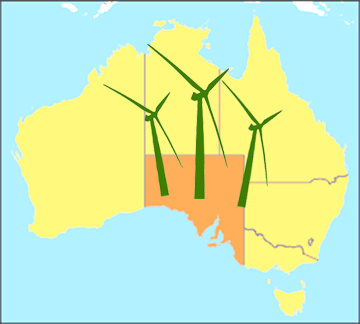 Wind power peaks in SA http://news.ninemsn.com.au/national/8528671/wind-power-peaks-in-sa Sep 6 2012 South Australia’s wind farms briefly provided 85 per cent of the state’s electricity during windy conditions this week, the Clean Energy Council says.
Policy director Russell Marsh said data from the Australian Energy Market Operator showed 55 per cent of all the electricity used by South Australians on Wednesday was generated by wind power.
But it said wind power peaked briefly at 85 per cent on Monday morning. “South Australia has proven once again that wind energy can generate real power and lots of it,” Mr Marsh said. “All this wind is putting South Australia well ahead of the curve on Australia’s 20 per cent renewable energy target.”
Australian Capital Territory leads with big solar, AND decentralised solar energy
 Canberra Goes Solar In A Big Way http://www.energymatters.com.au/index.php?main_pag news_article&article_id=3371 by Energy Matters, 6 Sept 12, Spanish company FRV has been awarded a project to develop a 20MW solar panel based electricity generation facility in the Australian Capital Territory.
The FRV Royalla Solar Farm will be constructed 23 kilometres south of Canberra’s CBD and will consist of approximately 83,000 solar panels – the largest facility of its kind to date in Australia. Royalla Solar Farm will generate enough electricity to supply the power needs of around 4,500 homes and avoid over half a million tonnes of greenhouse gas emissions during its serviceable life.
Country Manager of FRV Australia said the project represents an important step in the company’s long term commitment in Australia. The Australian Solar Council welcomed the announcement by the A.C.T. Government.
“This is a landmark day for Big Solar in Australia”, said John Grimes, Chief Executive of the Australian Solar Council.
“Australia’s clean energy future has arrived in Canberra…Solar is increasingly taking on coal-fired power on price.”
“Big solar plants will increasingly meet Australia’s peak power energy needs, and today’s announcement by the A.C.T. Government is a window into Australia’s solar future.”
Mr. Grimes also congratulated the ACT Government for “delivering Big Solar at low cost and at breakneck speed.”
ACT Environment Minister Simon Corbell said the project would make Canberra the solar capital of Australia – and at a low cost. “The Government’s reverse auction process is about getting the cheapest price for the best amount of renewable energy generation, and today we’ve delivered on that,” he said.
Construction is due to begin in 2013 and is expected to be finished in 2014, subject to relevant approvals. FRV states it has fully developed more than 360 MW of renewables capacity globally and has participated in the development of over 2,750 MW at different stages.
Bidding for the ACT project occurred under a reverse auction model. According to RenewEconomy’s Giles Parkinson, reverse auctions are already being deployed successfully in some of the world’s biggest energy markets, including India.
In addition to support for Big Solar, the ACT also encourages home solar power through a feed in tariff incentive. Surplus electricity generated by home systems is purchased by ActewAGL Retail at the customer’s electricity tariff rate.
According to national solar solutions provider Energy Matters, a 3kW solar panel system installed in Canberra can generate a financial benefit of nearly $800 a year.
Australia’s Liberal States, especially Queensland, fight renewable energy
 Newman’s antipathy to green energy runs deep.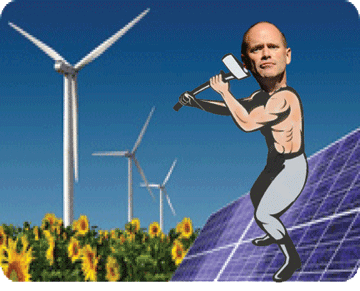
Campbell Newman’s war on green energy REneweconomy By Giles Parkinson 6 September 2012 It looks like the clean energy industry is going to have to go back to basics when dealing with the new conservative government in Queensland – just as it has had to do in Victoria, with that state’s Coalition government. Tomorrow, when the NSW Coalition government releases its renewable energy plan, it will learn if it will have to do the same there.
In Queensland, however, the industry is right back at first base. Not that it ever really left it: it is the one state that has hardly any large-scale renewable generation, apart from a series of biomass plants from sugar cane plantations and a single 12MW wind farm.
Premier Campbell Newman signalled his approach to renewables early in his term when he decided he didn’t want to put any state money into the Solar Dawn consortium, or any other renewable energy project for that matter, and announced he would disband the state’s climate change and renewables program. His approach was that the if federal government had a carbon tax and a renewable energy target, then Canberra should pay for it. It wasn’t the state’s business.
That might sound fine on the stump, or in a sound bite on radio talkback, but it’s actually self-defeating. The law states that each electricity retailer must provide a certain amount of renewable energy to its customers, paid for by renewable energy certificates, and that includes Queensland utilities.
If they don’t build renewable energy in their own state, then that money will simply be spent on projects being built by the southerners – be it in NSW, Victoria or South Australia. Continue reading
South Australia’s wind energy bonanza
Wind accounts for 58% of energy use in South Australia, By Giles Parkinson on 6 September 2012 It’s been another big week for wind production in South Australia – as another spring weather system with high winds makes wind energy the dominant force in local energy production.
According to figures pulled together by consultants Intelligent Energy Systems using data from the Australian Market Operator, wind energy produced accounted for 57.9 per cent of demand in the state on Tuesday, and followed up with 55 per cent of total demand on Wednesday……
exports from South Australia to other states. On Tuesday, the state was exporting almost all day, as the wind output was quite consistent. On Wednesday, it exported for most of the day and there is a bit of pink at the top in the late afternoon to indicate coal imported from Victoria. (South Australia’s coal generators are in mothballs right now due to the impact of wind, and lower demand, and the carbon price)……
These one day graphs, of course, are just snapshots of an overall trend happening in the state, and across the National Electricity Market, that will only become more apparent as the amount of wind and solar installed in the country increases. Indeed drew Reidy, from IES says these days only rank as the 6th and 12th highest in terms of energy produced on a single day, and 5th and 6th in terms of percentage of demand. The highest day in terms of output was on August 17 this year, while the highest in terms of percentage of demand came in February 5, when wind accounted for 64.1 per cent of demand across the day.
The Clean Energy Council’s Russell March said it was proof that wind energy can generate real power – and lots of it. “This type of significant wind generation is common in South Australia,” he said. In 2011/12, according to AEMO data, wind produced 24 per cent of the state’s generation, overtaking coal. And, Russell noted, AEMO data shows that emissions from South Australia’s electricity sector have dropped every year since 2005/06, and have reduced by more than 27 per cent over the last five years.
“All this wind is putting SA way ahead of the curve on the national Renewable Energy Target, helping provide farmers and local business owners in regional areas with extra income. It also means that the state’s residents collectively have a lower carbon price bill, while getting fully compensated from the Federal Government under the scheme.” Indeed, on Tuesday and Wednesday, the state enjoyed not just by far the cleanest energy in the country, but also the cheapest, with average prices over the day at $43/MWh, compared to more than $52/MWh for NSW….. http://reneweconomy.com.au/2012/wind-accounts-for-58-of-energy-use-in-south-australia-75810
University of New South Wales (UNSW)’s solar cell innovation
UNSW, Suntech Power and Hanwha Solar Partner to Improve Solar Cell Efficiency AZOcleantech, September 6, 2012 By Gary Thomas Researchers at the School of Photovoltaics and Renewable Energy Engineering (SPREE) at the University of New South Wales (UNSW) in Australia have developed an advanced processing technology for enhancing the efficiency of silicon solar cells. SPREE has entered into a research partnership with Suntech Power and Hanwha Solar, twomajor silicon solar cell manufacturers.
Thin film The electric insulator in a solar cell is located between the aluminium back-plate and the silicon wafer. The newly developed technology involves “self-patterning” tiny metal contact regions into the electric insulator of a solar cell…..
http://www.azocleantech.com/news.aspx?newsID=17281
USA was at first worried that Kevin Rudd as P.M might not toe the USA line
Another cause for US alarm was Rudd’s announcement in June 2008 of a new International Commission on Nuclear Non-proliferation and Disarmament (the Evans Commission). Cables show the US was affronted by Rudd’s decision to announce the Commission without telling them first……. By the time preparations for the 2010 RevCon began, Rudd government officials were echoing the line of their Howard-era predecessors.
 The Israelis regarded Rudd as being a useful tool in the propaganda war against Iran
WikiLeaks cables show how Australia works with the US to get Iran, Green Left 6 Sept, 12, “……Kevin Rudd US-Australian relations on nuclear issues were complicated by Kevin Rudd’s rise to power in 2007. Labor had a longstanding policy of opposing nuclear cooperation with non-NPT signatories, which the US feared might jeopardise its planned civil nuclear agreement with India, a non-NPT state. The US needed Australia’s support to approve the deal in the Nuclear Supplies Group (NSG) , which sets guidelines for nuclear-related exports. It repeatedly raised the issue in meetings with Australian diplomats.
Early on there were signs that Labor’s policy could be dispensed with. While Rudd was still Opposition leader, the US Embassy reported that his foreign policy adviser, Peter Khalil : “Understood and accepted that renewed nuclear-power cooperation with India was a necessary price to pay for a closer relationship. Australia’s uranium industry could in fact benefit from renewed trade with India, he noted …” Continue reading
The University of NSW a global leader in solar technology research and development.
UNSW, Suntech and Hanwha Solar Collaborate http://www.energymatters.com.au/index.php?main_page=news_article&article_id=3370 by Energy Matters 6 Sept 12, Technology being developed at the University of New South Wales to improve the efficiency of silicon solar cells has grabbed the attention of two of the world’s largest solar panel manufacturers.
The School of Photovoltaics and Renewable Energy Engineering (SPREE) has inked a collaborative research agreement with Suntech Power and Hanwha Solar to further develop experimental technology to automate and speed up patterning of solar cell electric insulators.
“Currently closely-spaced small-area metal contact regions in an insulating layer can only be formed by deliberately patterning the holes with a laser scanning over the surface, which is quite slow,” says Dr Alison Lennon, a senior lecturer from SPREE.
Dr Lennon says other methods such as aerosol and ink-jet printing are at this point too slow and have been unable to demonstrate the required patterning reliability.
Dr. Lennon and her PhD students are investigating the use of aluminium anodisation, a process where a chemical coating is formed on a metal surface to protect against corrosion, which she says can turn an aluminium layer on a silicon solar cell into a dielectric layer with many tiny holes; exactly what is needed.
The team has already constructed prototypes of cells using the process and is now working on improving cell efficiencies and refining the technique to make it commercially viable – and this is where Suntech and Hanwha Solar solar come in.
Dr Lennon says the collaboration is an example of two companies realising they can achieve more as partners than as competitors, which could result in faster commercialisation.
The University of NSW is a global leader in solar technology research and development.
It was announced recently UNSW would be a partner conducting research in connection with two large solar farms projects to be constructed over the next three years in western New South Wales.
UNSW also has a long association with Suntech. Among other achievements, earlier this year collaborative research between the two led to a world record 20.3% efficiency for a production silicon solar cell through further refinements to Suntech’s Pluto cell technology.
Suntech founder Dr. Zhengrong Shi is a graduate of UNSW.
Traditional Aboriginal Owners demand consultation on uranium
 6 Sept 12, The Walkatjurra Walkabout started at Yeelirrie on the 24th August, led by Traditional Owner, Kado Muir. Days after leaving Yeelirrie, BHP Billiton announced that they had sold their uranium project to Canadian company, Cameco.
Australia colluded with USA against Iran
WikiLeaks cables show how Australia works with the US to get Iran , September 5, 2012 Green Left By Linda Pearson WikiLeaks cables show Australian officials have colluded with the US to get the IAEA to declare Iran in breach of the Nuclear Non-Proliferation Treaty.
Barely 10 years after false claims about weapons of mass destruction were used to justify the invasion of Iraq, a similar narrative is being used by politicians in the US and Israel to push the case for war with Iran. You might not know it from mainstream media reports, but Iran does not have a nuclear weapons program and, as a signatory to the Nuclear Non-Proliferation Treaty (NPT ), has an inalienable right to enrich uranium for peaceful purposes.
It’s thought that Israel has up to 400 active warheads but, unlike NPT signatories, the country has never agreed to open up its nuclear program to inspection. The US has about 2000 active warheads and is arguably in violation of the NPT itself for its failure to meet the disarmament requirement enshrined in Article VI of the treaty .
US President Barack Obama’s “Global Zero” initiative to rid the world of nuclear weapons has amounted to little more than rhetoric . A 2011 report by the Carnegie Endowment for International Peace said the US spends more money on nuclear weapons than the rest of the world combined.
In effect, two countries with a combined nuclear arsenal probably greater than any other are threatening war with another country because it may have the capacity to develop nuclear weapons in the future. This would be yet another illegal war of aggression, the “supreme international crime” as defined at Nuremberg.
WikiLeaks has given us unprecedented access to information with which to challenge the self-conferred moral authority of the US and its allies to decide which states can and cannot have nuclear weapons. Diplomatic cables from the US Embassy in Canberra published by WikiLeaks suggest Australia’s role in US relations with Iran is shaped by its slavish support for the US alliance and Israel, and its position as the world’s second biggest seller of uranium. Continue reading
Nuclear spinner Ziggy’s gone quiet, but the Brook keeps babbling on
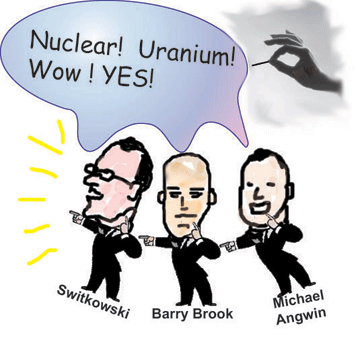 A curious silence lately, from Australia’s top nuclear salesmen – Ziggy Spinowski, and Michael Angwin. One can only assume that Ziggy, always one to be on the side of the winners, is quietly moving away from nuclear lobbying. Michael Angwin, CEO of the Australian Uranium Association, is now lying low, in view of the disastrous state of Australia’s uranium industry.
So – it is left to Barry Brook now – Australia’s lone pro nuke spruiker to carry that pernicious torch . He’s not awfully good at it – but the nuclear lobby must rejoice that Brook keeps at it, anyway.
Congratulations to Ludwig Heinrich, for nailing Brook’s arguments so convincingly.
And also – to Independent Australia for providing that Brook video, reminding us of the repetitive and rambling Brook. I am indeed reminded of the poem “The Brook” – “I chatter, chatter as I go to join the brimming river, for men may come and men may go, but I go on forever”.
And Brook sure does go on forever – telling us:
– that the tsunami caused the Fukushima disaster, (when it now has been shown that it was set off by the earthquake, before the tsunami arrived.)
– that the Fukushima accident “hasn’t significantly damaged any person” (mmm throat lesions, leukaemia – not significant?)
– that “in the past renewables have not been able to replace fossil fuels”. (What about the present, and the future?)
– that we “need to overcome fear of radiation” (!!!!)
– that he’s morbidly fascinated that people have ignored other disasters – petro chemical industries. (but then, as Brook thinks that increased ionising radiation is fine, then, to him, a nuclear accident is at the same level as any other accident.)
Above all, Brook says that “we already have really safe nuclear power plants”
That statement really shows up Brook’s ignorance of risk analyis. In calculating risk , you weigh up the probability of the risk against the seriousness of the consequences if an accident happens.
That’s exactly what insurance companies all over the world have done, in relation to nuclear power. They’ve found it an unacceptable risk because – although the probability of accident is small, the consequences of a nuclear accident are huge.
Barry Brook just doesn’t get it. – C.M
1 This month


Help Aunty Sue Protect Her Land and Sacred Sites From Destructive Rocket Testing.
.

Australians deserve the truth
about
AUKUS – https://aukuspublicinquiry.com/

PETITION – To: Prime Minister Anthony Albanese and the Australian Labor Government

of the week – Australians for War Powers Reform (AWPR)
To see nuclear-related stories in greater depth and intensity
 Antinuclear