MARK COLVIN: The head of BHP Billiton, Marius Kloppers, says he cannot guarantee that the company will redevelop the Olympic Dam mine in the future.
South Australia’s massive Olympic Dam dream down the toilet
Analysts had calculated the expansion would have cost BHP close to US$30 billion over several years as it developed a pit more than 4 kilometers long, 3.5 kilometers wide and 1 kilometer deep…. the plans had also envisaged the construction of a desalination plant, new port andairport facilities and expanded work accommodation.
 BHP Gives South Australia No Guarantees For Olympic Dam Fox Business September 03, 2012 Dow Jones Newswires BHP Billiton (BHP) Chief Executive Marius Kloppers in a meeting Monday could provide no revised schedule, or guarantees, to the state premier of South Australia for the expansion of the Olympic Dam copper and uranium mine… Continue reading
South Australian govt and BHP Billiton gloomy about the future of Olympic Dam uranium mine
Kloppers’ bleak Olympic hopes by: Michael Owen, The Australian September 04, A BLEAK outlook has been presented by BHP Billiton chief executive Marius Kloppers for an expanded Olympic Dam mine ever operating in South Australia.
Mr Kloppers yesterday held talks with Premier Jay Weatherill in Adelaide to explain why the miner’s board last month indefinitely shelved the $28.7 billion project. He emerged from the hour-long meeting to say there was no timeframe for the project and no guarantee it would ever go ahead.
This came more than a week after The Weekend Australian revealed that Mr Kloppers had warned the expansion might never happen because the project was now dependent on the uncertain development of cheaper “leaching” technology to expand the mine’s future production. He had said that unlike “optimistic” scientists, the miner was “insufficiently certain that an eventual project will happen”. Mr Kloppers reiterated that message yesterday after meeting with the Premier. “We have been working and expending a lot of money on trying to make this project a reality,” Mr Kloppers said…… “I can’t give you any timeframe on how these things could progress.”
Asked if he could give a guarantee the mine would be redeveloped, he said: “No, I cannot.”
Mr Weatherill tried to maintain a positive message, but conceded the current model planned for the expansion “does not work”.. they are not able to advance a time when the technology will be proven, nor are they able to give us certainty about whether the technology will be capable of being proven, and therefore they will not be in a position to give us certainty about when the mine proceeds.”…
Mr Weatherill said that after his meeting yesterday, any future expansion was even further away than he had previously thought……
The opposition said all of the government’s tough-talking about BHP meeting its December deadline to go-ahead with the expansion and the project’s benefits for the state, had proven to be “bluff and bluster”. http://www.theaustralian.com.au/national-affairs/kloppers-bleak-olympic-hopes/story-fn59niix-1226464289847
Baillieu governs in the interests of the fossil fuel lobby, damaging the wind farm industry
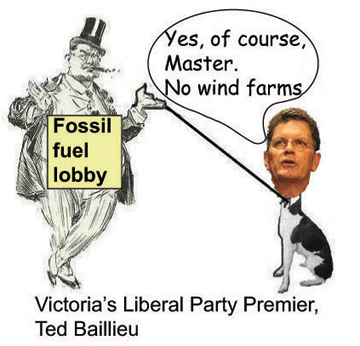 Victorian wind farm laws: a blow to Australia’s clean energy future? , The Conversation, Lisa Caripis Research assistant, Centre for Resources Energy and Environmental Law at University of Melbourne Anne Kallies PhD Scholar at University of Melbourne 4 September 2012,
It’s been just over one year since the Baillieu government introduced the second part of its far-reaching planning law reforms to restrict the development of wind farms in Victoria. The results are an example of how state planning law can be a barrier to achieving national renewable energy goals.
With a majority in both houses of Parliament, the Coalition was able to amend Victoria’s planning framework unhindered to deliver on its 2010 election promise to “restore fairness and certainty to the planning process for wind farms”.
In pursuit of this aim, the planning amendments most notably impose a blanket ban on wind farms in many parts of the state. They effectively give the owners of any dwelling within 2km of a proposed wind farm the power to decide whether or not the development should proceed. A July 2012 amendment clarifies that these changes are targeted at wind farms generating electricity for supply to the grid, not for on-site use.
Economically, reports indicate that the impacts of these changes in terms of lost or stalled wind farm investment and employment have been considerable, in a state that has some of Australia’s best wind resources. While promising to “give the community a greater voice” through these changes, the amendments instead render local, pro-wind initiatives, such as community wind farm projects impossible in many locations .
Not only do the planning law changes have the potential to entrench existing fossil fuel power generation in Victoria, they undermine the Victorian Government’s commitment to the federalRenewable Energy Target (RET).
The RET is designed to ensure that 41,000 GWh – close to 20% – of our electricity comes from large-scale renewable energy by 2020. It implicitly relies on implementation through state and territory planning frameworks, because decisions about what kind of development can take place and where rest with the states. The Climate Change Authority , which reviews the RET, notes
State and territory planning regulations may affect the level of renewable energy generation, its mix, and the geographic distribution of renewable power stations.
This can cause problems when state laws are out of step with national targets, as the electricity market rule-maker pointed out last year . It is of some concern that New South Wales draft guidelines also adopt the 2km consent rule and impose a noise assessment regime stricter than in any other jurisdiction in Australia, the United States or Europe….. http://theconversation.edu.au/victorian-wind-farm-laws-a-blow-to-australias-clean-energy-future-9163
Victoria’s Premier Baillieu – out to destroy renewable energy
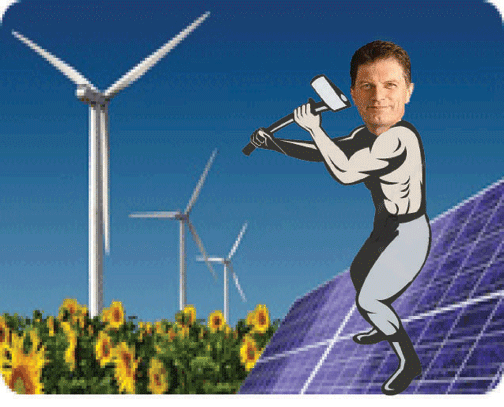 Victorian Solar Incentive Cut – Reactions http://www.energymatters.com.au/index.php?main_page=news_article&article_id=3366 by Energy Matters, 3 Sept 12, The new, “fairer” feed-in tariff for roof-top solar panels in Victoria appears to be anything but – and the race is on for households to secure the higher rate before the deadline hits. The new tariff will be slashed from the current 25c + up to 8c electricity distributor contribution to just 8c per kilowatt hour for households lodging the necessary paperwork after September 30. The rate will be adjusted annually in line with the wholesale electricity rate. According to Melbourne-based Energy Matters, the deadline provides little – and in many cases, no time – for households to acquire a system.
The company is urging those considering solar panels to call Energy Matters on 1300 727 151 as soon as possible to discuss what the change will mean to them, as it will vary according to circumstances. Environment Victoria was particularly scathing of the changes, stating the Baillieu Government has broken a key election promise to provide ‘fair reward’ for solar households.
“Ted Baillieu has dumped his promise to support the Mallee solar farm, he’s made it harder to build a wind farm than a new coal-fired power station, and now he’s slashed household and business solar support. At the same time he’s handing out tens of millions in cash to the big coal companies,” said Victoria McKenzie-McHarg. “It’s fair to ask what this government has against clean energy?” she said. The Clean Energy Council stated the rate was too low. We’re obviously disappointed at this decision to reduce support for solar power, which will make it harder for everyday Victorians to reduce their power bills and put industry jobs under pressure,” said Clean Energy Council Policy Director Russell Marsh. Labor’s energy spokeswoman, Lily D’Ambrosio, slammed the decision.
”The Baillieu government has again shown it just doesn’t care about supporting families who want to reduce their energy costs while also doing their bit for the environment,” Ms. D’Ambrosio said according to a report on The Age web site. Information from Energy Matters’ web site shows a good quality 5kW solar power system installed in Melbourne can slash a household’s electricity costs in the region of $1,920 annually under the higher feed in tariff incentive arrangements; an amount that will be significantly eroded under the new system.
Sovereign Union of First Nations is inevitable
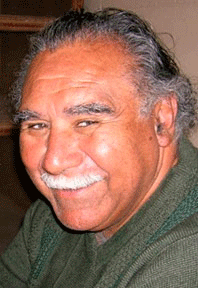 Darwin, 3 September 2012 — Two prominent East Arnhem Land leaders and sovereignty campaigner, Michael Anderson, have agreed in Darwin that a sovereign union of Aboriginal nations needs to grow from the grass roots.
Dr. Djiniyini Gondarra (OAM) from Galiwin’ku, George Gaymarani Pascoe, from Milingimbi and Anderson, the last survivor of the four founders of the Aboriginal Embassy in Canberra, agreed thatits success can only be achieved “if our people want it”.
“Dr Djiniyini Gondarra agreed that we now work towards building alliances with our nations right across this continent under our law. He said that when we feel we have achieved this we should all walk to the centre of Australia, Uluru, the Rock, in order for us to become a collective One and thereby showing our national unity,” Euahlayi leader Anderson writes in a media release.
George Pascoe said he was devastated when he realised that Minister Jenny Macklin had raided the Aboriginal-owned treasure chest of royalties in order to fund her Stronger Futures program, “but through their military junta demanded that Aboriginal people sign head lease agreements for 40 years before they agreed to fund housing projects or any other infrastructure projects that are so necessary”. Continue reading
BHP talking about leaching methods for Olympic Dam uranium mine
 AUDIO No guarantee for Olympic Dam mine expansion ABC Radio P.M. http://www.abc.net.au/pm/content/2012/s3581996.htm Nicola Gage reported this story Sept 3 2012,
“……NICOLA GAGE: Mr Weatherill says he was informed on the different technologies BHP are looking into. That included new forms of conveyor belts, and the potential use of heap leach technology.

JAY WEATHERILL: Which has been investigated in laboratories and is, over a period of six years, has been scaled up to a certain size in terms of tests, but needs to be tested further to see whether it can be brought to scale and be used for full production.
NICOLA GAGE: Heap leach technology was flagged as an alternative extraction option in BHP’s original environmental impact statement in May 2009. The company already uses it in South America.
Professor Bill Skinner specialises in environmental surface science at the University of South Australia.
BILL SKINNER: There is a precedent for heap leaching technology in Australia, so it’s not exactly a unique process in Australia.
NICOLA GAGE: While it might be considered a new technology in the public arena, the process has been around for years. But Professor Skinner says difficulties with constancy made it expensive.
BILL SKINNER: In the last few years, quite a lot more has been learned about the process that goes on inside a heap leach, and how one treats the ore in order to make sure that one heap behaves very similar to another, and sort of keep reproducibility up, because after all, that reproducibility of the process governs the constant, if you like, valuable recovery from those heaps.
NICOLA GAGE: Questions have been raised about whether another environmental impact statement would be needed with any future expansion. Premier Jay Weatherill.
JAY WEATHERILL: Because we don’t know what the technology is, it’s, it becomes difficult for us to make an assessment about whether there is any additional environment risk. We know that there are some leaching technologies that are used in different parts of the state, but on the face of it, yes, they do raise environmental issues. So, of course, there’s the feasibility of the technology, but then there’s the environmental approvals that may go with that.
NICOLA GAGE: The company’s 15,000-page environmental impact statement expires in 2016. …
Flinders University participates in USA Department of Energy’s pro nuclear propaganda
 Christina Macpherson 3 Sept 12, 18 months after the Fukushima nuclear accident, the truth is filtering out, about the continuing release of radiation from the crippled reactors, as radioactive water seeps into the ground below them, and radiation levels linger in the Fukushima area. The Chernobyl disaster’s health effects on the Ukrainian population are becoming widely known, but the evacuation following the 1986 Chernobyl nuclear accident was managed more swiftly, and permanently, than the Fukushima evacuation.
How important is the impact of continuing low level radiation on children’s health? We have our answer already in the high rate of thyroid disorders among Fukushma’s children.
It is shameful that an Australian university should participate in the USA’s Department of Energy’s propaganda to promote nuclear power, and whitewash the reality of ionising radiation’s harmful effect on human health:
Radiation response a meltdown in reason Flinders University News, July 14th, 2011 Published by FU Marketing and Communications. The possibility that low doses of radiation may prevent or delay the progression of cancer is being explored by a Flinders University research team led by Professor Pam Sykes in a move that runs counter to the widely held perception that exposure to any radiation is harmful.
Professor Sykes, recently appointed to the University’s Strategic Professorship in Preventive Cancer Biology in the Flinders Centre for Cancer Prevention and Control says the public panic in response to nuclear accidents such as that at Fukushima in Japan is the result of a general ignorance about radiation.
“…….. radiation is not the poison, the dose is,” Professor Sykes said……. “It’s now been accepted that they should not have evacuated so many people because the biggest detriment from Chernobyl was that they were dramatically disadvantaged, both economically and socially. Many suffered depression thinking they were going to die of cancer…..
Professor Sykes’ research, which involves doses of radiation that are up to three orders of magnitude lower than those used by other investigators, has been funded by the US Department of Energy Low Dose Radiation Research Program for almost 10 years…… Studies in Canada and Japan have also shown that low doses of radiation given to mice delay the onset of cancer, and reduce the symptoms of diabetes and atherosclerosis, improving the span and quality of life of the affected animals.
Professor Sykes and her team are currently examining low dose radiation therapy in reducing or preventing prostate cancer
Jennifer Robinson, Julian Assange’s Australian lawyer on UK’s ‘inhibited person list’
 Lawyer for Assange detained at Heathrow and told she was on a ‘secret watch list’ Daily Mail, By ABUL TAHER, 1 September 2012 A lawyer acting for WikiLeaks founder Julian Assange says she was stopped at Heathrow and told that she was on a secret watch-list and required special clearance before she could board her plane.
Australian Jennifer Robinson said she was left stunned after being told by an airline crew that she was on an ‘inhibited person list’ that means she must have ‘done something controversial’.
Ms Robinson said that she could not understand why she was on the list as she had never done anything controversial or criminal. She had only represented clients around the world, one of whom was Mr Assange….. Ms Robinson, 31, said: ‘This incident raises so many questions.
‘Why would I need clearance to travel to my own country? So far I have not had a proper explanation.’
The human rights lawyer is a member of Mr Assange’s legal team, which has been fighting his extradition to Sweden on alleged sexual assault offences.
She was also his legal adviser when WikiLeaks published US military documents as well as diplomatic cables from American embassies. http://www.dailymail.co.uk/news/article-2197003/Lawyer-Assange-detained-Heathrow-told-secret-watch-list.html#ixzz25RNRNfJl
Wind farm for Ballarat, Victoria
 Meridian to build third wind farm in Australia TVNZ September 03, 2012 Meridian Energy, one of the state-owned power companies slated for partial sale, is to start construction of its third wind farm in Australia, with the 131 megawatt Mt Mercer project in the state of Victoria.
Mt Mercer is a 64-turbine wind farm 30 kilometres south of the town of Ballarat with a construction cost of about $A260 million. The two-year project will begin in December and the commitment follows chief executive Mark Binns’s recent comments that the company’s best opportunities for investment new generation are offshore.
Mt Mercer will add to the Meridian owned-and-operated Mt Millar wind farm in South Australia and its project with AGL Energy to build the 420 MW Macarthur wind farm in western Victoria, which is touted as the largest in the southern hemisphere…. http://tvnz.co.nz/business-news/meridian-build-third-wind-farm-in-australia-5057752
Australian Dr Tilman Ruff co-chair of International Physicians for the Prevention Of Nuclear War
Dave Sweeney, 2 Sept 12, The International Physicians for the Prevention Of Nuclear War Hiroshima Congress has finished up and there was enough positive content and connections to make it all worthwhile from an Australian uranium perspective. The final conference statement re-lman Ruff affirms IPPNW’s position that the “entire nuclear chain – including uranium mining and processing, the production of energy from fissionable materials in dangerous reactors, and nuclear weapons themselves – is fraught with risks to health, our environment and our security..”…so we continue to build the voices and momentum against the uranium industry.
ICAN’s Tilman Ruff was elected as a co-Chair of IPPNW – this is both a recognition of his important and sustained work and a positive sign of increased Australian involvement in the global nuclear free movement.
A group of around 25 of us – including half a dozen Australians – are now heading to participate in three days of talking and listening about the implications and impacts of Fukushima at events in Tokyo and through a visit to the region.
In the week where BHP – the world’s biggest miner – has cited Fukushima as one of the reasons it has shelved its long held plan to develop Olympic Dam into the world’s biggest uranium mine it is timely to be here and to help ensure the reality of Australia’s uranium exports remains on the radar.
With solidarity and great regard for everybody’s efforts to nail this toxic trade,
Unionists and dedicated environmentalists walk to oppose Wiluna uranium mining project in Western Australia
Remote walk against uranium mining in WA ABC News Aug 31, 2012 A major union is vowing to overturn Labor leader Mark McGowan’s decision on uranium mining. Earlier this year, Mr McGowan softened Labor’s anti-uranium stance, saying if the party wins power at the State election it will not close any mines that have already received final approval.South Australian company, Toro Energy, is within a whisker of that deadline.
It hopes to open WA’s first uranium mine near Wiluna and is expecting the project to be approved by the end of the year.
But Steve McCartney from the Australian Manufacturing Workers Union says the union will be lobbying hard to reverse Mr McGowan’s decision.
“Our main objections are we don’t want our members exposed to uranium,” he said. “We believe it’s unsafe. We believe that this is an industry we don’t need in Western Australia.”
The union’s comments come as anti-nuclear protestors trek about 200 kilometres from Yeelirrie to Leonora to protest against uranium mining in Western Australia.
It may seem like a futile gesture, trying to raise awareness in one of Australia’s most remote locations.
But, the protestors, who have come from across Australia to take part in the walk, believe the event is all the more important given this week’s sale of WA’s largest uranium reserve, Yeelirrie, to Canadian uranium producer, Cameco.
Brisbane retiree, June Norman, says she is taking part in the walk because she is worried about Australia’s future.
“I’m really really concerned. I have grandchildren and I have great grandchildren and I want them to live in the beautiful country that I’ve grown up in and my children have grown up in and at the rate things are going, I worry about that,” she said….. http://www.abc.net.au/news/2012-08-31/remote-walk-against-uranium-mining-in-wa/4236918
How Australia’s top nuclear expert, Ziggy Switkowski, trivialised Fukushima nuclear disaster
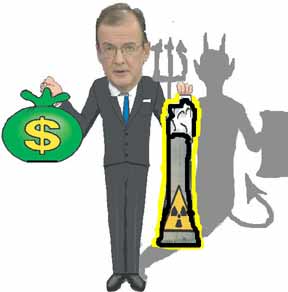 Threat from meltdown only minor: Ziggy Switkowski, fmr head, ANSTO, Paul Langley’s Nuclear History Blog, 1 Sept 12, Comparing the bullshit at the time with the reality….. http://www.smh.com.au/environment/threat-from-meltdown-only-minor-ziggy-switkowski-20110314-1btch.html Threat from meltdown only minor: Ziggy Switkowski March 14, 2011
The impact of any meltdown in Japanese nuclear reactors damaged by the recent earthquake will be small compared to the devastation caused by the quake itself and the subsequent tsunami, Australia’s best-known nuclear power expert says.
Ziggy Switkowski, who was chairman of the the Australian Nuclear Science and Technology Organisation (ANSTO) until a few months ago, says a significant build-up of radiation is unlikely.
“The contribution, if any, to this [disaster] from the nuclear fleet, I expect even under worst case scenarios is going to be small,” he told Fairfax Radio Network today……..
Contrast with reality:
http://www.bbc.co.uk/news/world-asia-16334434 BBC 26 Dec 2011 Fukushima accident: disaster response failed – report……. http://nuclearhistory.wordpress.com/2012/08/31/threat-from-meltdown-only-minor-ziggy-switkowski-fmr-head-ansto/
How Lynas Corporation has mucked up its rare earths reprocessing project
The radioactive residue produced is the responsibility of the company and if necessary, it will be returned to its place of origin.
And what might be the place of origin’s attitude?
“National legislation stipulates,” the WA minister for mines and petroleum has stated, “that Australia will not accept responsibility for any waste product produced from offshore processing of resources purchased in Australia such as from iron ore, mineral sands, and the rare earths produced by Lynas Corporation”.
“The Malaysian finding that Lynas must take the radioactive waste back to Australia may be the straw that breaks the camel’s back with the Lynas effort. This slight detail requires the governments of both Australia and the state of Western Australia to acquiesce in taking the waste from a plant that should have been built in Australia in the first place but wasn’t
LAMP going out for Lynas, 9 News, by Greg Peel, As recent FNArena articles on the subject of the rare earth metals space have noted, the global race to compete with China on rare earth element (REE) production has now come down to a mere handful of names including two stand-outs, and a big chunk of daylight to third. (See, for example: Rare Earths Done And Dusted? No, It’s Xeno-Time). Those two companies are Molycorp in the US and Australia’s own Lynas Corp . A year ago, it looked like Lynas had moved ahead of Molycorp.
According to research and opinion from REE specialist Hallgarten & Company, that is certainly no longer the case. Indeed, Lynas shareholders may be in some trouble. Continue reading
BHP dumped Olympic Dam uranium expansion because the nuclear industry is in crisis
 Lies, damned lies and Olympic Dam sized lies, http://www.independentaustralia.net/2012/politics/lies-damned-lies-and-olympic-dam-sized-lies/ Independent Australia 23 August, 2012 Managing editor David Donovan reports on Tony Abbott’s “dishonest, self-interested fear campaign” about BHP’s decision to defer the Olympic Dam expansion; before environment editor Sandi Keane provides some disturbing background to this controversial project. In what has been described as
“…one of the most dishonest, self-interested fear campaigns … [ever] seen in Australian politics,”
Opposition Leader Tony Abbott blamed the mothballing of the Olympic Dam uranium mine expansion on the mining and carbon taxes, before throwing in “industrial militancy” for ideological good measure.
In an excruciating interview on ABC 7.30, in which Abbott attempted to stick to his predetermined script, Leigh Sales’ unexpectedly direct questioning drew him unstuck.
In a telling moment, Abbott admitted to not having read the reasons for BHP making their decision, but dismissed that fact as irrelevant, emphasising the impact of the carbon and mining taxes — despite the mining tax only being levied on coal and iron ore mines.
To paraphrase The Opposition Leader’s icon:
“We will decide the reasons businesses make their internal commercial decisions and the manner in which they make them.”
For the record, the reasons offered by the Opposition Leader are in stark contrast to those given by BHP boss Marius Kloppers for the decision.
So, in other words, no, no and no, Mr Abbott.
The elephant in the room was, obviously, the fact that the nuclear industry is in crisis mode in the wake of the radioactive catastrophe at Fukushima last year, causing Japan to have no operating nuclear plants at present and Germany to make the decision to shut down all its nuclear plants by 2020. In light of that, it is perfectly reasonable for BHP to put this project in abeyance until it can be sure there will be a market for uranium — after they spend $30 billion to dig the biggest pit in human history.
One thing BHP, regrettably, is unlikely to have considered is the fact that the Olympic Dam mine expansion was always a rather dicey proposition — facing immense and concerted opposition from Indigenous and environmental groups.
This is because, firstly, there is significant evidence that the native title process entered into with Indigenous groups was flawed, perhaps even fraudulent (something IA is currently investigating).
In addition, as IA reported last year, Olympic Dam is an environmental catastrophe waiting to happen, due to inadequate safeguards for the immense amount of exposed radioactive tailings that will be left lying around after BHP removes an unprecedented amount of overburden to get to the ore.
The following is the Independent Australia report by environment editor Sandi Keane, originally published on 18 October 2011, in which she discusses the disturbing health and environmental implications of the Olympic Dam expansion.
Uranium mine expansion: unleashing radioactive dust storms across Australia… http://www.independentaustralia.net/2012/politics/lies-damned-lies-and-olympic-dam-sized-lies/
Australian uranium miner Paladin delivers an even bigger loss than last year’s
Uranium group Paladin’s loss widens, Business Report August 30 2012 Australian-listed Paladin Energy‚ a uranium producer with projects in Australia and two operating mines in Africa‚ delivered a net loss for the year to June 30 of US$172.8m‚ an increase of 110% from the previous year’s US$82.3m loss. This translates into a loss per share of US21.1 cents form a loss of US11.1 cents the previous year. No dividend was declared.
1 This month


Help Aunty Sue Protect Her Land and Sacred Sites From Destructive Rocket Testing.
.

Australians deserve the truth
about
AUKUS – https://aukuspublicinquiry.com/

PETITION – To: Prime Minister Anthony Albanese and the Australian Labor Government

of the week – Australians for War Powers Reform (AWPR)
To see nuclear-related stories in greater depth and intensity
 Antinuclear