Australia’s Prime Minister, and politicians just don’t “get” the solar photovoltaic energy revolution
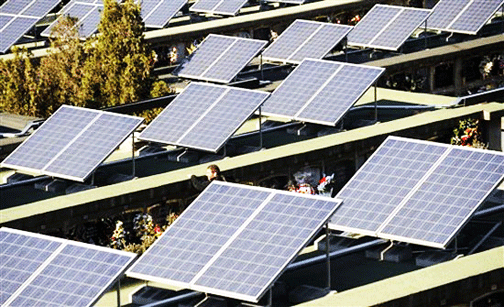 Solar PV industry has a fight on its hands, REneweconomy, By Giles Parkinson 7 August 2012 Prime Minister Julia Gillard’s speech about the need for electricity market reform is hugely welcome, but it highlights some of the challenges that the solar PV industry will face in the near and medium term future.
Gillard today outlined her plan to gain COAG agreement on changes to energy pricing regulation, moving energy towards a service than a commodity, and recognising the value of demand management and energy efficiency.
But like the rest of Labor, she and her advisors do not yet get solar. As Energy Minister Martin Ferguson and Climate Change Minister Greg Combet have said in recent weeks, Gillard trotted out the old canard: solar PV is the plaything of the rich. And who should we blame for such nonsense? Well, let’s start with AGL Energy…..Solar PV is on the cusp of becoming a game changer in Australia because it is able to deliver electricity to households cheaper than via the grid. Some say it could be the the firstmass-market for solar PV in the world. Its availability will increase massively as new financing models are introduced that offer zero cost upfront. That message is understood by some, but not by many. It has the potential to change the nature of the electricity debate and the political debate too.
AGL Energy is happy – via its highly influential series of economic papers – to demonise solar PV as a rich person’s indulgence that penalises the poor, because having great swathes of panels installed across the roofs of Australia, as envisaged by recent AEMO forecasts, does not fit easily into its business model. Nor does it fit easily with other generators and network operators, which is why many are trying to push back against its deployment with tariff changes and other regulation as we highlighted in this story How utilities propose to kill solar PV.
Yet, solar is having a demonstrable impact. According to the REC Agents Association, an industry body, the combination of energy efficiency and solar PV will reduce demand on the network by around 10,66gGWy, or 5 per cent, by 2015. Around one fifth of Australian households already have solar power or a solar hot water system.
The challenge for the solar industry is to make sure that their message is understood – not just by the public, but by the politicians too. http://reneweconomy.com.au/2012/solar-pv-industry-has-a-fight-on-its-hands-35969
USA nuclear-related bases in Australia still targets for attack
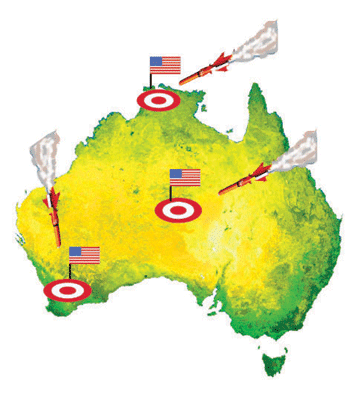
”I am sure that all important targets are included in Russian combat plans,” Colonel Valery Yarynich, a visitor to Australia, said at a rally in Hyde Park on the eve of today’s anniversary of the Hiroshima atom-bombing.
Questioned about the top-secret facilities at Pine Gap near Alice Springs, and WA’s North West Cape communications station, he said: ”Nobody knows, only the high command. It’s secret. Like American plans, too. And targeting can be changed in a matter of minutes.”…….
”I think the world was saved largely due to the fact that missiles of those days were imperfect. They required many hours to prepare to launch. This circumstance helped Kennedy and Krushchev to reach agreement. Today the Russian rocket and the American minuteman demand only a couple of minutes.”
In the 1980s, Soviet strategists became worried the high accuracy of new US missiles might allow a disabling first strike. Colonel Yarynich was involved in setting up the terrifying ”Perimitr” (perimeter) dead-hand system which set off a retaliatory strike automatically from sensor data. It is now disabled. Like many Cold War warriors, the colonel is now involved in efforts to reduce the risk of nuclear war.
He hopes negotiations on nuclear force reductions and de-alerting of remaining forces will pick up between Washington and Moscow after the US election in November and set an example for other nuclear powers. ”We must act,” he said. ”It is necessary and it is possible to remove the finger from the trigger.” http://www.smh.com.au/opinion/political-news/australian-bases-still-in-russian-sights–soldier-20120805-23nxr.html#ixzz22nWt1Gdc
In Cold War, Russia targeted Australia’s USA military bases, not our cities
the US-Australian naval communications station at North West Cape in Western Australia would be a high-priority nuclear target
risks of nuclear attacks on the Pine Gap signals intelligence satellite ground station in central Australia and the missile launch detection facility at Nurrungar
Secret’s out: Soviets did not target cities http://www.smh.com.au/opinion/political-news/secrets-out-soviets-did-not-target-cities-20120805-23ny1.html#ixzz22nPnXqyD August 6, 2012 Philip Dorling THE US-Australian joint defence installations were almost certainly Russian nuclear targets during the Cold War. However, Australia’s cities might well have survived unscathed if superpower tensions had erupted into a global conflagration, according to a top secret intelligence assessment released by the National Archives of Australia.
More than three decades after it was written, the Australian government has finally declassified its most secret study of the
potential impact on Australia of a nuclear war between the US and the former Soviet Union. Continue reading
The push for monster Olympic Dam uranium mine – a monster mistake for Marius Kloppers?
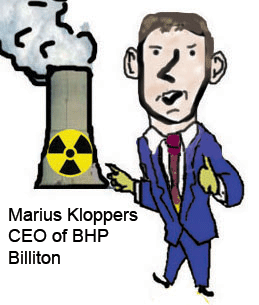 a go-ahead decision on the $US30bn expansion will be delayed for at least two years.
Kloppers made what can now be said to have been an error in talking up the ability of its monster cashflow to fund $US80bn over five years in organic projects to the end of the 2015 fiscal year. Olympic Dam was included in those organic growth projects…
The big money in horse racing waits to the last moment in case an unknown becomes known and changes the odds. A decision on Olympic Dam is much the same. ….
Olympic Dam decision will show Kloppers’ standing BY: BARRY FITZGERALD : The Australian July 31, 2012 THE number five is popping up everywhere for Marius Kloppers. He turns 50 next month, has been chief executive for five years come October, and on August 22 will get to announce an annual profit fall of $US5 billion ($4.7bn) and the need for a $US5bn or so writeoff on last year’s US shale gas push
Then there is the talk that the clock on his chief executive tenure is at five minutes to midnight, ….
Rounding out the string of fives is whether the time is right to commit $US5bn to kick-start the Olympic Dam expansion. A decision on that is due in December. Continue reading
Australian company SILEX: its laser uranium technology could promote nuclear weapons spread
 SILEX is an acronym for Separation of Isotopes by Laser Excitation. The company, a spin-off from the Australian government’s nuclear science and research establishment at Lucas Heights, ANSTO
the worry with SILEX laser technology ”is that it is particularly suited for nuclear proliferation
Uranium on the laser’s edge, Canberra Times, August 6, 2012, Michael Richardson Enrichment systems produce nuclear bomb-grade matter as well as fuel for civilian reactors. The United States is on the verge of approving a licence later this month for the world’s first plant to enrich uranium on a commercial scale for civilian nuclear power reactors
using laser technology developed by an Australian company.
The Australian firm, Silex Systems, says that its secret laser system is cheaper than existing methods of turning natural uranium into fuel for reactors that generate electricity. The plant could be in operation in the US by 2016. Continue reading
South Australian govt not keen to extend Olympic Dam agreement. BHP tightlipped
 No extension offer to BHP – Weatherill. Christopher Russell The Advertiser August 01, 2012 PREMIER Jay Weatherill has rejected suggestions the State Government has offered to grant BHP Billiton an extension to the
indenture agreement on the Olympic Dam project.
Reacting to interstate reports that the Government was offering BHP an olive branch and was willing to “entertain” an extension, Mr Weatherill said he had been misinterpreted.
The Government’s position had consistently been that it wanted BHP Billiton to make a decision by the December 15 expiry date of the indenture agreement….. “There has been no proposition advanced to us that would justify an extension of the 12-month period at this time.”
This is consistent with Resources and Energy Minister Tom Koutsantonis who has previously stated the Government would be reluctant to grant an extension… Despite outside speculation, BHP Billiton has said again this week that no decision has been made on the Olympic Dam project.
Its Adelaide office continues to work on a proposal to present to the BHP Billiton board.
http://www.adelaidenow.com.au/no-extension-offer-to-bhp-weatherill/story-e6frea6u-1226440162081
Australians taking up decentralised solar power – with a vengeance!
 The federal government’s principal forecasting body last week said its landmark assessment of 40 different technologies indicated that by 2030, solar PV would be the cheapest of all available
  technologies
Off grid and on household and commercial rooftops, solar PV is already offering a cheaper alternative.
nearly four million Australians are living in a home with solar hot water or a PV system – and that means they don’t listen to the bulls*** that it is not working, not ready or unreliable.”
Bolt from the blue: How Australia got gold in rooftop solar REneweconomy By Giles Parkinson 6 August 2012 Australia has long been regarded as one of the pioneers of the global solar photovoltaic industry, courtesy of its excellent research at institutions such as UNSW and elsewhere. Now, thanks to its excellent solar resource, rising electricity costs and the falling cost of solar PV, it is now emerging as the leading market for rooftop solar as well.
It wasn’t that long ago that visitors from Europe expressed their astonishment about the lack of solar panels on Australia’s rooftops. But, as one industry leader noted the other day, the growth of PV in Australia has jumped 6,900 per cent between the Beijing Olympics and the London Olympics – enough to earn it a gold medal in deployment.
As consulting group SunWiz noted last month, Australia installed more small-scale rooftop PV (systems less than 10kW) on households in 2011 than Germany, with 795MW vs 759MW. It now has an estimated 1.7 gigawatts of solar PV installed on rooftops, and is expected to get to 2,000MW by the end of the year. The Australian Energy Markets Operator recently said there could be 12,000MW to 18,000MW of rooftop solar PV in the country by 2030. Sunwiz and Solar Business Services say 18,000MW is conceivable by 2022. Continue reading
A multibillion-dollar nuclear aircraft carrier strike group for Australia?
 “full Australian participation in US theatre missile defence”.
US bid for multibillion-dollar nuclear aircraft carrier strike group in Perth, SMH, Nick O’Malley August 1, 2012
- US base in Perth would cost billions
- Strike group includes aircraft carrier, 9 squadrons, 2 submarines
- Read the full report
A report for the US military contains a recommendation to expand America’s defence presence in Australia by massively expanding a base in Perth for a US aircraft carrier and supporting fleet. Continue reading
Australian government’s secret study on nuclear war between USA and Societ Union
 Nuclear study unveiled ( Why did The Age remove this story from the Internet?)
The Australian government finally declassifies its most secret study of the potential impact on Australia of a nuclear war between the US and the former Soviet Union.
http://www.theage.com.au/opinion/political-news/nuclear-study-unveiled-20120803-23l9y.html
Nuclear study unveiled http://www.centralwesterndaily.com.au/story/169021/nuclear-study-unveiled/?cs=8 By Philip Dorling Aug. 4, 2012 More than three decades after it was written, the Australian government last week finally declassified its most secret study of the potential impact on Australia of a nuclear war between the US and the former Soviet Union.
Australia’s peak intelligence agency largely dismissed any danger to Australia from global radioactive fall-out or stratospheric distribution of smoke from burning cities.
In the top secret intelligence assessment released by the National Archives of Australia, the Office of National Assessments also questioned whether Australian cities would be targets for Soviet missiles, suggesting the US’ southern hemisphere ally would be a ”low priority” in a global nuclear exchange. But it acknowledged that direct attacks were a possibility.
Unions, Public Health Association, Environment Centre call on Alice Springs Council to oppose Muckaty nuclear waste dump plan
 Council implored to oppose Muckaty nuclear dump, ABC News, By Ruby Jones, August 02, 2012 The Public Health Association, the Council of Trade Unions, and the Arid Lands Environment Centre are calling on the Alice Springs town council to oppose the planned nuclear waste dump at Muckaty Station.
Muckaty Station, near Tennant Creek, has been put forward by the Federal Government as the best solution for the nation’s nuclear waste. The proposal has been strongly opposed by some traditional owners and environmentalists.
In a presentation to the council, Matthew Gardiner from the Council of Trade Unions said that the Northern Territory does not have the capacity to respond to a nuclear accident…… The groups want the Alice Springs Town Council to back calls for an independent inquiry into nuclear waste storage.
The Alice Springs Mayor Damien Ryan says he will not comment on the position the council might take….. Clive Rosewarne from the Public Health Association says the groups are happy to provide the council with further information.
http://www.abc.net.au/news/2012-08-02/muckaty-station-protest/4172982
Secret negotiations as Australia is drawn into USA’s war machine
none of these negotiations have been shared with the Australian public
Nuclear drumbeat grows as US eyes Australia, Crikey, by Harley Dennett , 3 Aug 12, Australian policymakers could not be getting a clearer picture of what our US ally expects of us. Nuclear weapons and joint military bases aimed at containing our largest trading partner will, sooner or later, be put in our backyard — and we’ll be expected to pay for the privilege.
The Center for Strategic and International Studies report making headlines over a proposal to establish a US base in Perth to host nuclear-powered aircraft carriers and manned and unmanned ISR (intelligence, surveillance and reconnaissance) drones is but the first report commissioned by this Congress. The second — as revealed by Crikey in May — will focus on positioning nuclear force in the Pacific.
Defence Minister Stephen Smith’s denials overnight were revealed as word trickery by the comments of the US Deputy Assistant Secretary of Defense for Plans Robert Scher in Congressional hearings early this morning, who pointed out that “no US bases” really means they expect Australia and other allies to share the costs of hosting large numbers of American troops at these so-called “shared facilities”: Continue reading
Radiation regulator to target miners http://www.governmentnews.com.au/2012/08/03/article/Radiation-regulator-to-target-miners/TODXIXSKLM.html , 03/08/2012, By Julian Bajkowski Radiation safety for workers in the mining and resources sector is set to be probed by the government after the Australian Radiation Protection and Nuclear Safety Agency (ARPANSA) revealed it is scouting for consultants to review the state of radiation exposure reporting. Continue reading
Port Augusta, South Australia, encouraged by government interest in solar thermal energy
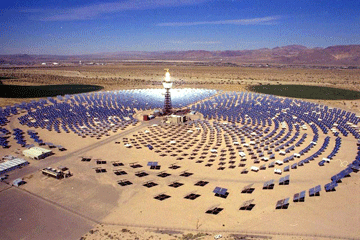 Minister on solar thermal fact-finding tour http://www.abc.net.au/news/2012-08-02/minister-on-solar-thermal-fact-finding-tour/4171960 August 02, 2012 South Australia’s Mineral Resources and Energy Minister, Tom Koutsantonis, will travel to Nevada to research the viability of solar thermal energy. The Minister met solar thermal lobbyists and local government representatives in Port Augusta yesterday. He was given documentation showing the community’s support for the local power stations to be converted to the renewable source.
Mr Koutsantonis says the trip to the United States is to explore and clarify details of solar thermal energy. “We understand gas power generation, we understand coal power generation, we understand wind – in terms of renewable energy we’re
basically the epicentre of Australia,” he said. “If South Australia was a country in its own right we would be number
two in the world for renewable energy.”
Mr Koutsantonis says he is willing to lobby the Federal Government and Alinta Energy to invest in solar thermal.
Port Augusta Mayor Joy Baluch says she is pleased the State Government is supporting a conversion to solar thermal energy for local power stations and is learning more about how the technology works.
“Our conversation has been extremely encouraging to the fact that the Minister is going to Nevada personally to check out the existing and operating solar thermal plant,” she said.
180,000 homes to be powered by Snowtown wind farm, (South Australia)
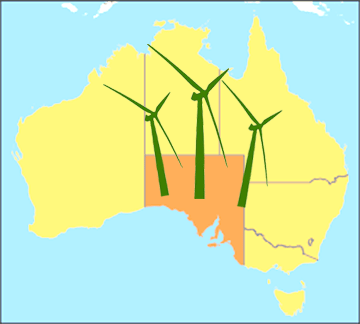 Siemens and TrustPower to build largest wind farm in South Australia, PACE, 3 August, 2012 Kevin Gomez, TrustPower has appointed Siemens as their turn-key supplier to construct South Australia’s largest wind farm at Snowtown using for the first time in Australia, gearless drive wind turbine technology.
With the project formally reaching financial close, the Snowtown II wind farm development will be capable of generating 270 megawatts of renewable energy and powering approximately 180,000 South Australian homes……. South Australia has now set a target of 33 per cent renewable energy by 2020. The new Snowtown II wind farm is set to help achieve this target.
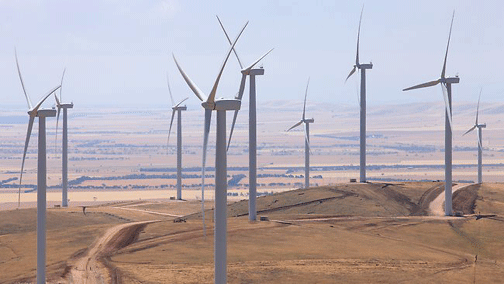
Snowtown II is co-located with the existing Snowtown wind farm, which will more than triple the renewable energy generation of the region. Early preparations have commenced at the site with construction commencing inAugust 2012 to ensure the project is fully operational by the end of 2014…. http://www.pacetoday.com.au/news/siemens-and-trustpower-to-build-largest-wind-farm
Reports indicate that Australia is set for huge change to renewable energy
 Poised for energy game-changer http://www.theaustralian.com.au/business/companies/poised-for-energy-game-changer/story-fn91v9q3-1226441797585 BY: GILES PARKINSON The Australian August 03, 2012 The Bureau of Resources and Energy Economics has found that solar and wind will be less expensive than new coal or gas by 2020
A WEEK ago, the Climate Institute published the results of a survey that showed Australians, despite being largely undecided about climate change, much preferred solar and wind energy over coal power and nuclear.
It was a choice largely driven by the urge to be clean and green, and two key reports delivered in the past year affirm their choice: solar and wind are the cheapest options too. The reports — a study by AECOM and a more detailed, landmark analysis of 40 technology options by the government forecaster, the Bureau of Resources and Energy Economics — suggest we are on the verge of a profound change in sentiment in the debate about renewables.
The studies have effectively blown the argument that the nation’s 20 per cent renewable energy target should be canned or wound back on the basis that it is too expensive.
BREE found that wind and solar will be less expensive than new coal or gas by 2020 and will be the cheapest of all energy options by 2030. Its findings suggest that the RET, because it encourages deployment, simply accelerates the fall in the cost curve. AECOM’s report found that building more renewables generation such as wind and solar would
enable the nation to protect against rising gas prices, which are seen as inevitable as gas is funnelled through the massive liquefied natural gas plants to the export market.
1 This month


Help Aunty Sue Protect Her Land and Sacred Sites From Destructive Rocket Testing.
.

Australians deserve the truth
about
AUKUS – https://aukuspublicinquiry.com/

PETITION – To: Prime Minister Anthony Albanese and the Australian Labor Government

of the week – Australians for War Powers Reform (AWPR)
To see nuclear-related stories in greater depth and intensity
 Antinuclear