Any new bulk electricity generation in Australia will be sourced only from renewables
 The only new generation that will be built in any great quantity in the next decade will be renewables THE AUSTRALIAN BY: GILES PARKINSON August 10, 2012 LAST year was a notable one for the global green energy industry: for the first time, the value of new generation exceeded that of fossil fuels. According to Bloomberg New Energy Finance, $US187 billion ($176bn) was invested across the globe in new plants generating electricity from the wind, sun, waves and biomass, while $US157bn was invested for natural gas, oil and coal. It is not a trend that is expected to be reversed.
This figure is rarely mentioned at home. Yet Australia seems destined for an even more dramatic turnaround in energy investment.
As the annual Electricity Statement of Opportunities published by the Australian Energy Market Operator concluded this week, there was no need for any new coal or gas baseload generation in the country for the next decade.
The only new generation that will be built in any great quantity will be renewables. Most of this will come from wind, which accounts for more than 90 per cent of the green energy plans, although solar may play a more prominent role in years to come. Continue reading
Australian breakthrough in solar energy storage
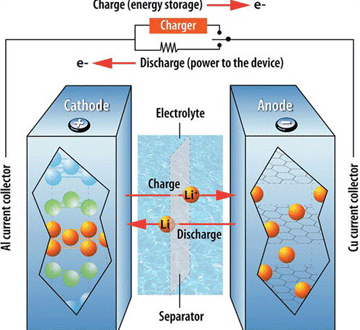
The picture at left is of a typical Lithium ion battery, not the sodium ion one. But I do my best! – CM
Australian scientists make renewable energy storage breakthrough, Home Heating Guide By Katie Anderson August 10, 2012 Although renewable energy technologies have come on leaps and bounds in the last couple of decades, a solution to economical energy storage remains a big stumbling block in the quest to generate more energy with sustainable technologies and to make renewable energies more affordable. However a team of scientists in Australia are one step closer to finding a viable solution in terms of storing solar and wind energy for use in non-generation times – at night and during windless days. And it comes in the form of a water-based sodium-ion battery , developed by researchers from the School of Chemical and Mathematical Sciences at Murdoch University in Perth, Western Australia. Continue reading
Australia’s Prime Minister aware of the importance of distributed solar energy
 Julia Gillard made two key points – apart from drawing attention to the massive overspend on
  poles and wires – about the energy systems of the future in her speech on Tuesday. One was about the introduction of smart technologies, and the other was about the power of choice. “People should be able to use what they want when they want it, and cut out expensive services they don’t need,”
new technologies are now offering alternatives and distributed generation has become cost-competitive and reliable
Do energy consumers want a smart grid, or no grid at all? REneweconomy, By Giles Parkinson on 8 August 2012 Robin Gudgel, the founder of Californian energy firm Midnite Solar, has been helping people provide their own electricity – mostly with renewable energy sources and batteries – for their homes and small businesses for several decades. …. now it’s more of a mainstream trend – people living where the grid doesn’t reach, and some who want to look after themselves because they want to make a statement about their green credentials, or their independence.
“Very seldom do you get people who get mad as hell about electricity prices and go off grid. It simply costs too much,” Gudgel told RenewEconomy during a recent visit to Australia. That may well be the case in mainland USA, where electricity prices are relatively benign.
But in Hawaii, where electricity prices are three times higher, customers are getting as mad as hell and are reportedly leaving the grid in droves. So is the US military…… Energy independence is the big new strategic play of the US military brass. And it’s on the wish list of consumers.
Why does this matter to Australians? Well, it turns out that Hawaii and Australia have a lot in common. Both are islands, both have plenty of sun, and both have really high retail electricity prices – Hawaii because it relies on imported fuel and Australia because of its massive network infrastructure, much of which may be surplus to requirements – and both have falling energy demand. Continue reading
Olympic Dam anti uranium protestors facing court
 Olympic Dam protest has court sequel http://www.abc.net.au/news/2012-08-09/olympic-dam-protest-charges-heard/4188096?section=sa August 09, 2012 Some of the protesters arrested near the Olympic Dam mine recently have faced the Magistrates Court at Port Augusta. Those who pleaded guilty were fined $150 and had no conviction recorded. Others who did not attend or pleaded not guilty will face a pre-trial conference in mid-September.
One man who was charged with interfering with a motor vehicle for allegedly chaining himself to a semi-trailer refused to enter a plea. He argued the court had no jurisdiction over him as he observed the laws of the Arabunna nation.
He also refused to stand in the dock, claiming it was where criminals stood and he was not a criminal.
Hundreds of people protested near the BHP Billiton mine, urging it be closed down rather than expanded.
Poor safety record of Australian Nuclear Science and Technology Organisation (ANSTO) and Australian Radiation Protection and Nuclear Safety Agency (ARPANSA)
 Inadequate Safety Practices at Lucas Heights and Inadequate Regulation by ARPANSA, Friends of the Earth 10 Aug 12 Since 2007, a saga has been unfolding regarding contamination accidents at the Australian Nuclear Science and Technology Organisation (ANSTO), ANSTO’s handling of those incidents, ANSTO’s treatment of whistleblowers, the handling of the matter by the Australian Radiation Protection and Nuclear Safety Agency (ARPANSA), and the
  independence or otherwise of ARPANSA.
The saga has exposed inadequate safety practices at ANSTO and an inadequate performance by the regulator ARPANSA. The problems would not have been exposed and partially rectified if not for a number of ANSTO whistleblowers.
A few snapshots of this saga are noted below and more details can be found on the Friends of the Earth website:
28 August 2008 − Incident at ANSTO involving a vial of molybdenum-99. An audit found that proper processes were not followed: evacuation of the area did not occur, timely communication and event reporting, thorough investigation and follow-up did not occur. The staff member in question had not completed occupational health and safety induction training or a radiation safety course.
June 2009 − David Reid, an ANSTO employee and staff-elected health and safety officer, was suspended in June 2009 and sacked in June 2011. He repeatedly raised concerns about contamination incidents and some of his concerns were later vindicated. ANSTO states that his suspension and dismissal were unrelated to his statements regarding safety problems at ANSTO.
5 May 2010 − The ABC report states: “ARPANSA is Australia’s nuclear industry watchdog and Lateline has obtained a copy of its report into the accident. It largely supports David Reid’s concerns and raises further questions about safety at Lucas Heights. Continue reading
Victoria’s Baillieu government destroying wind industry in that State
the Baillieu government has introduced severe planning restrictions, with 14 of the 18 previously publicly announced wind farm proposals that are now unlikely to proceed located in that state.
The wind farms that Baillieu killed. REneweconomy By Giles Parkinson 9 August 2012 If Victorian Premier Ted Baillieu came to power with a determination to kill off opportunities for wind farm development in Victoria, then he can be proud of his work.
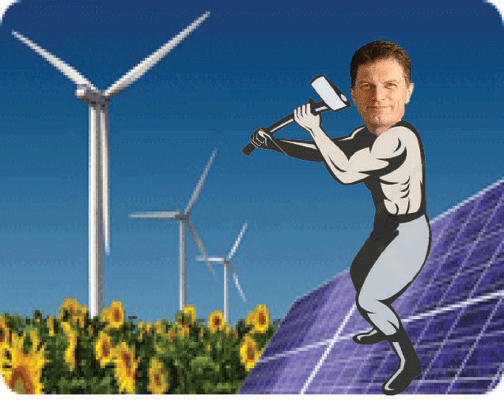
The annual Electricity Statement of Opportunities released today by the Australian Energy Market Operator highlights how much the opportunities for wind farm developments in Victoria have been reduced in the past year. Continue reading
Solar photovoltaic energy is here to stay, and to grow, in Australia
 The inevitability of Solar PV in Australia, The Energy Collective, Nigel Morris, August 8, 2012 Is 40 gigawatts by 2030 conceivable in Australia?We argue for the inevitable surprise PV has in store for us. Over the last few months, I have had the pleasure of presenting to hundreds of solar industry delegates at the EcoGeneration Master Classes held around Australia.
Inevitably, the most interesting part for me was the conversations with so many who are at the ‘coal face’; working day in, day out to sell the virtues of solar photovoltaic (PV) against rising coal-fired energy prices.
I met installers who told me that they could feel the attitude of the mass market changing, describing how the economic proposition was so compelling that conversion rates were rising, despite the declining levels of government support.
I met wholesalers who were astounded at the rate of demand from dealers, at the pull-through from the market, and that it is flowing well beyond 30 June – when the Small-scale Technology Certificate (STC) multiplier will be reduced. They are talking about short-term supply shortages, would you believe.
…….One of the most popular slides in my presentation was one that showed a snapshot of where the local market could be by 2030. This slide stems from analysis I helped produce for the Australian Energy Market Operator (AEMO) who – as a result – effectively lifted the expectations for solar PV from less than 2 gigawatts (GW) in 2030 to a potential of 18 GW. And that’s only the rooftop installations; the ‘behind-the-meter’ demand. But since the last Master Class, several fascinating events have occurred that got me thinking about how this revised projection fits into the wider context of predicting solar uptake. Continue reading
Giant cuttlefish – a unique species under threat – especially relating to Olympic Dam uranium mine
 Let us not forget that the giant cuttlefish has only one breeding ground in the whole world. And that is in Upper Spencer Gulf – where BHP Billiton would put its desalination plant -as part of its project for the world’s biggest uranium mine at Olympic Dam. The breeding ground depends on a very special, and delicate, balance of fresh and salt water.– CM
Green group demands cuttlefish study’s release http://www.abc.net.au/news/2012-08-08/green-group-demands-better-giant-cuttlefish/4185184 August 08, 2012 The Conservation Council of South Australia is calling on the State Government to release the results of a recent study on the population of giant Australian cuttlefish near Point Lowly.
Conservation Council CEO Tim Kelly says the Government needs to announce a plan of action and immediately put the cuttlefish on a protected species list. Continue reading
Demand for power falls http://www.theage.com.au/business/demand-for-power-falls-20120808-23uk9.html#ixzz235uEjIIk August 9, 2012 Brian Robins New power stations will not be needed until 2018: forecast WEAK electricity demand will delay for several years the need to build new power stations and, when building resumes, renewable power and peaking power plants using gas will be the main new sources of energy. Continue reading
Solar panel popularity cuts demand
Adelaide Now, Julian Swallow August 09, 2012 REDUCED electricity consumption and growing use of renewable energy will cause a five-year delay in the need for extra generation investment in SA, a new report says. Continue reading
Minister Martin Ferguson making radioactive waste policy on the run
 Waste dump tender is ‘putting the radioactive cart before the horse’. Calling for tender to design a remote radioactive waste facility while the only proposed site is under federal court challenge is putting the radioactive cart before the horse, the Beyond Nuclear Initiative (BNI) has said today.
BNI coordinator Natalie Wasley said “The only site federal Resources Minister Martin Ferguson has indicated he intends to pursue for a national radioactive waste dump- Muckaty, 120km north of Tennant Creek in the NT- is subject to a federal court challenge and ongoing community challenge. The NT government is strongly opposed and trade unions, environment and health groups across the country have committed to stand up and stop the Muckaty proposal”.
“The Minister is making radioactive policy on the run, based on a political assumption that a remote site is needed and a miscalculation that people living nearby or culturally connected to those areas do not have the determination or capacity to defeat this proposal,” Ms Wasley added. Continue reading
Government calls for nuclear dump designs http://www.abc.net.au/news/2012-08-08/nuclear-waste- dump-design-out-to-tender/4186010 August 08, 2012 The Federal Government has released a tender calling for concept designs for Australia’s first radioactive nuclear waste dump. The Government has previously announced its preferred site for the dump is on Muckaty Station in the Northern Territory, about 120 kilometres north of Tennant Creek.
The tender says the concept design will be appropriate for a site in arid to semi-arid areas of Australia. It says the facility should be designed to accommodate waste for at least 100 years, and equipment at the site may be required to
repackage the radioactive waste.
Nat Wasley from the Beyond Nuclear Initiative is campaigning against the dump. Ms Wasley did not know the tender was being released. “It came as quite a surprise, but once again it’s an indication of the completely secretive and very un-transparent [sic] process that the Government’s been using,” she said. Submissions for the tender close in September.
Toro Energy – time to come clean on costs of Wiluna uranium mine plan

 8 Aug 12 Western Australia’s peak environment group, one of the appellants against Toro Energy Ltd’s proposed Wiluna uranium mine, has called on the company to reveal the expected costs for closure and rehabilitation for the mine, which the Council says could make the project uneconomic.
Piers Verstegen, CCWA Director said “Under WA’s new mine closure guidelines, mining companies are required to pay the full costs of mine closure. In addition, the WA Parliament recently passed a motion that would require uranium mine waste to be isolated from the environment for no less than 10,000 years.
Despite these requirements, Toro are making claims about the financial viability of the Wiluna uranium project without disclosing the costs of mine closure and rehabilitation to shareholders, the WA Government or the community they expect to host the mine.”
“Mining giants BHP and Cameco have both recently concluded that their uranium projects in WA and South Australia are not economically viable. After carefully analysing the cost structure of uranium projects including the very high mine closure and rehabilitation costs, these companies have shelved their projects as they simply don’t stack up.
“The big difference between Toro Energy and the mining giants is they have no operating mining projects and nothing to lose. Unlike BHP and Cameco who have huge portfolios at stake, Toro energy could easily abandon an uneconomic uranium mine and leave the clean-up bill to be paid by WA taxpayers.
“Even their largest investor Oz Minerals, which holds a 43% stake in the company, described Toro as a ‘tiny company’ and a ‘non core asset’ at their recent AGM in Melbourne.
“It may be that Toro’s business model does not involve ever paying their mine closure costs, with the company instead planning to abandon the mine site and leave this liability to the WA taxpayer. This would explain the company’s failure to account for mine closure costs in the information they have provided to shareholders.
“Given this very real possibility, the WA Government should apply the same standards used by the big mining companies in assessing uranium proposals. If Companies like BHP and Cameco are not prepared to gamble their extensive assets on this uncertain industry, our Government should not be prepared to gamble taxpayers’ money and the health of our environment and communities on uranium mining.”
Australia willing to sell uranium to repressive, undemocratic Emirates regime
Think again on uranium sale to illiberal UAE Crikey, by Dr Rodger Shanahan, 8 Aug 12 “……our recent announcement of a $200 million deal to sell uranium to the UAE, and the UAE’s announcement at the same time that it would support Australia’s bid for a seat at the UN Security Council
What you won’t hear from the government or Foreign Affairs Minister Bob Carr is any mention of the Emiratis recent intolerance for anything that approaches free speech. This strikes one as, well, hypocritical, considering this government has espoused the need for autocratic rulers to listen to the voice of the people and in some cases to step aside when they don’t adopt this approach.
On the surface, the UAE is a socially liberal Arab state with which we and many other Western countries have close relations. But below the surface, the UAE is demonstrating that it is just as politically illiberal as other Arab regimes.
How else to explain the forced closure of democracy promotion NGOs earlier this year such as the US-funded National Democratic Institute and the German-funded Konrad Adenauer Foundation? Concerns about what has been happening in the UAE are neatly summarised in an article on open democracy.
Of more concern than the action against foreign NGOs, however, has been the detention without charge of over 50 political and human rights activists accused of a rather Orwellian-sounding plot against state security and the rather more standard claim that they had unspecified ties “to foreign parties”. It appears that no political activists in the Arab world, be it in Syria, Bahrain, Saudi Arabia, the UAE or Egypt, ever has a legitimate domestic political complaint: all political opposition is always carried out at the behest of foreign powers.
And what is Australia’s view on the crackdown on political activists and the closure of democracy-promoting institutes in the UAE? You guessed it: nothing.
Carr’s statements have spoken of our close trading relationship but you won’t find a single word of criticism levelled against the Emiratis for their unwillingness to countenance free speech. I am an advocate of close relations with the UAE because I believe it serves both our national interests. But a relationship in which we have to remain silent about repression of individual freedoms in order to maintain business interests is one in which we reveal ourselves to be less an activist middle power than a subservient mineral exporter….. http://www.crikey.com.au/2012/08/08/australia-uses-china-policy-on-the-emiratis/
Investors warn – forecast for Olympic Dam mega uranium mine just gets gloomier
 Argo worries BHP’s $3b write-downs a warning sign, The Age, Michael Evans August 7, 2012 JASON BEDDOW, the boss of listed investment company Argo Investments, has expressed concern over the $3 billion in write-downs at BHP Billiton, saying he fears there may be more to come.
After announcing a 3 per cent fall in Argo’s net profit to $167.3 million for 2012, Mr Beddow, who estimates his firm’s BHP 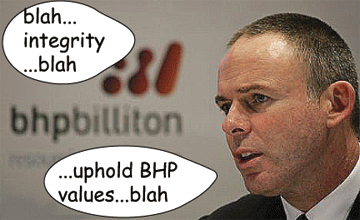 stake at about $260 million, told BusinessDay that he would like BHP management, led by the chief executive, Marius Kloppers, to know that ”you need to be a bit prudent”….
Mr Beddow said that there was ”every chance they will have to take [further] write-downs’….. if you really wanted to point the [finger] that’s what you’re paid for in a CEO. You’re paid for responsibility.”…
The market was concerned at the uncertainty around some of its major projects such as Olympic Dam, he said.
1 This month


Help Aunty Sue Protect Her Land and Sacred Sites From Destructive Rocket Testing.
.

Australians deserve the truth
about
AUKUS – https://aukuspublicinquiry.com/

PETITION – To: Prime Minister Anthony Albanese and the Australian Labor Government

of the week – Australians for War Powers Reform (AWPR)
To see nuclear-related stories in greater depth and intensity
 Antinuclear