Labor backs bill forcing charities to reveal donors
Labor backs bill forcing charities to reveal donors in deal with government for dropping voter ID laws

“The government has rushed through amendments to retrospectively capture charities it doesn’t like, in an effort to silence them
“We’re equally disappointed Labor has allowed this process to happen.”
Legal expert says legislation is ‘an effort to silence’ charities the Coalition government ‘doesn’t like’, Paul Karp@Paul_Karp, Guardian, Wed 1 Dec 2021 .Labor has helped pass a bill that will force charities to reveal their donors for all advocacy, after the Coalition agreed to drop its proposal to make voters show identification at the 2022 federal election.
The deal has enraged the charity sector, which believed the Senate crossbench would have helped Labor block both the voter ID and political campaigner bills, but they will now have to declare donors with retrospective effect.
On Wednesday the independent senator, Jacqui Lambie, announced that she would vote against the voter ID bill because there was “no way” the benefits outweighed the risks of discouraging legitimate voters……….
On Wednesday afternoon Labor confirmed to Guardian Australia it had reached a deal with the government to pass a watered down version of the bill because it lacked the numbers to refer it to an inquiry and feared the crossbench could wave it through………..
The bill passed the Senate on Wednesday evening with the Coalition and Labor voting together to defeat unrelated crossbench amendments.
The charities sector is concerned that despite the $250,000 threshold, organisations like the Australian Conservation Foundation, unions, Voices for groups backing independent candidates, and climate groups including Australian Youth Climate Coalition and Farmers for Climate Action will now have to declare their donors.
It is also concerned that the new definition of electoral expenditure will capture issues-based and awareness-raising campaigns that don’t aim to influence voters’ choice.
Senior lawyer at The Human Rights Law Centre Alice Drury told Guardian Australia a coalition of 80 charities was “really disappointed about the whole process this bill has taken”.
“The government has rushed through amendments to retrospectively capture charities it doesn’t like, in an effort to silence them,” she said.
“We’re equally disappointed Labor has allowed this process to happen.”
Drury said the bill has a “discriminatory” impact on charities, which must demonstrate they are non-partisan to maintain their charitable status, which could be imperilled by advocacy spending above the threshold.
“Our major concern with this law is the threshold will act as a spending cap on charities……..
Greens senator, Larissa Waters, said the party was “glad to see the back of the voter ID laws but secretly trading one legislative outcome for another is not how democracy is supposed to work”, labelling the deal a “cynical stitch-up between the government and Labor”………..https://www.theguardian.com/australia-news/2021/dec/01/labor-to-back-bill-forcing-charities-to-reveal-donors-in-deal-with-government-for-dropping-voter-id-laws
Australian government using a loophole to evade international non-proliferation treaties, to get nuclear submarines?
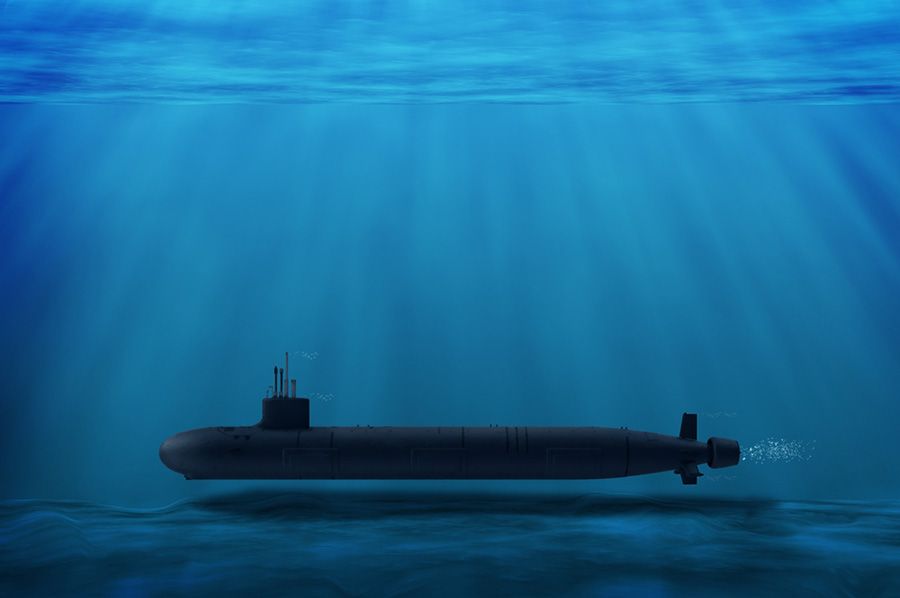
“interesting interpretation” that the government would try to qualify for an exemption from the International Atomic Energy Agency’s inspection regime by claiming military submarines, which will be fuelled with weapons grade uranium, are for peaceful purposes.”
Labor questions whether nuclear subs breach international law, AFR, Andrew Tillett, Political correspondent, 30 Nov 21, Labor MPs have raised concerns about Australia breaching its non-proliferation obligations under the Morrison government’s plan to acquire nuclear-powered submarines from Britain and the United States.
Parliament’s Treaties Committee has begun a snap inquiry into the first element under the AUKUS deal, an agreement between the three countries to allow the sharing of highly classified nuclear technology with Australian officials.
The nuclear agreement also covers training opportunities for Australian submariners and technicians with the British and American programs.
Under the AUKUS pact, the government will acquire up to eight nuclear-powered submarines, promising they will be built in Adelaide. The first is due to be delivered sometime before 2040.
The government is adamant the nuclear submarine deal will not be a precursor to acquiring nuclear weapons.
The inquiry is due to report by December 17 but at its first hearing on Monday, Labor MP Josh Wilson highlighted significant uncertainty over the government’s plan to use a loophole in the international nuclear safety regime, which had never been used before, to acquire the submarines.
Mr Wilson and fellow Labor MP Peter Khalil grilled officials from the Defence, Foreign Affairs and Attorney-General’s departments over how Australia could acquire nuclear-powered submarines while still complying with its obligations under the nuclear non-proliferation treaty.
Training ‘needs to start now’
Mr Wilson said it was an “interesting interpretation” that the government would try to qualify for an exemption from the International Atomic Energy Agency’s inspection regime by claiming military submarines, which will be fuelled with weapons grade uranium, are for peaceful purposes.
“If it was determined that was acceptable, we will have broken new ground in weakening the existing non-proliferation regime,” Mr Wilson observed……….. https://www.afr.com/politics/federal/questions-over-whether-nuclear-subs-breach-international-law-20211129-p59d0h
UK and Australian consultancy firms get together in anticipation of nuclear submarine programme
In readiness for the commencement of Australia’s nuclear-powered submarine program, local consultancy Coras has formed a partnership with Britain’s Abbott Risk Consulting. Coras partners with Abbott to deepen nuclear submarine capability
28 November 2021 Consultancy.com.au, The partnership between the Australian defence-focused management consultancy and the UK-headquartered risk management specialist comes ahead of Australia’s transition to a nuclear-powered submarine capability as part of its recently-struck AUKUS pact with the UK and US.
The formal agreement is built on an existing close working relationship between the two consulting firms and aims to capitalise on the melding of local knowledge and international nuclear expertise…………….. https://www.consultancy.com.au/news/4433/coras-partners-with-abbott-to-deepen-nuclear-submarine-capability
France’s Foreign Minister raises concerns about AUKUS, nuclear submarines, and risks of weapons proliferation.
the theme of ‘betrayal’ in terms of both being ‘cheated’ out of a deal and being deceived by NATO allies and, in Australia’s case, a historical ally.
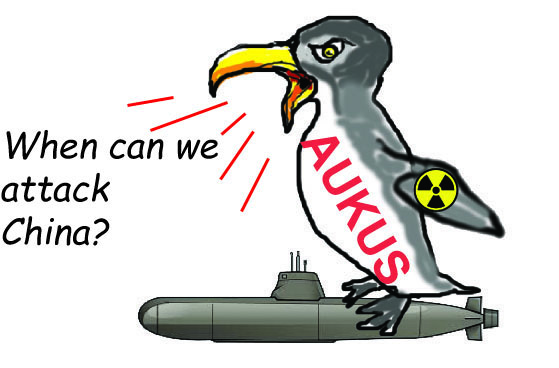
AUKUS was about ‘pressing a sense of confrontation with China’
if tomorrow Australia has some nuclear-powered submarines, why not, some other countries could ask for similar technology, it could be Indonesia, why not?’
Australia needs an entente cordiale with Indonesia over nuclear propulsion and non-proliferation, The Strategist, 29 Nov 2021, |David Engel However relaxed and comfortable Indonesian Defence Minister Prabowo Subianto might be about Australia’s plans to acquire nuclear-powered submarines (SSNs), the visit to Jakarta of French Foreign Minister Jean-Yves Le Drian has probably validated the very different view of Le Drian’s counterpart, Retno Marsudi.
……………………………………………. the most striking moment of the visit came during Le Drian’s address to Indonesia’s leading international affairs think tank, the Centre for Strategic and International Studies (CSIS). While his speech focused on issues such as multilateralism and the EU’s position on the Indo-Pacific, his response to a question on ‘minilateralism’—specifically, AUKUS and the Quad—took on a very different tone.
Ignoring the Quad, he levelled his remarks at AUKUS, stressing four points. The first two reiterated the theme of ‘betrayal’ in terms of both being ‘cheated’ out of a deal and being deceived by NATO allies and, in Australia’s case, a historical ally. He talked about American efforts to restore trust through various US commitments to France. He didn’t mention Australia in this context.
More significantly, his third point was that AUKUS was about ‘pressing a sense of confrontation with China’ (as the simultaneous translation put it). He said that, while France was not oblivious to China’s military threats and risks, he believed that the best way to respond to these threats was to ‘develop an alternative model rather than to first of all oppose’.
Perhaps his most significant point for Australian interests was his fourth, which went to the transfer of nuclear technology for submarine propulsion. He pointed out that until now no nuclear-weapon state had done this. But ‘if tomorrow Australia has some nuclear-powered submarines, why not, some other countries could ask for similar technology, it could be Indonesia, why not?’ He continued that, even though this technology was not covered by the Nuclear Non-Proliferation Treaty (NPT), the risk the arrangement posed of starting a trend was nonetheless of concern.
Irrespective of Le Drian’s intentions in answering the question in this manner—and it’s noteworthy that he didn’t cover AUKUS in his formal address—he would surely have known that his words would resonate powerfully with his audience, both at CSIS and more generally among Indonesia’s foreign policy establishment. While his depiction of Australia as duplicitous was evidently personal and heartfelt, it would also have struck a chord with those Indonesians who have characterised Canberra the same way over such issues as East Timor, Papua and spying allegations, irrespective of how justified that judgement might be.
Le Drian’s last point went directly to concerns about nuclear proliferation—issues that Indonesia highlighted in its official statement on AUKUS and the planned submarines. It corresponds closely ‘in spirit’ with subsequent official commentary to the effect that Indonesia was considering advocating a change to the NPT aimed at preventing non-nuclear-weapon states from acquiring SSNs………
whoever governs in Canberra now and into the future should at least make a priority of assuaging Jakarta’s worries on this subject, however overstated and unbalanced they are. While Indonesia’s prospects of changing the NPT and precluding Australia from having SSNs look remote at best—not least because several of its ASEAN colleagues do not share its views of Australia’s ambitions—the sooner the two countries can put this latest irritant to rest the better.
In the circumstances, the onus for doing so must primarily rest with Canberra………https://www.aspistrategist.org.au/australia-needs-an-entente-cordiale-with-indonesia-over-nuclear-propulsion-and-non-proliferation/
Traditional owners expected to challenge nuclear waste facility in South Australia

Traditional owners expected to challenge nuclear waste facility in South Australia
The Barngarla people have unanimously rejected the federal government’s controversial plan to store radioactive medical waste on their land, and may take their case to the state’s supreme court, Guardian, Tory Shepherd 29 Nov 21
The federal government has confirmed that a controversial nuclear waste facility will be built near Kimba, in South Australia – but the traditional owners are expected to mount a legal challenge.
Resources minister Keith Pitt announced two months ago that a 211-hectare site at Napandee, 24km out of Kimba, had been chosen from three potential sites to store Australia’s radioactive waste. After 60 days of further consultation, he confirmed that decision on Monday morning.
An Australian Electoral Commission ballot found more than 60% of local residents supported the facility. However, the traditional owners, the Barngarla people, say many of them missed out on the vote because they were not living in the Kimba council area.
When surveyed separately, the Barngarla voters unanimously rejected the proposal.
At the time, Barngarla Determination Aboriginal Corporation chair Jason Bilney said he planned to launch a judicial review, challenging in the supreme court the selection of Kimba over other sites.
Guardian Australia has contacted the corporation for comment.
Pitt said the government would now acquire the land to build a new facility that would store low- and medium-level medical waste that is scattered across more than 100 locations in Australia……….
The new facility will house low-level waste permanently, and medium-level waste temporarily, until a permanent solution is found for that.
Conservationists have told a parliamentary inquiry into the future of the Lucas Heights nuclear facility that the Sydney site should be expanded to take the nation’s waste until that long-term decision is made, rather than having a new facility built. https://www.theguardian.com/australia-news/2021/nov/29/traditional-owners-expected-to-challenge-nuclear-waste-facility-in-south-australia
The Kimba nuclear dump is a long way from a done deal: needs formal environmental and regulatory assessment and approval.
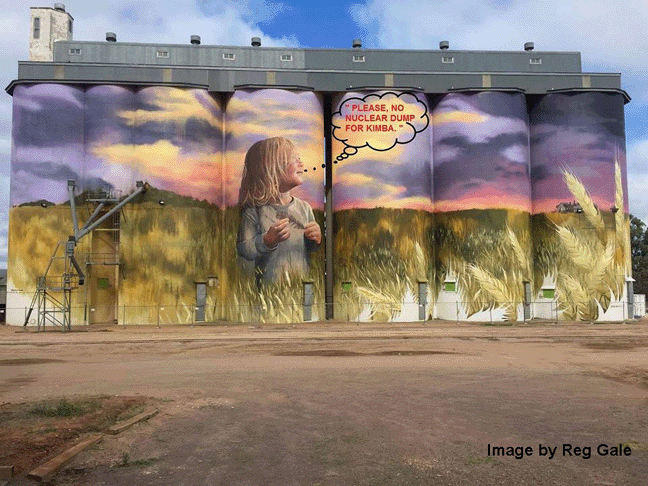
Resources Minister Keith Pitt’s formal declaration of Napandee, near Kimba in regional South Australia, as the location for a co-located radioactive waste disposal and storage facility is likely to see an escalation in community contest and opposition, the Australian Conservation Foundation said today.
ACF’s concerns with the plan include:
- No consent from the region’s Traditional Owners, the Barngarla people. Barngarla were actively excluded from key ‘consultation’ processes, including a highly restricted community ballot.
- The planned facility is unnecessary given federal parliament’s recent support for a $60 million waste storage upgrade to secure the most problematic intermediate level waste (ILW) at the Australian Nuclear Science and Technology Organisation’s (ANSTO) Lucas Heights nuclear site for the next three to five decades.
- Moving intermediate level waste from ANSTO, a site with many institutional assets – security, radiation monitoring and emergency response, local expertise etc – to a site near Kimba with far fewer assets and resources is irresponsible and inconsistent with best industry practice.
Further concerns are outlined in ACF’s 3-page background brief on radioactive waste plans.
“The Kimba plan is effectively redundant on the day Minister Pitt has made his decision,” said ACF’s national nuclear-free campaigner Dave Sweeney.
“Extended storage of Australia’s most problematic waste at Lucas Heights where most of it is already stored, makes far more economic, environmental and radiological sense than the ill-considered Kimba plan.
“Sites that currently store and manage nuclear medicine waste around Australia will still need to do so, irrespective of the status of any national facility, so the Minister’s repeated reference to nuclear waste being spread across 100 sites is disingenuous and inaccurate.
“The planned federal action is contrary to SA state law and does not enjoy bi-partisan political support.
“Fewer than one thousand South Australians have had a say in a plan that has profound inter-generational implications.
“This is particularly concerning given the prospect of project creep as atomic enthusiasts spruik domestic nuclear energy in the context of the proposed acquisition of nuclear-powered submarines.
“Minister Pitt is continuing the same top-down, flawed approach that has failed in the past.
“Minister Pitt’s decision is the start of a new stage in the campaign for responsible waste management.
“This politicised move will be contested in the Courts and on the streets.
“Setting up processes to manufacture consent – including denying a voice to Aboriginal Traditional Owners – speaks volumes about the poverty of the arguments in favour of the waste facility.
“If the Minister was convinced of the project’s merits he would not be cutting corners with Traditional Owners and the wider community or making myth about nuclear medicine.
“Canberra should stop playing politics and instead get serious about responsible radioactive waste management.
“This issue has a long way to run. The plan needs formal environmental and regulatory assessment and approval and is a long way from a done deal.”
ACF’s 3-page background brief on federal radioactive waste plans
Measure twice, cut once: Advancing responsible radioactive waste management in Australia
Kimba nuclear dump: Premier Marshall must enforce South Australia’s legislation
“The SA Nuclear Waste Storage Facility (Prohibition) Act was an initiative of the SA Olsen Liberal government to prevent the imposition of an intermediate-level nuclear fuel waste dump in SA. The state legislation was strengthened by the Rann government in 2002. Premier Marshall should fight Canberra’s push to dump nuclear waste on SA and to override state legislation, as did Premier Olsen and Premier Rann.
The Act mandates a state Parliamentary inquiry in response to any attempt to impose a nuclear waste dump on SA and the Premier should initiate that inquiry immediately.
The Morrison government’s plan to impose a national nuclear waste dump at Kimba still faces multiple hurdles despite today’s announcement from Minister Keith Pitt that the site has been formally declared and land acquired. Those hurdles include a judicial challenge to the declaration, environmental assessment, assessment by the federal nuclear regulator ARPANSA, a state parliamentary inquiry, and upcoming state and federal elections.
The Howard government had proceeded further towards imposing a dump on SA before abandoning the plan in 2004.
Dr. Jim Green, national nuclear campaigner with Friends of the Earth Australia, said: “The Morrison government’s disgraceful efforts to override the unanimous opposition of Barngarla Traditional Owners will be challenged in the courts. Barngarla Traditional Owners are expected to launch a judicial challenge following today’s announcement.
“Traditional Owners were excluded from the government’s sham ‘community ballot’ so they held their own ballot. When the results of the government’s ballot and the Barngarla ballot are combined, support falls to 43%, short of a majority and well short of the 65% that the government indicated was the benchmark to determine ‘broad community support’.
“Premier Steven Marshall’s support for a nuclear waste dump that is unanimously opposed by Barngarla Traditional Owners is unconscionable, crude racism and Friends of the Earth calls on the Premier to support Traditional Owners ‒ and all South Australians ‒ instead of shamefully falling into line behind his undemocratic, racist federal colleagues.
“The SA Nuclear Waste Storage Facility (Prohibition) Act was an initiative of the SA Olsen Liberal government to prevent the imposition of an intermediate-level nuclear fuel waste dump in SA. The state legislation was strengthened by the Rann government in 2002. Premier Marshall should fight Canberra’s push to dump nuclear waste on SA and to override state legislation, as did Premier Olsen and Premier Rann.
“The Act mandates a state Parliamentary inquiry in response to any attempt to impose a nuclear waste dump on SA and the Premier should initiate that inquiry immediately.
“The proposed nuclear dump will be contested at the SA and federal elections. Friends of the Earth welcomes SA Labor’s policy that Traditional Owners should have a right of veto over nuclear projects given the sad and sorry history of nuclear projects in this state. Deputy Leader Susan Close says that SA Labor is “utterly opposed” to the “appalling” process which led to the federal government targeting the Kimba site.
“The government’s claim that most of the waste arises from nuclear medicine is a blatant lie. The claim that 45 permanent jobs will be created is implausible. When the Howard government planned a dump in SA, it said there would be zero jobs.
“Measured by radioactivity, well over 90% of the waste is long-lived intermediate-level reactor waste that the federal government wants to store above ground at Kimba until such time as a deep underground disposal facility is established. No effort is being made to find a location for such a facility so this long-lived waste would remain stored above ground in SA ad infinitum. The only deep underground nuclear waste repository in the world, in the US state of New Mexico, was closed in 2014 following an underground chemical explosion in a nuclear waste barrel.
“Intermediate-level waste should be stored at ANSTO’s Lucas Heights site until a suitable disposal facility is available. The Morrison government’s plan to move intermediate-level waste from secure above-ground storage at Lucas Heights to far less secure storage at Kimba is absurd and indefensible.
“South Australians fought long and hard to prevent the Howard government turning SA into the nation’s nuclear waste dump. We fought and won the campaign to stop the Flinders Ranges being used for a national dump. We fought and won the campaign to stop SA being turned into the world’s high-level nuclear waste dump. And now, we will fight until the Morrison government backs off.”
Minister Keith Pitt confirms that the federal government has bought the land at Kimba for the national nuclear waste dump.

Kimba confirmed as home to nuclear waste facility, The Advertiser, 29 Nov 21,
Small Eyre Peninsula town of Kimba confirmed by Canberra as home to Australia’s new nuclear waste facility.
The small Eyre Peninsula town of Kimba will be home to a $325m nuclear waste facility for Australia, with Resources Minister Keith Pitt confirming the federal government has acquired land to build the complex.
Mr Pitt said the decision to choose Kimba provided “a solution that has eluded consecutive governments for more than 40 years’’. In August, Mr Pitt said the 211ha site at Napandee farm, 24km west of Kimba, was the preferred location for the dump, which will store low-level radioactive waste permanently and some intermediate waste for several decades.
The selection of Kimba has divided the local community. Opponents believe a nuclear waste dump would ruin the area’s clean, green image, although a ballot run by Kimba Council in 2019 found 62 per cent of residents supported the facility. The Barngarla Determination Aboriginal Corporation has previously argued that it was not consulted about the site and has flagged it will ask for a Judicial Review of the decision………
Australian Conservation Foundation comments to Parliamentary Committee on nuclear submarine agreement.

Australian Conservation Foundation comment on the Joint Standing Committee on Treaties review of the Agreement between the Government of Australia, the Government of the United Kingdom of Great Britain and Northern Ireland, and the Government of the United States of America for the Exchange of Naval Nuclear Propulsion Information (ENNPIA)
November 2021
- Unreasonable time frame
ACF maintains that the focus of the proposed Treaty action – the planned acquisition of nuclear powered submarines – has profound security, diplomatic, environmental and economic implications. The plan has been described by the RAN’s Head of Navy as one that “will shape the direction of our navy forevermore, and will no doubt change the shape of our nation”.
In this context the scarcity of time given to the consideration of this proposed action is neither justified nor acceptable.
To provide less than one working week for invited comment is not consistent with the credible and comprehensive consideration of the many and complex issues.
This truncated approach undermines community confidence and procedural credibility. There is a risk JSCOT be perceived not as a respected and effective review mechanism, but rather an eviscerated rubber stamp.
ACF seeks to formally record our concern and disappointment that the first piece of policy architecture being used to advance such a significant change has been approached in this fashion.
If part of the rationale for the planned action is to ensure “Australia is a responsible and reliable steward of this technology” this cavalier approach is a counter-productive one.
- Limited consultation
The consultation process for the proposed Treaty action mirrors the compressed timeline as it both unnecessarily restrictive and limited.
Only federal government agencies – DFAT, PMC and AGs – were consulted.
There has been no consultation with wider nuclear related agencies including the Australian Radiation Protection and Nuclear Safety Agency, the Australian Radioactive Waste Agency or any environmental experts.
State governments and state agencies were not consulted, despite these jurisdictions being the host sites for activities directly related to the Treaty action.
The comment that no public consultation was undertaken “as the ENNPIA relates to national security and operational capability matters” ignores the fact that there is a legitimate and high level of community interest and concern with the wider AUKUS proposal and further undermines community confidence in these politicised decision making processes.
In light of this, ACF would welcome clarification through the JSCOT review of the nature of the proposed “18 month consultation period” Who is going to be consulted? Will there be a public or wider stakeholder aspect to these consultations? Are they genuine consultations or top-down information updates?
ACF also notes that the NIA (in particular NIA point 5) contains assumptions on the benefits of nuclear submarines that underpin the wider AUKUS plan that have not been openly tested. The clear focus of this process is to advance a pathway to operationalise a decision that has already been made, rather than have an open examination of the issues to inform evidence-based decision making.
- Non-proliferation concerns
Should AUKUS be advanced, Australia would be the only non Nuclear Weapon State to have nuclear powered submarines. This unhelpful exercise in Australian exceptionalism and the proposed use of weapons grade highly enriched uranium (HEU) has clear proliferation sensitivities and has understandably been the focus of deep concern from nations in the region.
This has also attracted attention and concern from the International Atomic Energy Agency which has stated that “with Australia, with the United States and with the United Kingdom, we have to enter into a very complex, technical negotiation to see to it that as a result of this there is no weakening of the nuclear non-proliferation regime.”
The current approach to fast-track this Treaty action utterly fails to recognise or reflect the complexity and significance of the non-proliferation concerns related to the AUKUS plan.
The proposed use of a designated non-explosive military use, facilitated by direct military transfer, in order to place weapons grade HEU outside of IAEA safeguards is a disturbing development that could increase pressure on the already strained global non-proliferation framework. It raises the likelihood of other nations seeking similar exceptions and HEU safeguard exemptions.
ACF notes and welcomes that the “ENNPIA does not authorise and will not support the sharing or transfer of any information related to nuclear weapons”. ACF further notes that a comparable commitment that AUKUS does not involve nuclear weapons was made by the Prime Minister when the plan was announced in mid-September.
This pivotal commitment needs to be given a firmer basis than a political assurance. ACF has called on the PM and federal government to send an unequivocal signal that Australia will not countenance or consider nuclear weapons by moving to sign and ratify the UN Treaty on the Prohibition of Nuclear Weapons
- Nuclearisation by stealth
ACF has previously expressed concern that the AUKUS nuclear submarine plan could lead to increased pressure for a domestic nuclear industry: https://www.acf.org.au/dont-turn-nuclear-powered-subs-into-nuclear-power-subsidies and https://www.acf.org.au/nuclear-submarines-australia
ACF notes and welcomes that both the Prime Minister and Opposition Leader have explicitly ruled out a domestic nuclear power industry and stated that the AUKUS plan is not a forerunner to any such activity.
ACF notes that the NIA (12) limits the scope of the planned action to naval nuclear propulsion and states that the ENNPIA “does not support the transfer of any equipment or technology, nor does it support the sharing or transfer of any information on civil nuclear matters”. This is a welcome but insufficient specification.
Since the mid-September AUKUS announcement a range of voices, including within the federal government, have made calls for Australia to embrace domestic nuclear power. The Prime Minister needs to act decisively to give effect to his clear statements that AUKUS is not linked to and will not propel any domestic nuclear industry by explicitly referencing and re-affirming the two key legislative prohibitions on nuclear power in the EPBC and ARPANS Acts.
ACF notes with concern the potential for opaque expansion of the proposed Treaty action, including in Article 2 which states that parties will “provide support to facilitate such communication or exchange, to the extent and by such means as may be mutually agreed”.
This provides considerable latitude and given the AUKUS process to date has been characterised by surprise announcements, non-inclusion and fast-tracking there is no basis for community confidence that mutual agreement might see an expanded set of activities. Could UK or US nuclear submarines be hosted routinely or permanently in Australia as part of this critical skills and information exchange?
In a similar vein, the approach taken with this ENNIPA process reinforces community unease over the nature and speed of AUKUS related decision making and the risk that this approach will become the standard. In relation to further Treaty actions ACF notes that the “agreement can be changed subject to all party agreement and subject to Australia’s domestic treaty-making requirements”. Given the current truncated approach there is no assurance in this statement and no confidence that any future changes will be openly and robustly scrutinised.
- Recommendations:
- JSCOT not recommend advancing the current Treaty in the absence of sufficient time to credibly review key aspects of the proposed action, especially in relation to the “very complex, technical negotiation” needed to ensure there is no weakening of the nuclear non-proliferation regime.
- JSCOT recommends Australia sign the Treaty on the Prohibition of Nuclear Weapons (TPNW) both as a regional assurance mechanism and to give effect to PM Morrison’s clear statements that AUKUS is not related to any Australian ambition to acquire a nuclear weapons capability
- That greater detail on the proposed AUKUS submarine plan be presented to the Australian Parliament and people, including but not limited to issues around cost, rationale, the 18 month “consultation” process and emergency and waste management concerns.
- That the Prime Minister give effect to his repeated commitment that naval nuclear propulsion will not lead to increased moves for an Australian nuclear power industry by explicitly referencing and re-affirming the two key legislative prohibitions on domestic nuclear power in the EPBC and ARPANS Acts.
To discuss or clarify any aspect of this submission please contact Dave Sweeney, ACF nuclear policy analyst via dave.sweeney@acf.org.au or 0408 317 812
CSIRO study proves climate change driving Australia’s 800% boom in bushfires.
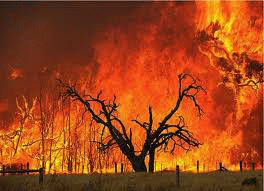
CSIRO study proves climate change driving Australia’s 800% boom in bushfires, The Age, By Mike Foley, November 26, 2021 Climate change is the dominant factor causing the increased size of bushfires in Australia’s forests, according to a landmark study that found the average annual area burned had grown by 800 per cent in the past 32 years.
The peer-reviewed research by the national science agency, CSIRO — published in the prestigious science journal, Nature — reveals evidence showing changes in weather due to global warming were the driving force behind the boom in Australia’s bushfires.
Lead author and CSIRO chief climate research scientist Pep Canadell said the study established the correlation between the Forest Fire Danger Index – which measures weather-related vegetation dryness, air temperature, wind speed and humidity – and the rise in area of forest burned since the 1930s.
“It’s so tight, it’s so strong that clearly when we have these big fire events, they’re run by the climate and the weather,” Dr Canadell said.
Prime Minister Scott Morrison went to the COP26 climate talks in Glasgow to commit Australia to reach net zero emissions by 2050, and to upgrade his expectations for Australia’s 2030 carbon cuts, but he defied a global push to commit to phasing out fossil-fuel use. Instead, the Coalition government is backing a significant expansion of the gas industry, which it predicts will be 13 per cent larger in 2050 than it is now.
Under the federal government’s gas industry strategy, taxpayers will support the private sector to develop viable new gas fields and develop an extensive network of new pipelines and related infrastructure.
The bushfire royal commission identified climate change as a key risk to ongoing bushfire catastrophe but did not make recommendations about reducing greenhouse emissions to curb the threat.
The CSIRO report found other factors have an impact on the extent and intensity of bushfires such as the amount of vegetation or fuel load in a forest, the time elapsed since the last fire, and hazard reduction burning. But Dr Canadell said the study showed the link between weather and climate conditions and the size of bushfires was so tight, it was clear these factors far outweighed all other fire drivers…………….
oyal c
Mega-fires, which burn more than 1 million hectares, have “markedly” increased with three of the four recorded from 1930 occurring since 2000, while the gap between big blazes has had a “rapid decrease”, the study says.
Last year, the bushfire royal commission reported fuel-load management through hazard reduction burning “may have no appreciable effect under extreme conditions” that typically cause loss of life and property. https://www.theage.com.au/politics/federal/csiro-study-proves-climate-change-driving-australia-s-800-percent-boom-in-bushfires-20211126-p59cgr.html
French nuclear submarines a better choice for Australia
We’re repeating all the same Collins mistakes, THE AUSTRALIAN 27 Nov 21, Why we should turn AUKUS into FAUKUS and buy our nuclear-powered submarines from France.By JON STANFORD
”…………………unfortunate decision is to effectively eliminate competition in selecting Australia’s SSNs. The likelihood is that our AUKUS partners will decide which of them – probably the British – will provide Australia with SSNs. Without a competitor – and the French Suffren is the only option – we will again be negotiating with a monopolist on a “take it or leave it” basis.
In addition, the prospect of acquiring a US or British SSN takes us back to the third problem with the Attack program – overambition. Both the British and US navies operate large submarines – around three times the size of Collins – that may be too much for the smaller RAN to digest.
Defence has stated that Australia should acquire a mature submarine design. This will be difficult to achieve within AUKUS. With production of its PWR2 reactor now terminated, there will be no further construction of the British Astute-class after delivery of the seventh boat. The next British SSNs will use the new PWR3 reactor, largely an American design, and the platform will need to be bigger in order to accommodate it.
Were we able to acquire an American submarine, this would also probably be a new design. The US is already planning for the first SSN(X) to replace the Virginia-class in the early 2030s.
In both the British and American options, therefore, all the risks of a new design, including late delivery, will be present.
Both these new platforms will be bigger than the submarines they replace and require even larger crews. The Virginia-class has a crew of 135, 80 more than Collins, while Astute’s complement is 98. Would we be able to populate these very large submarines? Even the British, with a much bigger population than Australia, have difficulty in recruiting and retaining crews for their submarines.
The latest French SSN, Suffren, has some advantages for the RAN. It is a relatively recent design with only the first of class in commission. Reputedly, it has superior stealth characteristics. It has a crew of 60, only five more than Collins. Given the progress already made on Attack, whose reference design was Suffren, Australia should be able to acquire a mature French SSN in a shorter timeframe than a new American or British design.
French SSNs also have the advantage of using low enriched uranium (LEU) rather than the weapons grade, highly enriched uranium (HEU) that fuels American and British boats………
The government’s story that Australian industry cannot refuel nuclear reactors is also pure fiction. ……. Our 20MW nuclear reactor is located in Lucas Heights, a leafy Sydney suburb in Sutherland Shire, adjacent to the Prime Minister’s electorate of Cook. The Australian Nuclear Science and Technology Organisation has been refuelling nuclear reactors there for more than 60 years
Unlike its predecessor, which was designed for HEU, the current OPAL reactor uses LEU fuel…….
It is difficult to see any benefit in scrapping our strategic partnership with France. While a Barry McKenzie-style of diplomacy may trigger political resonance for the government, it has needlessly damaged an important relationship and constrained our options for acquiring nuclear submarines……..
The US administration, blindsided by the unprecedented recall of the ambassador of its oldest ally, may already be thinking of extending an olive branch to France. Time for FAUKUS, anyone?
Jon Stanford is principal of the think tank Submarines for Australia and a former senior official in the Department of Prime Minister and Cabinet. https://www.theaustralian.com.au/inquirer/were-repeating-all-the-same-collins-mistakes/news-story/eaeff234940e33bec455dab9ead8ed3b
China calls on the Association of Southeast Asian Nations (ASEAN) to make Southeast Asia a nuclear-weapons-free zone
China pushes for nuclear-weapon-free Southeast Asia, KhmerTimes, Aandolu Agency ISTANBUL 22 Nov 1 – China on Monday said it is ready to work with the members of the Association of Southeast Asian Nations (ASEAN) towards a nuclear-weapon-free region besides ensuring stability in the disputed South China Sea.
“China supports ASEAN’s efforts to build a nuclear-weapon-free zone, and is prepared to sign the Protocol to the Treaty on the Southeast Asia Nuclear-Weapon-Free Zone as early as possible,” President Xi Jinping told the China-Asia summit marking 30 years of the relations between two sides.
Beijing’s demand for a nuclear-free Southeast Asia comes as the US and UK empower their ally Australia with nuclear-armed submarines under a deal called AUKUS signed in September………..
The bilateral trade between China and ASEAN has skyrocketed by 85 times to $684.6 billion in 2020 from less than $8 billion in 1991, making the two sides each other’s largest trading partners. https://www.khmertimeskh.com/50975461/china-pushes-for-nuclear-weapon-free-southeast-asia/
I MAY VOMIT
Australia, the United States and the United Kingdom officially signed the Exchange of Naval Nuclear Propulsion Information Agreement in Canberra, giving Australia access to nuclear-powered submarines technology.
Kimba Consultative Committee draft Minutes reveal what a mess the Federal Radioactive Waste dump project is in.
The most important part the draft minutes is the first item relating to the nature and activity of the radionuclides in the immediate level waste proposed to be stored at Kimba but there was no discussion recorded on this issue.
This should have probably been the main item of business of the meeting considering it is the major aspect of community safety but received scant attention
Peter Remta, 22 Nov 21, I was recently asked to comment on the draft minutes of the Kimba joint community meeting held on 24 October 2021 and attach them for your reference
The draft minutes are available on https://www.industry.gov.au/sites/default/files/2021-11/kimba-consultative-committee-kimba-economic-working-group-meeting-minutes-oct-2021.pdf?fbclid=IwAR3Ej8KsyWH8KtvfRlL5JXc8C3mubLJ5K5tThB1HMZfIfpI2c2M9_QO3Mdg
Suffice to say that the federal government is ill prepared to choose and pursue the Napandee site near Kimba and as I have previously shown it is a grossly unsuitable and highly expensive exercise
It tests common sense to continue with the plans for the facility as it will surely not be approved for the required licences
KIMBA COMMUNITY MEETING COMMENTS
I cringe when I read the draft minutes of the joint meeting at Kimba on 14 October 2021 and the explanations and reasons by the federal government’s personnel as recorded in those minutes relating to the proposed nuclear waste management facility at Kimba.
In most instances they are unconvincing and inconsistent explanations even bordering on the nonsensical considering that this is a most important and serious issue for this country deserving far better attention than has been given to it over the past few years.
From all of this is it is quite obvious that the radioactive waste management facility at Kimba is still in its infancy of planning and prematurely unprepared for its objectives which is hard to understand as the government has been assessing the various locations at Kimba for over five years and has so far spent up to $100 million for that purpose.
It is also a gross indictment on the competence of the government and its various agencies all of which has been aided and abetted by the responsible ministers involved which should be gauged in the light of
the imminent ministerial declaration of Napandee near Kimba as the site for the management facility as mentioned in section 2 of the draft minutes
The most important part the draft minutes is the first item relating to the nature and activity of the radionuclides in the immediate level waste proposed to be stored at Kimba but there was no discussion
recorded on this issue.
This should have probably been the main item of business of the meeting considering it is the major aspect of community safety but received scant attention.
I have pointed out previously that based on the best available scientific and technical information internationally the details and levels of the radionuclide activity in any nuclear waste to be stored (as that at Kimba) is of prime importance since it becomes the determining factor for the selection of an appropriate site for storage and the manner in which the storage is undertaken.
This means that there can be no realistic designs – however conceptual of any storage facility until that information on the radionuclides is fully disclosed and understood and hence the conceptual designs for
Kimba so far put out by the government are nothing more disingenuous and misleading promotional material to try and convince a rather sceptical public.
What is more the details of the radionuclides inventories and activity should have been given to the community at Kimba when the various locations were initially identified as possible sites for the facility
but this has still not been done to this day
The endless civil war among conservatives over nuclear power

https://johnmenadue.com/the-endless-civil-war-among-conservatives-over-nuclear-power/ Pearls and Irritations, By Jim GreenNov 22, 2021
The case for nuclear power in Australia is overwhelmingly weak, but that doesn’t deter the culture warriors in the Morrison government or the Murdoch media.
Wars usually have a beginning, a middle and an end. Not so the nuclear power culture wars which just keep rolling on and on and on.
Australia’s nuclear culture war is best thought of as a civil war: conservative politicians — and to a lesser extent Murdoch/Sky media loudmouths — are at each other’s throats while the rest of us watch on in bemusement. Ironically, attempts to wedge the Labor Party and the environmental movement are at the heart of the conservative nuclear push, but those efforts have been singularly unsuccessful and the culture warriors succeed only in wedging themselves.
The Murdoch media’s recent pivot towards accepting climate science and the need for action immediately degenerated into a push for nuclear power. Sky News can’t get enough of it. In addition to dozens of news stories promoting nuclear power, Sky produced a “documentary” called Going Nuclear: The Clean Energy Debate aired on October 25.
Academic Barry Brook opined in the Sky “documentary” that nuclear power was the “silver bullet” to tackle climate change. A decade ago, Brook was insisting “there is no credible risk of a serious accident” at Fukushima even as multiple nuclear fuel meltdowns were in progress.
Brook told the “documentary”: “We are not ever going to get beyond about 50 per cent renewable energy and continue to have the type of energy use in a modern society that we have today.” Brook lives in Tasmania, fully powered by renewable electricity thanks to the state’s wind and hydro projects.
And he used to live in South Australia, where, according to a new report by the Australian Energy Market Operator, wind and solar has delivered 62 per cent of local power generation in the past 12 months, wholesale sales were the lowest on the mainland at an average of $48 per megawatt-hour MWh, and grid emissions have fallen to a record low. South Australia is on track to comfortably meet the state government’s target of 100 percent net renewables by 2030.
Pro-nuclear environmentalists
The Sky “documentary” also featured one pro-nuclear environmentalist, Zion Lights, to prove the point that environmentalists are falling in love with nuclear power. Lights was recruited to the pro-nuclear cause by the notorious Michael Shellenberger.
A 2013 article in Grist summed up the nonsense about pro-nuclear environmentalists:
“There is no budding environmentalist movement for nukes… This handful of converts is always cited with the implication that it’s the leading edge of a vast shift, and yet it’s always the same handful. Shellenberger says, ‘I have a sense that this is a beautiful thing… the beginning of a movement.’ I fear he has once again mistaken the contents of his navel for the zeitgeist.”
The same could be said for Australia: you could count the number of pro-nuclear environmentalists on the fingers of one hand, and still have fingers left over to organise your next Zoom call or to pick your nose.
Zion Lights told Sky that climate change “could be solved overnight” with nuclear power. But an analysis by economist Professor John Quiggin concludes that it would be “virtually impossible” to get a nuclear power reactor operating in Australia before 2040. Quiggin notes that, in practice, support for nuclear power in Australia is support for coal. The promotion of nuclear power muddies the energy debate and helps to delay the transition from fossil fuels to renewables. Presumably that is the goal of at least some of those supporting nuclear power.
An Australian Workers Union representative featured on Sky’s pro-nuclear “documentary”. No mention was made of the unions opposing nuclear power, i.e. pretty much all of them: the ACTU, Unions ACT, Unions WA, Unions SA, Victorian Trades Hall Council, Unions NT, Tasmanian Unions, United Voice, AEU, AMWU, ANMF, ASU, CWU, ETU, IEU, MUA, NUW, and the UFU firies who would prefer not to have to fight nuclear fires.
No space for critical voices
The Murdoch/Sky media empire has made almost no space for critical voices. There are a couple of notable exceptions, however — recent commentaries by former NSW premier Bob Carr in The Australian and on Sky, and Paul Kelly’s column in The Australian on November 10. Carr, a former supporter of nuclear power, notes that “nuclear is lumbering, subject to breakdowns and cripplingly expensive” and that “the contrast with the surge to renewables is stark”.
He’s right, the comparison is indeed stark. Last year, 256 gigawatts of new renewable capacity were installed around the world (that’s four times greater than Australia’s total capacity) compared to just 0.4 gigawatts of nuclear power.
Kelly’s column in The Australian points to the “popular pull of renewables” and their falling costs. He notes that “nuclear plant construction remains poor in advanced OECD nations, the main reason being not safety but its weak business case”. Kelly also questions the rhetoric around small modular reactors given that “none has so far been built in developed nations”.
On the politics, Kelly writes:
“The populist conservatives have form. Before the 2019 poll, they campaigned on the mad idea that Morrison follow Donald Trump and quit the Paris Agreement. Now they campaign on the equally mad but more dangerous idea that he seek to split the country by running on nuclear power… As for those conservatives who say Morrison’s job is to fight Labor, the answer is simple. His job is to beat Labor. That’s hard enough now; vesting the Coalition with an unnecessary ideological crusade that will crash and burn only means he would have no chance.“
Coalition wedging itself
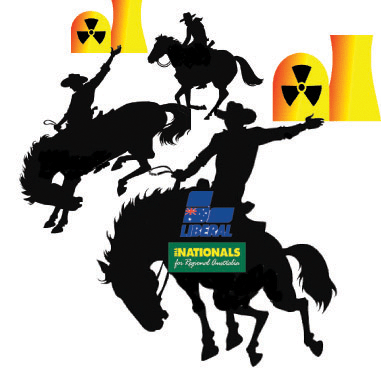
The Coalition’s civil war over nuclear power reached its zenith just before the COP26 climate conference in Glasgow, with media reports that the repeal of laws banning nuclear power might be a requirement for the Nationals to support a net-zero-emissions policy. But if such a demand was made by the Nationals, it was quickly retracted.
Prime Minister Scott Morrison spoke bluntly to Sky: “Right now, there’s a moratorium on nuclear power here in Australia and the Labor Party are totally opposed to it. I’m just not going to put Australia through the argument which doesn’t get us anywhere… and for the Labor Party to run around at the next election and get themselves elected on the basis of a scare campaign.”
An interesting feature of the 2019 federal parliamentary nuclear inquiry was that a number of state Coalition governments and parties made submissions opposing nuclear power while none made submissions supporting it.
The South Australian Liberal government’s submission said that “nuclear power remains unviable now and into the foreseeable future”. The Tasmanian Liberal government’s submission said that “Tasmania will not pursue nuclear energy … and considers that Australia’s energy needs are best met by pursuing renewable energy options, such as pumped hydro, with additional firming capacity supported through greater grid interconnection.”
The Queensland Liberal-National Party’s submission said that “the LNP does not support lifting the bipartisan ban on nuclear energy generation”, citing “unacceptably high health and safety risks” and “significant negative consequences for the environment”. The submission said that “Australia’s rich renewable energy resources are more affordable and bring less risk than the elevated cost and risk associated with nuclear energy”.
Likewise, the NSW government isn’t interested in nuclear power. Treasurer Matt Kean recently said that nuclear power was like “chasing a unicorn” and “doesn’t stack up at the moment on practical grounds or on economic grounds”. Kean said that nuclear is several times more expensive than renewables backed up with energy storage — a claim supported by CSIRO research.
Former prime minister Malcolm Turnbull described nuclear power as the “loopy current fad … which is the current weapon of mass distraction for the backbench”.
Still, the Murdoch/Sky culture warriors continue to promote “the idiot’s choice“. As do culture warriors within the Coalition. Senator Matt Canavan campaigned furiously against a commitment to net zero emissions by 2050. He opposes policies that will drive up power prices but supports nuclear power even though he has himself noted that nuclear power would increase power bills.
Confused? So is Matt Canavan.
1 This month
7 April – WEBINAR – Australia and the Doomsday Clock – Preventing nuclear war through NoFirstUse and other policies
Online | Tuesday April 7, 4:00-5:30pm, Australian Eastern Time / 8:00-9:30am Central Europe Time
– Access the registration link
15 April – Zoom –Nuclear Power is Not the Solution
Apr 15, 2026 01:00 AM in Canberra, Melbourne, Sydney

Join the International Physicians for the Prevention of Nuclear War (IPPNW) on Tuesday, April 14th for a timely webinar exploring the risks associated with nuclear power and challenging the myth that it offers a simple, safe, carbon-free solution to the climate crisis

21 April Webinar: No Nuclear Weapons in Australia
Start: 2026-04-21 18:00:00 UTC Canberra, Melbourne, Sydney (GMT+10:00)
End: 2026-04-21 19:30:00 UTC Canberra, Melbourne, Sydney (GMT+10:00)
Event Type: Virtual
A virtual link will be communicated before the event.
Host Contact Info: australia@icanw.org

of the week – Australians for War Powers Reform (AWPR)
To see nuclear-related stories in greater depth and intensity
 Antinuclear