Wiluna locals unhappy on uranium plans
 Western Nuclear free Alliance ,24th May 2012 Wiluna locals have sent letters to both WA Environment Minister Bill Marmion and Federal Environment Minister Tony Burke inviting them both to Wiluna to discuss the proposed uranium mine by Toro Energy.Wiluna local and senior law man Glen Cooke has been very critical of the consultation process and is now seeking consultation from the Ministers, with the support of others in the community.
Mr Cooke said “Toro Energy they only talk to a few people, always the same people. It’s not right, the people from Bondini’s (the community closest to the proposed mine) sometimes they don’t know about meetings, or they’re not invited to meetings or they can’t get to meetings. This is not right.”
“Marmion and Burke they will be making a big decision that will affect our community our dreaming and our health. Before they make a decision on what happens in our community, before signing away our country from many thousands of kilometers away they should come and look us in the eyes.”
Kado Muir, Chairperson of the West Australia Nuclear Free Alliance and Ngalia man said “The decision by EPA to approve the mining and transport of uranium has sent a shiver of fear through Aboriginal communities in the Goldfields. Our families in Wiluna face the prospect of having their country and environment poisoned by the Toro mine, while those of us living in Leonora and Kalgoorlie can only live in fear and hope that the road trains driving through our town does not have an unfortunate accident.
“The trucking of uranium down the Goldfields highway, sneaking around the back of Kalgoorlie and scurrying out of the State to South Australia along the Eyre highway is a striking commentary on the ‘not in my backyard syndrome’. Lead exports through Esperance and Fremantle demonstrated that industry and Government owned ports can’t cope with Lead, how will they ever transport uranium safely, it’s like playing Russian roulette with a loaded gun.
“This is an irresponsible politically motivated decision by the EPA to pander to Barnetts ‘development at all costs’ agenda for Western Australia. “The EPA needs to redeem its legitimacy and hold a full public enquiry as provided for under their Act into the wider environmental and public health consequences of uranium mining in WA” Mr Muir concluded.
(the signatures on this letter are only a few of the many many people in Wiluna who are concerned about the uranium mine at Wiluna- due to bad timing and meetings). http://nuclearfree.wordpress.com/media/
Clean Energy Finance Corporation (CEFC) a winning strategy for superannuation investment
After decades of failed renewable energy support programs, the Clean Energy Finance Corporation (CEFC) will prudently apply public funds to support private investors in bringing forward a more diverse, cheaper, cleaner energy supply. This is the winning strategy for mums and dads with their money in super and the investors who oversee it. The CEFC will build the foundations of the future our nation is demanding.
We can all invest in clean energy, SMH, Simon O’Connor May 24, 2012 “…….With the CEFC, the last pillar of the Clean Energy Future package is soon to become law. This makes it a good time to look at why the rest of the world is embracing this method of accelerating renewable energy investment, in a time of intense global spending pressures. Renewables are one of the few global industries that registered continued growth throughout the GFC. Clean energy investment is up 500 per cent since 2004.
Couple this with longer-term energy forecasts and most governments can see the importance of getting behind clean energy. Investing now in diverse sources is critical for the holy trinity of power: energy security, insurance against price shocks and lower energy prices.
Despite our coal and gas resources, Australia is in no way immune to potential price shocks. Most energy analysts believe it is only a matter of time before our cheap fossil fuels inflate to international prices, Continue reading
Australia-based Barefoot Power provides small scale solar power to 10 million impoverished homes
The Australia-based social enterprise Barefoot Power aims to expand access to its high-quality, energy efficient, affordable light-emitting diode (LED) lamps, home lighting systems and phone chargers, to more off-grid communities with expansion in Ghana, Senegal, Nigeria and India as a focus by 2015. The company has already captured the majority market share in East Africa.
Solar energy enterprise to provide 10 million with access to renewable energy , PR Wire 24 May 12 The BCtA is a global initiative that encourages private sector efforts to fight poverty, supported by several international organizations including the UN Development Programme (UNDP).
Ten million low-income people living in rural communities in Sub-Saharan Africa, Asia and the Pacific, Latin America
and the Caribbean, will gain access to low-cost solar energy by 2015, in part due to a commitment made by solar energy provider Barefoot Power to the Business Call to Action (BCtA).
The BCtA is a global initiative that encourages private sector efforts to fight poverty, supported by several international organizations including the UN Development Programme (UNDP). Continue reading
Close dirty coal-fired power stations – we want renewable energy, say Port Augusta residents
The State Government says above average lung cancer levels in the city are caused by smoking.
Locals lobby for renewable power http://www.abc.net.au/news/2012-05-22/port-augusta-locals-renewable-power/4025622?section=sa May 22, 2012 Port Augusta residents want the town’s coal fired power stations replaced with renewable alternatives . Residents at Port Augusta in South Australia’s north have launched a campaign to replace the city’s two ageing coal-fired power stations. A community group has been set up to encourage a switch to renewable energy. Continue reading
Australia’s uranium companies put on a bold face, but their prospects are not good
The uranium price tanked after the Fukushima disaster and so far there is no sign of a bounce. Current prices are too low to allow the smaller uranium wannabes to proceed with any confidence.
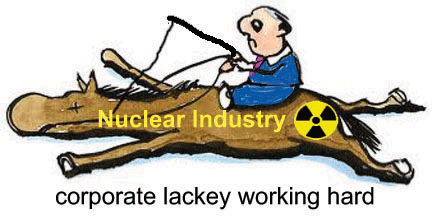 Uranium flashpoint in the wild West, The Drum, Jim Green, 22 May 12, Interesting times in the uranium sector. The mining companies have had a few wins in the 14 months since the Fukushima disaster, but they’ve had more losses.
Bill Repard, organiser of the Paydirt Uranium Conference held in Adelaide in February, put on a brave face with this claim: The sector’s hiccups in the wake of Fukushima are now over with, the global development of new nuclear power stations continues unabated, and the Australian sector has literally commenced a U-turn in every sense.
Yet for all the hype, uranium accounts for a lousy 0.03 per cent of Australian export revenue and a negligible 0.02 per cent of Australian jobs. The industry’s future depends on the nuclear power ‘renaissance’, but global nuclear power capacity has been stagnant for the past 20 years, and if there is any growth at all in the next 20 years, it will be modest. Continue reading
BHP reluctant to develop its Western Australian Yeelirrie uranium mining project
 Procrastinating BHP pressured over uranium deposit, Rania Spooner May 23, 2012 BHP Billiton has been challenged to develop or sell a West Australian uranium deposit, amid growing speculation it may offload the deposit later this year.
Despite a pro-uranium WA government, BHP Billiton delayed submission of the draft environmental review and management program for its Yeelirrie uranium project in June, citing a failure to meet internal standards and flagging a delay of at least six months. Almost a year later,.. speculation grows that a sell-down of the asset is imminent Continue reading
Toro Energy’s plan to track radioactive material through Western Australia and Northern Territory

The Australian, 23 May 12 WEST Australian yellowcake will be carted thousands of kilometres across state borders and shipped out of Adelaide or Darwin in a bold plan that limits political fallout in the west and puts the blowtorch on federal Labor to increase uranium exports.
South Australian company Toro Energy yesterday received approval from the WA Environmental Protection Authority to mine 1200 tonnes of uranium ore from its Wiluna operations, 520km north of Kalgoorlie, and to truck it in 200-litre drums across the Nullarbor. Once it crosses state lines, it will go direct to Adelaide and be shipped out or put on rail to Darwin.
The plan means the yellowcake will not have to be shipped through the port at Fremantle, near Perth, where the local council’s policy declares that “no uranium, nuclear waste nor other material connected with the nuclear power industry may be stored or transported in or through the municipality”.
Conservation Council opposes Wiliuna uranium mine, Kalgoorlie mayor not enthusiastic, either
The Kalgoorlie-Boulder mayor Ron Yuryevich says he is not opposed to the project as long as the uranium is not transported through residential areas of Kalgoorlie-Boulder.
Council to challenge Toro’s uranium approval, ABC News May 22, 2012 The Conservation Council is to challenge the approval of Toro Energy’s proposed uranium mine in Western Australia’s northern Goldfields. Yesterday, the Environmental Protection Authority gave the go-ahead for the company’s proposal to develop the mine 30 kilometres from Wiluna. Continue reading
Clean Energy Finance available to Australian companies first
Australian companies get first shot at green energy cash, David Wroe, Brisbane Times, May 23, 2012 AUSTRALIAN companies will be guaranteed the chance to pitch for business flowing from the Gillard government’s $10 billion clean energy fund that Labor will announce today in an effort to sell the benefits of green jobs at home.
Climate Change Minister Greg Combet will announce today that the Clean Energy Finance Corporation, which will provide grants and government investment to green projects, will require candidates to show they are
giving local firms a fair go to supply parts and services……
Mr Combet, meanwhile, will introduce today legislation to set up the $10 billion corporation, to be chaired by respected businesswoman Jillian Broadbent. It will require candidates for funding to have Australian Industry Participation Plans, which are a key part of the government’s broader manufacturing strategy.
Under these plans, which are already used by the resources sector in return for tax breaks, projects have to demonstrate they have given Australian firms ”full, fair and reasonable opportunity”. A wind farm, for example, might have to show it has offered Australian firms the chance to supply the turbine towers. http://www.brisbanetimes.com.au/opinion/political-news/australian-companies-get-first-shot-at-green-energy-cash-20120522-1z39j.html#ixzz1vjfBtHvJ
Australia’s clean, non nuclear, soil giving hope to Japanese farmers
Japan farmer harvests hope in our soil, BY: SUE NEALES The Australian May 23, 2012 JAPANESE farmer Takemi Shirado still sounds grief-stricken and shell-shocked when talking about last year’s Fukushima nuclear disaster that so devastated his rural community.
Catastrophic radiation contamination of the soil means his family won’t be able to sow rice on their Iwaki rice paddies, about 60km from the crippled defunct power plant, for at least 300 years. Other local farmers are starting to grow leafy vegetables on less-contaminated fields, but are finding consumers too scared to buy their risky produce.
But Mr Shirado is clearly not a man to moan and mope. Instead he has come to Australia as head of a consortium of Fukushima farmers to see if north Queensland’s fertile Burdekin valley might hold the solution to his prefecture’s long-term fallout-affected food problems.
Mr Shirado’s dream now is to turn the sugarcane fields around Ayr into fertile flooded rice paddies growing Japanese rice varieties in traditional organic ways, to supply the people of his ruined home prefecture once again with their staple food…… “So far this looks like being a very good area for growing rice; I think we can grow four crops a year here and the water is very pure too.”……http://www.theaustralian.com.au/news/nation/japan-farmer-harvests-hope-in-our-soil/story-e6frg6nf-1226363955828
EPA recommendation on uranium mine a dangerous new low – Australian Greens
“Toro has not revealed estimates of future mine closure liability and has not submitted a final rehabilitation plan. This is remarkable given the company intends for post-closure liability to pass to Australian taxpayers only 10 years after mining ceases, though the consequences of the mine will endure for many centuries. This project should not proceed until there is a full public inquiry as provided for under the Act into the wider environmental and public health consequences of uranium mining in WA.”
 May 21st, 2012 The Environmental Protection Agency should change its name after today’s appalling recommendation to approve Western Australia’s first uranium mine at Wiluna, WA Greens said today.
Greens national spokesperson on nuclear policy Senator Scott Ludlam said “The proposal by Toro Energy is full of gaping holes. If the EPA is prepared to back this half-baked, messy scheme – it sets a dangerous low standard for uranium mining in Western Australia”.
“The EPA recommends that the Minister ‘notes the EPA has concluded that it is likely that the EPA’s objectives would be achieved’. Well if this shoddy plan is all it takes to achieve the EPA’s objectives, then its objectives need to be reformed urgently in the interest of public health and safety.”
In his submission to the EPA, Senator Ludlam had identified a several alarming flaws in company’s impact assessment of the proposed mine. Continue reading
Musicians in the struggle for Aboriginals’ justice against Australia’s nuclear industry
The band also show their passionate connections to country in the song “Story”, whose deep story belies its brief lyrics. “Behind the lyrics lie one of the darkest stories of modern Australian history,” says Basil. “The dispossession of desert people by our country’s involvement in the atomic bomb-making industry.
“In the ’50s and ’60s, two groups of desert people living thousands and thousands of kilometres apart were taken out of their homelands. The song’s lyrics name those places. “In the north, Pintubi people were taken to Papunya. Blue-streak rockets fired from Woomera landed on their country. “In the south, Maralinga pe
Anti-nuclear brothers are radio activists, Green Left , May 21, 2012,By Mat Ward Nuclear Kop The Super Raelene Brothers www.superraelenebrothers.com.au
Anti-nuclear activist band The Super Raelene Brothers first made it into the pages of Green Left Weekly in 1995. But the duo, who have just dropped their latest atomic-bomb-atomising EP, Nuclear Kop, were making m usic way before then….. We create songs that celebrate what we see and where we are. We also build songs that voice concern about what is happening or not happening in our local community.”
Those concerns have led them to release songs such as “‘Wiya Angela-Pamela”, which went to number 1 on Triple J’s Unearthed charts in 2010, and a cover of Redgum’s 1980 classic “Nuclear Cop” ― both available as free downloads on their website . Continue reading
India’s democracy in peril
Should India’s troubled democracy give way to an authoritarian, and more militaristic regime – should Australia be send ing India uranium, the fuel for its nuclear weapons? – Christina Macpherson
 Australia’s next big problem: India’s democracy, SMH, May 21, 2012 Here’s a nasty thought: the big threat to Australia’s commodities-underwritten prosperity extending out to 2030 and beyond is India’s democracy. Much worse though is the threat that irresponsible democracy poses to India itself.
Present crises aside, Australia’s is supposed to live happily ever after thanks to India picking up the commodities demand slack as the Chinese economy matures, thus extending our resources boom for another decade or
two,….,
India barely has manufacturing industry thanks to a conspiracy of poisonous protectionism, stifling bureaucracy and
endemic corruption, never mind the gross waste of resources that is the caste system……
.Should the day arrive when one brand or another of authoritarianism – nationalistic, religious or military – is able to seize control through gross government failure, lack of demand for Australian coking coal could be the least of the region’s concerns. http://www.smh.com.au/business/australias-next-big-problem-indias-democracy-20120521-1z08u.html#ixzz1vYS6w3JG
Success of solar power is giving a shock to Australia’s utilities
 Fear and loathing as utilities grasp impact of solar PV, REneweconomy By Giles Parkinson 21 May 2012 Australia’s power generators and electricity network operators are viewing the rapid falls in the cost of solar PV and an anticipated surge in installation with an increasing level of concern.
The potential of solar PV to deliver cost-effective options for home and commercial consumers has been apparent to many in the industry for some time.
The report delivered by the Victorian Competition and Efficiency Commission into solar feed-in tariffs merely confirmed this, and offered it as a potential excuse for the utilities’ apparently lack of enthusiasm to ensure connections for solar PV and other forms of distributed energy.
While plunging costs are good news for consumers, who can turn to solar PV in increasing numbers with the emergence of innovative financing solutions, it is a massive headache for the incumbent generators and network operators, who are about to witness business models built up over decades being shredded by a technology that is as disruptive to the electricity industry as mobile phones were to telecoms…..
Australia has just over 1.5GW of solar PV installed on rooftops now – so there is little apparent impact on the NEM as it stands. By 2020, when the percentage of households with solar PV is expected to treble from around 7 per cent now to 19-20 per cent, the impact is significant.
By 2030 and 2035, it takes a large slice out of the generators’ earnings pie – an impact that has already been established in Germany, which has 25GW of solar PV and counting, and which we documented in our piece “Why generators are terrified of solar.”
It should be remembered that the profit projections – and the debt repayments – built into the Australian generators’ financing models depend almost entirely on the “super dividend” they receive when peak demand surges and the cost of wholesale electricity rises up to 10-fold for just a few hours of the year. A large deployment of solar PV will quite literally throw a spanner in those works…… http://reneweconomy.com.au/2012/fear-and-loathing-as-utilities-grasp-impact-of-solar-pv-15262
Revolutionary new Australian project studies runaway climate change

 Australian Project Simulates Runaway Climate Change Climate Central : May 19th, 2012 By Oliver Milman, The Guardian An Australian university has embarked upon an ambitious project — hailed as the first of its kind in the world — to simulate how the environment would cope with runaway climate change.
The decade-long study, at the University of Western Sydney’s Hawkesbury Institute for the Environment , will subject Australian bushland to heightened CO2 levels and altered rainfall patterns consistent with a “business as usual” global increase in greenhouse gases. Continue reading
1 This month


Help Aunty Sue Protect Her Land and Sacred Sites From Destructive Rocket Testing.
.

Australians deserve the truth
about
AUKUS – https://aukuspublicinquiry.com/

PETITION – To: Prime Minister Anthony Albanese and the Australian Labor Government

of the week – Australians for War Powers Reform (AWPR)
To see nuclear-related stories in greater depth and intensity
 Antinuclear