Australia’s Clean Energy Finance money is going to dirty gas, rather than renewables
Gas is not a new, emerging technology worthy of support. Gas power would keep Australia on a very high path of emissions compared with world averages.
It would take the building of a few initial solar thermal plants to bring its building costs down to a reasonable, commercially viable level.
But the CEFC is clearly not aiming at that result….
The conclusion is that the CEFC will probably do nothing to break the grip of the fossil fuel industry “greenhouse mafia” on Australia’s politics and energy supply.
First, because it has so much potential for supporting “clean” gas, not really clean renewable energy.

 Clean energy finance, or gas industry handouts? http://www.greenleft.org.au/node/51071, May 19, 2012 By Ben Courtice A concentrated solar thermal power plant. The CEFC will probably do nothing to break the grip of the fossil fuel industry “greenhouse mafia” on Australia’s politics and energy supply. The Clean Energy Finance Corporation (CEFC) is being set up under the Clean Energy Future legislation (the carbon price package). It will provide $10 billion to support renewable and low-emissions energy.
That’s the message that most climate-concerned people have been hearing from the Labor government and the Greens.
Unfortunately, it now seems overly optimistic. The recently completed CEFC expert review shows it may give most of its support to gas projects. Continue reading
Australia’s love-in with USA and NATO
 (I don’t know about the rest of Australians, but I found this article a bit sick-making – Christina Macpherson)
every time NATO deploys Australia is there as a great, great friend of the United States.
The increased formalisation of ties between NATO and partnership countries will be discussed at a meeting on Monday to be addressed by the Prime Minister, Julia Gillard.
US turns the screws on NATO, lauds its ally Australia SMH, May 19, 2012 “… the report was enthusiastic of the expanding role of non-NATO partnership countries, such as Australia, which was, it noted, among a small group of countries that contributed ”real combat or niche capabilities to the mission” in Afghanistan. Continue reading
Pakistan says it, as well as India, should get Australian uranium
Pakistan has contended that since Australia has lifted its ban for a country that has not signed the Nuclear Non-Proliferation Treaty, it too should be allowed to benefit from the concession.
Uranium sale: Australia says cases of India, Pak different, Business Standard, 18 May 12, Unlike Pakistan, India has an exemption from Nuclear Suppliers Group Press Trust of India / Islamabad May 18, 2012, Amid Pakistan’s demand that it be given access to Australian uranium for which India has been granted green light, Australia has said it
believes Islamabad is not eligible to buy the yellow cake from it. Continue reading
Australia will be an international pariah if new Northern Territory Intervention laws go ahead
The chairman of the National Congress of Australia’s First Peoples says it’s a major disappointment that the Government is extending laws for another 10 years, without the consent of the people concerned. Les Malezer says the laws are racist. Continue reading
Australia’s relentless growth is destroying Australia’s environment
We’re losing the natural places and things that make Australia Australia. And we’re losing our ability to get out there, to notice and to care about that.
Next year let’s give the environment its first proper slice of the Budget pie.

Crumbs not enough for our environment, The West.com.au Charlie Sherwin May 17, 2012, “……….In this day and age do we really so desperately need another coal mine, or another surge of urban growth? Enter the pesky greens, so that now it’s not just the wildlife getting in our way, but the environmental regulations that stop us taking more habitat and growing our bottom line.
The COAG business forum, the Premiers, the Government and the Opposition are right now ganging up to protect the bottom line by “streamlining” regulation and reducing the Federal Government’s role in environment protection.
It’s a global economy, and after a couple of hundred years of this we’ve grown and used a quarter of the Earth’s natural energy, half of its freshwater run-off and two-thirds of its habitable land surface to feed our unrelenting growth.
So we’re displacing other species. Australia’s landscapes, bush and wildlife are paying for our growth. Continue reading
Western Australia’s repressive police regime, in the interests of mining companies
 So is this the new Australia, produced by the longest mining boom in our history? One in which the views of residents and traditional owners are meaningless and where the state provides armies of foot soldiers, free of charge, to the big end of town? All this while the companies behind the project remain stony silent about actions taken in their name to divide and destroy Broome.
Not a word when last year Aboriginal women and their grandchildren were dragged away by tactical response police to allow the safe passage of Woodside’s contractors down the access road to James Price Point.
Miners hiding behind Barnett’s police army BY:LYNDON SCHNEIDERS . The Australian , May 19, 2012 THIS week the government of Western Australia dispatched about 200 police officers to the sleepy tourist town of Broome to do the dirty work for several of the world’s largest oil and gas companies.
This mini army has been assembled on the doorstep of the Kimberley wilderness for one purpose — to suppress the widespread opposition of the Broome community to the construction of the proposed $40 billion James Price Point industrial precinct.
In a startling admission, WA police commissioner Karl O’Callaghan confirmed earlier this week that the decision to drag police off their beats across the state and send them to Broome would cost taxpayers $100,000 a day, for an undisclosed period and with no cost to the companies involved in the project. The final bill will likely be several million dollars.
All this to move away and silence a dogged and growing band of locals who have stood in the way of the plans of a consortium of the world’s biggest companies, including Shell, Chevron, Woodside, BP and BHP Billiton, to build this massive gas plant in a beautiful and sensitive part of the remote Dampier Peninsula. Continue reading
Australian uranium company Paladin has to raise wages after African workers’ strike
Paladin agrees to hike salaries Daily Times, , 18 May 2012 Caroline Kandiero Paladin Energy Limited has agreed to review salaries for its local workers but in six months time following the kwacha devaluation.
Workers at Kayelekera Uranium Mine in Karonga run by Paladin from Friday May 11 walked off the mine site in protest against the company’s refusal to agree to a demand to grant an immediate 66 percent pay increase following the recent 50 percent devaluation of the national currency….
http://www.bnltimes.com/index.php/daily-times/headlines/sports/6452-paladin-agrees-to-hike-salaries
Dubious future for uranium market – will BHP pull the plug on the Olympic Dam project?
projects such as the massive expansion of the Olympic Dam copper-uranium mine in Australia and the potash development in Canada are far less certain…… Where the money is put will say a lot about their expectations for demand for specific commodities now and into the future.
Knives Are Out, But Will BHP and Rio Cut?, WSJ, By Robb M. Stewart, May 16, 2012, BHP Billiton and Rio Tinto have signaled that harder times lie ahead for global miners but have given little indication of where the cuts, if any, will come to the billions of dollars worth of mining projects that both have in the pipeline in Australia and globally.
Neither is backtracking on their long held view about China’s long-term demand for iron ore and coal, but it is now clear that not every expansion project is guaranteed to get off the ground in the current environment–and those that do will be phased in over a longer time period…
 … “Clearly what we’ve seen over the last 12 months or so is that our projected rate of cash generation has changed. So on balance while we still want to invest throughout the cycle, it just means that our ability to do those projects will change as the cash flow generation has changed,” Marius Kloppers, chief executive of BHP, told a mining conference in Miami overnight…..
Jacques Nasser, the mining giant’s chairman, speaking in Sydney on
Wednesday made it even clearer: the US$80 billion over five years that
BHP has previously said would be invested on its mining and petroleum
businesses, is no longer a target. Continue reading
Further evidence that greenhouse gas emissions are warming the Australian region
“Our study revealed that recent warming in a 1,000-year context is highly unusual and cannot be explained by natural factors alone, suggesting a strong influence of human-caused climate change in the Australasian region,”

 1,000 years of climate data confirms Australia’s warming http://phys.org/news/2012-05-years-climate-australia.html May 17, 2012 By Alvin Stone In the first study of its kind in Australasia, scientists used 27 natural climate records to create the first large-scale temperature reconstruction for the region over the past 1,000 years. The study led by researchers at the University of Melbourne, used a range of natural indicators including tree rings, corals and ice cores to study Australasian temperatures over the past millennium. They then compared these with climate model simulations. Continue reading
Distributed renewable energy bringing about an energy revolution
 The Victorian Competition and Efficiency Commission also recognised that distributed generation also offered a cheap form of energy, and made the network more efficient.
Nuclear’s financing meltdown While the technology costs of renewable technologies are falling rapidly, the costs of new nuclear appear to going in the other direction with equal speed
Five things we learned this week, REneweconomy , By Giles Parkinson 18 May 2012 “…….Solar costs are coming down rapidly …. It seems everyone is now cottoning on to the idea that costs of solar PV have come down so rapidly that the technology is likely to revolutionise the electricity industry, at least at the retail level.
Welcome to the new world of “socket parity”, where comparisons with the price of rooftop solar and the electricity produced at coal-fired power stations becomes redundant, because consumers only care about the cost of electricity at the socket. In Australia, despite its abundant cheap coal, its overcapitalised network guarantees that the grid-based power will be more expensive.
NRG CEO David Crane said this week that solar PV is so cheap, and so compelling for residential and commercial customers, that it would likely do to the electricity grid what mobiles did to fixed line telephony,which basically means that much of the current infrastructure would be made redundant, and the industry would be dominated in the future by new, nimble players with different energy products. …..
Wind costs are falling too …. Continue reading
Investment fund manager relieved that BHP will delay expansion
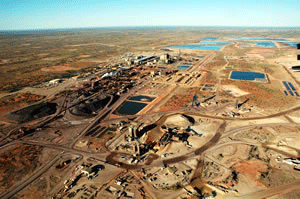 Fund manager welcomes BHP’s capex pullback, THE AUSTRALIAN,BY:BARRY FITZGERALD , May 18, 2012 BHP Billiton’s move to wind back plans to spend $US80 billion ($80.5bn) over five years on growth projects has been applauded by the head of Perennial Investment Partners’ growth funds, Lee Mickelburough.
Mr Mickelburough was one of the few local investment managers to publicly criticise BHP’s big-bang growth plan after it was revealed by the company in February last year… subscribers only http://www.theaustralian.com.au/business/mining-energy/fund-manager-welcomes-bhps-capex-pullback/story-e6frg9df-1226359363680
Negative investor sentiment delaying expansion of Olympic Dam uranium mine?
 the $10 billion initial expansion of Olympic Dam may be stretched out over a longer period, analysts and investors said….. BHP would have to seek an extension from the South Australian state government if it fails to commit to the Olympic Dam project by December, or else it would lose its approvals for the project….
BHP may delay at least two mega projects to rein in spending, By Sonali Paul MELBOURNE May 17 (Reuters) – BHP Billiton, the world’s biggest miner, is likely to delay signing off on at least two mega projects after its chairman put the brakes on an $80 billion plan to grow the company’s iron ore, copper and energy operations, analysts say.
Slumping commodity prices and escalating costs have squeezed cash flows, pushing BHP to join rival Rio Tinto in reconsidering the pace of their long-term expansion in countries such as Australia and Canada. “The major message is: ‘We can’t approve anything right now. We don’t have a spare cent to spend,'” UBS analyst Glyn Lawcock said.
In BHP’s bleakest outlook yet, Chairman Jacques Nasser said on Wednesday the company expects commodity markets to deteriorate further and that investors have lost confidence in the longer-term health of the global economy. Continue reading
Australia’s uranium to India, but not to Pakistan
 Nuclear deal with Pakistan not possible: Australian HC, Business Recorder 18 May 12, Australian High Commissioner Tim George on Thursday said nuclear deal similar to Australian-Indo nuclear agreement was not possible with Pakistan. George, whose three-year term as Australian envoy to Pakistan comes to an end, was speaking at a farewell news conference. To a question, he said Pakistan does not qualify for Nuclear Supplier Group (NSG) and a bilateral nuclear agreement similar to his country struck with India, was not possible with Pakistan…… http://www.brecorder.com/general-news/172/1190658/
Australian Council of Trade Unions (ACTU) joins opposition to Muckaty nuclear waste dump plan
 “Today the unions passed this motion in Sydney and next week the community is holding a protest in Tennant Creek to mark five years since Muckaty was nominated as the possible waste dump. It is time that the government listened to all the Traditional Owners because we are not going to stop until they stop”.
Trade union support strengthens NT nuclear waste dump campaign Muckaty Traditional Owners have welcomed news that Australia’s peak trade union body, the Australian Council of Trade Unions, has today committed to actively support the campaign against a proposed radioactive waste dump at Muckaty, 120km north of Tennant Creek in the Northern Territory.
The ACTU National Congress unanimously passed a motion (full text below) expressing ‘disappointment that the highly contested Muckaty Land Trust site will continue to be pursued’ and agreeing to stand ‘in solidarity with Traditional Owners and communities resisting federal government plans for a radioactive waste dump’.
The move comes as a further blow to plans by Federal Resources Minister Martin Ferguson to advance the highly contested waste dump site at Muckaty. Recent legislation, the National Radioactive Waste Management Act (NRWMA), names Muckaty as the only site to be further assessed for a national radioactive dump and allows the Minister to override any state or territory law that would hinder the dump being built, but the plan faces growing political, legal and community challenge. Continue reading
Despite government support, Olympic Dam expansion might not be economic for BHP
BHP cuts spending on major projects, Adelaide Now, Julian Swallow And Cameron England May 16, 2012 BHP Billiton has backed away from a commitment to spend $80 billion on  major projects over the next five years, including the
Olympic Dam mine expansion. The miner said yesterday it would make a decision on the $25 billion Olympic Dam expansion by the end of the year but made it clear that its key assets globally would be competing for funds.
BHP had previously announced an $80 billion fund, but chairman Jac Nasser said this figure had been reconsidered.
“When (CEO Marius Kloppers) talked about that $80 billion … the environment was different,” Mr Nasser said….. BHP has already started spending $1.2 billion earmarked to kick-start the Olympic Dam expansion, which will eventually involve the company digging a 4km-long, 1km-deep, open-cut copper, gold and uranium mine in the state’s Far North. Continue reading
1 This month


Help Aunty Sue Protect Her Land and Sacred Sites From Destructive Rocket Testing.
.

Australians deserve the truth
about
AUKUS – https://aukuspublicinquiry.com/

PETITION – To: Prime Minister Anthony Albanese and the Australian Labor Government

of the week – Australians for War Powers Reform (AWPR)
To see nuclear-related stories in greater depth and intensity
 Antinuclear