The Australian Uranium Association’s plan to make Aborigines become uranium miners
Uranium industry to set Indigenous jobs benchmark ABC News By Myles Morgan April 27, 2012 The body representing Australia’s uranium miners and associated businesses says the industry will start to set targets for Indigenous employment from this year. The Australian Uranium Association says each company it represents
will set its own targets for providing jobs to indigenous people, which will be reviewed annually.

Association chief executive Michael Angwin says Indigenous people deserve to be represented in the uranium industry. “Our projects are mostly on land owned by Indigenous people,” he said…… He says says the plan follows advice from the association’s Indigenous Dialogue Group……
“Balance” in the media: the ABC gives anti-science a national platform
 ABC’s latest climate change doco another PR victory for doubters Crikey, by Clive Hamilton 27 April12, The strategy of doubt-mongering has been highly effective for climate deniers at exploiting the media’s practice of presenting “two sides” to controversial issues. The media have an ethical commitment to provide “balance” and stories are more interesting if there is a conflict to report, whether that conflict is real or manufactured. Which is why ABC TV’s I Can Change Your Mind … About Climate Change is yet another victory for climate denial ..
.. If there were a real debate among scientists, then the climate deniers would be publishing their counter-evidence in the professional scientific journals. But they are not, because they do not have evidence that will stand up to scrutiny.
So they set out to do something else, to create the impression in the public mind that there is a serious debate among scientists about global warming. To do so they must shift the terrain away from the scientific journals and into the popular media, where they do not have to face the scrutiny of experts.
It’s certain that when asked last year to participate in the program, Minchin grabbed the chance with two hands. His denialist comrades have been patting him on the back ever since…..
Scholars such as Naomi Oreskes have exposed the tactics of the climate deniers with a mass of documentary evidence.
Yet the ABC persists with the charade of “providing balance”. Some news organisations abroad have decided they will no longer fall for the doubt-mongering ruse. Professional pride now prevents editors and journalists from being manipulated by the denial machine.
The BBC would not air a program such as this. In the United States, National Public Radio has revised its ethics handbook. “Our goal,” it states, “is not … to produce stories that create the appearance of balance, but to seek the truth.”
When it reports on questions such as climate science its aim is not the spurious fairness of presenting “both sides”; instead NPR commits itself to be “fair to the truth”. “To be fair to the truth.” Once we simply expected that of the national broadcaster. This latest program tells us that the truth no longer carries so much weight at the ABC, not when it comes to climate science. http://www.crikey.com.au/2012/04/26/hamilton-abcs-latest-climate-change-doco-another-pr-victory-for-doubters/
Tony Abbott the man for a fossil fuel future for Australia
 the Coalition’s refusal to recognise the CEFC as anything more valuable than a political football has been obstinate and single-minded…… Only a leader willing to ignore the threat Australia faces from its dependence on fossil fuels could so easily ignore the value of a body whose sole purpose is bringing down the cost of renewable power for all Australians.
Abbott clings to a fossil fuel future, CLIMATE SPECTATOR, Andrew Bray, 24 Apr 2012 In Oscar Wilde’s Lady Windermere’s Fan, Lord Darlington pins the cynic as “a man who knows the price of everything and the value of nothing.”
As Tony Abbott tries to paint himself as an environmentalist, it’s worth asking the question: does he understand the value of renewable energy sufficiently to outweigh his finely honed sense of political opportunity?
While his address to the Australian Industry Group last Friday made not a single mention of renewable energy, greatly increased levels of renewable energy are a crucial part of any scenario that protects Australia’s environment into the future while also boosting our economy. Continue reading
BHP Billiton looking for more uranium in South Australia

 BHP Steps Up Its Olympic Ambitions, WSJ, By Stephen Bell, April 24, 2012, BHP Billiton is a fully paid-up believer in the mining theory of ‘nearology’ if its latest Australian land grab is anything to go by. The Anglo-Australian miner has tabled applications for exploration licenses covering more than 10,000 square kilometers in arid regions surrounding the huge Olympic Dam copper-gold–uranium mine in South Australia state……
BHP is expected to make a decision this year on whether to proceed with an expansion at Olympic Dam, a project analysts estimate could cost close to US$30 billion. Continue reading
Australia’s carbon emissions down: renewable energy played a part
RENEWABLE energy has helped Australia to cut carbon emissions
http://www.power-eng.com/news/2012/04/26/renewable-energy-has-helped-australia-to.html 04/26/2012 RENEWABLE energy has helped Australia to cut its total carbon emissions for the second year running, according to figures published in the Australian National Greenhouse Accounts, a quarterly update of Australia’s national greenhouse gas inventory, which is published by the federal government’s Department of Climate Change and Energy Efficiency. Continue reading
Paladin Uranium’s debts require it to sell off assets
Paladin Energy under pressure to flog assets The Australian, BY: ROSS KELLY Wall Street Journal April 26, 2012 PALADIN Energy still needs to offload assets to meet looming debt payments and funding requirements, according to Citigroup, which has nominated two of the uranium miner’s non-producing assets in Australia and Canada as possible candidates for divestment……“If the cash squeeze became very acute on Paladin the company could also look to
sell an interest in a producing asset,” Citigroup says.
U.S. marines unwelcome in Okinawa, moving to Australia
US to move 9,000 Marines out of Okinawa, By Reuters, 27 April 12, WASHINGTON — The United States and Japan announced on Thursday a revised agreement on streamlining the U.S. military presence on Okinawa that will shift 9,000 Marines from that southern Japanese island to Guam and other Asia-Pacific sites. The new plan, unveiled days before Japanese Prime Minister Yoshihiko Noda visits President Barack Obama, helps the allies work around the still unresolved, core dispute over moving the Futenma air base from a crowded part of Okinawa to a new site that had vexed relations for years.
Under the agreement, 9,000 U.S. Marines will relocate off Okinawa: 5,000 to Guam and the rest to other locations such as Hawaii and Australia, U.S. officials said……
Friction over U.S. bases intensified after the 1995 gang rape of a Japanese schoolgirl by U.S. servicemen. The case sparked widespread protests by Okinawans, who had long resented the American presence due
to crime, noise and deadly accidents. There are about 47,000 U.S. troops in Japan under a 1960 bilateral
security treaty. Okinawa, occupied by the United States from 1945-72, accounts for less than 1 percent of Japan’s total land, but hosts three-quarters of the U.S. military facilities in the country in terms of land area…..
http://worldnews.msnbc.msn.com/_news/2012/04/26/11418757-us-to-move-9000-marines-out-of-okinawa
While the nuclear/fossil fuel establishment pontificates, young Australia is on the move
My greatest challenge is…
 Thinking up ways to help our 70,000 members make the biggest change they can on climate change. It’s a huge, global issue and sometimes it’s tough finding the most strategic points of influence. But ultimately, what we need is a movement of people all pushing in thesame direction, and luckily that’s what we’re building…..
Changemakers – Ellen Sandell Pro Bono News, April 23, 2012 llen Sandell, National Director at the Australian Youth Climate Coalition, is profiled in Changemakers – a regular column which examines inspiring people and their careers in the Not for Profit sector. Continue reading
The facts on wind power in Australia
Although the cost of wind energy continues to fall, government support such as the Renewable Energy Target (RET) Scheme is crucial to support investment in the industry and enables the wind power sector to play a major role in helping Australia’s transition to a low carbon economy. The introduction of a price on carbon, which is anticipated for
mid-2012, will provide the focal point of the government’s strategy to reduce emissions.

 Five new wind farm projects were commissioned in 2011 in Australia, Reve April 23, 2012 At the end of 2011, Australia had 1,211 operating wind turbines across 58 wind power plants with a total installed wind energy capacity of 2,224 MW.
Australia’s exceptional wind resources have allowed wind energy to make an increasing contribution to Australia’s energy mix. Although it is still a relatively new industry, wind farm supplies over 6,400 GWh annually, which represents more than 2% of national electricity consumption.
At the end of 2011, Australia had 1,211 operating wind turbines across 58 wind power plants with a total installed wind energy capacity of 2,224 MW. The total installed capacity of wind power has grown by an average of 35% per year over the past five years.
Although the cost of wind energy continues to fall, government support such as the Renewable Energy Target (RET) Scheme is crucial to support investment in the industry and enables the wind power sector to play a major role in helping Australia’s transition to a low carbon economy. The introduction of a price on carbon, which is anticipated for
mid-2012, will provide the focal point of the government’s strategy to reduce emissions. Continue reading
Electricity price rise from carbon tax – less than expected
 Carbon tax to raise electricity prices less than expected http://www.independentaustralia.net/2012/business/consumers/carbon-tax-impact-on-electricity-prices-less-than-expected/ 19 April, 2012 12:01 am The effect of the carbon price on retail electricity will be lower than predicted and vary considerably by region, a new University of Queensland study has projected.
The most accurate estimate to date for the impact of the carbon price on retail electricity prices reveals the burden will vary considerably, depending on a household’s location.
Tasmanians, with a relatively low carbon footprint, are set to gain significantly from the carbon price once tax and pension changes are factored in, while Queenslanders – heavily dependent on coal to generate electricity – will wear the biggest increase in power prices, according to economic models run on “supercomputers” at The University of Queensland. Continue reading
Australia’s Environment Protection and Biodiversity Conservation Act is not much use
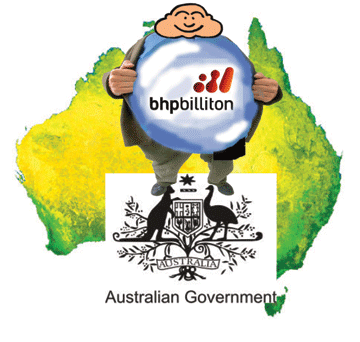 MINING GIANT SEEKS COSTS FROM ARABUNNA ELDER AFTER RULING ON CHALLENGE TO FEDERAL APPROVAL OF THE OLYMPIC DAM EXPANSION 20 April 12, In a packed courtroom today Justice Besanko dismissed Uncle Kevin Buzzacott’s challenge of the Federal approval of the Olympic Dam expansion. The judge did not discuss his reasons in the court.
Both BHP and the Federal government are seeking costs from Kevin Buzzacott. The hearing was held in the Federal Court on the 3rd and 4th April, after which the Judge reserved his judgement. Both BHP Billiton and the South Australian government had successfully sought to become parties to the proceedings.
“The speed with which this decision was made suggests pressure to resolve the matter as quickly as possible so as not to impact the project,” said Nectaria Calan of Friends of the Earth Adelaide.
“The judgement is really a product of the constrained nature of such administrative challenges. It really rests on interpretation of two pieces of legislation which govern the Ministers approval. The merits of the project were never on the table for discussion.”
“If such an approval with so many future plans yet to be approved constitutes a proper approval under the Environment Protection and Biodiversity Act, how can such an open-ended project be judicially reviewed?” said Ms Calan. “The question we are left with is whether the EPBC Act protects the environment,” Ms Calan continued.
“This is a very sad day,” said applicant Kevin Buzzacott. “We offered the judge the issue on a platter, and he wasted an opportunity to make changes that will reverberate in this nation for thousands of years.”
“But we’re not going away. This isn’t over yet,” Mr Buzzacott concluded. Both Kevin Buzzacott and Nectaria Calan will be available for comment on the details of the ruling early next week once the lengthy judgement has been considered.
A sad day for Aborigines, as BHP wins court case, and will seek costs from Aboriginal elder.
 Elder loses court fight over outback mining plan, ABC News, April 20, 2012 The Federal Court has dismissed an application by an Aboriginal elder to overturn a proposed expansion of the Olympic Dam uranium and copper
mine in outback South Australia. Kevin Buzzacott challenged the Federal Government’s approval for the
expansion, which was granted last year.
He argued environmental risks from the planned expansion of underground mining to an open pit operation had not been properly considered. But Justice Anthony Besanko dismissed the application.
Mine owner BHP Billiton is seeking court costs from Mr Buzzacott. Outside court, he said he was disappointed with the result. “We were expecting something like that to happen,” he said. “I guess it’s another sad day for the people of South Australia and especially my people as well.”….. The mining company’s board is due to make a final decision later in the year on whether to proceed with the expansion.
BHP spokesman Kym Winter-Dewhirst says the company was always confident the court would rule in its favour. ….
http://www.abc.net.au/news/2012-04-20/federal-court-elder-challenge-bhp-mine-expansion/3963312
BHP’s Olympic Dam mine expansion might not go ahead anyway

Acting chief executive of the South Australian Chamber of Mines and Energy Nigel Long said the state’s mining industry was not solely reliant on the expansion of Olympic Dam because there were other “exciting opportunities” ahead,
“The decision to press the pause button is a decision to be made by the BHP board, but we see a very good future for other projects in South Australia regardless…..
The BHP board will be considering whether to approve the project at a time when cost pressures in Australian mining are rising and profit margins are contracting.
BHP has Olympic hurdles to overcome, Financial Review 17 APR 2012 The South Australian government says it is not inclined to grant BHP Billiton an extension on an approvals expiring in December that cover the $US20 billion expansion of the Olympic Dam mine at this stage. Jamie Freed and Lucille Keen
“They’d need a ministerial exemption to continue those approvals,” the state’s Minister for Natural Resources Tom Koutsantonis told ABC Radio South Australia yester day. “Thus far I’ve seen nothing that would incline me to grant an exten sion.”
His comments followed a report in The Australian Financial Review on Saturday that BHP was weighing whether to hit the pause button on the project amid a weaker outlook for commodities, industry-wide cost inflation, added government imposts and pressure from shareholders to return more cash.
BHP’s largest shareholder, Black- Rock, has lowered its stake in the miner’s Australian arm from 5.7 percent to 4.99 per cent over the past six months, according to US regulatory filings. “BlackRock are realising BHP are going to press the button on Olympic Dam so they are getting out,” Continue reading
Australian company Lynas suing Malaysian news portal for defamation
Local regulators Atomic Energy Licensing Board (AELB) had said in January it would approve a TOL subject to added conditions including identifying a suitable long-term waste disposal site.
Lynas had said last month that identifying this site “is a work in progress.” It also said prior to AELB’s decision that a permanent depository facility (PDF) will only be needed in a “worst-case scenario” where it is unable to reprocess the waste into a commercial product.

 Lynas sues news portal, protest groups for defamation, The Malaysian Insider, By Anisah Shukry April 20, 2012 KUALA LUMPUR, — Lynas Corp has filed a defamation suit against online news portal Free Malaysia Today for “false and misleading statements” in a recently published article.
The Australian mining group is also suing Save Malaysia, Stop Lynas’s (SMSL) directors and committee members over an open letter published on the group’s web site…..
Lynas has faced fierce protests from Kuantan residents and opposition politicians who say that the RM2.5 billion rare-earth refinery in nearby Gebeng will cause radiation pollution Continue reading
Australia needs Renewable Energy Target for financial reasons, as well as for jobs, and climate action
 But one of the most important reasons for the RET has nothing to do with reducing carbon emissions, nor the $20 billion of investment and 30,000 jobs it would secure in rural and regional Australia where most of our renewable resources are found.
It is the need to make sure we’ve got lots of renewable energy to call on in the future as we face the spiralling costs of fossil-fuelled electricity….
Let’s keep our power pants on, SMH, Kane Thornton, April 20, 2012 Suggesting we don’t need a Renewable Energy Target because we have a carbon price is like suggesting you don’t need pants because you have a jacket. Sure there’s a little overlap, but heading boldly into the world without your pants isn’t going to earn you any respect – particularly when just about everyone else is wearing them.
Over the last week, both the Business Council of Australia and the NSW Government have argued against our 20 per cent Renewable Energy Target (RET). While the cost of renewable energy is falling quickly, the carbon price alone is not high enough to generate sufficient investment in renewable energy projects. That’s why we need the RET too. Each also has a role to play in reducing our carbon emissions.
Both sides of Australian politics understand the importance of the RET. It was established by Liberal Prime Minister John Howard, and Labor’s Kevin Rudd increased it to 20 per cent with the support of the Coalition and Greens in 2009. In recent weeks, both Climate Change Minister Greg Combet and his opposition counterpart, Greg Hunt, have
restated their support for the policy. Continue reading
1 This month


Help Aunty Sue Protect Her Land and Sacred Sites From Destructive Rocket Testing.
.

Australians deserve the truth
about
AUKUS – https://aukuspublicinquiry.com/

PETITION – To: Prime Minister Anthony Albanese and the Australian Labor Government

of the week – Australians for War Powers Reform (AWPR)
To see nuclear-related stories in greater depth and intensity
 Antinuclear