Port Augusta South Australia ideal for a renewable energy revolution

 Repowering Port Augusta With Solar And Wind – Blueprint http://www.energymatters.com.au/index.php?main_page=news_article&article_id=3171 by Energy Matters 20 April 12, Non-profit think-tank Beyond Zero Emissions (BZE) has released ‘Repowering Port Augusta’; a blueprint for replacing South Australia’s emissions intensive Northern and Playford B brown coal-fired power stations with wind power and solar energy facilities. Continue reading
The New South Wales Pacific Highway’s ‘toxic ditch’
Ben Colton said his uncle Robert Deards was one of the initial police officers called to the crash and handled the drums,  which “made him sick to the point he nearly died”. Mr Colton said his uncle and another officer spent 14 hours at the scene – and were later told to go for a swim to wash off any radioactive particles – but their complaints and recognition of their exposure fell on deaf ears.
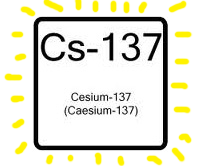 CAESIUM-137 A radioactive isotope formed as a by-product of nuclear fission usually involving uranium. It has a half-life of 30 years. It remains the main health risk and source of radiation around the Chernobyl nuclear power plant. Short term high-level exposure can produce nausea, vomiting, diarrhoea, head aches and blisters, which can return
up to weeks later in the body. It is also blamed for birth defects.
Lethal, toxic truth buried in a highway ditch Herald Sun, By Richard Noone and Neil Keene From: The Daily Telegraph April 19, 2012 WHY radioactive materials, a banned pesticide and food were on the same truck that crashed on the New South Wales Pacific Highway in 1980 is a mystery….. An ANSTO spokesman said the drums – one 60 litres and another smaller one – carrying the nuclear material were undamaged in the crash and later taken with the undamaged food to Brisbane. The rest, including the DDT, was believed to have been buried.
Despite full knowledge of its location the then RTA proceeded with the $60 million upgrade, awarded to BMD Constructions, in March last year without removing it first. Continue reading
Road workers recovered, mystery of 1980 toxic spill remains
 [ on December 4, 1980] The first two police officers on the scene were senior constables Robert Deards and Terry Clifton, who remained there for 12 hours, handling two drums of radioactive material, and handling burst bags containing DDT.
Mystery illness recalls 1980 toxic spill, SMH, Ben Cubby, Nick Ralston, April 19, 2012 FIVE road workers have recovered after exposure to a mystery toxic chemical they unearthed while building a new section of the Pacific Highway near Port Macquarie. The workers were struck by nausea, vomiting and sore throats after excavations uncovered a patch of greyish clay that became streaked with orange after it was exposed to the air.
The site, between Herons Creek and Stills Road near the town of Laurieton, is notorious as the location of one of Australia’s most controversial spills of toxic chemicals and radioactive material. In 1980 a truck rolled over while carrying several tonnes of the insecticide DDT, two drums of radioactive material and some other chemicals. Some of the DDT was apparently buried on site. It sparked a chain of events that saw allegations of a ”massive cover-up” by a local doctor who claimed 13 people involved in the clean-up fell ill, and a parliamentary investigation.
Although the affected workers were exposed nearly three weeks ago and have since returned to work, the cause of the illness remains unknown and a 50-metre exclusion zone has been imposed around the construction site, NSW Roads and Maritime Services said. The Roads Minister, Duncan Gay, said there was no sign of radioactivity, though further tests would be undertaken. Continue reading
ANSTO says not involved in 1981 truck’s toxic spill. Inquiry to be held
Nuclear agency distances itself from toxic scare ABC News, April 18, 2012 Australia’s peak nuclear agency says toxic material that has halted upgrade work of the Pacific Highway in New South Wales did not originate at its Lucas Heights facility…… a statement from the Australian Nuclear Science and Technology Organisation (ANSTO), says a review of records shows its predecessor, the Australian Atomic Energy Commission (AAEC), was not concerned with any aspect of the truck accident….
It went on to say that a report from April 1981 stated that “the sources were not the property of the AAEC nor were they being consigned to or from the AAEC”. “They were the property of a geophysical company and do not appear to have suffered any harm.” ANSTO says it has received advice from the Environmental Protection Agency that there is no indication of radioactive drums or canisters being located at the site……A federal parliamentary report into
hazardous materials in 1982 included details of the crash which Mr Higgins says is being checked in light of the sick workers….. http://www.abc.net.au/news/2012-04-18/ansto-distances-itself-from-radiation-scare/3958572
Minister calls for highway inquiry http://news.smh.com.au/breaking-news-national/minister-calls-for-highway-inquiry-20120419-1x83j.html April 19, 2012 NSW Roads Minister Duncan Gay says an independent inquiry will investigate how five road workers came to be exposed to potentially toxic material buried on the state’s mid-north coast. Continue reading
Don’t worry: radiation’s OK: nuclear is cleaner than wind or solar energy – says uranium industry’s Michael Angwin
 Facts ‘needed to end radiation fear’, Herald Sun April 19, 2012 AUSTRALIANS would fear radiation less if they better understood the science behind it, a uranium advocacy group says.
A misinformed fear of radiation, from disasters like Chernobyl and Fukushima, drives public perception about uranium, the Australian Uranium Association (AUA) says…
.. AUA CEO Michael Angwin says radiation is a safe natural phenomena that need not be feared…… “You do see people who will become physically ill due to just the fear of the unknown.” He said he saw people sick with worry in Japan last year following the major earthquake and feared radioactive disaster at the Fukushima
nuclear plant….
 Mr Angwin said while Fukushima had been a set-back for the image of uranium it remained a clean-energy option for the future. “Emissions from nuclear energy are very low, about the same as wind and in many cases less than a number of the solar technologies,” “For the same amount of electricity produced, the emissions from the nuclear industry are very low.”….http://www.heraldsun.com.au/ipad/facts-needed-to-end-radiation-fear-expert/story-fn6bfkm6-1226331893359
Expert panel reviews the Clean Energy Finance Corporation
the panel has recognised the significance and the potential for new technologies to transform Australia’s energy system and ensure it remains competitive with other countries.
Now, however, just watch the Opposition attack it, along with the usual suspects among the established energy generators and emitters. The key themes of this report – investment for long-term gains over short term costs, the “external” benefits which are overlooked by banks and statutory authorities, and the issue of future competitiveness – will no doubt be lost in the shouting.
 Ten things you should know about the CEFC REneweconomy, By Giles Parkinson 17 April 2012 The long-awaited “experts review” into the proposed $10 billion Clean Energy Finance Corporation has been delivered to – and accepted by – the federal government.
The CEFC is seen as one of the most critical elements of the Clean Energy Future package by large parts of the clean energy industry, particularly those trying to introduce new technologies. It will certainly be one of the political hot potatoes going into the next election. The federal Government says it intends to introduce legislation into the Budget sittings of parliament which begin in May. The Opposition calls it a “slush fund.”
Here are some highlights from review by the team led by Reserve Bankboard member Jillian Broadbent, and supported by funds manager David Paradice and former banker Ian Moore. Continue reading
New South Wales: road workers made sick by ionising radiation?
 Workers sick amid highway radiation scare http://www.abc.net.au/news/2012-04-18/radioactive-discovery-halts-pacific-hwy-upgrade/3957168 April 18, 2012 Road workers were sent for medical treatment after vomiting when suspected nuclear material was unearthed during work on an upgrade to the Pacific Highway on the mid-north coast of New South Wales The materials, which include caesium, were buried north of Port Macquarie after a truck carrying radioactive isotopes from Sydney’s Lucas Heights nuclear reactor crashed in the area in 1980.
The isotopes were being taken to Brisbane, before being shipped to the United States. The upgrade’s project manager, Bob Higgins, says road workers fell ill after unearthing a strange clay-like material.
“As we’ve taken down the cutting there we exposed the face of the existing material (and) came across a clay material that when it’s exposed to air it gets an orange streak through it,” he said. “There were a number of workers that felt a little bit of nausea and there was a bit of vomiting when they were in close proximity. “[They went] off to the doctor, but obviously we need to be extremely careful here.”
The Environmental Impact Statement for the highway upgrade had noted some uncertainty about where exactly the containers were buried. Specialists are in the area assessing what to do with the radioactive materials, and if they pose any risk.
Radioactive transport accident New South Wales 1980
Let the Facts Speak: 1980, December 4 PORT MACQUARIE, AUSTRALIA
An accident near Port Macquarie involved a truck carrying a 60-litre drum labelled ‘danger radioactive – Americium 241’, plus a smaller container labeled ‘Caesium 137’ and foodstuffs. When Sydney police called the Atomic Energy Commission at Lucas Heights for advice, they were told to call back later ‘when the AEC opens’. Dr. John McKay of Port Macquarie claimed that 16 people who attended the accident are suffering from symptoms of radioactive poisoning.
Dr. McKay has accused the AEC of a cover-up regarding the dangers of the accident, and has claimed that this lack of concern may endanger the 8,000 people in nearby Laurieton if radiation poisons the town’s water supply. The NSW Minister for Public Health accused Dr. McKay of ‘causing public mischief’. The Minister said the Health Commission report had found that, although the protective containers of the radioactive material were damaged, both were considered to be safe with no spillage or leakage of radioactivity.
Sydney Morning Herald – 16 April 1981; Canberra Times – 11 March 1981; WISE Vol.3 No.3 June/July 1981 p.16; Canberra Times – 11 March 1981
It looks as if the Northern Territory govt will allow uranium mining in water catchment area!
 Exploration in dam catchment http://www.ntnews.com.au/article/2012/04/18/299461_ntnews.html NIGEL ADLAM | April 18th, 2012 TEN mining exploration licences have been granted in the water catchment for a possible new dam. Resources Minister Kon Vatskalis denied any of the licences had been issued specifically for uranium. “Rather the authorisation allows the holder to undertake exploration within a specific area,” he said.
The licences are in the catchment for Warrai Dam, 8km upstream from Adelaide River township, 100km south of Darwin.
Power and Water Corporation boss Andrew Macrides said the $500 million dam may not have to be built for at least 20 years – and possibly not at all.
Tony Abbott will not be able to destroy the Clean Energy Finance Corporation
 Abbott-proof fence around clean-energy funds, The Age, David Wroe April 18, 2012 THE Gillard government will fireproof its $10 billion green technology fund against an attack from any future Coalition government by forcing Tony Abbott to repeal legislation in order to shut down the flow of money.
Ensuring its clean energy policies are carved in stone even if it loses next year’s election, Labor indicated yesterday that the funding for the Clean Energy Finance Corporation would be ”specifically appropriated” in legislation to be introduced to Parliament next month. Continue reading
Australian Government set to launch Clean Energy Finance Corporation (CEFC)
$10b fund for renewable energy firms http://www.perthnow.com.au/business/b-fund-for-renewable-energy-firms/story-e6frg2r3-1226330084361 AAP April 17, 2012 COMPANIES involved in renewable energy will soon be able to tap into a $10 billion federal pool. The Gillard government released today an independent review into the Clean Energy Finance Corporation (CEFC), which is due to start operating from July 2013.
The government accepted all recommendations made by the review.
The CEFC will provide $10 billion worth of financing to companies involved in renewable energy, low-emissions and energy efficiency technology. The review was led by Reserve Bank of Australia board member Jillian Broadbent.
The CEFC will encourage private investment and help overcome capital market barriers for cleaner energy technologies, the government said in a statement today.
The fund will apply “commercial rigor” to its investment decisions to make sure companies have a positive rate of return and are able to repay the loans.
Australian uranium miner Paladin – shares down again
 Paladin misses targets, shares drop, Peter Ker April 16, 2012 Shares in Paladin Energy are sliding lower this
morning, after the uranium miner revealed it had missed production targets yet again and had been forced to reduce its annual production targets.
Uranium production at Paladin’s flagship Langer Heinrich mine was 10 per cent below the company’s target during the first three months of2012, while its secondary mine also missed its production targets.
The missed targets, combined with concerns over Paladin’s debt, was pushing shares were down by 3 cents to 1.77 shortly after 11am…. Many analysts are concerned about Paladin’s debt levels, and the company is looking to sell minority stakes in its non-producing assets as a way to boost cashflow.
Concerns over the debt situation prompted Patersons Securities to downgrade Paladin to a sell earlier this month.
http://www.brisbanetimes.com.au/business/paladin-misses-targets-shares-drop-20120416-1x2od.html#ixzz1sQlkNcbp
Australian company Lynas has ‘no concrete radioactive waste management plan’
 Unlike the Lynas plant, the other three refineries’ radioactive wastes are sent back to the respective mines.
“Lynas has no concrete radioactive waste management plan. Lynas claims it can store its waste onsite forever.
The Lynas plant, she added, would have 500 tonnes of liquid discharge per hour channelled into the Balok River.
 Lynas whitewashing refinery safety concerns, says Fuziah, The Malaysian Insider, By Shazwan Mustafa Kamal April 16, 2012 KUALA LUMPUR, — PKR’s Fuziah Salleh has accused Lynas Corp of whitewashing safety concerns of its planned refinery in Kuantan by claiming there is a “concerted political campaign” against the plant’s construction,
In response, Fuziah accused the Lynas Corp head of “deviating” from the real issue of safety, saying that a simple
comparative study showed the Lynas refinery did not support any form of “sustainable development.”
“They are not addressing concerns of safety, whitewashing safety concerns, silent about safety issues. “They have only addressed radiation aspects, external radiation… they are narrow-minded in terms of perspective of radiation,” the PKR
vice-president told The Malaysian Insider. Continue reading
Uranium spot price ‘dead for months’, despite lobby propaganda
 18 April 12, Yesterday 9 news reported on the uranium spot price’s continuing dismal slide : –
“Last week a mere three transactions occurred in the global spot uranium market, totalling 500,000lbs, industry consultant TradeTech reports. TradeTech’s spot price indicator remains unchanged at US$51.25/lb. Year to date trading has seen 8.2mlbs of U3O8 equivalent change hands compared to 18.4mlbs in the same period last year. ….
the spot uranium market has been pretty “dead” for the past several months….. Australian-listed Paladin Energy has been following a bumpy road to becoming one of the world’s more significant uranium producers as it deals with the usual pitfalls of project development and expansion and deals with them in Namibia. Aside from production issues, Paladin is suffering from cashflow tightness as development costs rise in the face of weak post-Fukushima uranium pricing”
Lucas Heights nuclear reactor’s slips and leaks
Radiation leak fear at Sydney’s Lucas Heights as four workmen contaminated, Linda Silmalis The Sunday Telegraph April 15, 2012 FOUR workmen at the Lucas Heights nuclear reactor suffered low-level radiation contamination late last year.
An investigation by the nuclear safety watchdog of the reactor log books to ensure it was meeting its licence conditions has found a rise in the number of contamination events recorded in November and December..
…Two reactor trips were also recorded, while “unusual” water leakage was identified coming from one of the control rods, the Australian Radiation Protection and Nuclear Safety Agency report said…. While the watchdog ticked off the 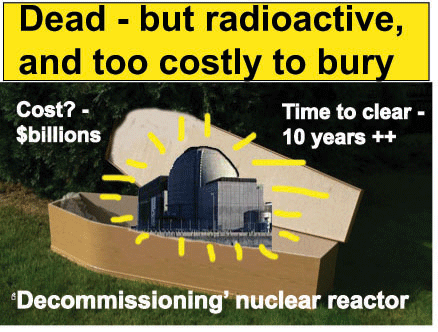 operations at the reactor as complying with safety regulations, it recommended the Australian Nuclear Science and Technology Organisation (ANSTO) consider increasing the level of detail it recorded for events.
It noted a number of events and items of interest that had been recorded in the Reactor Operation Event Management System and log book. “The number of minor contamination events at OPAL has increased recently,” it said..
… OPAL replaces the high flux reactor, which began a $50 million decommissioning phase in 2007. The process is expected to take 10 years, with dismantling of the structure only to begin in 2016 after short-lived radioactive materials in the reactor have decayed. http://www.dailytelegraph.com.au/news/sydney-nsw/radiation-leak-fear-in-sydney/story-e6freuzi-1226326493993
1 This month


Help Aunty Sue Protect Her Land and Sacred Sites From Destructive Rocket Testing.
.

Australians deserve the truth
about
AUKUS – https://aukuspublicinquiry.com/

PETITION – To: Prime Minister Anthony Albanese and the Australian Labor Government

of the week – Australians for War Powers Reform (AWPR)
To see nuclear-related stories in greater depth and intensity
 Antinuclear