Australia’s generous compensation to citizens, as it brings in the carbon tax

 One million Queenslanders to receive extra welfare payments to offset rising costs fuelled by carbon tax by: Steven Scott The Courier-Mail April 14, 2012 “…..New data from the tax office and welfare agencies reveals just under one million Queenslanders will receive some form of extra welfare payments to help offset rising costs fuelled by the carbon tax.
Almost 1.6 million Queenslanders who are likely to earn less than $80,000 next year will get a tax cut. About 1.3 million of those will receive a cut of more than $300 a year. About 121,000 more Queenslanders are likely to pay no income tax next year when the tax-free threshold is tripled as part of the carbon tax compensation package.
As Labor braces for a backlash to the carbon tax, which will take effect on July 1, the Government will roll out increases to pensions with initial lump sums in May and June…. About 675,000 Queensland pensioners will get an extra $338 a year if they are single and up to $510 a year if they are a couple, while 45,000 of the state’s self-funded retirees will get an extra $380 a year.
More than 350,000 families will enjoy boosts to payments, including up to $110 extra a year for each child for families on Family Tax Benefit A and up to $60 a year for those on Family Tax Benefit B…
http://www.couriermail.com.au/news/queensland/one-million-queenslanders-to-receive-extra-welfare-payments-to-offset-rising-costs-fuelled-by-carbon-tax/story-e6freoof-
Australia’s carbon tax benefits will kick in in May 2012
Carbon tax’s family dividends http://www.themercury.com.au/article/2012/04/14/318411_tasmania-news.html
DAVID KILLICK | April 14, 2012 HUNDREDS of thousands of Tasmanians will shortly benefit from increased welfare payments and tax cuts under the Federal Government’s new carbon tax regime. Increases in family payments, pensions and benefits will start with lump-sum payments next month, followed by benefit rises which take effect in the new year.
Tax cuts also kick in on July 1 and 14,000 Tasmanians will no longer have to pay tax at all, thanks to a tripling of the tax-free threshold. More than 100,000 Tasmanian pensioners will receive up to $510 a year more in benefits, 44,000 families will get $110 per child and self-funded retirees will be $380 a year better off. Around 17,000 jobseekers will be paid another $218 for singles and $390 for couples, the state’s 8500 single parents will receive $234
more a year and 7500 students will be $218 a year better off. And 179,000 Tasmanians on less than $80,000 a year will receive tax cuts. Continue reading
ERA talking about closure costs for Ranger uranium mine (have they budgeted enough?)
Era adds A$251m to Ranger closure plan By: Esmarie Swanepoel, Mining Weekly, 11th April 2012 PERTH – The CEO of uranium miner Energy Resources of Australia (Era), Rob Atkinson on Wednesday told shareholders that the company had increased the provision for the closure of its Ranger mine, in the Northern Territory, from A$314-million to A$565-million, following a desktop review.
At the company’s annual general meeting, Atkinson said that the miner would continue investigating its closure plan during the remainder of 2012…… He noted that the revised plan would support a review of the rehabilitation cost estimate, later this year.
Senator Christine Milne – a strong voice for rural Australia and progressive business
 Tough negotiator Milne to carry cause into the regions, BY: SID MAHER The Australian April 14, 2012 “…….Senator Milne, in accepting the leadership from her predecessor, nominated climate change as the key issue confronting the nation in the 21st century and signalled she would seek to build support for the Greens in rural and regional areas in her new role.
She lashed the “rapacious” mining industry, arguing “we are seeing the biggest assault on the environment in Australia that we have seen for a very long time”. She attacked the willingness of the ALP and the Coalition to “cave in to the few who want to push out of the way environmental protection”. Rallying the party faithful, Senator Milne said the departure of Senator Brown represented an opportunity to recommit to the Greens and commit to the party’s objectives. She said
the party would build on Senator Brown’s legacy and praised his compassion and advocacy of the “need for a more caring, inclusive
society”. She said Australia needed an economic narrative that involved sustainable environmental outcomes and to “support the kind of society we want”.
Senator Milne said rural and regional Australia had a critical role to play in terms of providing food security in a global context, also citing its potential to participation in the provision of renewable energy and energy sustainability.
Senator Milne, who grew up in rural Tasmania, said: “I’m going out there as a country person, to say to other country people it’s time that the Greens and country and rural Australia really worked together.” She flagged working more closely with “progressive business”, signalling she will seek to encourage renewable energy companies to be
more vocal and boost corporate social responsibility. http://www.theaustralian.com.au/national-affairs/tough-negotiator-milne-to-carry-cause-into-the-regions/story-fn59niix-1226326234831
$Billions of investment money at risk, as New South Wales Liberal government calls for scrapping of renewable energy target
 Investment fears over ‘attack’ on green energy SMH Anna Patty April 14, 2012 THE NSW government’s decision to withdraw support from clean energy schemes was criticised yesterday as a retrograde step that would threaten billions of investment dollars.
The Energy Minister, Chris Hartcher, has said the government would not be supporting green schemes that require a subsidy and is calling for the closure of the federal government’s renewable energy target. He called for the closure of the renewable energy target – legislation that is supported by the federal opposition.
The NSW opposition spokesman for energy, Luke Foley, said yesterday the tribunal’s determination found that green energy schemes had not contributed to electricity price increases. Power bills are forecast to rise between $182 and $338 a year from July 1. Mr Foley said the state government had ended bipartisan support for the 20 per cent renewable energy target after calling for the target to be removed, despite adopting the target in its state plan released
last year. ”The O’Farrell government has launched a relentless attack on renewable energy, with chilling investment signals sent by the government throughout its first year in office,” he said.
”Solar in NSW has been stopped dead in its tracks. The draft wind guidelines are designed to chronically handicap the expansion of the wind industry.
”Renewable energy is already contributing to lower wholesale electricity prices. The Australian Energy Market Commission recently reported that new wind energy projects in Victoria will mean that increases to wholesale electricity prices in that state will be lower than in NSW. Rather than attacking wind farms, the O’Farrell
government should require its own planning review to come up with a sensible and workable planning regime for the development of the wind industry in NSW.”
The acting chief executive of the Clean Energy Council, Kane Thornton, said it was a “worrying sign that the NSW government would seek the removal of one of Australia’s most significant energy policies without considering the impact this would have on investors who have put billions of dollars into clean energy projects in NSW. The renewable
energy target is scheduled to run until 2030 and these projects would face collapse if it was removed.”
http://www.smh.com.au/environment/investment-fears-over-attack-on-green-energy-20120413-1wysv.html#ixzz1s3udpo35
In Western Australia – a window in Australia’s solar future
“[It’s] a window into Australia’s solar future,” – Australian Solar Energy Society chief executive John Grimes
“Big solar makes sense in the Mid West. The region’s enormous appetite for energy is matched by some of the best sunshine in the world.
“Solar increasingly makes economic sense in the Mid West, with a dramatic fall in the price of solar PV countering a significant rise in the cost of electricity.”
Mr Grimes said there was no reason why solar could not provide a significant amount of Austral’s electricity needs by 2020, particularly with the introduction of the carbon tax from July 1 and the national 20 per cent renewable energy target.
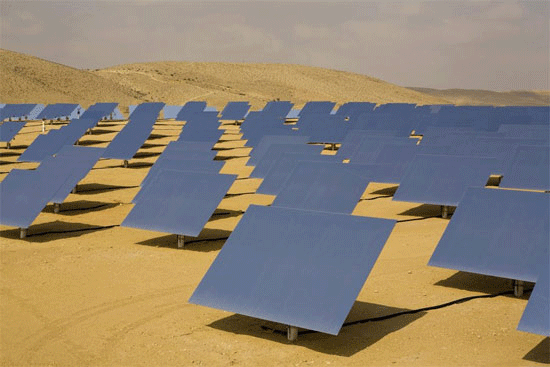
Historic solar farm transforms WA landscape http://www.watoday.com.au/wa-news/historic-solar-farm-transforms-wa-landscape-20120412-1ww3t.html#ixzz1s49L4pPw WA Today, Courtney Trenwith April 12, 2012 WA’s historic solar power farm will soon be glistening in the outback, with the first panel installed today. In what will be the largest solar energy generator in the country, the farm will house 150,000 panels across 80 hectares, creating a remarkable sight and producing an environmental feat.
The 10 megawatt Greenough River Solar Farm is being built 50 kilometres south of Geraldton, with 100 construction jobs created. It is expected to generate enough electricity for 3,000 average homes while displacing 20,000 tonnes of greenhouse gas each year – the equivalent of taking 4000 vehicles off the road. Continue reading
Unlike Labor and Liberal, the Greens conduct a gracious leadership transition
She conducted a complicated dual negotiation last year on the carbon package, selling the deal to the party’s
hardliners ….also winning a $10 billion clean energy finance corporation from the Gillard government
”This is our opportunity to build on Bob Brown’s legacy,” – Christine Milne
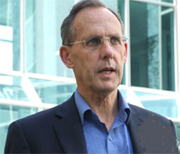 A warrior for the wilderness, Brisbane Times, Lenore Taylor April 14, 2012 Bob Brown built the Greens into a powerful force in Australian politics. His successor faces a challenge in keeping it there.
It was the kind of civilised leadership transition no major party has pulled off in recent history – the popular long-serving leader stands down at a time of his own choosing ”to make way for new talent” and his loyal deputy is unanimously elected in his place. No rancour. No back-stabbing. Plaudits all round.
But Bob Brown – the father of Australia’s Greens – and its new federal leader Christine Milne have been tag-teaming like this through-out their careers. Brown the fearless trailblazer, Milne the organiser, the negotiator, the campaigner, not far behind. Continue reading
Residents near Windy Hill, Queensland, speak about wind energy
 (includes video) Winds of change generating a powerful debate over Mt Emerald The Cairns Post Tony Stickley, April 14, 2012 The proposal of a wind farm at Mt Emerald has created a strong debate over noise issues for residential properties nearby. The Cairns Post explored how residents at Windy Hill feel about the wind farm noise. CLEAN, green renewable energy powering 60 per cent of Cairns and the whole of the Tableland shines like the holy grail of electricity generation. Could you live next door to a windfarm? Listen to Windy Hill residents and make up your own mind. Continue reading
Australia’s lost opportunities in solar power
 the big dish was by-passed in the Federal Government’s Solar Flagships program. The claim that it was not “commercially ready” is directly contradicted by the creation of the Solar Oasis consortium that is now building a 40 MW big dish solar power generator at Whyalla, in South Australia.
Solar lessons from Korea, Daily Mercury, John Mathews | 14th April 2012 “……. [Korea] is streamlining investment into the new green sectors, that so far run to financing of nearly $50 billion. That’s billion, not million – compared with Australia’s much-touted Solar Flagship program which is funded at the level of millions.
………the Korean approach will be – mark my words – to turn the solar dish concept into a central component of their new green growth industrial strategy. They will be expected to acquire rights to the technology, and then adapt it through the intervention of Hyundai or LG or Samsung (the Korean innovation champions). They will mass produce the dishes in the thousands and then promote use of the technology throughout the world, providing all the components and materials from Korean sources.
The contrast with our approach in Australia could not be more stark. So far, we have seen two major solar technologies starved of funds and shipped offshore. There was thin-film solar photovoltaic technology, developed at the University of NSW under Professor Martin Green, that became a political football and a casualty of NSW state politics (when Bob Carr was premier). It was eventually sold off to Germany. Continue reading
Senator Bob Brown to resign. Senator Christine Milne to take over Greens leadership
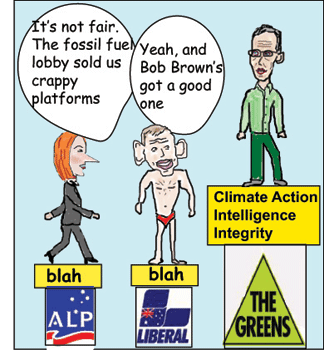 Brown’s protests and causes in his trailblazing career, ABC News, April 13, 2012 After 16 years at the helm of the party he founded, Bob Brown has retired as Greens leader and will stand down as a senator in June. His resignation ends a trailblazing career in federal politics which saw him become Australia’s first openly gay member of Parliament.
Since his early career as a doctor, Senator Brown adopted left-leaning causes and was passionate about the environment and human rights.
In 1976 he held a fast for one week on top of Mt Wellington in protest of the arrival of the nuclear-powered warship USS Enterprise……
Senator Brown was an advocate for a range of human rights and green issues, introducing bills for forest protection, to ban mandatory sentencing of Aboriginal children and to block the dumping of nuclear waste.
Parliamentary rebel He was an opponent of the war in Iraq and campaigned for justice for David Hicks, the Australian who was imprisoned at Guantanamo Bay. Senator Brown was famously suspended from Parliament in 2003 when he
disrupted a speech being delivered by visiting United States president George W Bush.
During Mr Bush’s speech Mr Brown demanded the American “return Australians” respect Australians. He was barred for 24 hours but he and Mr Bush shook hands afterwards despite the altercation.
Later, when US president Barack Obama visited Australia in 2011 Senator Brown said he did not intend to interrupt his speech to Parliament. “We’ve got a president now who knows a lot more about equality and respect than his predecessor, George W Bush,” he said…… http://www.abc.net.au/news/2012-04-13/brown27s-trailblazing-career/3948578
Council of Australian Governments (COAG) to weaken Australia’s environmental protection
 The ‘Green Tape’ Furphy, New Matilda By Ben Eltham, 13 April 12, Reducing ‘green tape’ is on the COAG agenda – but fast-tracking environmental regulation will end up hurting productivity in the long term, writes Ben Eltham“……..Yesterday’s roundtable ended with a statement from those assembled which pledged to cut some of the burdensome duplication of regulatory approvals between state and Commonwealth levels. “The Government has agreed to develop bilateral arrangements with the states to fast-track state assessments and approvals,” it reads. “This means states will be accredited to do certain Commonwealth assessments.” There will also be a commitment to form inter-governmental taskforces for major projects, “so approvals are administered by a single state agency and unnecessary duplication is removed.”
But the Greens maintain that federal environmental legislation is sometimes the only thing that prevents pro-development state governments from giving bulldozers the green light. “All the big environmental wins of recent history have been when the federal government stepped in to protect an area from development the state government had approved,” Queensland Greens Senator Larissa Waters pointed out.
Waters is right. Federal legislation is generally the last line of resort for blocking big projects that impinge on sensitive habitats or threatened species, but which have been waved though by state authorities. The experience of Tasmania shows how, in a small state, the interests of a powerful industry can often subvert the interests of the broader environment, as happened when regulatory approval the Bell Bay pulp mill proposed by Gunns was rammed through parliament with little due diligence. It was the Commonwealth that stepped in protect the Franklin in the early 1980s, and the Commonwealth that stepped in to protect Coronation Hill. More recently it is the Commonwealth that has provided world-leading benchmarks for no-fish zones in the Great Barrier Reef…. http://newmatilda.com/2012/04/13/greentape-furphy
Queensland Premier Campbell Newman wants his State to have open slather on environmental assessments
 Premier Campbell Newman says Julia Gillard’s move to remove duplication on environmental approvals with the states falls short Courier Mail, by: Steven Scott From: The Courier-Mail April 13, 2012 CAMPBELL Newman has demanded the Federal Government hand over complete control of environmental assessments to the state in a move designedto cut business costs.
But Julia Gillard has vowed to retain the final say over high-risk and World Heritage area developments, warning Mr Newman’s plan could allow Queensland to build a nuclear reactor without any input from the rest of the country……
Liberal premiers including Mr Newman say they want the carbon tax on the table as part of the talks, which will continue at the Council of Australian Governments summit in Canberra today.
But Mr Newman has gone further than other Premiers and called for complete control over environmental assessments in the Sunshine State….. Ms Gillard said her plan to streamline environmental rules with states
would mean developers “don’t go through double assessments”. But she said the Federal Government still had to oversee developments in World Heritage areas in Commonwealth waters and nuclear power.
Ms Gillard said Mr Newman’s proposal would stop the Federal Government having a say if there was a plan for another nuclear reactor like the Lucas Heights plant in Sydney…..
the Greens said the plan to streamline assessments could cut environmental protection….
http://www.couriermail.com.au/news/queensland/deal-will-cut-green-tape/story-e6freoof-1226325279269
Solar powered air conditioning – the answer to Australia’s electricity peak load

 How solar air-con could avoid costly network upgrades http://reneweconomy.com.au/2012/how-solar-air-con-could-avoid-costly-network-upgrades-46101 REneweconomy By Giles Parkinson 13 April 2012 The biggest strain on our electricity networks right now – and the cause for at least one third of the $45 billion network upgrades, and at least half of the recently announced tariff increases – are the “super” peak demand periods triggered when everyone returns home from work and flicks on their air conditioning.
In some states this might only occur for a few hours a year, more in others, but network operators have been at a loss to address the issue, apart from building more capacity. Other solutions have been offered – demand management being one of them – but what if the network operators could turn to solar-powered air conditioners as the solution to reduce peak load? Continue reading
BHP’s Marius Kloppers leads the fight against renewable energy
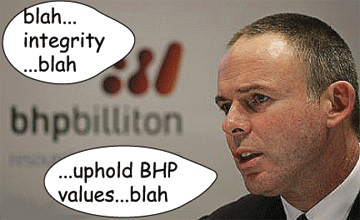 Renewables target under fire , The Australian BY: ANNABEL HEPWORTH, DAVID CROWE April 13, 2012
LABOR faces growing business pressure to scale back its renewable energy target when it is reviewed this year, with BHP chief executive Marius Kloppers urging the Gillard government to “take a cold, hard look” at how it will interact with the carbon tax. …
Lynas Advanced Materials Plant (LAMP) – profits to Australians, radioactive wastes to Malaysia
 Today, the government is the official custodian of this repository in Bukit Merah. This site in Bukit Merah is declared as a restricted and dangerous dump site for radioactive materials but a curtain of official silence has descended on it. Has the government not learnt from Bukit Merah?
The Lynas project is likely to be a replay of the ARE fiasco but on a much larger scale.
The benefits gained by Malaysia from the Lynas investment are very little relative to the risks involved. Whilst the profits of the project go to Lynas (untaxed) and the few Malaysian companies that are involved in the construction of and the provision of supplies to the Gebeng rare earth plant, the radioactive waste will remain in
Malaysian soil for hundreds of years.
 Lynas issue: Not learning from bitter experience —The Malaysian Insider, Richard Pendragon, April 12, 2012 — Every Malaysian should know that Australia has a land mass 58 times bigger than peninsular Malaysia. But the Australian government and people have not permitted rare earth processing to take place on Australian soil.
With a population that is vigilant and a government that answers to the people, Australia dares not permit a rare earth plant because the health and environmental risks are too high.
Why does Malaysia – a country with less scientific and engineering expertise – think it is all right to go ahead with the plant? Continue reading
1 This month


Help Aunty Sue Protect Her Land and Sacred Sites From Destructive Rocket Testing.
.

Australians deserve the truth
about
AUKUS – https://aukuspublicinquiry.com/

PETITION – To: Prime Minister Anthony Albanese and the Australian Labor Government

of the week – Australians for War Powers Reform (AWPR)
To see nuclear-related stories in greater depth and intensity
 Antinuclear