Morrison’s tactless belligerence towards China, while USA moves to mend relationship to China
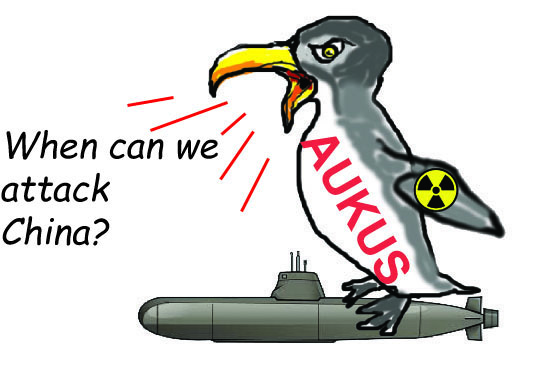
Morrison didn’t mention China – he didn’t have to, https://www.afr.com/policy/foreign-affairs/morrison-didn-t-mention-china-he-didn-t-have-to-20211117-p599t4
Scott Morrison is selling the broader and immediate technology benefits of the AUKUS deal as he campaigns on national security.Jennifer HewettColumnist he Morrison government’s blueprint for critical technologies is supposed to demonstrate the immediate benefits of much broader research and technology exchange as a result of the AUKUS deal on nuclear submarines.
After all, it’s not just France’s Emmanuel Macron expressing savage criticism about the “fantasy” of the decades-long timetable for Australia’s new submarine strategy to be realised.
So the Prime Minister wants to sell the national security significance of advanced technology co-operation with allies in protecting Australia from urgent, increasing threats in the Indo-Pacific region, including cyber attack.
A first step is $70 million for a quantum commercialisation hub to co-ordinate industry and research in quantum computing and partner with equivalent bodies in “like-minded countries”, starting with a joint co-operation agreement with the US.
“Our trilateral efforts in AUKUS will enhance our joint capabilities and interoperability with an initial focus on cyber capabilities, artificial intelligence, quantum technologies and additional undersea capabilities,” Morrison told the inaugural Sydney Dialogue.
Even though he didn’t specifically name China, Morrison’s primary target might as well have had blinking red lights around it. It wasn’t just that the government partnered for the dialogue with the Australian Strategic Policy Institute, regularly condemned by Beijing for overt antagonism towards China.
Morrison’s repeated references to the importance of trust, shared values and like-minded countries are all supposed to buttress the image of an Australian government in lockstep with other leading democracies against aggression and interference from governments that don’t “see technology the same way”.
“To state the obvious, AUKUS is about much more than nuclear submarines,” he said.
“The simple fact is that nations at the leading edge of technology have greater economic, political and military power. And, in turn, greater capacity to influence the norms and values that will shape technological development in the years to come.”
But the timing of Morrison’s address, right after US President Joe Biden held his virtual summit with China’s Xi Jinping, is an awkward reminder of Australia’s uniquely isolated status in China’s diplomatic deep freeze.
Even the government’s relatively modest $111 million “down payment” on quantum computing as one of nine priority critical technologies demonstrates the limits of Australia’s attempts to harness revolutionary global trends in technology as well as in geopolitics.
China’s leadership is clearly willing to punish Australia’s supposed transgressions with punitive trade measures and a refusal to engage indefinitely. Beijing’s blanket attitude will not soften and may yet harden, especially given the propensity of various government ministers to emphasise Australia’s determination to confront China.
US-China relationship reset
Beijing certainly paid furious attention to recent comments by Defence Minister Peter Dutton, for example, that it would be “inconceivable” for Australia not to support the US in defending Taiwan if the US chose to take that action. So much for the attempt at maintaining deliberate diplomatic nuance with a long-term policy of “strategic ambiguity” on this sensitive topic.
It will become yet another marker making it hard for Australia to retreat on its rhetoric and easy for China to berate with its own. While it is certainly China under Xi that has changed most – and made no friends in the region by doing so – Australia’s challenges to China’s approach can never add up to an argument between economic and power equals.
That’s why most other governments are more cautious in their wording unless their borders or direct interests are threatened.
And now the Biden administration is also keen to at least partially reset its relationship with China after the open hostility of the past few years.
That is despite continuing US ire over China’s behaviour translating into rare bipartisanship in Congress about the need to aggressively counter China as a military and economic threat.
Despite his confidence in the West’s steady decline and China’s inevitable ascendance, Xi also wants to improve the connection with the US.
Unlike its rejection of Australia, China can’t afford to ignore the potential moves and countermoves of another great power. With the erratic Donald Trump no longer in office and Xi seemingly in office for as long as he wants, talks have become more feasible.
The US President declared it to be the responsibility of both leaders to “ensure that the competition between our two countries does not veer into conflict, whether intended or unintended”.
The most obvious flashpoint is Taiwan with the virtual summit not producing any breakthroughs or much evidence of the “commonsense guardrails” that Biden had suggested could help manage tensions.
But beneath the litany of grievances reiterated by both leaders on a range of issues, the three-and-a-half-hour meeting demonstrated a desire to keep lines of communication open and encourage potential co-operation in discreet areas of mutual interest.
That was evident in their agreement on climate change – however vaguely worded – that was unexpectedly announced in Glasgow. After the summit, the two sides have also tentatively agreed to explore the possibility of arms control talks – spurred by China’s rapid acceleration of its nuclear weapons capability.
In contrast to the treatment of Australian journalists, there is also an apparent easing of current restrictions on journalists following China’s expulsion of some US reporters during the Trump Administration.
How much all this will alter the substance as well as the tone of the strategic rivalry and disputes between two great powers asserting themselves in the Indo-Pacific is even less clear.
But for all the talk of trusted partners, the importance of alliances of democracies and the US not “leaving Australia on the field” in terms of China’s economic coercion, the Biden administration will be heavily focused on its own national interest in dealing with China.
Caveat emptor.
”.
Australia needs independent Inquiry on nuclear production and wastes. Kimba nuclear dump plan is not supported by facts.
Nuclear waste and nuclear medicine in Australia
Jim Green, Online Opinion, 16 Nov 2021, https://www.onlineopinion.com.au/view.asp?article=21721&page=0
Claims that the Australian government’s proposed national nuclear waste storage and disposal ‘facility‘ near Kimba in South Australia is required to support nuclear medicine are not supported by the facts.
Australia’s radioactive waste arises from the production and use of radioactive materials in scientific research and industrial, agricultural and medical applications. The Australian Nuclear Science and Technology Organisation (ANSTO), operator of the research reactor at Lucas Heights, south of Sydney, is the main source of waste destined for a national nuclear waste facility. (Other waste streams ‒ such as those generated at uranium mines, and wastes from nuclear weapons testing ‒ would not be disposed of at the national facility.)………….
Scare-mongering
Regardless of the outcome of the current push for a national waste facility ‒ and bearing in mind that all previous plans have been abandoned ‒ there will be an ongoing need for hospitals to store clinical waste. After nuclear medicine is used in a patient, the vast majority is stored on site while it decays. Within a few days, it has lost so much radioactivity that it can go to a normal rubbish tip. There will always be multiple waste storage locations even if a national facility is established.
The government’s claim that a national waste facility is urgently required lest nuclear medicine be affected amounts to scare-mongering………….
health professionals noted in a joint statement in 2011: “The production of radioactive isotopes for nuclear medicine comprises a small percentage of the output of research reactors. The majority of the waste that is produced in these facilities occurs regardless of the nuclear medicine isotope production. Linking the need for a centralised radioactive waste storage facility with the production of isotopes for nuclear medicine is misleading.”………..
ANSTO’s Lucas Heights site
ANSTO’s Lucas Heights site cannot be used for disposal of nuclear waste. It is unlikely that the site would meet relevant criteria, and in any case federal legislation prohibits waste disposal there.
But nuclear waste can be (and is) stored at Lucas Heights; indeed much of the waste destined for a national facility is currently stored there.
Claims that storage capacity at Lucas Heights is nearing capacity and that a national waste facility site is urgently needed have been flatly rejected by Dr Carl-Magnus Larsson, CEO of the federal nuclear regulator, the Australian Radiation Protection and Nuclear Safety Agency (ARPANSA). Dr Larsson stated in parliamentary testimony in 2020: “Waste can be safely stored at Lucas Heights for decades to come”.
Similar comments have been made by ANSTO officers, by the federal government department responsible for radioactive waste management, and by the Australian Nuclear Association. ANSTO officers have noted that “ANSTO is capable of handling and storing wastes for long periods of time” and that waste is stored there “safely and securely”.
Long-lived intermediate-level waste
Of particular concern is long-lived intermediate-level waste (ILW) including waste arising from the reprocessing of irradiated nuclear fuel from the OPAL research reactor at Lucas Heights as well as earlier research reactors. The government plans to move this ILW to the Kimba site for above-ground storage while a deep underground disposal site is found. (Lower-level wastes will be permanently disposed of at Kimba if the project proceeds.)
But the process of finding an ILW disposal site has barely begun and will take decades; indeed ARPANSA has flagged a timeline of 100 years or more.
The vast majority of ILW is currently stored at Lucas Heights. Why not leave it at Lucas Heights ‒ described by an ANSTO officer as “the most secure facility we have got in Australia” ‒ until a disposal site is found? The government doesn’t have a good answer to that question ‒ indeed it has no answer at all beyond false claims about storage capacity limitations and scare-mongering about nuclear medicine supply.
Until such time as a disposal site is available, ILW should be stored at Lucas Heights for the following reasons:
* Australia’s nuclear expertise is heavily concentrated at Lucas Heights;
* Storage at Lucas Heights would negate risks associated with transportation over thousands of kilometres;
* Security at Lucas Heights is far more rigorous than is proposed for Kimba (a couple of security guards); and
* Ongoing storage at Lucas Heights avoids unnecessary costs and risks associated with double-handling, i.e. ILW being moved to Kimba only to be moved again to a disposal site.
Conversely, above-ground storage of ILW in regional South Australia increases risk, complexity and cost ‒ for no good reason.
Need for an independent inquiry
The current plan for a waste facility at Kimba should be scrapped. It is unacceptable to be disposing of nuclear waste against the unanimous wishes of Barngarla Traditional Owners, and ILW storage at Kimba makes no sense for the reasons discussed above.
Australia needs a thorough independent inquiry of both nuclear waste disposal and production. We need a long-term disposal plan that avoids double-handling and unnecessary movement of radioactive materials and meets world’s best practice standards.
An inquiry should include an audit of existing waste stockpiles and storage. This could be led by the federal nuclear regulator ARPANSA in consultation with relevant state agencies. This audit would include developing a prioritised program to improve continuing waste storage and handling facilities, and identifying non-recurrent or legacy waste sites and exploring options to retire and decommission these.
An inquiry would also identify and evaluate the full suite of radioactive waste management options. That would include the option of maintaining existing arrangements until suitable disposal options exist for both ILW and lower-level wastes.
Radioisotope production options
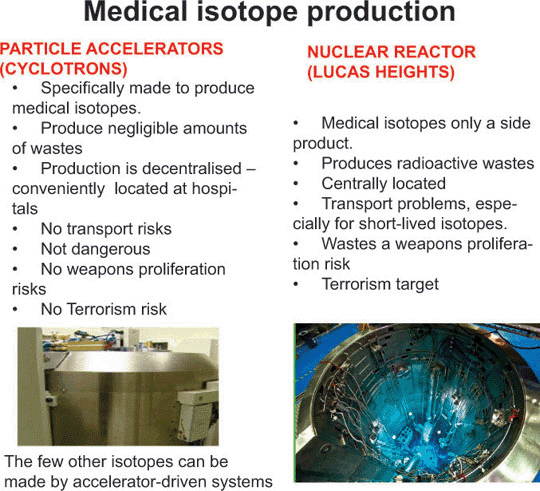
We also need to thoroughly investigate medical radioisotope production options with the aim of shifting from heavy reliance on reactor production in favour of cyclotrons (a type of particle accelerator). Among other advantages, cyclotrons produce far less radioactive waste than research reactors…………. https://www.onlineopinion.com.au/view.asp?article=21721&page=0
America’s relentless pursuit of Australian Julian Assange is a threat to any journalist who might expose a USA massacre of civilians
Julian Assange currently sits in Belmarsh Prison waiting to find out if British judges will overturn a lower court’s ruling against his extradition to the United States to be prosecuted under the Espionage Act for journalistic activity which exposed U.S. war crimes. War crimes not unlike those that were just exposed by The New York Times in its reporting on the Baghuz massacre.
The precedent the U.S. government is trying to set with its persecution of Assange will, if successful, cast a chilling effect over journalism which scrutinizes the U.S. war machine, not just in the United States but around the world.
Syria Massacre Coverup Shows Danger of Assange Precedent, https://consortiumnews.com/2021/11/15/syria-massacre-coverup-shows-danger-of-assange-precedent/ November 15, 2021 The precedent the U.S. government is trying to set with its persecution of Assange will, if successful, cast a chilling effect over journalism which scrutinizes the U.S. war machine, writes Caity Johnstone. By Caitlin Johnstone
CaitlinJohnstone.com The New York Times has published a very solid investigative report on a U.S. military coverup of a 2019 massacre in Baghuz, Syria which killed scores of civilians. This would be the second investigative report on civilian-slaughtering U.S. airstrikes by The New York Times in a matter of weeks, and if I were a more conspiracy-minded person I’d say the paper of record appears to have been infiltrated by journalists.
The report contains many significant revelations, including that the U.S. military has been grossly undercounting the numbers of civilians killed in its airstrikes and lying about it to Congress, that special ops forces in Syria have been consistently ordering airstrikes which kill noncombatants with no accountability by exploiting loopholes to get around rules meant to protect civilians, that units which call in such airstrikes are allowed to do their own assessments grading whether the strikes were justified, that the U.S. war machine attempted to obstruct scrutiny of the massacre “at nearly every step” of the way, and that the Air Force’s Office of Special Investigations only investigates such incidents when there is “potential for high media attention, concern with outcry from local community/government, concern sensitive images may get out.”
“But at nearly every step, the military made moves that concealed the catastrophic strike,” The New York Times reports. “The death toll was downplayed. Reports were delayed, sanitized and classified. United States-led coalition forces bulldozed the blast site. And top leaders were not notified.”
Journalist Aaron Maté has called the incident “one of the U.S. military’s worst massacres and cover-up scandals since My Lai in Vietnam.”
Asked by the Times for a statement, Central Command gave the laughable justification that maybe those dozens of women and children killed in repeated bomb blasts were actually armed enemy combatants:
“This week, after The New York Times sent its findings to U.S. Central Command, which oversaw the air war in Syria, the command acknowledged the strikes for the first time, saying 80 people were killed but the airstrikes were justified. It said the bombs killed 16 fighters and four civilians. As for the other 60 people killed, the statement said it was not clear that they were civilians, in part because women and children in the Islamic State sometimes took up arms.“
I mean, how do you even address a defense like that? How do you get around the “Maybe those babies were ISIS fighters” defense?
Reading the report it becomes apparent how much inertia was thrown on attempts to bring the massacre to light and how easy it would have been for those attempts to succumb to the pressure and just give up, which naturally leads one to wonder how many other such incidents never see the light of day because attempts to expose them are successfully ground to a halt.
The Times says the Baghuz massacre “would rank third on the military’s worst civilian casualty events in Syria if 64 civilian deaths were acknowledged,” but it’s clear that that “acknowledged” bit is doing a lot of heavy lifting there.
And it really makes you appreciate how much work goes into getting information like this in front of the public eye, and how important it is to do so, and how tenuous the ability to do so currently is.
Julian Assange currently sits in Belmarsh Prison waiting to find out if British judges will overturn a lower court’s ruling against his extradition to the United States to be prosecuted under the Espionage Act for journalistic activity which exposed U.S. war crimes. War crimes not unlike those that were just exposed by The New York Times in its reporting on the Baghuz massacre.
The precedent the U.S. government is trying to set with its persecution of Assange will, if successful, cast a chilling effect over journalism which scrutinizes the U.S. war machine, not just in the United States but around the world.
If it can succeed in legally establishing that it can extradite an Australian journalist for publishing information in the public interest about U.S. war crimes, it will have succeeded in legally establishing that it can do that to any journalist anywhere. And you can kiss investigative reporting like this goodbye.
This is what’s at stake in the Assange case. Our right to know what the most deadly elements of the most powerful government on our planet are doing. The fact that the drivers of empire think it is legitimate to deprive us of such information by threatening to imprison anyone who tries to show it to us makes them an enemy of all humanity.
COP 26, especially Australia, has failed First Nations people

At this supposedly historic event, I saw a conference that relied on dated colonial constructs and ignored Indigenous people. I watched the Australian pavilion used to promote gas and carbon capture and storage, sponsored by corporations such as Santos. Outnumbered by fossil fuel lobbyists, First Nations people witnessed an aggressive big business approach to climate negotiations, hardly the turning away from and permanent closure of extractive, polluting industries that we are all calling for.
Guardian 15th Nov 2021
Unanswered questions and problems in secretive Kimba Consultative Committee about the proposed nuclear waste dump
Kazzi Jai 13 Nov 21, Fight to stop a nuclear waste dump in South Australia, For those who are time poor, here are some “gems” which stand out from the last DRAFT minutes of the KCC October 14th, 2021…..

The “community conversations” are not open to anyone. Apparently they invite an interest group – and then representatives are to be selected to represent that interest group ….
Honestly – we are talking of a small country town council area – population of around 1000 if you include the children too….and they want to be SELECTIVE of who they have at these COMMUNITY CONVERSATIONS???!!!

Next…apparently the bribe money aka Community Benefit Program money which was announced by Minister Pitt in May 2021, successful nominations will be selected this time, not by AusIndustry as in all the other times….but by the Minister himself! Anyone smell an up coming election in the air?Cultural Heritage Assessment Plan…..O..M.G!! Got to love those “tick the box” things! Makes you feel like you are doing something – when you’re not doing ANYTHING AT ALL!! And get this – The “process” outlined will ONLY TAKE PLACE AFTER THE SITE IS ACQUIRED!!!!!!
Gotta love the line regarding a question about possible High Level Nuclear Waste storage …”that was not the case, and reiterated that there is no intention to expand the scope of the facility“….BUT LATER IN THE FOLLOWING PARAGRAPHS says “we cannot speak for the decisions of future governments”!!!!
Do they take people for fools??

Notice that they are AVOIDING the term NATIONAL when referring to the Nuclear Dump? Is this deliberate? Because it will be the NATIONAL DUMP AND THAT IS WHERE ALL THE NUCLEAR WASTE WILL END UP!! WHETHER IT IS LOW, INTERMEDIATE OR HIGH!!Soil Management and Fire Hazard Management….Well, Well, Well…..Got very excited about – where the discussion would go on this one, – but alas, the discussion was curtailed to only within the confines of the proposed dump area! Too bad that OTHER FACTORS OUTSIDE THE PROPOSED DUMP AREA WILL AFFECT IT TOO!!
Another sideline little gem of information…..”Mr Osborn advised members that the CEO is expected to commence in January 2022, in the Adelaide office, and following a handover period, Ms Sam Chard, A/g Head of Division for ARWA, will move to another senior leadership role within the Australian Public Service.”
So does that mean she ISN’T staying as the General Manager of ARWA anymore after being the Acting Head of Division for ARWA?Another interesting comment …”Mr Osborn reminded members that ARWA is a separate entity from the facility, and will be looking at all radioactive waste management matters in Australia.“
….Just keep that one in your back pocket for future reference – In all likelihood the NRWMF may become a casualty of privatization by the Government to “cut loose” anything which presents ” a drain on public taxpayers’ purse strings”!! International Dump here we come!!
Oh….the Information Centre may be in town and may end up being staffed BY VOLUNTEERS!
Where are these HIGH PAYING JOBS??
They seem to be DISAPPEARING right before our eyes!!Then lo and behold…..Sam Chard made an appearance via video conference! Didn’t stay long, but long enough to say that ..”letters of comfort will be provided to ANSTO, meaning they may be able to start pre-conditioning their waste holdings…“
This is a BIT PREMATURE given that the Notice for Declaration by Minister Pitt was STILL OPEN when she made this comment on October 14th, 2021!! The Notice for Declaration only closed on October 22nd 2021!On that HIGH NOTE, I’ll leave it there…… https://www.facebook.com/groups/344452605899556
US Ex military man says nuclear submarines could arrive sooner, wants USA to get tough on China, re Taiwan
Nuclear subs can arrive much earlier than 2040, US ex-commander says Australia should be able to acquire nuclear submarines much earlier than a mooted 2040 delivery date, easing fears of a capability gap, according to a former top US military commander with responsibility for the Indo-Pacific. AFR, Andrew TillettPolitical correspondent In an interview with The Australian Financial Review, retired admiral Harry Harris said the AUKUS agreement the Morrison government struck with the United States and United Kingdom to access nuclear technology “changes the regional balance” amid growing alarm over China…………
Time for clarity on Taiwan
Mr Harris said the US needed to harden its position of “strategic ambiguity” over the defending Taiwan from a Chinese invasion to one of “strategic clarity” that makes it explicit how America would react to a Chinese attack.
Currently the US is not obliged by treaty to defend Taiwan, but US laws allow for arms sales to help Taiwan’s self-defence, leaving open the question of whether America would come to its aid. https://www.afr.com/politics/federal/nuclear-subs-can-arrive-much-earlier-than-2040-us-ex-commander-says-20211114-p598rm
The Australian Radiation Protection and Nuclear Safety Agency (ARPANSA) must be required to fully inform the Kimba community of the safety and financial risks of the nuclear dump

[importance of] the community at Kimba getting their own full and independent assessment and report on the government’s intentions for Napandee assisted by both government funding and by access to all records and information for that purposeAnother issue forThe Australian Radiation Protection and Nuclear Safety Agency (ARPANSA)
NAPANDEE ASSESSMENT
It is the intention of ANSTO to store intermediate level nuclear waste at the proposed nuclear waste management facility at Napandee near Kimba in South Australia for an indefinite period but suggested to be 30 years

Since it is merely the storage of the intermediate level waste ANSTO is suggesting that it is not necessary to obtain any licences from ARPANSA for that purpose and consequently will not be making any application to ARPANSA in that regard
This is clearly against the concept of the enabling legislation and irrespective of this suggestion ARPANSA as the statutory regulator must insist on ANSTO having an appropriate licences for both the storage of the intermediate waste at Napandee and for the construction of the required facility for the increased storage capacity at Lucas Heights
Should there be any reluctance by ARPANSA in enforcing the licensing compliance by ANSTO then legal action will need to be taken by way of mandamus by interested parties which would be the Kimba community to make certain that the required licences will be sought by ANSTO
In order to ensure that the community position is fully protected ARPANSA should provide adequate funding either directly or by
government grant to the community to enable them to obtain proper and detailed legal advice and to undertake any appropriate actions that may be required or necessary to protect their position
This should be coupled with the community at Kimba getting their own full and independent assessment and report on the government’s intentions for Napandee assisted by both government funding and by access to all records and information for that purpose
This is an essential requirement for enabling the community at Kimba to understand and negotiate with full knowledge of the safety case required for the Napandee facility as the independent assessment will no doubt be critical of the inappropriate and unsuitable site selection and nature of the facility by way of above the ground storage
The special rapporteurs of the United Nations Human Rights Council for the sound management and disposal of hazardous substances including nuclear wastes and for the rights of indigenous peoples are aware of the Kimba community concerns and will monitor the situation and if necessary take appropriate action to ensure protection of their human rights
Issue for The Australian Radiation Protection and Nuclear Safety Agency (ARPANSA): IS ANSTO’s NUCLEAR REACTOR VIABLE?
ISSUES FOR URGENT RESOLUTION BY ARPANSA
The Australian Radiation Protection and Nuclear Safety Agency (ARPANSA) is the national regulator of all federal government aspects of nuclear and radiation sources and activities with the prime objective of protecting and keeping safe the nation’s population and environment from the harmful effects of radiation and other nuclear pursuits.
In its regulatory role ARPANSA will shortly have to address issues linked to nuclear waste and collectively are probably the most important and significant situation that has had to be dealt with by ARPANSA since its foundation over twenty years ago
ANSTO VIABILITY
The first is the need for ARPANSA to obtain an independent andcomprehensive assessment and report on the proposed increased
production of nuclear medicine by reactor generation by the AustralianmNuclear Science and Technology Organisation (ANSTO) at its Lucas Heights precinct
The reason behind this is that ANSTO is relying on its production of nuclear medicine as the mainstay of its activities and intends to become a major international producer and exporter of reactor generated nuclear medicine.
However this appears to be a misconceived and purposeless intention since nuclear medicine generated by reactor isotopes is in significant decline throughout the world due to its dangerous inherent state in being used in medical diagnosis and treatment
There is a world wide turning away by the medical profession from using reactor generated nuclear medicine because of its sever danger to patients coupled with its extremely high production costs.
More alternatives to this form of nuclear medicine are already extensively used as they are far safer and pose little risk to patients and additionally are much cheaper to produce with the involvement of major international drug companies
ARPANSA should seek the independent and expert assessment and review of the proposal and intentions by ANSTO as part of the licensing process for the increased storage facility for nuclear waste at Lucas Heights recently proposed by ANSTO
The assessment and review must include a financial examination to determine commercial and economic viability of the activities and proposals by ANSTO as this is an essential ingredient of the qualifications for the licence for the increased storage capacity
Since the suitably qualified experts for the assessment are not in Australia (as in any case this could create a conflict situation) ARPANSA will need to rely on and engage the highly qualified experts in this field available
from overseas
From the general tenor and prescriptions of the Australian Radiation Protection and Nuclear Safety Act 1998 and applicable regulations – which are referred to as the enabling legislation – it seems quite certain that the commercial and financial aspects must be included by ARPANSAin considering an application for a licence
This should be even more imperative since the funds sought by ANSTO for the increased storage capability at Lucas Heights are being provided by the federal government which is in direct and colloquial terms taxpayers’ money and it is an obligation of the government to protect public revenue and expenditure
There has never been any publicly released information by ANSTO on the financial aspects of the production and sale of its nuclear medicine but as justification for the production ANSTO has relied on the emotivearguments that in their lifetime everyone has or will have a need for nuclear medicine.
ANSTO claims that it has given to the government a recently commissioned independent study into future nuclear medicine supply in Australia and this study should be given to ARPANSA with all supporting information for assistance for its assessment and review as part of the licensing process.
Nuclear power for Australia? A crazy fantasy that would surely lose the election for the Liberals
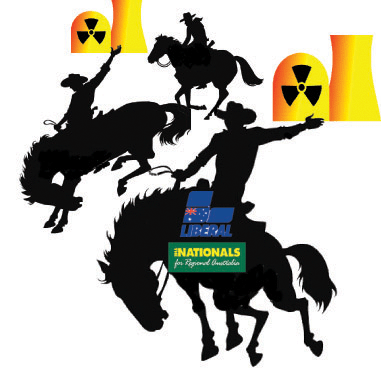
The notion advanced by some advocates that Scott Morrison should take a nuclear industry proposal to the 2022 election would be an act of electoral madness and court political suicide. Morrison has enough problems at present without gifting Labor the perfect scare campaign on an issue that has no policy or political saliency.
The populist conservatives have form. Before the 2019 poll, they campaigned on the mad idea that Morrison follow Donald Trump and quit the Paris Agreement. Now they campaign on the equally mad but more dangerous idea that he seek to split the country by running on nuclear power.
Why nuclear power for Australia is just a grand fantasy https://www.theaustralian.com.au/commentary/why-nuclear-power-for-australia-is-just-a-grand-fantasy/news-story/e8a35f288ca1ea44be9bec66864f3536 8 Nov 21, Paul Kelly
One result of more ambitious emissions-reduction targets from the Glasgow climate conference will be rising support for nuclear power, but its champions in Australia need to start talking to the people who will decide this issue – the Labor Party, the left, and climate change progressives.
As the difficulty intensifies around getting to net zero and keeping rising temperatures within the 1.5C limit, investors will reassess nuclear – but the idea that conservative politics in Australia will stage a glorious resurgent battle that culminates in nuclear power is yet another grand fantasy.
Civil nuclear power in Australia would be an intergenerational, whole-of-government project that would require long-run political bipartisanship to underwrite investment security with legislative and regulatory backing.
The notion advanced by some advocates that Scott Morrison should take a nuclear industry proposal to the 2022 election would be an act of electoral madness and court political suicide. Morrison has enough problems at present without gifting Labor the perfect scare campaign on an issue that has no policy or political saliency.
Can you imagine the media frenzy? The invoking of Chernobyl and the biggest scare since WorkChoices? Every Coalition MP would be quizzed by Labor and the media on whether they would accept a nuclear power plant in their electorate. The issue would divide the Coalition side, unite Labor, distract from Morrison’s re-election campaign on the economy and create a destructive sideshow.
IIt would undermine, perhaps fatally, Morrison’s national security achievement, the nuclear submarine fleet as authorised by the AUKUS agreement. As Morrison has explained, he proceeded only because technical advice said it could be delivered short of a civil nuclear industry.
Continue readingAustralian-UK-US nuclear submarine deal makes the connection clear between civilian and military nuclear activities
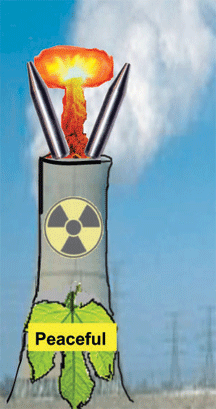
In failing fully to investigate this link between military nuclear and civil energy policy, the UK media have also missed more intimate connections. The senior Energy Ministry figure who negotiated the extraordinarily costly electricity contracts with France from the sole UK nuclear power plant currently under development went on to become the leading official in the Defence Ministry.
This same individual confirmed under questioning by Parliament that the nuclear submarine program is connected to civil nuclear policy. And it is this same person who is reported to have played a lead role in brokering the AUKUS deal.
In the United Kingdom, France, the United States, and Australia, policies in non-military, non-nuclear areas are often shaped by military nuclear interests. The AUKUS alliance is driven, in part, by a longstanding crisis in the nuclear submarine industry’s efforts to realize economies of scale.
In these countries, energy policy is steered towards risky, costly, delay-prone nuclear options rather than alternatives. In the process, policymakers impede progress on vital climate targets. Throughout, the public remains unaware. So, the gravest damage inflicted by hidden nuclear military interests is not their warping effects on non-military policy but on the health of democracy.
Australian-UK-US nuclear submarine deal exposes civilian-military links, https://thebulletin.org/2021/11/australian-uk-us-nuclear-submarine-deal-exposes-civilian-military-links/ Bulletin, By, Phil Johnstone | November 9, 2021 Andy Stirling Andy Stirling is Professor of Science and Technology Policy in the Science Policy Research Unit at Sussex University where he co-directs the ESRC. Phil Johnstone is a Senior Research Fellow at the Science Policy Research Unit at Sussex University. Phil has researched and published widely .
Under the AUKUS agreement, the United States and the United Kingdom plan to transfer nuclear submarine technologies to Australia. One international security scholar characterized the deal as “a terrible decision for the nonproliferation regime,” noting grave concerns for peace and security worldwide. Others have expressed concerns about “loopholes” surrounding nuclear submarine fissile materials, increased nuclear risks in the Pacific, and a potential acceleration of an arms race in the region. Still others doubt the purported efficacy of nuclear-propelled submarine designs.
Within national borders, nuclear activities often depend on expensive access to specific skills, supply chains, regulatory and design capabilities, educational and research institutions, and waste management and security infrastructures. These dependencies are especially strong in national struggles to build, maintain, and operate nuclear-propelled submarines. The AUKUS announcement overturned normally sacrosanct nuclear secrecy on these matters. It also raised bigger questions about energy policy, climate strategies, and democracy itself.
In democratic nuclear weapons states such as the United States, the United Kingdom, and France, shared civil-military nuclear industrial bases are largely—albeit indirectly—funded by electricity consumers. Colossal investments in new nuclear power are underwritten by anticipated revenues from future electricity sales. These investments flow through nuclear construction supply chains and outward to support military nuclear activities. In this way, crucial support is given to military infrastructures, outside of defense budgets and off the public books. But as civil nuclear power declines, this massive hidden funding flow may diminish, which presents problems for nuclear submarines whose costs are not only often prohibitive but escalating.
The AUKUS deal makes more sense when viewed in light of this crisis in the US, UK, and French national nuclear submarine industries. Spiralling civil nuclear construction delays, technological failures, bankruptcies, and fraud exercise little effect on government commitments to civil nuclear power, given pressure to underpin military capability. This is why these governments are failing to recognize the radical technology and market changes that render baseload power, according to industry, “outdated.” This is why policymakers so often neglect renewables and storage options that are outcompeting nuclear power. This is why some argue that nuclear power must persist as a “necessary part of the mix” in nuclear weapons states, despite diverse alternatives offering sufficient volumes of zero carbon power more quickly and cheaply than can nuclear.
Although well documented in the defense policy documents of existing and aspiring nuclear weapons states, these military drivers have been seriously neglected in discussions of energy and climate strategies. Recently however, some countries have begun to acknowledge the strong connections between civil and military nuclear capabilities.
In the United States, for instance, a report led by former energy secretary Ernest Moniz said in 2017 that “a strong domestic supply chain is needed to provide for nuclear Navy requirements. This supply chain has an inherent and very strong overlap with … commercial nuclear energy.” Since then, multiple high level reports have acknowledged that US military nuclear programs depend on a vibrant civil nuclear sector. “The connectivity of the civilian and military nuclear value chain—including shared equipment, services, and human capital—has created a mutually reinforcing feedback loop, wherein a robust civilian nuclear industry supports the nuclear elements of the national security establishment,” according to one study. Civil nuclear activities transfer an effective value of $26.1 billion dollars to the US military nuclear enterprise, according to this study.
In recent years, French press reports have hinted that dwindling civil nuclear power threatens national military nuclear capabilities. President Macron confirmed this when he said that “without civil nuclear power, there can be no military nuclear power.” Military drivers of civil nuclear activities are also acknowledged in more authoritarian nuclear states like Russia and China.
Australia possesses some of the most abundant and competitive renewable energy resources in the world. Yet the Australian nuclear lobby argues that acquiring military nuclear technology will benefit the claimed imperative to establish a civil nuclear industry. Prime Minister Scott Morrison asserted that he is not pushing for a civil nuclear power program, but other prominent voices disagree. Referring to submarine-derived small modular reactors, Australian politician and UK trade advisor Tony Abbott said that “if nuclear power is ok at sea, pretty soon it will be ok on land, too.” The Minerals Council for Australia claims that acquiring military nuclear technology is an “incredible opportunity” because it “connect[s] [Australia]… to the growing global nuclear power industry and its supply chains.”
Australian civil nuclear proponents welcome the aspirations of military nuclear proponents—and the reverse is also true. Australia’s military is concerned that a lack of a civil nuclear industry may pose difficulties for sustaining nuclear submarine competencies. Australian Navy Admiral Chris Barry pointed out that the absence of a civil nuclear industry left a “big gap” in the country’s ability to manage nuclear submarines. Some argue that a civil nuclear sector in Australia could provide the skills and expertise to enable military nuclear capability. Others are concerned that Australia will be the only country with nuclear submarines but no civilian nuclear industry. Military nuclear ambitions drive otherwise-inexplicable civil nuclear attachments.
In the United Kingdom, some worry about a post-imperial loss of a coveted “seat at the top table” of world affairs. Here again, nuclear submarine capabilities take center stage. Former prime minister Tony Blair worried that relinquishing nuclear capabilities would be “too big a downgrading of our status as a nation.” Meanwhile, detailed official energy policy analyses urged the government to set nuclear plans aside, given trends in renewables and related options. But shortly after a Defence Ministry report on submarine capabilities, Tony Blair swapped the open energy policy consultation for a quicker, covert process, after which the government proclaimed a “nuclear renaissance.”
The Royal Courts of Justice found reasoning for this policy insufficient, but Blair doubled down. “Nuclear power is back with a vengeance,” he said, invoking the name of the recently launched ballistic missile submarine, HMS Vengeance. He did not mention the military rationale. Since then, UK government white papers have failed to justify the country’s civil nuclear commitments—for instance by comparing nuclear costs with those of renewable alternatives. The commitment is taken for granted.
In the United Kingdom, the submarine industry’s openness about military pressures for civil nuclear power contrasts with energy policymakers’ silence. Now-declassified defense reports express grave worries that faltering civil nuclear programs undermine provision for essential military skills. Submarine-builder BAE Systems admits that funding for civil programs “masks” military costs. Naval reactor manufacturer Rolls Royce states that their expensive, government-funded efforts on ostensibly civilian small modular reactors can “relieve the burden” on Defence Ministry efforts to retain skills and capabilities for military programs. Numerous other government documents highlight synergies between civil and military nuclear skills. Yet when challenged, the UK Government denies that civil nuclear commitments influence military activities.
Boris Johnson emphasized that the AUKUS deal offers the United Kingdom “a new opportunity to strengthen Britain’s position as a science and technology superpower, and … could reduce the cost of the next generation of nuclear submarines for the Royal Navy.” Indeed, as discussed in this publication, the deal is “…likely to have particular significance for the UK’s nuclear program” because “the UK is struggling through a number of issues related to the revamping of its nuclear enterprise.” Despite government denials, Johnson’s statement confirms that the AUKUS deal is influenced by the same cost pressures and economies of scale associated with dogged maintenance of a shared civil-military industrial base.
In failing fully to investigate this link between military nuclear and civil energy policy, the UK media have also missed more intimate connections. The senior Energy Ministry figure who negotiated the extraordinarily costly electricity contracts with France from the sole UK nuclear power plant currently under development went on to become the leading official in the Defence Ministry. This same individual confirmed under questioning by Parliament that the nuclear submarine program is connected to civil nuclear policy. And it is this same person who is reported to have played a lead role in brokering the AUKUS deal.
In the United Kingdom, France, the United States, and Australia, policies in non-military, non-nuclear areas are often shaped by military nuclear interests. The AUKUS alliance is driven, in part, by a longstanding crisis in the nuclear submarine industry’s efforts to realize economies of scale. In these countries, energy policy is steered towards risky, costly, delay-prone nuclear options rather than alternatives. In the process, policymakers impede progress on vital climate targets. Throughout, the public remains unaware. So, the gravest damage inflicted by hidden nuclear military interests is not their warping effects on non-military policy but on the health of democracy.
Former Prime Minister Paul Keating scathing about Australia’s planned nuclear submarine deal
Mr Keating accused Mr Morrison of ‘wantonly leading Australia into a strategic dead end by its needless provocations against China’.
Australia’s eight nuclear subs by 2040 will be like ‘throwing toothpicks at a mountain’ when facing China, ex-PM declares in scathing pro-Beijing speech slamming Scott Morrison’s Covid origins probe. Daily Mail UK
- Australia cancelled a $90billion submarine contract with France in September
- Instead Scott Morrison has partnered with US and UK to obtain nuclear boats
- Former Prime Minister Paul Keating said they will be ‘very old’ when ready
- He also blasted Mr Morrison for offending China with call for Covid inquiry
By CHARLIE MOORE, POLITICAL REPORTER FOR DAILY MAIL AUSTRALIA 10 November 2021 In September, Mr Morrison cancelled a contract with France for 12 conventional submarines in favour of a new partnership with the US and UK known as AUKUS which will give Australia the technology to build nuclear boats for the first time.
But Mr Keating said they will take too long to arrive and pale in comparison to China’s navy which already has six nuclear-powered subs and more than 50 diesel-powered subs.
Mr Keating, who led Australia as a Labor Prime Minister between 1991 and 1996, said the eight US-style nuclear submarines would have no impact militarily.
‘These Virginia-class submarines were designed in the 1990s – by the time we have half a dozen of them it’ll be 2045 or 2050 – they’ll be 50 or 60 years old.
‘In other words, our new submarines will be old tech – it’ll be like buying an old 747.
‘And here we are, we’re going to wait 20 odd years to get the first one and 35 to 40 years to get the lot. For what will be then very old boats.’
Mr Keating said Australia was falling in line with the US strategy to use nuclear ‘hunter killer’ submarines to contain China.
‘The whole point of these hunter killer submarines is to round up the Chinese nuclear submarines and keep them in the shallow waters of the Chinese continental shelf before they get to the Mariana Trench and become invisible,’ he said.
‘To stop them having nuclear capability towards the United States.’
The 77-year-old insisted that China has no desire to expand its territory in the east and said Australia should be focussing on its own defence with conventional subs.
[Former Deputy Prime Minister] Kim Beazley and I built the Collins [class submarines]. I built the Anzac frigates, they were built for the defence of Australia. Their range was to stop any incoming vessels, military vessels against us,’ he said. ……….
Mr Keating accused Mr Morrison of ‘wantonly leading Australia into a strategic dead end by its needless provocations against China’.
Instead, he said Australia should show China respect for the way it has brought millions of people out of poverty with rapid economic growth over the past few decades.
‘I think what the Chinese want is the acknowledgement of validity of what they have done and what they have created,’ he said.
Mr Keating, who has frequently defended the Chinese Government, said Beijing does not represent a threat to Australia despite its military build up in the south and east china seas and its sweeping territorial claims in the region.
China does not represent a contiguous threat to Australia,’ he said, insisting it is not like the Soviet Union which wanted communism to spread across the world after the Second World War.
‘China is not about turning over the existing world order. It only wants to reform it, and it wants to reform it because of its only scale,’ he said.
‘It signed up to the World Trade Organisation, it signed up to the International Monetary Fund, it signed up to the World Bank, it signed up to the World Health Organisation.’……………… https://www.dailymail.co.uk/news/article-10184775/Paul-Keating-blasts-Australias-nuclear-submarines-pro-China-speech.html
Australia’s very awkward nuclear embrace
The very awkward nuclear embrace, Jon Faine,
https://www.smh.com.au/national/the-very-awkward-nuclear-embrace-20211105-p5969l.html November 7, 2021 How can Scott Morrison just decide and announce – with no mandate or national debate whatsoever – that Australia is going to embrace nuclear technology?
One of the most impassioned and torrid domestic policy tussles of the last 50 years has suddenly been gazumped – after extensive secret discussions with top Americans and Brits but not a word with Australians. A fleet of Australian Navy nuclear-powered submarines, unimaginable just a few weeks ago, have been declared as integral to our future with barely a murmur.
The transition to and adoption of nuclear technology may well be the right call – my quibble is that we have not even had the courtesy of a national debate about the biggest technology shift in a generation.
Our Prime Minister no more readily engages in discussion about underwater matters than he did with “on water” matters as immigration minister. He has again stopped the boats – stopped the making of boats. The decades of policy paralysis on climate change has been matched by nearly 20 years of flip-flopping on replacing our vintage Collins Class subs.
We have long been a people committed to keeping nuclear technology at arms length. The British military in the 1950s used the Montebello islands off WA and the Pitjantjatjara lands of Maralinga in the South Australian outback to experiment with and test nuclear bombs.
It took a royal commission in 1985 to establish the causal link to an otherwise inexplicable rise in the rate of birth defects and cancers among the service personnel and local Indigenous communities impacted
The British soldiers involved were issued protective gear, but the Aussies were not. The authorities were indifferent – to say the least – to the safety of First Nations people, many of whom suffered terribly. Widespread community outrage followed.
Around the same time as that royal commission, regular huge street protests expressed our collective anger with – yes – France over their years of nuclear explosions at Mururoa Atoll in the Pacific Ocean.
When French secret service agents bombed the Greenpeace flagship the Rainbow Warrior in Auckland harbour in 1985 and killed Portuguese volunteer photographer Fernando Pereira, anti-French sentiment across Australia and NZ was palpable.
Sales of Citroens, Peugeots and Renaults suffered – while croissant and Camembert sales barely dipped.
Vigorous discussion has centred on whether PM Morrison ought to be apologising to President Macron. But what about an apology to the Australian people for ignoring our legitimate role in making one of the most significant decisions any government of this country will ever make? It is astonishing that any PM can make such a momentous decision without asking us first.
The ALP has pragmatically supported the new commitment to the AUKUS alliance and its essential ingredient of a commitment to nuclear-powered subs from either the USA or the UK instead of the French alternative.
Anthony Albanese is determined to deny the PM a “khaki election” and consistent with his small-target strategy, has all but ensured that the numbers are there in the Parliament to vote through the legislative changes required to embrace a technology that we have consistently rejected.
We have long embraced laws that prohibit nuclear proliferation. There are many on the left of the ALP who have profound disquiet about “going nuclear” but dare not say anything controversial as a federal poll approaches.
Has the Australian public changed their mind about embracing nuclear technology? The only real test has been in South Australia, which recently abandoned a plan for a lucrative nuclear waste program amid overwhelming opposition.
Germany and Japan are retreating from decades of relying on nuclear power, and post-Fukushima and Chernobyl, nuclear industry boosters have had to accept the commercial reality that their technology is uninsurable and unwelcome.
Defence insiders despair as the original submarine proposal for a German design to be built here for $20 billion morphed to Japanese-designed subs for $40 billion, then French designed but locally assembled subs for $50 billion and now $90 billion for subs that decades from now will be made in the USA or the UK. And this is supposed to be a better outcome?
Naval planners concede that the future use for submarines is as underwater mother-ships for a range of satellite autonomous submersible drones.
What Morrison has announced is no more than an idea for a plan for a proposal for a contract to splurge vast amounts of Australian taxpayer’s money overseas for technology that almost surely will be redundant by the time anything is delivered.
Naval planners concede that the future use for submarines is as underwater mother-ships for a range of satellite autonomous submersible drones.
What Morrison has announced is no more than an idea for a plan for a proposal for a contract to splurge vast amounts of Australian taxpayer’s money overseas for technology that almost surely will be redundant by the time anything is delivered.
Russian deputy UN envoy supports China’s concern on AUKUS’ nuclear threat
Russian deputy UN envoy supports China’s concern on AUKUS’ nuclear threat
By Global Times Russia supported the concerns voiced by China on AUKUS, the new tripartite defense alliance formed with the intention of intimidating China, at a recent meeting of the UN General Assembly’s First Committee, saying that they are legitimate concerns as this kind of cooperation is related to the nuclear field and clearly has a military dimension.
More time and information are needed in order to respond properly to the trilateral nuclear cooperation, Russian Deputy Permanent Representative to the UN Office and Other International Organizations in Geneva Andrei Belousov, who represented Russia at recent meetings of the UN General Assembly’s First Committee in New York, was quoted as saying in Russian media reports. …………
He noted that ASEAN countries also expressed serious concerns at the First Committee’s session as they viewed AUKUS as a threat to regional security. In particular, the delegations of Indonesia and Malaysia said that the implementation of the initiative might trigger an arms race in the region.
The trilateral partnership announced in September will allow Australia to build at least eight nuclear-powered submarines using US technology. Russian President Vladimir Putin accused AUKUS of undermining regional stability and hoped the nuclear submarine cooperation will not develop in an unprecedented way and create additional problems in the region. Chinese Foreign Ministry spokesperson Zhao Lijian said on October 14 that the AUKUS nuclear submarine cooperation has created serious nuclear proliferation risks, and clearly violated the spirit of the Treaty on Non-Proliferation of Nuclear Weapons.
He noted that it would not only have a far-reaching impact on the international non-proliferation system, but also bring real threats to regional peace and stability. …….. https://www.globaltimes.cn/page/202111/1238296.shtml
Lies, lies and nuclear submarines
Lies, lies and nuclear submarines, Green Left, Binoy Kampmark, November 6, 2021
The sundering of the relationship between Australia and France over the new trilateral security relationship between Canberra, Washington and London and, more importantly, the rescinding of the submarine contract with Australia, was playing on President Emmanuel Macron’s mind at the G20 Summit in Rome.Did he think he had been lied to by the Australian Prime Minister Scott Morrison about the intended scrapping of the Franco-Australian submarine deal with the creation of AUKUS? “I don’t think, I know,” came the definitive answer.
The response from Morrison was one of shameless dissembling. Making sure that Australian audiences and news waves would only pick up select gobbets, he told the media that the French president had attacked Australia. He said he was concerned about “the statements that were made questioning Australia’s integrity and the slurs that have been placed on Australia”. Further, he said, he was “not going to cop sledging at Australia”. A full reading of Macron’s words in the brief encounter suggests that didn’t happen. He respected “sovereign choices” but said it was vital to “respect allies and partners.” It was the conduct of Australia’s government Macron had issues with………………….
Morrison’s mendacity is also pronounced in how he justified pursuing the nuclear submarine option with the United States…………
The Morrison government also used the well worn practice of selective leaking to bolster its quicksand position.
A prodding text from Macron to Morrison, sent two days prior to the AUKUS announcement and the cancellation of the contract, involved a query as to whether good or bad news could be expected about the French submarines.
The insinuation is that Macron had an inkling that something was afoot from the Australian side — hardly counting as being informed. Morrison’s response is not noted. The Elysée has also denied suggestions that Canberra made several warning efforts regarding the AUKUS announcement.
An Elysée official said: “Disclosing a text message exchange between heads of state or government is a pretty crude and unconventional tactic”. It may be crude, but it is an apt summation of the Prime Minister’s view of diplomacy. https://www.greenleft.org.au/content/lies-lies-and-nuclear-submarines
Australia’s Foreign Minister off to South East Asian countries to try to soothe their worries about nuclear submarines
Australian foreign minister seeks to allay south-east Asia fears that nuclear submarines will stir up conflict
Marise Payne is visiting four countries in the region, including Malaysia and Indonesia, which have both raised concerns over Aukus deal, Guardian, Daniel Hurst Foreign affairs and defence correspondent Sat 6 Nov 2021 0 Australia’s foreign minister will attempt to reassure south-east Asian countries that the government’s plan for nuclear-powered submarines will “make us a more capable partner” and is not intended to stir up conflict.
Marise Payne flew out of Australia on Friday for a four-country trip that will include Malaysia and Indonesia – both of which have raised concerns the Aukus deal could add to a regional arms race and pose nuclear non-proliferation issues.
It is understood Payne will seek to reassure counterparts that Australia’s decision to acquire at least eight nuclear-propelled submarines is driven by a reassessment of its defence capability needs – not a change of Australia’s intentions in the region…………..
China is increasingly emphasising nuclear proliferation concerns as it condemns the “extremely irresponsible” Aukus arrangement.
Beijing also cited the increasingly messy diplomatic dispute between France and Australia, amid accusations the Morrison government failed to be upfront about its plans to dump the $90bn contract for 12 French-designed conventional submarines.
“I want to stress that the Aukus nuclear submarine cooperation is not just a diplomatic spat between a few countries, but a serious matter that will create risks of nuclear proliferation and undermine regional peace and stability,” a Chinese foreign ministry spokesperson, Wang Wenbin, said………………………… https://www.theguardian.com/australia-news/2021/nov/06/australian-foreign-minister-seeks-to-allay-south-east-asia-fears-that-nuclear-submarines-will-stir-up-conflict
1 This month


Help Aunty Sue Protect Her Land and Sacred Sites From Destructive Rocket Testing.
.

Australians deserve the truth
about
AUKUS – https://aukuspublicinquiry.com/

PETITION – To: Prime Minister Anthony Albanese and the Australian Labor Government

of the week – Australians for War Powers Reform (AWPR)
To see nuclear-related stories in greater depth and intensity

