Solar energy can power your electronic book, iPad, iPhone, other mobile phones and USB devices
 Solar Panel Cover For The Kindle E-reader, by Energy Matters, 9 Jan 12 Using solar energy to provide power for hand-held devices has huge potential and while solar panels embedded in mobile phones mightn’t be much chop (yet) in terms of performance; it seems a new solar cover for the Kindle e-reader delivers.
The SolarKindle, weighing just 215 grams, incorporates a flexible, lightweight triple junction amorphous solar panel and is able to provide some level of charging even in the shade. A one hour charge in direct sunlight can provide almost three days worth of reading time according to the company that created the device, SolarFocus Technology.
After fully charging the Kindle, the solar panel automatically switches to charge the SolarKindle’s 1500mA reserve battery. A fully charged reserve battery requires around eight hours of direct sunlight and provides up to 80% of backup power to the Kindle.
However, bearing in mind that Australia’s sunshine and temperatures can be extreme during summer, perhaps sticking your SolarKindle enshrouded e-reader out in the sun on a 40 degree day for extended periods may be unwise.
The SolarKindle also incorporates an 800 lux LED reading lamp. If the reserve battery is used for lighting alone, it can power the light for up to 50 hours. An LED indicator incorporated in the SolarKindle shows battery power level and status of charging and discharging.
The SolarKindle can be purchased online for around AUD $80, plus delivery.
SolarFocus was named an International CES Innovations 2012 Design and Engineering Awards Honoree for its SolarKindle Lighted Cover. The company says it holds several solar technology patents with their products used in extreme environments such as the Himalayas and the North Pole.
SolarFocus also manufactures a folding solar charger for the iPad, iPhone, other mobile phones and USB devices called the SolarMio Pro. While certainly not as compact as the embedded solar panel Nokia recently trialed, the 5 watt SolarMio Pro watt system can provide 6 hours of talk time on the iPhone 3Gs with just an hour of solar charging.. http://www.energymatters.com.au/index.php?main_page=news_article&article_id=1972
Australia’s carbon tax can benefit commercial electricity consumers
 Australia’s Carbon Tax And Commercial Electricity Customers , Energy Matters, 4 Jan 12, “……..While carbon tax relief for Australian households has been well publicised, the situation for commercial customers has received less coverage.
Commercial electricity customers often pay a lower rate for power than residential users; so the carbon tax will in effect see electricity costs increase by a greater degree for some enterprises from July 1, 2012. According to some estimates, the jump could be as much as 19 percent for big power users.
In terms of government support, the manufacturing sector will be able to benefit from the $800 million Clean Technology Investment Program, which will provide grants to manufacturers to support investments in energy-efficient capital equipment and low-pollution technologies, such as commercial solar power systems. ….
Small businesses can also take advantage of the Solar Credits scheme to purchase a solar power system right now. For just a few thousand dollars, even an entry-level rooftop solar panel array can slash power bills by a significant amount. The Solar Credits rebate will be further reduced from July 1 this year.
Other forms of carbon tax relief will be available for small and large enterprises, the details of which can be viewed on the Australian Government’s Clean Energy Future web site.
The carbon tax isn’t the only power bill bogeyman on the horizon – frequent electricity price rises in the years ahead due to other factors will become the norm rather than the exception. For businesses in Australia, energy efficiency and the implementation of on-site alternative energy generation will become an increasingly pressing issue and an important part of maintaining profitable enterprises. http://www.energymatters.com.au/index.php?main_page=news_article&article_id=1966
Australia’s largest renewable energy fund kicks off
$200 million in seed money will kick-start the fund, half coming from the Australian government and half coming from Softbank China Venture Capital.
The money comes from the Australian Renewable Energy Agency, which is funded at $3.2 billion a year.
Australia Seeds Largest Renewable Energy Fund, Flagship Raises VC Fund SustainableBusiness.com News, 12 Jan 12, In a difficult environment for fundraising, especially for funds that invest in early stage companies, venture capital firm Flagship Ventures closed its fourth fund, a $270 million fund.
Flagship says they exceeded their target of $250 million for the fund, which will invest in healthcare and cleantech/ sustainability. Investors in Flagship Ventures Fund IV include pension funds, foundations, fund-of-funds, corporations and individuals. Its previous fund, launched in 2007, was $235 million, which invested in 24 companies. Continue reading
Quotations from prominent Australians on nuclear power and nuclear weapons
“The nuclear power industry is unintentionally contributing to an increased risk of nuclear war. This is the most serious hazard associated with the industry.” – Ranger Uranium Environmental Inquiry, 1977
“We were interested in this thing [a planned nuclear power reactor at Jervis Bay] because it could provide electricity to everybody and it could, if you decided later on, it could make an atomic bomb.” – Former Prime Minister John Gorton
Quotes about safeguards and proliferation, Friends of the Earth, Jim Green 11 Jan 2012,

…..Quoting from prominent Australians on nuclear power and nuclear weapons, Jim Green, 11 Jan 2012,
“Nuclear energy is a bad fuel, a dirty fuel, a dangerous fuel. This is not a good industry to encourage, and anyone that has an electricity program, ipso facto ends up with a nuclear weapons capability.” – Former Prime Minister Paul Keating, October 16, 2006, Herald Sun / AAP.
“Again and again it has been demonstrated here and overseas that when problems over safeguards prove difficult, commercial considerations will come first.” – Mike Rann, 1982, ‘Uranium: Play It Safe’. Continue reading
Wind farming an economic opportunity for Australia’s struggling farmers
Wind farms in Australia face the toughest guidelines in the world in relation to their siting, operation and permissible 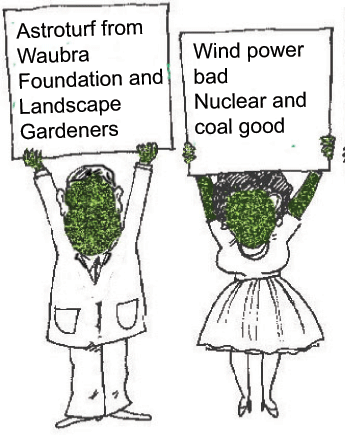
noise levels.
opponents of renewable energy seem determined to use wind farms as political footballs, fuelling community divisions they claim they want to avoid. They make inflammatory claims about noise – when a wealth of scientific research shows that noise from wind farms does not have a harmful effect on people.
Thornton: Winds of change for farmers Adelaide Now, by: Kane Thornton January 11, 2012 WIND turbines can help save struggling farms, argues Kane Thornton. LIFE on the land has only become tougher. The cruel effects of drought, fires and floods, along with the strong Aussie dollar and challenging global markets, have pushed farming families to the limit.
In many cases, diversification has been the key to their survival. Responding to changing market dynamics, consumer demands and weather conditions by moving into different crops, livestock and land uses, is helping save the family farm.

It would be a brave outsider who demanded the removal of the farmer’s right to make those choices for themselves.
Yet that is what the activists opposed to wind farms are doing.
They are saying that individual farmers should not have the right to choose wind farming to help them drought-proof their properties, make better use of marginal farming land, or insure against market downturns. But for those farmers fortunate enough to live in some of the windiest places in the world, farming wind can be the best option. Continue reading
Secretive Victorian government sets up toothless freedom of information watchdog
Federal government figures say the calculations in the press release overestimate the expected costs [of Australia’s carbon tax] and ignore compensation to be offered to some.
Using freedom of information laws, the state [Labor] opposition asked Mr O’Brien’s Department of Primary Industries for all modelling and briefings behind the press release.
Four months later the department wrote back, denying access to all documents
The Baillieu government this year will put in place a freedom of information watchdog. It will not have powers over ministers or department heads, will be unable to review decisions relating to secret cabinet documents, and could ultimately result in longer delays.
 Baillieu hides carbon tax documents, The Age, Clay Lucas, January 10, 2012 THE Baillieu government has been accused of using ”laughable” excuses to block the release of economic modelling it used to attack the Gillard government’s carbon tax.
The government cited public interest and privacy issues as reasons it will not hand over calculations behind a media release by state Energy Minister Michael O’Brien last July. The press release, titled Julia Gillard duds Victorians again, lashed the federal Labor government over its carbon tax plans. Continue reading
Wind energy: South Australian govt in the grip of fossil fuel astroturfers?
Proposed Policy Threatens Wind Power Investment In South Australia, Energy Matters, 8 Jan 12, Australia’s Clean Energy Council (CEC) says the South Australian Opposition’s policy on wind farms would threaten more than $3 billion of investment and result in a further increase in electricity prices in the state if implemented.
South Australian Opposition leader Isobel Redmond has vowed to ban wind farms within 2 kilometres of any residence. Another key element of the Liberal’s policy is a ban on wind farms within 5 kilometres of townships.
Clean Energy Council Acting CEO, Kane Thornton, said wind power projects currently proposed for South Australia would provide for the electricity needs of more than 567,000 homes and create 948 direct jobs.
“As we’ve seen in Victoria, such measures would effectively make South Australia a ‘no-go’ zone for wind farms, driving billions of dollars of investment from the state. In addition, South Australians would see higher electricity prices as future renewable energy will need to come from higher cost sources,” said Mr. Thornton.
Mr. Thornton pointed out over 20 per cent of South Australia’s electricity is generated by wind power and the wind industry is one of the reasons the state’s carbon emissions fell by 18 per cent over the past five years.
In August last year, then-Premier Mike Rann said South Australia was home to 54% of Australia’s wind power capacity, 5 times more per capita than Victoria and 10 times more than New South Wales.
While Ms. Redmond reportedly claims wind turbines are being installed “willy-nilly with no accountability“, the CEC states current guidelines ensure a proper balance between wind farm developments and community in South Australia.
The CEC says it will work with the South Australian Liberal Party to “ensure they understand the value of the wind industry to the state, and to provide them with a more complete understanding of wind farms and associated issues.” http://www.energymatters.com.au/index.php?main_page=news_article&article_id=1973
Community solar energy for Australia – Mallacoota shows the way
 While these types of schemes are still relatively uncommon in Australia, a popular method of using the power of collaboration to install solar here is the solar buyers group. Consisting of people within a local area, these groups use their collective clout to secure better pricing for installing solar panels on their own rooftops…
In an initiative led by local resident Jim Sakkas, the community banded together to form a solar buyers group and since that time, close to one hundred solar power systems have been installed in Mallacoota by national solar solutions provider Energy Matters under the model.
A Co-operative Approach To Going Solar, by Energy Matters, 6 Jan 12, A growing number of people are starting renewable energy schemes in their communities through co-operatives and other forms of collaboration. A recent report from Co-operatives UK and The Co-operative Group states 43 communities are in the process of or already producing renewable energy by investing money to install solar panels, large wind turbines or hydro-electric power in their area.
£16 million has been invested by over 7,000 people in these schemes, which include a £2 million wind farm and a 98kW solar photovoltaic installation on the roof of a brewery.
The report says green economy co-operatives are the most rapidly growing part of the UK co-op sector, jumping 24% since 2008. In addition to these co-operatives’ efforts seeing clean, renewable energy being supplied to their communities, there is also a financial return to participants through the sale of electricity produced.
The co-operative approach covered in the report basically works like this: Continue reading
Look out: Australia’s National Open Source Intelligence Centre is watching you
 I don’t know about the rest of you, but I for one, will be piqued if I am not on Jody and Amanda Lambden’s list of secret “issue monitoring”. I know that the big corporations run a list of “hostile websites” – and I am a proud member of that list.
But I didn’t know that Martin Ferguson had couple of pals in my very own home town, watching us evil environmentalists. I’ve been at least 5 years on the job, and I expect to be included.
It’s only fair, Martin Ferguson. After all, we’re all watching you and your subservience to the nuclear lobby. – Christina Macpherson
 The watchdog’s kennel in clandestine Croydon, The Age, Philip Dorling January 7, 2012 AN INCONSPICUOUS Melbourne apartment block is home to a monitoring service that keeps watch on environment groups at the request of the federal government. The National Open Source Intelligence Centre, a private intelligence company, works under contract for the Australian Federal Police and Federal Attorney-General’s Department to monitor activist websites, blogs, Facebook and Twitter to provide warning and analysis of protest activity.
Owned jointly by Croydon couple Jody and Amanda Lambden, NOSIC has been operating since 1999. It aims to provide law enforcement agencies and other private clients with internet monitoring and analysis directed at groups engaged in
”radical activism, criminal (terrorist) activity or unlawful behaviour”.
Services provided by NOSIC include ”issue monitoring”, ”tactical intelligence”, ”threat analysis” and ”trend analysis and
forecasting focus on emerging patterns and trends in activism”. NOSIC has been engaged on contract by the AFP and the
Attorney-General’s Department since at least 2003. From 2006 to 2008, it was paid $184,800…..
NOSIC’s website does not identify its director, Mr Lambden, and provides no phone number or business address.
However, corporate records list the company’s principal place of business as a residential apartment block on Hewish Road, Croydon….
Federal security sources told The Saturday Age that NOSIC provided a ”cost-effective service” that ”frees AFP analysts from spending time chasing publicly available information”. http://www.theage.com.au/national/the-watchdogs-kennel-in-clandestine-croydon-20120106-1poox.html#ixzz1ioI5bPri
Martin Ferguson pushing for increased surveillance of environmental activists
The Greens leader, Bob Brown, condemned the surveillance, saying it was “intolerable that the federal Labor government is spying on conservation groups” and wanting to “criminalise political protest”……
 AFP spies targeting green activists SMH, Philip Dorling January 7, 2012 THE Resources and Energy Minister, Martin Ferguson, has secretly pushed for increased surveillance by federal police intelligence officers of environmental activists who have been protesting peacefully at coal-fired power stations and coal export facilities. Continue reading
Australia should welcome climate change refugees from the Pacific islands
Australia is the world’s biggest greenhouse gas emitter, per head of population. The consequences of global warming already mean extreme climate events here in Australia.
But low-lying Pacific islands pay the greatest price of global warming – the complete loss of their homeland. Yet these Pacific islanders are among the least causers of greenhouse gas emissions.
It’s a staggering injustice. Already, Australia has a reputation for treating asylum seekers like criminals. We had better shape up to responsibilities, and not become a global pariah – Australia should welcome climate change refugees from the Pacific. – Christina Macpherson
Maldives warns of climate refugees, The Age, Ben Doherty, January 7, 2012 THE president of what could be the first country in the world lost to rising sea levels has urged Australia to prepare for a wave of climate refugees. Maldivian President Mohamed Nasheed’s government is considering Australia as a new home if the archipelago disappears into the ocean.
”I think it’s really quite necessary for Australians and for every rich country to understand that this is unlike any other thing that’s happened before,” Mr Nasheed told The Saturday Age.
The Intergovernmental Panel on Climate Change predicts a sea level rise of up to 59 centimetres over the next century, a level that would inundate most of the Maldives’ inhabited atolls. Low-lying Pacific island nations, such as Kiribati and Tuvalu, would also face being flooded…..
Fourteen islands in the Maldives have already been abandoned because of massive erosion by the sea. Mr Nasheed described Australia’s decision to adopt a carbon tax from 2012 as a ”brave move forward”.
http://www.theage.com.au/national/maldives-warns-of-climate-refugees-20120106-1poog.html#ixzz1ioGSk6q0
South Australia’s Liberal Party sucked in by anti wind power astroturf
Liberals to ban wind farms within 2km of homes by: Political Reporter Daniel Wills The Advertiser January 06, OPPOSITION Leader Isobel Redmond has vowed to ban wind farms within 2km of any home. In her second policy announcement since declaring the end of her small-target strategy, Ms Redmond said she would move to “protect”
residents from the possible economic, social and health impacts of wind turbines if the Liberals won the 2014 election.
This comes just more than two months after Planning Minister John Rau released a scheme to reform the wind power industry, including allowing turbines 1km from homes, and follows Ms Redmond’s commitment this week to find savings in public sector wages.
Ms Redmond yesterday labelled wind “probably the least efficient and most unreliable of all the green energy sources”. She said she would not be fazed if the policy caused a drop in turbine investment…..
Government figures show wind energy contributes 21 per cent of power generated in the state. The Clean Energy Council estimates $2.8 billion has been invested in the sector…..
http://www.adelaidenow.com.au/news/south-australia/liberals-to-ban-wind-farms-within-2km-of-homes/story-e6frea83-1226237791196
Call for Constitutional change, to end Australia’s discrimination against Aborigines
The council recommended “the removal of those remaining sections of the Constitution which discriminate on the basis of race”; a preamble recognising Aboriginal and Torres Strait Islander peoples as the first peoples of Australia, as well as their prior occupation and ownership; and the repeal of “the anachronistic race power” contained in section 51 (xxvi), which allows laws to be made that benefit or discriminate against Aborigines.
Australia was one of the only modern democracies that did not guarantee racial equality in its Constitution and it would be an “unfortunate irony” if Australians voted to recognise Aborigines, but the capacity for discrimination remained within the Constitution.
 Lawyers backed new race power BY: STUART RINTOUL The Australian January 6 A PANEL that recommended constitutional reform to recognise and protect Aboriginal people and culture had the strong backing of the Law Council of Australia. A submission by the council recommended the key changes to the Constitution ultimately adopted by the panel in its report, which will be handed to Julia Gillard this month.
The legal profession’s peak body said a minimalist approach confined to recognising Aboriginal people in the preamble to the Constitution “would be of little if any practical effect”. It supported “an approach to constitutional recognition which goes beyond the preamble to the Imperial Act and secures enforceable rights”. Continue reading
Radioactive colonialism – Autralian company Lynas’ rare earths plant in Malaysia
This little news item from THE AUSTRALIA barely touches on the salient points about Australian company Lynas’ planned rare earths processing plant in Malaysia. It should not be forgotten that:
- Lynas was well into building the plant before it obtained the necessary permissions from teh Malaysian government
- The plant is in a highly populated area (unlike the rare earths plant in China, which radioactively polluted a huge area)
- Lynas wanted to go ahead with no plan for the permanent disposal of its radioactive wastes
- No doubt the waste disposal problem was Lynas’ reason for not planning the rarenearths processing plant in Australia. As with Australian uranium mining companies in Nigeria, Tanzania etc – another example of radioactive colonialism. – Christina Macpherson
Lynas licence decision date set for Malaysian plant, THE AUSTRALIAN, BY: ROSS KELLY January 05,“………Malaysian authorities have indicated the Atomic Energy Licensing Board will meet January 30 to decide whether Lynas should be granted a temporary operating license, Lynas said in a statement to the Australian Securities Exchange. The decision is then expected to be tabled to a full session of the Malaysian cabinet. …
Rare earths typically occur in deposits that contain uranium and thorium, meaning radioactive waste is present in tailings that require safe disposal. Activists and some politicians have actively campaigned against the Malaysian processing plant, prompting authorities to ask the International Atomic Energy Agency to review the $232 million
development that’s almost complete.
A report by the IAEA in June largely backed the plant, while recommending Lynas deliver a plan for dealing with its waste.
A temporary license will allow the company to ramp up production at the Malaysian facility to nameplate capacity and sell its products, Lynas said. If Lynas complies with the strict monitoring and government oversight requirements of the temporarily license, a permanent operating licence can be issued within two years. …
http://www.theaustralian.com.au/business/mining-energy/lynas-plant-license-decision-set/story-e6frg9df-1226237278015
Australian Greens defend renewable energy schemes against fossil fuel “greenhouse Mafia”
 Greens defend loans for renewables, Herald Sun, AAP , January 04, 2012 AUSTRALIAN Greens leader Bob Brown says fossil fuel industry attacks on a government loan scheme for renewable energy projects are “a bit rich” given the massive subsidies they get.
Senator Brown was defending the $10 billion Clean Energy Finance Corporation, which will provide finance to renewable energy, energy efficiency and low-emissions technologies…..
The corporation has been attacked by the opposition as a slush fund, with finance spokesman Andrew Robb saying it would only “fund projects that the private sector won’t touch with a barge pole”. Now a new attack has come from some of Australia’s biggest industry sectors. The Australian Industry Greenhouse Network – whose members include the Australian Coal Association, the Minerals Council of Australia and the National Generator’s Forum as well as large mining and petroleum companies – says the loans fund could distort markets, the Australian newspaper reported today…….
Senator Brown said government had a legitimate role in helping establish new markets that had wider public benefits. He cited the fact that most coal fired power stations in Australia were originally built by governments, even if they were now privately owned.
“Here we’ve got that same industry, having been built upon government financing, claiming now that the renewable energies of this century shouldn’t even be subject to assistance through loans,” he told ABC radio today. Senator Brown said the fossil fuel industry was currently subsidised to the tune of $11 billion a year.
“The subsidies involved in the clean energy finance corporation are really very restrained compared to those going to the polluting industries at the moment,” he said.
“The fossil fuel industry is largely foreign-owned, it pours billions of dollars out of the country each year and it’s complaining about domestic industries getting a $10 billion loan fund.
“It’s a bit rich isn’t it?” http://www.heraldsun.com.au/news/breaking-news/greens-defend-loans-for-renewables/story-e6frf7ko-1226236190140
1 This month


Help Aunty Sue Protect Her Land and Sacred Sites From Destructive Rocket Testing.
.

Australians deserve the truth
about
AUKUS – https://aukuspublicinquiry.com/

PETITION – To: Prime Minister Anthony Albanese and the Australian Labor Government

of the week – Australians for War Powers Reform (AWPR)
To see nuclear-related stories in greater depth and intensity
 Antinuclear