Poll shows Australians rate solar energy tops, and nuclear energy bottom

 Solar power tops poll of positive perceptions, The Age, Michelle Grattan, October 10, 2011 SOLAR energy has a very positive rating in the public’s mind, while the nuclear industry and coal-fired power stations are at the bottom when people are asked about their perceptions of energy industries……
A UMR survey last month found more than eight in 10 people had a positive view of solar energy; only 10 per cent were negative. Three-quarters were positive on renewable energy. The gas industry also scored positively (61 per cent), but those rating the coal industry favourably outstripped those seeing it negatively relatively narrowly (45-38 per cent). People were equally divided about the oil industry (42 per cent each).
Only 36 per cent viewed the coal seam gas industry in a good light, compared with 41 per cent who were negative. Coal-fired power stations, which have copped bad publicity in the carbon debate, were seen negatively by almost half (48 per cent) accompanied by 34 per cent who had a benign view. The nuclear industry scored 51 per cent negative and 33 per cent positive in the online survey of a nationally representative sample of 1000…… Read more: http://www.theage.com.au/business/solar-power-tops-poll-of-positive-perceptions-20111009-1lfoh.html#ixzz1aQmXRcmj
Australian government policies drive Aborigines off their healthy lives on homelands
More than one-third of the NT’s Aboriginal population lives in 500 remote homeland communities…..people were more healthy living in small communities on traditional homelands
 Aboriginal policies ‘ethnic cleansing’, SMH, Lisa Martin, October 9, 2011 –Starving Aboriginal people off their traditional homelands is akin to “ethnic cleansing”, the Amnesty International boss has been told during his Central Australia visit.Amnesty International chief Salil Shetty visited communities in Utopia on the weekend describing the plight of locals as “devastating.”….. The human rights group profiled the Utopian region, in an August report that claimed homeland communities were being starved of money for proper housing, maintenance and basic services like rubbish removal.
Amnesty says the policies are aimed at driving Aborigines off their homelands and herding them into 21 “hub towns” where the federal and NT governments were splashing out cash for resources and services. Community leader Rosalie Kunoth Monks told Mr Shetty how desperately her people wanted to stay on their land. Continue reading
Victoria’s Baillieu government hands out coal mining leases on coastal and agricultural land
 So who is benefiting from the Baillieu government’s assault on the environment?
Big Mining. In spades….
Hundreds of brown coal mining leases have now been issued by this government for the very areas out of bounds to wind farms — coastal regions and areas of significant environment value….Oh, and Victoria’s prime agricultural land,
.. The overriding advantage of wind farms is that agricultural production or grazing can continue unimpeded. Open-cut coal mines can never be converted to agricultural land and coal seam gas wells are notorious for leaking toxic chemicals into aquifers…..
 How ‘Red’ Ted Baillieu hoodwinked Victorian voters, Independent Australia, Sandi Keane, 7 Oct 11 It’s hard to know where to start on the transformation of Ted Baillieu from the champion of small-l liberalism to the worst environment Premier on record. Conservative politics these days displays little conscience about robbing future generations of their heritage…..
cattle are OK in National Parks but not so wind farms. Draconian new legislation, Amendment VC82, prohibits wind farms from being constructed in National Parks, near the coast or any area thought to have “environmental value”.
The earlier Amendment VC78 by the Baillieu government already gave local councils the power to reject wind farms. Interestingly, if you read through the legislation, you’ll see that the designated “no go” zones for wind farms are the very same areas of the state singled out by the Landscape Guardians whose agenda appears to be stopping wind farms from replacing coal fired power. For more facts on the Guardian’s phony health claims, their links to the mining industry and the climate skeptics in the Liberal Party, read here. Continue reading
Uranium SA address to shareholders – all the right weasel words
 Russel Bluck Chairman Uranium SA Limited gave a brave Address to Shareholders
on 6 October. It was designed to jolly them up, and Mr Bluck is to be admired, for he has learned all the right terms. I was reminded of schooldays, when I was taught certain religious beliefs and words by rote. Obviously Australia’s uranium mining executives have followed the same sort of teaching.
First comes the admission – ” The rate of corporate and generational change has been slowed [ a better word than plummeted?] by external circumstance”
But this is followed quickly by the new nuclear dogmas: about “robust returns on invested capital”,…..”The failure of the Fukushima nuclear plants was an industrial [ not a nuclear?] catastrophe within the context of a major natural disaster.”…
…as the fog of disinformation [does he mean the facts on radiation?] clears , it is again clear nuclear power generation is safe and made even safer by the lessons of Fukushima,…
New uranium mines not likely to be viable, with costs greater than uranium prices
with demand lower than was expected before, the price outlook is also down in both the medium and long-term..
 It is clear that some of the anticipated new mines, heavily promoted by financial backers, will be ‘out of the money’—in other words, too expensive to develop in the new environment. Future uranium projects are very sensitive at prices in the $50 to $70 per pound level, and many may need more than $70 for viability.
 Uranium – what are the prospects post-Fukushima?, Nuclear Engineering, Steve Kidd Deputy Director General of the World Nuclear Association, 06 October 2011“………..Falling uranium demand in the short-term is likely to delay some new projects, particularly those in Africa where financial requirements are heavy. But the reaction of producers will largely depend on the continuation of China’s new build programme and its willingness to finance new mines abroad.
…….Turning to potential new reactors, where the anticipated demand has been important in pushing up the uranium price since 2003, the position has also become arguably more difficult. A highly politicised industry has become, rightly or wrongly, even more politicised, and nuclear plans in some countries may be scaled back, or at best delayed. The position of China in this is not surprisingly crucial, as it has almost half of the reactors under construction around the world. Its immediate reaction to stop the approval process for new units and look more closely at the safety of those already approved is a typical reaction. Continue reading
Xstrata mining company, like its close friend Glencore, out to wreck renewable energy in Australia
 The mining giant Xstrata is now behaving just like the company that is the world’s most ruthless, secretive and lacking in integrity – Glencore.
This is hardly surprising, as the two companies are as thick as thieves, and tipped to merger very soon. or might have already merged. Glencore’s CEO, South African -born Ivan Glasenberg, took the trouble to become an Australian citizen. Glencore very recently listed as a public company. Both actions designed to further Glencore’s interest in Australia, as Glencore bought into Xstrata Australia.
It’s a dead shame that Australian governments can lie down and let these rapacious corporations, known. especially in Glencore’s case, for illegal activities and environmental degradation – walk all over efforts to get renewable energy happening in this country.
Given the government’s description of CopperString [ involving renewable energyplan]as a “once in a generation opportunity,” it now seems extraordinary that it should agree with the proposal by Sims, a noted economic rationalist, to allow “the market” – effectively Xstrata – to decide the fate of the project….
Xstrata gas deal sinks renewables hub, Climate Spectator Giles Parkinson, 7 oct 11, Hopes of building one of Australia’s largest renewable energy hubs in north Queensland appear to have been dashed after the Swiss-based global mining giant Xstrata signed a deal instead with AGL Energy to build a gas-fired power station in Mt Isa. Continue reading
Australia’s Greenhouse Mafia lobbying hard to undermine Clean Energy Finance Corporation
 The hardest thing is that the big polluters are working to stop the CEF being passed and at the same time, actively lobbying to turn it into more compensation, undermining the carbon price……. to divert funding from genuine energy efficiency merit to be used as “compensation” for big polluters who do not want to actually pay a price on carbon. For some people, too much pork is barely enough!
I am keen to see the whole $1.2 billion of the CTP invested in good programs and believe it will be. It is certainly possible for ambitious investments to be made through an unambitious funding scheme….
Australia’s $1.2 Billion Clean Technology Program, Renewable Energy World, By Dan Cass , October 6, 2011 When the Labor Government, Greens and independents pass the Clean Energy Future (CEF) package later this year, there will be more than $13.2 billion on the table for renewables and low-carbon investment. Continue reading
Vixctoria’s State Library saves $60,000 a year through energy efficiency
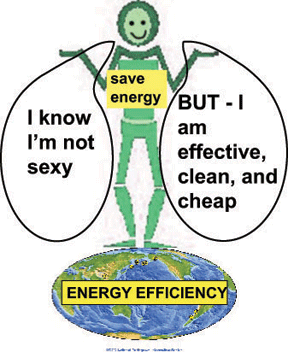 VICTORIA’S STATE LIBRARY REAPS THE BENEFITS OF ENERGY EFFICIENT TECHNOLOGY
PACE, By Hartley Henderson 6 October 2011, Over the last ten years the push for energy efficiency has been rapidly gathering momentum, particularly in relation to productivity improvement and reduction of carbon emissions.
During a recent visit to Australia from Low Voltage Drives headquarters in Finland, ABB group vice president, Pekka Tiitinen, pointed out that 65 percent of all energy consumption at industrial sites goes through motors, and that the biggest challenge is ignorance of the scope for savings…. “Some 50 percent of carbon reduction comes from energy efficiency improvement from renewable energy and other non-fossil, plus carbon capture storage,” he said.
“Australia is a front runner in legislating for energy efficiency and recognising the benefits of energy appraisals for industry and large buildings.
In industry, cost/benefit analysis demonstrates that big savings of up to 50 percent can be achieved, with payback typically in one to two years and sometimes even five to eight months. “The easiest way to add more electricity capacity, is to improve the energy efficiency that would release existing capture in new consumption. Nowadays, more and more systems are playing a key vital role in that.”…
The State Library of Victoria was founded in 1854 and is a reference and research library for over one million visitors a year.
It holds more than two million books and occupies an entire city block of two hectares, comprising reading rooms, galleries, exhibition spaces, conference centre and cafe. Jussi says that an energy appraisal carried out at the library concluded that significant energy savings could be made by replacing the existing HVAC flow control, which used throttling valves, with variable speed drives..
Jussi advises that by using 15 ABB standard drives for HVAC, from 5.5 kW to 55 kW, energy savings of between 30 to 60 percent were achieved across the various applications. “With combined motor ratings of 400 kW and 24/7 plant operation, the total energy consumption was reduced by 1,800 MWh annually, saving the library nearly $60,000 per year. Payback, including maintenance savings, was achieved in just 14 months,” he said…. http://www.pacetoday.com.au/news/victoria-s-state-library-reaps-the-benefits-of-ene
Deep mining might increase Australia’s earthquake risks
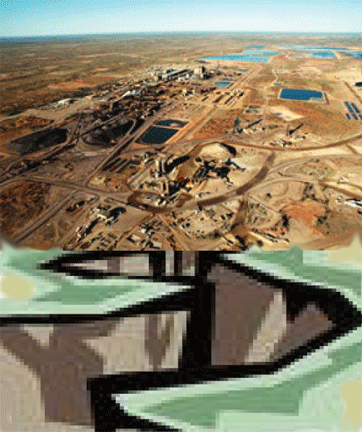 about every five years there’s a potentially devastating quake of magnitude 6.0 or more.
some scientists have suggested that mining might have been to blame in that case [Earthquake in Newcastle 28 December 1989,] …..Some experts think this [ deep-core mining] might be enough to destabilise pre-existing faults in the Earth’s crust, and to trigger an earthquake. Certainly, human activity – like large dams being filled – has been linked to quakes overseas….
Earthquakes in Australia, AUSTRALIAN GEOGRAPHIC BY:EMMA YOUNG | OCTOBER-6-2011 Earthquakes don’t only occur near our neighbours Japan and New Zealand – they’re common in Australia too “……..Australia doesn’t sit on the edge of a tectonic plate. However, the Indo-Australian plate, at the centre of which our continent lies, is being pushed to the north-east at about 7cm per year. It’s colliding with the Eurasian, Philippine and Pacific plates, causing stress to build up in the 25km-thick upper crust. This build-up of pressure within the plate can cause earthquakes in Australia.
In fact, Australia has more quakes than other regions that sit in the middle of plates and are considered relatively stable, Continue reading
Australia’s Clean Energy Finance Corporation a chance to turbocharge renewable energy
 Next generation of clean energy technology is within Australia’s grasp, SMH, Kane Thornton October 5, 2011 “…….The Clean Energy Finance Corporation (CEFC) pledged under the federal government’s carbon price package will use $10 billion of carbon price revenue from big polluters as loans for new, clean energy technologies. It will be overseen by an independent board of finance professionals.
Last year, renewable energy provided about 8.6 per cent of Australia’s electricity. We are headed for 20 per cent by 2020 under the bipartisan Renewable Energy Target. A recent review by the Productivity Commission found that most of Australia’s trading partners have introduced some kind of target for renewable energy. The debate on a carbon price continues, but the energy target is currently Australia’s largest climate change policy, set to lead to the reduction of about 380 million tonnes of carbon emissions by the end of the decade. Like the IT industry in the late 1990s, some incredibly bright minds across the world have turned their attention to developing new technologies that can produce clean, renewable electricity…..lobally there are plenty of examples where the investment is indeed paying off. Figures from Bloomberg New Energy Finance show that $US243 billion ($A252 billion) was invested in clean energy last year, as the sector continues to outstrip traditional energy. Some of the world’s biggest players are seeing the value in clean energy investments, including Google, GE, the US military, Samsung and engineering giant Siemens. GE’s Ecomagination program made more than $80 billion for the company over the past five years by combining good business and sustainability.
Clean energy is a massive opportunity for Australia. There will be the occasional setback, but this is an opportunity we should be seizing with both hands rather than looking for reasons to sit on them. http://www.smh.com.au/business/next-generation-of-clean-energy-technology-is-within-australias-grasp-20111004-1l77n.html#ixzz1a25GMjO9
Uranium mining – Global X Uranium ETF is down over 60% this year!
Over the last month, these companies have lost between 25 and 29 percent, and they have lost between 57 and 84 percent so far this year. These significant losses proliferate uranium miners and producers, as can be seen from the Global X Uranium ETF (URA), which tracks the Solactive Uranium Index and is down over 60% so far this year…..
 An Abysmal Month For Uranium Producers Extends Their 2011 Pain, Seeking Alpha 4 Oct 11, The uranium industry is not what it used to be, nor are the share values of the uranium producers. This may well go down as the worst year for uranium in the modern era, even though several nuclear power experts continue to claim that uranium use is sensible and safe.
This first quarter of 2011 started off with Japanese nuclear concerns following the destruction caused by the earthquake and tsunami that hit the nation, and uranium prices entered a tailspin shortly thereafter. In the wake of tsunami, Germany opted to discontinue nuclear power plant development and reveal plans to eventually eliminate nuclear power as an energy source.
It also appears likely that Japan may be hesitant to build more nuclear power plants in the near future. For many years, Japan and Germany have been significant users of nuclear power. This perceived vacuum to demand weakened the price of uranium. It also weakened the shares of those companies that produce and/or provide uranium…..
In the third quarter, which just ended last week, uranium and its producers continued to drop along with the broader market, only mostly to a broader extent as the investment was deemed more and more speculative. Most uranium producers ended the third quarter at their 2011 lows.
Below are the 1-month, 3-month, 6-month, and 2011-to-date performance rates for several companies that mine and/or provide uranium for energy production: Continue reading
Short or long term , the news is all bad for uranium industry
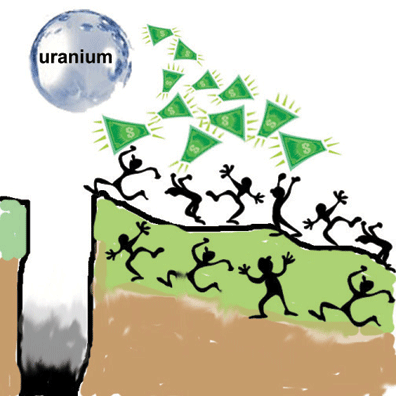 Uranium Contract Prices Slip, FN Area News, 4 Oct 11, by Greg Peel, Unlike the uranium spot market, which in recent weeks has been dominated by traders and hedge funds on both sides of the price, the uranium term market more represents legitimate supply deals between producers and utilities, and is thus more representative of ongoing longer term uranium demand.
Shares of Denison Mines and Uranium Resources Face Strong Downward Pressure, MarketWatch, NEW YORK, NY, Sep 30, 2011 (MARKETWIRE via COMTEX)–– Uranium stocks have struggled this month as prices for the radioactive material have plunged. According to the latest quarterly report by Resource Capital Research, uranium prices are down 27 per cent over the past three months and 23 per cent over the past year….
Kazakhstan Ends Rise In Uranium Production To Stabilize Prices Fox Business, By Christopher Pala & contributing to Dow Jones Newswires, October 03, 2011 ALMATY, Kazakhstan – After more than tripling its output of uranium in four years to become the world’s top producer, Kazakhstan has stabilized production to around 20,000 metric tons annually in order to avoid further depressing prices, Sergei Dara, Director of Strategic Development and International Projects at Kazatomprom, the state nuclear company, said Monday.
He said as long as prices remain at their current low levels, “Kazakhstan will not develop new projects and our production will remain at the current level.”..
Australia-Norway climate proposal seen as “recipe for inaction”
 “This is the only way ahead. There is no other way than failure,” said a senior climate negotiator from a developed country on the Australia-Norway proposal, who declined to be named because of the sensitivity of the talks.
 World divided on new plan to combat global warming, Reuters David Fogarty, Reuters, SINGAPORE October 2, 2011 A new plan to curb global warming risks becoming a battleground between rich and poor nations and could struggle to get off the ground as negotiators battle over the fate of the ailing Kyoto climate pact.
The 1997 Kyoto Protocol covers only emissions from rich nations that produce less than a third of mankind’s carbon pollution and its first phase is due to expire end-2012. Poorer nations want it extended, while many rich countries say a broader pact is needed to include all big polluters.
Australia and Norway have proposed negotiations on a new agreement, but say it is unrealistic to expect that to be ready by 2013. They have set a target date two years later, in 2015. Continue reading
Australian rooftop solar system providing power at all times
 under the current government’s lack of incentives, rooftop solar is not economically attractive … until now.”
urban consumers wanted access to the grid to ensure they had power at all times.
“This achieves that for people – it’s a system which guarantees power supply from a predominantly solar source,”
What solar crisis?, Daily Examiner, 3 Oct 2011 A CLARENCE Valley solar power innovation promises to dramatically reduce household power costs and is offering hope to an industry sector which has had the rug pulled from under it.
In a first for Australia, Northern Rivers Renewable Energy (NRRE) has developed a system that automatically manages a home’s solar and grid power to the advantage of the home owner.
In a nutshell, the household’s entire electricity needs are stored in batteries which are, for the most part, recharged by solar power.
Now – and here’s the innovation – if enough solar energy is not produced, due to persistent rain for example, the system then recharges the batteries from grid power using a combination of off-peak and peak electricity. Continue reading
Radioactive birds may arrive in Tasmania in seasonal migration
 Mutton bird radiation warning, ABC News, September 30, 2011 Tasmanians are being warned not to collect dead mutton birds for research. A recent Tasmanian Farmers and Graziers Association newsletter describes research into mutton bird exposure to radiation from Japan’s Fukushima nuclear plant. It says the birds will soon be migrating back to Australia after many spent winter in the Sea of Japan.
The article says people can help researchers by collecting freshly dead mutton birds, freezing them and handing them over to their local Parks and Wildlife office or museum. But the department says it is not seeking samples and discourages people unfamiliar with wildlife from collecting them. A spokeswoman says suggestions of radiation exposure in birds is being further investigated. http://www.abc.net.au/news/2011-09-30/20110930-muttonbird-radiation-warning/3193736?section=tas
1 This month


Help Aunty Sue Protect Her Land and Sacred Sites From Destructive Rocket Testing.
.

Australians deserve the truth
about
AUKUS – https://aukuspublicinquiry.com/

PETITION – To: Prime Minister Anthony Albanese and the Australian Labor Government

of the week – Australians for War Powers Reform (AWPR)
To see nuclear-related stories in greater depth and intensity
 Antinuclear