‘It makes us sick’: remote NT community wants answers about uranium in its water supply
‘It makes us sick’: remote NT community wants answers about uranium in its water supply, Laramba’s Indigenous residents fear they are at risk of long-term illness and say they need to know who is responsible for fixing the problem, Guardian, by Royce Kurmelovs and Isabella Moore, Mon 18 Oct 2021,
Jack Cool is looking to hitch a lift out of town.
The 71-year-old former stockman has lived in Laramba, a remote Indigenous community in the Northern Territory, for most of his life
Since his partner, Jennifer, 57, and his youngest daughter, Petrina, 35, started kidney dialysis at the end of last year, he has been trying to make the two-and-a-half hour trip south into Alice Springs whenever he can.
Cool, who also takes medication for kidney issues, says he doesn’t know why this has happened to his family but he thinks it has something to do with the water.
“When we drink the water it makes us sick,” he says.
Problems with Laramba’s water supply have been known since at least 2008 but the scale of the issue was not revealed until 2018, when testing by the government-owned utility company Power and Water Corporation (PWC) found drinking water in the community of 350 people was contaminated with concentrations of uranium at 0.046mg/L.
That is nearly three times the limit of 0.017mg/L recommended in the Australian drinking water guidelines published by the National Health and Medical Research Council.
Follow-up testing in 2020 found the problem was getting worse as uranium concentrations – which occur naturally in the area – had risen to 0.052mg/L, and the water also contained contaminants such as nitrate and silica.
A stream of conflicting advice
Prof Paul Lawton, a kidney specialist with the Menzies School of Health Research who has been working in the Territory since 1999, says there is no good evidence to say for sure whether the water at Laramba is safe to drink…….
Assoc Prof Tilman Ruff from the Nossal Institute for Global Health at the University of Melbourne says uranium contamination also delivers “relatively low but relatively frequent doses” of radiation
“The overall consequences from a radioactive point of view is that this will widely dispose in the body and organs, and will contribute to a long-term risk of cancer,” Ruff says.
Because children are particularly vulnerable, with girls 40% more likely than boys to be affected over their lifetime, Ruff says there is “no good amount of radiation”.
Though there are still many unknowns, authorities elsewhere have addressed similar situations by acting with caution. In Eton, Queensland, a bore supplying the community was turned off when concerning concentrations of uranium were found in the water supply……….
A permanent holding pattern’
Laramba is just one of many among the 72 remote Indigenous communities in the Territory whose water is contaminated with bacteria or heavy metals.
This year the NT government promised $28m over four years to find “tailored” solutions for 10 towns, including Laramba, after a campaign by four land councils for laws to guarantee safe drinking water across the territory.
Asked what was being done to fix the problem, a spokesperson for PWC directed Guardian Australia to sections of the company’s latest drinking water quality report that discuss pilot programs for “new and emerging” technologies to “potentially” clean water of uranium and other heavy metals……….
What little information that is available has filtered through in the media or highly technical language that many people, for whom English is a second language, can’t understand.
In the meantime both men say several people, including some in their own families, have been diagnosed with kidney problems or cancer.
“We have to drink, so we are drinking it,” Hagan says. “We don’t know anything about $28m. We’re still here drinking the same water. Nothing’s changed.”
The co-director of the Environment Centre NT, Kirsty Howey, says communities such as Laramba have been left in a “permanent holding pattern” and the lack of engagement is a “feature of a flawed system”.
Boiling point
Andy Attack, a non-Indigenous man who runs the Laramba general store, says in the three years he has lived there he has noticed a change in the community.
“People here are just so respectful and polite and calm,” he says. “The water is something that makes them really angry, and they don’t like being angry. It’s not nice seeing them like that.”
Attack says the first thing he was told when he moved to Laramba was not to drink the water. He installed reverse osmosis filters normally used in hospitals, which cost $130 a year to maintain, on the taps in his house.
Those who can’t afford such sums must either rely on rainwater or buy expensive 10L casks. ……….https://www.theguardian.com/australia-news/2021/oct/18/uranium-in-the-water-remote-nt-community-wants-answers-about-safety
Rowan Ramsey, Federal Member for nuclear waste dumping, ignores HUGE PORT AUGUSTA RENEWABLE ENERGY PARK (PAREP)
Kazzi Jai No nuclear waste dump anywhere in South Australia, 17 Oct 21, You CANNOT MISS the HUGE PORT AUGUSTA RENEWABLE ENERGY PARK (PAREP) just outside Port Augusta on the approach from Adelaide on Highway 1!
Why is Rowan Ramsey so quiet over this?
It is ALL HAPPENING in his Federal Seat of Grey – and NOT ONE PEEP OUT OF HIM!!!!
NOTHING!!
Maybe he really is ONLY the Federal Member for Council Area of Kimba with EYES ONLY for a NATIONAL NUCLEAR DUMP for Kimba after all!!
Heads up Rowan! – Kimba is NOT AN ISLAND!
You drag Kimba into being a National Nuclear Dump you drag the REST of South Australia along with it!!
And in case you don’t read the article – BHP Olympic Dam/Roxby Downs is and always has been a copper mine first and foremost. The uranium contaminates the copper and they can’t sell the copper contaminated! Gold, Silver and Uranium are really just sidelines. And copper is needed more than ever for renewable energy technology.
Committing to using Renewable Energy from the PORT AUGUSTA RENEWABLE ENERGY PARK (PAREP) by BHP actually fits like a hand in glove.
 |
https://www.facebook.com/groups/1314655315214929
|
Pro nuclear argument has ‘more holes than Swiss cheese’ Ian Lowe
Nuclear argument has ‘more holes than Swiss cheese’ CLARE PEDDIE, The Advertiser p.21 Sat 16 October
Scientist and author Professor Ian Lowe

“The costs of solar and wind are still coming down, while it requires optimism bordering on delusion to see any realistic prospect of nuclear electricity becoming competitive,”
AUSTRALIA makes more money selling cheese than uranium, according to the author of a new book on the nuclear industry who says those pushing to expand it need a reality check.
Professor Ian Lowe, an adjunct professor at Flinders University, says he wants to inject cold hard facts into the hot nuclear power debate. Professor Lowe said nuclear power was too costly for Australia, because it was four times more expensive than renewable energy and came with the problem of long term radioactive waste storage. “The costs of solar and wind are still coming down, while it requires optimism bordering on delusion to see any realistic prospect of nuclear electricity becoming competitive,”
Professor Lowe said. Launching his new book Long Half-life, The Nuclear Industry in Australia, he also referred to the chapter on the SA Nuclear Fuel Cycle Royal Commission, for which Professor Lowe was a member of the expert advisory committee and gave evidence to the citizens’ jury. “While the process followed by the royal commission was clearly best practice and its report was an exceptionally thorough document, its most contentious recommendation (on SA becoming a repository for the world’s nuclear waste) failed to achieve the level of social consent needed,” he said.
To put Australia’s nuclear industry in perspective, he said uranium accounted for 1 per cent of mineral exports, ranking with such metals as tin and tantalum. Export figures for 2019-20 were 7195 tonnes valued at $688m for uranium compared to almost 158,000 tonnes of cheese, worth about $995m. “(Nuclear) safeguards arrangements have more holes than Swiss cheese and Scientist and author Professor Ian Lowe radioactive waste is more unsavoury than an old gorgonzola, (so) I’d rather we supported cheese,” he said
Uncertain delivery date for nuclear submarines. Australia’s existing fleet still in use in 2050?
Nuclear submarines’ uncertain delivery date means ageing Collins class could be in use until , could be more than 50 years old by the time the Aukus deal delivers Australia’s nuclear fleet. Guardian, Daniel Hurst and Tory Shepherd
Fri 15 Oct 2021
Australia’s navy chief has left the door open to keeping some of the existing Collins-class submarines in the water until 2050, amid uncertainty about the exact schedule for acquiring new nuclear-propelled submarines.
The government is already planning to extend the life of the six Collins class submarines by 10 years, with the extensive refitting work set to cost between $3.5bn and $6bn.
But the navy chief, V-Adm Michael Noonan, indicated on Friday that a “potential” option was to refit them a second time to further extend their life.
Given the first Collins-class submarines were commissioned in the late 1990s, that option could see them used until they are about 50 years old…….
The South Australian senator Rex Patrick accused the government of being “extremely reckless” with national security amid the latest revelations…….
At a shipbuilding committee hearing on Friday – the first since the $90bn French deal was dumped – senators explored concerns about Australia facing a “capability gap” while it waited for the new submarines to be ready……….
Labor – which has backed the Aukus plan – said the evidence raised many questions for the government, including whether the Collins class submarines would be able to withstand multiple upgrades of this type.
Labor’s defence spokesperson, Brendan O’Connor, asked: “If enhanced submarine capability is critical to our national security, why would we still have 50-year-old Collins Class vessels in 2050?”……..
The Australian government has set up a taskforce, with 89 members and growing, whose job over the next year and a half is to work with the US and the UK on “identifying the optimal pathway to deliver at least eight nuclear-powered submarines for Australia”……..
It remains unclear precisely how much the Australian government will have to pay to settle contracts with France’s Naval Group and another defence contractor, Lockheed Martin………….. https://www.theguardian.com/world/2021/oct/15/nuclear-submarines-uncertain-delivery-date-means-ageing-collins-class-could-be-in-use-until-2050
Collapse of the nuclear industry’s ”golden hope”
Nuclear industry isn’t offering the ‘golden hope’ it promised https://www.skynews.com.au/opinion/paul-murray/nuclear-industry-isnt-offering-the-golden-hope-it-promised/video/2d7dd9a7b928b85657fe94df1483c459, October 12, 2021
Former NSW premier Bob Carr says cost blowouts and huge delays around the world are showing the nuclear industry is not offering the “golden hope” it promised. “In the whole of the United States there is only one nuclear power plant under construction and it is being subjected to the most extreme delays and cost blowouts,” he told Sky News host Paul Murray. “And meanwhile there are six currently being taken out of commission.
“In France there hasn’t been a new power plant added to their grid since 1999 and they’re taking at least three, perhaps six out of it. “The only new plant to be built in western Europe has been in Finland it was supposed to be operating in 2009 and there’ve been huge cost blowouts there.
“That’s why I say the industry is not offering us the silver bullet, the golden hope that we were led to believe and which persuaded me 15 years ago.” Mr Carr argued renewables backed up by batteries are Australia’s “safest bet” for pulling off a transition to net zero emissions.
All nuclear reactors are very expensive, but small nuclear reactors are even more expensive
Australian Submarines May Go Nuclear But Our Power Stations Never Will, SOLARQUOTES, October 11, 2021 by Ronald Brakels
- ”…………………….Small Modular Reactors Are More Expensive An SMR is a Small Modular Reactor. There have been claims these will provide cheap energy in the future, but this seems unlikely given their designers have stated that…
- Before cost overruns are considered, SMRs will produce electricity at a higher cost than current nuclear reactor designs.Being more expensive than conventional nuclear power is a major obstacle for any plan to supply energy at a lower cost.
- The advantage of SMRs is they are supposed to be less likely to suffer from disastrous cost overruns. This means they are a more expensive version of a type of generation that is already too expensive for Australia before cost overruns. While any cost overruns that do occur may not be as bad as conventional nuclear, that’s not what I call a good deal.
There is nothing new about small nuclear reactors. India has over a dozen reactors of 220 megawatts or less in operation. But all Indian reactors now under construction are larger because they want to reduce costs. Technically their small reactors aren’t modular because major components weren’t constructed at one site and then moved to where they were used. This leads to another major problem with SMRs…- They don’t exist. Before Australia can deploy an SMR, a suitable prototype reactor will have to be successfully built and operated. Then a commercial version will need to be developed and multiple units constructed overseas without serious cost overruns and used long enough to show they can be operated safely and cheaply. Given nuclear’s prolonged development cycle, this could easily take over 20 years. The very best estimate for the cost of electricity from an SMR I have seen is around 6.2 cents per kilowatt-hour and it relies on everything going perfectly — a rare thing for nuclear power. It also leaves out several costs that have to be paid in the real world. :……….https://www.solarquotes.com.au/blog/submarines-nuclear-not-power-stations/
Nuclear power is too expensive for Australia.

Australian Submarines May Go Nuclear But Our Power Stations Never Will, SOLARQUOTES, October 11, 2021 by Ronald Brakels
Australia recently decided to buy nuclear-powered submarines as part of the AUKUS pact with the UK and United States.
Assuming it goes ahead, the first sub may be ready around 2040. But while our submarines may have nuclear reactors, our power stations never will.
There is a simple reason Australia will never have nuclear power despite deciding to get reactors that wander around under the ocean. The reason is…
- Nuclear power is too expensive for Australia.
- Every other concern — whether it’s safety, waste disposal, decommissioning, insurance, or location — is irrelevant because nuclear energy can’t clear the first and vital hurdle of making economic sense. Some suggest building nuclear power in addition to renewables because the threat from global roasting is so great we should fight emissions using every means at our disposal. But this would be counterproductive because:
- Nuclear power consumes resources that would result in greater emission cuts if used for solar and wind generation plus energy storage.
- In other words, $1 spent on solar power will cut greenhouse gas emissions far more than $1 spent on nuclear energy.Finally, some people say we need nuclear power to provide a steady source of low emission baseload generation, but this suggestion is completely nuts. Even if we built nuclear power stations, they would soon be driven out of the market in the same way coal power is because:
- Nuclear power has exactly the wrong characteristics to be useful in a grid with a high penetration of solar and wind.Australia currently doesn’t have a nuclear power industry, and building submarines with American made sealed reactors that are never refuelled will do next to nothing to make nuclear power more cost-effective. In this article, I’ll explain why nuclear power makes no economic sense in Australia, and at the end, I’ll also whinge a bit about nuclear submarines. ………..
- Nuclear Power Is Ridiculously Expensive The cost of energy from new nuclear isn’t just expensive; it’s ridiculously expensive. Here are examples of reactors under construction in developed countries, using Australian dollars at today’s exchange rate:
Finland’s Olkiluoto #3 reactor: So far, this 1.6 Gigawatt reactor has cost about $14 billion, which is around $8,750 per kilowatt of power output. Construction started in 2005 and was scheduled to be completed in 2009. Due to delays, it’s now scheduled to commence normal operation in February 2022 for a total construction time of 17 years.- France’s Flammanville #3 reactor: The cost of this 1.6 gigawatt reactor is approximately $31 billion. That’s $19,400 per kilowatt. Normal operation is scheduled for 2023 — 16 years after construction began.
- UK’s Hinkley Point C: These two reactors will provide 3.2 gigawatts of power and cost around $42 billion. That’s $13,100 per kilowatt. Construction began in 2018, and they’re currently scheduled to come online in 2026.
- US Vogtle 3 & 4: These two reactors in Georgia (the US state, not where Stalin was born) will total 3.2 gigawatts and, by the time they are complete, may cost over $38 billion. That’s around $12,000 per kilowatt. Construction started in 2013, and they’re expected to come online next year. These are the only commercial reactors being built in the United States.
- As you can see, new nuclear isn’t cheap. Note these aren’t the most expensive reactors under construction in Western Europe and North America, they’re the only ones under construction. If you think these reactors are expensive to build but provide cheap electricity, that’s not the case. The Hinkley Point C reactors under construction will receive a minimum of 21 cents per kilowatt-hour they supply for 35 years after they come online. If the wholesale electricity price goes above 21 cents, they’ll receive that instead. The 21 cents is indexed to inflation, so it will remain ridiculously expensive for the full 35 years. In the US, households in Georgia will have paid around $1,200 each towards the new Vogtle reactors by the time they come online. After that, their electricity bills will increase by around 10% to pay for the new nuclear electricity. For another nuclear power station to be constructed in the US would require a payment per kilowatt-hour similar to or higher than Hinkley Point C. ………………..
………….. Poor Choice For Emission Reductions. Some people ask…“Why not build both nuclear and renewable capacity to reduce CO2 emissions as rapidly as possible?”
The answer is…“Because every dollar invested in nuclear will cut emissions by much less than a dollar spent on renewables.”
If the goal is to cut emissions rapidly, it’s counterproductive to invest in nuclear. Australia doesn’t have existing nuclear capacity or a half-built reactor, so whether it makes sense to keep old reactors operating or complete construction doesn’t come into it.Nuclear capacity isn’t quick to build. Some notable examples:
Olkiluoto 3 — 17 years- Flammanville 3 — 16 years
- Watts Bar 2 — 43 years
- Because Australia has no nuclear power industry, it would take more than five years to build a nuclear power station even if we could start construction today1. But Australia can increase its solar energy generation almost immediately. Extra wind power will take months to arrange, as wind turbine purchases are more complex than just ordering extra solar panels and inverters. Firming the grid with energy storage is also fast. The world’s largest battery, the Hornsdale Power Reserve or “Tesla Big Battery”, was built in 100 days.Whether cost or time are considered, nuclear energy is a poor choice for reducing emissions.
- Nuclear Energy Not Needed For Baseload GenerationOne of the craziest reasons given for building nuclear power in Australia is we need low emission baseload generators. This idea is nuttier than a lumpy chocolate bar because:
- No baseload generators are required.
- Like coal, nuclear power has the wrong characteristics to support a grid with high solar and wind generation.It’s impossible to argue that we need baseload generators that run continuously (except for maintenance). This is because South Australia has none. The state doesn’t continuously import electricity either.
- Despite having no baseload generators, SA still manages to meet demand as well as other states. South Australia had coal baseload generators in the past, but as wind and solar power capacity expanded, there were increasing periods of low or zero wholesale electricity prices2 resulting from solar and wind having zero fuel costs. Because their fuel is free, they have little or no incentive not to provide electricity even if they receive next to nothing for it.
- Because coal power is expensive to start and stop and saves very little money by shutting down because its fuel cost is low — but not zero — it often had no choice other than to keep operating during periods when it was losing money on every kilowatt-hour generated. In 2016 South Australia shut down its last remaining coal power station because it was no longer profitable. This same process is happening throughout Australia as solar, wind, and energy storage capacity increases. In a (hopefully) short period of time, renewables will drive coal power out of the market.
- If it doesn’t make economic sense to keep existing coal power stations around to supply baseload power, it definitely makes no sense to replace them with more expensive nuclear reactors with the same problem – that shutting down saves little money because their fuel cost is low. Building a nuclear power station and then only using it half its potential capacity almost doubles the cost of energy it produces.
………………. Other Nuclear Energy IssuesThere are many issues associated with nuclear power that are often discussed but are irrelevant. I’ll quickly mention and dismiss half a dozen or so:……….https://www.solarquotes.com.au/blog/submarines-nuclear-not-power-stations/
New push for nuclear energy in Australia, but does it really stand the test?
Explainer: should Australia build nuclear power plants to combat the climate crisis?
Though renewable energy could meet 100% of demand by 2025, the nuclear option still looms over discussions on how to rapidly lower emissions. Is it worth it? Royce Kurmelovs. Guardian, 13 Oct 21,
Weeks out from the Cop26 climate summit in Glasgow, political figures and commentators have again suggested Australia should consider nuclear energy as part of its future power grid.
Though renewable energy could meet 100% of demand by 2025 at certain times of day at current rates of progress – a trend that could be turbocharged with active support from the federal government – the prospect of an Australian nuclear power station still looms large in the public conversation.
………. On Monday BHP’s vice-president of sustainability and climate, Dr Fiona Wild, called for Australia to consider nuclear due to the urgency of the threat of climate collapse.
…….. On Tuesday the Australian newspaper’s contributing economics editor, Judith Sloan, defended the “plight of nuclear power” by calling for a rational debate on the merits of adopting the technology.
………… As of 2019, the cost of a nuclear power plant had risen to US$1bn for 100MW of generation capacity. Construction of a commercial-scale plant would take at least 15 years. If Australia had started work on a nuclear reactor before the pandemic, it would not be in operation until about 2035. The small or “modular” reactors that are held up as the future of the industry won’t be affordable until 2050.
Could they help to reduce emissions?
Nuclear power is not carbon neutral. While the act of generating power itself is fairly efficient and low-emitting, the process of mining the uranium, trucking it somewhere to be refined and pouring the concrete to build the plant creates significant emissions. As uranium is a finite resource, nuclear power is also not “renewable”.
Renewables, of course, share similar problems because so many other systems still rely on fossil fuels – wind turbine towers require steel, PV solar cells need resins, everything relies on diesel to transport it – but the total CO2 emissions are minute and the rapid rate of installation means there is a better shot at decarbonising these processes more quickly than with nuclear. With dirt cheap PV solar and rapid improvements being made in hydrogen and battery technology, it will only get easier.
What about stabilising the grid?
Critics of renewable energy sources say they do not have the capacity to respond to periods of high electricity demand with “dispatchable power” on calm, cloudy days, because they depend on the wind and sun. Nuclear, it is argued, can substitute effectively for the industrial-scale fossil fuel plants now in use that can idle up or down according to demand.
The problems with renewables are real, but they are becoming less of a roadblock. Plans are already in train to make Australia’s power grid more decentralised with a combination of PV solar, offshore wind and onshore wind working to pick up any slack in the system when one goes offline. With the addition of battery technology to store and deliver electricity on demand, the business case for nuclear starts to look pretty thin.
The challenge of renewables
Thanks to the uptake of PV solar on rooftops it is costing coal and gas power plants more to keep running during periods of low demand and high supply. Operators are faced with a choice: push through or power down. In Australia, operators of ageing coal plants have so far chosen to push through, but as periods of oversupply become more frequent, the costs will make it more attractive to turn off the generator. Firing them back up again is another expensive process – one not shared by renewables, which can be turned on or off quickly.
Australia is a long way from hitting peak renewable energy, and there is time to resolve the challenges associated with it long before any nuclear plant would have a chance to make it off a whiteboard. Should current trends hold, breaking ground on a new nuclear plant today would mean committing to a white elephant that would be too expensive even to turn on.
Any other problems?
All of this is without even talking about plans to handle the decommissioning of old nuclear reactors at the end of their lifecycle or the storage of spent nuclear fuel – another very expensive, time-consuming process. Australia already struggles with decommissioning and rehabilitating old mine sites, but nuclear power presents new challenges.
…… The federal government is currently working on a separate plan to build a storage facility for low-level and intermediate waste at Kimba in South Australia, but the process has proved divisive. Under the current proposal, this facility would not be equipped to handle spent nuclear fuel, and to scale it up would mean starting all over again. https://www.theguardian.com/environment/2021/oct/13/explainer-should-australia-build-nuclear-power-plants-to-combat-the-climate-crisis
AUKUS nuclear submarines deal must be abandoned
AUKUS nuclear submarines deal must be abandoned, Pearls and Irritations, By Brian TooheyOct 13, 2021
Australia doesn’t need nuclear powered submarines, especially given the Australia’s long-standing support for the world’s nuclear non-proliferation goals.
The White House failed to think beyond its Anglo-Saxon allies in London and Canberra when agreeing to sell Australia eight nuclear submarines.
The US’s north Asian allies Korea and Japan are much closer to China and more at risk, however slight. The Japan Times responded with a cool headed article spelling out the folly of the decision. It said the US, “has put at risk long-standing but fragile global pacts to prevent the proliferation of dangerous nuclear technologies”.
It also reported that US Navy ships “use about 100 nuclear bombs worth of Highly Enriched Uranium (HEU) each year”.
Although the US or the UK is supposed to build Australia eight nuclear-powered attack submarines under as new agreement called AUKUS, there is no realistic way this can occur without trashing Australia’s long-standing support for the world’s nuclear non-proliferation goals.
One of the key problems is the US Navy insists it is essential to use uranium enriched to 93 per cent to obtain the main fissile isotope of U-235, the same level as in nuclear weapons. It also insists it couldn’t switch to low levels of enrichment without greatly increasing the costs and size of the submarines as well as the construction time.
This means the US Navy will reject Malcolm Turnbull’s suggestion to get the French to supply non-weapons grade fuel. The British can’t help as they get their HEU fuel from the US. The enrichment to 93 per cent compares to around 40 per cent for Russian and Indian submarines. The French only enrich to 7.5 per cent, China to about 5 per cent and civilian power reactors to around 3.5 per cent. Anything less that 20 per cent is defined as low level enrichment.
The White House’s attitude has changed since the 1980s when the US blocked Canada’s attempts to buy nuclear submarines from the UK or France.
Nevertheless, some members of the US Congress and senior officials want the navy to shift to low enrichment to eliminate proliferation problems.
A nuclear problem
In a letter to The New York Times, former US undersecretary of state for arms control and international security Rose Gottemoeller said the proposal to share HEU-fuelled submarines with Australia “has blown apart 60 years of US policy” designed to minimise the use of HEU uranium.
“Such uranium makes nuclear bombs, and we never wanted it in the hands of non-nuclear-weapon states, no matter how squeaky clean,” she said.
Of the seven nuclear weapons states, five have nuclear submarines. Australia will be the first non-nuclear weapons state to get nuclear submarines. The understandable concern is that other allies will want similar treatment, expanding the risk that weapons grade uranium will be stolen or diverted.
In some interpretations, a loophole exempts naval nuclear reactors from the International Atomic Energy Agency’s anti-proliferation requirements.
But there are numerous other agreements that Australia might have to comply with if it stores HEU in its submarines.
In addition, the AUKUS agreement includes Australian access to other technologies, including Tomahawk long-range cruise missiles for the navy’s Hobart-class destroyers. Because the Tomahawk can be armed with nuclear or conventional explosives, this could make it difficult to comply with the Missile Technology and Control Regime which Australia has strongly backed.
Another hurdle stems from the Howard government’s passage of a parliamentary act in 1999 outlawing just about all nuclear activities, apart from mining and exporting uranium. If circumstances prevent the US from maintaining all the nuclear aspects of Australia’s future submarines, this might spark calls for the rapid construction of nuclear facilities here. But the necessary amendments to the 1999 act could be blocked in the Senate.
Prime Minister Scott Morrison can’t credibly commit Australia to never engaging in nuclear proliferation. In the 1960s, Liberal prime minister John Gorton took preliminary steps to develop Australia’s own nuclear weapons, explaining to the US secretary of state Dean Rusk that he did not trust the US to defend Australia if it had to use nuclear weapons. A prime minister sharing Gorton’s assessment could emerge at any time.
Perhaps the White House will overrule the navy after a protracted battle to ensure the new submarines use low enrichment uranium posing no proliferation problem.
Nuclear submarines are not essential
However, the deal would still make no sense for Australia.
Government sources are widely quoted as saying the cost of the new submarines will be well over $100 billion, yet the first one won’t be operational until after 2040 and the last until after 2060. By then, the submarines would be obsolete death traps, susceptible to detection and destruction by several existing and new technologies.
The time scale reinforces the entire air of unreality about acquiring these submarines, only a couple of which may be operationally available at any one time.
Some commentators suggest Australia must buy the submarines to help the US counter a Chinese threat to Taiwan.
But no one knows what will happen to China or the US in a radically uncertain future. By 2060, China may be the dominant country in Asia, it may have returned to its earlier policy of living in Confucian harmony with its neighbours………………..
|
Batteries Also Make Nuclear Uneconomic

Australian Submarines May Go Nuclear But Our Power Stations Never Will, SOLARQUOTES, October 11, 2021 by Ronald Brakels
- ”………………………………………..Batteries Also Make Nuclear Uneconomic. As solar and wind generation increases, the worse the economics of nuclear energy become. This is because its low cost pushes down wholesale electricity prices. There can be periods of high electricity prices when renewable output isn’t sufficient to meet demand, but this isn’t enough to make nuclear pay. Nuclear wouldn’t pay if there were no such thing as battery storage, but battery storage makes its economics worse.
- Next year a 580 megawatt-hour battery will be built in Victoria for $270 to $300 million. That’s around $500 per kilowatt-hour. If each kilowatt-hour of storage capacity provides a total of 4,000 kilowatt-hours of stored energy over its lifetime — a not unreasonable amount — then the cost of storage will be around 13 cents per kilowatt-hour.
- That’s not cheap, but still a lot cheaper than nuclear energy, especially since we will often charge it with renewable electricity that costs 1 cent or less per kilowatt-hour. It also has the advantage it will supply electricity when prices are high, rather than more or less continuously, as is usually the case for nuclear power.
- There’s no reason to expect the cost of utility-scale battery storage to stop falling anytime soon, so by the time a nuclear power station could be completed in Australia, its economics will be far worse from falling energy storage costs alone. ………https://www.solarquotes.com.au/blog/submarines-nuclear-not-power-stations/
Questions for Ministers Taylor, Birmingham and Hunt, on their extravagant claims about ANSTO’s ”great commercial future”

I suggest a proper independent and expert review and assessment by appropriately qualified experts. It would however be essential that ANSTO and all other government entities be compelled to provide on request all necessary information for the review
The Ministers released a joint statement -Technology. Safeguarding the future of critical medicine supply, 30 September 2021
Joint media release with the Minister for Finance, Senator the Hon Simon Birmingham and the Ministerfor Health and Aged Care, the Hon Greg Hunt MP MP,,
The Morrison Government is safeguarding Australia’s sovereign capability to produce vital nuclear medicines by launching a $30 millionproject to design a new world-leading manufacturing facility to be built at Lucas Heights in Sydney.
So many questions to be answered about this:
Question: What precisely is to be involved in this design project for a new manufacturing facility?
What will the new facility comprise in an engineering and technical sense?
In any case the purchase by Australia of overseas nuclear medicine during the several occasions when the OPAL reactor at Lucas Heights was shut down proved to be a relatively easy and cost effective manner of satisfying the local consumption with no greater sovereign risk than applicable to other essential imports
country.
Acting Minister for Industry, Science and Technology Angus Taylor said the new facility will not only help to improve health care in Australia, but will also support nearly 1000 highly-skilled jobs across the country.
Questions. How will the improved health care be achieved by the new facility in light of the continued reduction in using reactor generated nuclear medicine – this goes against all the known facts?
How many of the total staff complement of ANSTO are actually involved in the production and associated services for the nuclear medicine isotopes?
The actual staff of ANSTO is more like 1,200 but their number and nature of work are really questioned despite the high government funding involved. Is this not another scheme by ANSTO to fund its large staff levels and its operational expenses?
Minister Taylor ‘s claims of expanding production of nuclear medicine, creating many high skilled jobs, collaboration with other agencies and radiopharmaceutical companes —
Questions. Please identify which major or even medium sized pharmaceutical manufacturers internationally are involved at present in the manufacture of reactor generated isotopes
Who are the main overseas customers or purchasers of the ANSTO produced isotopes?
What price do they pay for them?
Will there be any third world countries who are unable to pay for their purchase as has already been the case for some years?
What price do they pay for them?
What are the full production costs of ANSTO for these isotopes? As it is known that the sales revenue derived by ANSTO is only a fraction of the production costs calculated in a properly commercial manner how and to what extent is this subsidised by the federal government?
Minister Hunt’s claims of improved health care across the nation.
Question. Again how will the improved health care be achieved?
Claims of expanding industry – Australia a world leader in nuclear radiopharmaceuticals.
COMMENT. You cannot surely be serious when the production and use of reactor generated isotopes is in major decline worldwide due to its inherent dangerous nature and many alternative methods with far
less risk are now being used for diagnostic and treatment procedures
**********************************
CONCLUDING COMMENTS
How will this sit with the proposed but somewhat limited inquiry by ARPANSA as to the public consultations for the licensing applications by ANSTO for what appears to be an unjustified
extension of its temporary but now described as interim solid ntermediate level nuclear waste facility at Lucas Heights?
If the now new proposal described by the government as the design a new world-leading manufacturing facility is to be built at Lucas Heights then I suggest that it be the subject of a proper independent
and expert review and assessment by appropriately qualified experts which should be as wide and far ranging as possible and include all related aspects.
I suggest this review in preference to a more formal parliamentary inquiry whether self constituted or called externally which ultimately will depend on research and advice by persons who would have limited knowledge and experience of the issue under consideration.
In all probability the review will need to be carried out by overseas experts since none is available locally.
Moreover this review should prove to be far more effective and suitable than a formal inquiry process and at a much lower cost.
It would however be essential that ANSTO and all other government entities be compelled to provide on request all necessary information for the review
Deathly Silence: Journalists Who Mocked Assange Have Nothing to Say About CIA Plans to Kill Him
Deathly Silence: Journalists Who Mocked Assange Have Nothing to Say About CIA Plans to Kill Him https://fair.org/home/deathly-silence-journalists-who-mocked-assange-have-nothing-to-say-about-cia-plans-to-kill-him/, JOHN MCEVOY,YAHOO! NEWS (9/26/21) A BOMBSHELL REPORT DETAILING THE US CENTRAL INTELLIGENCE AGENCY’S “SECRET WAR PLANS AGAINST WIKILEAKS,” INCLUDING CLANDESTINE PLOTS TO KILL OR KIDNAP PUBLISHER JULIAN ASSANGE WHILE HE TOOK REFUGE IN THE ECUADORIAN EMBASSY IN LONDON.
Following WikiLeaks‘ publication of the Vault 7 files in 2017—the largest leak in CIA history, which exposed how US and UK intelligence agencies could hack into household devices—the US government designated WikiLeaks as a “non-state hostile intelligence service” (The Hill, 4/13/17), providing legal cover to target the organization as if it were an adversarial spy agency.
Within this context, the Donald Trump administration reportedly requested “sketches” or “options” for how to kill Assange, according to the Yahoo! expose (written by Zach Dorfman, Sean D. Naylor and Michael Isikoff), while the CIA drew up plans to kidnap him. (Assange was expelled from the embassy in 2019 and has since then been in British prison, fighting a demand that he be extradited to the US to face charges of espionage—FAIR.org, 11/13/20.)
Shortly after publication, former CIA director Mike Pompeo (Yahoo! News, 9/29/21) seemed to confirm the report’s findings, declaring that the former US intelligence officials who spoke with Yahoo! “should all be prosecuted for speaking about classified activity inside the CIA.”
Ghoulish indifference
It would seem that covert plans for the state-sanctioned murder on British soil of an award-winning journalist should attract sustained, wall-to-wall media coverage.
The news, however, has been met by Western establishment media with ghoulish indifference—a damning indictment of an industry that feverishly condemns attacks on press freedom in Official Enemy states.
BBC News, one of the most-read news outlets in the world, appears to have covered the story just once—in the Somali-language section of the BBC website (Media Lens on Twitter, 9/30/21).
Neither the New York Times or Washington Post, two of the world’s leading corporate news organizations, have published any articles about Assange since July 2021.
To its credit, since the story first broke on September 26, the Guardian has reported twice on the CIA-led conspiracy to kill or kidnap Assange. But to offer perspective, during the week after Russian opposition figure Alexei Navalny was reported to have been poisoned by the Russian government, the Guardian published 16 separate pieces on the issue, including video reports and opinion pieces.
Similarly, a Nexis search of British newspapers for the word “Navalny” brings up 288 results from August 20–25, 2020. The same search for “Assange” between September 26–October 1, 2021, brings up a meager 29 results—one of which, a notable exception, was a Patrick Cockburn piece in the Independent (10/1/21).
Crucial relief
As is typical of stories that embarrass the Western intelligence services, independent media provided crucial relief to the backdrop of chilling indifference, with the Grayzone’s Aaron Maté (YouTube, 9/30/21) conducting a rigorous interview with one of the report’s authors, Michael Isikoff.
Indeed, the Grayzone (5/14/20) was the first outlet to provide evidence of a CIA-linked proposal to “kidnap or poison Assange” in May 2020. The story, however, was almost universally ignored, suggesting that, as Joe Lauria wrote in Consortium News (10/2/21), “until something appears in the mainstream media, it didn’t happen.”
One thing the corporate media cannot be accused of with regards to Assange, however, is inconsistency. After a key witness in the Department of Justice’s case against the publisher admitted to providing the US prosecution with false testimony, a detail that should
ordinarily turn a case to dust, the corporate media responded by ignoring the story almost entirely. As Alan MacLeod wrote for FAIR.org (7/2/21):
The complete uniformity with which corporate media have treated this latest bombshell news raises even more concerns about how fundamentally intertwined and aligned they are with the interests of the US government.
Even after it was revealed that the UC Global security firm that targeted Assange had also spied on journalists at the Washington Post and New York Times, neither outlet mounted any
protest (Grayzone, 9/18/20).
Perhaps most remarkably, UK judge Vanessa Baraitser relied on a falsified CNN report (7/15/19) to justify the CIA’s spying operation against Assange (Grayzone, 5/1/21). Now, CNN’s website contains no reports on the agency’s plans to kill or kidnap Assange.
The prevailing silence has extended into the NGO industry. Amnesty International, which refused in 2019 to consider Assange a prisoner of conscience, has said nothing about the latest revelations. Likewise, Index on Censorship, which describes itself as “The Global Voice of Free Expression,” hasn’t responded to the story.
The establishment media’s dismissal of Assange supports Edward Herman and Noam Chomsky’s framework of “worthy” and “unworthy” political dissidents, with Assange situated firmly in the latter camp.
The present circumstances become even more deplorable upon consideration of the corporate journalists who arrogantly diminished, or even delighted in, Assange’s concerns for his own safety.
Continue readingPrince Charles urges Australian Prime Minister Scott Morrison and other leaders to attend COP26
Prince Charles urges Australian Prime Minister Scott Morrison and other leaders to attend COP26 ABC By Jack Hawke in London 11 Oct 21, Prince Charles has urged Prime Minister Scott Morrison and other world leaders to attend the UN’s climate change conference, calling it a “last chance saloon” to save the planet.
Key points:
- Prince Charles appeared surprised to learn Prime Minister Scott Morrison may not attend the COP26 UN climate change conference
- More than 100 world leaders, including US President Joe Biden, the Queen and the Pope will attend the summit
- Prince Charles also said he shared the concerns of younger generations that not enough is being done to combat cliamte issues
World leaders including Joe Biden, Boris Johnson, the Queen and the Pope will be at the event, but Mr Morrison has not yet made a decision on whether he will attend.
The Prince of Wales was giving an interview to the BBC when he was pressed about Australia’s action on climate change ahead of the COP26 UN Climate Change Conference in Glasgow at the end of this month.
Prince Charles seemed genuinely surprised when told by the BBC’s climate editor Justin Rowlatt that Mr Morrison was still on the fence about coming.
“Is that what he says?” Charles asked……… https://www.abc.net.au/news/2021-10-12/prince-charles-scott-morrison-climate-change-cop26/100531092
Scott Morrison gets a mention on global summary of climate change leaders – and it’s not good!
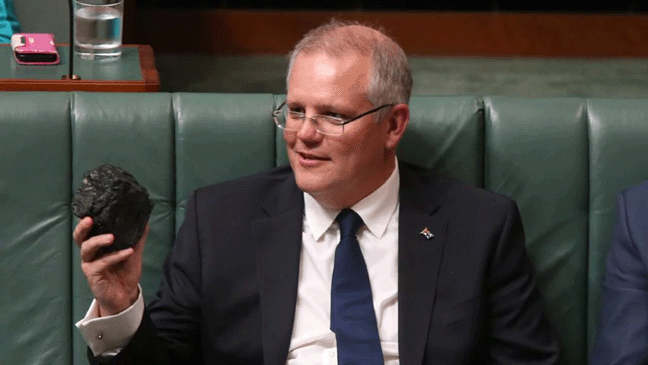
Who’s who at Cop26: the leaders who hold the world’s future in their hands, Guardian 11 Oct 21,
”……..Scott Morrison
“A rogue nation on the climate” is how one Cop expert describes Australia, urging other countries to ostracise the coal exporter, which under Morrison has refused to take on new commitments on emissions. But if anything the Aukus deal appears to have buoyed the Australian prime minister’s sense that he can get away with it – he may not even attend……..” https://www.theguardian.com/environment/2021/oct/11/whos-who-at-cop26-the-leaders-who-hold-the-worlds-climate-in-their-hands
Radioactive risks of nuclear submarines

The radioactive waste from reactors poses a difficult and expensive problem to manage health and environmental hazards for geological time periods. The governments involved in this proposal have been silent about disposal of the high and intermediate level waste that would be generated. Despite many flawed and failed attempts at interim storage, Australia has no current plan for disposal of the much smaller amount of its existing intermediate level radioactive waste.
Proposed US/UK nuclear-powered submarines for Australia jeopardise health while escalating an arms race no one can win
Joint statement by International Physicians for the Prevention of Nuclear War and its affiliates in Australia, UK and USA: Medical Association for Prevention of War (Australia); Medact (UK); Physicians for Social Responsibility (USA) 10 Oct 21, ”……. Radioactive risk
Nuclear reactors on ships and submarines have been involved in numerous accidents. The risks of accident or attack causing release of radioactive material combined with the targeting by adversaries of such vessels including while they are in port, are why many cities around the world sensibly oppose visits of such vessels to their harbours. Such incidents could cause chaos and panic, the need to evacuate large areas of cities for years, and expose tens or hundreds of thousands of people to harmful radioactive fallout.
Australia’s lack of nuclear scientific, engineering, management and regulatory capacity and experience will inevitably mean that more is likely to go wrong building and operating nuclear submarines. If something does go wrong with one of its nuclear submarines, the likelihood of it being quickly and effectively managed is reduced and the risks of radioactive release in a port city or into the marine or coastal environment is increased.
A total of 8 nuclear-powered submarines have sunk because of accidents at sea between 1963 and 2003 – two because of fires, two by weapon explosions, two by flooding, and one each from storm damage and unknown reasons. These contribute substantially to the already widespread radioactive pollution resulting from naval reactors. The most recently reported fatal accident was a fire in a Russian nuclear submarine in 2019, which killed 14 people.
The radioactive waste from reactors poses a difficult and expensive problem to manage health and environmental hazards for geological time periods. The governments involved in this proposal have been silent about disposal of the high and intermediate level waste that would be generated. Despite many flawed and failed attempts at interim storage, Australia has no current plan for disposal of the much smaller amount of its existing intermediate level radioactive waste. …. https://beyondnuclearinternational.org/2021/10/10/nuclear-submarine-deal-needlessly-raises-tensions/
1 This month
17 October, Free Public Talk on Nuclear Issues in South Australia
David Noonan will speak on public interest concerns over the new Roxby Downs Indenture Act 2026 on BHP copper-uranium mining and ore processing in SA, and on how AUKUS may face SA with a High-Level nuclear waste agenda.
Dr Jim Green will discuss international developments in the field of nuclear power including ‘small modular reactors’ and Generation 4 ‘advanced’ nuclear reactor concepts.


Help Aunty Sue Protect Her Land and Sacred Sites From Destructive Rocket Testing.
.

Australians deserve the truth
about
AUKUS – https://aukuspublicinquiry.com/

PETITION – To: Prime Minister Anthony Albanese and the Australian Labor Government

of the week – Australians for War Powers Reform (AWPR)
To see nuclear-related stories in greater depth and intensity

