The facts contradict the pro nuclear spin of the Minerals Council of Australia’s report, written by Ben Heard.
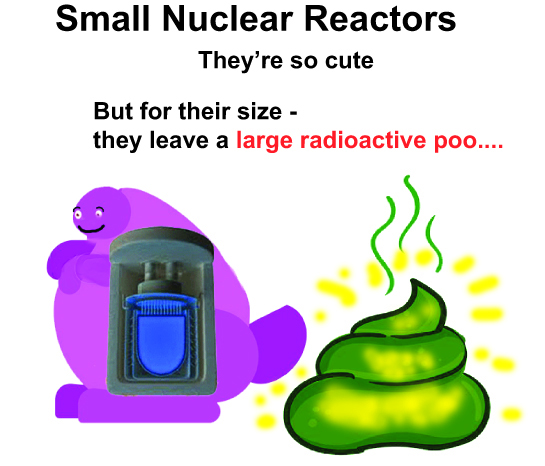
“a smaller reactor, at least the water-cooled reactors that are most likely to be built earliest, will produce more, not less, nuclear waste per unit of electricity they generate because of lower efficiencies.”
”Due to the loss of economies of scale, the decommissioning and waste management unit costs of SMR will probably be higher than those of a large reactor (some analyses state that between two and three times higher).”
Small nuclear reactors, huge costs Dr. Jim Green 11 October 2021 Even by the standards of the Minerals Council of Australia (MCA), the new report published by the country’s most influential coal lobby on the subject of small modular nuclear reactors (SMRs) is jiggery-pokery of the highest order.
Why would a mining industry body promote SMRs? After mining for some years — or at most decades — no company would want to take on the responsibility of decommissioning a nuclear reactor and managing high-level nuclear waste for millennia. No companies are cited in the report expressing interest in SMRs to power their mining operations.
Perhaps the MCA – which infamously provided the lump of coal for Scott Morrison to wave around in parliament – thinks that promoting nuclear power will slow the transition from fossil fuels to renewables, and believes that it is in the interests of some of its member companies to slow the transition.
If so, the timing of the report isn’t great, coming in the same week as the Business Council of Australia’s report which argues for a rapid, renewables-led decarbonisation, and Fortescue’s announcement that it plans to build the world’s largest green energy hydrogen manufacturing facility in Queensland.
Perhaps the MCA is doing the bidding of the (mostly foreign-owned) uranium mining companies operating in Australia? The MCA’s CEO Tania Constable said: “Australia should take advantage of growing international interest in nuclear energy and look to expand its already significant uranium sector.”
Perhaps … but there’s no evidence that the two companies mining uranium in Australia — BHP (Olympic Dam) and Heathgate Resources (Beverley Four Mile) — are lobbying for nuclear power. And Australia’s “already significant” uranium industry could hardly be more insignificant — it accounts for about 0.2 percent of Australia’s export revenue and about 0.01 percent of all jobs in Australia.
Bob Carr’s atomic bombshell
The MCA report also came in the same week as Bob Carr’s striking about-face on nuclear power. Having previously supported nuclear power, Carr wrote in The Australian: “In 2010 one enthusiast predicted within 10 years fourth-generation reactors and small modular reactors would be commonplace, including in Australia. None exists, here or abroad.”
The MCA report says SMRs are an “ideal fit” for Australia, citing their enhanced safety, lower cost than large-scale nuclear reactors or equivalent energy production methods, and lower waste production than current reactors.
It’s all nonsense. The safety claims don’t stack up. Nor do the claims about waste. Academic M.V. Ramana notes that “a smaller reactor, at least the water-cooled reactors that are most likely to be built earliest, will produce more, not less, nuclear waste per unit of electricity they generate because of lower efficiencies.”
And a 2016 European Commission document states: “Due to the loss of economies of scale, the decommissioning and waste management unit costs of SMR will probably be higher than those of a large reactor (some analyses state that between two and three times higher).”
SMRs have a similar capacity to many existing coal and gas-fired power plants in Australia, the MCA report states, so would make an ideal replacement. Back to Bob Carr:
“Where is the shire council putting up its hand to host a nuclear power plant? Harder to find than a sponsor for a high-temperature toxic waste incinerator.
“Nobody in the Hunter Valley has urged nuclear for the Liddell site, even on the footprint of this coal-fired power plant scheduled to close. And not even invoking the prospect of a small modular reactor that 10 years back was the vanguard of the nuclear renaissance. About to be planted across the Indonesian archipelago and the rest of Asia, we were promised. Today they exist only on the Rolls-Royce drawing boards they have adorned since the 1970s.”
Economics
The MCA said in June 2020 that SMRs won’t find a market unless they can produce power at a cost of A$60-$80 per megawatt hour (MWh). That’s a big problem for enthusiasts because there’s no chance whatsoever that SMRs will produce power in that cost range.
An analysis by WSP / Parsons Brinckerhoff, prepared for the 2015/16 South Australian Nuclear Fuel Cycle Royal Commission, estimated a cost of A$225 / MWh for a reactor based on the NuScale design, about three times higher than the MCA’s target range.
CSIRO estimates SMR power costs at A$258-338 / MWh in 2020 and A$129-336 / MWh in 2030.
Russia’s floating nuclear plant is said to be the only operational SMR in the world, although it doesn’t fit the ‘modular’ definition of serial factory production.
A 2016 OECD Nuclear Energy Agency report said that electricity produced by the Russian floating plant is expected to cost about US$200 (A$273) / MWh, about four times higher than the target range cited by the MCA and more expensive than power from large reactors (US$129-198 / MWh).
Completion of Russia’s floating plant was nine years behind schedule and construction costs increased six-fold.
Yet, despite a mountain of evidence that SMRs won’t come close to producing power in the A$60-80 / MWh range, the new MCA report asserts that “robust estimates” using “conservative assumptions” suggest that SMRs will produce power at a cost of A$64-77 MWh by 2030.
One wonders who the MCA think they’re kidding.
The MCA report was written by Ben Heard, who recently closed his ‘Bright New World’ nuclear lobby website, just before taking up a full time role with consultancy Frazer-Nash. Heard promotes Canadian SMR-wannabe Terrestrial Energy in the MCA report but does not disclose his role on the company’s advisory board.
Heard also contributed two chapters on nuclear power to a 2020 book titled ‘An Australian nuclear industry: Starting with submarines’.
Dr Jim Green is lead author of a 2019 Nuclear Monitor report on SMRs and national nuclear campaigner with Friends of the Earth Australia.
US and UK begin jostling to supply Australia with nuclear submarine fleet
US and UK begin jostling to supply Australia with nuclear submarine fleet, ABC By defence correspondent Andrew Greene‘ 10 Oct 21, ‘……….In 2021, the Australian Defence Force is again considering what role the Royal Navy could play in developing its next submarines, or whether like many modern acquisitions, it will focus on interoperability with American technology.
Under the AUKUS partnership struck in September, the leaders of the United Kingdom and the United States have agreed to work with Australia on how to build a new class of nuclear-powered submarines.
Over the next 18 months, the Nuclear-Powered Submarine Task Force inside the Department of Defence will lead a study into the numerous regulatory issues involved in the ownership and operation of nuclear-powered boats.
While the design is not yet known, or what the criteria will be, for many commentators the existing British Astute-class is emerging as an early favourite for Australia to replace the Collins-class fleet
Others inside the defence industry believe any nuclear-powered Australian submarine will need to be an American boat, based on the Virginia-class so that it can be serviced at nearby US bases in Guam or Japan.
Both the British and US options have various advantages and disadvantages, which highlight the extraordinarily complex process the ADF faces to select a nuclear-powered submarine — which may never actually eventuate.
Already the regulatory challenges appear significant, as nothing is more complex and costly in the military world than nuclear-powered submarines, particularly for a country with no domestic nuclear industry.
In the United States, an eminent group of former officials and experts has written to President Joe Biden warning the AUKUS deal could threaten national security by encouraging hostile nations to obtain highly enriched uranium (HEU).
Australia insists it will uphold its commitments under the Nuclear Non-Proliferation Treaty, but the engineering sector warns it will be a steep learning curve for the Defence Department.
The now dumped Attack class submarine being designed by France’s Naval Group was based on the Barracuda class, which lost three years in development because of less complex regulatory issues associated with low enriched uranium (LEU).
“This is a very long-term effort that’ll be decades, I think, before a submarine goes in the water,” US Chief of Naval Operations Admiral Mike Gilday predicted last month………… https://www.abc.net.au/news/2021-10-10/us-and-uk-begin-jostling-for-nuclear-submarine-contract/100525756
Nuclear submarines – A step towards nuclear power and nuclear weapons?
Nuclear submarine deal needlessly raises tensions, Proposed US/UK nuclear-powered submarines for Australia jeopardise health while escalating an arms race no one can win
Joint statement by International Physicians for the Prevention of Nuclear War and its affiliates in Australia, UK and USA: Medical Association for Prevention of War (Australia); Medact (UK); Physicians for Social Responsibility (USA), Beyond Nuclear, 10 Oct 21,
”……..A step towards nuclear power and nuclear weapons?
Already, in the wake of the announced plans, there are mounting calls in Australia, including from some government MPs, for Australia to embrace nuclear power as well. Throughout the 1950s and 1960, Australia made active plans and preparations to acquire nuclear weapons. Calls that Australia needs to be prepared to acquire its own nuclear weapons, from former senior government officials and those employed by think tanks close to the government, have never gone away.
Twenty nuclear weapons could be built from the amount of HEU fuelling the nuclear reactor of each planned submarine.
The way forward
More than a leader’s word is needed to ensure that the planned submarines will not be used as the thin end of a wedge towards an expanded civil nuclear industry, such as nuclear power generation, and that the planned submarines will not be armed with US, UK or Australian nuclear weapons.
Rather than escalating a nuclear-propelled new cold war, both the UK and US should make their people and the world truly safer by pursuing a verifiable and binding agreement with other nuclear armed states to eliminate their nuclear arsenals. They should welcome and work towards joining the 2017 UN Treaty on the Prohibition of Nuclear Weapons (TPNW), which provides the only internationally agreed, treaty-codified framework for the elimination of nuclear weapons. Naval nuclear propulsion, especially with HEU, should be phased out.
There are abundant compelling reasons for all states to join the TPNW — indeed that is the best test of whether they are serious about nuclear disarmament, or not. Contrary to its support for the treaties prohibiting all other major types of inhumane and indiscriminate weapons and weapons of mass destruction — biological and chemical weapons, landmines and cluster munitions — Australia opposes the TPNW.
The best way for Australia to provide surety that any nuclear-powered submarines would not be a stepping stone towards acquiring nuclear weapons, nor have any role in the possible use of nuclear weapons, is to join the TPNW. If it continues to refuse to do so, such concerns will remain well justified.
If Australia does proceed to acquire nuclear submarines, it should insist on LEU fuel, implement stringent safeguards, the submarines should be configured so that they cannot carry nuclear weapons, and nothing about their construction or operation should impede Australia joining the TPNW.
For the full joint IPPNW statement with signatures, go here. https://beyondnuclearinternational.org/2021/10/10/nuclear-submarine-deal-needlessly-raises-tensions/
Nuclear submarine deal needlessly raises tensions — Highly Enriched Fuel a particular danger

World needs to work together, not provoke further conflict
Nuclear submarine deal needlessly raises tensions — Beyond Nuclear International 10 Oct 21, s
Proposed US/UK nuclear-powered submarines for Australia jeopardise health while escalating an arms race no one can win
Joint statement by International Physicians for the Prevention of Nuclear War and its affiliates in Australia, UK and USA: Medical Association for Prevention of War (Australia); Medact (UK); Physicians for Social Responsibility (USA)
Physicians in the countries involved in the proposal announced on 16 September for Australia to acquire nuclear-powered submarines with UK and US assistance are concerned this plan will jeopardise global health and security. Under this proposal, Australia would become the seventh country to use nuclear propulsion for its military vessels, and the first state to do so which does not possess nuclear weapons, or nuclear power reactors. These submarines are to be armed with sophisticated long-range missiles including US Tomahawk cruise missiles. These submarines would increase tensions and militarisation across Asia and the Pacific region, fuel an arms race and risk deepening a new cold war involving China.
The wrong decision at the wrong time
Humanity is in the midst of a major pandemic, and facing twin existential threats of dire urgency — global heating and the growing danger of nuclear war. People everywhere desperately require our leaders to work together to address these major challenges, which can only be solved cooperatively.
Beginning on November 1, the UN Climate Change Conference will be held in Glasgow, when leaders have a choice to condemn humanity to cascading climate catastrophe, or step up and take the decisive and ambitious actions needed to drastically reduce greenhouse gas emissions and keep warming within 1.5 degrees. COVID vaccines are still out of reach for most of the world’s poor people. If ever there was a time to build goodwill and focus on cooperation to complex global problems rather than escalate military confrontation, that time is now.
Our leaders should be focussing their energies not on escalating a new cold war arms race with China, but on building peaceful cooperation to address urgent shared threats with the government of the world’s most populous and largest greenhouse gas emitting nation.
Instead, this plan will raise tensions, make cooperation more difficult, drive proliferation of ever more destructive weapons, divert vast resources needed to improve health and well-being and stabilise our climate, and increase the risks of a slide to armed conflict between the world’s most heavily armed states, risking nuclear escalation in which there can be no winners.
Spreading nuclear bomb fuel
Commendable international efforts over decades to reduce production, use and stockpiles of highly-enriched uranium (HEU) worldwide have been supported by Australia, UK and US, including through the Nuclear Security Summits led by President Obama. In its role as G7 president, the UK has committed to ‘reinvigorate the aim of minimising production and use of Highly Enriched Uranium (HEU)’.
UK and US nuclear-powered submarines use HEU as fuel, which is directly usable in nuclear weapons, including those of the simplest design easiest for terrorists to build. Indeed their current naval reactor fuel is enriched to 93% and was originally produced for use in nuclear warheads. They have resisted and delayed efforts to convert their naval reactors to much less proliferation-prone low-enriched uranium fuel, as France and China have done, and any conversion to LEU is not likely before the late 2030s at the earliest.
So it seems very likely that any Australian nuclear submarines built with US or UK naval reactors over the next 20 years will also use HEU. Precisely because of the proliferation dangers of naval reactor fuel, the US has previously gone to considerable lengths to thwart the spread of naval reactors, such as in the 1980s blocking Canada from buying nuclear attack submarines from France and the UK.
A loophole exists in the international safeguards required under the nuclear Non- proliferation Treaty (NPT): states without nuclear weapons can remove fissile materials (which can be used to build nuclear weapons) from safeguards for a temporary period for use in military applications short of nuclear weapons. No nation has yet done this in relation to naval nuclear reactors.
The quantities of HEU involved are large. As Sebastien Philippe from Princeton University has estimated, a fleet of between 6 and 12 nuclear submarines as proposed, operated for about 30 years, will require between 3 and 6 tons of HEU. The International Atomic Energy Agency (IAEA) stipulates that 25 kg of HEU would enable a nuclear weapon, even though US nuclear weapons are known to contain an average of only 12 kg of HEU.
So HEU fuel for the proposed Australian submarines would involve 120 to 240 times the amount of HEU as the IAEA stipulates is sufficient to build a nuclear weapon, and it could be out of international safeguards for decades. Philippe has aptly characterised this as “a terrible decision for the non-proliferation regime”. It discredits all three nations’ claims to support a treaty curbing fissile materials, and would make such a treaty harder to verify.
The Australian government proclaims its support for strong nuclear safeguards, while falsely claiming that the safeguards obligations in the UN Treaty on the Prohibition of Nuclear Weapons (TPNW) are weaker than those under the NPT 3 (they are, in fact, stronger). Its plan to drive large amounts of HEU in reactors roaming the oceans for decades through a loophole in its safeguards does not indicate good faith on safeguards and non-proliferation.
This proposal needs careful independent scrutiny and strong new safeguards provisions to ensure Australia fulfills its obligations under both the NPT and the South Pacific Nuclear Free Zone Treaty. The latter goes further than the NPT in prohibiting the stationing of any nuclear explosive device in the territory of a state party.
The UK announcement in March of a planned 40% increase in its nuclear arsenal is in breach of its NPT obligations, as the UN Secretary-General has stated. The UK and US are modernising their nuclear arsenals, both in breach of their now 51-year-old legally binding NPT commitment to disarm.
Australia acquiring nuclear-powered submarines could well encourage other states, such as South Korea, Japan and Iran to pursue a similar path. Proliferation of submarines or other vessels with lifespans of several decades that are fuelled by weapons-grade HEU will encourage uranium enrichment, wider use and storage of HEU, and will set back and make more difficult control and elimination of fissile materials…….. https://beyondnuclearinternational.org/2021/10/10/nuclear-submarine-deal-needlessly-raises-tensions/
Press Freedom Groups React to reports of CIA plots to kidnap, assassinate Assange
Australian Gov morally and legally obliged to immediately remove @withMEAA member and Australian citizen Julian #Assange from harm’s way If kidnapping and assassination actively considered by CIA @MarisePayne must act now. This MUST STOP #BringJulianHome
— President of MEAA, director of Walkleys Foundation Marcus Strom
Press Freedom Groups React to reports of CIA plots to kidnap, assassinate Assange https://dontextraditeassange.com/press-clip/press-freedom-groups-react-to-reports-of-cia-plots-to-kidnap-assassinate-assange/?fbclid=IwAR3RQx5yU7u5rLGUStrkGSCpKaD5wYmRDF41isUSEDuLSUjMxmaElsMr6e4 This incredible story strikes right at the heart of the prosecution case against Julian Assange. They have repeatedly asserted that this is not a political case. This shows that it absolutely is, and that the legal attack on Assange came very close to becoming an actual physical assault and kidnapping and possibly an attempted murder. It also shows that the British authorities were willing to participate in this grotesque plan and to participate in gun battles on London streets in pursuit of Assange. British journalists, lawmakers, and citizens must now ensure that the government drops the case against Assange and answers questions about their willingness to participate in illegal acts.
Freedom of the Press Foundation: After shocking story about CIA illegal acts, Biden admin must drop Assange charges immediately.
“The CIA is a disgrace. The fact that it contemplated and engaged in so many illegal acts against WikiLeaks, its associates, and even other award-winning journalists is an outright scandal that should be investigated by Congress and the Justice Department. The Biden Administration must drop its charges against Assange immediately. The case already threatens the rights of countless reporters. These new revelations, which involve a shocking disregard of the law, are truly beyond the pale.” — Executive director Trevor Timm
National Union of Journalists: CIA reportedly plotted to kidnap and assassinate Julian Assange
“I am calling on the UK home secretary to explain whether the security services had any involvement in, or knowledge of, these plans. Furthermore, it is clear that when the US appeal against the dismissal of its extradition application in respect of Assange is heard in October, it should be dismissed out of hand and its subject released at once.” — NUJ general secretary Michelle Stanistreet
Reporters Without Borders: Alarming reported CIA plot against Julian Assange exposed
“If true, these allegations of a CIA threat to Assange’s life are alarming, and underscore the very serious risk he remains at in detention, which would be exponentially heightened if the US is successful in securing his extradition. The exposed alleged plots that could cause severe harm or loss of life to Assange or his associates are threats to press freedom itself. The Biden administration must act immediately to distance itself from these shocking reports of the Trump administration’s actions, close the case against Assange once and for all, and allow for his release from prison before any further harm is caused.” — RSF’s Director of International Campaigns Rebecca Vincent
Defending Rights & Dissent: DRAD Condemns Outrageous CIA Attacks on Assange and Press Freedom
“Regardless of the targets, such actions are illegal and immoral.That the CIA seriously considered resurrecting some of its most criminal tactics of the Global War on Terror and Cold War is cause for serious alarm. That the target was an award winning journalist, however, makes these revelations all the more chilling.” — Defending Rights & Dissent’s Policy Director Chip Gibbons
The International Federation of Journalists: US: CIA reportedly plotted to kidnap and assassinate Julian Assange
“If these accusations are true, it would cast a long shadow over all independent journalism and they would once again prove that extraditing Assange to the United States would put his life at serious risk. We are calling for a full investigation and for the British authorities to release him immediately.” — IFJ General Secretary Anthony Bellanger
IPI – The Global Network for Independent Journalism
The revelation by @YahooNews that the CIA considered kidnapping or assassinating @wikileaks founder Julian Assange is deeply disturbing. IPI reiterates its call on the US government to abandon its prosecution of Assange under the Espionage Act.
ACLU – American Civil Liberties Union
This new report highlights that the prosecution of Julian Assange poses a grave threat to press freedom. We’ll say it again: The government needs to drop its charges against him.
MEAA – Media Entertainment and Arts Alliance
Australian Gov morally and legally obliged to immediately remove @withMEAA member and Australian citizen Julian #Assange from harm’s way If kidnapping and assassination actively considered by CIA @MarisePayne must act now. This MUST STOP #BringJulianHome
— President of MEAA, director of Walkleys Foundation Marcus Strom
It’s unfortunate that the AUKUS nuclear submarine deal looks like weakening global nuclear non proliferation.
Limiting the nuclear-proliferation blowback from the AUKUS submarine deal, The Strategist, 21 Sep 2021|Anastasia Kapetas If the If the architects of the AUKUS pact and its headline initiative to supply Australia with nuclear-powered submarines imagined it would be seen as proliferation neutral, the reality might not be so straightforward. The announcement was extremely sketchy on many critical details, particularly from a non-proliferation perspective.
Of course, how nuclear non-proliferation issues are addressed isn’t the sole test of this deal, but it will be part of managing its future trajectory. It’s notable that the State Department doesn’t seem to have been in the loop on negotiations. It has carriage of US non-proliferation commitments, so some of the proliferation consequences may not have been front of mind.
Prime Minister Scott Morrison has said the deal will comply with Australia’s international non-proliferation commitments. That’s true, as there’s a massive loophole in Article III of the United Nations Treaty on the Non-Proliferation of Nuclear Weapons that exempts naval reactors from nuclear safeguards. However, the non-proliferation community has long seen the loophole as a major threat to one of the treaty’s key aims—to limit the production and use of highly enriched uranium (HEU), which can be used to make nuclear weapons………
There could also be implications for negotiations on the proposed fissile material cut-off treaty, historically supported by Australia, which aims to strictly limit the amount of fissile material that nucelar-weapon states can manufacture. Negotiations are locked in a stalemate, largely thanks to Pakistan. Nonetheless, the treaty’s goals have broad international support and the manufacture of more weapons-grade uranium to power Australia’s submarines will likely also set those goals back.
There seems to be an emerging consensus in the global arms-control community that the AUKUS submarine deal could have a hugely negative effect on non-proliferation norms and practices. Depending on how Washington responds, this could have an impact on how the program unfolds.
Hans Kristensen, director of the Nuclear Information Project at the Federation of American Scientists, says that the deal ‘will further intensify the arms race in the region and dynamics that fuel military competition’. Pointing to the sparse strategic rationale offered so far, he adds, ‘Other than fielding more and better weapons, does anyone have a plan?’
Similar views have rippled across non-proliferation and arms-control circles, driven by fears that the deal will set a precedent ushering in a dangerous era of loosened nuclear restraints.
Daryl Kimball, director of the Arms Control Association, points out that if Australia gets a HEU submarine like the US Virginia class, it will be the first non-nuclear-weapon state to have such a capability.
What will Washington say to other allies, such as Israel, that might want the same technology? ………..
The US and Australia both recognise the importance of strengthening global rules and the institutions that allow existential nuclear-proliferation issues to be mediated. Conventional nuclear and military deterrence might make state adversaries think twice before using nuclear weapons, but it’s of little use in stopping acquisition and the attendant risks of catastrophic miscalculation. https://www.aspistrategist.org.au/limiting-the-nuclear-proliferation-blowback-from-the-aukus-submarine-deal/?fbclid=IwAR2TrXJx7UbCJUDBUCMzhGJ0i_RFC188XE1Xotq9b-hP
Australians for Assange call for help – save our failing democracy, as USA continues, by despicable means, their case against him.
Australians for Assange 11 Oct 21
Dear Friends, John [Julian’s father] is headed back to London for Julian’s appeal trial to be held on the 27th & 28th of October.
Despite the incredible admission of lying by the US key witness, AND also revelations of a CIA plan to kidnap and assassinate Julian in London…the US is continuing with the case…this beggars belief.
We now know the US has been spying, plotting to kill and colluding with a known criminal to manufacture evidence.In John’s own words, “there is a Mount Everest of criminality surrounding Julian…and right at the very peak they even plotted to put poison in his cup…it makes you feel sick.”Everyone’s rights are being crushed and so to our “Justice” systems.
We must act to save what little is left of our democracy.Please help support John through this dark time in our history. Many thanks to those who have contributed already and even several times. The cost to Julian’s family is both emotional and financial…everyone’s help is critical to continue the campaign. WE MUST WIN! https://au.gofundme.com/f/saving-julian-assange
https://www.facebook.com/search/top?q=australians%20for%20assange
Scott Morrison’s bromance with Boris Johnson is being tested, because Morrison might not attend Glasgow climate conference
They have bonded over nuclear submarines at the White House and Welsh lamb washed down with Australian wine in Downing Street — but the budding bromance between Boris Johnson and Scott Morrison is being tested by the Australian prime minister’s reluctance to travel Glasgow for the Cop26
climate change summit.
Morrison has said he has not made a “final decision” on whether to attend the event at the end of the month as it would mean another spell in quarantine for him, just as Australia prepares to reopen its international borders. This excuse has not gone down well in the Johnson camp.
Times 10th Oct 2021
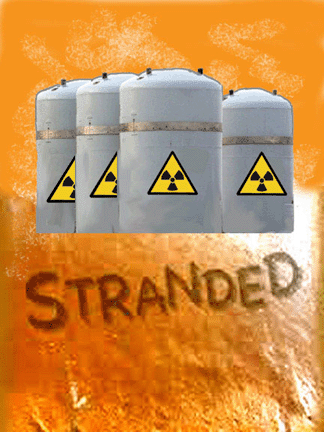
Kimba Consultative Committee living in la la land over the prospect of stranded nuclear wastes.
A VIEWING PLATFORM……Soooooo….let me get this right….People from around the world, will come flooding into Kimba (this is paraphrasing Adi Paterson’s claim that it will be a “tourist” attraction), to “view” the dump from a viewing platform!!!
And it gets better – “Members seem to be strongly for the visitor centre in the township and liked Mr Osborn’s idea about the viewing platform. It was also raised that they did not want to see the visitor centre offer coffee or lunch, as it would affect local businesses.”
 |
Kazzi Jai Fight to stop a nuclear waste dump in South Australia, 8 Oct 21,
For those time poor, here is a brief summary of the latest minutes of the Kimba Consultative Committee August 26th 2021
1. Downplaying Judicial Review….What a surprise! Biggest laughable line – “Choosing Napandee is an educated decision based on in-depth community consultation and extensive technical assessment work undertaken over a 4 year period, which started with voluntary land nomination by the owners of land.”!!
2. Cultural Heritage Assessment….to be done AFTER site acquisition because apparently “the work is quite costly and it would be prudent to wait until the site is acquired to spend further public money on this activity.”!!
3. Fluff words – no substance – “ARWA will work with ANSTO, CSIRO, and others to develop this research and implement an Australian appropriate disposal pathway in due course” – with respect to the “temporary” storage of Intermediate Level Nuclear Waste!
NOT ONE RED CENT SPENT YET TO DEAL PROPERLY WITH INTERMEDIATE LEVEL NUCLEAR WASTE – SO NOT GOING TO HOLD ONE’S BREATH ON THIS “PROMISE”….ALWAYS “LOOKING INTO IT” SEEMS TO BE THE FALLBACK ANSWER TO “APPEASE” PEOPLE….FROM WHAT WILL BE IN FACT STRANDED WASTE!!!!! ….Again….why is there no mention of a HOT CELL should the Intermediate Level Nuclear Waste be stored in Kimba? TN-81 casks ONLY have a 40 year lifetime manufacturer’s warranty. Given that it will now NOT be ANSTO’S PROBLEM – THEY ARE ONLY THE CUSTOMERS……WHERE DOES THIS LEAVE THE TN-81 WASTE??
4. Seems there is a REDUCTION in ACTUAL SECURITY already happening BEFORE EVEN DECLARATION OF THE SITE HAS HAPPENED!!…..”There were questions around the police presence in the community with an influx of people for construction, and whether this is something that has been considered. Mr Osborn said that this is something that needs further discussion with South Australian Police and Council. There will be security at the site, however it is yet to be decided if it will be Australian Federal Police (AFP).”
5. “Mr Osborn said that he envisaged a visitor centre in town and the possibility of there being a viewing platform at the facility where people can look over the site to get a birdseye view.”
A VIEWING PLATFORM……Soooooo….let me get this right….People from around the world, will come flooding into Kimba (this is paraphrasing Adi Paterson’s claim that it will be a “tourist” attraction), to “view” the dump from a viewing platform!!!
And it gets better – “Members seem to be strongly for the visitor centre in the township and liked Mr Osborn’s idea about the viewing platform. It was also raised that they did not want to see the visitor centre offer coffee or lunch, as it would affect local businesses.” https://www.facebook.com/groups/344452605899556
Opal nuclear reactor at Lucas Heights is simply not economically viable
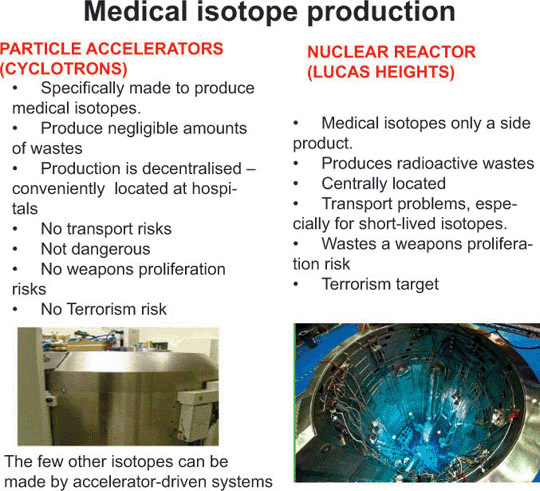
The BIG question is ECONOMIC VIABILITY given the continued uptake of cyclotrons worldwide. On this basis alone it will fail, but the Feds fervidly will try to continue to prop it up anyway – purely for political and NOT practical reasons!
In fact it is high time to move with the times! Canada has been through all of this already and decided to go with cyclotrons to produce their isotopes. They could no longer justify their taxpayers footing the bill for exporting isotopes and all of its inherent costs! And cyclotrons mean they can tailor make the isotopes they need rather than producing mass “available” isotopes which may or may not be used which is the model currently used for Australia!
Kazzi Jai shared a link. Fight to stop a nuclear waste dump in South Australia, 8 Oct 21,
So….what do you do when you are ACTING MINISTER FOR SCIENCE, INDUSTRY AND TECHNOLOGY? Seems the lucky ACTING MINISTER for that portfolio- Angus Taylor – knew EXACTLY what to do on 30th September 2021!
“ANSTO welcomes the joint announcement from The Acting Minister for Industry, Science and Technology, the Hon Angus Taylor MP, the Minister for Finance, Senator the Hon Simon Birmingham and the Minister for Health and Aged Care, the Hon Greg Hunt MP to safeguard the future of Australia’s nuclear medicine production. The government has announced it will safeguard Australia’s sovereign capability to produce vital nuclear medicines by launching a $30 million project to design a new world-leading manufacturing facility to be built at our Lucas Heights campus in Sydney. About 80 per cent of nuclear medicine isotopes used to fight diseases like cancer are produced at Lucas Heights and one of the key facilities that makes this possible is nearing the end of its operating life.” – ANSTO website “Safeguarding the future of Australia’s nuclear medicine”
When the likes of Angus Taylor uses the words “safeguard Australia’s sovereign capability”…you KNOW there’s something shonky going on! Too bad he isn’t worried about “Australia’s sovereign capability” with regards to iron, gas, water, ports, utilities, land acquisition etc etc….the list goes on!
Anyway, this “wish list” is separate to the brand new ANM facility (The Australian Nuclear Medicine Molydenum-99 Facility (ANM Mo99), which has now become known as ANSTO Nuclear Medicine Facility  ) which cost taxpayers $168 million and has had a number of teething problems since it was built in 2019 and only has become fully functional in March 2020.
Using the wording in the announcement, the “$30 million project to design a new world-leading manufacturing facility to be built”….means this is only a commitment by the Feds to give $30 million to DESIGN the facility which will replace “building 23” which is an “ageing nuclear medical facility” according to the now ex-CEO Adi Paterson back in 2018.Ideally, ANSTO would LOVE for the Feds to cough up $210 million to replace it – probably costing more than that now, since that was quoted 2018 figures not 2021 figures!!
The BIG question is ECONOMIC VIABILITY given the continued uptake of cyclotrons worldwide. On this basis alone it will fail, but the Feds fervidly will try to continue to prop it up anyway – purely for political and NOT practical reasons! In fact it is high time to move with the times! Canada has been through all of this already and decided to go with cyclotrons to produce their isotopes. They could no longer justify their taxpayers footing the bill for exporting isotopes and all of its inherent costs! And cyclotrons mean they can tailor make the isotopes they need rather than producing mass “available” isotopes which may or may not be used which is the model currently used for Australia!
With regard to treatment,which is only a tiny amount of what isotopes are used for – they are predominantly used for diagnostic imaging- the trend now is to do the least amount of damage to normal cells as is possible. Isotopes are rather a blunt instrument in that regards, and now techniques like immunotherapy and nanotechnology are the fields of advancement in that respect.There’s even advancements in radiotherapy which went to LINAC machines (linear accelerators) many decades ago…and now proton therapy units are finding their way into our major capital cities! Neither need nuclear reactors!https://www.minister.industry.gov.au/…/safeguarding… “MINISTER.INDUSTRY.GOV.AUSafeguarding the future of critical medicine supply | Ministers for the Department of Industry, Science, Energy and Resources https://www.facebook.com/groups/344452605899556
—
Nuclear power for Australia? It’s not going to happen!

Nuclear enthusiasts and fellow travellers like me once said of solar it’s the greatest future source of power and always will be. Solar investors may aim that rhetorical dart at small modular reactors and, indeed, the nuclear sector as its energy share, for years stagnant, proceeds to go backwards.
In Australia nuclear attracts not the remotest investor interest. If nuclear were an option a merchant bank or superannuation fund might be manoeuvring to own the space. They might have formed a consortium with a miner and a construction company or two, with a brace of lobbyists at work. It’s not happening.
The contrast with the surge to renewables is stark………..
[ED. An interesting and important piece here re the failure of nuclear power in today’s Australian.
Important because Bob Carr used to be pro-nuke and has changed in response to evidence.
This is timely and a good reinforcement to federal Labor re their strong opposition to any domestic nuclear industry.]
Nobody’s really interested in the nuclear option
BOB CARR, OCTOBER 7, 2021,THE AUSTRALIAN
Australians may be open to nuclear power, as evidenced by Tuesday’s Newspoll. But nuclear is not open for them.
Globally the industry is moribund. “The dream that failed,” says The Economist magazine, concluding it needs government money for life support.
In 2010 one enthusiast predicted within 10 years fourth-generation reactors and small modular reactors would be commonplace, including in Australia. None exists, here or abroad.
More damning, the industry lacks a single example in a Western country of a new power plant being built remotely on time and budget. According to the World Nuclear Industry Status Report, 94 plants were to come on line across the last decade but 98 get decommissioned. Yet 48 of those to be built are to be in China. Remove them and that leaves 46 coming online and – stubborn fact – 98 being decommissioned in the rest of the world.
In 2019, for the first time, renewable sources, excluding hydro, generated more power than nuclear.
In Australia nuclear attracts not the remotest investor interest. If nuclear were an option a merchant bank or superannuation fund might be manoeuvring to own the space. They might have formed a consortium with a miner and a construction company or two, with a brace of lobbyists at work. It’s not happening.
The contrast with the surge to renewables is stark. Andrew Forrest and Mike Cannon-Brookes are prepared to put their own funds into a vast solar farm in the Northern Territory and Forrest to make a huge commitment to hydrogen. There is no single investor with a comparable zest for nuclear power, either high net worth individual or institution.
Ziggy Switkowski produced a report on nuclear power for John Howard in 2007. It was to be the foundation of Australian nuclear power, a decades-long dream. Even with a partiality for the industry Switkowski could only conclude nuclear power, at double the price of coal and gas, would require a price on carbon – and even additional government subsidy.
Three prime ministers – Tony Abbott, Malcolm Turnbull, Scott Morrison – have not reopened the debate. For his part, by becoming chair of Crown in August, Switkowski seems to demonstrate more confidence in gaming-based tourism than the commercial potential of the nuclear fuel cycle.
I argued a pro-nuclear case within the Labor Party and scorned what I saw as the left phobia against the nuclear option. Like British scientist James Lovelock I thought coal more destructive and nuclear the bridge to the era of renewables.
But it’s now clear nuclear is lumbering, subject to breakdowns and cripplingly expensive. New renewable sources such as wind and solar increased by 184 gigawatts last year while nuclear grew by only 2.4GW. The number of active reactors has barely changed since the 1980s.
France was the poster child. But no new reactor has been connected to its grid since 1999. It closed its pressurised water reactor in 1991 and followed by terminating two fast breeder reactors and a small heavy-water reactor.
Poor reliability plagues the fleet. On any day at least four plants are at zero output because of technical failures. The average per plant is a month per year at zero production. But investment in upgrades faces competition from renewables and tough new EU energy efficiency standards.
Not even Scandinavian efficiency can provide a happy pro-nuclear narrative. Finland became the first country in western Europe to order a new nuclear reactor since 1988 but it’s running 13 years late, plagued with management and quality control issues, bankruptcies and investor withdrawals.
Who could have the faintest confidence that Australia could throw up a nuclear reactor with more panache – exceeding with efficiency not only the Finns but the British with their delays and cost blowouts and the Americans with their construction disasters in Georgia and South Carolina?
Doing big complex projects is hardly an Australian competitive edge. Think of the 50 years opining about a second Sydney airport, or – killer fact – the fumbling with submarines.
Where is the shire council putting up its hand to host a nuclear power plant? Harder to find than a sponsor for a high-temperature toxic waste incinerator.
Nobody in the Hunter Valley has urged nuclear for the Liddell site, even on the footprint of this coal-fired power plant scheduled to close. And not even invoking the prospect of a small modular reactor that 10 years back was the vanguard of the nuclear renaissance. About to be planted across the Indonesian archipelago and the rest of Asia, we were promised. Today they exist only on the Rolls-Royce drawing boards they have adorned since the 1970s.
Nuclear enthusiasts and fellow travellers like me once said of solar it’s the greatest future source of power and always will be. Solar investors may aim that rhetorical dart at small modular reactors and, indeed, the nuclear sector as its energy share, for years stagnant, proceeds to go backwards.
Bob Carr is the longest-serving premier of NSW and a former Australian foreign minister.
Growing pressure for Australia to scrap the plan for nuclear submarines fuelled by Highly Enriched Uranium (HEU)

Experts warn Joe Biden supplying nuclear submarines to Australia threatens US security
Malcolm Turnbull says reactor not a ‘plug and play’ power pack as former US officials raise national security concerns, Guardian Tory Shepherd, Fri 8 Oct 2021 Malcolm Turnbull says reactor not a ‘plug and play’ power pack as former US officials raise national security concerns.
There is growing pressure on the new Aukus partners to scrap plans to use weapons-grade uranium on submarines.
A group of former US officials and experts has written to the US president, Joe Biden, warning the deal could threaten US national security by encouraging hostile nations to obtain highly enriched uranium (HEU).
At the same time, the former Australian prime minister Malcolm Turnbull says if Australia does buy the submarine reactors without a domestic nuclear industry – and therefore the nuclear expertise – it will be “more plug and pray” than “plug and play”.
The former Nato deputy secretary general Rose Gottemoeller has called on Australia to make a new deal with France to use their uranium, which is not weapons grade. That would heal the rift with France and ease nuclear proliferation fears, she said.
In the letter to Biden, the seven signatories called on him to commit to using low-enriched uranium (LEU), which is what the French use in their submarine program.
“The Aukus deal to supply Australia with nuclear-powered attack submarines fuelled with weapons-grade uranium could have serious negative impacts on the global nuclear non-proliferation regime and thereby on US national security,” wrote the group, which includes former White House officials.
At the heart of their concern is that if Australia, as a non-nuclear country, gets HEU then other countries would use that example to justify their own acquisition of the material.
Iranian officials intimated to the UN that, like Australia, they might want HEU for naval purposes.
France described Australia’s decision to ditch the $90bn submarine project in favour of the Aukus deal as a “stab in the back”, while Australia has argued that switching to nuclear-propelled submarines is strategically necessary.
There will now be an 18-month process to work out the details of the deal, which has come under heavy criticism.
Turnbull told Guardian Australia that the government should have stuck with the French deal, bought an initial three diesel-electric boats, then switched to their LEU technology.
That would be the “honest and straightforward” course, and would speed up the process because crews would already train in a very similar boat.
“(And) we wouldn’t have double-crossed France and destroyed people’s trust in Australia,” he added.
He said one of the reasons Australia had chosen France over Germany and Japan was the possibility of transitioning to nuclear……………
Morrison has said Australia won’t need a nuclear industry because the reactor will be made overseas then put into the Australian-built boat.
Morrison’s decision on AUKUS and nuclear submarines was made with no debate in Parliament
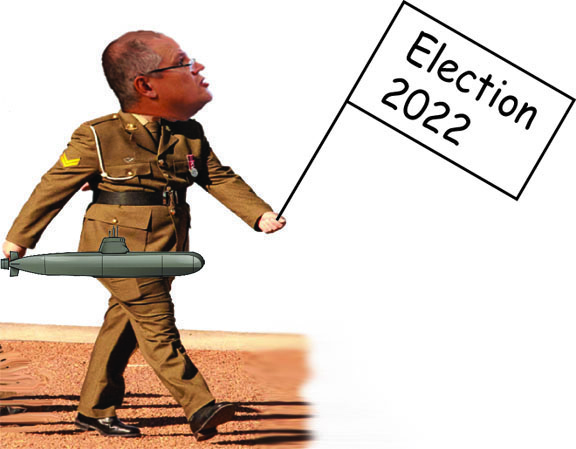
Our PM, Scott Morrison, struts the world stage, vilifies China (some of it deserved), but in the process is locking in Australia’s subservience to US foreign policy while guaranteeing increased US troop access and US spy stations on Australian territory for the future. Add to this the crippling cost of procurement of nuclear powered subs and the possible return of Donald Trump to ‘guide’ our nation into the future.
This sabre rattling at an external enemy will allow Morrison some catch up in the polls while the ALP is wedged. The huge crime here is to make a decision without debate in the Federal Parliament.
Times change, but some things regarding the nuclear industry and international political posturing remain the same.
Local anti-nuclear activists who chose to make a difference…https://www.echo.net.au/2021/10/local-anti-nuclear-activists-who-chose-to-make-a-difference/ By Ian Cohen October 7, 2021 Following the Nuclear Disarmament Party’s close loss with front man Peter Garrett in 1984, nuclear issues were at the forefront of people’s minds. We extended our influence far beyond our Shire. The pending arrival of nuclear armed warships sent the local region into overdrive. Benny Zable from Nimbin rolled out his ‘radioactive’ barrels for street theatre. Dean Jefferys based in Brunswick Heads came with his ultralight, Hoss (Ian Hoskens) of Main Arm with his megaphone voice and me with my surfboard.
September 1986 heralded the arrival of the largest assembly of international ships in Sydney Harbour’s history. Many were nuclear armed.
Our north coast contingent was vital to the success of the protest actions. Driven by a reckless, but heartfelt, desire to impact on the nuclear arms race and send a direct message to US President Ronald Reagan and USSR’s Yuri Andropov.
The mad concept of surfing the nose of a nuclear armed warship was mine, but Sydney Morning Herald photographer, Robert Pearce, from a media barge directly in front of myself and the warship, captured the image of a vulnerable surfer hanging onto the nose of a nuclear armed destroyer that went global.
Continue readingDr Margaret Beavis on why nuclear waste is best kept at Lucas Heights, and on the advantages of cyclotrons.

concerningly, in terms of nuclear medicine, ANSTO has proved an unreliable supplier with multiple outages and supply shortages in the last few years. You will find references to that in our submission. When you’re sourcing from a single nuclear reactor, one break in the chain shuts down the whole process. If technetium were instead sourced from multiple cyclotrons, which could be based in hospitals around Australia at not a huge cost—certainly much less than a nuclear reactor—if one of these cyclotrons broke down, there would be multiple other cyclotrons to supply technetium.
Dr Carl-Magnus Larsson, head of ARPANSA, – the ‘waste could be safely stored at Lucas Heights for decades to come’. He said that there was no urgent need for relocation of this waste and that ARPANSA has not raised any safety concerns regarding storage of waste at the interim waste facility [at Lucas Heights]
PARLIAMENTARY STANDING COMMITTEE ON PUBLIC WORKS Intermediate level solid waste storage facility, Lucas Heights, New South Wales (Public) MONDAY, 13 SEPTEMBER 2021 BEAVIS, Dr Margaret, Vice President, Medical Association for Prevention of War (Australia) [by audio link] RUFF, Dr Tilman, AO, Member, Medical Association for Prevention of War (Australia) [by audio link]
Dr Beavis, Thank you for the opportunity to speak today. MAPW supports the construction of a new facility at Lucas Heights. As noted in ANSTO’s submission, there will be minimal expected impact on the community, and ANSTO has an excellent record of managing this waste on site. This contrasts with the massive distress and community division a succession of nuclear waste storage proposals have caused in regional and remote Australia.
I’ll now address the sort of individual criteria of the committee. The stated purpose and suitability: the facility is needed and the proposal is suitable. You’ve already heard Dr Carl-Magnus Larsson, head of ARPANSA, say that the ‘waste could be safely stored at Lucas Heights for decades to come’. He said that there was no urgent need for relocation of this waste and that ARPANSA has not raised any safety concerns regarding storage of waste at the interim waste facility [inaudible] ANSTO. Addressing the need for the work: clearly intermediate level waste has to be stored safely and securely. It’s radioactive for over 10,000 years. Putting that in perspective, the Egyptian pharaohs were about 5,000 years ago, so it needs to be kept safe for a very long time.
Addressing cost effectiveness: this plan may prove to be very cost effective if, as a result of the extra capacity, there is time for an open and independent inquiry looking at world’s best practice management of nuclear waste. Given current world’s best practice standards, it’s very likely that the plan to move the waste will not proceed.
At some point ANSTO does indeed need to address the proper disposal or long-term management of intermediate waste. Countries, such as Finland, have spent decades researching how best to do this, and Australia could learn a lot from their research and expertise. In terms of the current and prospective value of the work, as noted, this work may provide breathing space enabling the open—and I stress—independent review of the claimed need for a temporary storage facility in South Australia.
The work would have even greater value if waste production was also reviewed and curtailed. If this were done, the proposed new site at Lucas Heights would take much longer to fill and be available for a much greater time frame.
It’s worth remembering that the first principle of managing toxic waste is to reduce production. Currently ANSTO is rapidly expanding production of the nuclear medicine isotope called technetium-99 precursors, which is the most commonly used isotope. This export business continues because it is very heavily subsidised. There’s no cost-benefit analysis and no attempt at full cost recovery. Historically Australian supply has been one per cent of the world supply and, as a doctor, I support nuclear medicine. One per cent of the world’s supply has been what Australia has needed.
ANSTO is in the process of increasing from that one per cent for the last few years and aims to produce 25 to 30 per cent of global supply, with very little acknowledgement of the massively increased quantity of intermediate waste that this will generate.
On top of that, concerningly, in terms of nuclear medicine, ANSTO has proved an unreliable supplier with multiple outages and supply shortages in the last few years. You will find references to that in our submission. When you’re sourcing from a single nuclear reactor, one break in the chain shuts down the whole process. If technetium were instead sourced from multiple cyclotrons, which could be based in hospitals around Australia at not a huge cost—certainly much less than a nuclear reactor—if one of these cyclotrons broke down, there would be multiple other cyclotrons to supply technetium.
Additionally, clean cyclotron production of technetium has recently been approved through all the health hurdles in Canada. It’s being implemented now there. This should rapidly become the future of isotope production. It avoids the high cost and the serious accident and terrorist risk inherent in nuclear reactors. It has no weapons proliferation potential, and it creates very little nuclear waste. You can use pre-existing cyclotrons. There are already cyclotrons in hospitals making other isotopes. Japan, the US, the UK and several European countries are all looking into implementing more reliable, safer, cheaper and much cleaner cyclotron production of technetium-99 https://parlinfo.aph.gov.au/parlInfo/download/committees/commjnt/cfc4f9dc-b73c-4166-b484-eeaddcab5bc0/toc_pdf/Parliamentary%20Standing%20Committee%20on%20Public%20Works_2021_09_13_9111.pdf;fileType=application%2Fpdf?fbclid=IwAR0ZzP4j5ukpfZOgyipP2ak92avAEz19B2wqC_Zz4bcbCDXGB9cRcT2siFo#search=%22Australian%20Nuclear%20Scie
Danger in transporting nuclear wastes from Lucas Heights, and ANSTO’s conflict of interest.

profoundly increased risks to the security of nuclear material that occur during transport, which are obviously minimised if they stay at Lucas Heights, and that’s one of the key reasons that we’re in favour of extended interim storage at Lucas Heights rather than anywhere else.
They [ANSTO] are a nuclear operator, so of course they’re organisationally, professionally, bureaucratically and budget-wise invested in nuclear technology.……..They have no expertise or interest, and no history, in alternative technologies. So I think, from an institutional point of view, there’s probably a pretty clear conflict of interest here. – Tilman Ruff
PARLIAMENTARY STANDING COMMITTEE ON PUBLIC WORKS Intermediate level solid waste storage facility, Lucas Heights, New South Wales (Public) MONDAY, 13 SEPTEMBER 2021 BEAVIS, Dr Margaret, Vice President, Medical Association for Prevention of War (Australia) [by audio link] RUFF, Dr Tilman, AO, Member, Medical Association for Prevention of War (Australia) [by audio link]
Dr Ruff: Very briefly, I want to add one important element for the committee’s deliberations that would support not just the proposed facility—as the previous witness and, I think, most of the submissions that you’ll be deliberating on today have supported—but ongoing interim storage of Australia’s intermediate-level nuclear waste at Lucas Heights, and whatever facilities are planned or put in train now should be amenable to implementing that capacity.
The particular reason I just want to draw your attention to is the profoundly increased risks to the security of nuclear material that occur during transport, which are obviously minimised if they stay at Lucas Heights, and that’s one of the key reasons that we’re in favour of extended interim storage at Lucas Heights rather than anywhere else. But it would be a major concern for reliance on a plan to shift that waste—uncertain, as highlighted—to anywhere else but particularly to somewhere as distant as South Australia with either very long road transport through multiple states or sea transport through ports.
The two global databases on nuclear accidents and trafficking are run out of the United States. The public one and the International Atomic Energy Agency both highlight, including in their most recent reports, that around half of the total reported incidents with nuclear materials occur during transport, and they highlight this as a particular vulnerability. Lucas Heights has, to my knowledge, been the subject of six publicly known terrorist threats. A couple of them have involved identification of explosive materials on or near the site. A couple have involved prosecutions of people with clear evidence of significant stages of planning. If that’s an issue at Lucas Heights, then the vulnerability of transport is particularly highlighted.
And it’s clear in both the reports that I mentioned that there are well-organised terrorist groups of various kinds around the world that are interested in, and have a demonstrated track record in seeking to acquire, nuclear materials suitable for, essentially, dirty radiological bombs, and intermediate-level nuclear waste would be very suitable for that purpose. So that’s one of the key factors why, from a health point of view, we’re particularly concerned that multiple handling and, particularly, long-distance transport of hazardous nuclear waste be minimised.
Dr Beavis: The recommendations of MAPW ask for an open and independent review of nuclear waste production and disposal, and also that the committee recommend inquiry and research into shifting to cyclotrons rather than reactor based production of isotopes for nuclear medicine in a phased and transition manner. We’re not talking about anything that would threaten nuclear medical supplies but, as rapidly as is feasible, to reduce the amount of waste that is produced.
Dr Beavis: It’s a very complex market. Every year, the OECD and Nuclear Energy Agency—they haven’t done it last year—put out a report on the supply of medical isotopes, and there’s been a recurring theme on the problems with full-cost recovery and the problems with supply security. I’ll just read you a bit from the 2019 report which I have in front of me which says that governments are not always aware of the extent to which molybdenum-99 production—that’s the technetium precursor—relies on subsidies. I think all of us are aware.
The report goes on: Some governments were essentially subsidising the production of Mo-99 that was exported to other countries, thus subsidising imaging services in importing countries. And this report is very keen for full-cost recovery, or FCR so they’re trying to stop countries heavily subsidising exports because it’s making the provision of new suppliers not cost competitive. I’ll read a little further: Other countries have decided to allow older facilities that were operating below FCR— that’s full-cost recovery— to cease operations and have not subsidised extensions of their working lifetime. While this increased the risk of insufficient supply or challenged reserve capacity, decisions to end the operation of facilities … have been helpful in achieving the six NEA— the Nuclear Energy Agency— policy principles … by removing subsidised services from the market. These actions also reduced the level of subsidised reserve capacity and reduced perceived overcapacity within the market.
I can read you more, but, basically, what they’re saying is that, because nuclear reactors are very, very expensive to set up, Australia is actually going down the path that Canada chose not to continue in the late 2000s. In 2009 and 2010, there was a massive global shortage of nuclear medicine for this technetium isotope. That was because the Canadian reactor supplied about 25 to 30 percent of the market. Canada has chosen not to replace those reactors for a number of reasons but not least because they were tired of accumulating all the nuclear waste from the export business of isotopes around the world.
In fact, the OECD and the NEA are advocating that we should not be continuing to subsidise these nuclear medicine suppliers. It also means that, if you rely on a reactor, when that reactor breaks down, your tendency to create havoc in the global markets is much greater. It would be much better if there were decentralised, much cleaner production of isotopes.
But, because we have a reactor and because ANSTO, as a business entity, has decided that it wishes to increase its market share—which, as a business entity, it’s certainly entitled to do—it means that the Australian public is left with a great deal of waste. It’s going to double the waste inventory, as you’ve heard, without really any social licence to do so.
Given that the OECD and the NEA are saying that we should not be continuing to subsidise this, I think what we need to do, as I said, is a phasing transition. We need a phased and coordinated reduction in Australia’s production isotopes for an export business, and, for Australian owned nuclear medicine suppliers, we actually need to decentralise. Cyclotrons are about the size of a four-wheel drive and cost in the order of—actually, I shouldn’t get into that, but it would be less than $5 million per cyclotron to have the work done and dusted. They are much cheaper to run, they don’t produce the waste, they don’t leave us with 10,000-year intermediate-level waste doubling in the next few decades. So I think it’s something Australia should be looking at. I think the huge subsidies that are going into this export business—I’ll backtrack. With new technologies and cyclotrons now being demonstrated to work in Canada, we need to have a review of how we produce our nuclear medicine so that we can have more reliable, safer and cleaner supplies.
Mr ZAPPIA: Again, Chair, I would have had lots, but I will ask just one question based on those last few comments. Doctor, why do you believe that ANSTO is not going down the path that Canada has gone down and the path that you’re recommending—that is, to increase the production of cyclotrons as opposed to isotopes?
Dr Beavis: I would be hesitant to second-guess how ANSTO thinks. I find that a difficult question. They may wish to increase the income that comes into ANSTO as a natural entity. I think they are not factoring in the cost of the waste. They’ve said explicitly they do not want responsibility for this waste that they are generating, and I think if you don’t have to worry about the waste, then putting subsidised material out into the global community—
Dr Ruff: If I could add to that very briefly: without wanting to speak for ANSTO, I think the institutional context is worth looking at. They are a nuclear operator, so of course they’re organisationally, professionally, bureaucratically and budget-wise invested in nuclear technology. Setting up a reactor is very expensive. The OPAL reactor cost at least $400 million, so there’s a very high upfront cost, and they, presumably, like most other reactor operators, want to operate it as long as possible. They have no expertise or interest, and no history, in alternative technologies. So I think, from an institutional point of view, there’s probably a pretty clear conflict of interest here.
That’s why we’re deeply concerned that, in Australia, we’re being left behind with emerging technologies. Australian medicine is very well placed. Cyclotrons are already dispersed in pretty much all of the major hospitals around capital cities because they produce isotopes for PET scans and other modern nuclear medicine interventions. But that’s probably not an enterprise that ANSTO would be essentially involved in, and I suspect that’s the context in which you’re not hearing a peep from them or any active interest in progressing and advancing implementation of much safer technologies of the future.
Mr ZAPPIA: , what is the significant objection to something that’s in the heart of Sydney, fundamentally, and that has been managed safely for a significant amount of time versus something in a far less densely populated area? What’s the basis for the objection?
Dr Beavis: I think the expertise and security at ANSTO is far greater. I also think the risks from this waste pale into insignificance compared to the risks of the nuclear reactor. So, if you’re going to be keeping one large facility secure, you may as well keep it all there. The regulator has said quite clearly that there’s sufficient space at Lucas Heights to store this waste for decades to come. https://parlinfo.aph.gov.au/parlInfo/download/committees/commjnt/cfc4f9dc-b73c-4166-b484-eeaddcab5bc0/toc_pdf/Parliamentary%20Standing%20Committee%20on%20Public%20Works_2021_09_13_9111.pdf;fileType=application%2Fpdf?fbclid=IwAR0ZzP4j5ukpfZOgyipP2ak92avAEz19B2wqC_Zz4bcbCDXGB9cRcT2siFo#search=%22Australian%20Nuclear%20Scie
1 This month
17 October, Free Public Talk on Nuclear Issues in South Australia
David Noonan will speak on public interest concerns over the new Roxby Downs Indenture Act 2026 on BHP copper-uranium mining and ore processing in SA, and on how AUKUS may face SA with a High-Level nuclear waste agenda.
Dr Jim Green will discuss international developments in the field of nuclear power including ‘small modular reactors’ and Generation 4 ‘advanced’ nuclear reactor concepts.


Help Aunty Sue Protect Her Land and Sacred Sites From Destructive Rocket Testing.
.

Australians deserve the truth
about
AUKUS – https://aukuspublicinquiry.com/

PETITION – To: Prime Minister Anthony Albanese and the Australian Labor Government

of the week – Australians for War Powers Reform (AWPR)
To see nuclear-related stories in greater depth and intensity

