Murrumbidgee Council launches survey on establishing nuclear power generator near Coleambally, Darlington Point or Jerilderie

from Greg Phillips -I was wondering if this was a belated April Fool’s joke. Especially since it is an “online survey” with no checks on who votes (as usual I expect it to be overrun by nuclear fanatics pretending to be locals). I think the rate payers in that area will have to pay much more attention to who they let get into the council next time.
30 April 2024 | Oliver Jacques, https://regionriverina.com.au/council-launches-survey-on-establishing-nuclear-power-generator-near-coleambally-darlington-point-or-jerilderie/59543/
Murrumbidgee Council has asked residents of Coleambally, Darlington Point, and Jerilderie to voice their opinions on the idea of establishing a nuclear power generator in their area.
“In an effort to explore diverse energy solutions, the community is invited to participate in an online survey aimed at understanding their appetite for nuclear power,” the council said in a statement.
Nuclear power plants generate electricity by using controlled nuclear chain reactions to heat water and produce steam to power turbines.
Advocates say the plants can generate clean energy without the by-products emitted by fossil fuels, while critics argue nuclear power is expensive, unreliable, possibly unsafe and it produces hazardous waste.
Murrumbidgee Council General Manager John Scarce said the council sought to understand public sentiment regarding the possible integration of nuclear power into the local energy landscape.
Mr Scarce said the concept would be contingent upon dismantling existing renewable energy infrastructure, including solar and wind farms, at the end of their operational life.
“The land would then be reclaimed for agricultural purposes, aligning with sustainability and resource optimisation goals,” he said.
The survey is designed as a precursor to gathering more information on the idea, with a view to undertaking a more formal poll in the future.
Nuclear power is banned in Australia and under current laws, nuclear power stations can’t be built in any state or territory.
At a recent event in Wagga, Essential Energy CEO John Cleland said nuclear energy would remain an important part of the global energy network, but it was an unlikely option for Australia in the near future.
“The lived experience and reality of nuclear is that all new nuclear generation built globally in the last 40 or 50 years has ended up being very expensive,” he said.
“In Australia, we have this wonderful endowment of wind and solar and existing gas reserves and systems that will provide a very robust peaking generation source going forward.
“The economic case for nuclear is challenging but we do need to continue to monitor the evolution of the technology around small-scale modular nuclear reactors because they might in time play a role.”
The Murrumbidgee Council survey can be accessed online at survey monkey and will remain open until 5 pm on 22 May 2024.
“History is Calling: Australia and the Treaty on the Prohibition of Nuclear Weapons”
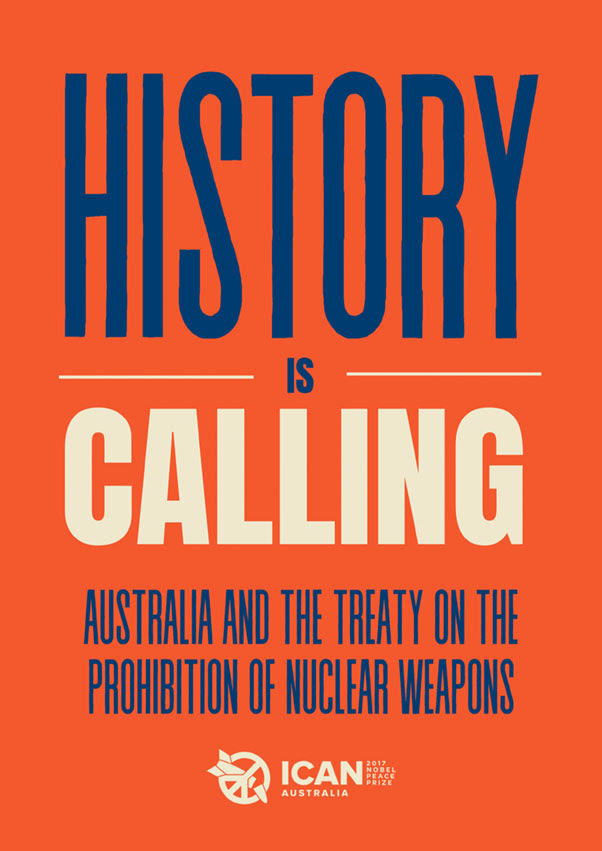
– Melissa Parke, ICAN International Executive Director, 30 Apr 24 https://icanw.org.au/history-is-calling-report/
“History is Calling: Australia and the Treaty on the Prohibition of Nuclear Weapons” sets out in detail the case for Australia to join the global majority of nations in supporting the nuclear weapon ban treaty. It outlines Australia’s progress on implementation, the TPNW’s complementarity with other agreements, nuclear safeguards and disarmament architecture, enforcement, universalisation, victim assistance and environmental remediation, Australia and its alliances, and nuclear deterrence theory.
By early 2024, almost half the world’s nations have already joined the TPNW. More will join. And they are getting to serious, practical work implementing the treaty.
Australia is currently the only nuclear-allied state where the governing party has repeatedly committed to sign and ratify the ban treaty. Under governments both Coalition and Labor, Australia has joined every other treaty banning an inhumane, indiscriminate weapon, but not yet this one banning the worst weapons of mass destruction.
Australia must step up and do its part to wind back the looming nuclear danger. Let’s get on the right side of history, not add to the risk of ending it. It’s time Australia joined the Treaty on the Prohibition of Nuclear Weapons.
– Melissa Parke, ICAN International Executive Director
Dutton’s plan to save Australia with nuclear comes undone when you look between the brushstrokes
Graham Readfearn, https://www.theguardian.com/environment/2024/apr/24/duttons-plan-to-save-australia-with-nuclear-comes-undone-when-you-look-between-the-brushstrokes
The dystopian picture of renewables painted by the opposition leader is full of inconsistencies, partial truths and misinformation
The Coalition leader, Peter Dutton, has been trying to paint a picture of what life in Australia will be like if it tries to power itself mostly with renewable energy and without his technology of choice: nuclear.
Towering turbines offshore will hurt whales, dolphins and the fishing industry, factories will be forced to stop working because there’s not enough electricity and the landscape will be scoured by enough new transmission cables to stretch around the entire Australian coastline.
At the same time – so his story goes – only his option to go nuclear will save Australia from falling behind the rest of the world.
But Dutton’s dystopian image, with more brushstrokes added in an interview on the ABC’s flagship Insiders program, is a picture of inconsistencies, partial truths and misinformation.
Let’s have a look between the brushstrokes.
Is it a credible plan?
The Coalition has said it wants to put nuclear reactors at the sites of coal-fired power plants, but hasn’t said where, how big the reactors will be, when it wants them built or given an estimate on cost.
The Coalition has previously said it would give more details on its plan in time for its response to the Albanese government’s budget next month, but Dutton is now saying it will come “in due course”.
Despite this, Dutton claimed in his interview with the ABC’s David Speers that: “I believe that we’re the only party with a credible pathway to net zero by 2050.”
OK then.
28,000 kilometres?
Dutton claimed the government’s plans relied on “28,000km of poles and wires being erected” to connect renewables to the grid – a distance he said was “equal to the whole coastline of Australia”.
That’s a catchy soundbite, but where does this number come from?
According to the Australian Energy Market Operator’s most recent plan for the development of Australia’s east-coast electricity market, the most likely scenarios to decarbonise the electricity grid would require about 10,000km of additional transmission lines to be built between now and 2050.
What about the extra 18,000km? That figure comes in an estimate of what would be needed if Australia chose to become a major exporter of clean hydrogen as well as decarbonising the grid.
So about two-thirds of Dutton’s 28,000km is not so much related to decarbonising the electricity grid, but rather to an export industry that may or may not happen, to an as-yet-unknown extent.
Turning off power?
Dutton claimed: “At the moment, we’re telling businesses who have huge order books to turn down their activity in an afternoon shift because the lights go out on that grid. Now, no other developed country is saying that.”
Dutton is suggesting that businesses are being routinely forced to reduce their demand for power. This is simply not true.
Dr Dylan McConnell, an energy systems analyst at UNSW, says it’s very rare for businesses to be told by the market operator they are going to have their power interrupted.
Such “load shedding” has happened only five times in the last 15 years, he said, typically occurs in extreme conditions such as storms or coal plants going offline, and only a subset of consumers are affected.
There are two main formal voluntary schemes in place across the National Electricity Market (everywhere except NT and WA) where major electricity consumers can offer to reduce their demand for electricity at certain times, but businesses are compensated for being part of those schemes. Nobody is telling any of these businesses that they have to do anything.
Neither is it true that no other country is engaging in some sort of process where demand for electricity can be managed.
Is Australia really the only developed country engaged in what’s known as demand response? No.
The International Energy Agency lists the UK, US, France, Japan and South Korea as having large markets already in place to help their electricity systems balance the supply of electricity with demand.
McConnell said: “Demand response is becoming a common and important part of modern electricity systems. This includes countries like France and the US, which have both nuclear and demand response programs.”
G20 and nuclear
Dutton said Australia was the only G20 nation “not signed up to nuclear or currently using it”.
According to information from the World Nuclear Association, Australia is one of five G20 nations with no operating nuclear power plants, alongside Indonesia, Italy, Saudi Arabia, Germany and Turkey.
But aside from Italy, Germany and Australia, the rest do have some plans to develop nuclear power in the future. Dutton’s phrase “currently using it” allows him to capture countries like Italy that import electricity from nuclear nations.
But what’s also important to note is that among the G20 countries (actually 19 countries) nuclear is mostly playing a marginal role. Nuclear provides more than 5% of its electricity in only seven of those 19 countries.
Social licence?
Projects would need a “social licence” to go ahead, Dutton said, but there was opposition in western New South Wales where “productive” land was being sold for renewables projects.
This is a variation of a previous Dutton speech, where he lamented a supposed “carpeting of Australia’s prime agricultural land with solar and windfarms”.
The renewable energy industry’s Clean Energy Council has countered claims like this, saying even if all the country’s coal plants were replaced with solar farms, the amount of space needed would be about 0.027% of agricultural land.
The Coalition leader has been to the Hunter coast more than once where offshore windfarms are being planned, telling reporters they were a “travesty” and that they would put whales, dolphins and the fishing and tourism industries “at risk”. He told Speers the turbines would rise “260 metres out of the water”.
Dutton told the ABC that Australia should be mindful of the environmental consequences of windfarms – which is, of course, true – but his past statements have sounded more like cheerleading for voices opposed to the plans than an attempt to understand the scale and legitimacy of the concerns, some of which are being stoked by misinformation.
Dutton can’t know what impact offshore windfarms will have on fishing or tourism, but is willing in any case to use labels like “travesty”.
‘A little awkward’: Coalition faces internal tension over nuclear plans
Sky News host Chris Kenny says the Coalition is in an “awkward” situation with their behind the scenes negotiations around nuclear energy.
It is reported that a rift has formed with the Coalition regarding Opposition leader Peter Dutton’s nuclear energy plans.
“Inside the Coalition, there is argument about where the nuclear power stations might be sited in this country,” Mr Kenny said.
“Apparently some MPs saying they don’t want them in their backyard.
“Sounds like there is tension.”
Washington Syndrome: Australia’s sovereignty sell-out hidden in plain sight

“The process is almost complete. The Australian Defence Force’s integration into the US military to serve the needs of Washington has been announced, albeit without announcement, this week.”
Arguably the only thing left to do is to adopt American spelling and replace the letter ‘c’ with the letter ‘s’ in ‘Department of Defence’.
by Rex Patrick | Apr 21, 2024 https://michaelwest.com.au/washington-syndrome-marles-defence-plan-sovereignty-sell-out/
Defence Minister Richard Marles rolled out some glossy new brochures this week spelling out the composition of the Australian Defence Force in the decades ahead. As media quibbled about this equipment purchase or that one, former Senator and submariner Rex Patrick explains the sovereignty sell-out hidden in plain sight.
Washington Syndrome
It’s confirmed. All the evidence points to the Defence Minister suffering from Stockholm Syndrome (or more accurately Washington Syndrome), except that he hasn’t just formed a bond with his Defence Department, where he won’t challenge them. He’s swallowed the whole kit and caboodle; adopting Defence lingo and lines as his own.
Marles has expressed Defence’s wishes beautifully, without revealing explicitly what that wish is. But it’s sitting there in plain sight.
National Defence Strategy
The use of smokescreens is a longstanding battlefield tactic, and it’s often employed by bureaucrats too. To get a clear and truthful picture from the National Defence Strategy released this week, you have to peer through a dense cloud of verbiage to get a clear sense of what’s really going on.
Early in the document the strategic framework is laid out.
Our Alliance with the US remains fundamental to Australia’s national security. We will continue to deepen and expand our defence engagement with the US, including by pursuing greater scientific, technological and industrial cooperation, as well as enhancing our own cooperation under force posture initiatives.
So, we’re joined at the hip to the United States, and we intend to stay that way.
The document spells out why Defence thinks we need to do that. The optimism at the end of the Cold War has been replaced by uncertainty and tension of entrenched and strategic competition between the US and China.
It is accompanied by an unprecedented conventional and non-conventional build-up in our region, taking place without strategic reassurance or transparency.
…
This build up is also increasing the risk of military escalation or miscalculation that could lead to a major conflict in the region.
Indeed, it zooms in with on the specifics. The risk of a crisis in the Taiwan Strait is increasing, as well as other flashpoints, including disputes in the South and East China Seas and on the border with India.
The Government will continue to strengthen its defence engagement with the US to:
- ensure joint exercises and capability rotations with the US are focused on enhancing collective deterrence and force posture cooperation.
- Acquire the technology and capability required to enhance deterrence, including through increasing collaboration on defence innovation, science and technology.
- Leverage Australia’s strong partnership with Japan in its trilateral context, including opportunities for Japan to participate in Australia-US force posture cooperation activities, to enable interoperability and contribute to deterrence; and
- Progress enabling reforms to export controls, procurement policy and information sharing to deliver a more integrated industrial base.
- Meanwhile, the US is increasing its military footprint in Australia in terms of facilities in the north (mission briefing/intelligence centre and aircraft parking aprons) at RAAF Darwin, fuel storage at Darwin Port, infrastructure at RAAF Tindal near Katherine and logistics storage in both Victoria and Queensland).
- This is on top of the long established top secret signals intelligence base, the Joint Defence Facility Pine Gap, and Australian support for US naval communications through the very low-frequency receiving and transmission facility at North West Cap. As far as American strategists are concerned, Australia has long been “a suitable piece of real estate”.
But now there’s a new dimension to the alliance with Australian taxpayers are sharing the alliance love by pouring billions into the US submarine industrial base.
US Seventh and a Half Fleet
Of course, it’s hard to fight a conflict in Taiwan Straights with an army. That’s reflected in the distribution of future expenditure outline in the Integrated Investment Program, released alongside the National Defence Strategy.
The Navy will receive almost 40% of all Defence expenditure. The Royal Australian Navy will become the seventh and a half fleet of the US Navy, supported by what are being referred to as the expeditionary air operations by the Royal Australian Air Force.
Again, hidden in plain sight.
Taiwan
Taiwan is a democracy of 22 million people. I might like to think we would come to their aid in the event their democracy was threatened.
But sending our sons and daughters to engage in a northern hemisphere conflict is a matter which should be decided upon by our Parliament at some future time.
We should seek to have a balanced and flexible Defence Force optimised first for Defence of Australia and second for near regional security (a deployment to Taiwan, if approved by our elected members, should draw from an order-of-battle optimised for Defence of Australia).
Sovereignty Stolen
But that’s not what’s happening.
It’s all too tempting to suggest that the sovereignty sell-out started at with AUKUS, announced by Scott Morrison on 16 September 2021 and adopted by Anthony Albanese at the Kabuki show in San Diego on 15 March 2023. But it didn’t.For those astute enough to have picked up and read a copy of Professor Clinton Fernandes’ book “Sub-Imperial Power: Australia in the International Arena”, they’ll know AUKUS is just natural and obvious. So too is the even greater embedding of the ADF into the US military to serve the needs of Washington that has been announced this week, albeit without announcement.
“The process is almost complete. The Australian Defence Force’s integration into the US military to serve the needs of Washington has been announced, albeit without announcement, this week.”
Arguably the only thing left to do is to adopt American spelling and replace the letter ‘c’ with the letter ‘s’ in ‘Department of Defence’.
History repeats
We have been down this road before.
n the 1920s and 1930s conservative Australian Governments saw Australian security as part of that of the British Empire as a whole. As a consequence, they implemented defence programs that were designed to produce forces, especially the Royal Australian Navy, that were hopelessly unbalanced and only made sense as a subset of British forces. Imperial Defence was prioritised ahead of national defence in a ‘strategy’, if you can call it that, that compromised Australia’s then very new national sovereignty and almost came to disaster in 1942.
Bureaucratic and political self-interest
Australia’s new “National Defence Strategy” really is nothing of the sort. It’s a sub-set of strategic planning made in Washington, not an Australian national perspective.
AUKUS has devoured whatever vestiges of independent strategic thought that might have been lingering in our Defence Department.
But don’t imagine that there’s any dissent about this in Defence Headquarters.
Those in Defence bureaucracy guiding our politicians are be happy, uproariously happy, because they’ll personally benefit from the arrangement.
AUKUS and this latest steerage will serve as a tremendous career and institutional opportunity for them. They’ve cemented their position in an alliance arrangement that involves important meetings and conferences, important decisions, trips overseas, and, for some, exchange postings. For them, they’ve got ringside seats and the opportunity to be occasional players in the big league.

Which brings me back to Defence Minister Marles, who can’t really be blamed for the sell-out.
Marles isn’t, and never was, the sort of political figure that could develop much of an understanding of what is going on around him, let alone be the one to lead with strategic vision and agenda forward. He’s too busy learning the lingo, enjoying the photo opportunities, and impressing upon his ‘sub-ordinates’ in Defence Headquarters that he’s not to be referred to as the Defence Minister, but rather as the Deputy Prime Minister. Surely he deserves that courtesy!
Why South Australia will be a nuclear power battleground at the 2025 federal election

Adelaide Now, 15 Apr 24
Crunch time for affordable, reliable electricity is coming fast and SA will be key to deciding nuclear power’s fate, writes Paul Starick.
Crunch time is rapidly approaching in the race to deliver affordable, reliable electricity while transitioning Australia to a net-zero economy.
The next federal election, expected early next year, will be yet another battle in the climate war that has deadlocked politicians and delivered little for voters – other than dramatically higher power prices.
The fundamental choice at this election will be between pumping billions of dollars into building wind and solar farms – or nuclear power plants.
Prime Minister Anthony Albanese argues renewable energy will bring cheaper power prices and boost sovereign capability by reviving manufacturing.
A Net Zero Australia report released last July finds $1.5 trillion will have to be spent by the end of this decade, particularly on rolling out transmission networks to support new wind and solar, if Australia is going to meet its emissions reductions targets by 2050.
The group, which included experts form Melbourne, Queensland and Princeton universities, said: “Nuclear power should not be in our plans, because it’s too expensive and slow”.
His rival, Opposition Leader Peter Dutton, argues the Coalition could deliver cheaper power prices by installing the first small-modular nuclear power reactors into the grid by the mid-2030s, at a cost of $3.5bn to $5bn each.
They would be built by Rolls-Royce, also the supplier of nuclear reactors for AUKUS submarines to be built in Adelaide as part of $368bn project.
The reported cost and timeline, at the very least, raises strong questions over Labor’s blanket rejection of nuclear as uneconomic, given the amount that is being ploughed into renewables.
I find it amazing that the Advertiser just accepts Peter Dutton’s claims on the timing and costs of the as yet non-existent small nuclear reactors
South Australia will be at the epicentre of this epic battle over electricity generation and prices.
The state has world-leading penetration of renewable energy and the world’s largest uranium resource at Olympic Dam.
The Coalition wants a nuclear power plant at Port Augusta.
The consequences are huge, as straight-talking Alinta Energy chief Jeff Dimery said on Wednesday, when he argued Australians must face the “hard truth” of having to pay more for electricity to reach net zero by 2050”.
State and federal Labor governments want to rapidly accelerate the renewable push.
Premier Peter Malinauskas in late February said the 100 per cent renewables net electricity generation target would be brought forward three years from 2030 to 2027.
The catalyst, he vowed, would be a clean energy boom underpinned by the state-owned, $593m hydrogen power plant operating in Whyalla from 2026.
This project, a core 2022 election promise, almost certainly will attract federal funding in the May federal budget, as part of massive government investment in the energy transition promised by Prime Minister Anthony Albanese in a landmark speech on Thursday.
Mr Albanese is citing green iron production at Whyalla steelworks, fuelled by green hydrogen from the state-operated plant, as a key example of his Future Made in Australia plan.
But the federal Coalition and state Liberals sense an opportunity to wedge Mr Malinauskas on nuclear energy.
He seems a supporter, frustrated only by a disciplined commitment to implement his hydrogen power plant election promise, plus remain in lock-step with Labor colleagues by insisting it is uneconomic……………….
Whatever the machinations, voters will soon, appropriately, decide nuclear power’s future.
No decisions on site for nuclear waste dump as spin doctor sought

By Karen Barlow – Canberra Times, April 15 2024 – https://www.canberratimes.com.au/story/8591149/the-nuclear-waste-dump-quest-is-waiting-for-its-spin-doctor/
The Albanese government has confirmed it is searching for, and is yet to settle on, sites for both low- and intermediate-level radioactive waste as it seeks a highly skilled PR team to manage likely “high” outrage over possible sites.
In a series of answers to questions from potential suppliers on the federal tender site, the Department of Industry, Science and Resources also advised that there may be a need to reference the future AUKUS nuclear-powered submarine program through the contract, but only in educational materials.
It comes after a major government approach to market was uncovered by The Canberra Times, revealing that a nuclear-specific crisis management team is being sought – six months after the government abandoned plans for a low-level waste dump near Kimba in remote South Australia – to bid for a two-year contract to help manage public discussion of nuclear waste in Australia.
The move has been criticised by the Greens and the Coalition as spin and “steamrolling regional communities,” but the new approach to market appears to address other criticism that nuclear waste dumps are announced and later argued as needed.
Asked by an unnamed potential supplier if the department has a list of sites or communities looking to be engaged over the two-year contract period, the answer is “no.”
“This information is unknown,” the answer reads. “The Australian Radioactive Waste Agency has started work on alternative proposals for the storage and disposal of the commonwealth’s civilian low-level and intermediate-level radioactive waste.”
So that is not just the low-level option that was being sought, but abandoned, at Napandee at the top of the Eyre Peninsula.
The answers to the questions of potential suppliers, which have to bid for the contract, offer greater insight to the process for delivering a secure storage facility, but are limited to current timelines.
“No site has been been shortlisted or selected and no benefits package has been determined, this will be a matter for government,” the department stated.
The department also advises that there are not currently “specific deliverables” that the department is looking to complete. It is also advised there may be some stakeholder engagement activities that involve a role in decision making.
The original approach to market, posted March 26, asked for assistance with “nuclear-specific” public relations and professional communications services during the early stages of a new radioactive waste management approach being identified. This is described as the first three to five years of a 100-year project.
It would involve engagement with “impacted communities”, “stringent preparation for technical and challenging questions” from the public, and support for the public’s “comprehensive understanding of the nation’s radioactive waste inventory, origins and need for safe management.”
“This is a highly specialised high-outrage area and there are times of uplift where urgent assistance is required and additional industry-relevant specialist support is needed, including upskilling staff to undertake these activities in a high outrage environment,” the document reads.
It comes as Australia, as well as AUKUS partners the United States and the United Kingdom, continues to be without a long-term solution for radioactive waste disposal.
Asked by a potential supplier if there is consideration for SSN-AUKUS (nuclear powered submarines under the AUKUS trilateral pact) or visiting nuclear-powered naval capabilities, the department said maybe, but not much.
“While information about Australia’s nuclear-powered submarine program may form a small part of ARWA educational materials, the supplier will not be required to undertake engagement work focused on AUKUS or nuclear-powered submarines,” it responded.
There appears to be no willingness to waive the requirement for baseline security clearance, even for a world-leading technical subject matter expert.
Asked if a waiver was possible for the duties which include assisting in preparing “factually correct nuclear technology and radioactive waste engagement materials”, the department responded, “Any specified personnel must be able to obtain and hold a Baseline Security Clearance.”
Asked further if people with equivalent security clearances from other five eyes nations (the US, UK, New Zealand and Canada) are able to work on the project, the response was the same: “Any specified personnel must be able to obtain and hold a Baseline Security Clearance.”
Nuclear lobby manipulates ABC’s 7.30 Report

By Noel Wauchope | 11 April 2024, https://independentaustralia.net/business/business-display/nuclear-lobby-manipulates-abcs-730,18498—
An ABC report on nuclear energy presented a one-sided viewpoint, dominated by the pro-nuclear lobby, writes Noel Wauchope.
ON 4 APRIL, on ABC’s 7.30, regional affairs reporter Jane Norman presented a sort of debate on nuclear power for Australia. An accompanying article was also published on 2 April as a debate about ‘a generational divide’.
The show was quite gripping, with excellent visual snippets of Australia’s history of nuclear issues and promotional visualisation of the industry’s proposed new small modular reactors (SMRs).
The essence of this debate seemed to be that old people are inclined to oppose nuclear power, but young people see it as a new and valuable way to reduce carbon emissions and counter global heating.
In discussing the pros and cons of nuclear power, Norman, herself relatively young, mentioned some recent opinion polls in which public opinion was split, with younger Australians being more supportive of nuclear.
In opposition to nuclear, elderly Indigenous Aunty Sue Haseldine gave an intensely personal history, passionately setting out her concern for the environment and for the children of the future. We learned, as the programme went on, that older generations had been influenced by the history of past atomic tests in Australia, and by past accidents overseas, and had developed a distrust of nuclear power.
And, presently, the Liberal Coalition Opposition, led by Peter Dutton, is putting nuclear ‘at the centre of its energy policy’.
Moving on to those supporting nuclear power, Jane Norman interviewed the enthusiastic Helen Cook.
Cook is deeply involved in the pro-nuclear lobby as principal of GNE Advisory, whose website states:
‘Helen is recognised as a nuclear law expert by the International Atomic Energy Agency [and] the former Chair of the World Nuclear Association’s Law Working Group…’
She is definitely a nuclear promoter and a favoured speaker for the industry, along with luminaries such as Michael Shellenberger, Zion Lights and Dr Adi Paterson. She said that she had had trouble overseas trying to explain Australia’s ban against nuclear power, but now back in Australia, did not find negative attitudes towards it.
We then heard very limited support from the Grattan Institute‘s Tony Wood. He was clear that at present the economics for nuclear power are “terrible”, but said that SMRs could be an option for the future. (BHP, a big uranium miner, is a big backer of the Grattan Institute.)
The programme reinforced the message for small nuclear power, showing attractive graphics of SMRs prominently marked with text: ‘Reliable, cost-effective, clean and safe.’
Then came Mark Ho, nuclear engineer and president of the Australian Nuclear Association, on the need to overturn the legislation banning nuclear. Construction of SMRs would take from three to five years.
The International Atomic Energy Agency (IAEA) says that a country could go from considering nuclear energy to having nuclear energy in its power grid in ten to 15 years
Associate Professor Edward Obbard, the head of nuclear engineering at UNSW, was the final pro-nuclear expert. He explained that there is, among young people, very little opposition to AUKUS nuclear submarines. Younger generations regard climate change as the greatest threat, so nuclear could be one of the solutions. Obbard sees it as a moral case — an environmentally low-impact way to decarbonise.
Helen Cook has interesting insights. She says that Australia has expertise in nuclear power — a questionable claim when it is based on just the staff of one small research reactor. She argues that the USA, Japan and Ukraine have experienced severe nuclear accidents, yet have pledged to treble their nuclear energy production by 2050. One does wonder why.
This is problematic, as all three countries are burdened with nuclear waste and the industry now promises the reactors that might “eat the waste” (itself a dodgy claim). The UK government now admits that the nuclear weapons industry is the real reason for civil nuclear reactors. Her case for nuclear power for Australia seems to boil down to if others are doing this, so should we.
So we have on one side a little old (very articulate and eloquent) Indigenous lady, who probably does not have a university degree, let alone a big job in the industry, versus four “highly qualified” prestigious members of the pro-nuclear lobby.
I wrote to 7.30 suggesting a bit of genuine balance in this debate. I suggested for speakers the very well-informed Jim Green, of the international Nuclear Consulting Group and Friends of the Earth Australia, Dr Helen Caldicott, or Dave Sweeney of the Australian Conservation Foundation. But I now reflect that these might be a bit much for the ABC.
They might consider interviewing former nuclear supporters such as Ziggy Switkowski, Alan Finkel, or some more neutral experts like economist Professor John Quiggin or Jeremy Cooper.
Anyway, it’s the same old problem of false balance that has plagued the ABC in the past.
And there’s another dimension, now. The programme depicted Aunty Sue Haseldine as an admirable person, with genuine concern and emotion. But she hasn’t got the facts, the new young expert technical facts that appeal to today’s young people.
But 7.30 didn’t really present the facts. The gee-whiz SMRs are not new and young. They were tried out in the 1940s to 1960s but turned out to be uneconomic, time-consuming, gave poor performance and produced toxic wastes. The programme glossed over important issues such as waste problems, genuine study of the probable delays before SMRs could be operational, safety issues, risks of terrorism and weapons proliferation.
The ABC has a pretty noble history of tackling tough issues. And so does Sarah Ferguson, presenter of 7.30. I think they let us down this time and hope they will rectify this.
“No feasible pathway:” Liberal MP Matt Kean quits Coalition-based charity because of its obsession with nuclear
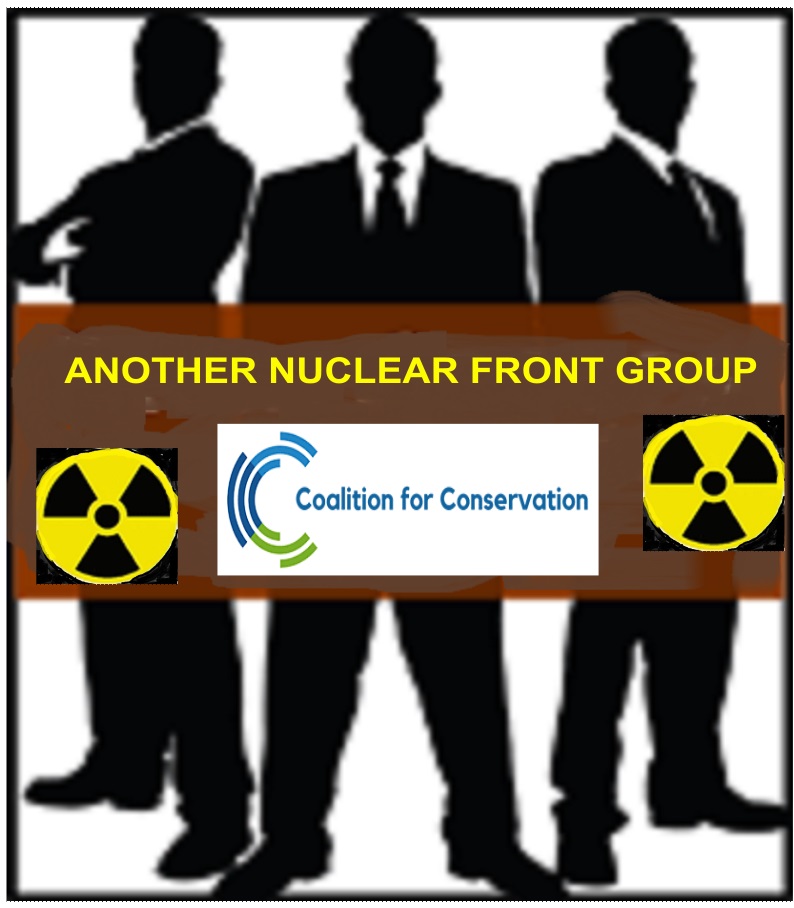
Giles Parkinson, Apr 4, 2024, https://reneweconomy.com.au/no-feasible-pathway-kean-quits-coalition-based-charity-because-of-its-obsession-with-nuclear/
Former NSW Liberal government energy minister Matt Kean has quit his role as ambassador of an environmental charity dominated by state and federal Liberal and National Party MPs, saying it had become obsessed with promoting nuclear power and is seeking to delay the rollout of renewables.
Kean says he is quitting the Coalition for Conservation (c4C) because of concerns about the direction of the charity, which has undergone a major shift in focus in the past year, coinciding – according to the AFR – with the growing involvement of patrol Trevor St Baker, the former coal baron and now nuclear investor and proponent.
“When the network was formed, I was an enthusiastic supporter, because I believe that it is the Coalition that should be the best custodians for our environment,” Kean wrote in a letter to the organisation’s chair, former federal Coalition minister Larry Anthony.
“It has become clear in recent times that the Coalition for conservation has increasingly focussed on nuclear power in the electricity system.
“In particular I was concerned to read an article in the Canberra times advocating nuclear power stations as an alternative to building new large scale transmission lines.
“While I recognise that one cannot rule out nuclear playing a constructive role in the Australian electricity system in the distant future, the reality is that there is no feasible pathway to play any material role in helping Australia replace our coal fired power stations in line with the climate science.”
The C4C appears to have undergone a rapid rethink on emissions reductions, dumping its previous support for renewable as the cheapest path to net zero in favour of nuclear.
It is a major major shift which has coincided – according to the AFR’s Rear Window column – with the growing involvement of one of the C4C two patrons, the billionaire Trevor St Baker, the former coal baron and now nuclear investor and proponent.
Kean is the architect of the plan to replace Australia’s biggest fleet of coal generators with wind, solar and storage, and whose work now forms the basis of the Federal Labor government’s Capacity Investment Scheme that will lead its own ambitious renewable energy targets.
His decision to quit the group highlights the growing divide between moderates in the Coalition, and the hard right, which has become obsessed with nuclear and is supported by a growing number of so-called “think tanks”, Murdoch media, and charities such as C4C.
The group’s recent activity on X and its own website have been focused entirely on nuclear, and it has joined the chorus of conservatives, including Coalition leader Peter Dutton and energy spokesman Ted O’Brien, in attacking institutions such as the CSIRO and AEMO for their GenCost reports and renewable energy roadmaps.
Kean wrote in his letter that large scale nuclear reactors have proven costly and slow to deliver, particularly in the UK with the massive delays and cost overruns at the Hinkley point C nuclear power project.
He also noted that small modular nuclear reactors promoted by the charity as a solution to Australia’s energy challenges are not currently commercial anywhere in the world, and early stage demonstration projects have been cancelled or delayed into the 2030’s.
“Even if (nuclear energy in Australia) were possible, it would be extremely expensive and far more expensive than the alternative as set out in AEMO’s integrated system plan,” he wrote.
“I not only regard advocacy for nuclear power as against the public interest on environmental, engineering and economic grounds, I also see it as an attempt to delay and defer responsible and decisive action or climate change in a way that seems to drive up power prices in NSW by delaying renewables.”
A hard job for the Australian government to find credible spruikers for a nuclear waste dump
Nobody wants a nuclear waste dump, By The Canberra Times, April 2 2024, https://www.canberratimes.com.au/story/8576489/nuclear-waste-disposal-woes-in-australia/
One would think, given the Australian continent is second only to Antarctica in terms of low population density, it would be easier to develop a nuclear waste dump here than almost anywhere else.
COMMENT. Why on Earth would Australia want a nuclear waste dump? Just because it has space?
Unfortunately, due in large part to a series of hubristic decisions by former governments, that is not the case.
It is now more than two decades since plans for a nuclear waste facility at Woomera had to be abandoned. A subsequent proposal to site a national storage facility at Muckaty Station in the Northern Territory fell over 10 years later.
Then, after more than seven years of research and planning, the former Coalition government’s push to use farmland near Kimba in South Australia was derailed last July and August after traditional owners took their case to the Federal Court and won.
The court set the 2021 site declaration aside on the grounds that not only had the traditional owners not been consulted, they had been deliberately excluded from the consultation process.
According to Ian Lowe, emeritus professor of environment and science at Griffith University, the process had been doomed from the start by the government’s heavy-handed approach.
“The ‘decide and defend’ model where a government decides to put radioactive waste somewhere and then attempts to defend it against the community hasn’t worked anywhere,” he said.
Opposition to the proposal, which left Kimba bitterly divided, was fuelled by revelations that even though it had been billed as a “low level” nuclear waste dump, once up and running Kimba would be used to “temporarily” store intermediate-grade material until a suitable “permanent” disposal site could be found.
While millions of Australians have benefited from radioactive medical isotypes created at the former HIFAR reactor and its replacement, the Opal reactor, at Lucas Heights nobody wants the leftover waste in their backyard. And that’s perfectly understandable.
Unfortunately the temporary storage facility at Lucas Heights, which holds some of the 5000 cubic metres of waste Australia has accumulated at about 100 locations over more than six decades, is reportedly running out of space. It apparently won’t be able to accept some classes of material as early as 2027.
COMMENT. Confusion here between the “low level” medical wastes, mainly with short half-lives of radioactivity, stored at various locations across Australia, and the “higher level” long-lasting wastes resulting from the nuclear reactor itself.
Plenty of space at Lucas Heights for continued storage of these more dangerous reactor wastes.
This has put the Albanese government on the spot. As a result it has opted to go on the front foot in terms of damage control by seeking expressions of interest for a public relations team able to manage the “high outrage” national conversation about nuclear waste disposal.
The multi-million dollar question, given Kimba had been costed at $300 million, is what process will be followed in selecting the next site. Will Resources Minister Madeleine King revisit the six sites originally shortlisted almost a decade ago? Or will fresh expressions of interest from interested landowners be sought?
And, most importantly, what consultation process does the government intend to follow? Will it repeat the “decide and defend” mistakes of past governments or will it listen to the experts including Professor Lowe who urge the highest possible level of community engagement?
Given, as he has said, that under the AUKUS agreement Australia is to manage high-level waste from the future nuclear submarine fleet this is going to be a very hard sell. Australia has come a long way since the 1950s when the Menzies government, admittedly at the height of the Cold War, gave Britain carte blanche to test its nuclear weapons in the outback.
Whoever wins the “high outrage” PR tender is going to have a big job ahead of them.
‘Poison portal’: US and UK could send nuclear waste to Australia under Aukus, inquiry told

Labor describes claims as ‘fear-mongering’ and says government would not accept waste from other nations.
Tory Shepherd, Tue 2 Apr 2024, https://www.theguardian.com/world/2024/apr/02/poison-portal-us-and-uk-could-send-nuclear-waste-to-australia-under-aukus-inquiry-told
Australia could become a “poison portal” for international radioactive waste under the Aukus deal, a parliamentary inquiry into nuclear safety legislation has heard.
New laws to establish a safety framework for Australia’s planned nuclear-powered submarines could also allow the US and UK to send waste here, while both of those countries are struggling to deal with their own waste, as no long-term, high-level waste facilities have been created.
The government introduced the Australian naval nuclear power safety bill in November last year. If passed, it will establish a nuclear safety watchdog, allow for naval nuclear propulsion facilities to be created, including for storing or disposing of radioactive waste from Aukus submarines. A second bill to enable the regulator to issue licenses was introduced at the same time.
Both have been referred to a Senate inquiry, which is due to report on 26 April.
Dave Sweeney, the Australian Conservation Foundation’s nuclear free campaigner, said the issue of waste disposal was “highly disturbing” and that the Aukus partners could see Australia as a “a little bit of a radioactive terra nullius”.
“Especially when it’s viewed in the context of the contested and still unresolved issue of domestic intermediate-level waste management, the clear failure of our Aukus partners to manage their own naval waste, the potential for this bill to be a poison portal to international waste and the failure of defence to effectively address existing waste streams, most noticeably PFAS,” he said.
The defence minister, Richard Marles, has previously accused the Greens of “fearmongering” when they raised similar concerns, saying the government would not accept waste from the other nations.
However, the legislation allows for the creation of facilities for “managing, storing or disposing of radioactive waste from an Aukus submarine”, and defines an Aukus submarine as either an Australian or a UK/US submarine, and “includes such a submarine that is not complete (for example, because it is being constructed or disposed of)”.
The Greens defence spokesperson, David Shoebridge, said HMS Dreadnought, one of the UK’s first nuclear submarines, had been “rusting away” since being decommissioned in 1980.
“You can go on Google Maps and look at them rusting away in real time, can’t you?” Shoebridge asked Australian Radiation Protection and Nuclear Safety Agency (Arpansa) chief regulatory officer, James Scott.
“Yes. There is no disposal pathway yet,” Scott said, adding he was “aware of the UK plans to establish a deep geological repository somewhere in the 2050s to 2060s”.
“There’s no exact date,” he said.
“The UK is pursuing a disposal pathway, and Australia will need to do the same. We are fully aware of this; we are engaging with our own radioactive waste agency, ARWA, on this, and it’s something that needs to be dealt with now, not later.”
The Dreadnought’s nuclear fuel has been removed to be stored safely. This has happened with some but not all of the submarines, but there is still no permanent disposal facility. The US also removes nuclear fuel for temporary storage.
Senior Western Australia Liberal calls for Australia to become nuclear weapons power

Brisbane Times, Hamish Hastie, March 11, 2024
A two-time WA Liberal candidate and party office bearer says Australia should have nuclear weapons.
Jim Seth made the argument at a Liberal Party state council meeting this month, saying nuclear weapons had made North Korea untouchable and suggested Australia should follow suit.
At the party’s March 2 meeting, details of which were leaked to WAtoday, Seth asked the question-and-answer panel:
“North Korea, a small country, has got nuclear fire, right? Nobody can do a mimicry [sic] on them, no neighbour can touch them, why we as first world country not nuclear react?”
Seth, who was a WA Liberals candidate for Bassendean in 2017 and for Morley in 2021 and is now the marketing committee chair and state executive member, furthered his point in a follow-up question about the Australian Navy’s capabilities to counter drone attacks…………………..
Seth claimed $90 million was being paid every day to Canberra public servants to create federal policies and suggested this money could be better spent on making Australia a nuclear power.
“We could have spent that money into making Australia a nuclear power, so nobody can come and do mimicry [sic] on us,” he said………………………….
WAtoday contacted Seth to clarify whether he was talking about nuclear energy or weapons, and he said “as a patriotic Australian” he believed Australia should have nuclear weapons.
He did not respond to follow-up requests for comment.
Australia has since 1970 been a signatory to the United Nations Nuclear Non-Proliferation Treaty, which binds the country to an agreement not to acquire nuclear weapons.
According to the Department of Foreign Trade and Affairs Australia has been one of the treaty’s strongest supporters and was a key player in ensuring the treaty was extended indefinitely in 1995.
Seth’s comments alarmed Nuclear Free WA co-convener Mia Pepper who said nuclear weapons would make Australia a target, not safer.
“Nuclear weapons have no strategic utility and would not enhance Australia’s defence or security,” she said.
“In a time of growing conflict and uncertainty, Australia should be proliferating peace and diplomacy, not fuelling nuclear tensions and threat.”………………… https://www.brisbanetimes.com.au/politics/western-australia/senior-wa-liberal-calls-for-australia-to-become-nuclear-weapons-power-20240308-p5fazr.html?ref=rss&utm_medium=rss&utm_source=rss_feed
‘Like a radioactive cloud’: elegance and horror combine in powerful Yhonnie Scarce exhibition
Australia’s forgotten nuclear history and its dehumanisation of Aboriginal people come together in First Nations glass artist’s fiercely intellectual work.
Guardian, by Rosamund Brennan, 2 Apr 24
Yhonnie Scarce grew up in the grim aftermath of nuclear weapons testing in South Australia in the 50s and 60s, not far from her birthplace of Woomera. From the tender age of ten, she heard stories from elders about a cataclysmic roar, the sky turning red and a poisonous black mist hovering over the desert, like an apparition.
Born in 1973, the Kothakha and Nukunu glass artist has spent much of her career researching the British government’s testing of nuclear weapons in Maralinga and Emu Field, which she says “lit a fire in my heart that hasn’t been extinguished”.
The blasts wreaked havoc on generations of Aboriginal people, as well as military personnel and non-Aboriginal civilians – sending radioactive clouds thousands of kilometres, causing burns, blindness, birth defects and premature death.
When the toxic plumes reached Ceduna, where Scarce’s family lived, radioactive slag rained down from the sky, singeing their skin. Their concerns about the burns were rebuffed by doctors, who spuriously claimed there was a measles outbreak. But today, according to Scarce, cancer is prevalent in the town.
“I call this a mass genocide,” Scarce says. “I don’t know if we’ll ever find out how many Aboriginal people died over that 10-year period. But I can imagine it’s thousands.”………………………………………………………………………………………………..
The series is revelatory of Scarce’s practice: at once fiercely intellectual, deeply felt and elegant in its materiality. As a glass-blower, Scarce quite literally breathes life into her work, animating its delicate, molten surface, giving form to invisible pain and loss.
Glass holds special significance for Scarce: crafted from silica, or sand, it emerges from the very essence of the landscape. As Australia’s only professional Indigenous glass-blower, she veered away from working with traditional forms like decorative vases or bowls, instead drawing from what she calls the “bush supermarket”: depicting yams, plums and bush bananas to convey the history of her people.
Conceived by Wardandi and Badimaya curator Clothilde Bullen, the career-spanning exhibition at AGWA also features works which examine the dehumanisation and exploitation of Aboriginal people through displacement, indentured labour and institutionalised racism. One such work is In The Dead House, which features glass bush bananas laid out on a mortuary trolley, their bodies split wide open.
……………………………………………………………………………………………… In a seemingly fated moment, when those monstrous atomic bombs exploded at Maralinga almost 70 years ago, the red desert sand melted into thousands of green shards of glass that still litter the site today. Across Scarce’s 20-year career, it’s as if she’s been slowly collecting the disaster’s shattered remains and, piece by piece, crystallising a dark, hidden chapter of Australia’s history. Like a radioactive cloud, her astonishing body of work engulfs you in its sheer power and potency.
https://www.theguardian.com/artanddesign/2024/apr/02/yhonnie-scarce-light-of-day-art-gallery-western-australia
- Yhonnie Scarce: Light of Day is showing at the Art Gallery of Western Australia until 19 May 2024
IFM Investors steers clear of nuclear projects
Jenny Wiggins, Infrastructure reporter, AFR, 28 May 24
IFM Investors, which manages some $217 billion for Australian superannuation funds, is steering clear of investments in nuclear projects due to the difficulties of managing nuclear waste.
While IFM Investors believes “energy security is fundamental,” it hasn’t invested in any nuclear projects to date, global head of infrastructure Kyle Mangini told The Australian Financial Review.…………… (Subscribers only) https://www.afr.com/companies/infrastructure/ifm-investors-steers-clear-of-nuclear-projects-20240325-p5ff1h
Nuclear ranks last on list of good investments by big institutions
Marion Rae, Mar 25, 2024, https://reneweconomy.com.au/nuclear-ranks-last-on-list-of-good-investments-by-big-institutions/
Nuclear energy is last on the list of technologies that investors want exposure to, according to a survey of big financial institutions.
The vast majority of investors do not see nuclear power as a good investment, with less than one in 10 exploring this technology, the survey released on Monday found.
Opposition Leader Peter Dutton is spruiking nuclear reactors as an option for Australia’s future low-carbon economy although the energy source is illegal under existing laws and Labor has ruled it out.
Renewable energy is tipped to deliver the best long-term financial returns, with half the investors surveyed exploring opportunities to invest.
Investors have also become more confident about Australian climate policy under the Albanese government, according to the survey by the Investor Group on Climate Change.
“Investors have given the government a pretty good report card,” the group’s policy chief Erwin Jackson said.
But Australia will need globally competitive, targeted incentives to suit the nation’s economic strengths and values to stop “ongoing capital flight” to the United States and Europe where there are more generous tax breaks.
Clear timelines for the phase-out of fossil fuels by 2050 would also help investors manage transition risks and remain invested in the Australian economy, according to the group.
This year’s data includes 63 superannuation funds as well as other asset owners and managers, with more than $37 trillion in assets under management globally. Their beneficiaries include more than 15 million Australians.
Emerging priorities include clear timelines for phasing out coal, oil and gas and clear policies to build resilience and adapt to physical damage from climate change.
Opinions citing policy and regulatory uncertainty as a barrier to clean economy investment in Australia have changed dramatically, supported by four out of 10 investors compared with 7 out of 10 in 2021.
Renewable energy (47 per cent) was picked as the best option for long-term climate solutions, followed by nature-based schemes including biodiversity projects (34 per cent).
But investors are still in the dark on the federal government’s sector-by-sector decarbonisation plans for heavy polluters such as the energy, transport, agriculture and resources industries – and on the scope of the 2035 emissions reduction target.
“Credible and clear sector by sector decarbonisation plans to achieve a 2035 target with the highest possible level of ambition are critical for investment and it is critical to build on the steps already taken,” Mr Jackson said.
Climate Change and Energy Minister Chris Bowen has said the 2035 target will be “ambitious and achievable”, with advice to come from Australia’s recently beefed-up Climate Change Authority.
The sectoral review by the authority has an August 1 deadline, and will be released shortly afterwards.
AAP
1 This month

of the week – Australians for War Powers Reform (AWPR)
To see nuclear-related stories in greater depth and intensity
 Antinuclear