The cloud of coal has long hung over the Latrobe Valley. Now nuclear power is dividing it
Cait Kelly, Mon 24 Jun 2024 https://www.theguardian.com/australia-news/article/2024/jun/23/the-cloud-of-coal-has-long-hung-over-the-latrobe-valley-now-nuclear-power-is-dividing-it
No matter where you are in the Latrobe Valley, you can see the smoke haze. The transmission lines that punctuate the region’s dairy farms and clusters of blue gums all lead to some of the country’s biggest coal-fired power plants, where the plumes of smoke soar from smokestacks and steam from cooling towers.
This valley provides most of Victoria’s electricity, but it’s been on the edge of a precipice. Over the next 11 years, Loy Yang A and Yallourn are expected to be decommissioned. Residents know the writing is on the wall for coal, but confusion over what comes next is creating a deep chasm.
Now the valley’s communities – and those of six other locations around Australia – are on a new energy frontline. On Wednesday, the Coalition promised that, if elected to government, a part of the Loy Yang station would be one of seven sites to host a nuclear reactor.
The announcement spread quickly down the valley. Some welcome it, seeing it as a lifeline for their dying community. And then there are pockets of outrage.
Wendy Farmer is an unlikely advocate for renewables because coal is in her blood. She is a miner’s daughter; her father was a miner’s son. Her husband worked at the Hazelwood plant before it was decommissioned in 2017. The plant was infamous for two things – the 2014 fire that burned for 45 days and for being Australia’s dirtiest power station.
But Farmer is helping lead a group of advocates for a healthier and more sustainable valley – and she’s outraged by the nuclear proposal when “we have the technology we need to move forward without it”.
“It’s a slap in the face,” she says. “It’s them going, ‘You’re desperate, so you’ll take it’.”
There are many questions about the Coalition policy, including the cost, what to do about the waste, how the plants could be built and when, how many jobs would it actually create – and how geographically safe would it be to have a nuclear plant near a faultline.
“Why would you even consider putting nuclear on earthquake faultlines?” Farmer says.
“It doesn’t feel like it’s community-driven – no one in the community has been asked about it. They’ve just been told this is what our plan is.”
On Wednesday, Farmer led a snap protest outside the Gippsland National MP Darren Chester’s office. Chester has cautiously welcomed the nuclear policy, saying in a statement it could create “enduring social and economic benefits to our community”, before adding that “more detailed investigations will be required in the years ahead”.
‘Always looking for more jobs’
Traralgon is the biggest town in the valley and is wedged between the power plants and the big hole left by Hazelwood – between a brown coal past and Australia’s commitment to get to net zero emissions by 2050.
Of the 125,000 people who live in the valley, 26,000 call Traralgon home.
In the newsagent it’s buzzing. People are queueing for their Lotto ticket or a copy of the paper. The workers behind the counter won’t say much about nuclear – one thinks it’ll just get her in trouble and the other says she’s supportive but will grab the boss.
The boss is Gary Garth. He’s upfront with his opinion and cares about his community and the number of jobs. He loves the nuclear idea.
“I think there are a lot of hurdles, obviously, they’ve got to get through to do it. But I think the vision is good. And it would be great for the area,” Garth says.
“We are always looking for more jobs for locals and that’s probably the most important thing a society can have: people in employment.”
Decades ago, this area was booming – high-paying jobs created a cashed-up community. But coal is no longer king. The most recent census had unemployment sitting at 6.6%, higher than the Victorian average of 5%.
“If the governments can come up with a way of turning energy into nuclear where it’s safe, safe for the environment, safe for everyone, it’s very clean, so if it can be done, that would be a real benefit to the area,” Garth says.
In parts of the community, renewables are also seen as a threat. Garth describes windfarms as “a disaster for the environment” – he’s worried about the birds and what we do with the materials when they come to the end of their lifespan.
But it’s not a concern he holds for nuclear waste.
“Australia is a big place. They need to be able to come up with something – they seem to do in other countries around the world,” he says.
He thinks the community will vote for it and says the Coalition will have a mandate to proceed with it if it wins power – and that the state government would be foolish not to listen to the electorate.
Before the announcement, the Coalition reportedly polled each of the seven communities, with 55% of the Latrobe Valley respondents said to be supporting nuclear.
But on the streets of the valley, not everyone is convinced by the Coalition’s promise.
Ian, a former geologist, says the opposition leader, Peter Dutton, “hasn’t done his homework”.
But another resident, Jesse, thinks it will be a good creator of jobs.
“I think it’s a good thing, especially with all the coal shutting down,” Jesse says.
“I think the nuclear side of things will offer more ongoing jobs [than windfarms]. And we’ll have a stable power supply. Everyone needs the power to keep warm and cook and all that sort of stuff … We need to have a stable power supply.”
‘Softened up for nuclear’
Penelope Swales is sitting in a rare slither of winter sun on her organic farm at the bottom of the Strzelecki Ranges. It’s cut from a different cloth to Traralgon – there’s a rail trail, a brewery and a beloved community band. It lures former city slickers with its shaggy green hills and bush walks, and turns them into locals. Swales was a lawyer before she took up the plough.
“I feed 20 local families with this farm,” she says.
“That cloud between the two trees” – she points to the distance where the smoke is slowly filling the air, making a large cloud that drifts east towards Melbourne – “that’s Loy Yang. So pretty close.”
Swales is joined by her friends Marge Mackay and Lisa Mariah, who have also moved to the valley for its natural beauty and relaxed lifestyle. They don’t want nuclear.
“The demographic here is a little bit odd,” Swales says.
“While most people work in Morwell and Traralgon, progressive and pro-renewable voices don’t get a lot of a look in because most of us live up here in the Strzelecki corridor, which is bisected by the electoral boundary.
“So a bunch of us are on one side and a bunch of us are on the other side.”
She says that, over the past four years, the region has been “softened up for nuclear”. There has also been a bitter campaign over plans to build a windfarm in a pine plantation overlooking the former Hazelwood coal plant.
“People came in from outside, held public meetings, ran a very slick campaign telling people, ‘this is going to be bad for your community, this is going to destroy your community, this is going to ruin your property values, infrasound will keep you awake at night’,” Swales says.
The fight spread misinformation and put the sleepy community at loggerheads, she says.
“The more progressive people tend to keep their heads down,” she says. “There’s been some very vicious stuff going on. We’ve had vandalism. One of their friends had ‘sell-out’ sprayed on the footpath outside at home. You know, she’s a pensioner.”
The long campaign against renewables has created “fertile ground”, Swales says. If someone says “jobs”, they get the votes.
But the group of friends is determined to fight – they say they’ve done it before. Mackay jumps in and says her community was dumped with coal, was not supported after the Hazelwood fire and is now getting shunted with nuclear. She wants a different future.
“The valley has been the dumping ground for Victoria for a very long time,” she says.
“There is a lack of forward vision for future generations – this is your children and your grandchildren.
Matt Kean to helm Climate Change Authority, says no to nuclear

Rachel Williamson, Jun 24, 2024, ReNewEconomy
The architect of New South Wales’ (NSW) renewable energy transition is set to be the next Climate Change Authority (CCA) chair, with Matt Kean stepping up to take on the job of advising on the options and pace of the national shift to decarbonisation.
The former NSW Liberal MP and state energy minister – who only stepped down from politics late last week – will combine decarbonisation with economic policy in his new role, a job whose importance is taking on an outsized importance in advance of an election set to be fought on how to get to net zero.
The CCA advises the government on climate change policy.
He then handled the NSW emissions reductions target of 70 per cent by 2035.
Today, Kean rejected nuclear as a solution the CCA will support, saying that his department looked into the energy source for NSW and advice was that it would take too long and be too expensive.
He says the advice was from professor Hugh Durrant-Whyte, who was responsible for the British government’s nuclear defence program and is one of the few people in Australia to have actually run a nuclear program.
Retiring chair Grant King restored the agency to “its proper role” supporting the government’s climate goals, says energy and climate change minister Chris Bowen.
“Good climate and energy policy is good economic policy – the Albanese government gets that and so does Matt Kean,” he said in a statement.
“Our ambitious but achievable policies are ensuring our approach is credible and delivers benefits for all Australians. The Climate Change Authority is critical to this agenda.
“Matt Kean’s time in public office was marked by reform and the ability to bring people from across the political spectrum with him for the good of the community.”…………………………………………………………………. more https://reneweconomy.com.au/matt-kean-to-helm-climate-change-authority-says-no-to-nuclear/
Nuclear industry workers face significant, inevitable and unavoidable radiation health risks
By Tony Webb, 24 June 24, https://johnmenadue.com/nuclear-industry-workers-face-significant-inevitable-and-unavoidable-radiation-health-risks/
Nuclear industry workers face significant, inevitable and largely unavoidable radiation health risks which have so far not been addressed in the debate about Australia possibly buying into this industry.
In addition to the important arguments against the coalition policy that currently proposes building seven nuclear power plants to replace closing coal fired generators, notably that such:
will be likely cost about twice that of firmed renewable generation and take at least 15 years to build – and this in the context where most nuclear plant construction worldwide appears to routinely involve a doubling of both cost and time to build
– and so are dangerously irrelevant to meeting the existential challenge to reduce carbon and methane emissions that are driving climate change;
will require legislative changes at state and federal levels that are to say the least unlikely to be achieved;ignores the challenge of developing workforce skills to manage this technology;
ignores the as yet intractable if not insoluble problem of managing long lived nuclear wastes;
and poses significant risks to the public in the event of nuclear accidents as witnessed in the USA, Ukraine/former USSR, and Japan;
There is also an inevitable and unavoidable risk to workers in the industry and public ‘downwind’ from such reactors from routine exposure to ionising radiation.
This last has to date received little attention and whenever raised results in dismissive but misleading arguments from the nuclear industry advocates, notably that any such exposures to individuals are small and pose little, indeed ‘acceptable’ health risks compared to other risks faced in day to day living and working. Tackling this misinformation as part of the campaign has much to offer in convincing the nuclear target communities and the workers in these that might be seduced by prospects of employment in these facilities that the risks they face are far from insignificant – that, as a community they will face an increase in the incidence of fatal and ‘treatable / curable’ cancers, an increase in other, notably cardio vascular diseases and increased risk of genetic damage affecting children and future generations.
Allow me to introduce myself. I have been an active campaigner on the health effects of ionising radiation since the late 1970s. With two colleagues in 1978 I founded the UK based Radiation and Health Information Service that highlighted the evidence showing the risk estimates from radiation exposure, on which the national and international occupational and public exposure limits were based, grossly under-represented the actual risk.
This radiation-health argument was developed as part of a national campaign that resulted in a significant change of the, until then, pro-nuclear policies of UK unions with members in the industry and a review of Trade Union Congress policy in 1979. It was also an integral part of the union-led national Anti-Nuclear Campaign opposing the Thatcher government’s nuclear expansion – revealed in leaked cabinet minutes as part of the government strategy for undermining the power of the unions, particularly the National Union of Mineworkers (NUM), the Transport and General Workers Union, (T&GWU) and the General and Municipal, Boilermakers’ and Allied Trades union (GMBATU). In late 1980 I took this work on Occupational Radiation risks to the USA establishing the US Radiation and Health Labor Project, auspiced by the Foundation for National Progress / Mother Jones Magazine, that built union support across the country for AFL-CIO policy calling for a reduction in the occupational exposure limit.
Subsequently I worked as a consultant to the Canadian union (CPSU – local 2000) representing workers in the nuclear power industry and built a Canadian coalition of five Unions representing workers exposed to radiation on the job. Linking these North American union demands with those of UK and European unions (also similar concerns from unions in Australia following a 1988 organising tour) reinforced pressures from within the scientific community – notably the US Biological Effects of Ionising Radiation (BEIR) committee.
These sustained pressures led eventually to the International Commission on Radiological Protection (ICRP) reducing the recommended limits for permissible occupational (and public) exposures in 1991. Despite evidence that would have justified a ten-fold reduction (from the 50 mSv annual occupational limit to a limit of 5 mSv) the ICRP limit was only reduced by 40% (to 20 mSv a year but with individual exposures still permitted to 50 mSv in any year so long as the average over 5 years was no higher than 20 mSv).
Since then, a large-scale study of UK, EU, and US nuclear industry workers has shown radiation-induced cancer risks to be on average 2.6 times higher than the estimates used to set the ICRP limits. To put it in simple if statistical terms, the lifetime cancer risk for a worker exposed to the permissible annual dose of radiation over say a 25-year career would be of the order of 6.5% higher than normal. To this should be added the significant health effects of non-fatal cancers, an approximate doubling of the normal rate of cardio-vascular disease and a not insignificant increase in genetic damage to workers children and future generations. Nuclear industry workers face significant, inevitable and largely unavoidable radiation health risks which have so far not been addressed in the debate about Australia possibly buying into this industry.
What needs to be more clearly understood however is that the concern is not just in relation to risks faced by individuals exposed on the job, or from relatively small amounts of radiation released from routine operations of nuclear plants. What is of far greater public concern is the impact of the collective exposure. What is not fully appreciated is that there is simply no safe level of exposure – any dose however small may be the one that causes damage at cellular level in the human body that may show up years later as cancer, genetic damage or some other health effect. it is the total/collective dose that will determine the number of such health effects. Spreading the dose over a larger population will reduce the risk to any individual but not the total health effects. Indeed, it may increase it. An individual affected by cancer can only die once.
These arguments carry weight. They formed a significant part if the discussions within the 2016 South Australian government’s ‘Citizens Jury’ convened to consider proposals to import and store around a third of the world’s nuclear wastes. The concern about radiation and health received special note in the report of this jury to the SA Premier that a two-thirds majority said ‘no – under any circumstances’ to the radioactive waste proposal. The issues can also form the basis for increased collaboration between the trade union, environment, medical reform and public health movements as was the case in the mid 1990s when UK, Labour MP Frank Cook convened a Radiation Roundtable that brought together representatives of these constituencies.
So, within the current debate about a possible Australian Nuclear Power program – alongside the arguments already made about its excessive cost, extended construction time frame, ill-fit within an essential decentralised renewable energy program, risks of major accidents, and the intractable problems of multi-generation waste management, can we please add this concern over health effects that will inevitably result from occupational and public exposures to radiation. Can we particularly focus the attention of trade unions and their members in the seven former coal-fired generation-dependent communities on the effect of these exposures on health of workers who might seek to be employed in operating these facilities and on the health of their families, neighbours, and future generations.
A key demand from unions should be that the occupational limit for annual radiation exposures cbe reduced from the current ICRP level of 20 mSv to a maximum of 5 mSv a year with a lifetime limit of 50 mSV. This revision of standards would put real pressure on the nuclear industry – the current uranium mining and any future enrichment, fuel fabrication, nuclear generation, fuel reprocessing, and waste management – to keep such exposures as low as possible. In the unlikely event of any of the reactor proposals getting the go-ahead there should be baseline monitoring of the health of the community and any workers employed so that any detrimental increase in health effects can be detected early and possibly remediated in the future.
Nuclear power exits Australia’s energy debate, enters culture wars

Jim Green, Jun 13, 2019, https://reneweconomy.com.au/nuclear-power-exits-australias-energy-debate-enters-culture-wars-47702/
What do these politicians and ex-politicians have in common: Clive Palmer, Tony Abbott, Cory Bernardi, Barnaby Joyce, Mark Latham, Jim Molan, Craig Kelly, Eric Abetz, and David Leyonhjelm?
Yes, they’re all men, and all so far to the right of the political spectrum that right-wing ideologues think they are right-wing ideologues.
And they all support nuclear power.
To the far-right, pro-nuclear luminaries listed above we could add the right-wing of the right-wing National Party (pretty much all of them), the Minerals Council of Australia (who lobby furiously for clean nuclear and clean coal), the Business Council of Australia ,media shock-jocks Alan Jones and Peta Credlin (and others), the Murdoch media (especially The Australian newspaper), the Citizens Electoral Council, and the Institute of Public Affairs and its front group the Australian Environment Foundation.
It’s no surprise that the far-right supports nuclear power (if only because the ‘green left’ opposes it).
But in Australia, support for nuclear power is increasingly marginalised to the far-right. Indeed support for nuclear power has become a sign of tribal loyalty: you support nuclear power (and coal) or you’re a cultural Marxist, and you oppose renewables and climate change action or you’re a cultural Marxist.
Support for nuclear power in Australia has ebbed in the aftermath of the Fukushima disaster, catastrophic costs overruns on reactor projects, and the falling costs of renewables.
Dr Ziggy Switkowski used to be nuclear power’s head cheerleader in Australia and he led the Howard government’s review of nuclear power in 2006. But he said last year that “the window for gigawatt-scale nuclear has closed” and that nuclear power is no longer cheaper than renewables with costs rapidly shifting in favour of renewables.
Peter Farley, a fellow of the Australian Institution of Engineers, wrote in RenewEconomy earlier this year:
“As for nuclear the 2,200 MW Plant Vogtle [in the US] is costing US$25 billion plus financing costs, insurance and long term waste storage. … For the full cost of US$30 billion, we could build 7,000 MW of wind, 7,000 MW of tracking solar, 10,000 MW of rooftop solar, 5,000MW of pumped hydro and 5,000 MW of batteries. … That is why nuclear is irrelevant in Australia. It has nothing to do with greenies, it’s just about cost and reliability.”
In January, the Climate Council ‒ comprising Australia’s leading climate scientists and other policy experts ‒ issued a policy statement concluding that nuclear power plants “are not appropriate for Australia – and probably never will be”.
The statement continued: “Nuclear power stations are highly controversial, can’t be built under existing law in any Australian state or territory, are a more expensive source of power than renewable energy, and present significant challenges in terms of the storage and transport of nuclear waste, and use of water”.
NUCLEAR COSTS INCREASE FOUR-FOLD, SEVEN-FOLD, TEN-FOLD
The 2006 Switkowski report estimated the cost of electricity from new reactors at A$40–65 per megawatt-hour (MWh). That’s roughly one-quarter of current estimates. Lazard’s November 2018 report on levelized costs of electricity gives these figures:
- New nuclear: A$161‒271 / MWh(US$112‒189)
- Wind: A$42‒80 / MWh(US$29‒56)
- Utility-scale solar: A$52‒66 / MWh(US$36‒46)
- Natural-gas combined-cycle: A$59‒106 / MWh(US$41‒74)
In 2009, Switkowski said that the construction cost of a 1,000 MW power reactor Australia would be A$4‒6 billion.
Again, that’s about one-quarter of all the real-world experience over the past decade in western Europe (and Scandinavia) and north America, with cost estimates of reactors under construction ranging from A$14‒24 billion.
The V.C. Summer project in South Carolina (two AP1000 reactors) was abandoned after expenditure of at least A$12.9 billion. The project was initially estimated to cost A$14.1 billion; when it was abandoned, the estimate was around A$36 billion. Largely as a result of the V.C.
Summer disaster, Westinghouse filed for bankruptcy and its parent company Toshiba almost went bankrupt as well.
The cost estimate for the Vogtle project in US state of Georgia (two AP1000 reactors) has doubled to A$38.8‒43.2+ billion and will increase further, and the project only survives because of multi-billion-dollar government bailouts.
In 2006, Westinghouse said it could build an AP1000 reactor for as little as A$2.0 billion ‒ that’s 10 times lower than the current estimate for Vogtle.
In the UK, three of six proposed reactor projects have been abandoned (Moorside, Wylfa, Oldbury), two remain in limbo (Sizewell and Bradwell) and Hinkley Point C is at the early stages of construction.
The estimated combined cost of the two EPR reactors at Hinkley Point, including finance costs, is A$48.7 billion (£26.7 billion ‒the EU’s 2014 estimate of £24.5 billion plus a £2.2 billion increase announced in July 2017).
A decade ago, the estimated construction cost for one EPR reactor in the UK was almost seven times lower at A$3.7 billion.
The UK National Audit Office estimates that taxpayer subsidies for Hinkley Point ‒ primarily in the form of a guaranteed payment of A$169 / MWh, indexed for inflation, for 35 years ‒ will amount to A$55 billion, while other credible estimates put the figure as high as A$91 billion.
Hitachi abandoned the Wylfa project in Wales after the estimated cost of the twin-reactor project had risen from A$26.4 billion to A$39.7 billion.
Hitachi abandoned the project despite offers from theUK government to take a one third equity stake in the project; to consider providing all of the required debt financing; and to consider providing a guarantee of a minimum payment per unit of electricity (expected to be about A$137 / MWh).
In France, one EPR reactor is under construction at Flamanville. It is seven years behind schedule (and counting) and the estimated cost of A$17.7 billion is more than three times the original estimate of A$5.4 billion.
In Finland, one EPR reactor is under construction. It is 10 years behind schedule (and counting) and the estimated cost of A$13.8 billion is nearly three times the original A$4.9 billion estimate.The A$13.8 billion figure was Areva’s estimate in 2012; true costs have likely increased
NUCLEAR EXITS AUSTRALIA’S ENERGY DEBATE, ENTERS CULTURE WARS
The far-right won’t let facts get in the way of their promotion of nuclear power. NSW Deputy Premier John Barilaro claims that nuclear power would probably be the cheapest power source for the average Australian household and is “guaranteed” to lower power bills.
The claim by the Institute of Public Affairs that 10 power reactors could be built for A$60 billion is out by A$100 billion or so. Jim Molan claims nuclear power is cheap and the cost is comparable to coal.
Clive Palmer claims that nuclear power is cheap and that the federal government should fund the construction of a nuclear power plant.
The far-right repeatedly claim that ‘small modular reactors’ (SMRs) will come to the nuclear industry’s rescue. But real-world experience with SMRs under construction suggests they will be hideously expensive.
According to a December 2018 report by the CSIRO and the Australian Energy Market Operator, the cost of power from SMRs would need to more than halve to be competitive with wind and solar PV even with some storage costs included (two hours of battery storage or six hours of pumped hydro storage).
Tony Abbott’s rationale for supporting nuclear power ‒ and repealing Howard-era legislation banning nuclear power plants ‒ is to “create a contest” with the unions, GetUp, the Greens and the Labor Party. Likewise, he said last year that promoting nuclear power “would generate another fight with Labor and the green left.”
Abbott ‒ and some others on the far-right ‒ would undoubtedly oppose nuclear power if Labor and the ‘green left’ supported it and they would be pointing to the A$14‒24 billion price-tags for new reactors in western Europe and north America.
Abbott seems to have forgotten the experience in John Howard’s last term as Prime Minister. Howard became a nuclear power enthusiast in 2005 and the issue was alive in the 2007 election contest.
Howard’s nuclear promotion did nothing to divide the Labor Party. On the contrary, it divided the Coalition, with at least 22 Coalition candidates publicly distancing themselves from the government’s policy during the election campaign.
The policy of promoting nuclear power was seen to be a liability and it was ditched immediately after the election.
LUNATICS IN CHARGE OF THE ASYLUM
Those of us opposed to nuclear power can take some comfort in its increasing marginalisation to the far-right. But there are far-right-wingers highly placed in the federal government and a number of state governments.
Right-wing National Party MPs are lobbying for a Senate inquiry and for a repeal of the legislation banning nuclear power. According to Greens Senator Sarah Hanson-Young:
“Talk of overturning the ban on nuclear power in Australia is crackpot stuff. Aside from being a dangerous technology, nuclear power is wildly expensive and would take a decade or more to build. It would be a funny joke if it wasn’t so embarrassing to have the Nationals, who are in government and who sit around the cabinet table, pushing for this. These people are meant to be in charge, and they’re running around like a bunch of lunatic cowboys.”
Senator James McGrath claims that many Nationals support nuclear power, hence the push for a Senate inquiry “to make informed decisions rather than allow the loons of Twitter to shout down this important discussion.”
On the subject of “loons”, as he describes them, McGrath’s pown erformance on ABC’s Q&A program in April was likened to a “one way trip to crazy town“.
It has the sense of a political set-piece: the far-right wins control of the numbers on a Senate inquiry and the government agrees with its pro-nuclear findings and repeals the legislation banning nuclear power.
But would Prime Minister Scott Morrison agree to repeal the ban given that there is no prospect of nuclear power being a viable option for Australia in the foreseeable future? Surely that would be an own goal, providing ammunition to political opponents and opening up divisions within the Coalition.
If Morrison agreed to repeal the ban ‒ and he says the government has no plans to do so ‒ it would presumably only be because he felt constrained to do so by far-right Coalition MPs and by non-government far-right Senators such as Pauline Hanson. (He is also dealing with the far-right push for government funding for a new coal-fired power plant.)
NSW Premier Gladys Berejiklian has the same calculation to make in response to the nuclear power push driven by right-wing Nationals (including Deputy Premier John Barilaro) and by One Nation’s Mark Latham (who introduced the Uranium Mining and Nuclear Facilities (Prohibitions) Repeal Bill 2019 to the NSW Parliament in May 2019).
ECOMODERNISTS
Of course, support for nuclear power in Australia isn’t exclusively limited to the far-right, although it is heading that way.
A tiny number of self-styled ‘pro-nuclear environmentalists’ or ‘ecomodernists’ continue to bang the drum. Ben Heard, for example, continues to voice his support for nuclear power ‒ his advocacy lubricated by donations and amplified by the right-wing media and by invitations to any number of nuclear-industry talk-fests.
Heard continues undeterred by the South Australian Nuclear Fuel Cycle Royal Commission’s clear acknowledgement that nuclear power is not economically viable in Australia or by its complete rejection of his ‘next generation’ nuclear fantasies.
But what impact could Heard’s nuclear advocacy possibly have in the current context, with fossil fuel interests fighting to protest their patch and to curb the growth of renewables, and with nuclear power being so exorbitantly expensive that isn’t part of any serious debate about Australia’s energy options?
Surely the only effect of nuclear advocacy in the current context is to muddy the debate about transitioning from fossil fuels to renewables and thus to shore up incumbent fossil fuel interests.
Australian economist John Quiggin discussed these issues last year:
“The problem is that nuclear fans like Ben Heard are, in effect, advocates for coal. Their line of argument runs as follows:
(1) A power source with the characteristics of coal-fired electricity (always on) is essential if we are to decarbonise the electricity supply
(2) Renewables can’t meet this need
(3) Nuclear power can
“Hence, we must find a way to support nuclear. The problem is that, on any realistic analysis, there’s no chance of getting a nuclear plant going in Australia before about 2040.
So, the nuclear fans end up supporting the Abbott crew saying that we will have to rely on coal until then. And to make this case, it is necessary to ignore or denounce the many options for an all-renewable electricity supply, including concentrated solar power, large-scale battery storage and vehicle-to-grid options.
As a result, would-be green advocates of nuclear power end up reinforcing the arguments of the coal lobby. … In practice, support for nuclear power in Australia is support for coal. Tony Abbott understands this. It’s a pity that Ben Heard and others don’t.”
Dr Jim Green is the editor of the Nuclear Monitor newsletter and national nuclear campaigner with Friends of the Earth Australia
Nuclear engineer dismisses Peter Dutton’s claim that small modular reactors could be commercially viable soon

Hugh Durrant-Whyte says 2045 is a realistic timeframe, adding it was likely to be ‘more expensive than anything else you could possibly think of’
Peter Hannam, Fri 21 Jun 2024, https://www.theguardian.com/australia-news/article/2024/jun/21/peter-dutton-coalition-nuclear-policy-engineer-small-modular-reactors-no-commercially-viable
Australia would need “many decades” to develop the regulations and skills to operate a nuclear power plant, and the experience gained at the existing Lucas Heights facility won’t help much, according to New South Wales’ chief scientist and engineer.
Hugh Durrant-Whyte said he stood by comments made to a 2019 NSW upper house inquiry into uranium mining and nuclear facilities that running a plant and its fuel supply chain would require skills “built up over many decades”.
Stressing he spoke in the capacity of a trained nuclear engineer rather than as the state’s chief scientist, Durrant-Whyte said the industry demanded regulations and monitoring for all stages of fuel handling, power generation and waste management.
He told Guardian Australia that 2040 or even 2045 was the “realistic” timeframe.
“We would need people who were trained [on] how to measure radioactivity, how to measure containment vessel strengths, how to [manage] everything we do.”
The federal opposition on Wednesday revealed plans to build seven nuclear power stations in five states at existing coal plant sites, promising the first could be operating by the mid-2030s.
The government would own the plants and compulsorily acquire the sites if the owners – private companies as well as the Queensland and Western Australian governments – declined to sell them.
The shadow energy spokesperson, Ted O’Brien, has cited France and Canada as examples Australia could follow. He also offered the example of Lucas Heights, located in Sydney’s south, where a small reactor has been used for medical research for decades.
Durrant-Whyte said Canada’s nuclear industry employed about 30,000 people while France’s employed 125,000 – “not a trivial number of people”.
The UK, which operated nuclear plants for many years, has just one nuclear engineering program at an undergraduate level, limiting the supply of talent that could be imported from there.
He was also dismissive of the prospect that small modular reactors – which the opposition proposes to start its nuclear program with – were likely to be commercially viable soon.
“When I was [at Rolls-Royce] in 1979 my colleagues in the couple of desks next to me were designing SMRs,” he said. “It’s always the issue with anything big and complex. Whether it’s an aeroplane or a nuclear reactor, the first one is always the hardest.”
The capabilities learned at the Lucas Heights Ansto (Australian Nuclear Science and Technology Organisation) facility would make “little contribution” to supporting a nuclear power industry in the country, he wrote in his 2019 report.
“It must be recognised that this is a ‘zero-power’ pool reactor where the complexities of high pressure, high power, high radiation environments do not exist.”
Similarly, the capabilities needed to manage nuclear-powered submarines as part of the Aukus program also offered few transferrable skills. The pressurised water reactors on the submarines would be, in effect, SMRs of a 100-200 megawatt capacity size.
“My suspicion is we will buy the reactors in a piece of submarine and assemble that piece into submarines here,” Durrant-Whyte said. “But even then, let’s be clear, we’re not going to be doing that until the mid-2040s.”
As for safety, he said nuclear reactors were designed to be “very, very safe”. But there “have been a lot of accidents because of fuel handling and things like that” as a result of human error.
“It’s not like we haven’t had this [nuclear] conversation many times over the last 20 years in Australia,” Durrant-Whyte said. “It would be expensive, and likely more expensive than anything else you could possibly think of.”
Australian Futures: Bringing AUKUS Out of Stealth Mode, and the true financial costs

June 21, 2024, by: The AIM Network, By Denis Bright
With both sides of the mainstream Australian political divide supporting the AUKUS deal, debate about the merits of this commitment by Scott Morrison has largely gone into recess.
As the third anniversary of Scott Morrison’s announcement of the AUKUS deal on 16 September 2021 approaches, there is growing confidence in the defence establishment that Australians have accepted the need for nuclear-powered submarines. The Defence Special Supplement in The Australian (28 May 2024) is a sign of this confidence. Multinational defence companies have lined up to fund advertisements which demonstrated their patriotic commitment to AUKUS with the support of the South Australia Government.
Each of the defence companies listed maintains a profitable involvement in both military and civilian projects. The KBR engineering company of Houston emphasizes a benign involvement in Australian civilian engineering projects like the Snowy Mountains upgrade and the Adelaide to Darwin Railway. This company is more deeply involved in the military sector globally.
Readers with access to the Defence Supplement can undertake their own research to uncover the ownership and activities of each of the British and US companies listed in the supplement. Here is a sample of the defence outreach from KPR Engineering:
KBR’s Defense Systems Engineering Business Unit goes beyond providing full spectrum engineering and technical solutions across the lifecycle of DoD military systems on land, at sea, in the air, and in space. KBR differentiates itself in the industry by integrating emerging technologies with platform experience to deliver increased value to US DoD and our allies.
Advertising in combination with sensational eyewitness news reporting works in eroding resistance to AUKUS. The Lowy Institute has monitored quite favourable public support for AUKUS arrangements:
Expect concerns about AUKUS to resurface in the future as the cost burdens increase and the encirclement of China by the US Global Alliance takes its toll on longer-term trade and investment relationships between Australia and China. Strategic mishaps are always possible as surface vessels and submarines compete for space in the South China Sea, the Taiwan Strait and the East China Sea. Sabre rattling over uninhabited rock outcrops and remote islands has continued for a couple of decades over rival claims about freedom of navigation. Fortunately. There have been no major mishaps.
Ironically, the US has not ratified the UN’s Freedom of Navigation conventions from the 1980s. Its strategic policies seek alternatives to Chinese trade and investment links with countries across the US Global Alliance as an afford to the peace outreach of China:
The costs of the AUKUS extend well beyond the financial and strategic costs of future naval hardware. Australia’s support for the naval encirclement of our best trading partnership will have an unknown impact on our own regional economic diplomacy. Australia’s Future Fund Chief Executive Dr Raphael Arndt dared to warn that global strategic tensions had intruded into financial decision-making and risk assessments (AFR Weekend 15 June 2024). The longer-term impact on Australian trade and investment with China is still a matter for speculation.
Financial Costs of AUKUS
According to Al Jazeera News (11 June 2022), the Albanese government completed a final payment to France of approximately $850 million for breach of contract over the abandonment of the purchase of twelve Attack-class submarines from Naval Group. Despite cost increases and construction delays, delivery of the diesel-electric submarines should have commenced in the late 2020s at a cost that was a fraction of the AUKUS estimates.
The costs of the AUKUS deal are less transparent. Construction costs alone extending over 30 years were initially set at up to $368 billion (AFR 17 March 2023). The extended delivery dates are a cause for concern. US and British supplied nuclear-powered (SSN) submarines might be deployed here in the late 2020s. At least three Virginia class submarines will be built for Australia with a new class of British submarines arriving in the late 2030s before Australian built SSNs come online in the 2040s.
Strategic Risks
Hopefully, the strategic risks of maintaining a new SSN fleet were considered prior to the AUKUS announcement by Scott Morrison on 16 September 2021. How could this have been achieved competently with a critical review from only three cabinet ministers?
Media concerns should have been raised after Scott Morrison claimed in the 7.30 Report interview with Sarah Ferguson that discussions on the AUKUS alternatives were made with just two other ministers at a time when he held multiple ministerial portfolios with the approval of the Australian Governor General between March 2020 and the election in 2022 (14 March 2023).
Before attending the G-7 Summit in Cornwall as a specially invited guest of the Summit Chair Boris Johnson, Scott Morrison had been sworn into the portfolios of Health, Finance, Industry, Science, Energy and Resources, Home Affairs and Treasury. The 47th G-7 Summit convened a month after Scott Morrison’s last two ministerial appointments. Perhaps Boris Johnson could be quizzed on this issue. Both Boris Johnson and Scott Morrison met in person at the G7 Summit in Cornwall (11-13 June 2021). It is logical for them to have discussed the emergent AUKUS deal which was hardly the brainchild of Scott Morrison as claimed by Sky News (27 February 2024).
New SSN submarines place at risk our currently favourable economic diplomacy with China. There are hazards for extended operations in stealth mode in disputed waters. Readers can always investigate the risks of accidental collisions, mechanical malfunction, radioactive hazards and psychological stress on crew members.
Even in friendly waters off Hawaii, the USS Greeneville (SSN-772) surfaced too close to a Japanese fishery high school training ship Ehime Maru. It sank with the loss of nine people on 9 February 2001.
A show of force to diffuse a territorial dispute is an archaic concept. Such gimmicks belong to the pre-1914 era. Both Britain and the US have a long history of involving middle powers in bolstering their strategic outreach…………………………………………………………………………………………………………………………
Both sides of Australian mainstream politics want to hoist those imperial umbrellas at great financial and strategic costs to future generations. Continuing to quiz political insiders about the consequences of their strategic and diplomatic policies is imperative in these troubled times. Asking questions should be imperative for all political parties. https://theaimn.com/australian-futures-bringing-aukus-out-of-stealth-mode/
Ziggy Switkowski- Senior Nuclear Sales Executive – a Trojan horse for the nuclear industry

• waste
• weaponsBy the time Switkowski had rolled out the TELSTRA privatisation, we knew we had been conned.Switkowski will roll out the same business plan for implementing another energy monopoly ensuring there is no democratisation of the Australian national grid.Because what he did with TELSTRA, Switkowski did with NBN Co.
By the time Switowski had got hold of this, then rolled it out, we lost FTTP^
The NBN modified outcome lost emerging generations post-2013, their direct engagement with the global business world and any technological advantage was rapidly lost for SME.
On The Plus Side
Any NBN advantage was handed off to do what Switowski specialises in;
• making money for the corporate state of listed companies
• Boards, CEO, CFOs, EOs, stakeholders and corporate couturiers.
It takes 40 years to achieve ‘proof of concept’ for any bespoke reactor, none have proved economically viable.
Switkowski, is claiming to reach innovation efficiencies just not possible in the engineering world regarding any product.
Let alone one as complex as a nuclear fission reactor, whose economies of scale have never been tested anywhere.
He is a Senior Nuclear Sales Executive, flogging advantage for his friends with benefits, in government, and the corporate sector, including the US Military-Industrial Complex.
As if Australia was a nation of over 80 million people!
From Ziggy Switkowski – a new load of nuclear codswallop

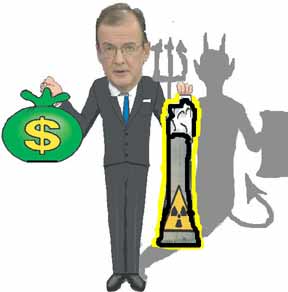 Unfortunately, I no longer have access to the full text of this. Somewhere in this article, Switkowski says that small nuclear power is
  more economic than large. Interesting that he doesn’t compare it to the cost of other energy forms – solar and wind.
He’s promoting the idea that Australia’s no-nuclear laws should be changed, – perhaps to a compromise – meaning that large nuclear reactors would still be prohibited, but small ones permitted. Good luck with that and all the perambulations involved! Only recently, Switkowski warned on risk of catastrophic failure, if Australia adopts nuclear energy. He sorta covers his back well!
Switkowski preaches for nuclear energy invoking Bill Gates, Elon Musk, AFR, Aaron Patrick, Senior Correspondent
Prominent businessman Ziggy Switkowksi urged Australians to take inspiration from two of the leading entrepreneurs of the twenty-first century, Bill Gates and Elon Musk, and support the development of a nuclear power industry.
Dr Switkowksi, a nuclear physicist, NBN board member and former Telstra chief executive, said nuclear power could become a major contributor to the electricity grid by 2040 if legalisation of the power source began now…..
With three separate inquiries into nuclear power under way, Dr Switkowksi has emerged as a leading advocate for the next generation of nuclear power plants known as small modular reactors, which supporters hope can avoid the huge costs and perceived safety risks of large-scale nuclear plants.
Dr Switkowksi, who has also briefed two separate federal parliamentary committees, told the NSW inquiry that half of NSW’s power supply could eventually be provided by nuclear power, which would compliment renewable sources after the state’s coal stations shut down. ……
Nuclear power is illegal under NSW and federal law. The NSW parliament is considering a proposed law by One Nation MP Mark Latham that would permit a nuclear industry to be developed in the state.
Many environmentalists strongly oppose the plan, including the Nature Conservation Council of NSW and the Australian Conservation Foundation, which also gave evidence to the committee on Monday.
Nuclear advocates, including Dr Switkowksi, have acknowledged that the big impediments to a nuclear industry are the cost of building reactors and the challenge of getting a wary public to support them.
Exploring for uranium is allowed in NSW, but mining is not. One first step towards developing a nuclear industry in the state could be to allow the uranium-mining industry to expand from South Australia across the border to NSW.
Officials from the Department of Planning, Industry and Environment told the inquiry that mining uranium wasn’t very different to any other mineral and that two mineral sands mines near Broken Hill bury uranium that is an inadvertent byproduct of their operations……
Inquiry chairman Taylor Martin, a Liberal MP, suggested that the federal and state laws be changed to prohibit existing forms of nuclear power technology but allow small modular reactors.
The compromise idea is designed to allow Labor MPs to support the development of a nuclear industry without appearing to give in to the demands of the mining industry, which has launched a below-the-radar campaign to legalise nuclear power.
Inquiry chairman Taylor Martin, a Liberal MP, suggested that the federal and state laws be changed to prohibit existing forms of nuclear power technology but allow small modular reactors.
The compromise idea is designed to allow Labor MPs to support the development of a nuclear industry without appearing to give in to the demands of the mining industry, which has launched a below-the-radar campaign to legalise nuclear power. …..https://www.afr.com/companies/energy/switkowski-preaches-for-nuclear-energy-invoking-bill-gates-elon-musk-20191111-p539j1
Nuclear plan is fiscal irresponsibility on an epic scale and rank political opportunism

The LNP wants to burn untold tens of billions of public money in a nuclear debt bin fire because nuclear is 100% uncommercial – no private investor will touch it with a ten foot pole short of massive multi-decade subsidies.
The LNP wants to burn untold tens of billions of public money in a nuclear debt bin fire because nuclear is 100% uncommercial – no private investor will touch it with a ten foot pole short of massive multi-decade subsidies.
Tim Buckley & AM Jonson, ReNeweconomy, Jun 19, 2024
While the Coalition has failed to release any detail or costings, today we have confirmation that if it gets into office, Australians will be paying a mult-billion dollar “nukebuilder” tax for generations to come for a national build out of government-owned nuclear reactors across seven locations, including on the sites of former coal-fired power stations.
It beggars belief that opposition leader Peter Dutton proposes nationalising a nuclear public debt bomb and detonating it at the heart of energy policy in this country.
This exacerbates the problem that electricity generated from nuclear is two to four times as expensive as power from firmed renewables – as the CSIRO has confirmed – and would permanently lock in higher energy prices for consumers already crushed by cost of living pressures.
The medium term energy price implications are horrendous. Electricity prices would skyrocket as private investment in new replacement capacity is crowded out, resulting in undersupply for the next 15-25 years while we wait for the LNP’s nuclear white elephants to arrive.
We know that firmed renewables – utility scale solar and wind, backed by big batteries, and orchestrated with accelerated deployments of distributed consumer energy resources such as rooftop solar, storage and EVs in a modernised grid – can and will keep the lights on, delivering consistent, secure, reliable and affordable supply at a fraction of the cost. This transition is already underway and accelerating.
Critically, the Coalition’s announcement puts at serious and imminent risk planned private capital investments in clean energy as policy uncertainty and chaos make proposals uninvestable – especially in light of public statements by Nationals Leader David Littleproud that the LNP would, bizarrely, “cap” renewables investment here.
The thought bubble released this week threatens to undermine our energy and economic security and our future prosperity as it creates sovereign risk.
By destroying investor confidence, it deters the private clean energy capital we need to attract at speed and scale – capital for which we are competing with the rest of the world.
The LNP wants to burn untold tens of billions of public money in a nuclear debt bin fire because nuclear is 100% uncommercial – no private investor will touch it with a ten foot pole short of massive multi-decade subsidies.
As the Investor Group on Climate Change, representing energy investors with $35tn in assets, said, there is “no interest” among investors in nuclear, when nuclear has time blowouts up 15+ years and cost blowouts in the tens of billions, and lowest-cost technologies – renewables, batteries and so on – are available to deploy now.
Further, to model our energy transition on the great government-owned public infrastructure debacles of the last quarter century – Snowy 2.0 and the NBN – is an egregious blunder with dire consequences now and for future generations.
The LNP’s Snowy 2.0 was due to be operational in 2021 at a cost of $2bn. After a rolling series of crises, it’s now expected to come online around 2028 and is likely to cost Australians $15bn, a budget blowout of 700%. And we have been lumped with one of the world’s worst, slowest (64th fastest in the world) and most expensive NBNs after a litany of LNP mismanagement.
The idea that nuclear could be up and running in 2035-37 is fanciful. Community opposition, inevitable protracted state and federal legal challenges, technological hurdles and the requirement that nationwide legislative bans on nuclear be overturned make a 2035 timeline impossible.
There is zero mention of how Australia plans to deal with nuclear waste for many centuries to come, or provide for the $10bn per nuclear plant end of life closure costs, another two LNP debt burdens dumped on future generations. The people of Japan are funding the US$200bn cleanup of the Fukushima disaster for the next century.
The international experience shows that the western nuclear industry is plagued with massive delays and cost blowouts. There is zero reason to expect Australia would be any different when the risks for us are higher, as we have no history of deployment of nuclear energy generation here.
The Vogtle nuclear power plant expansion debacle in Georgia, US, is a case point, massively delayed and the most expensive public works project in US history at $35bn, with consumers left to carry the can for the runaway costs.
And the £33bn Hinkley Point C nuclear plant in England – with completion now delayed to 2031 – is a millstone around UK citizens’ necks for the next 60 years or so, even as owner EDF of France took a €12bn writedown on this white elephant after China General Nuclear (CGN) walked away.
Dutton now centres Australian energy and climate policy on nuclear against the explicit and unequivocal advice of our flagship national scientific agency, the CSIRO, which warned that nuclear would take until at least 2040 to stand up in Australia, if legislative bans and other barriers could be overcome, and the energy generated would cost at least twice that of firmed renewables. …………………………………………………………………………… more https://reneweconomy.com.au/nuclear-plan-is-fiscal-irresponsibility-on-an-epic-scale-and-rank-political-opportunism/
Peter Dutton reveals seven sites for proposed nuclear power plants
By political reporter Tom Crowley and national regional affairs reporter Jane Norman, 19 June 24 https://www.abc.net.au/news/2024-06-19/dutton-reveals-seven-sites-for-proposed-nuclear-power-plants/103995310—
Peter Dutton has told his Coalition colleagues he will go to the next election promising to build seven nuclear power stations.
Mr Dutton will promise the first two sites can be operational between 2035 and 2037, several years earlier than the timeframe the CSIRO and other experts believe is feasible.
As had been previously flagged, the stations are all on retiring or retired coal sites.
The seven sites are:
- Tarong in Queensland, north-west of Brisbane
- Callide in Queensland, near Gladstone
- Liddel in NSW, in the Hunter Valley
- Mount Piper in NSW, near Lithgow
- Port Augusta in SA
- Loy Yang in Victoria, in the Latrobe Valley
- Muja in WA, near Collie
Five of the seven are in Coalition seats: Muja in Rick Wilson’s seat of O’Connor, Loy Yang in Darren Chester’s seat of Gippsland, Port Augusta in Rowan Ramsey’s seat of Grey, Callide in Colin Boyce’s seat of Flynn and Tarong in Nationals leader David Littleproud’s seat of Maranoa.
Mount Piper is in the seat of Calare, held by independent Andrew Gee who was elected as a Nationals MP in 2022 but quit the party.
Liddel is in only site in a Labor seat, the seat of Hunter, held by Labor’s Dan Repacholi.
Further details are expected later this morning, including about how much government funding would be required and whether the proposal is for large-scale nuclear reactors, small modular nuclear reactors, or a combination.
The Coalition had been promising a nuclear policy, including specific sites, for several months amid expert concerns over the cost and timeframe.
Last week, Mr Dutton also revealed the Coalition would campaign against the Labor government’s legislated target to reduce emissions by 43 per cent by 2030, and would not outline a 2030 emissions reduction target of its own before the election.
Coalition energy spokesperson Ted O’Brien and Nationals leader Mr Littleproud will address an energy conference held by The Australian today.
This morning, Treasurer Jim Chalmers will tell that conference the Coalition’s nuclear plan is “the dumbest policy ever put forward by a major party” and will seek to contrast the Coalition’s plan, likely to require significant public funding, with Labor’s plan to encourage private investment in renewables and gas.
Farmers who graze sheep under solar panels say it improves productivity. So why don’t we do it more?
Guardian, by Aston Brown, 14 June 24
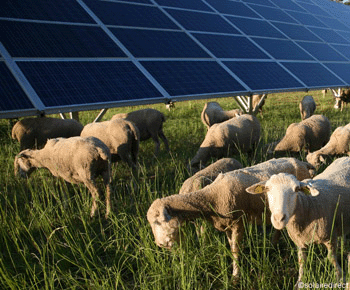
Allowing livestock to graze under renewable developments gives farmers a separate income stream, but solar developers have been slow to catch on.As a flock of about 2,000 sheep graze between rows of solar panels, grazier Tony Inder wonders what all the fuss is about. “I’m not going to suggest it’s everyone’s cup of tea,” he says. “But as far as sheep grazing goes, solar is really good.”
Inder is talking about concerns over the encroachment of prime agricultural land by ever-expanding solar and windfarms, a well-trodden talking point for the loudest opponents to Australia’s energy transition.
But on Inder’s New South Wales property, a solar farm has increased wool production. It is a symbiotic relationship that the director of the National Renewables in Agriculture Conference, Karin Stark, wants to see replicated across as many solar farms as possible as Australia’s energy grid transitions away from fossil fuels.
“It’s all about farm diversification,” Stark says. “At the moment a lot of us farmers are reliant on when it’s going to rain, having solar and wind provides this secondary income.”
In exchange, the panels provide shelter for the sheep, encourage healthier pasture growth under the shade of the panels and create “drip lines” from condensation rolling off the face of the panels.
“We had strips of green grass right through the drought,” Dubbo sheep grazier Tom Warren says. Warren has seen a 15% rise in wool production due to a solar farm installed on his property more than seven years ago.
Despite these success stories, a 2023 Agrivoltaic Resource Centre report authored by Stark found that solar grazing is under utilised in Australia because developers, despite saying they intend to host livestock, make few planning adjustments to ensure that happens……………………………………………………………………………….
According to an analysis by the Clean Energy Council, less than 0.027% of land used for agriculture production would be needed to power the east coast states with solar projects – far less than the one-third of all prime agricultural land that the rightwing thinktank the Institute of Public Affairs has claimed will be “taken over” by renewables. That argument, which has been heavily refuted by experts, has been taken up by the National party, whose leader, David Littleproud, said regional Australia had reached saturation point with renewable energy developments.
Queensland grazier and the chair of the Future Farmers Network, Caitlin McConnel, has sold electricity to the grid from a dozen custom-built solar arrays on her farm’s cattle pastures for more than a decade.
“Trial and error” and years of modifications have made them structurally sound around cattle and financially viable in the long-term, she says.
“As far as I know, we are the only farm to do solar with cattle,” McConnel says. “It’s good land, so why would we just lock it up just for solar panels?” https://www.theguardian.com/australia-news/article/2024/jun/13/farmers-who-graze-sheep-under-solar-panels-say-it-improves-productivity-so-why-dont-we-do-it-more
Why bet on a loser? Australia’s dangerous gamble on the USA

June 15, 2024, by: The AIM Network, By Michael Williss, https://theaimn.com/why-bet-on-a-loser-australias-dangerous-gamble-on-the-us/
A fresh warning that the US will lose a war with China has just been made by a US data analytics and military software company with US Department of Defense contracts.
It seems no-one is prepared to back the US to win a war with China, so why is Australia going all-out to align itself with provocative moves and hostility from the US directed at China?
Govini released its latest study of US capacity to fight China in June. Its annual reports measure the performance of the US federal government, looking at 12 top critical national security technologies through the lens of acquisition, procurement, supply chain, foreign influence and adversarial capital and science and technology.
It concluded that it is nearly impossible for the US to win a war against the PLA if a conflict were to break out between the two global superpowers.
The report also found that China has more patents than the US in 13 of 15 critical technology areas, further demonstrating how the US is falling behind in AI development.
“This year’s report also highlighted another reason a US conflict with China could be unwinnable: the very real possibility of parts scarcity.”
It identified serious risks within seven major DoD programs, including the cornerstone of AUKUS, namely the Virginia-class submarines. Not that this will worry the cargo-culters in Canberra who keep throwing billions at the fraught arrangement.
Another factor was China’s lead in the global supply chains.
-ADVERTISEMENT-
Govini CEO Tara Murphy Dougherty said:
”China still has a dangerously high presence in US government supply chains. The Departments of the Navy and Army showed a decreasing reliance on Chinese suppliers over the past year, however, the Department of the Air Force showed a 68.8 percent increase in the usage of Chinese suppliers.”
Govini’s report adds to a number of similar scenarios in recent years, starting with the headlined warning by The Times on May 16, 2020 “US ‘would lose any war’ fought in the Pacific with China.”
In the New Atlanticist, Lieutenant Colonel Brian Kerg, an active-duty US Marine Corps operational planner, critiqued biases in modern US war games, in which military planners command opposing armed forces in simulated warfare. He writes that instead of a short, sharp war over Taiwan with a win for the US, as predicted by war games, the greater likelihood is one of a years-long war with China with uncertain outcomes. One of those, too terrible to contemplate, must be the likelihood of Chinese retaliation against Australia for joining the US, for being fully interoperable with its military, and the consequent rubbleisation of Australian cities and attacks on US military bases here.
Retired US Army Colonel Dr John Mauk agrees that any conflict over Taiwan will almost certainly be a prolonged war, and he says that it would be one that favours China. He writes:
“U.S. military forces are too small, their supply lines are too vulnerable, and America’s defense industrial capacity is far too eroded to keep up with the materiel demands of a high-intensity conflict. Another critical factor undermining U.S. capacity to sustain a war is that Americans lack the resilience to fight a sustained, brutal conflict.”
By contrast, China is well-postured to sustain a protracted high intensity war of attrition.
He says that the current political divide in the US impedes its ability to respond to national security crises, and that:
“Americans in general are unprepared for, unwilling, or incapable to perform military service. Short of reinstituting a draft, U.S. military services cannot attract or retain enough manpower quickly enough to sustain a fight with China.”
Former US assistant secretary of state for Europe and Eurasia, A. Wess Mitchell, believes that “United States is a heartbeat away from a world war that it could lose.” He writes that:
“… today’s U.S. military is not designed to fight wars against two major rivals simultaneously. In the event of a Chinese attack on Taiwan, the United States would be hard-pressed to rebuff the attack while keeping up the flow of support to Ukraine and Israel.”
Comparing US and Chinese naval growths, Mitchell says that the US is no longer able to “outproduce its opponents”. With US debt already in excess of 100% of GDP, he says that the debt loads incurred through war with China would risk catastrophic consequences for the U.S. economy and financial system.
He raises the possibility of a Chinese fire-sale of US debt:
“China is a major holder of U.S. debt, and a sustained sell-off by Beijing could drive up yields in U.S. bonds and place further strains on the economy.”
Hillary Clinton raised this quandary facing the US with then PM Kevin Rudd in 2010 when she asked him “How do you deal toughly with your banker?” It is a question that the US has yet to find an answer to.
And questions there are. Harlan Ullman, a senior adviser at the Atlantic Council, opens a January 2024 article with the observation that:
“Since World War II ended, America has lost every war it started. Yes, America has lost every war it started – Vietnam, Afghanistan and the second Iraq War.”
He sounds a warning:
“… given likely weapons expenditure rates should a war with China erupt, the U.S. has the capacity for about a month before, as in Ukraine, it runs out of inventory,” before asking his questions: “War with China would be a strategic catastrophe. The U.S. has not explained how such a war could be fought and won. The economic consequences would be disastrous. And how would such a war end? Can anyone answer these questions?”
China is quite adept at utilising sentiments such as these. Major Franz J. Gayl, a retired Marine Corps infantry officer has regularly written for Chinese online news outlet Global Times. Last year, a number of his contributed articles to GT were published as a book, “The United States Will Lose the Coming War with China” which is available on Amazon.
Australia’s Liberal-Labor pro-US coalition has placed a $368 billion bet on the ability of the US to prevent the expansion of Chinese influence in the South Pacific or its recovery of the island province of Taiwan.
It is an expensive way to be taught the African proverb that when the elephants dance, it is the grass that suffers.
Resources Minister Madeleine King challenges Peter Dutton to name Western Australia nuclear power station sites
Joe Spagnolo, The West Australian, Sat, 8 June 2024
WA Federal Labor Minister Madeleine King has challenged Peter Dutton to come clean on where nuclear power stations would be located in WA — as the Federal Liberal leader spruiks nuclear energy for Australia.
Addressing the media in Kwinana on Saturday morning, the Resources Minister said WA communities like Collie, Kwinana and Fremantle could all be targets for a nuclear power station under a Dutton-led Federal Government…………………. (Subscribers only) https://thewest.com.au/politics/state-politics/resources-minister-madeleine-king-challenges-peter-dutton-to-name-wa-nuclear-power-station-sites-c-14953838
Will Port Adelaide, Fremantle or Port Kembla be the Australian Chernobyl?
By Douglas McCartyJul 21, 2023 https://johnmenadue.com/aukus-will-adelaide-fremantle-or-port-kembla-be-the-australian-chernobyl/
While most discussion of the AUKUS Agreement has focussed on the geopolitical implications for Australia’s standing in the world, the escalation of the risk of war and the crippling cost of the nuclear submarine purchases when less expensive and more sensible non-nuclear options are available, little has been said of the risk to the civilian population posed by these nuclear-powered submarines (or other nuclear-powered naval vessels) in Australia’s home ports.
Perhaps we citizens only enter the calculations as ‘collateral damage’. Any such necessarily technical discussion is hampered by military secrecy. Some information has been released officially, but most is from generalised inference, or conjecture, and so subject to uncertainty. However, in this important matter, it is worth attempting to join the dots….
News from the war in Ukraine includes, almost every other night, a report on the situation around the Zaporizhzhia Nuclear Power Plant, the largest in Europe. Though no longer continuing to generate power for Ukraine, it is always at risk of being shelled or bombed by one side or the other, and regularly just avoiding reactor cooling water pump failure from damaged power transmission lines or lack of diesel fuel for their backup generators for the pumps. How long this situation will continue remains to be seen. And now, after the breaching of the Kakhovka Dam, it is estimated just three months of water for cooling remains.
The consequences of the catastrophic failure of a nuclear reactor are well known to both the Ukrainians and the Russians. To the Northwest of Zaporizhzhia, and just 100 kilometres North of Kyiv, lies the Chernobyl Reactor No. 4, which, on 26 April 1986, underwent meltdown after a coolant and moderator failure, exploded, and caught fire. Radioactive material and fission products were ejected into the air, spreading across the immediate countryside and into Northern Europe. Radioactive rain was reported on the mountains of Wales and Scotland, in the Alps, and contamination in reindeer herds in Northern Sweden. The principal radiological contaminant of concern across this vast area was Caesium-137, one of many fission products and representing some 6% of fission reactor spent fuel. Just 27 kg of Caesium-137, it is calculated, caused this contamination. Some 150,000 square kilometres of Ukraine, Belarus and Russia were initially contaminated. Of course, at the time of the accident, all this was part of the Soviet Union. To this day, 2600 square kilometres around the plant are considered unsafe for human habitation, or agriculture, and will remain so for between 300 and 3000 years! The Reactor used 2% enriched Uranium fuel.
Although the loss of life at Chernobyl was a small fraction of the 100,000 deaths from one of the only two uses of nuclear weapons in war, on Hiroshima in 1945, Chernobyl created 400 times more radioactive pollution. The Hiroshima bomb, “Little Boy”, contained 64 kg of enriched Uranium, though less than 2% actually underwent nuclear fission. The bomb was detonated 500 metres above ground (‘airburst’), and the fatalities were the result of blast, heat, and irradiation, in a city centre. Chernobyl occurred at ground level and so ejected debris upwards initially, followed by smoke columns from subsequent fires. . The 31 deaths at Chernobyl were plant operators and, of course, firemen. The G7, the AUKUS Partners and the Quad just met at ‘ground zero’ in a rebuilt Hiroshima City, 78 years after the bombing.
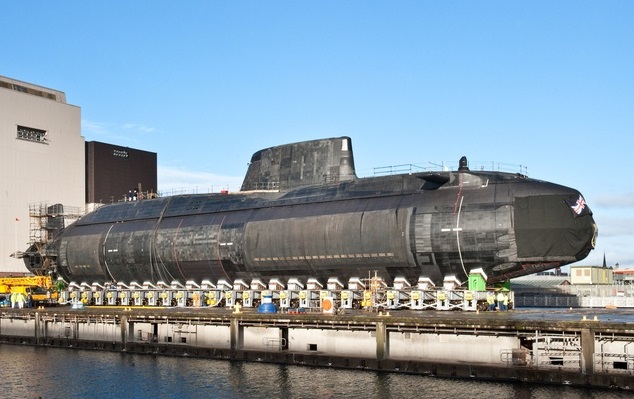
The US Navy nuclear powered warships, including the ‘Virginia’ Class submarines that Australia would buy under the AUKUS Agreement, principally use Highly Enriched Uranium (HEU) reactors. The Uranium is enriched to above 93% fissionable Uranium-235. It is weapons grade material and has in part been sourced from decommissioned nuclear weapons. The submarine reactors are intended to last for the ‘Life of Ship’ (LOS), up to 33 years, without needing refuelling. Low Enriched Uranium reactors need fuel replacement every 5 to 10 years, when, importantly, the containment pressure vessel around the reactor is physically inspected for flaws and deterioration. This is not done for the HEU, LOS reactors.
The US Navy nuclear powered warships, including the ‘Virginia’ Class submarines that Australia would buy under the AUKUS Agreement, principally use Highly Enriched Uranium (HEU) reactors. The Uranium is enriched to above 93% fissionable Uranium-235. It is weapons grade material and has in part been sourced from decommissioned nuclear weapons. The submarine reactors are intended to last for the ‘Life of Ship’ (LOS), up to 33 years, without needing refuelling. Low Enriched Uranium reactors need fuel replacement every 5 to 10 years, when, importantly, the containment pressure vessel around the reactor is physically inspected for flaws and deterioration. This is not done for the HEU, LOS reactors. In one year, at full power, (210 x 365 ÷ 940 =) 81.5 kg of U-235 would be required. Along with other decay products from the U-235 (Strontium-90, Iodine-131, Xenon-133 etc.), as noted earlier some 6% (or 4.9 kg) would be Caesium-137. The ‘neutron poisons’ also created are balanced out by ‘burnable’ neutron poisons incorporated into the core when new, to maintain reactor function over the years. So far, simple nuclear physics and thermodynamics.
Operationally, one surmises, the submarine reactor will infrequently run at full power. Actual annual production of Caesium-137 may lie between, say, 0.8 kg for 1/6th capacity operation on average for the whole year, and 2.45 kg at half capacity for the year. As the reactor is designed to not need refuelling for the ‘Life of the Ship’, the Cs-137 would continuously accumulate inside the reactor fuel elements. At the lower bound of 1/6th operation, there would be approaching 27 kg of Cs-137 in the core after 33 years, allowing for the decay of some of the Caesiun-137, given its half-life of 30.05 years. At the upper bound, it would take about 13 years for 27 kg of Caesium-137 to accumulate.
Visiting nuclear-powered submarines, from the US or UK, would be similar. Visiting US nuclear-powered aircraft carriers, each with two A1B reactors each of 700MWt, may have 27 kg of Cs-137 in their reactor cores after just two years of operation.
Visiting ships may stay in Australian ports for days or even weeks. Australian submarines will be in port not only between deployments, but also for maintenance, for months and years. The US Navy appears to have about 40 Virginia Class Subs, with some 18 undergoing long-stay maintenance, or about half. We might expect the same. So, at any one time, the AUKUS plan would see naval nuclear reactors, US, or UK, or Australian, or all, in Adelaide, and/or Fremantle, and/or Port Kembla. While peacetime only presents the risk of a nuclear accident, wartime would see these important military assets easily detectable – and targetable – while in port. In the event of a nuclear war, this may be just one of our worries.
In a conventional, non-nuclear conflict, the story may be very different. The situation of the Zaporizhzhia civilian reactors in Ukraine is most instructive. However, as legitimate military targets, would such restraint be shown towards the reactors in the submarines? What would be the impact of a conventional cruise or hypersonic or ballistic missile warhead on the pressure hull and reactor containment vessel (and plumbing) of a nuclear-powered submarine?
Should just 27 kg of the Caesium-137 in the naval reactor cores be released into the air through an explosion (as at Chernobyl) in an accident or deliberate attack, what would be the outcome? In Fremantle, especially if the ‘Fremantle Doctor’ was blowing, would sections of Fremantle and Perth become unsafe for human habitation? In Port Kembla, especially if a ‘Southery Buster’ came through, the Illawarra and, depending on the particular weather conditions, would parts of the South of Sydney become unsuitable for human habitation? For Port Adelaide, especially if a NW change came through, would the Adelaide coastal strip from Gawler to Aldinga become unsuitable for human habitation?
Imagine the number of “single mums doing it tough” who would have to be relocated to emergency accommodation – somewhere! Imagine all that social housing rendered uninhabitable! Even if we ‘won’ the war.
This is a real possibility if we have nuclear reactors in surface ships or submarines in our ports, or in our ship building and maintenance facilities.
Nuclear Shaping Up To Be The Big Issue Next Election
https://10play.com.au/theproject/articles/nuclear-shaping-up-to-be-the-big-issue-next-election/tpa240602vcgxm 2 June 24 We’ve just passed the two-year anniversary of Anthony Albanese being elected as the Prime Minister of Australia, and now rumours are swirling around when the PM will call the next election.
And there’s one issue that shapes up to be a cornerstone election issue when we go to the polls.
The battle lines have been drawn and nuclear power plants are at the centre of them.
The Prime Minister has set the agenda for the remainder of his term, saying the government will campaign on the issue until the day Australia heads to the polls.
It’s been almost two years since the opposition leader first flagged his nuclear policy proposal, but the devil is in the details, and that’s precisely what the PM says is missing.
It comes as rumours swirl around whether Anthony Albanese will call an early election when he still has more than a year left to do so.
And while the PM has repeatedly said he intends to serve a full term… There are a few reasons he may decide not to.
The impact of foreign forces could also play a role in his decision.
So will Albo stick to his guns and hold out until next year, and will the next campaign go totally nuclear.
1 This month


Help Aunty Sue Protect Her Land and Sacred Sites From Destructive Rocket Testing.
.

Australians deserve the truth
about
AUKUS – https://aukuspublicinquiry.com/

PETITION – To: Prime Minister Anthony Albanese and the Australian Labor Government

of the week – Australians for War Powers Reform (AWPR)
To see nuclear-related stories in greater depth and intensity

