“We haven’t been consulted:” Coal town on transition to renewables is not interested in nuclear
ReNewEconomy, Aaron Bunch, Jun 2, 2024
A Western Australian coal town lined up as a potential site for a nuclear power station by the federal Coalition says the plan is a distraction as it works to ditch fossil fuels and transition to renewables and storage.
The federal coalition has floated plans to add nuclear energy to the power grid should it win government by building reactors at sites currently home to either coal or gas-fired power stations.
The sites have not yet been announced but the list is widely reported to include Collie, 200km south of Perth and home to about 7500 people, where a state government-supported pivot away from the coal industry is underway. It is the site for two of the country’s biggest battery storage projects.
Shire President Ian Miffling said the state $662 million Just Transition plan had created a “buzz” in the town and the federal coalition’s nuclear power plan hadn’t received much attention.
“Collie hasn’t been consulted at all and we don’t know any of the details of the policy and what they propose, so we’ve not given it too much credence at this stage,” he told AAP…………………
Mr Miffling said locals were focused on bolstering their skills for jobs in new industries, like the recently approved green steel mill and Synergy’s $1.6 billion battery to store renewable energy once coal is retired as an energy supply in 2030.
“The potential for nuclear, which would be a long way down the track, is a bit of a distraction and it really doesn’t need us to spend too much time talking about it at this point,” he said………………..
Local state Labor MP Jodie Hanns said federal opposition leader Peter Dutton and the coalition were out of touch with what was happening on the ground in Collie and floating plans for a reactor in the town was “arrogant and disrespectful”……………………….
“No one I’ve spoken to is in support of a nuclear reactor being put in Collie … my house will be up for sale if this becomes a reality.”
AMWU state secretary Steve McCartney said Collie workers had been discussing for years what they wanted for the town after coal mining ended, “and I can guarantee you one of the things wasn’t a nuclear power station”…………… https://reneweconomy.com.au/we-havent-been-consulted-coal-town-on-transition-to-renewables-is-not-interested-in-nuclear
Summary of Australian federal and state/territory nuclear/uranium laws and prohibitions.

Current prohibitions on nuclear activities in Australia: a quick guide
From Jim Green, 30 May 2024
https://www.aph.gov.au/About_Parliament/Parliamentary_departments/Parliamentary_Library/pubs/rp/rp2324/Quick_Guides/NuclearActivitiesProhibitions
PDF Version [564KB]
Dr Emily Gibson
Science, Technology, Environment and Resources; Law and Bills Digest Sections
This quick guide provides an overview of current prohibitions on nuclear activities under Commonwealth, state and territory laws. It considers the primary legislation most relevant to current policy debates about domestic nuclear energy only and consequently does not consider recent changes to Commonwealth law to facilitate Australia’s acquisition of conventionally-armed, nuclear-powered submarines under the AUKUS partnership.[1] It also does not include consideration of Australia’s international obligations in respect of nuclear activities, including the safeguarding of nuclear materials and the non-proliferation of nuclear weapons.
If a domestic nuclear energy industry were to progress, it is expected that a comprehensive framework for the safety, security and safeguarding of the related nuclear material would need to be legislated to accommodate such an industry.[2] Consideration of these issues is beyond the scope of this paper.
What are nuclear activities?
A nuclear activity is any process or step in the utilisation of material capable of undergoing nuclear fission; that is, any activities in the nuclear fuel cycle.[3] Nuclear activities therefore include:
- mining of nuclear or radioactive materials such as uranium and thorium milling, refining, treatment, processing, reprocessing, fabrication or enrichment of nuclear material
- the production of nuclear energy
- the construction, operation or decommissioning of a mine, plant, facility, structure, apparatus or equipment used in the above activities
- the use, storage, handling, transportation, possession, acquisition, abandonment or disposal of nuclear materials, apparatus or equipment.
Prohibitions on nuclear activities
Commonwealth
Nuclear activities are regulated under the Australian Radiation Protection and Nuclear Safety Act 1998 (ARPANS Act) and the Environment Protection and Biodiversity Conservation Act 1999 (EPBC Act).
Australian Radiation Protection and Nuclear Safety Act 1998
The ARPANS Act establishes a licensing framework for controlled persons (including a Commonwealth entity or a Commonwealth contractor) in relation to controlled facilities (a nuclear installation, a prescribed radiation facility, or a prescribed legacy site).[4] A nuclear installation includes a nuclear reactor for research or the production of radioactive materials for industrial or medical use, and a radioactive waste storage or disposal facility with an activity that is greater than the activity level prescribed by the Australian Radiation Protection and Nuclear Safety Regulations 2018.[5]
The ARPANS Act allows the CEO of the Australian Radiation Protection and Nuclear Safety Agency (ARPANSA) to issue licences for controlled facilities.[6] In issuing a facility licence, the CEO ‘must take into account the matters (if any) specified in the regulations, and must also take into account international best practice in relation to radiation protection and nuclear safety’.[7]
However, subsection 10(2) of the Act expressly prohibits the CEO from granting a licence for the construction or operation of any of the following nuclear installations: a nuclear fuel fabrication plant; a nuclear power plant; an enrichment plant; or a reprocessing facility.[8] This prohibition does not appear to apply to a radioactive waste storage or disposal facility.
Environment Protection and Biodiversity Conservation Act 1999
The EPBC Act establishes 9 matters of national environmental significance (MNES) and provides for the assessment and approval of these actions if the action has, will have, or is likely to have a significant impact on the MNES.[9] ‘Nuclear actions’ are one of the MNES.[10] Where a nuclear action is determined to be a controlled action (that is, one likely to have a significant impact and requiring assessment and approval under the Act), the assessment considers the impact of a nuclear action on the environment generally (including people and communities).[11]
The Act establishes offences for the taking of nuclear actions in those circumstances.[14]
Similarly, the Act provides that a relevant entity (as set out below) must not take an action (including a nuclear action) unless a requisite approval has been obtained under Part 9 of the Act or a relevant exception applies:
- a person must not take a relevant action on Commonwealth land that has, will have or is likely to have a significant impact on the environment[15]
- a person must not take a relevant action outside Commonwealth land if the action has, will have or is likely to have a significant impact on the environment on Commonwealth land[16]
- the Commonwealth or a Commonwealth agency must not take inside or outside the Australian jurisdiction an action that has, will have or is likely to have a significant impact on the environment inside or outside the Australian jurisdiction.[17]
The Act establishes offences and civil penalty provisions for the taking of an action in those circumstances.[18]
Subsection 140A(1) prohibits the Minister for the Environment from granting an approval for a nuclear action relating to specified nuclear installations. These installations are a nuclear fuel fabrication plant, a nuclear power plant, an enrichment plant, and a reprocessing facility.
Potential reform of the nuclear action trigger
The second independent review of the EPBC Act, completed in October 2020 by Professor Graeme Samuel (Samuel Review), recommended that the nuclear actions MNES be retained.[19] The review recommended that ‘the EPBC Act and the regulatory arrangements of [ARPANSA] should be aligned, to support the implementation of best-practice international approaches based on risk of harm to the environment, including the community’.[20]
In 2022, the Government’s Nature Positive Plan adopted this approach and stated, ‘[a] uniform national approach to regulation of radiation will be delivered through the new National Environmental Standards’.
In February 2024, a policy draft of the National Environmental Standard for Matters of National Environmental Significance indicates that ‘nuclear actions’ will be renamed ‘radiological exposure actions’ and states:
Relevant decisions must:
Not be inconsistent with the ARPANSA national codesfor protection from radiological exposure actions including in relation to:
- human health and environmental risks and outcomes; and. radiological impacts on biological diversity,
- the conservation of species and the natural health of ecosystems.[22]
States and territories
States and territories generally regulate nuclear and radiation activities through either the health or the environmental protection portfolios. The relevant legislation provides for the protection of health and safety of people, and the protection of property and the environment, from the harmful effects of radiation by establishing licensing regimes to regulate the possession, use, and transportation of radiation sources and substances.[23] Mining of radioactive materials is regulated through the resources portfolio.
In addition, as outlined below, the states and territories have legislation prohibiting certain nuclear activities or the construction and operation of certain nuclear facilities. Importantly, where permitted, nuclear activities (including mining) would also be subject to assessment and approvals under a range of other legislation, including planning and environmental impact assessment, native title and cultural heritage, and radiation licensing laws at the state or territory and Commonwealth level.
New South Wales
Exploration for uranium has been permitted under the Mining Act 1992 since 2012.[24] However, the mining of uranium is prohibited by the Uranium Mining and Nuclear Facilities (Prohibitions) Act 1986 (NSW Prohibitions Act).[25]
The NSW Prohibitions Act also prohibits the construction and operation of certain nuclear facilities, including uranium enrichment facilities, fabrication and reprocessing plants, nuclear power plants, and storage and waste disposal facilities (other than for the storage and disposal of waste from research or medical purposes, or the relevant radiological licensing Act).[26]
Northern Territory
The Atomic Energy Act 1953 (Cth) provides that the Commonwealth owns all uranium found in the territories.[27] Uranium exploration and mining in the Northern Territory (NT) is regulated under both NT mining laws (the Mineral Titles Act 2010 and the Mining Management Act 2001) and the Atomic Energy Act.[28] The Ranger Uranium Mine operated until 2021 and is now undergoing rehabilitation.[29]
The Nuclear Waste Transport, Storage and Disposal (Prohibition) Act 2004 (NT) prohibits the construction and operation of nuclear waste storage facilities, as well as the transportation of nuclear waste for storage at a nuclear waste storage facility in the NT.[30] Nuclear waste is defined as including waste material from nuclear plants or the conditioning or reprocessing of spent nuclear fuel.[31]
This Act also:
- prohibits public funds from being expended, granted or advanced to any person for, or for encouraging or financing any activity associated with the development, construction or operation of a nuclear waste storage facility
- would require the NT Parliament to hold an inquiry into the likely impact of a nuclear waste storage facility proposed by the Commonwealth on the cultural, environmental and socio‑economic wellbeing of the territory.[32]
Queensland
Exploration for and mining of uranium are permitted under the Mineral Resources Act 1989. However, it has been government policy to not grant mining leases for uranium since 2015.[33] The government policy ban extends to the treatment or processing of uranium within the state.[34]
The Nuclear Facilities Prohibition Act 2007, in similar terms to the NSW Prohibitions Act, prohibits the construction and operation of nuclear reactors and other nuclear facilities in the nuclear fuel cycle.[35]
Unlike other state and territory prohibition legislation, the Nuclear Facilities Prohibition Act would require the responsible Queensland Minister to hold a plebiscite to gain the views of the Queensland population if the Minister was satisfied that the Commonwealth Government has taken, or is likely to take, steps to amend a Commonwealth law or exercise a power under a Commonwealth law to facilitate the construction of a prohibited nuclear facility, or if the Commonwealth Government adopts a policy position of supporting or allowing the construction of a prohibited nuclear facility in Queensland.[36]
South Australia
The exploration and mining of radioactive material (including uranium) is permitted in South Australia (SA), subject to approvals under the Mining Act 1971 and the Radiation Protection and Control Act 2021 (RP&C Act).[37] For example, uranium is mined at Olympic Dam, Four Mile and Honeymoon. However, conversion and enrichment activities are prohibited by the RP&C Act.[38]
The Nuclear Waste Storage Facility (Prohibition) Act 2000 prohibits the construction or operation of a nuclear waste storage facility, and the import to SA or transport within SA of nuclear waste for delivery to a nuclear waste storage facility.[39]
The Nuclear Waste Storage Facility (Prohibition) Act prohibits the SA Government from expending public funds to encourage or finance the construction or operation of nuclear waste storage facilities.[40] The Act would also require the SA Parliament to hold an inquiry into the proposed construction or operation of a nuclear waste storage facility in SA authorised under a Commonwealth law.[41]
Tasmania
The exploration and mining of atomic substances (which includes uranium and thorium) is permitted under the Mineral Resources Development Act 1995 (Tas), subject to approval.
Victoria
The Nuclear Activities (Prohibitions) Act 1983 prohibits a range of activities associated with the nuclear fuel cycle, including the exploration and mining of uranium and thorium, and the construction or operation of facilities for the conversion or enrichment of any nuclear material, nuclear reactors and facilities for the storage and disposal of nuclear waste from those prohibited activities.[42]
Western Australia
Exploration for and mining of uranium is permitted under the Mining Act 1978. A state policy ban on mining approvals was overturned in November 2008;[43] however, this was reinstated in June 2017, with a ‘no uranium’ condition on future mining leases.[44] The ban does not apply to 4 projects that had already been approved by the previous government.
The Nuclear Activities Regulation Act 1978 aims to protect the health and safety of people and the environment from possible harmful effects of nuclear activities, including by regulating the mining and processing of uranium and the equipment used in those processes. The Nuclear Waste Storage and Transportation (Prohibition) Act 1999 also prohibits the storage, disposal or transportation in Western Australia of certain nuclear waste (including waste from a nuclear plant or nuclear weapons).[45]
Can the Commonwealth override a state ban on nuclear activities?
The Commonwealth Parliament only has the power to make laws in relation to matters specified in the Constitution of Australia, including in sections 51, 52 and 122. Assuming the Commonwealth has a sufficient head of power to legislate, section 109 of the Constitution specifically provides for circumstances in which there might be an inconsistency between Commonwealth and state laws:
When a law of a State is inconsistent with a law of the Commonwealth, the latter shall prevail, and the former shall, to the extent of the inconsistency, be invalid.
Therefore, even though some states have enacted prohibitions on certain nuclear activities within their jurisdictions, the Commonwealth Parliament could enact specific legislation in relation to nuclear activities so that such activities can take place within those jurisdictions. One such example is the National Radioactive Waste Management Act 2012 (Cth), which provides for the establishment of a national radioactive waste management facility at a site to be declared by the responsible Commonwealth Minister. Section 12 of that Act provides that state and territory laws have no effect in regulating, hindering, or preventing such a facility
Further information
- ‘Who we regulate’, ARPANSA
- ‘State & territory regulators’, ARPANSA
- ‘Uranium and thorium’, in Geoscience Australia, Australia’s Energy Commodity Resources, 2023 Edition, (Canberra: Geoscience Australia, 2023).
Scott Morrison on the revolving door- government nuclear AUKUS deal, to Dyne, company advising on AUKUS
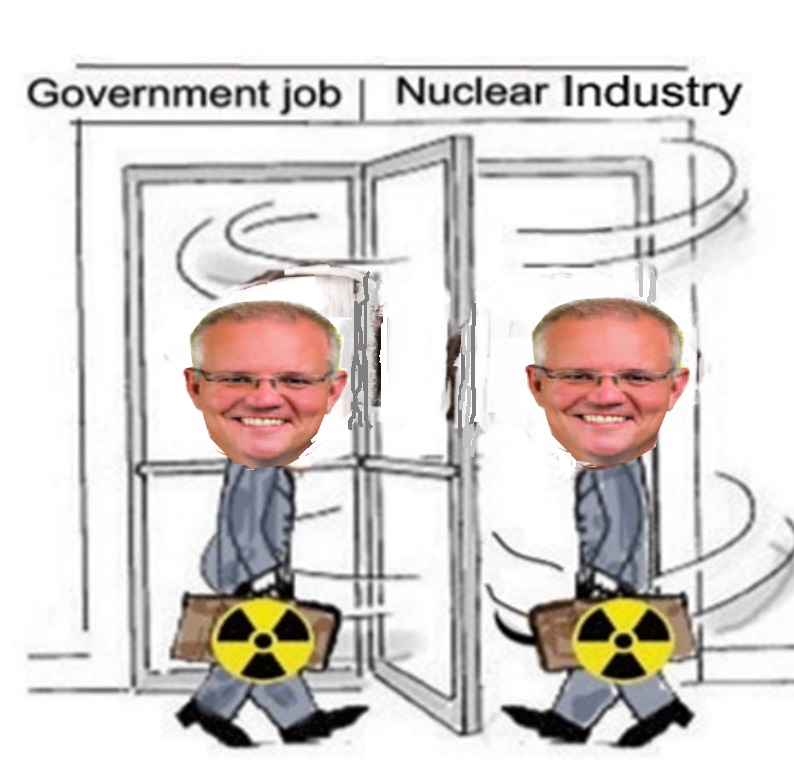
As a strategic advisor to DYNE, Morrison hopes to advance investment in dual-use technologies — inventions that have military and civilian applications. That innovation is being helped by the second pillar of AUKUS, the one that has to do with tearing down military-industrial trade barriers between the US, UK and Australia.
Facing post-Parliament poverty, multitasking Morrison looks to seafloor for riches
What to do when your taxpayer-funded salary drops from $549k, to $225k, to nothing? Multitask, of course.
Crikey, ANTON NILSSON, MAY 30, 2024
Scott Morrison has yet another new job — and like some of his other post-Parliament gigs, it’s tangentially linked to the AUKUS submarine pact he helped set up as prime minister.
The Age reports Morrison is listed as a strategic advisor at a newly created venture called the Seafloor Minerals Fund, alongside ex-US secretary of state Mike Pompeo. Both men are also behind venture capital firm DYNE, set up to support the strategic goals of AUKUS, and which also has interests in deep sea mining, according to the story.
Crikey figured it was time to have another look at Morrison’s post-politics career.
In need of cash …………………………………………..
Multitasking
So what has Morrison done to set himself up for success? His LinkedIn lists three jobs: author, non-executive vice chairman of American Global Strategies, and board member at “various companies”. The voters who brought you Scott Morrison want stronger anti-corruption protectionsRead More
As an author, he’s already published his first work: the religious memoir Plans For Your Good. The book was aimed at the $1.175 billion US Christian book market, but in Australia, it’s reportedly sold very few copies so far.
At American Global Strategies, Morrison is working with two former Donald Trump staffers to “help clients navigate a highly dynamic geopolitical landscape that presents risks and opportunities”, in the ex-PM’s own words.
As a strategic advisor to DYNE, Morrison hopes to advance investment in dual-use technologies — inventions that have military and civilian applications. That innovation is being helped by the second pillar of AUKUS, the one that has to do with tearing down military-industrial trade barriers between the US, UK and Australia. The new gig, with the Seafloor Minerals Fund, will set Morrison and Pompeo up for taking advantage of the estimated trillions of dollars in rare metals estimated to be on the seafloor. According to The Age, Australians can expect a fierce future debate about the merits and risks of mining the seabed for minerals, as China seeks to do the same. https://www.crikey.com.au/2024/05/30/scott-morrison-seafloor-minerals-fund/?utm_medium=Social&utm_source=Twitter#Echobox=1717042244
Nuclear will cost Queensland jobs
JOINT STATEMENT Premier The Honourable Steven Miles, Minister for Energy and Clean Economy Jobs, The Honourable Mick de Brenni, 13 May, 2024 https://statements.qld.gov.au/statements/100305
- The LNP backed “Nuclear for Climate Australia” has identified multiple sites in North Queensland for nuclear reactors.
- This would see nuclear reactors in Townsville, the Sunshine Coast, Rockhampton, Brisbane Valley, Toowoomba, the Darling Downs and more.
- LNP going nuclear risks Copperstring jobs, critical minerals boom for Townsville to Mount Isa
- Labor backs clean and renewable energy not nuclear.
- The Miles Government is already delivering jobs and clean energy through the Queensland Energy and Jobs Plan and development of the SuperGrid.
- Those jobs would be at risk with the LNP’s nuclear plans.
The Miles Government is focussing on clean energy jobs and has a working plan for a safe and responsible transition to renewable energy, that will protect existing jobs and create new ones.
Queenslanders from Townsville to Mt Isa are at the heart of Labor’s leading plan for a clean economy future.
Our plan to build CopperString will provide more than 800 jobs during construction and will unlock the $500 billion North West Minerals Province, by linking it with Hughenden and up to 6,000 MW of renewable energy.
This is the nation’s largest expansion to the power grid and it is paid for by progressive coal royalties.
By putting their fossil fuel friends before Queensland’s transition, the LNP is risking thousands of jobs and return to high unemployment.
The LNP’s nuclear option is an LNP recipe for a cost-of-living meltdown. Nuclear is the most expensive option. It is 5 times the price of renewables.
International examples show it will take around 19 years to build a nuclear power station.
This is decades too late for Townsville employers who need clean, affordable energy now to remain competitive.
Nuclear is neither clean nor renewable. And it’s illegal in both Queensland and Australia.
The LNP backed proposal targets nuclear power stations in Townsville, Gladstone, Sunshine Coast, Toowoomba, Brisbane Valley, Ipswich, Darling Downs, the Western Downs, Rockhampton, and Callide.
Quotes attributable to Premier Steven Miles:
“The LNP are proposing nuclear reactors right across this state. Up to three near Townsville, while they have earmarked locations on the Sunshine Coast, Toowoomba, Brisbane Valley and Ipswich.
“What we know about those nuclear reactors is that they will be much more expensive. As much as five times more expensive for your household power bills.
“We also know that as a result of those reactors, future generations of Queenslanders will have to manage nuclear waste forever.
“That’s the LNP’s plan. Higher prices and nuclear waste; putting our waterways, our environment and our beautiful state at risk.”
Quotes attributable to Energy Minister Mick de Brenni:
“Everyone from Townsville Enterprise to the Queensland Resources Council backs Labor’s plan on renewable energy, because Copperstring means jobs and long-term prosperity for the region.
“The only exception is the LNP, who voted in Parliament to oppose the Energy and Jobs Plan, because they are opposed to renewables and public ownership.
“It seems that everybody in Townsville wants local manufacturing and jobs here, except David Crisafulli, who will not stand up to Peter Dutton and Ted O’Brien and actually back Townsville jobs.
“We know how risky and expensive nuclear is and we know David Crisafulli deserted North Queensland for the glitter strip on the Gold Coast, and now he’s setting Townsville up for an unemployment and cost of living meltdown.
“North Queensland already has the world’s best plan to protect local jobs through the transition, so why would the LNP turn its back on the Queensland Energy and Jobs Plan and Copperstring, just so they can cosy up to their big donors?
“Labor is backing renewable energy because it protects jobs in North Queensland, from Townsville to Mt Isa and beyond, and Labor is not prepared to risk those jobs.”
Quotes attributable To Thuringowa MP Aaron Harper:
“I do not want to see a nuclear reactor in Townsville and anywhere near the banks of the much loved and well used Ross River.
“Nobody in Thuringowa and the Upper Ross will accept nuclear waste travelling down Riverway Drive.
“We know the LNP back nuclear energy and are against renewable energy.
“We know that David Crisafulli and the state LNP are too weak to stand up to Peter Dutton’s nuclear agenda.
“There are serious questions to answer from the LNP about their connections to Nuclear for Climate’s plan for nuclear power in Townsville.
“Peter Dutton and David Crisafulli’s nuclear agenda pose an unacceptable risk to Townsville.”
Background information:
- Nuclear for Climate Australia, which has the backing of the Coalition, has identified multiple sites in Queensland as ideal spots to host nuclear reactors.
- Nuclear power is currently illegal in Queensland.
- Miles Government is delivering cheaper, cleaner, reliable power to develop the North West Minerals Province.
- Nation’s largest expansion to the power grid – SuperGrid, not a MiniGrid.
- CopperString will connect nation’s largest renewable energy zone at Hughenden and power a critical minerals industry that will supply world’s transition
- CopperString will be 100% publicly owned
Fast Facts
- Nuclear power production is prohibited under two pieces of legislation:
- Australian Radiation Protection and Nuclear Safety Act 1998
- Environment Protection and Biodiversity Conservation Act 1999
- CSIRO estimate the capital cost of small modular reactors in 2030 to be $15,959/kW, compared to wind at $2105/kW and solar at $1134/kW.
WA Liberals reject Peter Dutton’s nuclear plan
New Daily, AAP, May 26, 2024,
The Western Australia Liberal Party has poured cold water on the federal Coalition’s plan for nuclear power in the state, while backing coal to keep the lights on.
Energy spokesman Steve Thomas says federal Opposition Leader Peter Dutton’s plan for nuclear power won’t work in WA.
“To get approvals and construction happening on a nuclear power plant, whatever the size is, is probably a 15-to-20-year timeframe,” he told reporters on Sunday.
“In the meantime, we have to keep the lights on we have to keep the air conditioners running and we have to do it at a cost that the community can afford.”
WA’s power system was small and a large cost-effective nuclear power plant wouldn’t work, Mr Thomas said.
“The size of the unit would matter significantly because as CSIRO has said, the small ones which will fit into our marketplace are more than two-to-three times as expensive per unit of electricity as the large ones,” he said.
“There might one day be room for a small one when the time is right and the business case steps up and the community accepts it.”
A CSIRO report released last week found building a large-scale nuclear power plant in Australia would take 15 years, cost at least $8.5 billion and produce electricity about twice the cost of renewables.
Any nuclear plant in WA would need significant federal government investment and Mr Thomas said he was happy to look at Mr Dutton’s business case and continue talks.
“This is a long, ongoing discussion and we the state Liberals are not afraid of nuclear energy … but it has to stack up and it has to have support,” he said………………………………… https://www.thenewdaily.com.au/news/2024/05/26/wa-liberals-reject-dutton-nuclear-plan
The Heroism of David McBride
By John Kiriakou https://consortiumnews.com/2024/05/16/john-kiriakou-the-heroism-of-david-mcbride/
By 2014 McBride had compiled a dossier into profound command failings that saw examples of potential war crimes in Afghanistan overlooked and other soldiers wrongly accused. On Tuesday he was sentenced to nearly six years in jail.
Sometimes a whistleblower does everything right. He or she makes a revelation that is clearly in the public interest. The revelation is clearly a violation of the law. And then he or she is even more clearly abused by the government. It would be great if these stories always had happy endings. Unfortunately, they don’t.
In this case, the whistleblower, the hero, Australian David McBride has been sentenced to five years and eight months in prison for telling the truth. He will not be eligible for parole for 27 months.
David McBride is former British Army officer and a lawyer with the Australian Special Forces who blew the whistle on war crimes committed by Australian soldiers in Afghanistan, specifically the killing of 39 unarmed Afghan prisoners, farmers, and civilians in 2012.
After failing to raise a response through official channels, McBride shared the information with the Australian Broadcasting Corporation (ABC), which published a series of major reports based on the material.
The ABC broadcasts in 2017 led to a major inquiry that upheld many of the allegations. Despite this, the ABC and its journalists themselves came under threat of prosecution for their work on the story.
The ABC offices in Sydney were raided by the national police, but in the end the government did not prosecute an ABC journalist because it was not in the public interest. McBride himself, however, was prosecuted for dissemination of official information.
Two Tours in Afghanistan
Let’s go back a few years. McBride at the time already was a seasoned attorney. After studying for a second law degree at Oxford University, he joined the British military and eventually moved back to Australia where he became a lawyer in the Australian Defence Forces (ADF). In that role he had two tours in Afghanistan in 2011 and 2013.
While on deployment, McBride became critical of the terms of engagement and other regulations that soldiers were working under, which he felt were endangering military personnel for the sake of political imperatives determined elsewhere.
By 2014 McBride had compiled a dossier into profound command failings that saw examples of potential war crimes in Afghanistan overlooked and other soldiers wrongly accused. His internal complaints were suppressed and ignored.
McBride’s reports also looked at other matters, including the military’s handling of sexual abuse allegations. After his use of internal channels had proven ineffective, McBride gave his report to the police. And eventually, he contacted journalists at ABC.
ABC’s Afghan Files documented several incidents of Australian soldiers killing unarmed civilians, including children, and questioned the prevalent “warrior culture” in the special forces. Subsequent to McBride’s disclosures, the behavior of other Coalition Special Forces in Afghanistan also came under sustained investigation.
In many ways, McBride’s reports went further than the issues identified by ABC. Amid prevalent rumors that Australian troops were responsible for war crimes, questionable deaths in Afghanistan had led to calls for investigations.
Report Vindicated McBride & ABC
In November 2020, the Brereton report (formally called the Inspector General of the Australian Defence Force Afghan Inquiry report) was published, utterly vindicating McBride and the ABC. Judge Paul Brereton found evidence of multiple incidents involving Australian personnel that had led to 39 deaths. Among his recommendations were the investigation of these incidents for possible future criminal charges.
There would be almost no criminal charges, however. At least, there would be only one eventual criminal charge against one single soldier in the murder of Afghan civilians. There have been no charges against the officers who covered up the war crimes.
Instead, though, there would be serious charges against McBride for “theft of government property” (the information) and for “sharing with members of the press documents classified as secret.” He faced life in prison.
McBride’s sentence illustrates the challenges that Australian whistleblowers face when reporting evidence of waste, fraud, abuse, illegality, or threats to the public health or public safety.
First, just like in the United States, there are no protections for national security whistleblowers. McBride took his career — indeed, his life — into his hands when he decided to go public with his revelations. But what else could he do?
Second, as in the United States, there is no affirmative defense. McBride, like Edward Snowden, Jeffrey Sterling, Daniel Hale and like me, was forbidden from standing up in court and saying, “Yes, I gave the information to the media because I witnessed a war crime or a crime against humanity. What I did was in the public interest.”
Those words are never permitted to be spoken in a court in the United States or Australia.
Recalling Nuremberg
Third, Australia is in dire need of some legal reforms. The judge in McBride’s case said at sentencing that McBride, “had no duty as an army officer beyond following orders.” That defense was attempted at Nuremberg and it failed. It’s time for the Australian judiciary to get into the 21st century.
There are a couple points of light in this whole fiasco. The Brereton Commission did indeed recommend that 19 members of the Australian Special Forces be prosecuted for war crimes. So far, one has been charged with a crime. He is accused of shooting and killing a civilian in a wheat field in Uruzgan Province in 2012.
Indeed, Andrew Wilkie, a former Australian government intelligence analyst-turned-whistleblower, and now member of Parliament, says that “the Australian government hates whistleblowers” and that it wanted to punish David McBride and to send a signal to other government insiders to remain silent, even in the face of witnessing horrible crimes. I would say exactly the same thing about the United States.
I’m proud to call David McBride a friend. I know exactly what he’s going through right now. But his sacrifice will not be in vain. History will smile on him. Yes, the next several years will be tough. He’ll be a prisoner. He’ll be separated from his family. And when he gets out of prison, well into his 60s, he’ll have to begin rebuilding his life. But he is right and his government is wrong. And future generations will understand and appreciate what he did for them.
John Kiriakou is a former C.I.A. counterterrorism officer and a former senior investigator with the Senate Foreign Relations Committee. John became the sixth whistleblower indicted by the Obama administration under the Espionage Act — a law designed to punish spies. He served 23 months in prison as a result of his attempts to oppose the Bush administration’s torture program.
And McBride will be allowed to appeal his conviction. Still any other light at the end of the tunnel is likely an oncoming train, rather than relief for the whistleblower.
But the bottom line is this. There is a war against whistleblowers in Australia just like there is in the United States.
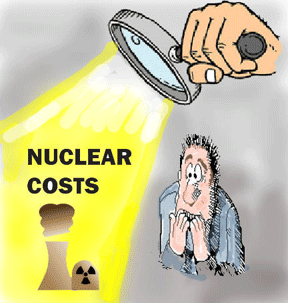
Nuclear option costs ‘six times more’ than renewables
By Marion Rae, May 18 2024, https://www.canberratimes.com.au/story/8632826/nuclear-option-costs-six-times-more-than-renewables/—
The high upfront costs and burden on consumers of adding nuclear to Australia’s energy mix have been confirmed in an independent review.
Building nuclear reactors would cost six times more than wind and solar power firmed up with batteries, according to the independent report released on Saturday by the Clean Energy Council.
“We support a clear-eyed view of the costs and time required to decarbonise Australia and right now, nuclear simply doesn’t stack up,” the industry body’s chief executive Kane Thornton said.
Taxpayers needed to understand the decades of costs if they were forced to foot the bill for building a nuclear industry from scratch, Mr Thornton warned.
The analysis prepared by construction and engineering experts Egis also found nuclear energy had poor economic viability in a grid dominated by renewable energy.
Renewable energy will provide 82 per cent of the national electricity market under current targets for 2030, which is at least a decade before any nuclear could theoretically be operational.
Further, nuclear power stations are not designed to ramp up and down to align with renewable energy generation.
Adding to the cost challenges, Australia has no nuclear energy industry because it is prohibited under commonwealth and state laws, which would all need to be changed.
Mr Thornton said the analysis confirmed that building nuclear power stations instead of renewables would cause power prices to “explode”.
The analysis was based on the CSIRO’s GenCost 2023-24 consultation draft, the Mineral Council of Australia’s Small Modular Reactors study and the industry benchmark Lazard Levelized Cost of Energy Report.
These reports did not include waste management and decommissioning of a nuclear plant in cost calculations, which meant the true cost could be even higher, Mr Thornton said.
Australian Greens’ dissenting report on The Australian Naval Nuclear Power Safety Bill .

1.1The Australian Naval Nuclear Power Safety Bill 2023 (the Bill or ANNPS) is deeply flawed legislation that is only being progressed because of the deeply flawed trilateral agreement that is AUKUS.
1.2The Bill proposes a seriously flawed regulatory model for the dangers of naval nuclear reactors and associated waste.
1.3 The proposed regulator lacks genuine independence, the process for dealing with nuclear waste is recklessly indifferent to community or First Nations interests and the level of secrecy is a threat to both the environment and the public interest.
1.4 Any amendments proposed to improve the many deficiencies of this legislation should not be interpreted as support for the Bill itself or for the AUKUS deal.
1.5 This Bill establishes a new defence naval nuclear regulator that will oversee all aspects of the nuclear production and waste cycle associated with Australian nuclear-powered submarines (and with regard to waste but not the operational activities of UK and US submarines) that operate, are constructed or decommissioned in Australia and Australian territorial waters.
1.6 This regulator will be entirely separate from the existing and long-standing nuclear regulation framework in Australia, which currently sits under the Australian Radiation Protection and Nuclear Safety Act 1998 (ARPANS Act).
Independence
1.7This Bill fails to meet the fundamental international principles of regulatory independence for safely addressing the inherent risks of nuclear power and nuclear waste.
1.8In this Bill, the proposed Australian Naval Nuclear Power Safety Regulator reports directly to the Minister of Defence. The Defence Minister is also responsible, through the Australian Defence Force, for the operation of those same nuclear submarines.
1.9 This is widely out of step with international standards of legal and functional independence for nuclear safety and is contrary to current practice on civil nuclear regulation in Australia.
1.10This is also in direct opposition to the International Atomic Energy Agency in its Fundamental Safety Principles that state: An effective legal and governmental framework for safety, including an independent regulatory body, must be established and sustained.[1]
1.11It is also not in line with the current regulation of nuclear waste in Australia. The regulator, called the Australian Radiation Protection and Nuclear Safety Agency (ARPANSA) sits in the Ministry of Health whereas the Australian Nuclear Science and Technology Organisation (ANSTO) (which operates the Lucas Heights reactor) sits in the Ministry of Industry and Science. This is to ensure the regulator is independent of the industry it oversees.
1.12As the majority report notes in some detail, the proposed model under this Bill is distinct from either the UK or US naval nuclear regulators.
1.13 In the UK, while the main naval nuclear regulator does report through the Ministry of Defence, there is a significant ongoing role for the independent civilian Office for Nuclear Regulation (ONR) in overseeing defence nuclear activities. This is formalised in the General Agreement between the Ministry of Defence and the Office for Nuclear Regulation. This agreement clearly delineates the relationship between the Ministry of Defence and the ONR in discharging their respective roles and responsibilities for the UK’s defence nuclear operations. There is no equivalent role for ARPANSA in this Bill.
In the US, the regulator is known as the Naval Nuclear Propulsion Program (NNPP). This is not run solely by Defense but rather is jointly managed and self-regulated by the civilian National Nuclear Security Administration (NNSA) that reports to the Department of Energy, and the Department of the Navy. By contrast, under this Bill the regulator will be entirely within the Department of Defence and the Defence Minister will have sole ministerial responsibility.
1.15The importance of regulatory independence was outlined in a letter to the CEO of ARPANSA from the Radiation Health and Safety Advisory Council in October 2022 that stated:
Independence of the regulator is a critical part of its effectiveness. The regulator should be independent of the operators and departments overseeing any aspect of purchase, manufacture, maintenance, and operation of the program. It is noted that some of the more significant global nuclear and radiation incidents have arisen from inadequate separation of responsibilities from regulatory capture. More than functional separation, it is important that the independent regulator can operate without influence, and with a strong voice. If a regulatory body cannot provide information on safety and incidents at licensed facilities without the approval of another organisation, issues of independence and transparency will arise. Reporting arrangements should therefore enable the regulatory body to be able to provide safety related information to the Government and the public with the maximum amount of transparency.[2]
1.16During a committee hearing, these concerns were put to the Royal Institution of Naval Architects (RINA), concerning the importance of independence in ‘social licence’:
Senator SHOEBRIDGE: We have good examples, though, of independence. ANSTO is an operator. The regulator of ANSTO reports to a different minister, and that is part of how ANSTO gets social licence. That’s a good example, isn’t it, of structural independence?……………………………………………………
ARPANSA also acknowledged that the key to their social licences was independence through reporting to a minister not associated with the industry they are regulating
1.18In further questioning concerning how this independence can be achieved with the Defence Minister having both the regulator and the body it’s regulating reporting to them, ARPANSA stated:
Senator SHOEBRIDGE: Do you agree it’s a weakness in this bill to have the operator and the regulator both report to the same minister? Or if you don’t want to adopt my phrase, tell me how you would respond to the fact that the regulator and the operator both report to the same minister, given the fundamental importance of independence?
Dr Hirth: I think it’s important to go back to the IAEA, and I think the comments made by RINA in your questions to them this morning around undue influence. Establishing reporting arrangements in order that there isn’t undue influence of interested parties does present a challenge for the Minister for Defence…………………………….
1.19Furthermore, there were concerns raised about the development of a new regulatory body, with all the concerns of independence with the ANNPS Bill, which may also lack the expertise needed……………..
The ability of the Minister through proposed section 105 to issue directions to the regulator further blurs the independence of the new regulator. This was a concern for the Australian Shipbuilding Federation of Unions (ASFU),……………………………………………
1.21Another aspect of the lack of independence concerns the staffing and leadership of the new regulator. It is true that neither the Director-General nor Deputy Director-General can be an active member of the ADF (Australian Defence Force) as specified in proposed section 109.
1.22 However, there is nothing stopping someone from immediately stepping out of the ADF and the next day becoming the Director-General or Deputy Director-General, as this exchange with Defence made clear:……………………………………………………..
1.23 Furthermore, there are no such restrictions on the staff of the regulator, which may all be drawn from active ADF personnel.
1.24 This means the supposed independent regulator of Defence can be run by someone who, the day before was in the Defence, staffed by the Defence and report to the Minister of Defence.
Recommendation 1
1.25 It is recommended that the Bill be amended to ensure a genuinely independent regulator and that the regulator reports to the Minister of Health rather than the Minister of Defence.
1.26 Alternatively, that the regulator more closely reflects the arrangements in the United States and jointly reports to both the Minister of Health and the Minister for Defence, with these Ministers jointly holding Ministerial responsibility under the Bill.
Recommendation 2
1.27 It is recommended that for transparency any direction issued under section 105 be tabled in Parliament within three days where the direction may, or will, negatively impact public health or safety.
Recommendation 3
1.28 It is recommended that section 109 be amended to:
prohibit the Director General from being a current or former member of the ADF or Department of Defence, and;
that the Deputy Director General not be a current member of the ADF or Department of Defence or have been a member of the ADF or Department of Defence for at least two years prior to any appointment.
No public or First Nations consultation
1.29This Bill allows the Minister of Defence to establish ‘designated zones’ for the storage, management and disposal of low, medium and high-level nuclear waste in any part of Australia the Minister chooses by regulation.
1.30This Bill establishes an initial two zones, one at HMAS Stirling at Garden Island in Western Australia and another at the Osborne Naval Shipyard in South Australia. Both zones are close to major metropolitan centres.
1.31Concerning future nuclear waste dumps, the Minister for Defence has indicated that they will only be on Defence land, however, that includes large parcels of land within every major population centre in the country. The Minister also said this can include ‘future’ Defence land.[9]
1.32However, the Bill does not provide even this limitation on where nuclear waste can be located. In fact, the Bill says in bold terms the waste can be on defence land or ‘any other area in Australia’ identified in the regulations. This means, with the flick of the Minister’s pen, any location in Australia can be made into a high-level nuclear waste dump.
1.33This completely excludes any consultation with the local impacted community or with First Nations people whose land and water will be targeted by Defence. With this Bill, neighbours to large defence sites like Holsworthy in Sydney or Greenbank in Brisbane are right to be concerned that they may wake up one morning, with no notice, to find they back onto a high-level nuclear waste dump.
1.34 We have seen from decades of failed attempts to set up nuclear waste sites across the country, most recently at Kimba, that Federal governments have routinely sought to override First Nations people’s claims to the land on this issue. The United Nations Declaration on the Rights of Indigenous Peoples (UNDRIP) specifies the importance of free, prior and informed consent before any such action is taken. This Bill does not even pretend to engage with these principles.
1.35 As the submission from Friends of the Earth stated:
First Nations communities have repeatedly defeated thuggish, racist governments in relation to radioactive waste facilities but that has come at a huge cost in terms of physical and mental health.[10]
1.36The few protections that the law currently gives to First Nations people over their land are removed by this Bill. The Independent and Peaceful Australia Network raised this during a hearing, stating:
There doesn’t seem to have been any notice taken of the United Nations Declaration on the Rights of Indigenous Peoples. They should have the right to prior informed consent on this issue and have full consultation before any designations are made for nuclear waste.[11]
1.37Multiple submissions also raised the comments by Dr Marcos Orellana, UN Special Rapporteur on Toxics and Human Rights, in 2023 on this issue, saying:
It is instructive that all siting initiatives by the Government for a radioactive waste repository have failed, leaving a legacy of division and acrimony in the communities. The loss of lives and songlines resulting from exposure of Indigenous peoples to hazardous pesticides in the Kimberley region, from asbestos exposure in Wittenoom in Western Australia, and from the radioactive contamination following nuclear weapons testing in South Australia, are all open wounds. Alignment of regulations with the UN Declaration on the Rights of Indigenous Peoples is a critical step in the path towards healing open wounds of past environmental injustices.[12]
1.38Concerning the proposed nuclear ‘designated zone’ in Perth, Nuclear Free WA and Stop AUKUS WA noted the importance of the areas around HMAS Stirling, stating in their submission:
Cockburn Sound and Garden Island have significant cultural value for First Nations Peoples … The ecological values of Garden Island, the proximity to Cockburn Sound make radioactive waste disposal here incompatible.[13]
1.39 It is remarkable that on an issue so vital to communities, the potential location of a nuclear waste dump, there is zero public consultation required under this Bill. Compare this to existing laws such as the National Radioactive Waste Management Act 2012, where a site must be voluntarily nominated, evaluated against technical, economic, social and environmental criteria, and offered for public consultation.
1.40 This, together with the express inclusion of the UNDRIP principles, is the minimum standard that should be expected under this Bill for public and First Nations consultation.
Recommendation 4
1.41 It is recommended that the Bill must ensure that there is free, prior and informed consent from First Nations people and the communities impacted before any designated zone is established for low, medium or high-level naval nuclear waste.
Recommendation 5
1.42 It is recommended that the Bill should expressly include reference to, and compliance with, Australia’s international obligations including the United Nations Declaration on the Rights of Indigenous Peoples.
Recommendation 6
1.43 It is recommended that the Bill should adopt the requirements for public consultation and site identification for designated nuclear zones found in the National Radioactive Waste Management Act 2012.
Transparency and collaboration
1.44 The ARPANS Act has key elements to ensure the management of nuclear waste is done in collaboration with other experts and bodies, as well as openly with the public. This Bill fails on both of these fronts……………………………………………………………………………………………
1.47 By creating a legally and functionally separate naval nuclear regulator this Bill ignores decades of experience in both the UK and the US where there is a co-regulatory civil and defence regime. This not only ignores international experience, it also ignores the decades of experience held in Australia’s civilian nuclear regulators and advisers. This is a reckless proposal that will leave Defence to be both the nuclear operator and the nuclear regulator without having ongoing advice from an independent body.
Recommendation 7
1.48 It is recommended that the Bill should require close co-operation and consultation between the proposed naval nuclear regulator and the civilian regulator ARPANSA.
Recommendation 8
1.49 It is recommended that the Bill should be amended to ensure that the Director General receives advice from the relevant nuclear safety advisory groups including the Radiation Health and Safety Advisory Council, Radiation Health Committee and the Nuclear Safety Committee.
UK and US nuclear waste dumping ground
1.50 As noted above the Bill is drafted to allow the UK and US to dump nuclear waste, including high-level nuclear waste, from their existing and decommissioned nuclear submarines in Australia.
1.51 Despite Minister Marles rejecting this as ‘fear-mongering’ when first raised, this fact was admitted by multiple witnesses, including Defence officials and BAE Systems Australia. It also flows from any even moderately close reading of the Bill.[16]
1.52 It turned out to be significantly more than this with numerous organisations confirming that this Bill indeed does allow for the dumpling of nuclear waste in Australia from UK and US submarines.
1.53 Mr Peter Quinlivian, Senior Legal Counsel, BAE Systems Australia admitted the law would permit the dumping of nuclear waste from UK nuclear submarines in the following exchange:…………………………………………………………………………………………………………………….
1.54 Mr Adam Beeson, General Counsel, Australian Conservation Foundation, further corroborated this information said:………………………………………………………………………….
1.55 Mr Kim Moy, Assistant Director-General of the Domestic Nuclear Policy Branch, Department of Defence also admitted that this Bill would allow for the dumping of foreign nuclear waste:……………………………………………………
1.56 Question on Notice 1 from Defence during this hearing also made clear that the current definition is not just limited to low-level nuclear waste, but high-level nuclear waste too.[20]
1.57 This is particularly disturbing given the UK currently has no plan to dispose of the nuclear waste from their nuclear submarines. In the UK there are now six decades of decommissioned rusting nuclear submarines that are filled with high and medium-level nuclear waste for which they have no solution.
1.58 To be clear, under this Bill, there is a real and present danger that either this government or a future government will allow UK nuclear waste to be brought to Australia. This is an extraordinary proposal and is so clearly not in Australia’s interests, let alone the interests of communities and First Nations peoples on whose land this toxic waste will be dumped.
1,59 Mr Dave Sweeny, Nuclear Policy Analyst, Australian Conservation Foundation addressed these concerns ………………………………………………………..
1.60If the AUKUS nuclear submarine deal is to splutter on, then it must not be allowed to become a back door entry for the world’s most toxic nuclear waste.
Recommendation 9
1.61 The Bill must be amended to ensure that no UK or US nuclear waste can be stored or disposed of in Australia.
Overrides other laws
1.62 This Bill also seeks to override or disregard other laws and international obligations.
1.63 For example, the Bill allows for the Minister to override State and Territory laws that might limit where the Federal Government proposes nuclear waste will be stored through proposed section 135 which reads:
If a law of a State or Territory, or one or more provisions of such a law, is prescribed by the regulations, that law or provision does not apply in relation to a regulated activity.
1.64 This issue has been noted by local communities and environmental groups including David J Noonan who stated in his submission:
The Bill is undemocratic and disrespectful to the people of SA in a proposed power under Section 135 “Operation of State and Territory laws” to over-ride any SA Laws or provisions of our Laws effectively by decree, a fiat of unaccountable federal agents to annul our Laws by naming then in Regulations.[22]
Recommendation 10
1.68 It is recommended that section 135 of the Bill should be removed to retain existing State and Territory protections for the safe treatment of nuclear materials.
Recommendation 11
1.69 It is recommended, to ensure the Bill meets the existing requirements for Australia’s nuclear safety regime to be consistent with international standards, that section 136 be amended to require functions performed to be in accordance with, rather than simply to have regard to, prescribed international agreements.
1.70 Each of the above amendments are intended to strengthen a dangerously undercooked bill. Taken together they would significantly strengthen the proposed regulatory regime to make it more independent and to ensure the public interest, public consultation and First Nations’ rights are respected.
1 .71 However, even if all were adopted, the Bill’s express purpose is to facilitate Australia spending some $368 billion to obtain a handful of nuclear submarines. This entire project comes at an eye-watering cost that strips vital public resources from addressing the climate challenge, the housing crisis and rising economic inequality in our country.
1.72 For all these reasons the Bill should be rejected by the Parliament in its entirety.
Recommendation 12
1.73 It is recommended that the Bill be rejected in full.
Senator David Shoebridge, Substitute member, Greens Senator for New South Wales
Footnotes ………………………………………………………………………………………………………………………….. https://www.aph.gov.au/Parliamentary_Business/Committees/Senate/Foreign_Affairs_Defence_and_Trade/ANNPSBills23/Report/Australian_Greens_dissenting_report?fbclid=IwZXh0bgNhZW0CMTAAAR05CTHduGYDKKcA97g2CvxUE5GZijeBqCITeyjzP0E6YtRmwA_t1EDhwE0_aem_AfsyqQjkM1ez6NUjpa-gSqQ_S_XuhvR6d41rhpWq5VIanWmfHvNRjs3Fqrq_uzaOhVymvSX39Jdbj-LRRbQGamPl
Koonibba looks to the future as a rocket launch site, but one elder is concerned about impact on sacred sites
ABC Eyre Peninsula / By Jodie Hamilton and Amelia Costigan, Sat 11 May 2024
When an 11.5 metre German rocket was launched from the tiny South Australian former mission town of Koonibba last Friday, it lit the candle for self-determination and the future of local Indigenous youth.
But one elder says the project risks damaging sacred women’s sites and the next generation’s connection to country.
Kokotha elder Sue Coleman-Haseldine was camped out in the firing line on the rocket range with a handful of supporters to protest the space venture.
However, the majority of the 125 residents of Koonibba — down from a population of 145 in 2016 — supported the launch.
The community negotiated and developed the venture in partnership with Adelaide company Southern Launch over six years.
The partnership is already delivering educational benefits for town’s small school and nearby Ceduna schools, with plans for a space observatory to attract tourists.
Connection to country
But Ms Coleman-Haseldine has vowed to continue protesting against the site.
She is worried it could help develop weapons technology, the scars of which still plague the lands to the north of Koonibba at Maralinga and Emu Fields, where the Australian and British governments tested nuclear weapons from 1952 to 1963.
Ms Coleman Haseldine was born at the Koonibba Mission in 1951 and said she was no stranger to battles, having addressed the United Nations in 2017 about the impact of those weapons tests at Maralinga.
Walking across a large granite rock outcrop, she points out symbols and talks about the stories of the land.
With family and friends, she has been maintaining and cleaning sacred deep waterholes and clearing dirt and soil washed into shallow surface rock pools, to provide safer drinking holes for emus, kangaroos, birds and reptiles.
She set up camp in the Yumbarra Conservation Park, part of the 41,000 square kilometre rocket launch range, which allows for rocket re-entry and retrievals.
The Yellabinna Wilderness Protection Area to the north is also in the rocket launch range
“That rocket launching, I think it could start fires, it could just hit one of these rocks and smash it, starting to break the storylines,” Ms Coleman-Haseldine said.
A Department for Environment and Water spokesperson said the department ensured Southern Launch had consulted appropriately with the Far West Coast Aboriginal Corporation and the Yumbarra Conservation Park Co-management Board…………………………..
Ms Coleman-Haseldine said she had been going to the area from childhood and had a custodial role to protect the land, animals and stories.
“This area is all part of the Seven Sisters dreaming,” she said.
“Country gives us bush med, food, teaches the kids out here how to survive.
“And it teaches them respect for the country and each other, and the animals………………………………………….. https://www.abc.net.au/news/2024-05-11/koonibba-rocket-launch-aboriginal-community-protest-kokotha-sa/103808598
How long does it take to build a nuclear reactor? We ask France

Sophie Vorrath, May 8, 2024, https://reneweconomy.com.au/how-long-does-it-take-to-build-a-nuclear-reactor-we-ask-france/
A short answer to this question might be, it depends who you ask. Ask Opposition leader Peter Dutton, for instance, and he will tell you a federal Coalition government under his leadership could have a nuclear power plant up and running in Australia within a decade.
Ask the highly experienced French state-owned nuclear power giant EDF, which manages 56 reactors in the world’s most nuclear dependent country, and you would get rather a different answer.
Bloomberg reports that EDF this week got regulatory approval to start up its newest nuclear reactor, the 1.6GW Flamanville plant in France’s north west – a milestone that is 12 years behind schedule and more than four times over budget, thanks to a range of construction problems including concrete weakness and faulty pipe welds.
The green light allows EDF to load the fuel in the reactor, proceed with trials, then begin operations, the Autorite de Surete Nucleaire said in a statement on Tuesday. Further approvals will be needed upon reaching key milestones during the trial phase, the regulator said.
According to other reports, EDF said last month it hoped to connect the Flamanville pressurised reactor to the national grid by the European summer and reach full power by the end of the year.
But it will not be smooth sailing from there. A faulty vessel cover still needs replacing at the plant, with reports suggesting this has been pushed out to 2026, when the plant would be shut down for up to a year.
Meanwhile, EDF in March raised its cost estimate for the construction of six new nuclear reactors to €67.4 billion ($A102.5 billion), Reuters has reported, up from the company’s first estimated their cost of €51.7 billion.
So, how long does it take to build a nuclear reactor?
Kobad Bhavnagri, Bloomberg New Energy Finance’s energy expert and global head of strategy says the long delay and cost blowout at Flamanville 3 is not an isolated incident.
“Very similar delays and multifold cost blowouts have occurred with recent reactor builds in the UK, Finland and USA,” Bhavnagri writes on LinkedIn.
“Countries with well established nuclear industries.
“The lesson here? Don’t believe anyone who says they know how much it will cost and how long it will take to build a new nuclear plant (unless they are in China).”
Federal election 2025: Peter Dutton’s nuclear plans worry voters in Nationals-held seat of Gippsland.
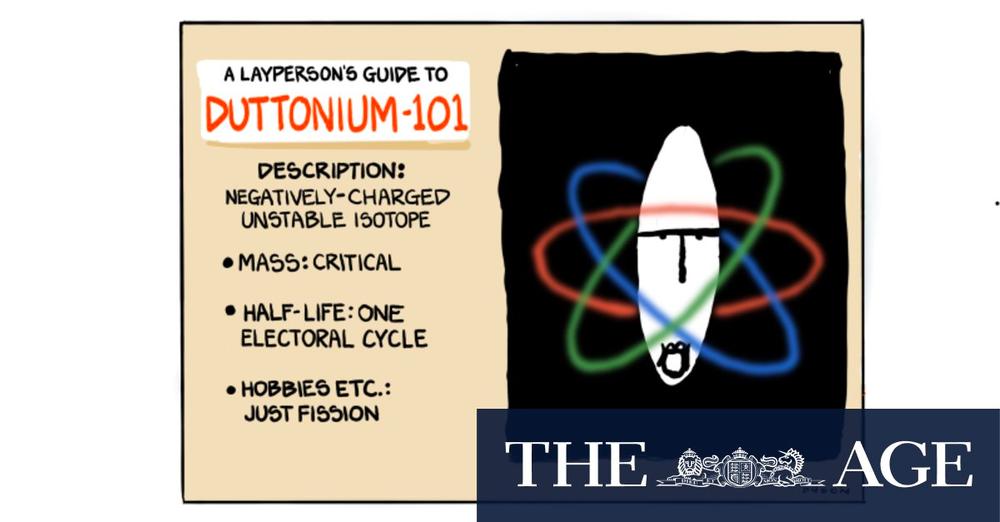
‘A big risk’: Voters wary of nuclear replacing coal-fired power Tom McIlroy Political correspondent, AFR 7 May 24
Voters in Victoria’s Latrobe Valley have raised the Chernobyl and Fukushima nuclear disasters when asked about Peter Dutton’s plan to build large-scale reactors near them, suggesting strong reservations about the energy plan.
As the Coalition finalises a policy for coal-fired power station sites to host nuclear energy – and for small modular reactor technology to be deployed in other places – focus group research in the federal electorate of Gippsland showed voters had safety concerns about living near a reactor.
Mr Dutton wants nuclear to provide baseload power to firm renewable energy and ensure Australia achieves net-zero emissions by 2050.
Communities near coal plants would be called on to host nuclear facilities, with at least six sites expected to be named before the next election.
Mr Dutton says nuclear must stack up on four key criteria: safety, waste disposal, location and cost.
But a focus group of Coalition-leaning voters questioned by polling firm Redbridge last week revealed doubts in the seat held by Nationals MP Darren Chester.
One male participant said he was opposed to nuclear replacing coal-fired power at sites like Loy Yang A, Loy Yang B and Yallourn.
“I know there’s a lot of safeguards with nuclear but it is still a very big risk if something does happen,” he said.
“It uses up a lot of resources and at the end of the day, once it has used up all its radioactiveness, we have to go bury it in the desert somewhere because we can’t do anything with it.”
A woman told the group she did not know much about the plan but had strong concerns.
“The thought of it makes me want to move. I’ve got kids. I don’t want them to be exposed to something that could affect them.”
Another woman said future generations would suffer if Australia lifted the ban on nuclear power.
“We’ve seen in the past with Chernobyl. Obviously, the situation has got better and people have learnt from things but mistakes happen and it’s a risk that you have to weigh up when considering putting something into an area with population.”
Another male participant cited the 2011 accident at Japan’s Fukushima power plant. He said Australia could face the risk of a similar disaster if nuclear was developed here. Another suggested that carp in local waters would “be huge” in the event of a nuclear spill………………………………………………………..
Fellow director Tony Barry said there was “intense” opposition in Gippsland.
“There is some limited opportunity for the Coalition to leverage a perception that a nuclear reactor in the region might produce local economic benefits.
“However, the problem for the Coalition is that to overcome these wide and deep concerns and to successfully leverage the perceived benefits they will need to spend millions of campaign dollars on messaging.”…………………………………… https://www.afr.com/politics/federal/a-big-risk-voters-wary-of-nuclear-replacing-coal-fired-power-20240506-p5fp9d
Murrumbidgee Council launches survey on establishing nuclear power generator near Coleambally, Darlington Point or Jerilderie

from Greg Phillips -I was wondering if this was a belated April Fool’s joke. Especially since it is an “online survey” with no checks on who votes (as usual I expect it to be overrun by nuclear fanatics pretending to be locals). I think the rate payers in that area will have to pay much more attention to who they let get into the council next time.
30 April 2024 | Oliver Jacques, https://regionriverina.com.au/council-launches-survey-on-establishing-nuclear-power-generator-near-coleambally-darlington-point-or-jerilderie/59543/
Murrumbidgee Council has asked residents of Coleambally, Darlington Point, and Jerilderie to voice their opinions on the idea of establishing a nuclear power generator in their area.
“In an effort to explore diverse energy solutions, the community is invited to participate in an online survey aimed at understanding their appetite for nuclear power,” the council said in a statement.
Nuclear power plants generate electricity by using controlled nuclear chain reactions to heat water and produce steam to power turbines.
Advocates say the plants can generate clean energy without the by-products emitted by fossil fuels, while critics argue nuclear power is expensive, unreliable, possibly unsafe and it produces hazardous waste.
Murrumbidgee Council General Manager John Scarce said the council sought to understand public sentiment regarding the possible integration of nuclear power into the local energy landscape.
Mr Scarce said the concept would be contingent upon dismantling existing renewable energy infrastructure, including solar and wind farms, at the end of their operational life.
“The land would then be reclaimed for agricultural purposes, aligning with sustainability and resource optimisation goals,” he said.
The survey is designed as a precursor to gathering more information on the idea, with a view to undertaking a more formal poll in the future.
Nuclear power is banned in Australia and under current laws, nuclear power stations can’t be built in any state or territory.
At a recent event in Wagga, Essential Energy CEO John Cleland said nuclear energy would remain an important part of the global energy network, but it was an unlikely option for Australia in the near future.
“The lived experience and reality of nuclear is that all new nuclear generation built globally in the last 40 or 50 years has ended up being very expensive,” he said.
“In Australia, we have this wonderful endowment of wind and solar and existing gas reserves and systems that will provide a very robust peaking generation source going forward.
“The economic case for nuclear is challenging but we do need to continue to monitor the evolution of the technology around small-scale modular nuclear reactors because they might in time play a role.”
The Murrumbidgee Council survey can be accessed online at survey monkey and will remain open until 5 pm on 22 May 2024.
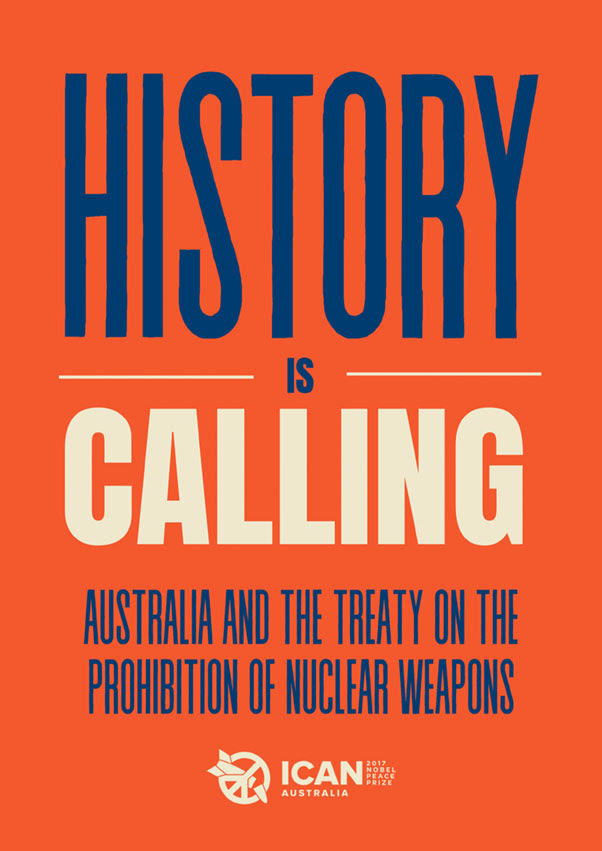
“History is Calling: Australia and the Treaty on the Prohibition of Nuclear Weapons”
– Melissa Parke, ICAN International Executive Director, 30 Apr 24 https://icanw.org.au/history-is-calling-report/
“History is Calling: Australia and the Treaty on the Prohibition of Nuclear Weapons” sets out in detail the case for Australia to join the global majority of nations in supporting the nuclear weapon ban treaty. It outlines Australia’s progress on implementation, the TPNW’s complementarity with other agreements, nuclear safeguards and disarmament architecture, enforcement, universalisation, victim assistance and environmental remediation, Australia and its alliances, and nuclear deterrence theory.
By early 2024, almost half the world’s nations have already joined the TPNW. More will join. And they are getting to serious, practical work implementing the treaty.
Australia is currently the only nuclear-allied state where the governing party has repeatedly committed to sign and ratify the ban treaty. Under governments both Coalition and Labor, Australia has joined every other treaty banning an inhumane, indiscriminate weapon, but not yet this one banning the worst weapons of mass destruction.
Australia must step up and do its part to wind back the looming nuclear danger. Let’s get on the right side of history, not add to the risk of ending it. It’s time Australia joined the Treaty on the Prohibition of Nuclear Weapons.
– Melissa Parke, ICAN International Executive Director
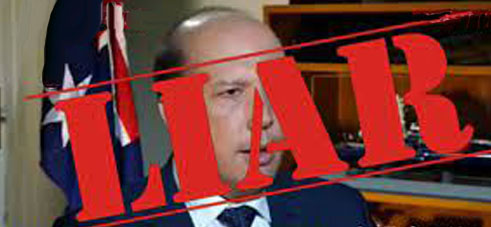
Dutton’s plan to save Australia with nuclear comes undone when you look between the brushstrokes
Graham Readfearn, https://www.theguardian.com/environment/2024/apr/24/duttons-plan-to-save-australia-with-nuclear-comes-undone-when-you-look-between-the-brushstrokes
The dystopian picture of renewables painted by the opposition leader is full of inconsistencies, partial truths and misinformation
The Coalition leader, Peter Dutton, has been trying to paint a picture of what life in Australia will be like if it tries to power itself mostly with renewable energy and without his technology of choice: nuclear.
Towering turbines offshore will hurt whales, dolphins and the fishing industry, factories will be forced to stop working because there’s not enough electricity and the landscape will be scoured by enough new transmission cables to stretch around the entire Australian coastline.
At the same time – so his story goes – only his option to go nuclear will save Australia from falling behind the rest of the world.
But Dutton’s dystopian image, with more brushstrokes added in an interview on the ABC’s flagship Insiders program, is a picture of inconsistencies, partial truths and misinformation.
Let’s have a look between the brushstrokes.
Is it a credible plan?
The Coalition has said it wants to put nuclear reactors at the sites of coal-fired power plants, but hasn’t said where, how big the reactors will be, when it wants them built or given an estimate on cost.
The Coalition has previously said it would give more details on its plan in time for its response to the Albanese government’s budget next month, but Dutton is now saying it will come “in due course”.
Despite this, Dutton claimed in his interview with the ABC’s David Speers that: “I believe that we’re the only party with a credible pathway to net zero by 2050.”
OK then.
28,000 kilometres?
Dutton claimed the government’s plans relied on “28,000km of poles and wires being erected” to connect renewables to the grid – a distance he said was “equal to the whole coastline of Australia”.
That’s a catchy soundbite, but where does this number come from?
According to the Australian Energy Market Operator’s most recent plan for the development of Australia’s east-coast electricity market, the most likely scenarios to decarbonise the electricity grid would require about 10,000km of additional transmission lines to be built between now and 2050.
What about the extra 18,000km? That figure comes in an estimate of what would be needed if Australia chose to become a major exporter of clean hydrogen as well as decarbonising the grid.
So about two-thirds of Dutton’s 28,000km is not so much related to decarbonising the electricity grid, but rather to an export industry that may or may not happen, to an as-yet-unknown extent.
Turning off power?
Dutton claimed: “At the moment, we’re telling businesses who have huge order books to turn down their activity in an afternoon shift because the lights go out on that grid. Now, no other developed country is saying that.”
Dutton is suggesting that businesses are being routinely forced to reduce their demand for power. This is simply not true.
Dr Dylan McConnell, an energy systems analyst at UNSW, says it’s very rare for businesses to be told by the market operator they are going to have their power interrupted.
Such “load shedding” has happened only five times in the last 15 years, he said, typically occurs in extreme conditions such as storms or coal plants going offline, and only a subset of consumers are affected.
There are two main formal voluntary schemes in place across the National Electricity Market (everywhere except NT and WA) where major electricity consumers can offer to reduce their demand for electricity at certain times, but businesses are compensated for being part of those schemes. Nobody is telling any of these businesses that they have to do anything.
Neither is it true that no other country is engaging in some sort of process where demand for electricity can be managed.
Is Australia really the only developed country engaged in what’s known as demand response? No.
The International Energy Agency lists the UK, US, France, Japan and South Korea as having large markets already in place to help their electricity systems balance the supply of electricity with demand.
McConnell said: “Demand response is becoming a common and important part of modern electricity systems. This includes countries like France and the US, which have both nuclear and demand response programs.”
G20 and nuclear
Dutton said Australia was the only G20 nation “not signed up to nuclear or currently using it”.
According to information from the World Nuclear Association, Australia is one of five G20 nations with no operating nuclear power plants, alongside Indonesia, Italy, Saudi Arabia, Germany and Turkey.
But aside from Italy, Germany and Australia, the rest do have some plans to develop nuclear power in the future. Dutton’s phrase “currently using it” allows him to capture countries like Italy that import electricity from nuclear nations.
But what’s also important to note is that among the G20 countries (actually 19 countries) nuclear is mostly playing a marginal role. Nuclear provides more than 5% of its electricity in only seven of those 19 countries.
Social licence?
Projects would need a “social licence” to go ahead, Dutton said, but there was opposition in western New South Wales where “productive” land was being sold for renewables projects.
This is a variation of a previous Dutton speech, where he lamented a supposed “carpeting of Australia’s prime agricultural land with solar and windfarms”.
The renewable energy industry’s Clean Energy Council has countered claims like this, saying even if all the country’s coal plants were replaced with solar farms, the amount of space needed would be about 0.027% of agricultural land.
The Coalition leader has been to the Hunter coast more than once where offshore windfarms are being planned, telling reporters they were a “travesty” and that they would put whales, dolphins and the fishing and tourism industries “at risk”. He told Speers the turbines would rise “260 metres out of the water”.
Dutton told the ABC that Australia should be mindful of the environmental consequences of windfarms – which is, of course, true – but his past statements have sounded more like cheerleading for voices opposed to the plans than an attempt to understand the scale and legitimacy of the concerns, some of which are being stoked by misinformation.
Dutton can’t know what impact offshore windfarms will have on fishing or tourism, but is willing in any case to use labels like “travesty”.
‘A little awkward’: Coalition faces internal tension over nuclear plans
Sky News host Chris Kenny says the Coalition is in an “awkward” situation with their behind the scenes negotiations around nuclear energy.
It is reported that a rift has formed with the Coalition regarding Opposition leader Peter Dutton’s nuclear energy plans.
“Inside the Coalition, there is argument about where the nuclear power stations might be sited in this country,” Mr Kenny said.
“Apparently some MPs saying they don’t want them in their backyard.
“Sounds like there is tension.”
1 This month
17 October, Free Public Talk on Nuclear Issues in South Australia
David Noonan will speak on public interest concerns over the new Roxby Downs Indenture Act 2026 on BHP copper-uranium mining and ore processing in SA, and on how AUKUS may face SA with a High-Level nuclear waste agenda.
Dr Jim Green will discuss international developments in the field of nuclear power including ‘small modular reactors’ and Generation 4 ‘advanced’ nuclear reactor concepts.


Help Aunty Sue Protect Her Land and Sacred Sites From Destructive Rocket Testing.
.

Australians deserve the truth
about
AUKUS – https://aukuspublicinquiry.com/

PETITION – To: Prime Minister Anthony Albanese and the Australian Labor Government

of the week – Australians for War Powers Reform (AWPR)
To see nuclear-related stories in greater depth and intensity

