The CIA Plot to Kidnap or Kill Julian Assange in London is a Story that is Being Mistakenly Ignored
The CIA Plot to Kidnap or Kill Julian Assange in London is a Story that is Being Mistakenly Ignored https://www.counterpunch.org/2021/10/05/the-cia-plot-to-kidnap-or-kill-julian-assange-in-london-is-a-story-that-is-being-mistakenly-ignored/?fbclid=IwAR3t BY PATRICK COCKBURN 5 October 21, Three years ago, on 2 October 2018, a team of Saudi officials murdered journalist Jamal Khashoggi in the Saudi consulate in Istanbul. The purpose of the killing was to silence Khashoggi and to frighten critics of the Saudi regime by showing that it would pursue and punish them as though they were agents of a foreign power.
It was revealed this week that a year before the Khashoggi killing in 2017, the CIA had plotted to kidnap or assassinate Julian Assange, the founder of WikiLeaks, who had taken refuge five years earlier in the Ecuador embassy in London. A senior US counter-intelligence official said that plans for the forcible rendition of Assange to the US were discussed “at the highest levels” of the Trump administration. The informant was one of more than 30 US officials – eight of whom confirmed details of the abduction proposal – quoted in a 7,500-word investigation by Yahoo News into the CIA campaign against Assange.
The plan was to “break into the embassy, drag [Assange] out and bring him to where we want”, recalled a former intelligence official. Another informant said that he was briefed about a meeting in the spring of 2017 at which President Trump had asked if the CIA could assassinate Assange and provide “options” about how this could be done. Trump has denied that he did so.
The Trump-appointed head of the CIA, Mike Pompeo, said publicly that he would target Assange and WikiLeaks as the equivalent of “a hostile intelligence service”. Apologists for the CIA say that freedom of the press was not under threat because Assange and the WikiLeaks activists were not real journalists. Top intelligence officials intended to decide themselves who is and who is not a journalist, and lobbied the White House to redefine other high-profile journalists as “information brokers”, who were to be targeted as if they were agents of a foreign power.
Among those against whom the CIA reportedly wanted to take action were Glenn Greenwald, a founder of the Intercept magazine and a former Guardian columnist, and Laura Poitras, a documentary film-maker. The arguments for doing so were similar to those employed by the Chinese government for suppressing dissent in Hong Kong, which has been much criticised in the West. Imprisoning journalists as spies has always been the norm in authoritarian countries, such as Saudi Arabia, Turkey and Egypt, while denouncing the free press as unpatriotic is a more recent hallmark of nationalist populist governments that have taken power all over the world.
It is possible to give only a brief precis of the extraordinary story exposed by Yahoo News, but the journalists who wrote it – Zach Dorfman, Sean D Naylor and Michael Isikoff – ought to scoop every journalistic prize. Their disclosures should be of particular interest in Britain because it was in the streets of central London that the CIA was planning an extra-judicial assault on an embassy, the abduction of a foreign national, and his secret rendition to the US, with the alternative option of killing him. These were not the crackpot ideas of low-level intelligence officials, but were reportedly operations that Pompeo and the agency fully intended to carry out.
This riveting and important story based on multiple sources might be expected to attract extensive coverage and widespread editorial comment in the British media, not to mention in parliament. Many newspapers have dutifully carried summaries of the investigation, but there has been no furor. Striking gaps in the coverage include the BBC, which only reported it, so far as I can see, as part of its Somali service. Channel 4, normally so swift to defend freedom of expression, apparently did not mention the story at all.
In the event, the embassy attack never took place, despite the advanced planning. “There was a discussion with the Brits about turning the other cheek or looking the other way when a team of guys went inside and did a rendition,” said a former senior US counter-intelligence official, who added that the British had refused to allow the operation to take place.
But the British government did carry out its own less melodramatic, but more effective measure against Assange, removing him from the embassy on 11 April 2019 after a new Ecuador government had revoked his asylum. He remains in Belmarsh top security prison two-and-a-half years later while the US appeals a judicial decision not to extradite him to the US on the grounds that he would be a suicide risk.
If he were to be extradited, he would face 175 years in prison. It is important, however, to understand, that only five of these would be under the Computer Fraud and Abuse Act, while the other 170 potential years are under the Espionage Act of 1917, passed during the height of the patriotic war fever as the US entered the First World War.
Only a single minor charge against Assange relates to the WikiLeaks disclosure in 2010 of a trove of US diplomatic cables and army reports relating to the Iraq and Afghan wars. The other 17 charges are to do with labeling normal journalistic investigation as the equivalent of spying.
Pompeo’s determination to conflate journalistic inquiry with espionage has particular relevance in Britain, because the home secretary, Priti Patel, wants to do much the same thing. She proposes updating the Official Secrets Act so that journalists, whistle-blowers and leakers could face sentences of up to 14 years in prison. A consultative paper issued in May titled Legislation to Counter State Threats (Hostile State Activity) redefines espionage as “the covert process of obtaining sensitive confidential information that is not normally publicly available”.
The true reason the scoop about the CIA’s plot to kidnap or kill Assange has been largely ignored or downplayed is rather that he is unfairly shunned as a pariah by all political persuasions: left, right and centre.
To give but two examples, the US government has gone on claiming that the disclosures by WikiLeaks in 2010 put the lives of US agents in danger. Yet the US Army admitted in a court hearing in 2013 that a team of 120 counter-intelligence officers had failed to find a single person in Iraq and Afghanistan who had died because of the disclosures by WikiLeaks. As regards the rape allegations in Sweden, many feel that these alone should deny Assange any claim to be a martyr in the cause of press freedom. Yet the Swedish prosecutor only carried out a “preliminary investigation” and no charges were brought.
Assange is a classic victim of “cancel culture”, so demonised that he can no longer get a hearing, even when a government plots to kidnap or murder him.
In reality, Khashoggi and Assange were pursued relentlessly by the state because they fulfilled the primary duty of journalists: finding out important information that the government would like to keep secret and disclosing it to the public.
Patrick Cockburn is the author of War in the Age of Trump (Verso).
Minerals Council pushes for the nuclear industry, despite its failing record compared to renewables
Historic alliance reignites old debate over Australian nuclear energy, SMH , By Nick O’Malley, September 16, 2021 The head of the Minerals Council of Australia says the development of a nuclear submarine fleet provides the nation a great opportunity to build a domestic nuclear power capacity.
The council, which counts uranium miners among its members, has long supported the pro-nuclear case in a decades-old debate over the potential of a domestic nuclear energy industry for Australia, which the submarine announcement may reignite…….
Energy economist Bruce Mountain said he expected the submarine announcement would reignite the decades old debate over nuclear power in some quarters, but such a fleet would not change the Australian circumstances.
Wind and solar are now the cheapest sources of energy and nuclear remains by far the most expensive, he said.“Every single piece of key tech [in the mooted submarine program] would be imported, it is not the same as having an indigenous nuclear power industry,” he said.
Prime Minister Scott Morrison said Australia is not seeking to acquire nuclear weapons or establish a civil nuclear capability, and it would continue to meet all nuclear non-proliferation obligations……..
According to the World Nuclear Status Report, an analysis of the global industry published annually by the Paris-based energy analyst Mycle Schneider, the world’s fleet of nuclear reactors provides about 10 per cent of electricity, but is ageing and shrinking…….
Last year Mr Schneider told the Herald and The Age that though nuclear energy was emission-free, money spent on nuclear power was a drain on clean energy development as it misdirected funds that might have been spent on faster and cheaper clean energy projects. https://www.smh.com.au/national/historic-alliance-reignites-old-debate-over-australian-nuclear-energy-20210916-p58sc8.html
Can the Australian government ignore this powerful letter exposing the foolish decision to ”go nuclear” with submarines and AUKUS?
Ed. note. Here I summarise the points in this well-researched letter: Diplomatic Repercussions – Geopolitical Tensions and Australian National Security(Why the decision makes Australias national security worse not better) – We now have No Submarine Program at All. – But Is Nuclear the Best Stealth? – Can we Build them at Osborne? -Time to re-evaluate our Submarine Program? –The worst option is to do as we have now done. – Conclusion – This decision should be re-visited
Conclusion
The submarine decision, especially within the context of the new ‘AUKUS’ grouping, but even taken on its own:
—Worsens rather than improves Australias own national security, making us (more of) a nuclear target than we have ever been, and extending the targeting potentially from joint facilities to Australian cities and naval bases.
—Worsens rather than improves regional security, adding impetus to regional arms racing, and increasing the likelihood that other Governments may decide they would like to have submarines fueled by HEU
—Leaves Australia currently with no replacement program for the Collins Class submarines
—Makes no sense even within its own restricted terms of reference because it does not offer a submarine with the best stealth
—Requires a submarine that may not be possible to construct even in part at Osborne.
Letter Sent 5 October to Cabinet Security Cttee, Senate, Reps, DFAT, re Nuclear Subs, AUKUS,
PEOPLE FOR NUCLEAR DISARMAMENT
HUMAN SURVIVAL PROJECT – NUCLEAR SUBMARINES, AUKUS
Dear Prime Minister Scott Morrison, other decision-makers on the Australian nuclear submarines project, Cabinet National Security Committee, AUKUS:
Summary:
The decision to establish a new diplomatic/military grouping, AUKUS, deepens confrontational tendencies in the Indo-Pacific region and is hence destabilizing, and worsens rather than improves Australia’s national security. It helps to ‘paint nuclear targets on Australia’s backside’.
The decision to equip Australia with nuclear submarines fueled with highly enriched uranium is both destabilizing and proliferative even if technically within the letters of the NPT. The decision to go with HEU fueled subs in particular opens a proliferation ‘pandoras box’.
The new Australia, UK, and US nuclear submarine announcement: a terrible decision for the nonproliferation regime
The decision to ‘go nuclear’ with submarines has been justified on the supposed technical superiority of nuclear over conventional subs. However a look in detail at the real – world technical and operational characteristics of advanced conventional and nuclear subs shows clear technical superiorities on the part of advanced conventional submarines exactly where we are being told nuclear subs are superior – in the area of quietness and non-detectability. The technical case for nuclear over conventional submarines is not established.
No analysis, and no thought, has been given as to what are Australia’s real security needs, and into whether submarines of any description fit into it.
The decision leaves Australia with currently NO replacement program for the Collins Class subs.
The Submarine Decision and AUKUS
The decision to cancel an existing, well – established, contract with the French Naval Group for a diesel version of the Suffren class attack submarine has not met with universal acclaim, particularly from the French.
At the same time, the closely related decision to establish a new military/diplomatic grouping to be known as ‘AUKUS’ (Australia-UK-US) has also raised questions as to its geo-strategic impact, and contributed further to the deterioration of our relations with China, and possibly with Russia, with potentially catastrophic implications for Australias national security and the safety of all Australians.
It has quite reasonably been suggested that the establishment of ‘AUKUS” cements Australia into an ‘Anglo-sphere’ that is intrinsically limited in scope (how for example, does it relate to the ‘quad’ of India, Australia, Japan, US?), that excludes other nations that have strong Indo-Pacific interests and are allies (including France itself, now snubbed and smarting), and above all, that deepens confrontational attitudes in the region, especially with China.
It is by no means clear that the decision to substitute nuclear powered submarines is even the best decision on technical grounds, or that nuclear powered submarines are necessarily superior in the respects that might be important to Australia and particularly in extreme stealth – to conventionally powered submarines, either the existing Collins class, the erstwhile projected French submarine, or to an evolutionary successor to Collins.
Continue readingWill all submarines, even nuclear ones, be obsolete and ‘visible’ by 2040?
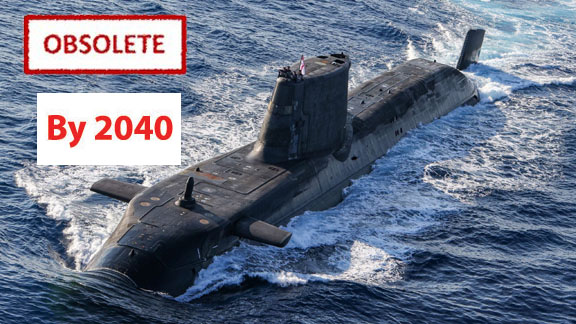
Will all submarines, even nuclear ones, be obsolete and ‘visible’ by 2040?
Technologies could render the ocean transparent by the time Australia’s new submarines are ready, some experts say, Guardian, Tory Shepherd, 5 Oct 21, Australia’s proposed nuclear-powered submarines could be obsolete by the time they hit the water in the 2040s due to new technologies making underwater vessels “visible”, some experts argue.
One of the controversies over the federal government’s decision to ditch the $90bn deal to build conventional submarines in favour of nuclear boats is the timeline for getting them battle-ready.
The navy will have to stretch out the lifespan of the existing Collins-class fleet and possibly hire submarines to fill the gap before the new ones are on the horizon.
But even before the deal to buy 12 submarines from France’s Naval Group was made, military analysts warned that submarines of all types would be rendered obsolete by new technology including submersible drones and new weapons systems.
There are also warnings that different technologies will render the ocean “transparent”, so even the stealthiest submarines could be spotted by an enemy force.
The Australian National University’s National Security College report Transparent Oceans? found that transparency is “likely or “very likely” by the 2050s, a decade after Australia’s new fleet of nuclear-powered subs is due to enter service.
A multidisciplinary team looked at new sensor technology, underwater communications and the possibility of tripwires at choke points. They also examined new ways to detect chemical, biological, acoustic and infra-red signatures, finding that even with improvements in stealth submarines will become visible.
The report found “future technologies will make the oceans broadly transparent and counter-detection technologies will not have the same salience in the decades ahead as they have had previously”.
China has already developed submarine-spotting lasers.
CSIRO is working with a Chinese marine science institute that has separately developed satellite technology that can find submarines at depths of up to 500 metres.
That collaboration is due to end next year. The Australian has reported that Asio warned it could help the Chinese navy to hunt down Australian submarines but CSIRO said making that connection was “alarmist and irresponsible reporting”.
The defence analyst Albert Palazzo, writing for the Lowy Institute, said China’s technology will be advanced enough that “any Australian submarine that attempts to do something in these waters, such as launch a tomahawk missile, will reveal its position and shortly thereafter be destroyed”.
Others say submarines are just a base platform for a range of new and evolving technologies…………….
According to the taskforce set up under Aukus, the new submarines will have “superior characteristics of stealth, speed, manoeuvrability, survivability, and almost limitless endurance”, with better weapons, the ability to deploy drones and “a lower risk of detection”. https://www.theguardian.com/australia-news/2021/oct/05/will-all-submarines-even-nuclear-ones-be-obsolete-and-visible-by-2040
Taiwan endorses AUKUS pact, asks Australia for help in war with China
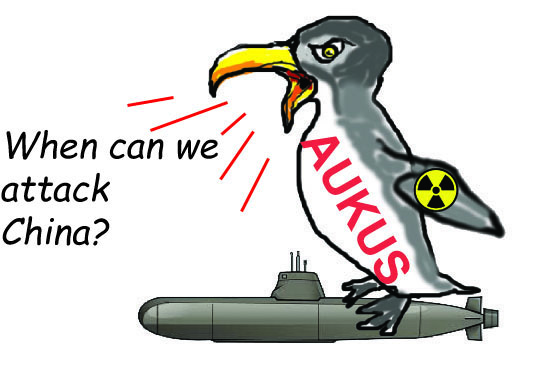
Taiwanese Foreign Minister warns his country is preparing for war with China, asks Australia for help, ABC, by defence correspondent Andrew Greene and Stan Grant 4 Oct 21, Taiwan’s Foreign Minister warns his nation is preparing for war with China and urges Australia to increase intelligence sharing and security cooperation as Beijing intensifies a campaign of military intimidation.
Key points:
- Taiwan’s Foreign Minister Joseph Wu warns of looming war with China and urges closer cooperation with Australia
- Dozens of Chinese military aircraft have flown into Taiwanese airspace in recent days
- Mr Wu has also thanked Australia for supporting Taiwan’s bid to join a new trade pact
Dozens of aircraft from the People’s Liberation Army (PLA) have flown sorties into Taiwan’s Air Defence Identification Zone (ADIZ) since Friday, prompting the self-ruled island to scramble its own military jets.
Speaking to the ABC’s China Tonight program, Taiwan’s Foreign Minister Joseph Wu declared that if the PLA were to launch an actual strike, his democratic state would be ready to repel it……………
Australia does not formally recognise Taiwan diplomatically, but the federal government regularly calls for a “peaceful resolution” of differences between China and the small independent nation through dialogue and without the threat or use of force or coercion.
A communique issued after last month’s AUSMIN meetings between Australia and the United States declared that “both sides stated their intent to strengthen ties with Taiwan, which is a leading democracy and a critical partner for both countries”.
Taiwan endorses new AUKUS pact, won’t seek its own nuclear submarines
Taiwan has also welcomed the recent establishment of the AUKUS strategic partnership between Australia, the United Kingdom, and the United States, as well as the growing activity between the Quad allies, the US, India, Australia and Japan.
……………….The Taiwanese Foreign Minister said that unlike Australia, his nation would not be trying to acquire nuclear-powered submarines, because it has a “different war strategy”.
Defence analyst Professor Clinton Fernandes from the University of New South Wales warns it would be difficult for the US and allies to prevent any invasion attempt by China……….. https://www.abc.net.au/news/2021-10-04/taiwan-preparing-for-war-with-china/100511294
Kimba nuclear waste dump is absolutely not a foregone conclusion – David Noonan.

ANSTO have made decisions on the location of this new facility relative to the existing facility, and they’ve made that decision in terms of how much waste there will be and for how long they consider it to be their responsibility to retain those wastes on site. I think that those evaluations should have been made with the primary safety contingency in mind to retain not just existing waste and the next decade’s waste, but—if their intention is to operate the OPAL reactor through to 2057 under this existing licence—the full complement of waste that they intend to produce.
Parliamentary Standing Committee on Public Works 13/09/2021 Intermediate level solid waste storage facility, Lucas Heights, New South Wales, NOONAN, Mr David, Private capacity [by audio link]
Mr ZAPPIA: Mr Noonan, you expressed some concerns about the facility in South Australia proceeding. What are those concerns? That is, why do you believe that it is still not a foregone conclusion that that facility will be built?
Mr Noonan : In a number of respects it’s absolutely not a foregone conclusion. You should first consider prior evidence that with all of the power and influence of the Howard federal government, which tried between 1988 and 2004 to do, analogously, the same imposition of ANSTO nuclear waste on South Australia, and they failed. They had to abandon their plan and proposal. They recognised it was flawed and electorally unacceptable in the lead up to the 2004 federal election.
Secondly, it’s illegal in South Australia. The plan as proposed by ANSTO—the import, transport and storage of nuclear waste—was made illegal by the previous South Australian Liberal Premier, John Olsen AO. He passed legislation that prohibits the import, transport and storage of those wastes. So it’s against the law. It’s against the will of the parliament and the people in South Australia. It’s highly publicly contentious. The South Australian opposition ALP oppose the plan. They say that the process is flawed.
Federal Labor have raised some concerns about the double-handling and the failure of the government to further any proposal to reach a waste-disposal isolation capacity. There are significant concerns at the public level that it’s untenable and unacceptable, in terms of safety and security for SA, to simply bring ANSTO’s nuclear waste complement over to SA and store it above ground, potentially indefinitely—for up to 100 years, according to the regulator—in what is effectively a fancy shed in regional SA, on agricultural land, against the will of traditional owners, compared to the safety and security that is already provided for at Lucas Heights.
ARPANSA hold the deciding factor, essentially, on whether licences are ever granted in future to site, construct and operate the proposed store that ANSTO’s plans—the works before you—rely on. In terms of democracy within South Australia, and in terms of the consideration that your committee and ANSTO should have to give to not pre-empt ARPANSA’s future licensing decisions, I think there are multiple time lines and tests that would have to be passed by ANSTO’s plan to transfer waste to South Australia before that could ever be relied upon, and one of those tests is the South Australian election early next year.
…….. Mr PASIN: You’re obviously concerned about an engineering matter that would prevent it operating in the long term. I would have thought that, whether you’re storing waste for a short period or a long period, a facility like this would have to be engineered to similar standards, wouldn’t it?
Mr Noonan : For instance, ANSTO have made decisions on the location of this new facility relative to the existing facility, and they’ve made that decision in terms of how much waste there will be and for how long they consider it to be their responsibility to retain those wastes on site. I think that those evaluations should have been made with the primary safety contingency in mind to retain not just existing waste and the next decade’s waste, but—if their intention is to operate the OPAL reactor through to 2057 under this existing licence—the full complement of waste that they intend to produce. They should have to show a plan and a capacity to retain those wastes at Lucas Heights for the period required, and I don’t know if the existing works as proposed match that public purpose…. https://parlinfo.aph.gov.au/parlInfo/search/display/display.w3p;db=COMMITTEES;id=committees%2Fcommjnt%2Fcfc4f9dc-b73c-4166-b484-eeaddcab5bc0%2F0001;query=(Dataset%3Acommsen,commrep,commjnt,estimate,commbill%20SearchCategory_Phrase%3Acommittees)%20CommitteeName_Phrase%3A%22parliamentary%20standing%20committee%20on%20public%20works%22;rec=4
ARPANSA may not give licence for Kimba nuclear waste dump. Nuclear wastes best managed at Lucas Heights
 |
ANSTO’s proposed public works appear premised on an ill-considered, unassured and, arguably, untenable proposed transfer of intermediate-level waste into indefinite above-ground storage in South Australia. That’s a plan which may never come to fruition, just as the prior proposal by then Prime Minister Howard’s federal government to impose transfer and storage of ANSTO’s nuclear waste into South Australia, which was run between 1998 and 2004, had to be abandoned as a flawed proposal.
As the CEO of ARPANSA has said, nuclear waste can be safely managed at ANSTO at Lucas Heights for decades to come. With respect, that should be the premise on which your committee addresses the works before you.
Parliamentary Standing Committee on Public Works 13/09/2021 Intermediate level solid waste storage facility, Lucas Heights, New South Wales
NOONAN, Mr David, Private capacity [by audio link] Mr Noonan : I have nearly 25 years experience of following nuclear waste issues in Australia, both in capacity, working for non-government organisations, and more recently as an individual—an independent consultant and campaigner.
My first key point is that the primary premise that your committee should consider, evaluate and scrutinise of ANSTO’s proposed works is in terms of the safety contingency set by the independent regulator ARPANSA to retain ANSTO’s nuclear waste at Lucas Heights until the availability of a final isolation and disposal option. With respect, I think that should be the primary matter that should have been addressed by ANSTO in their submission to you and apparently was not.
My second key point is that, in contrast, ANSTO, as, with respect, a vested-interest proponent, presents a plan of proposed works that relies on proposed transfer of intermediate-level waste into indefinite above-ground storage in South Australia—potentially for up to 100 years. Firstly, I’d say that is arguably untenable, and I’d welcome a question line on that if it suits the committee. Secondly, it appears to pre-empt the proper role of ARPANSA licensing decision-making. ARPANSA have said that they will require separate licence processes to assess potential siting, construction and operation of a proposed store for ANSTO intermediate-level waste in South Australia. ANSTO don’t have a right, in the design of their plan and works toward you, to pre-empt a potential grant of outcome to that, and ARPANSA have been clear that they may or may not grant those licences in future.
Thirdly, your mandate as a committee goes to both scrutinising and assessing proposed works. But it holds a fundamental provision, in that you have a right to alter the proposed works—and I would ask you to consider doing so—to make them best comply with the suitability of the overarching purpose of meeting the best public value in the proposed works and the best cost-effectiveness in expenditure of public funds. With respect, I would say that that assessment and the scrutiny which you provide to ANSTO’s application should be in terms of their capacity and willingness to match the safety contingencies set by the independent regulator to retain intermediate-level waste on site at Lucas Heights until availability of a final isolation and disposal option.
Fourthly: I think the scrutiny that your committee would conduct is best served by the highest level of transparency. In that respect, I would call for you to ask ANSTO to publicly release two fundamentally important reports with regard to their planning and capacities to manage intermediate-level waste at Lucas Heights that were due under their licensing conditions. These reports were due to the independent regulator mid last year, in June. Those reports, as far as I’m aware, are not before your committee in the public evidence, and they should be. With respect, I think they should have been available for members of the public to scrutinise in their preparation of submissions to you. Further, in terms of transparency, it would be best if you could bring onto the public record ARPANSA’s evaluation of those ANSTO reports on their plans and capacities to manage intermediate-level waste at Lucas Heights. Preferably, you would hear from the regulator, ARPANSA, given their overarching role in these public interest issues. They would give evidence before you as a witness, for instance, or you could at least put questions to them.
In conclusion, I would present that ANSTO’s proposed plan fails to meet the proper safety contingency for extended storage of intermediate-level waste on site at Lucas Heights. This is, with respect, the primary purpose and warranted public interest measure by which their work should be scrutinised, assessed and evaluated by your committee. In my view and experience, ANSTO’s proposed public works appear premised on an ill-considered, unassured and, arguably, untenable proposed transfer of intermediate-level waste into indefinite above-ground storage in South Australia. That’s a plan which may never come to fruition, just as the prior proposal by then Prime Minister Howard’s federal government to impose transfer and storage of ANSTO’s nuclear waste into South Australia, which was run between 1998 and 2004, had to be abandoned as a flawed proposal.
The then Prime Minister gave assurances that it wouldn’t be renewed for South Australia, and yet we have to face this federal government’s policy agenda to transfer waste out of Lucas Heights unnecessarily when, arguably, it could be safely and securely managed. As the CEO of ARPANSA has said, nuclear waste can be safely managed at ANSTO at Lucas Heights for decades to come. With respect, that should be the premise on which your committee addresses the works before you…. https://parlinfo.aph.gov.au/parlInfo/search/display/display.w3p;db=COMMITTEES;id=committees%2Fcommjnt%2Fcfc4f9dc-b73c-4166-b484-eeaddcab5bc0%2F0001;query=(Dataset%3Acommsen,commrep,commjnt,estimate,commbill%20SearchCategory_Phrase%3Acommittees)%20CommitteeName_Phrase%3A%22parliamentary%20standing%20committee%20on%20public%20works%22;rec=4
To be internationally credible, ARPANSA (Australian Radiation Protection and Nuclear Safety Agency) needs to include detail on radionuclides in Intermediate Level nuclear waste


If it were included by ARPANSA in the latest edition of the Safety Guide for Classification of Radioactive Waste, Radiation Protection Series No. 20 (RPS 20) then ARPANSA would have been required at least on request to disclose the inventory and mobility of the radionuclides in the intermediate level waste which would be made extremely difficult for ANSTO to pursue a facility at Kimba and previously Hawker due to the lack of proper planning and design of the facility structure
It would have also made it difficult to keep claiming that the reprocessed waste from France was of intermediate level as classified by ANSTO when the French then and still now insisted that it was at lower end of high level waste
As pleasant as its people may be at ARPANSA it still has a long way to achieve international credibility .
In April 2010, ARPANSA published the Safety Guide for Classification of Radioactive Waste, Radiation Protection Series No. 20 (RPS 20). This guide sets out non-prescriptive, best-practice guidance for classifying radioactive waste and was based on the International Atomic Energy Agency (IAEA)’s General Safety Guide: Classification of Radioactive Waste, GSG-1 (IAEA 2009).
When talking about nuclear waste and radioactivity, blurring the figures is a good pro nuclear strategy!
Kazzi Jai Fight to stop nuclear waste dump in South Australia , 3 Oct 21, · Something which really ticks me off is when percentages are quoted WITHOUT giving the actual figures involved AS WELL!
Case in point – Hef Griffiths is quoted in the latest minutes (August 2021 Kimba City Council) as saying….
“Mr Griffiths said that there is a lot of information about ILW remaining radioactive for 10,000 years, however the material that remains from synroc and reprocessing that’s returned from France indicates that after 300 years 99% of the radioactivity will have decayed away. After 600 years, 99.9% will have decayed away.”
Okay – let us assume that the highest upper level of ILW classification is 10^4 TeraBequerels/m3….which is the same as 10^16 Becquerels/m3.
Now it is IAEA and ARPANSA who choose to use Becquerels, so we will stick with those units. Becquerels are the International Unit (SI Unit) for radioactivity activity. It is defined as the number of times each second a nucleus in radioactive material decays and releases radiation. The higher the number of Becquerels, the more radioactive the material is. However, it is a very small unit.
37 billion Becquerels = 1 Curie. It can be written as 3.7 x 10^10 Becquerels or disintergrations per second…… Be mindful that 1 Curie of any radioactivity – alpha, beta or gamma – will fry you.
Okay….so let’s use some easy figures to get my point across.
Let us use hypothetically for example 100 TeraBecquerels as the nuclear waste in question for ease of mathematics. This would technically fall within the category of ILW in Australia, under Australia’s criteria.
It is sitting there, in its shielded cask.
What Hef Griffiths is saying is that in 300 years (approximately 12 generations of future people from us today – or looking back BEFORE European Colonization of Australia – to put it in perspective) that 99% of that waste would have decayed away. I will give him the benefit of the doubt, since AGAIN this information IS NOT REFERENCED, but that means that 1% activity REMAINS! So….that 100 TeraBecquerels of nuclear waste now measures 1 TeraBecquerel!! That is by no means SAFE to handle without shielding EVEN AT THAT STAGE….AND IS NO WHERE NEAR BACKGROUND LEVELS!!
Hopefully that puts this type of PRESENTATION IN CONTEXT!!
Percentages are OFTEN used to HIDE REAL TIME FIGURES!
This is NOT unique to the Nuclear Industry – it is a ploy often used in Politics to HOODWINK people to thinking that the figures ARE NOT IMPORTANT AT ALL – when in fact THEY ARE!!
ALWAYS ASK FOR EXACT FIGURES, WHEN PERCENTAGES ARE QUOTED!!
This was the SAME CASE when it came to the “Community Support” assessment – PERCENTAGES AGAIN ONLY QUOTED!
When they do this – THEY ARE TRYING TO GET AWAY WITH SOMETHING!! https://www.facebook.com/groups/344452605899556
Unknowns about Australia’s proposed nuclear submarines, especially weapons proliferation risks
U.S., UK Pledge Nuclear Submarines for Australia, October 2021 Arms Control Association,
By Julia Masterson, Australia could become the first non-nuclear-weapon state to field a nuclear-powered submarine as part of a new trilateral security partnership with the United States and United Kingdom known as AUKUS. The initiative was unveiled at a joint virtual press conference held Sept. 15.
…………… The United States has shared nuclear submarine propulsion technology only with the UK, a product of a series of Cold War agreements aimed to counter Soviet influence in Europe.
The UK Royal Navy operates three nuclear-powered submarine systems: the Vanguard-class ballistic missile submarine and the Astute- and Trafalgar-class attack submarines. Johnson said the AUKUS partnership will provide “a new opportunity to reinforce Britain’s place at the leading edge of science and technology, strengthening our national expertise.”
Morrison said that Australia will work with Washington and London over the next 18 months “to seek to determine the best way forward to achieve” a conventionally armed nuclear-powered submarine fleet. He also said that the submarines will be constructed “in Australia in close cooperation” with the UK and the United States. The submarines will reportedly be finished in time to be fielded in the 2040s. Early reports suggest Australia may lease U.S. or UK nuclear-powered submarines in the meantime, but the details remain unclear.
At a press conference in Canberra on Sept. 16, Morrison noted that “[n]ext-generation nuclear-powered submarines will use reactors that do not need refueling during the life of the boat. A civil nuclear power capability here in Australia is not required to pursue this new capability.”
A senior Biden administration official appeared to confirm on Sept. 20 that the vessels will be powered with HEU, as UK and U.S. submarines are, when they commented on Australia’s fitness for “stewardship of the HEU.” It remains unclear who would supply Australia with the fissile material necessary to fuel the submarines or whether the nuclear-powered submarines might be provided through a leasing arrangement.
Another unknown is whether the submarine design will be based on existing U.S. or UK attack submarines or an entirely new design. One of the reasons that Australia may lease U.S. or UK vessels in the near term is to “provide opportunities for us to train our sailors, [to] provide the skills and knowledge in terms of how we operate,” Australian Defense Minister Peter Dutton told reporters Sept. 19, suggesting the new submarines may share a similar design.
The AUKUS initiative is not limited to the new submarine project. It will also facilitate the sharing of information in a number of technological areas, including artificial intelligence, underwater systems, and quantum, cyber-, and long-range strike capabilities. Morrison said Australia will also enhance its long-range strike capabilities through the purchase of Tomahawk cruise missiles and extended range Joint Air-to-Surface Standoff Missiles.
………. Australian, UK, and U.S. officials have endeavored to assure the international community that the initiative does not pose a heightened proliferation risk………
Most nonproliferation experts, however, say the concern is not necessarily with Australia’s intentions but the precedent that the nuclear-powered submarine-sharing scheme would set. Although Australia’s new submarines would be conventionally armed, they clearly would be deployed for military use and will reportedly utilize HEU, which can also be used for nuclear weapons………
In a Sept. 21 letter to the editor published in The New York Times, Rose Gottemoeller, former U.S. undersecretary of state for arms control and international security, criticized the proposal to share HEU-fueled submarines with Australia. The proposal, she wrote, “has blown apart 60 years of U.S. policy” designed to minimize HEU use. “Such uranium makes nuclear bombs, and we never wanted it in the hands of nonnuclear-weapon states, no matter how squeaky clean,” she said.
As recently as May 2021, the UK and United States declared that they wanted to “reinvigorate” efforts to minimize the use of HEU, according to the official statement laying out the goals for the G7 Global Partnership Against the Spread of Weapons of Mass Destruction. (See ACT, June 2021.) Reducing the production and use of HEU “enjoys broad support but requires more solid political support,” the statement said.
Senior Biden administration officials have called the decision concerning Australia “a one-off,” implying that similar arrangements would not be made with other U.S. allies.
Despite support for the new initiative among the three capitals, the AUKUS partnership risks undermining U.S. and UK relations with allies, particularly France……………
Paris also cancelled a French-UK defense minister’s summit scheduled for the week of Sept. 20.https://www.armscontrol.org/act/2021-10/news/us-uk-pledge-nuclear-submarines-australia
Trevor St Baker and the latest push for nuclear energy
Trevor St Baker and the latest push for nuclear energy, Independent Australia, By David Paull | 2 October 2021 Quickly following the Morrison Government’s new ill-defined arrangements to obtain nuclear technology from its UK and U.S. (AUKUS) alliance partners, we have seen a new push from nuclear advocates for a domestic nuclear power industry.
Senator Matt Canavan, the Australian Workers Union (AWU) and pieces appearing in the Murdoch media have been leading the charge. There was also a puzzling link made by Deputy PM Barnaby Joyce on ABC’s Insiders.”
It wasn’t too long ago when Energy Minister Angus Taylor’s inquiry into a new domestic nuclear energy sector was held. Submissions by the nuclear industry and their lobbyists were widely condemned as containing shiploads of misinformation regarding the cost of nuclear versus renewables and the greenwashing of the carbon footprint. The Committee, however, recommended a partial lifting of the standing nuclear energy ban for ‘new and emerging technologies’.
The leading “new and emerging technology” is a reference to small modular reactors (SMRs), designed specifically to provide baseload power to the grid via a network of nuclear generators. As it turns out, Taylor has been leaking information to a far-right media outlet on the need to develop this sector in Australia with the co-operation of expertise from the UK, even with the assistance of our nuclear agency ANSTO.And here emerges a key player in this debate in Australia — the managing director of the company set up to develop this industry, Trevor St Baker.
With respect to his acknowledged need to de-carbonise our economy, Mr St Baker is on the record for claiming that “to reduce CO2 we must go nuclear” and that a rush to renewables would be a disaster for the power network. He claims that “intermittent” renewables are only projected to supply little more “than 25% annually any time soon” and that “electricity supply grids need synchronous generation supply for at least 40% of electricity demand at any time”.
Inherent in this way of thinking is that a dispatchable renewable power system backed by batteries cannot meet a base-load (24 hour) demand, a common theme expressed by other nuclear and fossil fuel lobbyists but an argument nonetheless increasingly on shaky ground. Nonetheless, the nuclear lobbying effort is attempting for all its might to gain momentum.
St Baker, depending on how you look at it, is a very clever businessman, one of the richest in Australia or one who is extremely “well connected”. His position on energy seems to many to be incongruous, attacking banks for withdrawing support for new fossil fuel ventures on the one hand yet investing substantially in renewable projects such as EV recharging stations through his Energy Innovation Fund……….
The Australian Nuclear Association (ANA) is our leading nuclear lobby group whose views on the need for a domestic nuclear industry mirror those views articulated by St Baker, including the view that SMR reactors are more or less “ready to roll”. Their latest media maintains that a poll has been conducted showing that ‘Australians support for considering nuclear energy reaches 70%’. However, the polls mentioned were conducted by the Liberal Party-affiliated Menzies Research Centre, so it’s hardly an independent poll given the Government’s past position on the issue and given the Centre’s position that ‘nuclear is beautiful’.
Like the international fossil fuel lobbying network, there are national and international bodies operating in tandem in the nuclear sector. The ANA is an affiliate of the World Nuclear Association (WNA) who it seems is conducting a vamped-up PR campaign to open new markets for nuclear power. Central to this is an emphasis on small modular reactor technology, announcing the first such reactors in Russia in December 2019 and now is most concerned by issues with licensing and design of SMRs. Other themes include the suitability of such technology for rapid changes in energy systems in response to climate issues.
Of course, this is what St Baker is banking on, literally with his considerable investment in the SMR technology. It is clear that the ruling political party in Australia would dearly love to get behind the nuclear transition as quickly as possible. The only real stumbling block is Labor’s opposition to the concept, public opinion and our adherence to the Nuclear Non-Proliferation Treaty.https://independentaustralia.net/politics/politics-display/trevor-st-baker-and-the-latest-push-for-nuclear-energy,15578
Vatican not happy with Australia getting nuclear submarines (that’s except for George Pell, who backs them)
Vatican drops its oar into Aussie bid for nuclear submarines, THE AUSTRALIAN, TESS LIVINGSTONE 3 Oct 21, The Vatican has raised concerns about AUKUS, Australia’s defence collaboration with the US and Britain, especially the agreement to help the Australian Navy acquire a fleet of eight nuclear-powered submarines.
Secretary of State Pietro Parolin, the main architect of the Vatican’s secretive agreement with the Chinese Communist Party government, spoke to journalists on September 23, during a meeting of the European’s People’s Party in Rome. He is second behind Pope Francis in the church hierarchy.
“The Holy See is against rearmament,’’ Cardinal Parolin said. “All the efforts that have been made and are being made by the Vatican are to eliminate nuclear weapons because they are not the way to maintain peace and security in the world. They create even more dangers for peace and even more conflict.’’
……… Cardinal George Pell, who has returned to Rome from Australia and was questioned last week about Cardinal Parolin’s views, backed the deal and the AUKUS partnership. “I agree, as do the vast majority of my fellow citizens and the political forces of government and opposition,’’ he told Italian newspaper Avvenire…….. https://www.theaustralian.com.au/world/vatican-drops-its-oar-into-aussie-bid-for-nuclear-submarines/news-story/8e5f5aede5b66ae8ca611655f42856b8
Russia warns that AUKUS is a ” a great challenge to the international nuclear non-proliferation regime.”
AUKUS deal leaves Russia ‘concerned’ that Australia will have nuclear-powered submarines, ABC 1 Oct 21, Russia says it is concerned that the AUKUS defence agreement between Australia, Britain and the United States will allow Australia to enter the select group of nations that operate nuclear-powered submarines.
Key points:
- Deputy Foreign Minister Sergei Ryabkov said the pact is a challenge to global nuclear non-proliferation
- The EU has delayed free trade talks with Australia for a month but denies it is in retaliation for ripping up a submarine deal with France
- The AUKUS announcement has angered China which has previously questioned Australia’s willingness to improve relations
Currently the United States, Russia, Britain, France and China operate such submarines.
The three-way pact, under which Australia will obtain nuclear submarine technology from the United States, has angered France and concerned China since it was announced………..
We are also concerned about the … partnership that will allow Australia, after 18 months of consultations and several years of attempts, to obtain nuclear-powered submarines in sufficient numbers to become one of the top five countries for this type of armaments,” Mr Ryabkov was quoted as saying by Russia’s TASS news agency.
“This is a great challenge to the international nuclear non-proliferation regime.”
China’s Foreign Minister Wang Yi said earlier in the week that the security pact brings a hidden danger to regional peace, stability and international order.
Foreign ministry spokesman Hua Chunying also questioned whether Australia really cared about improving relations with China.
The defence pact has worried some of Australia’s closer neighbours…………. https://www.abc.net.au/news/2021-10-02/russia-concerned-about-aukus-and-nuclear-submarines/100509258
Scott Morrison confirms he’s unlikely to attend UN climate summit in Glasgow
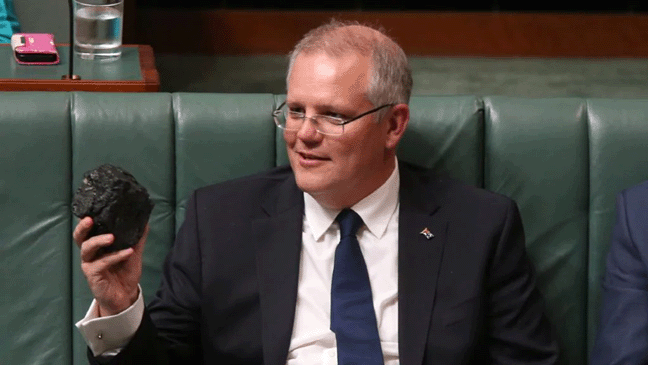
Scott Morrison confirms he’s unlikely to attend UN climate summit in Glasgow, SBS, 2 Oct 21, Scott Morrison says attending COP26 would require him to go into quarantine for a fourth time, disrupting his ability to “engage in my normal duties” as prime minister.
Scott Morrison has given the strongest indication yet he will not attend United Nations climate talks in Glasgow, blaming coronavirus quarantine requirements……
“I will have spent, if I do that, a total of four times 14-day quarantine, basically, in this building, not being able to engage in my normal duties around the country as much as I would like to.”
“That’s a long time for a prime minister to be in quarantine in a six-month period.”
More than 100 world leaders have so far indicated they will attend the summit in person………
Meanwhile, Nationals resisting coalition attempts to get a 2050 net zero emissions target over the line before Glasgow say they are yet to see the government’s plan for how to achieve it……… https://www.sbs.com.au/news/scott-morrison-confirms-he-s-unlikely-to-attend-un-climate-summit-in-glasgow/6649bcbf-6bcc-4ae5-8572-70e988624437
Liberal Coalition prepares for greenwashing at the Glascow climate summit
Right faction hardheads will accept greenwashing ahead of Glasgow if that’s required to keep the Coalition in power, Guardian Katharine Murphy 2 Oct 21, But even if Scott Morrison lands net zero he would rather market his climate pivot at home rather than abroad – there’s an election to prepare for……………………………………….. Right now, Morrison is trying to land new climate commitments ahead of the Cop26 in Glasgow. While senior people insist Morrison’s net zero plane is going to land, on a runway, with zero casualties, either in the second or third week of October, climate policy can be lethal territory for Australian prime ministers, and not just prime ministers called Malcolm Turnbull (as Kevin Rudd and Julia Gillard can attest).
Morrison’s current trouble seems to be confined to a handful of Queensland Nationals as opposed to the entire right faction of the Liberal party, which was Turnbull’s cross to bear during rounds one and two of his internal climate wars.
Thus far, the right has been quiet. People say the majority view is grudging acceptance because of the shifting politics – although some conservatives report a growing backlash bubbling up from the base about a net zero commitment.
Morrison referenced the shifting politics when he met a deputation of mainly moderate Liberals earlier this week. This group of MPs was given some face time with Morrison after they asked to see him. The objective was to send a clear message: the group wanted a commitment to the net zero target. They did not want a handful of Queensland Nationals writing the government’s climate change policy.
…… If the centre of political gravity has shifted in favour of climate action in parts of the country where the Liberals need to hold or win seats, then the Liberal party will need to act, or (more pertinently) at least look like it’s acting.
If that’s the electoral reality, political hard heads in the right faction of the Liberal party can hold their noses about net zero if they believe greenwashing ahead of Glasgow is what’s required to keep Labor out of power.
But for some hardcore conservatives, Morrison revisiting the Coalition’s climate crime scene will be a provocation. It will be yet more proof of his obnoxious dictatorial pragmatism. It is not clear yet whether or not conservative feet will be stamped or rhetorical punches thrown. Perhaps they won’t, because there are always consequences for picking fights. But wise prime ministers prepare for all contingencies………..
Assuming the prime minister can land his net zero deal with Barnaby Joyce, Morrison would rather market his climate pivot at home rather than abroad……….https://www.theguardian.com/australia-news/2021/oct/02/right-faction-hardheads-will-accept-greenwashing-ahead-of-glasgow-if-thats-required-to-keep-the-coalition-in-power
1 This month


Help Aunty Sue Protect Her Land and Sacred Sites From Destructive Rocket Testing.
.

Australians deserve the truth
about
AUKUS – https://aukuspublicinquiry.com/

PETITION – To: Prime Minister Anthony Albanese and the Australian Labor Government

of the week – Australians for War Powers Reform (AWPR)
To see nuclear-related stories in greater depth and intensity

