Wind power could prove to be an economic boom for Cloncurry, Queensland
The project, expected to cost the sire $8 to $9 million dollars, already has support from local miner CuDeco and three potential pilot program sites will be tested over the next few weeks.
 Wind power the future for Cloncurry Yes 2 renewables, n August 23, 2013 by martanieczyporuk Even in the far reaches of Australia, the benefits of wind energy are gaining interest among communities. The small town of Cloncurry can see a big future in wind. The North West Starreports on the Mayor’s proposal: ….
Friends of the Earth Australia renewable projects coordinator Leigh Ewbank said the ‘visionary’ idea could see the shire follow in the footsteps of a small French village that increased their budget from $573,000 to $3.29 million after installing 11 wind turbines.
“Income generated by a wind farm in the small French village of Afrons has resulted in a five-fold increase in the town’s budget,” he said. Continue reading
US bombs on the Great Barrier Reef are PROBABLY safe
Bombs dropped on Reef ‘virtually impossible’ to explode SMH, Kim Stephens, July 24, 201 US naval authorities say it is ‘‘virtually impossible’’ two undetonated bombs lying on the Great Barrier Reef will explode.
United States 7th fleet spokesman Lieutenant David Levy has revealed four bombs – two inert and two explosive – dropped in the ocean off Rockhampton by US warplanes during a recent bungled training exercise may not be recovered.
‘‘The Australian and US governments are currently reviewing this possibility’’, Lieutenant Levy said, when asked if they would be retrieved……: http://www.brisbanetimes.com.au/queensland/bombs-dropped-on-reef-virtually-impossible-to-explode-20130724-2qi1l.html#ixzz2a6oHziSi
Talisman Sabre war games disrupted by Peace Convergence
 Peace Convergence http://peaceconvergence.wordpress.com/2013/07/23/peace-pilgrims-enter-shoalwater-bay-military-training-facility/ civil society against militarism in Australia
Peace Pilgrims enter Shoalwater Bay Military Training Facility 23 July, 2013 Two people entered the Shoalwater Bay Military Training Area this morning to disrupt the Talisman Sabre training exercises.
The two are Greg Rolles (31yrs), school teacher from Brisbane; and Graham Dunstan (71yrs), retired grey nomad.
There are currently 28,000 Australian and US troops undertaking joint military training in Australia, with a focus on the Shoalwater Bay Military Training Area. Last week two US aircraft dropped 4 bombs on the Great Barrier Reef when they were unable to land at their planed location.
Pre-prepared statements from the two peace pilgrims point to the effect of the wars in Iraq and Afghanistan and their desire to act against the Australian & US military alliance.
Graeme Dunstan stated “It is my intention to trespass onto the Shoalwater Bay Military Area and, by creative nonviolent actions, do the best i can to disrupt the military exercises, demonstrate resistance to the culture of war and preparation for war and create a counter narrative to the propaganda of the military”
Greg Rolles stated “the Australian and US military forces have taken and continue to take many innocent lives and waste money that could be used in, amongst others, our ailing education system.”
The two pilgrim’s full statements follow. Continue reading
Call for US bombs to be removed from Great Barrier Reef
Great Barrier Reef Marine Park Authority boss wants US bombs removed BRIAN WILLIAMS AND ROBB KIDD THE COURIER-MAIL JULY 23, 2013 FOUR bombs dropped on the Great Barrier Reef will be recovered but the US Navy will not face any penalties because they were offloaded during an emergency.
Great Barrier Reef Marine Park Authority chief executive Russell Reichelt yesterday said he was not concerned the 3m long, 226kg bombs would explode but he wanted them removed from the World Heritage area.…..
Peace Convergence Protesters arrested in Rockhampton, protesting Talisman military exercises
Four peace activists have been arrested blockading the Caroona Street gate of Western Street Barracks, Rockhampton.
Can you believe Queensland’s Energy Minister – about uranium and nuclear?
‘No plans’ for uranium mining and nuclear energy http://www.sunshinecoastdaily.com.au/news/no-plans-uranium-mining-nuclear-energy-queensland/1948775/ Rae Wilson 17th Jul 2013
WATER and Energy Minister Mark McArdle has categorically ruled out nuclear energy options in Queensland during an estimates committee hearing.
He said there were “no plans at all” during questioning from the Opposition about uranium mining and nuclear energy.
The LNP lifted a 30-year ban on uranium mining last year and has been undertaking research into best practice for resuming mining in some parts of the state for export.
Sunshine Council – an Australian first – to have council solar farm
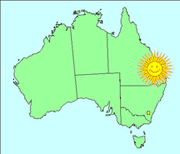 Sunshine Coast Council To Go Solar http://www.energymatters.com.au/index.php?main_page=news_article&article_id=3837 14 July 13, Queensland’s Sunshine Coast Council is planning to build a solar farm that would supply half of its electricity needs. Mayor Mark Jamieson says it would be the first council in Australia to have a utility scale solar farm constructed.
“The $24-30m solar farm proposed to be built at Valdora near Coolum would meet half of council’s electricity needs for at least the next 30 years,” he said. “Over the next three decades council is expected to pay in excess of $110m for electricity, and the solar farm would have the potential to reduce that by many millions of dollars.”
Council believes it will save around $10 million over the expected life of the project.
The solar farm project would inject $10 million into the local economy over the next 10 years and create 40 jobs during construction.
One of the reasons Sunshine Coast Council believes now is the right time to invest is energy contract re-negotiation with current retailers is due in 2014. It also recognises solar panel prices are currently very low; something that could change given fluctuations in the Australian dollar and other factors.
The solar farm would help develop the Sunshine Coast’s cleantech industry hub and skills developed during construction could be deployed to similar projects within Queensland and elsewhere in Australia; helping to further diversify the local economy.
“This project has the potential to transform the Sunshine Coast. It would become the embodiment of everything we stand for; a region which is economically, environmentally and socially sustainable,” said Councillor Mark Jamieson. “It would save money, reduce our carbon footprint and take us another step closer to becoming the most sustainable region in Australia”
Council will call for Expressions of Interest to design and build the solar farm in the next few weeks and hopes construction will commence in 2014.
Solar air conditioning on show at Brisbane’s Clean Energy Event
Kingtec Solar to Showcase Solar Powerered Air Conditioner in Australia’s Clean Energy Week Event Visit http://kingtecsolar.com for further information Event runs July 24-26 at the Brisbane Convention & Exhibition Centre Australia Melbourne, Australia, July 9th, 2013: Kingtec Solar, a recognized leader in solar powered air condition technology, is pleased to announce its participation in events at the Clean Energy Week, Australia’s largest solar event. Following its exceptional success last year (2012) in Sydney, where over 2500 delegates from local and international organization participated; this year’s events take place at the Brisbane Convention & Exhibition Centre from July 24th to 26th. …….
Kingtec’s current PV solar air conditioner line-up includes:
K25FT – Solar Split Ductless
K25CJ – Solar Window Air Conditioner
K25DZ – Solar RV Roof Top AC
and have special significance for businesses and homeowners in areas hit by constant blackouts or rolling brownouts.
Kingtec Solar’s unique PV-powered air conditioners are designed with simplicity and economy in mind, and are built to run using free and abundant solar renewable energy. We deliver 100% zero energy consumption for up to 7 1/2 hours on as little as 1000 watts of solar panels for a 16000 BTU AC. These air conditioners feature tri-energy inputs from any combination of solar, grid or batteries and can run in three modes: Energy Saving, Off Grid, or Hybrid.
And while you get a durable renewable energy solution, you not only save the planet by reducing your personal CO2 footprint, but also save on energy bills. Our air conditioners will run 100% on solar with grid or batteries! ……
To learn more about Kingtec Solar and it’s solutions, visit us online at: http://kingtecsolar.com/
Uranium company cuts back its NT and Queensland operations as uranium price plummets
 Deep Yellow slashes jobs, cuts pay, Minng.com, 5 July, 2013 Vicky Validakis Uranium exploration company Deep Yellow has cut jobs and reduced salaries by five per cent as it ramps up steps to reduce overhead costs, blaming the move on the weakness in the uranium sector.
The company announced board fees and executive salaries would be reduced by five per cent for at least six months, with salary scales to remain fixed at 2013 rates.
The company also said its Perth office had reduced staff to just three, comprising the managing director, financial controller and office manager.
Deep Yellow is said it is also planning to move to a smaller office by the end of the year.
The latest pay cuts follow a ten per cent reduction in base salary and fees and group-wide salary freezes in July 2012…… Deep Yellow’s chairman Mervyn Greene said the steps to reduce overheads costs was due to ongoing volatility in financial markets and a weakness in the uranium market…… In Australia the company owns the Napperby Uranium project in the Northern Territory as well as exploration tenements in Queensland. http://www.miningaustralia.com.au/news/deep-yellow-slashes-jobs-cuts-pay
Mary Kathleen uranium mine – still toxic decades after closure
Remediation efforts continue at abandoned uranium mine Australian Mining, 11 June, 2013 Vicky Validakis Queensland officials inspected the abandoned uranium mine at Mary Kathleen last week, as part of an ongoing assessment of the site’s remediation status.
Minister for Natural Resources and Mines Andrew Cripps announced last year, the government would assess opportunities for mining at the site, which contains millions of tonnes of ore tailings.……. A spokesperson for the minister said the inspection was not connected to an assessment of opportunities for future mining at the site.
The Mary Kathleen mine is under a Restricted Area 232 status, meaning exploration and production are both prohibited.
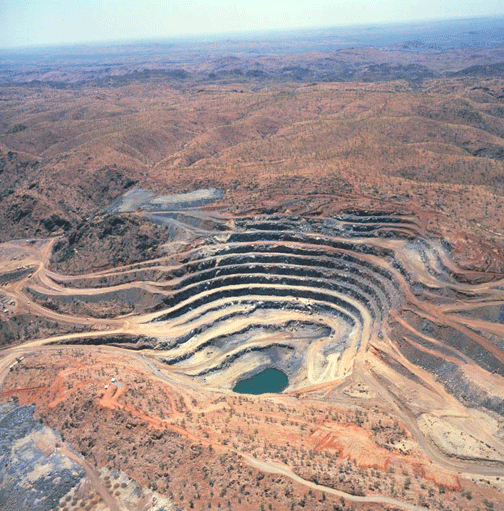
“Remediation and environmental management issues are critical factors for the Queensland Government to address prior to any future consideration about whether or not to release land from Restricted Area 232,” Cripps said.
Cripps said Abandoned Mine Lands program officers from the Department and the Geological Survey of Queensland would undertake field assessments later this month, including drilling at the tailings dam.
“This work will enable the Department to gain a better understanding of the current condition of the abandoned mine,” he said.
The Greens North Queensland spokesperson Jenny Stirling, said “toxic” tailings at the mine meant that uranium mining had made the site useless for other purposes.
“They are looking to mine rare earth and, if they had the good sense that God gave them, they would know that they would have to deal with the toxic tailings of uranium mining at Mount Kathleen,” Sterling said.
“It’s just a highly problematic situation.” http://www.miningaustralia.com.au/news/remediation-efforts-continue-at-uranium-mine
Cairns Evolve Energy has evolved a renewable energy + jobs plan for Far North Queensland
 The Tropical North Queensland Renewable Energy Industry Development Plan developed strategies to see 2500 people employed in the industry by 2020.
 Cairns energy costs could be lowered the natural way, Cairns, Caitlin Guilfoyle , June 8, 2013 SUGAR cane, wind and sunshine – it sounds more like a weekend away but experts reckons these natural resources could pull the Far North out of an electricity crisis…… experts say theFar North should take advantage of the region’s natural surrounds to harness renewable energy and ultimately cut back on spending.
Cairns’ Evolve Energy prepared the Tropical North Queensland Renewable Energy Industry Development Plan for the State Government last year, which detailed strategies to ramp up renewable energy use in the region. Continue reading
Liberal State governments attack renewable energy – prelude to Abbott destruction of renewable energy
The second story was not just one, but a barrage of media placements from Queensland Premier Campbell Newman and others seeking to lay the blame for the state’s stunning 22.5 per cent average rise in electricity costs in 2013/14 on green energy schemes, glossing over the fact that the overwhelming majority of the bill increases come because the cost of the billions of dollars of network upgrades is being borne by the consumer.
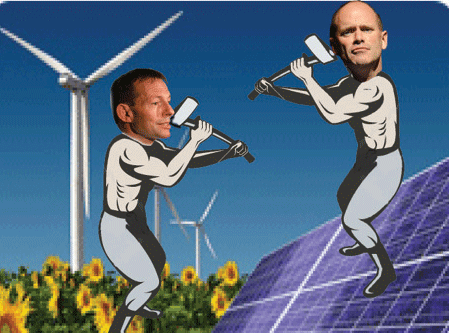 Abbott strangles $20bn green investment – to save 50c/week REneweconomy, By Giles Parkinson 3 June 2013 Two news stories over the weekend give a chilling insight into what might await the Australian renewable energy industry under a Federal Coalition government.
The first story was mostly symbolic in nature. The Newcastle Herald reported that the only wind turbine in Newcastle, the 600kW Kooragang turbine that was constructed in 1997 to “promote the emerging green energy market” is to be removed by Ausgrid – to make way for a new coal loader.
It is just a single turbine but, amazingly, apart from a small demonstration turbine at the CSIRO energy centre nearby, it is the only one in NSW north of Sydney. In fact, going north, you need to travel 2,000kms to the Atherton Tablelands before coming across another commercial wind turbine, 20 small towers amounting to 12MW at Windy Hill in the Atherton Tablelands. There are two other small turbines on Thursday Island, at the tip of the country and that is it – just 12.45MW of wind energy north of Sydney, out of a total of 2,500MW across the country.
How many other turbines are built in NSW will likely be influenced by key decisions being made by NSW Cabinet as early as today about rules governing wind farm developments and the state’s renewable energy plans. That, of course, and the fate of the large-scale renewable energy target – a federal decision. Continue reading
Queensland’s electricity consumers copping huge costs paid to State Government
 Qld’s financial bonanza from networks – paid for by consumers REneweconomy, By Giles Parkinson 4 June 2013As Queensland Premier Campbell Newman and his senior ministers continue their campaign to vilify rooftop solar, a new report has thrown further light on the real reason behind the massive increases in electricity bills in recent years – the huge increase in money pocketed from the network providers by the state government.
A report prepared for the Queensland CaneGrowers association by Melbourne-based energy consultancy CME says receipts pocketed by the state government from its network operators has more than doubled each year – from $47 million in 2007/8 to $970 million in 2011/12 – and this has been paid for by the consumers. Continue reading
Queensland Competition Authority (QCA) clears solar households as cause of higher electrcity charges
Queensland Solar Households Vindicated http://www.energymatters.com.au/index.php?main_page=news_article&article_id=3772 3 June 13 Plans by Queensland Premier Campbell Newman and Energy Minister Mark McArdle to whack solar households with higher electricity charges appear to have been scuttled.
On Friday, the Queensland Competition Authority (QCA) released its Final Determination on regulated retail electricity prices for 2013-14. A typical Queensland customer’s annual bill will increase from $1,184 to $1,451. However, it has not recommended an extra charge for solar users.
Prior to the QCA’s final determination, Premier Newman was pushing a proposal to charge all solar homes an extra $200 a year; even though the Government had promised in December last year that there would be no fixed charge of any sort on people using solar.
Queensland Energy Minister Mark McArdle also launched an attack on solar households, placing the blame for power price increases primarily on green schemes.
This has not been echoed by the QCA, which says the increases are being primarily driven by increases in network charges. The QCA also points out the freezing of electricity rates by the Newman Government in 2011/12 has resulted in a bigger jump now.
The Clean Energy Council has applauded the QCA for moving away from the proposal to levy an extra charge on solar power users, an issue the CEC had heavily lobbied on.
“The QCA’s rigorous and comprehensive analysis of power price rises in Queensland has made it clear that renewable energy was a much smaller contributor to electricity bills than most other factors,” said Clean Energy Council Chief Executive David Green.
Mr. Green pointed out when anyone installs an air-conditioner, it costs all electricity users an estimated $7000 to pay for network upgrades. He also addressed the myth that solar users were “rich”; stating Queensland’s solar hotspots were Bundaberg, Hervey Bay, Ipswich, Toowoomba and Beenleigh. Even though the QCA has made it clear that network charges are the major culprit in upcoming electricity price rises, the Queensland Government’s demonising of solar has continued since the Final Determination was released.
Following the Queensland Competition Authority’s announcement; Solar Citizens, an advocacy group representing current and future solar users, has written to Premier Newman and Mark McArdle asking them to address a number of critical questions about what it says are Mr McArdle’s misleading statements on the impact of solar on energy costs in Queensland.
Spurred on by threats to solar households such as those recently issued by the Queensland Government, Solar Citizens is in a recruitment drive to bolster its numbers to ensure Australian solar users are well represented under a united front – and the group’s numbers are rapidly growing.
There are now over 300,000 solar users in Queensland, who have invested over $2.2 billion dollars of their own money into reducing their electricity costs and carbon emissions impact. The upcoming electricity rate increases will see that number grow.
According to national solar provider Energy Matters, a good quality 4kW solar power system installed in Brisbane can return a financial benefit of up to $1,960 a year. Energy Matters now also offers Queensland households a zero deposit payment plan option.
Commercial scale solar systems now becoming competitive in Australia
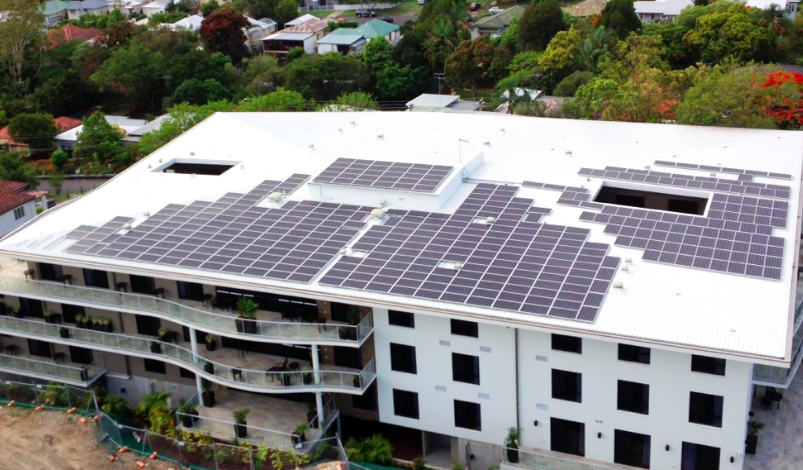
Conergy tips Australia solar market to grow 20% a year to 2015 REneweconomy, By Giles Parkinson on 23 May 2013 German solar giant Conergy is predicting 20 per cent annual growth in the Australian solar market between now and 2015 as commercial-scale solar systems become competitive with the local electricity market. Conergy said the levellised cost of energy (LCOE) for solar PV systems in Australia had fallen to just under 13c/kWh, which is less than half of the average retail price in the country. It says commercial scale plants, such as the recent 100kW system it commissioned at the Casa dAmore nursing home [seen below] in South Brisbane, were now cost effective with no subsidies.
Below – Brisbane’s solar powered nursing home. The installation was made by SEQ Energy Pty Ltd: http://www.seqenergy.com.au The generation of this plant is 160 MWH/year, not 392 and the panels used are Conergy Power Plus 255M.
 “The excellent climatic conditions and the achievement of grid parity … are now opening up new opportunities for the Australian market,” said David McCallum, managing director of Conergy Australia in a statement. He said the market, which is expected to fall by 25 per cent in 2013 toa round 750MW, from its 2012 peak of around 1,000MW, should grow 20 per cent a year in coming years. “Thanks to solar power becoming competitive, the Australian market will move away from being a purely investment driven market and become part of the genuine energy market, where the main criteria are electricity availability and the price per kilowatt hour. “Bearing these criteria in mind, plants no longer need to be as large as possible but instead tailored precisely to the customers and their load profile in order to optimise production and consumption behaviour.
Grid parity has reached Australia. “Thanks to solar power becoming competitive, the Australian market will move away from being a purely investment driven market and become part of the genuine energy market, where the main criteria are electricity availability and the price per kilowatt hour. “Bearing these criteria in mind, plants no longer need to be as large as possible but instead tailored precisely to the customers and their load profile in order to optimise production and consumption behaviour. Grid parity has reached Australia. Conergy said the output of the 100kW system at Casa d’Amore was being consumed entirely on site, and accounting for one third of its total electricity needs. It will deliver $16,000 in savings from the annual electricity bills each year. http://reneweconomy.com.au/2013/conergy-tips-australia-solar-market-to-grow-20-a-year-to-2015-2015
1 This month

of the week – Australians for War Powers Reform (AWPR)
To see nuclear-related stories in greater depth and intensity
 Antinuclear