Another “Your Say” comment on Economics of Nuclear Waste Importing
It’s a pity that this radioactive trash import plan has not been knocked out on grounds of risks to health, damage to environment, disrespect of Aboriginal people, and importantly – on its real purpose – to save and promote the global nuclear industry.
At least the Nuclear Fuel Chain Royal Commission South Australia had to admit that there is no argument for nuclear waste importing actually benefiting the Nation’ or the State’s health, environment, or indigenous people.
 The Nuclear Fuel Chain Royal Commission had only one argument for the plan – that it would be an economic bonanza for South Australia. I could list the economic analysts who have destroyed that argument. But the well known Blind Freddie could see the economic flaws. South Australia is supposed to set up “interim” waste storage before the famous underground dump is built, – sort of using the money that will be paid for the dump to finance it – or some plan like that. South Australia has to spend $millions on the plan, for years before it gets any revenue. The planned revenue is entirely speculative, as there is no market for nuclear waste importing. If it goes ahead – any financial benefit will be decades away, yet South Australia needs economic development now, not decades later. If it were to go ahead, it could grind to a halt at any time – with changes in governments overseas, collapse of nuclear companies or untoward events, such as a disaster in the transport of the wastes. South Australia could well be left with expensive, dangerous, and useless Stranded Radioactive Trash.
Meanwhile, other clean, and quicker alternatives – in renewable energy, energy efficient design for example, have been neglected while South Australia pursues this toxic dream – which has the very real potential to bankrupt the state.
Will Australia become the global nuclear toilet? Events in Adelaide 29 October

Will Australia become the global nuclear toilet?, [corrected version] Noel Wauchope, 29 Oct 16 It’s not obvious to the 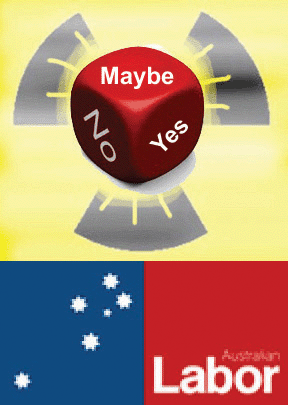 rest of the nation, but this question is about to be advocated in two South Australian events, that will have repercussions for the whole of Australia. These are the second Nuclear Citizens’ Jury in Adelaide on October 29 and the South
Australian Labor Party Conference, also on October 29. The ALP conference is really the most important one, as Premier Weatherill will surely need the backing of his own party as he moves to the process of overturning South Australia’s law against nuclear waste importing.
Indeed, the Nuclear Citizens’ Jury is really irrelevant. Whatever decision it makes, is in no way binding on the government. And anyway, this so-called “Jury” of 350 persons cannot make a convincing decision. The brief given to them is worded, in terms that come straight from the Nuclear Fuel Cycle Royal Commission South Australia’s (NFCRC) report that advocated nuclear waste importing:
Under what circumstances, if any, could South Australia pursue the opportunity to store and dispose of nuclear waste from other countries?
I understand that some jurors wanted a change from this question, but no change was allowed.
The previous Citizens’ Jury had some very dubious witness presentations, particularly on the health effects of ionising radiation. This was not entirely the fault of the organisers, DemocracyCo, as the 50 jury members themselves selected the witnesses to be invited.
One might expect this second Citizens’ jury to be better served by witnesses, but the new witness list is a curiously mixed bag. Of the 31 names, 16 are likely to be supporters of nuclear waste importing, 11 opposing it, and 4 appear to be neutral.
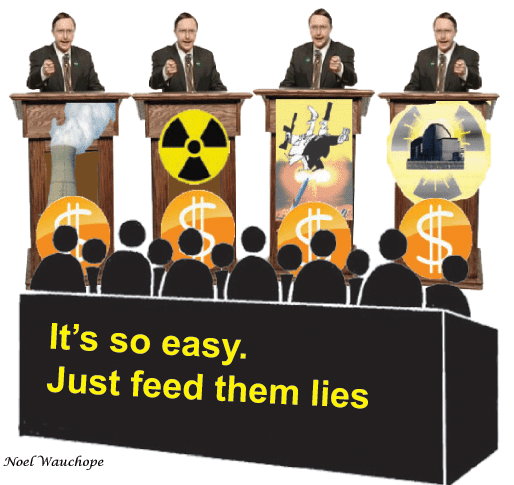 The most worrying section in this Citizens’ Jury is the session on SAFETY, dealing with general safety, siting and transport. For this session, there are 7 witnesses. Of these, only one witness, Dean Summers , appears to be anti nuclear, and one a neutral expert. This is Professor Sandy Steacy who knows all about earthquakes.
The witnesses are:
- Professor David Giles, of Minerals & Resources Engineering Future Industries Institute has all too strong a background in the mining industry.
- Dr John Loy: his theme is all about medical waste(an almost negligible component of Australia’s own Lucas Heights nuclear waste), and over-confidence on the safety of nuclear waste facilities. He has a background in promoting nuclear power to United Arab Emirates.
- Frank Boulton, General Manager WMC (Olympic Dam Marketing) Pty Ltd
- Dr AndrewHerczeg, formerly of the International Atomic Energy Agency
- Ian Hore-Lacy formerly of the Uranium Institute in Australia-he now works for the World Nuclear Association. Mr Hore-Lacy is unusual: he sees support for nuclear power as areligious and moral duty (He is also very critical of Pope Francis’ ideas on environment)
These pro nuclear experts have had much to say on storage of nuclear wastes. But none seems to have taken much interest in the issues around transporting highly radioactive wastes over thousands of kilometres across oceans and land. With the increasing volatility of weather events, as climate change progresses, and with the also growing concerns about terrorism, this omission is one of the greatest weaknesses of the case for importing nuclear wastes. The subject just glossed over in a few brief paragraphs in the NFCRC Report.
On the subject of SAFETY, focussing on the aspect of human health, one witness, Tony Hooker is a bit of a worry. He worked with Professor Pamela Sykes on her mouse studies, at Flinders University? Funded by America’s Department of Energy, Syke’s research purported to show that low dose radiation is actually good for you.
The 6 witnesss for this section are not evenly matched, with Dr Margaret Beavis and Dr Robert Hall opposing nuclear waste importing, and Dr Paul Degman, Dr Sami Hautakangas , Dr Stephan Bayer and Dr Tony Hooker likely to support it.
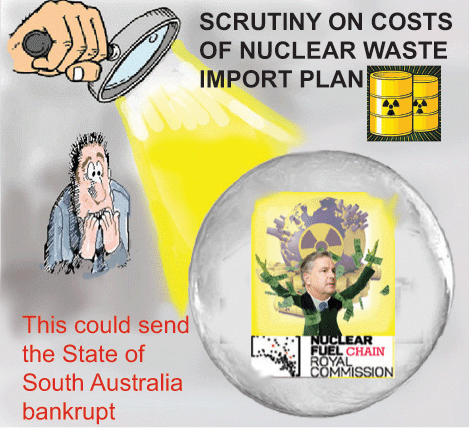 The vital section could well turn out to be ECONOMICS. And here, there IS a surprise, with an apparent bias towards the negative camp. Speakers Adjunct Professor Richard Blandy,Richard Dennis, Professor Barbara Pocock and Assoc. Professor Mark Diesendorf (via Skype) all have views opposing waste importation. The remaining speaker, Tim Johnson, from Jacobs, is supportive of the plan, but only cautiously so.
If economics were the only consideration, the waste import plan might conceivably die a quiet death, following this Citizens’ Jury, and a possibly negative report from a Parliamentary Inquiry. However, there are other considerations, such as underlying connections with the defence industry.
The South Australian Labor government, led by Premier Jay Weatherill, is enthusiastically backing the nuclear lobby’s campaign for setting up South Australia as the first place in the world to invite in the world’s nuclear waste, as a profit-making enterprise.
In practical terms, you can forget this government’s extravagant public relations promotion of the nuclear industry, culminating in these “Citizens’ Juries”. They really matter very little, in comparison with the actual steps to be taken for the pro nuclear campaign to succeed.
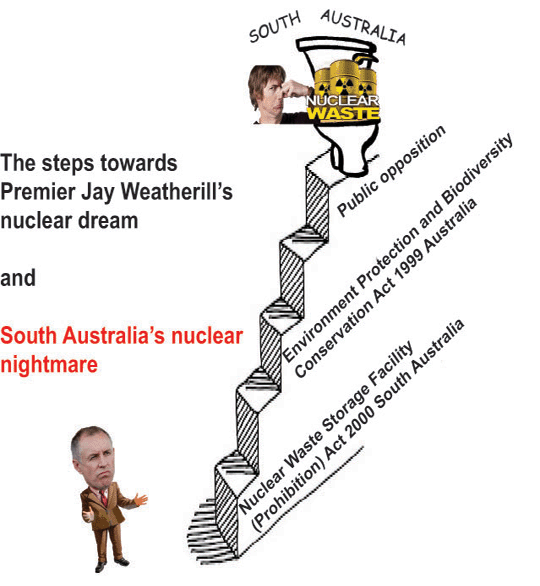 Step One is to overturn a South Australian law – the NuclearWaste Storage Facility (Prohibition) Act 2000. It includes:
8 Prohibition against construction or operation of nuclear waste storage facility
9 Prohibition against importation or transportation of nuclear waste for delivery to nuclear waste storage facility (The Act does have exemptions for the nuclear waste generated within Australia, e.g from Australia’s research reactor at Lucas Heights).
The government has already weakened this Act (In April 2016) by amending this provision:
13—No public money to be used to encourage or finance construction or operation of nuclear waste storage facility
(1) Despite any other Act or law to the contrary, no public money may be appropriated, expended or advanced to any person for the purpose of encouraging or financing any activity associated with the construction or operation of a nuclear waste storage facility in this State.
They had to change it quickly – to allow for financing community consultation or debate on the desirability or otherwise of constructing or operating a nuclear waste storage facility in this State. – seeing that they had already spent $7.2 million promoting nuclear waste storage, in the NFCRC
Anyway, prior to overturning this Act, Premier Weatherill is surely going to need to have the Labor Party onside. At last year’s ALP Conference, He and State Labor president Peter Malinauskas made a big push for South Australia going nuclear As the national ALP policy remains clearly opposed to all nuclear industry further development, we can expect that Weatherill will meet with some opposition to his nuclear plan from Labor members at the conference.
Perhaps the nuclear lobby, their captive South Australian Premier, and subservient national media, will not be able to press on with their plan without an unpleasant fracas.
Could there EVER be an ethical argument for Australia to import nuclear wastes?
If indeed, the waste importing idea were conditional on a Japanese plan to close down the industry, and help Japan overcome its very serious dilemma, this could be one big move towards halting the global nuclear industry juggernaut, with its undoubted connection to nuclear weapons. Japan could pay a reasonable amount to the waste host country, without being ripped off, without that country expecting to become mega wealthy. That would be one circumstance in which it would be an ethical choice for South Australia to import and dispose of nuclear waste.
“Pie in the sky!” I hear your cry.
Yes, sadly so. Is there any chance that such an ethical decision would ever be made? I doubt it. The Nuclear Citizens’ Jury is left with the question of whether or not to support the NFCRC’s plan for a nuclear waste bonanza, or to risk possible State bankruptcy in the event of it all going wrong. http://www.onlineopinion.com.au/view.asp?article=18603
Nuclear Citizens’ Jury: an ethical case for importing nuclear wastes, Online Opinion, Noel Wauchope, 25 Oct 16 The South Australian government will call another Nuclear Citizens’ Jury, on October 29 – 30. This time the jury must answer this question:
Under what circumstances, if any, could South Australia pursue the opportunity to store and dispose of nuclear waste from other countries?
That set me thinking. The main “circumstance” for recommending this “opportunity” is the State Government’s plan to eventually bring in a pot of gold for the State. There really is no other argument for this project in the Report. In the 320 page report any arguments about Aboriginal issues, safety, environment, health, are aimed at rebutting criticism of the plan. They provide no argument on the plan actually improving health or environment, and are in fact quite defensive about Aboriginal impacts. Continue reading
Confusion in the wording of the South Australia Nuclear Citizens’ Jury question
 The question has been worded in two different ways in the Juror’s materials. The two versions were:
(1) Under what circumstances, if any, should SA pursue the storage and disposal of high level nuclear waste from other countries?
(2) Under what circumstances, if any, should South Australia pursue the opportunity to store and dispose of nuclear waste from other countries?
Differences are (1) inclusion of the word “opportunity” in second version and (2) removal of the words “high level” in the second version.
Lack of balance in the Witness List for Nuclear Citizens’ Jury South Australia October 29-30 ?
 The Witness list for the 29 -30 Nuclear Citizens’ Jury in Adelaide is posted here on Antinuclear . This list is shown with indications of which witnesses are pro nuclear waste import and which are not.
It is interesting to observe that the pronuke and nuclear free witnesses are not always balanced evenly.
On “ECONOMICS” there is, oddly, a clear majority of nuclear-free opinions. It looks as if no-one in the nuclear lobby was game to face questioning on this topic! DemocracyCo was forced to step in and find a pro nuclear speaker!
On “SAFETY” (includes general safety, siting and transport) there are just two witnesses who appear to be neutral. The remaining four including the facilitator are pro nuclear.
“CONSENT” is a dodgy one, with only one nuclear-free opinion – three pro nuclear (including the facilitator, and two neutral.
Meanwhile – this Citizens Jury will probably go on under the media radar, as the South Australian Labor Party National Conference is happening at the same time – where the ALP will be debating changing their nuclear policy, and overturning or weakening the Nuclear Waste Storage Facility Prohibition Act 2000
Witness list for next Nuclear Citizens’ Jury 29 October South Australia
Pro nuclear waste import witnesses in RED. Probably Leaning to pro – orange Neutral (or I don’t know) in Yellow Leaning to nuclear free – light green Nuclear free -GREEN
It is not clear exactly which individuals are to be the facilitators.
| Safety (1)
(includes overview and focus on impact on human health)
Location: |
Dr Paul Degman
Dr Sami Hautakangas (alternate for Timo Äikäs) |
| Dr Margaret Beavis | |
| Dr Robert Hall (alternate for Professor Tilman Ruff) | |
| Dr Stephan Bayer (alternate for John Carlson) | |
| Dr Tony Hooker (added by democracyCo from Fact Check queries) | |
| Dr Jim Green | |
| Safety (2)
(includes general safety, siting and transport)
Location: |
Dean Summers (alternate for Paddy Crumlin)
Dr John Loy (alternate for Carl-Magnus Larsson) |
| Frank Boulton | |
| Dr Andrew Herczeg | |
| Ian Hore-Lacy | |
| Professor David Giles | |
| Dr Dirk Mallants (alternate for Dr Ian Chessell) | |
| Professor Sandy Steacy | |
| Trust
(includes role of Government, legislation, regulation, trust in Government)
Location |
Steve McIntosh |
| Hon. Mark Parnell, MLC | |
| Dr Benito Cao | |
| Keith Baldry (added by democracyCo from Fact Check queries) | |
| Professor Haydon Manning | |
| Judy Hughes Attorney General/Crown Solicitors Office | |
| Economics
Location |
Richard Dennis |
| Adjunct Professor Richard Blandy | |
| Professor Barbara Pocock | |
| Assoc. Professor Mark Diesendorf (via Skype) | |
| Tim Johnson (added by democracyCo from Fact Check queries) | |
| Consent
Location |
Dan Spencer |
| Professor Bob Watts (via Skype) | |
| Gerald Ouzounian | |
| Ross Womersley | |
| Dr Simon Longstaff | |
| Cathy O’Loughlin (alternate Gill McFadyen)
Dave Sweeney |
Geordan Graetz, pro nuclear spruiker is a ‘Community Engagement Advisor” to South Australians
Tim Bickmore, Nuclear Citizens Jury Watch South Australia, 20 Oct 16
 A player in this scene currently flying under the radar is Geordan Graetz, DPC Community Engagement Advisor.
In the past he has published opinions not only about Fukushima, but also regarding indigenous people & uranium mining: “Representatives of the Martu and Adnyamathanha communities in Western Australia and South Australia respectively have expressed confidence in the companies that have approached them with plans to develop deposits on their lands (Graetz and Manning 2011)” p3, IAIA, 2012.
As recently as 2014 he published material orientated toward removing indigenous people as an impediment to the expansion of uranium mining, albeit it thru application of inclusion under the auspices of international human rights conventions. [Journal of Cleaner production xxx 2014 1-9]
He appears to be an advocate of a ‘Nuclear Renaissance’ – or rather identifies indigenous peoples as a potential roadblock for such.
The NFCRC Final Report cites him & co-author Manning Ch6 Land Rights Section p130 notes ref 8 & again ref 11 (3 mentions).
His partner in a number of publications, Haydn Manning, is a well known pro-nuke spruiker.
There is a linkage between Graetz & the farcical Schools Nuclear Lockdown … probably instigated under his &/or Manning’s social engagement strategy…. more to come.
Hard for South Australia’s Nuclear Citizens’ Jury to reach a consensus about importing radioactive trash
Tim Bickmore Nuclear Citizens Jury Watch South Australia, 20 Oct 16 My gut feeling is that whilst there is a high apathy coefficient within the wider community, the Nuclear Citizens’ Jury (CJ) make-up does display the polarity that is also evident in the public sphere & which, at least in general expressions, appears to be mostly against the proposal.
At this stage of proceedings, I find it hard to see a consensus being reached.
I also think that South Australian Premier Jay Weatherill is aware of this: hence whilst previously he would have crowed about a ‘positive’ or even ‘maybe’ outcome, now the game plan diversifies. e.g. last night I had a South Australian Govt sponsored survey cold call regarding the Nuclear Fuel Chain Royal Commission (NFCRC) – but was excluded coz they had already reached my ‘age bracket quota’.
I wondered if that ‘quota’ was valid – are they now targeting younger folk under some misguided notion that this cohort would be more amenable to the idea? – and the quota, did that include the already received on-line & Nuclear Roadshow data? I also did not get to hear the questions – which are usually loaded in these types of things.
Also in the mix is the Senate Parliamentary Joint Committee, & my feeling there is that, too, is not a bed of roses for Jay Weatherill.
I am still crossing my fingers that the CJ will return RED coz AMBER allows Jay a small window to change legislation – tho methinks he would need a lot more oomph other than just a CJ-AMBER outcome to really justify doing that.
If no CJ consensus is reached, does that mean an open verdict? If no verdict is reached then “as you were” [=NO] seems the logical outcome. ra ra https://www.facebook.com/groups/1172938779440750/
Wording of question to the Nuclear Citizens’ Jury is becoming an issue
Tim Bickmore , Nuclear Citizens Jury Watch South Australia, 19 Oct 16 Apparently, the ‘traffic light’ question was not provided/created by the Weatherill Govt – but by NewDeMocracy XD Ian Walker – who has also now been inserted into the jury to witness their deliberations.
There are still rumblings about the question being loaded.
“I asked Ian Walker who was responsible for the question at lunch on the second day. I asked him if any other options had been proposed and he said others had been considered but it was his choice as to the final question and the wording of same. I asked him if the Premier had approved the question and he began to become vague (or so it seemed to me) I was unable to establish if the Premier had approved the final wording of the question. Ian claimed the final wording was his,
With Royal Commissions the wording of the question is critically important and is framed to achieve the outcome that the instigator of the Commission desires………” [from Basecamp Blog 18/10/16] ra ra https://www.facebook.com/groups/1172938779440750/
1 This month

of the week – Australians for War Powers Reform (AWPR)
To see nuclear-related stories in greater depth and intensity
 Antinuclear
Noel Wauchope 30 Oct 2016