Assessing the risks of Australia becoming the world’s nuclear wasteland
 Shunning nuclear power but not its waste: Assessing the risks of Australia becoming the world’s nuclear wasteland http://www.sciencedirect.com/science/article/pii/S2214629616301323 Mark Diesendorf
Abstract
The South Australian Nuclear Fuel Cycle Royal Commission has undertaken ‘an independent and comprehensive investigation into the potential for increasing South Australia’s participation in the nuclear fuel cycle’. In its Final Report, issued 6 May 2016, it acknowledges that nuclear power would not be commercially viable in South Australia in the foreseeable future. However it recommends that ‘the South Australian Government establish used nuclear fuel and intermediate level waste storage and disposal facilities in South Australia’. This is a business proposition to store a large fraction of global nuclear wastes, providing interim above-ground storage followed by permanent underground storage in South Australia. The present critical evaluation of the scheme finds that the Royal Commission’s economic analysis is based on many unsubstantiated assumptions. Furthermore, the scheme is financially risky for both Australian taxpayers and customers and has a questionable ethical basis.
Some uncomfortable questions ignored by the South Australian Nuclear Waste Dump Commission
 SA Nuclear waste dump questions http://chriswhiteonline.org/2016/06/sa-nuclear-waste-dump-questions/
Nuclear un-clear: Some questions that need answers before
South Australia becomes the world’s nuclear waste dump
by Dr Tony Webb June 2016
Where is it coming from and where is it going?
• Where is this waste coming from? The Royal commission speculates about various countries wanting us to take their waste but there’s nothing definite.
• Where will it come into Australia? We’ve heard that it might come in via Darwin (unlikely) or (more likely) through a new specially built port in theSpencer Gulf. If so where is this to be built – and at what cost, paid for by whom?
• Where are the detailed engineering plans for this supposedly ‘secure’ but ‘unguarded’ underground site? No other country in the world has yet found a way to safely dispose of nuclear wastes. Several countries are trying – on a much smaller scale than proposed for South Australia – and for their own waste only.
Once again, Australian government wages nuclear war on Aboriginal people
The plan to turn South Australia into the world’s nuclear waste dump has been met with near-unanimous opposition from Aboriginal people.
The Royal Commission acknowledged strong Aboriginal opposition to its nuclear waste proposal in its final report – but it treats that opposition not as a red light but as an obstacle to be circumvented.
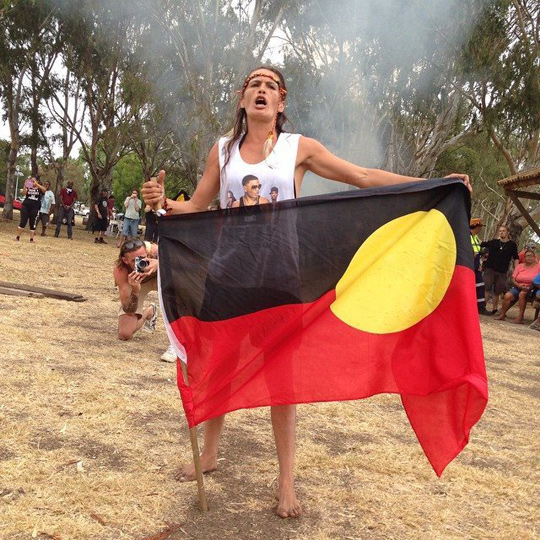

 Radioactive waste and the nuclear war on Australia’s Aboriginal people, Ecologist Jim Green 1st July 2016
Australia’s nuclear industry has a shameful history of ‘radioactive racism’ that dates from the British bomb tests in the 1950s, writes Jim Green. The same attitudes persist today with plans to dump over half a million tonnes of high and intermediate level nuclear waste on Aboriginal land, and open new uranium mines. But now Aboriginal peoples and traditional land owners are fighting back!
Then the government tried to impose a dump on Aboriginal land in the Northern Territory, but that also failed.
Now the government has embarked on its third attempt and once again it is trying to impose a dump on Aboriginal land despite clear opposition from Traditional Owners. The latest proposal is for a dump in the spectacular Flinders Ranges, 400 km north of Adelaide in South Australia, on the land of the Adnyamathanha Traditional Owners.
The government says that no group will have a right of veto, which is coded racism: it means that the dump may go ahead despite the government’s acknowledgement that “almost all Indigenous community members surveyed are strongly opposed to the site continuing.”
The proposed dump site was nominated by former Liberal Party politician Grant Chapman but he has precious little connection to the land. Conversely, the land has been precious to Adnyamathanha Traditional Owners for millennia.
It was like somebody ripped my heart out’
The site is adjacent to the Yappala Indigenous Protected Area (IPA). “The IPA is right on the fence – there’s a waterhole that is shared by both properties”, said Yappala Station resident and Adnyamathanha Traditional Owner Regina McKenzie.
The waterhole – a traditional women’s site and healing place – is one of many archeological and culturally significant sites in the area that Traditional Owners have registered with the South Australian government over the past six years. Two Adnyamathanha associations – Viliwarinha Aboriginal Corporation and the Anggumathanha Camp Law Mob – wrote in November 2015 statement:
“Adnyamathanha land in the Flinders Ranges has been short-listed for a national nuclear waste dump. The land was nominated by former Liberal Party Senator Grant Chapman. Adnyamathanha Traditional Owners weren’t consulted. Even Traditional Owners who live next to the proposed dump site at Yappala Station weren’t consulted. This is an insult.
“The whole area is Adnyamathanha land. It is Arngurla Yarta (spiritual land). The proposed dump site has springs. It also has ancient mound springs. It has countless thousands of Aboriginal artefects. Our ancestors are buried there.
“Hookina creek that runs along the nominated site is a significant women’s site. It is a registered heritage site and must be preserved and protected. We are responsible for this area, the land and animals.
“We don’t want a nuclear waste dump here on our country and worry that if the waste comes here it will harm our environment and muda (our lore, our creation, our everything). We call on the federal government to withdraw the nomination of the site and to show more respect in future.”
Regina McKenzie describes getting the news that the Flinders Ranges site had been chosen from a short-list of six sites across Australia: “We were devastated, it was like somebody had rang us up and told us somebody had passed away. My niece rang me crying … it was like somebody ripped my heart out.”
McKenzie said on ABC television: “Almost every waste dump is near an Aboriginal community. It’s like, yeah, they’re only a bunch of blacks, they’re only a bunch of Abos, so we’ll put it there. Don’t you think that’s a little bit confronting for us when it happens to us all the time? Can’t they just leave my people alone?”
Adnyamathanha Traditional Owner Dr Jillian Marsh said in an April 2016 statement:
“The First Nations people of Australia have been bullied and pushed around, forcibly removed from their families and their country, denied access and the right to care for their own land for over 200 years. Our health and wellbeing compares with third world countries, our people crowd the jails. Nobody wants toxic waste in their back yard, this is true the world over. We stand in solidarity with people across this country and across the globe who want sustainable futures for communities, we will not be moved.”
The battle over the proposed dump site in the Flinders Ranges will probably be resolved over the next 12 months. If the government fails in its third attempt to impose a dump against the wishes of Aboriginal Traditional Owners, we can only assume on past form that a fourth attempt will ensue……
Now Aboriginal people in South Australia face the imposition of a national nuclear waste dump as well as a plan to import 138,000 tonnes of high-level nuclear waste and 390,000 cubic metres of intermediate level waste for storage and disposal as a commercial venture.
The plan is being driven by the South Australian government, which last year established a Royal Commission to provide a fig-leaf of independent supporting advice. The Royal Commissioner is a nuclear advocate and the majority of the members of the Expert Advisory Committee are strident nuclear advocates.
Indeed it seems as if the Royal Commissioner sought out the dopiest nuclear advocates he could find to put on the Expert Advisory Committee: one thinks nuclear power is safer than solar, another thinks that nuclear power doesn’t pose a weapons proliferation risk, and a third was insisting that there was no credible risk of a serious accident at Fukushima even as nuclear meltdown was in full swing.
Announcing the establishment of the Royal Commission in March 2015, South Australian Premier Jay Weatherill said: “We have a specific mandate to consult with Aboriginal communities and there are great sensitivities here. I mean we’ve had the use and abuse of the lands of the Maralinga Tjarutja people by the British when they tested their atomic weapons.”
Yet the South Australian government’s handling of the Royal Commission process systematically disenfranchised Aboriginal people. The truncated timeline for providing feedback on draft Terms of Reference disadvantaged people in remote regions, people with little or no access to email and internet, and people for whom English is a second language. There was no translation of the draft Terms of Reference, and a regional communications and engagement strategy was not developed or implemented.
Aboriginal people repeatedly expressed frustration with the Royal Commission process. One example (of many) is the submission of the Anggumathanha Camp Law Mob (who are also fighting against the plan for a national nuclear waste dump on their land):
“Why we are not satisfied with the way this Royal Commission has been conducted:
Yaiinidlha Udnyu ngawarla wanggaanggu, wanhanga Yura Ngawarla wanggaanggu? – always in English, where’s the Yura Ngawarla (our first language)?
“The issues of engagement are many. To date we have found the process of engagement used by the Royal Commission to be very off putting as it’s been run in a real Udnyu (whitefella) way. Timelines are short, information is hard to access, there is no interpreter service available, and the meetings have been very poorly advertised. …
“A closed and secretive approach makes engagement difficult for the average person on the street, and near impossible for Aboriginal people to participate.”
The plan to turn South Australia into the world’s nuclear waste dump has been met with near-unanimous opposition from Aboriginal people. The Aboriginal Congress of South Australia, comprising people from many Aboriginal groups across the state, endorsed the following resolution at an August 2015 meeting:
“We, as native title representatives of lands and waters of South Australia, stand firmly in opposition to nuclear developments on our country, including all plans to expand uranium mining, and implement nuclear reactors and nuclear waste dumps on our land. … Many of us suffer to this day the devastating effects of the nuclear industry and continue to be subject to it through extensive uranium mining on our lands and country that has been contaminated.
“We view any further expansion of industry as an imposition on our country, our people, our environment, our culture and our history. We also view it as a blatant disregard for our rights under various legislative instruments, including the founding principles of this state.”
The Royal Commission acknowledged strong Aboriginal opposition to its nuclear waste proposal in its final report – but it treats that opposition not as a red light but as an obstacle to be circumvented.http://www.theecologist.org/News/news_analysis/2987853/radioactive_waste_and_the_nuclear_war_on_australias_aboriginal_people.html
Nigel Carney analyses intrinsic flaws in the Nuclear Royal Commission
SA NUCLEAR BRIEFING Nigel Carney, June 16, 2016 Coober Pedy Regional Times “…… the issue South Australians are currently facing in the low level waste site selection process has always been a state and federal alliance, no mere coincidence of need…….
The Commission has been criticized widely as being a political stunt, not an independent Commission but rather a rubber stamp. The findings of the Commission released in May 2016 tend to support this view. The report itself presents evidence against its own findings. We are reminded that the Radium Hill mine and Port Pirie treatment plant remain as unresolved radioactive sites. The Commission finds:
‘The failure to consider the environment in the planning, operating and decommissioning of these facilities has resulted in ongoing management challenges….Although subsequent assessments of both sites show they do not pose a serious radiological risk to the health of visitors to the sites the state government is required to continue to monitor and manage potential environmental contamination’ (Nuclear Fuel Cycle Royal Commission Findings May 2016)
Why then, the public may ask, would a Commission which acknowledges the failure of government to manage the legacy of the nuclear fuel cycle suggest the state has the capability of managing the world’s nuclear waste? Continue reading
The Risky Economics of South Australia’s Nuclear Waste Importing Plan
 Risks, ethics and consent: Australia shouldn’t become the world’s nuclear wasteland, The Conversation, Mark Diesendorf, Associate Professor, Interdisciplinary Environmental Studies, UNSW Australia, June 28, 2016 Last month the South Australian Nuclear Fuel Cycle Royal Commission recommended that the state government develop a business venture to store a large fraction of the world’s high- and intermediate-level nuclear power station wastes in South Australia. It proposes to do this by first building an interim above-ground store, to be followed by permanent underground repository.
But the commission’s recommendation is based on several debatable assumptions, including:
- an economic analysis that purports to show huge profits with negligible commercial risk
- the notion that social consent could be gained by “careful, considered and detailed technical work”
- the argument that Australia, as a net exporter of energy, has an ethical responsibility to help other countries lower their carbon emissions by means of nuclear power.
I have analysed critically these and other assumptions of the royal commission in a scholarly paper published in the international journal Energy Research and Social Science.
Risky economics
The commission’s economic analysis rests on the heroic assumption that customers would, upon delivery of their nuclear wastes to South Australia, pay up-front for both interim above-ground storage andpermanent underground storage. This would be up to 17 years before the underground repository has actually been built. The estimated total payment would be about A$1.75 million per tonne of heavy metal (tHM) for storing possibly 138,000 tHM in total.
However, this ignores the huge financial risk to the government and taxpayers in the following scenario: the SA government builds the initial facilities – port, underground research and an interim above-ground storage – at a cost of about A$3 billion. Commencing in year 11, customers deliver their nuclear wastes in dry casks, but pay initially only for the costs of interim storage of the casks, declining to pay for geological storage until the underground repository has been built and becomes operational in year 28.
Despite the royal commission’s claim that the government would not develop the project under these conditions, the government could be influenced to accept the wastes by pressure, both positive and negative, from overseas governments, multinational corporations and/or internal politics.
Then, after a large quantity of nuclear waste has been placed into interim storage in SA, the government might not proceed with the geological storage, costing an extra A$38 billion, for technical, political or financial reasons.
A similar situation occurred in the United States with the termination of funding for the Yucca Mountain repository after US$13.5 billion had already been spent.
In this scenario, SA would be locked into managing a large number of dry casks, designed only for interim storage and located above ground, which will gradually erode and leak their dangerous contents over several decades. The physical hazards and the corresponding financial burden on future generations of all Australians would be substantial.
In this scenario, it would also be risky for customers who relied upon it and so failed to provide their own domestic geological repository……… https://theconversation.com/risks-ethics-and-consent-australia-shouldnt-become-the-worlds-nuclear-wasteland-61380
Social Consent and South Australia’s Nuclear Waste Import Plan
Risks, ethics and consent: Australia shouldn’t become the world’s nuclear wasteland, The Conversation, Mark Diesendorf, Associate Professor, Interdisciplinary Environmental Studies, UNSW Australia, June 28, 2016
“…….Aware that Australians are divided on the nuclear industry, the royal commission acknowledges that gaining “social consent warrants much greater attention than the technical issues during planning and development”.
Then, on the same page of its report, it postulates that community support could be gained by “careful, considered and detailed technical work”. It thus creates the false impression that all social and ethical concerns can be reduced to technical issues.
Ultimately, gaining social consent is a socio-political struggle that draws only slightly on research and education on science, technology and economics. This is demonstrated by current debate in Australia on climate science, in which citizens are influenced by a print media that in many cases is biased towards denial, and a Coalition government that contains several vocal climate sceptics
Indigenous Australians have successfully opposed for 20 years an above-ground dump for low-level national nuclear waste on their land at Muckaty in the Northern Territory. Indigenous communities are already mobilising, together with environmentalists, to resist very strongly any development of intermediate- and high-level repositories in South Australia. The social impacts of a low-level waste dump are bad enough, but would be dwarfed by the social, physical and financial impacts of a high-level waste repository…….” https://theconversation.com/risks-ethics-and-consent-australia-shouldnt-become-the-worlds-nuclear-wasteland-61380
Citizens Jury: the ever climbing costs of Jay Weatherill’s nuclear waste dream
 $7k each for Jay Weatherill’s nuclear citizen jury http://www.theaustralian.com.au/news/briefs-nation/7k-each-for-jay-weatherills-nuclear-citizen-jury/news-story/c363f8aac22374ef76e470b9c71d33e8 JUNE 27, 2016 Rebecca Puddy Reporter Adelaide The South Australian government has set aside $350,000 for 50 randomly chosen people to meet over four days to discuss the establishment of a nuclear waste dump, equating to $7000 a person.
The first two days of consultations of the citizens’ jury were held at the weekend, with Premier Jay Weatherill picketed by anti-nuclear activists on his way to open the deliberations over whether the state should have a high-level nuclear waste repository.
It is understood a budget of $350,000 has been set aside for the four days, including recruitment and management, accommodation and transport, event facilitation over the two weekends, live streaming and transcription services, catering, venue hire and security.
In announcing the citizens’ jury, Mr Weatherill last month said less than a $1 million had been budgeted for his nuclear consultation process, but more would likely be assigned in the state budget on July 7.
Gems from Nuclear Citizens Jury – South Australia today
Morning Session
Taxpayers $100,000,000 to be spent up front BEFORE any decision on South Australia nuclear waste importing
 Valdis Dunis Nuclear Fuel Cycle Watch South Australia 24 June 16
Last night on Adelaide ABC TV News, The Royal Commission’s Jacob Engineering Manager Tim Johnson was interviewed after his submission to SA Parliament yesterday. He stated for the government to be certain that a waste dump would be feasible technically and financially would – like any large technical engineering program – require detailed analysis, and given the complexity Jacob’s estimate is about A$100M that the State Government would have to spent upfront BEFORE we could confirm a yes/no to make sure it will work and make money for us.
Should we spend $100M on more nuclear analysis, or spend the money instead on renewables and other services in our state?
http://nuclearrc.sa.gov.au/…/2016/02/JOHNSON-Tim-489-496.pdf
http://www.abc.net.au/news/sa/
Nuclear Citizens Jury South Australia Saturday, June 25 and Sunday, June 26
 The first Jury of 50 South Australians has now been randomly selected with representatives from far and wide across the state ranging in age from 18 to over 65. The jurors will meet for the first time in Adelaide next Saturday, June 25 and Sunday, June 26 for a weekend of deliberations.
South Australians will have the chance to sit in and watch first-hand the deliberations and workings of a Citizens’ Jury. Ten randomly selected people will be able to attend selected sessions of over both upcoming Jury weekends.
To register for your chance to be offered an observer place at one of the Jury sessions, you must first be logged in or registered on the YourSAy Nuclear website, before filling out the application form.
The observers will be able to sit in during a morning or afternoon session. Each day there are between three and four sessions available. All open sessions will be streamed live on the YourSAy Nuclear website
Registration for the first two days of the Citizens’ Jury (Saturday 25 June and Sunday 26 June) will close at 5pm Wednesday 22 June, 2016.
Registrations for the last two days (Saturday 9 July and Sunday 10 July) will close at 5pm on Wednesday 6th July. All applicants’ names will be sorted into a random stratification process which will be
facilitated independently by newDemocracy Foundation. To allocate seats, a random number draw will be conducted.
David Noonan’s Nuclear waste security brief, in brief
Nuclear waste security brief by David Noonan, Independent Environment Campaigner, June 16
“Proposed International nuclear waste storage exposes Australia to risks of terrorism”
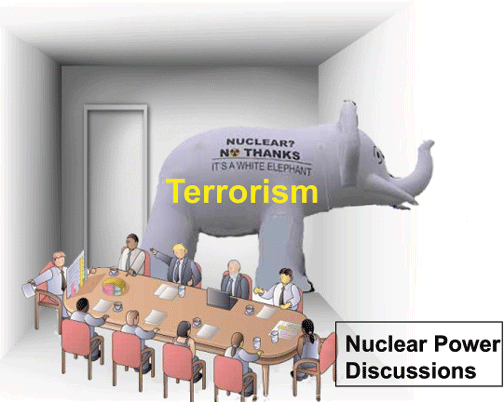
An International nuclear waste storage agenda exposes Australia to a range of potential profound adverse impacts through nuclear insecurity as a target for terrorism.
Claims by the Nuclear Commission Findings Report (Feb 2016, p.16-20) that SA “offers a safe long term capability” for the storage and disposal of high level nuclear waste are contradicted by the fact that Australia will be exposed to significant and developing threats in terrorism over decades of proposed Nuclear port and above-ground waste storage operations.
The UK Nuclear Free Local Authorities are concerned a determined terrorist group could be able to pierce nuclear waste transport and storage casks in use around the world and states that transport of nuclear materials should be limited as much as practical, with safe on-site storage facilities developed instead.
The Nuclear Commission’s nuclear waste transport and storage plans face fast emerging and unexpected nuclear security threats as lethal technology gets ever more destructive. Rocket propelled grenades, demolition charges and innovative available technology like the use of small drones by non-state actors are of increasing concern.
Attacks could seriously compromise operations of a nuclear port or an above-ground nuclear waste storage facility and the extent of impacts could conceivably require the site to be abandoned.
Security dangers in Nuclear Royal Commission’s plan
Nuclear Waste Brief (June 2016) by David Noonan, Independent Environment Campaigner
Proposed International nuclear waste storage exposes Australia to risks of terrorism “In the event of a major nuclear accident, adverse impacts on the tourism, agriculture and property sectors could potentially be profound.” Nuclear Royal Commission Finding 155 Feb 2016, Impacts on other Sectors p.28
An International nuclear waste storage agenda exposes Australia to a range of potential profound adverse impacts in major nuclear accidents and in nuclear insecurity as a target for terrorism.
The SA Nuclear Royal Commission Final Report (9 May 2016, 16 Mb) flagged risks in proposed high level nuclear waste transport and storage and concluded that terrorist attack scenarios are conceivable and rocket attack has the greatest potential to cause a release of radiation from impacted waste transport and storage casks (Appendix L – Transport risk analysis p.312).
In an age of terrorism following the devastating September 11th 2001 attacks there is no room for denial on the real security risks society faces in nuclear and radiological terrorism. Continue reading
Why a referendum is needed on South Australian govt’s nuclear waste import plan
john jasson, Your Say 17 June 16 Chapter 6 page 122 [Nuclear Fuel Chain Royal Commission Recommendations] states:
“Because of these shifts, a public vote on a proposal is not a reliable indicator of ongoing social consent: A vote for or against a proposal one day may not result in the same level of social consent one month later. ”
The two paragraphs that precede this unsubstantiated opinion as declared by the commission are in my view irrelevant because they relate to changes in public consent for matters of technological change that are easily reversible and have risk profiles that are minimal by comparison to a nuclear storage or transportation accident.
For this reason I have no trust in this process as I believe this to be a blatant attempt to circumvent the people of SA having a true say in this matter. A referendum is the only acceptable way to achieve public consent on a matter that has such significant commercial, safety and social implications for the public of SA. http://yoursay.sa.gov.au/discussions/nuclear-community-conversation-comment-on-the-specific-recommendations-in-the-final-report
One response to the recommendations of the South Australian Nuclear Fuel Chain Royal Commission
john jasson 09 Jun 2016Recommendations 1, …. Strongly disagree with removal of State powers on these matters. This is contrary to the interests of South Australians
Recommendations 2,3,4…….Agree with these recommendations as they apply to mining generally.
Recommendation 5 is an absolute nonsense and I strongly disagree as it is not practical and realistically enforceable. This appears to me be a hollow and deceptive assurance to gain support for recommendations 8 through 12. The recommendation overlooks the appalling history of contamination in this State that has already occurred and can not be economically remediated.
Recommendation 7 Agree subject to this activity NOT contravening the original intent and purpose of this facility. Priority should at all times support the fundamental purpose for which this facility was created.
Recommendation 8 Strongly disagree.
Recommendation 9 Agree with the intent of this recommendation but subject to the removal of Nuclear.
Recommendations 10, 11, 12 Strongly disagree. http://yoursay.sa.gov.au/discussions/nuclear-community-conversation-comment-on-the-specific-recommendations-in-the-final-report
The ‘pie in the sky’ financials of the South Australian Nuclear Royal Commission’s Report
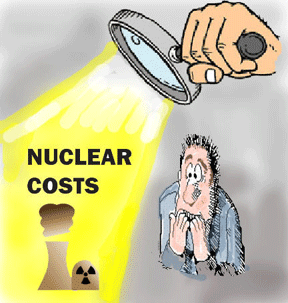
What happens when the private public partnership goes wrong, the private company can just declare bankruptcy and go back to whatever tax haven they more than are likely based in?
David Richards, Commenting on the specific recommendations in the Royal Commission’s Report, 12 June 16 http://yoursay.sa.gov.au/discussions/nuclear-community-conversation-comment-on-the-specific-recommendations-in-the-final-report
 The real weakness for this report is the ‘pie in the sky’ financials: The numbers may add up, however their basis in fact is largely illusory… Completion of the construction of the underground storage facility is by use of the money collected after many thousands of tonnes of waste has been collected and stored on the S.A surface. The proposal’s model is supposed to be simple: we start collecting the used fuel for which we will be paid $1.2 million a tonne, we store it on the surface for 10 plus years while the repository is prepared under the surface, and then inter it permanently underground. The weakness of this financial model is that it relies upon our potential customers providing a constant supply of waste at a premium price that we nominate for a sustained period.
What happens if not all of our customers is prepared to continue to pay the $1.2 million a tonne? They might send, 100 tonne, say, at the nominated price to get things started, and then ask for a discount. The potential suppliers will know the score, once the canisters are on the surface; the clock in S.A is ticking: success will rest upon this timeline for permanent storage below the surface, achieved by the sustainability of the cash flow generated by maintenance of the waste stream at the nominated price. The overseas suppliers will have done their sums, some of them have held on to this waste for the last 50 years, holding back for a little while longer to get a cheaper price is good business sense. Paying our initial asking price may free up enough space in their local repositories to allow them to absorb new waste until we offer them disposal at a reduced rate. They will have a good idea of the breakeven point of disposing of this waste, and will if they are feeling generous offer this price. Once the waste is accumulating on the South Australian surface, who will be the most desperate, those getting rid of the stuff, them that have been stock piling it for years, or us with a partially built facility and waste in temporary storage on the surface? Continue reading
1 This month

of the week – Australians for War Powers Reform (AWPR)
To see nuclear-related stories in greater depth and intensity
 Antinuclear