Some even more disturbing numbers on folly of South Australia nuclear waste import plan
Kim Mavromatis 10 June 16 MORE NUMBERS – 138,000 tonnes of high level nuclear waste in 69,000 high level radioactive waste canisters equates to a permanent underground nuclear waste dump size of around 112 square kms or 5,500 Adelaide ovals, 400 metres underground – and that’s not taking into consideration the 470,000 m3 of low and intermediate level nuclear waste.
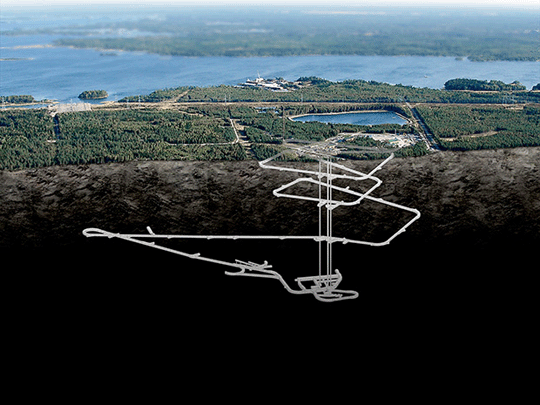
You can’t seriously tell me they will be able to build one nuclear waste dump that big?? in ground where there is no seismic activity in SA. Say yes to one and we will have many – say yes to one and we will end up with a toxic white elephant that will do us in or an economic white elephant that will do us in.
South Australia’s proposed nuclear waste import dump would be massively larger than Finland’s
Kim Mavromatis, 10 June 16 THE NUMBERS TELL A STORY
At the Royal Commission NFC event at the Hawke Centre in Adelaide (Wed June 1), Kevin Scarce made reference to Finland’s permanent underground high level Nuclear Waste dump, currently being built at Onkalo, which will have a capacity of 5,000 to 10,000 tonnes. Onkalo is featured in the must see doco “Into Eternity”(https://vimeo.com/111398583). The Royal Commission NFC final report specifies a capacity of 138,000 tonnes of high level nuclear waste for the proposed Nuclear Waste dump in SA and Kevin Scarce highlighted this figure at the Hawke Centre Nuclear event.
Comparing the Nuclear Royal Commission numbers with Onkalo, it’s clear that the proposed Nuclear Waste dump in SA will be of mammoth proportions.
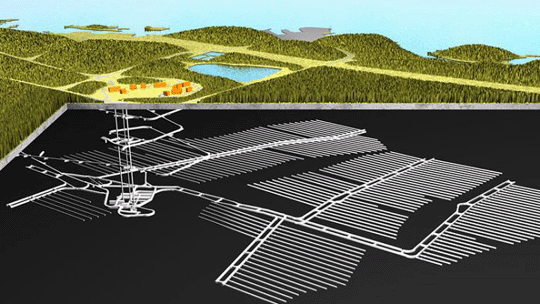
Onkalo (Finland), permanent underground high level Nuclear Waste Dump :
• Capacity 5,000 to 10,000 tonnes high level nuclear waste,
• or 2,500 to 5,000 high level nuclear waste canisters.
Proposed SA Nuclear Waste Dump :
• Capacity 138,000 tonnes high level nuclear waste or 69,000 high level nuclear waste canisters.
• Capacity 390,000 m3 intermediate nuclear waste.
• Capacity 81,000 m3 low level nuclear waste.
• Above Ground Temporary facility Capacity 72,000 tonnes high level nuclear waste.
• Above Ground Temporary facility Capacity 175,000 m3 Intermediate nuclear waste.
Just for high level nuclear waste alone, it will require a waste dump 14 to 28 times the size of Onkalo (69,000 high level nuclear waste canisters). And for decades, half of the high level nuclear waste will be stored above ground in a temporary facility. Imagine the risk of nuclear holocaust with all that high level nuclear waste in the one location?
And the preferred site for the proposed Federal govnt’s low and intermediate level nuclear waste dump, in the Flinders Ranges, is in an area where there is regular earthquake activity.
How smart are these people?????
I suspect if the state govnt say yes to one Nuclear Waste Dump (low, intermediate, high), the floodgates will open and there won’t just be one Nuclear Waste Dump site in South Australia, there will be many (50, 100 ????). And saying yes in SA will also open the floodgates to the rest of Australia. And I question whether they’ll stop at 138,000 tonnes (69,000 canisters) of high level nuclear waste????? If the state govnt takes us down this path and we become the world’s nuclear waste dump, there is no turning back
South Australia’s Labor and Liberal leaders for nuclear jaunt together to Finland
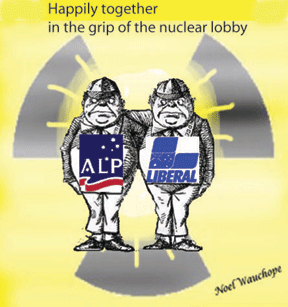 Weatherill, Marshall to make bipartisan trip to permanent nuke waste dump in Finland June 9, 2016 , Daniel Wills and Luke Griffiths,The Advertiser
PREMIER Jay Weatherill and Opposition Leader Steven Marshall will make a bipartisan trip to Finland in August and visit the world’s first long-term nuclear waste storage facility……
The bipartisan delegation to Finland will also include members of the Nuclear Fuel Cycle Royal Commission Consultation and Response Agency Advisory Board, which is overseeing statewide consultation on the proposal as the State Government considers whether to proceed.
It will visit the Onkalo nuclear waste facility in northern Finland, where the country plans to bury its own spent fuel in a labyrinth of tunnels 520m under the ground for permanent storage. Onkalo is expected to accept fuel for 100 years before being sealed for eternity. The facility is currently under construction is expected to become operational within a decade.
Mr Weatherill said it was critical to see first-hand the kind of facility SA could build.
“The research and evidence shows SA can safely deepen its involvement in the nuclear fuel cycle,” he said. “I want to see first-hand what this might look like and see what lessons Finland can share with us, should this be something South Australians want to consider.”
“To make an informed decision later this year, it’s important that I understand the concept of deep geological disposal. This bipartisan visit to the Onkalo site will allow us to learn valuable lessons from the Finnish experience, which we will share with the SA community.”
Mr Marshall said it’s important there is a bipartisan investigation of the opportunity and co-operation during the community consultation process.
Also on the panel was Greg Ward, chief of staff to the Nuclear Royal Commission…….http://www.adelaidenow.com.au/news/south-australia/weatherill-marshall-to-make-bipartisan-trip-to-permanent-nuke-waste-dump-in-finland/news-story/8a1be359682fb154b4fdccd48cc36dca
South Australia’s nuclear waste dump money mirage
Real juries hear both the Prosecution and Defence cases in open court. What I fear is that my fellow citizens selected for citizen’s jury duty will get to read and hear only what the State Government wants them to read and hear, so that they will give Premier Weatherill the “social licence” he wants in order to proceed with the dump.
South Australians do not need to mortgage their descendants’ future by building a high level nuclear dump in order to make ends meet. The alleged riches that the dump has been claimed to bring are a mirage, but the long-term risks are not.

How a high-level nuclear waste dump could lose money http://indaily.com.au/business/analysis/2016/06/07/how-a-high-level-nuclear-waste-dump-could-lose-money/ June 7 2016 The economic case for a high level nuclear waste facility in South Australia is far from convincing, writes Richard Blandy.
The Nuclear Fuel Cycle Royal Commission delivered its report early in May. I submitted my InDaily article on the Royal Commission’s tentative findings to the inquiry for its consideration. I received no acknowledgement, but I know that the article was discussed within the royal commission’s processes. It does not appear to have had any substantive effect on the report.
Having read the relevant sections of the report, I continue to believe that South Australia should not use part of its land mass as a dump for highly radioactive used fuel from overseas nuclear reactors (sp-called “high level waste”) which, in the royal commission’s own words, “requires isolation from the environment for many hundreds of thousands of years”.
The only reason why most South Australians would give a high level nuclear waste dump even a second’s thought is because it is being sold to them as a financial bonanza – a no-risk economic lifeline to a state down on its luck. Something for nothing.
In the summary of its report, the royal commission says that a high level waste dump “could generate more than $100 billion income in excess of expenditure over the 120-year life of the project (or $51 billion discounted at 4 per cent)”. Note that the report says “could”, not “would”.
But, in Appendix J, the report says that “applying a commercial pre-tax discount rate of 10 per cent the net present value of profits to the State would amount to $11.5 billion”. This is a big reduction from the headline number in the summary of $100 billion. Continue reading
Rushing the South Australian nuclear waste discussion will be a failure
 Royal commission engagement expert says nuclear opportunities will disappear if decision is rushed http://www.adelaidenow.com.au/business/royal-commission-engagement-expert-says-nuclear-opportunities-will-disappear-if-decision-is-rushed/news-story/f1bc0cf254e6b9d934669704a1b7196c June 8, 2016 Luke Griffiths The Advertiser THE person responsible for the Nuclear Royal Commission’s regional engagement says that if community consultation is rushed to meet political deadlines, the whole process will fall over.
Jon Bok, a former stakeholder engagement adviser to Santos, visited more than 50 SA communities over the course of 12 months. He told attendees at an Australasian Institute of Mining and Metallurgy uranium conference in Adelaide yesterday that if the State Government is to develop a high-level nuclear waste repository, the “fundamental threshold issue of safety has to be addressed”.
“For many people, it’s going to take a long time to get from where they are now to have a sufficient level of trust and confidence in government and industry that this can actually be done safely and taken forward,” he said.
Resistance remained strong in many areas, which Mr Bok said can be attributed in part to legacy issues that include the British government’s nuclear tests in Maralinga and issues at Radium Hill uranium mine in the state’s far east.
Royal Commission head Kevin Scarce delivered his final report to Premier Jay Weatherill in early May. His key finding was that a high-level waste storage facility would generate economic benefits in excess of $250 billion and that its development should be pursued by the State Government.
Mr Weatherill has since established a consultation and response agency, overseen by an advisory board, and a citizens’ jury to facilitate further community feedback.
He told Parliament on May 17 that, guided by the outcomes of this engagement, he will provide the Government’s response to the Commission’s report by the end of the year.
While unwilling to criticise the Government, Mr Bok said a timeline must not be set on the education of “dubious and curious” residents.
“There’s simply not going to be enough information in the public domain to make a yes or no decision in the next 12-18 months,” he said.
“The Government wants to be in a position to know where to take this by the end of the year, which is a very short time frame. But all of the international evidence suggests that rushing this process will lead to failure — it cannot be rushed. Continue reading
Submission time again – this time to South Australian Parliamentary Committee
JOINT COMMITTEE ON FINDINGS OF THE NUCLEAR FUEL CYCLE ROYAL COMMISSION

Nuclear ‘Citizens Jury’ will be a farce if it relies solely on that biased South Australian Royal Commission
 A big limitation of this so called first “Citizens’ jury is that it will take its information from the Nuclear Fuel Chain Royal Commission. But there are important aspects that are almost completely glossed over in that Commission. For example – they barely mention the dangers of transporting radioactive trash. That is an issue of high concern internationally.
Quoting a recent UK report on the dangers of a radioactive accident or of a radioactive attack – “The report on nuclear security, compiled by Dr David Lowry, a senior research fellow with the US Institute for Resource and Security Studies, argues that nuclear materials transported by road, rail, sea and air are also potential targets.”
If the “Agenda Setting Jury” is going to rely only on that biased pro nuclear Commission for the topics for discussion, then the whole thing will be a farce
Nuclear port in Australia to receive and store High level Nuclear Wastes
 The first high level nuclear waste shipment imposes untenable & unfunded liabilities on Australia, without a disposal capacity or even a site, and facing proposed decades of above ground storage.
David Noonan, 3 June 16 Nuclear port in Australia to store High level Nuclear wastes and receive waste ships every 24 to 30 days for decades:
The SA Nuclear Royal Commission Final Report (9 May 2016, 16 Mb) recommends a deep sea Nuclear port in Australia to receive an average 3 000 tonnes of high level Spent Nuclear Fuel (SNF) waste per year throughout the first three decades of proposed operations.
“In summary, the report recommends: Management, storage and disposal of waste, Recommendation: Pursue a purpose-built waste storage and disposal facility for used nuclear fuel. … The Commission’s firm conclusion is that this opportunity should be actively pursued, and as soon as possible.” (Nuclear Commission, Report Delivered, 9 May)
The Nuclear Commission report is based on a desk top nuclear waste consultancy “Radioactive waste storage and disposal facilities in SA” (Feb 2016) by Jacobs MCM, stating baseline requirements for:
the proposed Nuclear port is to take a total of 138 000 tonnes of high level nuclear waste (equivalent to 1/3 of total global SNF waste) over some 70 years from Project Year 11;
a “dedicated port facility specifically developed to transfer the canisters from the delivery ship to rail for transportation to the facility site” stating a “greenfield port is proposed”, with an allowance of A$100 million in baseline costs for the development of the port.
(Jacobs MCM, Enabling infrastructure, Port facilities, p.136);
“…estimated receivals of 3,000 tonne of SNF per year. With typical capacity per cask of 10 tonnes , this translates as 300 casks per year, requiring 12-15 sailings (nuclear waste shipments) per annum, meaning one ship each 24-30 days on average.” At 200 – 250 tonnes SNF waste per ship.(Jacobs MCM, Immediate port receival laydown area, p.170);
the proposed Nuclear port is to store high level nuclear waste on site, with a “minimum immediate port storage capacity for casks unloaded from ships suggested as 28 waste casks” required a storage capacity of some 280 tonnes of high level SNF waste, at an average timeline of 10-12 days to clear a shipment of 20 waste casks from the port (p.170). A loaded high level nuclear waste transport cask weighs in range of 100 to 140 tonnes (by type);
In addition, the proposed Nuclear port is required to receive some 390 000 cubic metres of intermediate level nuclear wastes. At a rate of 10 000 m3 per year for the first 28 years of operations (equating to circa 600 x OSO shipping containers per year) stepping down to circa 4 000 m3 per year over the following proposed 24 years of port operations (p.161 and 172).
The proposed Nuclear port is itself to become a high level nuclear waste dump holding SNF wastes (280 tonnes) equivalent to some 14 years operations of a nuclear power reactor. “A typical nuclear power plant in a year generates 20 metric tons of used nuclear fuel” (US Nuclear Energy Institute).
The first high level nuclear waste shipment imposes untenable & unfunded liabilities on Australia, without a disposal capacity or even a site, and facing proposed decades of above ground storage.
Business South Australia’s Nigel McBride touts nuclear waste importing plan
 Homer Simpson and nuclear politics as France shows the way for SA, Fin Rev 23 May 16 by Simon Evans Nigel McBride, the chief executive of Business SA, the organisation that oversees the interests of more than 46,000 businesses in South Australia, has just returned from Finland and France, where he researched the nuclear waste industry.
He is convinced there would be no detrimental impact to the image of prime wine regions such as the Barossa Valley, McLaren Vale, Clare Valley and the Coonawarra from having an underground storage facility elsewhere in the state.
“We’re not going to have any overt signs anywhere,” Mr McBride told reporters in Adelaide on Monday………
Mitchell Taylor, the managing director of Taylors Wines, which has operations in the Clare Valley, Adelaide Hills, McLaren Vale and the Coonawarra, said the most sensible thing would be to locate any future nuclear waste storage facility in arid lands hundreds of kilometres away from agricultural land.
“You wouldn’t put it close to agricultural land,” he said…….
From an overseas marketing viewpoint, Mr Taylor said he didn’t think it would have any impact on the image of South Australian wines and premium food, provided the two were kept separate.
“You’ve got to get politics out of it,” he said.
Mr McBride said the regulatory model in Finland was a good benchmark, and there had been too much simplistic criticism of a nuclear industry based on what he termed “The Simpson’s model” taken from the popular cartoon series where a hapless Homer Simpson works at the Springfield nuclear power plant.
A final report by royal commissioner Kevin Scarce in early May recommended the state set up a nuclear waste storage facility to generate $100 billion in profits over the project’s forecast 120-year life, with Mr Weatherill saying he would make a decision by the end of the year after an extensive community consultation process, on whether to proceed. http://www.afr.com/it-pro/homer-simpson-and-nuclear-politics-as-france-shows-the-way-for-sa-20160522-gp1851
More worrying aspects of the Nuclear Royal Commission’s Final Recommendations
 There is no existing market to ascertain the price that a customer may be willing to pay for the permanent disposal of used fuel.(CH 5 p 93)
The Commission is very vague on the nature of the public- private partnership that will pay for the capital costs of AS 41$billion (Ch 5 p.100)
The revenue would be paid on delivery of wastes to a South Australian port. That will be after the 20 – 30 years it will take to construct the facility, plus 10 years after the project begins operation.-
“a pre-commitment before project commencement would provide added assurance that capital costs are fully covered before construction began” (But after a commitment 40 years before, a foreign nuclear company could have gone bankrupt” (Ch 5 p. 100 -102) Finland.http://yoursay.sa.gov.au/system/NFCRC_Final_Report_Web.pdf
Worrying financial aspects of the Nuclear Royal Commission Final Recommendations.
It looks as if the customers for the nuclear waste import business could be dodgy Asian and Middle Easter ones, with unstable politics. The Commission does not name any countries as potential customers, but DOES RULE OUT countries that will NOT be – i.e. United States, France, the United Kingdom and Canada, and countries which have national laws that prohibit their export of waste, such as Sweden and Finland.http://yoursay.sa.gov.au/system/NFCRC_Final_Report_Web.pdf CH 5 p.93.
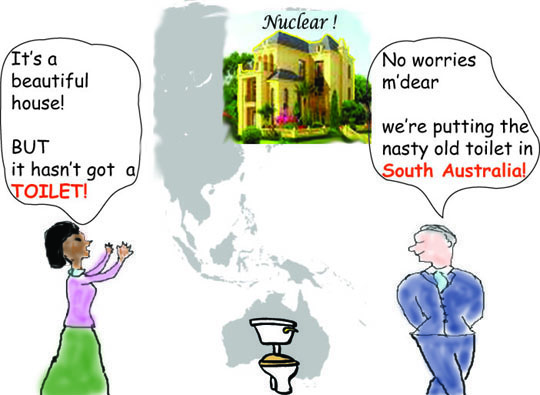
Dr Andrew Allison assesses the FINAL RECOMMENDATIONS of South Australia’s Nuclear Fuel Chain Royal Commission
Andrew Allison 23 May 16 Here is my assessment of “NUCLEAR FUEL CYCLE ROYAL COMMISSION – FINAL RECOMMENDATIONS Copied from Pg. 169 of the Commission’s final report, and republished here for the purpose of discussion.
Based on the findings set out in this report, the Commission recommends that the South Australian Government:
1. pursue the simplification of state and federal mining approval requirements for radioactive ores, to deliver a single assessment and approvals process
AA: The devil is in the detail for this one. The word “simplification” could be code for reducing environmental standards, or allowing corporations to avoid the consequences of their actions. I am suspicious.
2. further enhance the integration and public availability of pre-competitive geophysical data in South Australia
AA: It depends who owns the data. If a corporation has collected the data then it is part of the intellectual property of that corporation. It is difficult to see how they could be forced to share it, by a state government. If the data were collected by the state government then one would have to ask why she state government is investing in prospecting for nuclear materials. This is in an era where state governments supposedly cannot operate water utilities, banks, gas companies, public transport etc etc…. Why are they breaking their own laws to prospect for nuclear materials?
3. undertake further geophysical surveys in priority areas, where mineral prospectivity is high and available data is limited
AA: This is a matter for the corporations, subject to regulatory approval.
http://www.theaustralian.com.au/…/story-e6frg6n6…
AA: Readers may remember that Marathon resources breached environmental guidelines in The Flinders Ranges in 2012. We cannot allow this. I don’t see why the resources of the state should be spent prospecting on behalf of mining companies.
4. commit to increased, long-term and counter-cyclical investment in programs such as the Plan for Accelerating Exploration (PACE) to encourage and support industry investment in the exploration of greenfield locations
AA: Once again, this is a purely commercial matter. I don’t see why the state government should be investing money in this. There are much more efficient ways of carrying out counter-cyclical Keynesian investment, than exploring for nuclear materials. We could invest in schools, and hospitals and public transport infrastructure, for example.
5. ensure the full costs of decommissioning and remediation with respect to radioactive ore mining projects are secured in advance from miners through associated guarantees
AA: This seems to be very sensible to me. I ask the question: aren’t we already doing this? See the reference to marathon resources, above.
6. remove at the state level, and pursue removal of at the federal level, existing prohibitions on the licensing of further processing activities, to enable commercial development of multilateral facilities as part of nuclear fuel leasing arrangements
AA: In my view, the existing laws are in place to protect public safety and no good case has been made to overturn them. There is currently a glut of Uranium on the world market. The prices are low. To increase the supply of Uranium at this time would only depress the price further and affect the viability of existing producers.
7. promote and actively support commercialisation strategies for the increased and more efficient use of the cyclotron at the South Australian Health and Medical Research Institute (SAHMRI)
AA: The limited and controlled use of nuclear technology in medicine has been shown to be beneficial. I don’t see any logic in expanding the program, unless there is a demonstrated need that is currently not being met in South Australia.
AA: The use of cyclotrons should be carefully regulated, since they can be used to enrich fuel, leading to weapons proliferation:
http://nuclearweaponarchive.org/Iraq/Calutron.html
8. pursue removal at the federal level of existing prohibitions on nuclear power generation to allow it to contribute to a low-carbon electricity system, if required
AA: It is very doubtful that nuclear energy is “low carbon”, if one considers the entire fuel cycle.
9. promote and collaborate on the development of a comprehensive national energy policy that enables all technologies, including nuclear, to contribute to a reliable, low-carbon electricity network at the lowest possible system cost
AA: Of course, a centralized government energy policy that was oriented towards the needs of the people would be sensible. Unfortunately state governments were in a rush to privatize their energy assets (or to lease out monopolies on a long-term basis) so the control of the system has been relinquished to corporations, for the time being. The Royal Commission has admitted that there is no commercial basis for nuclear power, in Australia, for the foreseeable future.
10. collaborate with the Australian Government to commission expert monitoring and reporting on the commercialisation of new nuclear reactor designs that may offer economic value for nuclear power generation
AA: I will believe in “Generation IV” nuclear power stations when I see one actually operating. In the mean time, we do have to consider the opportunity cost associated with investing Australia’s limited research dollars on a technology that Australia does not even use, and will not use for the foreseeable future.
11. pursue the opportunity to establish used nuclear fuel and intermediate level waste storage and disposal facilities in South Australia consistent with the process and principles outlined in Chapter 10 of this report
AA: I am very curious to know why the Royal Commission is in such a hurry for South Australia to commit to a facility that may not even work, and will not actually hold any nuclear waste for over eighty years. I think that it would be much more prudent for South Australia to watch technological developments elsewhere in the world before committing to such a great an irreversible development as a nuclear waste dump. We should note that no country has yet completely solved the nuclear waste storage problem, not even the former nuclear superpowers, the USA and Russia.
12. remove the legislative constraint in section 13 of the Nuclear Waste Storage Facility (Prohibition) Act 2000 that would preclude an orderly, detailed and thorough analysis and discussion of the opportunity to establish such facilities in South Australia.”
AA: I argue that this legislation serves an important public safety purpose. A convincing case has not yet been made to remove this important piece of safety legislation. The “economic” analysis of the Royal commission is mostly based on the opinion of one consultant, in the Jacobs report. The assumptions that were made in this report are very generous to the pro-dump case.
Alinytjara Wilurara Natural Resources Management Board – response to Nuclear Royal Commission
 The Alinytjara Wilurara Natural Resources Management Board – reponse to Tentaive Findings of Nuclear Fuel Cycle Royal Commission
Olympic Dam for nuclear waste? BHP does not agree
 Have these people read BHP’s Submission to the Nuclear Fuel Cycle Royal Commission?
BHP clearly states that it doesn’t want to have any involvement in storage or disposal of nuclear waste:
“Irrespective of whether storage or disposal is preferred, BHP Billiton considers that either option would be inconsistent with our core business of mining and the production of high quality copper and associated by-products at Olympic Dam.” – http://nuclearrc.sa.gov.au/app/uploads/2015/11/BHP-Billiton-03-08-2015.pdf
Olympic Dam mooted as nuke dump site The area around BHP Billiton’s Olympic Dam site has been raised in informal discussions within government as a prospective site for a future high-level nuclear waste dump, InDaily can reveal. INDAILY, Tom Richardson, 12 May 15, While a decision on whether to proceed with an international nuclear repository – as strongly recommended by this week’s Scarce Royal Commission final report – won’t be made until November at the earliest, it’s understood the viability of the Stuart Shelf region of the Gawler Craton, much of which is covered by the Olympic Dam indenture agreement, is “a question that’s been asked” in State Government circles.
The discussions also raised the prospect of an approach to Oz Minerals, whose Prominent Hill operation is around 130km northwest of Olympic Dam…….
It’s understood the Rann Government approached BHP in its first term to canvas using Olympic Dam for a low-level state repository, a suggestion the company declined.
It has since maintained that stance, unsurprisingly given the relatively low financial return of such an enterprise, saying in February that it had not been shortlisted for the national waste repository for low and intermediate level waste “and we expect this process to run its course”……http://indaily.com.au/news/2016/05/12/olympic-dam-mooted-as-nuke-dump-site/
Can citizen’s juries make decision on Australia importing global nuclear wastes?
Citizen’s council to steer SA nuclear waste decision MEREDITH BOOTH THE AUSTRALIAN MAY 11, 2016
A system used to decide “tricky policy issues” such as how South Australians manage unwanted dogs and cats will be set up to decide the state’s nuclear future.
Labor Premier Jay Weatherill said a citizen’s jury of 50, chosen from 25,000 “everyday South Australians’’ in a similar way to how a jury is chosen for a criminal trial, will be formed next month to pose key questions raised by the Nuclear Fuel Cycle Royal Commission into the state’s further involvement in the nuclear industry.
A second jury of 350 would seek community feedback and report to the government by September, before a decision on a dump is made by November. Including an advertising campaign, the process would cost $1 million, Mr Weatherill said…..
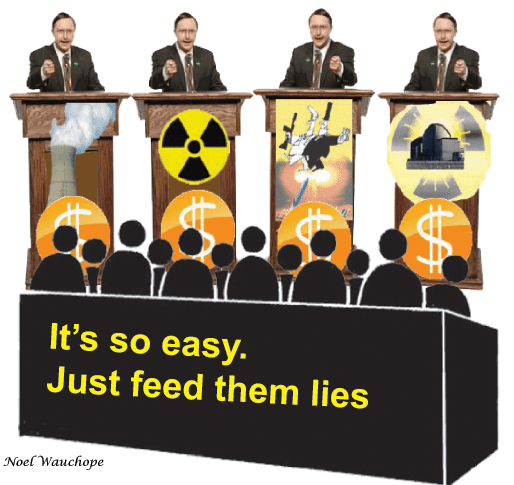
The Premier said it would be impossible to proceed with recommendations, which included expanding uranium mining and considering nuclear power, without strong community support. “This is going nowhere if it is going to be the subject of political controversy,” he said……
“No serious investor will co-operate with us, no international partner will want to be part of entering into what is a long-term, extraordinarily expensive set of investments if they don’t think the community is going to be able to deliver on them.
“This is a test of our democracy. Can we have a mature and reasoned debate about this issue and come up with a wise judgment,“ he said.
The government has recently used citizen juries on issues of dog and cat management and cycling laws, saying it develops independent views not dominated by lobbyists and activists.
But the nuclear question was “clearly a very significant decision to entrust to this process,’’ said University of Adelaide political analyst Clement Macintyre.
“It means that the decision is arms’ length from the government, and potentially politically safer for them,’’ he said.
Mr Weatherill’s openness to a nuclear dump has clashed with Labor’s national platform, which is strongly opposed to the importation and storage of nuclear waste. However, he said political consensus had to be achieved at state level before taking the question nationally. http://www.theaustralian.com.au/national-affairs/state-politics/citizens-council-to-steer-sa-nuclear-waste-decision/news-story/20e35875865926c8d1746ed9a55174b5
1 This month

of the week – Australians for War Powers Reform (AWPR)
To see nuclear-related stories in greater depth and intensity
 Antinuclear