Catholic Religious South Australia express duty to oppose Nuclear Commission’s import waste plan (extracts from Submission)
 Catholic Religious South Australia – response the the nuclear fuel chain Royal Commission’s ‘Tentative Findings’
Major financial risks for South Australia are ignored by Nuclear Fuel Cycle Royal Commission
 The proposal has major financial risks to taxpayers that have been ignored or played down in the Tentative Findings. These are sufficient grounds to reject the scheme. However, if the Royal Commission is determined to ignore or downplay the risks and recommend the proposed project, it should also recommend that 5 the substantial financial risks be taken by a private corporation or consortium, not Australian taxpayers
 Comments on the Cost Analysis, Business Case and Risks of Management for Storage and Disposal of Nuclear Waste in South Australia
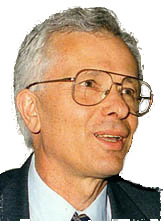
 Dr Andrew Allison challenges The Nuclear Fuel Cycle Royal Commission’s reckless Tentative Findings
 The proposal is that we should accept waste before the repository has been completely built and tested. This proposal is so reckless, as to be negligent. We would face the very real risk of being left with high-level nuclear waste, and no technology to properly handle it.
Response to the Nuclear Fuel Cycle Royal Commission’s Tentative Findings By Dr Andrew Allison, B.Sc. B.Eng. PhD. (Elec. Eng.) 17 March 2016
South Australia’s Nuclear Royal Commission was a nuclear lobby set-up from the beginning
There is no logical reason to believe that the SA government would perform any better than the U.S. government. On the contrary, there are good reasons to believe that nuclear waste management would be more difficult here given that the U.S. has vastly more nuclear waste management expertise and experience than Australia.
 SA nuclear Royal Commission is a snow job Jim Green, 29 April 2016 http://reneweconomy.com.au/2016/sa-nuclear-royal-commission-is-a-snow-job-18368
The South Australian Nuclear Fuel Cycle Royal Commission (RC) will release its final report on May 6. It was established to investigate opportunities for SA to expand its role in the nuclear industry beyond uranium mining.
Before his appointment as the Royal Commissioner, Rear Admiral Kevin Scarce said little about nuclear issues but what he did say should have excluded him from consideration. Speaking in November 2014 at a Flinders University guest lecture, Scarce acknowledged being an “an advocate for a nuclear industry”. Just four months later, after his appointment as the Royal Commissioner, he said the exact opposite: “I have not been an advocate and never have been an advocate of the nuclear industry.”
Other than generalisations, and his acknowledgement that he is a nuclear advocate, Scarce’s only comment of substance on nuclear issues in his 2014 lecture was to claim that work is “well underway” on a compact fusion reactor “small enough to fit in a truck”, that it “may be less than a decade away” and could produce power “without the risk of Fukushima-style meltdowns.” Had he done just a little research, Scarce would have learnt that Lockheed Martin’s claims about its proposed compact fusion reactor were met with universal scepticism and ridicule by scientists and even by nuclear industry bodies.
So the SA government appointed Scarce as Royal Commissioner despite knowing that he is a nuclear advocate who has uncritically promoted discredited claims by the nuclear industry. Scarce appointed an Expert Advisory Committee. Despite claiming that he was conducting a “balanced” RC, he appointed three nuclear advocates to the Committee and just one critic. The bias is all too apparent and Scarce’s claim to be conducting a balanced inquiry is demonstrably false.
Given the make-up of the RC, it came as no surprise that numerous questionable claims by the nuclear industry were repeated in the RC’sinterim report released in February. A detailed critique of the interim report is available online, as is a critique of the RC process.
The RC’s interim report was actually quite downbeat about the economic prospects for a nuclear industry in SA. It notes that the market for uranium conversion and enrichment services is oversupplied and that a spent fuel reprocessing plant would not be commercially viable. The interim report also states that “it would not be commercially viable to generate electricity from a nuclear power plant in South Australia in the foreseeable future.”
In a nutshell, the RC rejected proposals for SA to play any role in the nuclear fuel cycle beyond uranium mining. But that still leaves the option of SA offering to store and dispose of foreign high-level nuclear waste (HLW) and the RC strongly promotes a plan to import 138,000 tonnes of HLW for storage and deep underground disposal.
SA as the world’s nuclear waste dump The RC insists that a nuclear waste storage and dumping business could be carried out safely. But would it be carried out safely? The RC ought to have considered evidence that can be drawn upon to help answer the question, especially since Kevin Scarce has repeatedly insisted that he is running an evidence-based inquiry.
So what sort of evidence might be considered? The experience of the world’s one and only deep underground nuclear waste dump ‒ the Waste Isolation Pilot Plan (WIPP) in the U.S. ‒ is clearly relevant. And Australia’s past experience with nuclear waste management is clearly relevant, with the clean-up of nuclear waste at the Maralinga nuclear test site in SA being an important case study.
But the RC completely ignores all this evidence in its interim report. We can only assume that the evidence is ignored because it raises serious doubts about the environmental and public health risks associated with the proposal to import, store and dispose of HLW. Continue reading
Secrecy on health information about uranium workers – Submission to #NuclearCommissionSAust
NUCLEAR FUEL CYCLE ROYAL COMMISSION TENTATIVE FINDINGS RESPONSE March 2016 Dan Monceaux – Documentary filmmaker & South Australian citizen
EXPLORATION, EXTRACTION & MILLING “………I have previously expressed my criticism that this, and indeed all Royal Commissions conducted in South Australia are exempt from the Freedom of Information Act 1991. This is fundamentally undemocratic, and contradicts claims made by the Commissioner on many occasions of his commitment to openness and transparency.
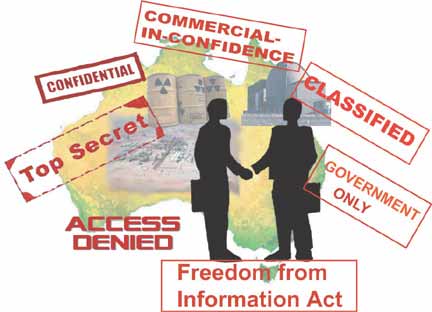
Returning to the subject of exploration drilling, I would suggest that there is another factor confounding the efficacy of exploration drilling regulation in South Australia- namely regulatory capture. This is accompanied by a tendency to withhold information regarding non-compliance and regulatory failure. The resulting impression can be one of false assurance. For example, by citing Marathon Resources Rectification Plan 2008 in its Tentative Findings, while neglecting to list the Eyre Iron compliance audit report which it also received, the Commission is misleading the reader. A reader would be forgiven for assuming that Marathon’s non-compliance was an isolated example, when clearly, this is not the case. The compliance audit report is found as Appendix A attached to my submission below. http://nuclearrc.sa.gov.au/app/uploads/2016/03/Dan-Monceaux-10-08-2015.pdf
The Government of South Australia has on its own record admissions of its institutional knowledge of lung cancer risk to uranium workers in underground mines. The evidence base dates back to the early experiences of miners at Joachimstahl in Czechoslovakia, from whose high incidence of lung cancer the first precautionary safety standards were subsequently set in other jurisdictions. The risk was understood in the 1920s as evidenced by publications of the South Australian Department of Mines from the mid 1950s, namely: Possible health hazards in uranium mining – Armstrong, A.T., Department of Mines (1955) https://sarigbasis.pir.sa.gov.au/WebtopEw/ws/samref/sarig1/image/DDD/RB00429.pdf The health consequences of workers in the uranium industry – Dr. B. S. Hanson (1956) https://sarigbasis.pir.sa.gov.au/WebtopEw/ws/samref/sarig1/image/DDD/RB4200080.pdf
They are found in the results of Radium Hill worker cohort studies published in peer-reviewed medical journals. The epidemiological studies of the 1980s, published circa 1990 proved, with epidemiological evidence of elevated cancer incidence, that confidence expressed in the safety of working conditions at the Radium Hill mine in the 1950s and 1960s was ill-founded.
Radon daughter exposures at the Radium Hill uranium mine and lung cancer rates among former workers, 1952-1987 – Alistair Woodward, David Roder, Anthony J. McMichael, Philip Crouch and Arul Mylvaganam (1991) http://www.jstor.org/stable/3553403………
the Olympic Dam mine’s radiological safety measures and records remain protected by special secrecy provisions established under the Roxby Downs (Indenture Ratification) Act 1982. Secrecy during the time of the Radium Hill mine was a matter of protecting Commonwealth secrets during the Cold War. The secrecy provisions of the Roxby Downs Indenture (Ratification) Act 1982, were according to Ian Gilfillan of the Australian Democrats, at least in part to protect the project from attack by environmental groups. The Indenture Act was revised in 2011, and forfeited the ideal opportunity to repeal Cold War-style exemptions as a sign of good faith to the people of South Australia and movement towards open government………… https://www.academia.edu/23544163/Nuclear_Fuel_Cycle_Royal_Commission_Tentative_Findings_Submission_-_March_2016
The health of uranium and nuclear workers. Response to #NuclearCommissionSAust’s ‘Tentative Findings’
It is extraordinary that the South Australian Nuclear Fuel Chain Royal Commission is not publishing Responses to its “Tentative Findings” before it makes its final announcement on May 6th.
Meanwhile, here is part of at least one very clear and informative response.
NUCLEAR FUEL CYCLE ROYAL COMMISSION TENTATIVE FINDINGS RESPONSE March 2016 Dan Monceaux – Documentary filmmaker & South Australian citizen.
“…… I sincerely hope that the health and wellbeing of South Australia’s workforce, its citizenry and its environment are considered sufficiently important topics for this Commission to elaborate on the matters raised here ahead of its final report to Parliament in May.
………The Commission’s opening tentative finding states that “South Australia can safely increase its participation in nuclear activities, and by doing so, significantly improve the economic welfare of the South Australian community.”
The evidence base for adopting such a confident and conclusive statement is questionable. In the case of nuclear industrial activities which have established links with health conditions including cancer and associated heart, lung and liver conditions and potential genetic harm, the safety or otherwise of an activity or regulatory regime can only be proven by epidemiological studies spanning a timeframe of decades. For example, little is known about the fates of worker cohorts from existing and past uranium mining and milling activity in South Australia………. The Commission has had time to consider this matter, but appears to have not deemed it sufficiently important. ……
I wish to make a case for the prioritisation of epidemiological studies of past and present South Australian uranium worker cohorts as a matter of the utmost importance. The results of such studies could provide an empirical basis for future commentary regarding the safety or otherwise of the industry as it has existed until now…….
The Commission states that “policies must be based on evidence, not opinion or emotion.” The same rule should apply to statements made by the Commission. To be considered credible, they must be supported by material evidence. The absence of evidence is not evidence of absence. Harm can neither be proven, nor safety assured without relevant epidemiological studies. This was known to South Australia’s Department of Mines in 1956, when Dr. B. S. Hanson wrote in The Health of Workers in the Uranium Industry (pg. 16): “It is only by long-term health examinations that the validity of our present speculative exposure limits may be tested.” This document is currently available on SARIG, the South Australian government’s resources industry geoserver: https://sarigbasis.pir.sa.gov.au/WebtopEw/ws/samref/sarig1/image/DDD/RB4200080.pdf…….
The available evidence suggests that contemporary publications of South Australian Government departments fail to adequately communicate occupational exposure risk to their readers. The perfect example of this is the Uranium fact sheet published by the Department of State Development in 2015, during the proceedings of this Commission. The “Fact Sheet” poses the question “Is uranium safe?” then neglects to answer the question. Instead, it provides the graphic reproduced from http://www.statedevelopment.sa.gov.au/upload/uranium/uranium%C2%ADthe-facts-final.pdf? t=1458534521755
Compare this to Hanson and Armstrongs statement from 1956, in documents held by the same South Australian government, written 60 years earlier:
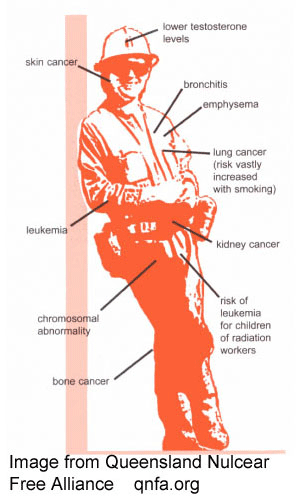 “Hazards associated with uranium ore are of two kinds, those due to radioactivity, including 6 external radiation as well as internal radiation; and those due to uranium metal poisoning. Radon gas and its solid daughter products would appear to offer the greatest potential danger. They can be inhaled and the solid products so lodged in the body.” (Armstrong, pg. 18)
“The individual employed in a mine or mill risks damage by external or internal radiation, and as to the latter the radioactive particles which form a danger are either ingested or inhaled.” (Hanson pg. 7)
“The daughter products are insoluble, but together with the dust to which they adhere some are engulfed by the reticulo-endothelial cells of the lung surface and there theoretically give a high intensity of alpha radiation to those very surface cells which form the type seen in the usual cancer of the lung.” (Hanson pg. 9)
“The inhalation of active deposit on dust particles, is so much the most important one that most of our [Department of Mines’] effort should be directed towards overcoming it.” (Hanson pg.10)
“In my opinion, dusty clothes inevitably mean an inhalation risk as well as an ingestion risk.” (Hanson pg.14)
“Almost without exception this report deals with the real or probable dangers of radioactivity.” (Hanson pg. 19)
The disparity between the messages of 1955 and 1956 (Department of Mines) and 2015 (Department of State Development) is alarming and deeply concerning…… https://www.academia.edu/23544163/Nuclear_Fuel_Cycle_Royal_Commission_Tentative_Findings_Submission_-_March_2016
Breakfast with the Toffs, after May 6th Nuclear Royal Commission announces wonderful waste import plan
 Spin all over the place about Australia’s so wonderful opportunities in the uranium/nuclear industry! It’s all part of the leadup to the shonky Nuclear Fuel Commission’s unsurprising recommendation that South Australia should import radioactive trash.
I guess they had a good time with the charade of the Royal Commission, jaunts overseas for the nuclear shills, and the spurious business of taking submissions – of course, as Kev says, the antinuke ones were mostly “emotional, so they don’t count anyway.
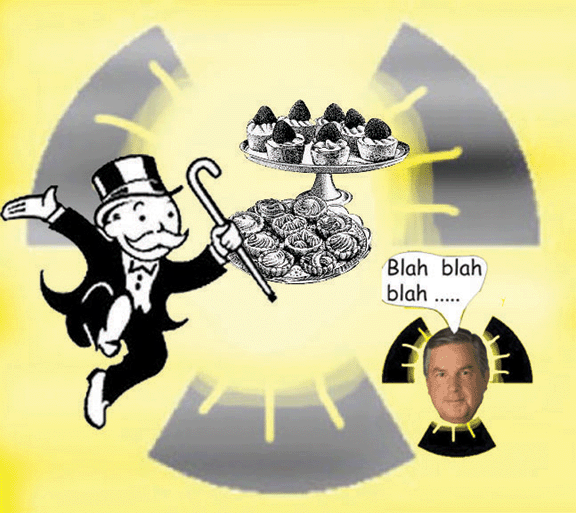
Let’s begin with good old reliable nuclear stooge Kevin Scarce. For just the measly $67.50 , you can have brekky with him – a sit-down hot breakfast, layered berry yoghurt muesli shot, seasonal fruit, brewed coffee, T Bar teas and fresh juice.
Meanwhile, Kev will tell you how you beaut it will be when South Australia goes full steam ahead with importing radioactive trash and expanding the nuclear fuel chain. See more at Action Australia.
Anyway, it’s a suitable breakfast price. We do want to keep the great unwashed out, after all .
Meanwhile, back at the struggling, barely surviving uranium mining industry, they are putting on a bold face, too.
The Minerals Council of Australia’s Uranium Forum has today released a range of material that purports to demonstrate the potential benefits of further developing Australia’s uranium industry. ‘Uranium: Untapped Potential’ includes a poster, a series of videos featuring industry experts and voices, and social media material highlighting the untapped potential further growth of the uranium industry offers Australia. They’r on Facebook, Twitter, Youtube. linked in, as well as the usual mainstream media.
Michele Madigan remembers Bob Ellis and that other nuclear royal commission
 In July 2004, a six-year anti-nuclear campaign spearheaded by Aboriginal women, who themselves had suffered in the British nuclear tests, was successfully concluded with the federal government’s announcement: ‘No national radioactive dump for SA.’
who could have imagined that just 11 years later, a new and far more dangerous plan would be launched by another royal commission, perhaps the first royal commission to plan a future scheme rather than examine one past?
Since this royal commission’s ‘tentative findings’ in February for South Australia to import international high-level nuclear waste, which it actually names as radioactive for ‘many hundreds of thousands of years’, the scepticism among South Australians is growing.
Bob Ellis and the other nuclear royal commission http://wwweurekastreet.com.au/article.aspx? aeid=47194#.VwrLvtR97Gg Michele Madigan | 07 April 2016
The passing of Bob Ellis recalls his faithful accompanying of the 1984–1985 royal commission into the British nuclear tests conducted in South Australia in the 1950s and 1960s. He went ‘to England and back’ and, as he described it, ‘to each black polis’ of the royal commission hearings.
Ellis’ article on the Wallatina hearings (The National Times, 3–9 May 1985), described what he named as the commission’s ‘worst story of all’ — Edie Milpudie’s telling of herself and her family camping, in May 1957, on the Marcoo bomb crater.
She told of being ‘captured by men in white uniforms … forcibly and obscenely washed down, miscarrying twice and losing her husband who to prove to the soldiers he knew English, sang, “Jesus loves me, this I know. For the Bible tells me so.”
‘And how the soldiers shot their beloved irradiated dogs.’
‘The bad parts of the story,’ Ellis went on, ‘the miscarriage and afterward, were communicated to Jim (Commissioner McClelland) in secret session, in the distance in the bush, with Edie’s women friends giving her comfort, and prompting with giggles and nudges her reminiscence of a story they knew by heart, already an old legend.
‘Jim called these women the best in the world, unstinting comforters, inextinguishable friends”
Five years later I had the privilege myself of meeting Edie Milpudie at her Oak Valley camp in the SA Maralinga lands. Many of the Yalata elders had prepared me in a way with the constant mantra: ‘Milpudie — she went through the bomb.’ Continue reading
South Australia’s Nuclear Fuel Chain Royal Commission virtually ignored dangers of transporting radioactive trash
As the days get a bit closer to #NuclearCommissionSAust’s announcement of its (predetermined) findings, we need to remember that the Commission’s “Issues Papers” almost completely ignored the question of the dangers of transporting highly radioactive trash across land and sea.
Paul Langley, in his fine response to the Commission’s “Tentative Findings” raised this very important matter – in the extract below
Response to the Tentative Findings of the SA Nuclear Fuel Cycle Royal Commission A Submission by Paul Langley Nuclear Exhaust 16 Mar 16 “……Transport of HLNW from around the world to a SA HLNW geologic repository
 The Royal Commission apparently assumes that the movements of many hundreds of thousands of tonnes of spent nuclear fuel from many countries around the world to the Gawler Craton will be low risk, no problems and perfectly safe. As contradictory as those stances are. I do not accept that position of default safety. Further I do not accept that the unloading of the HLNW will be perfectly safe. I do not accept that road transport from port to repository site will be perfectly safe, even on a dedicated purpose built road.
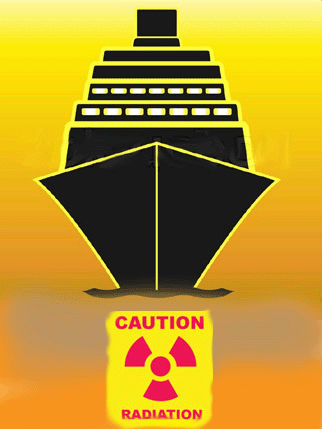 I would recommend that Super Freighters laden with the contents of countless reactor cores not sail down the Somali coast nor in the waters to the south of Thailand for fear of pirates. They should avoid man made Islands in the South China Sea. I suppose the ships will be guarded by 6 English policemen each with two revolvers between them. Rather than half the Pacific Fleet they would actually warrant. If they ever get to leave their home ports. What is the Somali coast going to be like in 40 years? Peaceful or short of rad weapons?…….” https://nuclearexhaust.wordpress.com/2016/03/15/response-to-the-tentative-findings-of-the-sa-nuclear-fuel-cycle-royal-commission/
6 April – 6 May : Assessing the Nuclear Fuel Chain Royal Commission before its results are released on 6 May
It’s one month until the South Australian Nuclear Fuel Chain Royal Commission will announce its findings. And everyone knows what they will be – “nuclear waste importing will be a bonanza for South Australia”
This is the first of the significant posts that will appear on this site each day, ,until 6th May.
Kevin Scarce has dismissed opposition to the plan as largely “emotional”, not “factual” . I suspect that will be the way in which the Commission will deal with the opposing Submissions. Here’s today’s:
The Greens SA’s submission to the Nuclear Royal Commission’s Tentative Findings rejects the suggestion that an economic bonanza awaits our State if South Australians would only resign ourselves to becoming the world’s nuclear garbage bin.
“The Royal Commission has been blinded by imaginary wealth and sucked into believing that a project that has never succeeded anywhere else in the World is South Australia’s for the taking”, said Greens SA Parliamentary Leader, Mark Parnell MLC.
“The most obvious question is being ignored: If this is such a great deal, how come no other country has grabbed it before now?
“The Greens are urging the Royal Commission to “get real” and critically examine the supposed economic benefits alongside the ongoing economic, social, environmental and reputational costs.
“Washing your hands of responsibility for a toxic legacy left to future generations is just immoral.
“The solution to South Australia’s current unemployment problems won’t be solved with mythical jobs that are decades into the future with the creation of toxic liabilities that last hundreds of thousands of year.
On releasing the “Tentative Findings” Report to the media on 15th February 2016, Commissioner Kevin Scarce stated, “The community needs to understand the risks and the benefits.” The Royal Commission’s “Tentative Findings” highlights many purported benefits but is scant on detail when it comes to the profound risks.
According to the Greens’ submission, the “Tentative Findings” suffer from:
1.Unrealistic expectations of the magnitude of the project;
2.Failure to appreciate 6 decades of international failure to solve the nuclear waste problem;
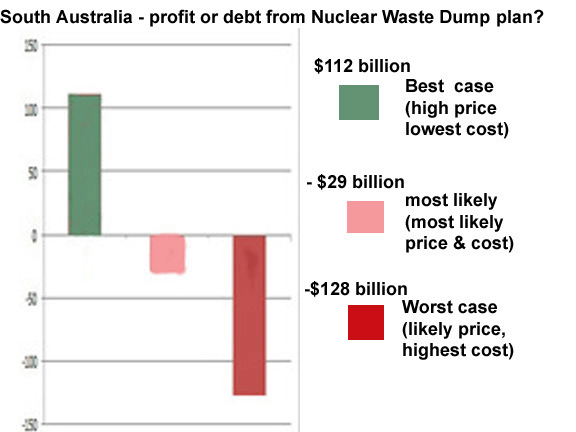
3.Missing costs, unfunded liabilities, missing contingencies and failure to recognise inevitable cost blow-outs
4.Heroic assumptions of other countries’ willingness to pay for SA to take their nuclear waste;
5.Lack of recognition of the potential for irrecoverable sunk costs and unlimited future liabilities;
6.Failure to address reputational damage and impact on other sectors of the economy; and
7.Naïve expectations that South Australia would get to keep all the profits from a nuclear waste dump in our State, without having to share them with other States.
“The Commission’s final report due on 6th May should recommend that the folly of South Australia’s increased involvement in the nuclear industry be abandoned.
“In relation to the other Terms of Reference, increased uranium mining, uranium processing or nuclear power were never really an option for SA and the Royal Commission was an expensive way to tell us what we already knew”, concluded Mark Parnell.
Kevin Scarce bemoans the “emotion” and “opinion” of opponents of nuclear waste dump
 Wealth beyond measure? Scarce commission backs SA nuke ‘dump’ Tom Richardson, INDaily, 11 Feb 2016 “…… “This commission is not driven by emotion or opinion,” Commissioner Kevin Scarce told reporters today. However, he conceded emotions and opinions would be divided by his findings on nuclear storage.
“The debate has been formed upon fear,” he said……..
Under questioning, however, he bristled at the use of the term “waste dump”, saying he “wished people would stop using” it.
“It’s a sophisticated engineering site… it has no bearing whatsoever on a dump,” he said. The case for nuclear waste storage was overwhelmingly the strongest of the four terms of reference considered, with Scarce finding nuclear electricity generation “would not be commercially viable in the foreseeable future… taking account of future demand and anticipated costs”……..
Greens MLC Mark Parnell insisted the economic case was flawed and “illusory”, because it only analysed the short-term benefits, rather than long-term environmental damage and reputational risk.
“If it looks too good to be true, it probably is,” he said, ignoring Scarce’s distaste for the terminology.
“A dump is a dump is a dump… if it looks like a dump and serves the purpose of a dump – it’s a dump.”…….
The commission has cost $5.5 million since it was established last year, but Scarce said that would be “value for money if the community has the opportunity to consider the facts”….
Dr Jim Green from Friends of the Earth denounced the commission’s “optimistic view of potential profits”. “Costs are likely to be astronomical, even over relatively short timeframes… just to build a repository would cost A$39 billion, according to the latest estimate in France, or A$43 billion according to an estimate from Japan,” Green said. ra ra http://indaily.com.au/news/2016/02/15/wealth-beyond-measure-scarce-commission-backs-sa-nuke-dump/
Political terms versus environmental time-lines – the South Australian nuclear waste folly
Saving the Environment or Centralized Control of a Monopoly in Power (Electricity)? Pan Chemistry, Gareth Lewis 03/03/15 “………Political terms versus environmental time-lines  This section raises an important point with environmental issues or challenges: the short duration of political terms (often three to six years) limits the amount that can be done in the field of environmental protection. This means that global problems, such as air pollution and global warming that have no geographic boundaries and are likely to be long-term challenges may not be attempted. Even ‘smaller’ challenges like preserving the Great Barrier Reef and ensuring the viability of water supply and usage along the River Murray cannot be addressed in any one political term (nor have they been): there’s just insufficient time and funds to do so. Additionally, the political fallout from such ventures may not ensure the duration of the political term (a political paradox). A case could easily be argued that such issues should be written into Federal politics and once initiated they should go ahead regardless of the social and political climate.
The proposed nuclear industry and global radioactive nuclear waste dump in South Australia is similarly a complex issue and will affect many generations to come. However, given the comparatively simple challenge of managing water supply and usage along the Murray River how likely is it that a proposed nuclear industry would be managed efficiently? I am not being overly ‘emotive’ here, I’m simply saying this: any proposed nuclear industry will ‘outlive’ a Royal Commission, a State and Federal Government and all of us! So; very careful consideration is needed, not only for the current generation of Australians, but for future generations who will not have a say in the decision making process that will determine the cleanliness and viability of ‘their’ environment………
Is the notion of establishing a nuclear industry in South Australia really about centralized control in the creation and distribution of energy (electricity)?
A skeptic  could easily argue that the use of nuclear energy has nothing at all to do with ‘saving the environment:’ but that it’s really about centralized control in the production and sale of electricity in a monopoly system. After all, it’s easy to control a centralized supply and demand system, and it’s exactly what we have in place today in the world-wide production and sale of fossil fuels.
This notion of ‘centralized control’ is a whole topic in itself and is beyond the scope of the original question: ‘should a nuclear industry (uranium mining, sale of uranium and storage of global radioactive nuclear waste) be established in South Australia. My personal opinion (emphasis) and answer to this question at this time is no. I believe we have sufficient solar energy and land mass in Australia to develop and perfect the solar cell industry and such technology could then be licensed and sold overseas. Besides, the success of this approach has been clearly demonstrated in other countries, many of which have far less sunshine and land mass than Australia.
Additionally, the inherent risks of initiating what may be an untethered proliferation of nuclear (fission) power plants has also been demonstrated in the past at Chernobyl and Fukushima, with close calls in Long Island. However, what has not been demonstrated (thankfully) is what could happen to our environment (groundwater and surrounds) if global radioactive nuclear waste was compromised in transit or in storage by man-made or natural means. It remains to be seen whether the proposed Royal Commission will make the ‘right recommendation’ to the government in South Australia that will benefit and protect not only the current generation, but also of many future generations of Australians: so; fingers crossed :-\ 😉 http://www.gareth-panchem.com/347345675?pagenum=2
Why take the risks of polluting South Australia with nuclear wastes?
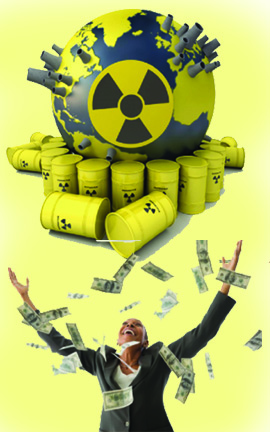 why take the risk(s)? Well, the short answer is that it would be worth taking the risk by the few and their families who would profit from the proposed venture in the short-term; but not the rest of us. Additionally, it will not be their families and their descendants that will suffer the consequences of a poor decision at this time since they will be able to afford to move elsewhere: the same may not be possible for future generations of Australians.
So, (hypothetically) what would Australia end up with should a nuclear industry go ahead in a self-promoting process? There would likely be many disused mining sites and disused nuclear reactors, the largest radioactive nuclear dump in the world, possibly a compromised water table and ecosystem and a few wealthy individuals (who may not be based in South Australia 😉
Saving the Environment or Centralized Control of a Monopoly in Power (Electricity)? Pan Chemistry, Gareth Lewis 03/03/15“……….Domestic and global transporting of nuclear waste is inherently risky and ocean, rail and road accidents do occur. Additionally, security in the transport of such waste would have to be assured to prevent the misuse of waste in our age of terrorism (would risks of nuclear weapons or dirty bombs increase in our attempt to curb global warming using nuclear energy?): such security would be complicated and expensive………
The Royal Commissioner commented that the notion of establishing a nuclear industry and waste dump in South Australia was ‘an emotive issue…’ Well, yes it is, and why shouldn’t it be based on the track records in Chernobyl, the Fukushimadisaster (with ongoing environmental pollution of the sea ecosystem) and a near miss in Long Island (there may be ‘other events’ that students could research).
What is also an issue is the destructive power of nuclear weapons and ‘dirty bombsthat can be manufactured from uranium and its radioactive waste products. Such devices could be made ‘anywhere’ in the world that may operate beyond the political term of any one local government that may initiate a nuclear industry in South Australia.
The Proposed South Australian Storage Depot
The grade and amount of waste will depend on the type of nuclear reactor. So, what then happens to radioactive waste? It would likely arrive in steel or
plastic drums and then be stored in geologically stable strata within
South Australia. The strata would have to be stable since radioactive nuclear waste takes thousands of years to reach safe levels (or levels that are unlikely to cause harm to
biota).
South Australia is well known for being one of the ‘driest places on the driest continent,’ but that’s not always been the case. We also get flooding events that may increase in intensity and severity as global weather pattern change, caused in part by our use of fossil fuels? Well, the vast majority of scientists seem to think so, and so do many politicians.
Let’s play ‘what if’ at this point, since it’s just a hypothesis or ‘one of those ideas.’ What if an extreme weather event caused massive flooding in the northern parts ofSouth Australia as often occurs in Queensland? That would mean that salts would be dissolved to create a hypersaline corrosive liquid. If this solution came into contact with the steel drums that contain radioactive waste they would begin to corrode. Alternatively, even plastic drums will deteriorate over time as their inner surfaces are bombarded by particles emitted from the
decaying radioactive waste. At that (hypothetical) stage, which may take thousands of years,
it would not be possible to move such a large mass of radioactive waste accumulated from throughout the world, it would simply be too risky. There is the argument that spent radioactive waste can be recycled and then reused, however the remaining residue (on reprocessing) will also provide another source of waste. Additionally, by that time other sources of energy (maybe even fusion) may provide economic benefits that far exceed the reclamation and reuse of fissionable material that has been accumulated over time and the original radioactive waste may simply remain where it was initially stored.
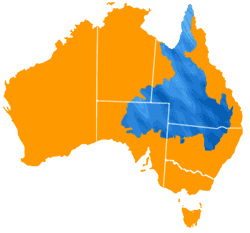 The northern parts of South Australia has a large Artesian Basin of fresh water deep beneath its surface which may then be put at risk from contamination by global radioactive nuclear waste that may have been stored over the millennia…….
why take the risk(s)? Well, the short answer is that it would be worth taking the risk by the few and their families who would profit from the proposed venture in the short-term; but not the rest of us. Additionally, it will not be their families and their descendants that will suffer the consequences of a poor decision at this time since they will be able to afford to move elsewhere: the same may not be possible for future generations of Australians.
So, (hypothetically) what would Australia end up with should a nuclear industry go ahead in a self-promoting process? There would likely be many disused mining sites and disused nuclear reactors, the largest radioactive nuclear dump in the world, possibly a compromised water table and ecosystem and a few wealthy individuals (who may not be based in South Australia ;-)……… http://www.gareth-panchem.com/347345675?pagenum=2
Kevin Scarce buys expert pro nuclear opinions from Switzerland and Belgium
Swiss and Belgian experts to front nuclear commission as green light looms. by Simon Evans, Financial Review, 31 Mar 16 Experts from Switzerland and Belgium will give South Australia’s nuclear royal commission advice on whether nuclear waste can be safely stored underground in Australia.
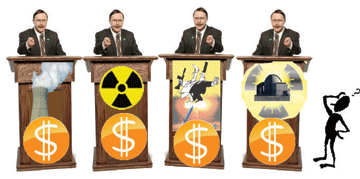
Royal commissioner Kevin Scarce has just visited both countries to scrutinise high-level waste disposal sites and their licensing regimes. All three places have similar soil, which means Swiss and Belgian experts should be able to give him detailed information about the danger of storing nuclear waste in the South Australian outback.
Mr Scarce said on Thursday his final report due on May 6 on whether the state should expand from just being a uranium miner and venture into nuclear waste storage was unlikely to differ greatly from his preliminary findings in mid-February.
He rejected suggestions that it was inevitable that South Australia would undertake some form of nuclear expansion……..
Mr Scarce said he had received 170 direct responses in the past few weeks to his tentative findings unveiled on February 15 in which he concluded that a nuclear waste storage facility housing spent nuclear fuel rods and other waste could deliver $5 billion in revenue annually over 30 years.
He said some of those submissions had accused him of exaggerating the economic benefits, but he said he was confident that his economic modelling had been robust and said he had taken a “conservative” approach.
Mr Scarce said he had visited Sweden and Finland earlier in his commission’s work but in the wake of the tentative findings had made a special visit to Belgium and Switzerland because they had similar sedimentary soil structures to South Australia………http://www.afr.com/news/policy/swiss-and-belgian-experts-to-front-nuclear-commission-as-green-light-looms-20160331-gnv15s
Anti-nuclear opinions don’t count for much with SA’s elitist Royal Commission
Comments today from Nuclear Royal Commissioner, Kevin Scarce, show that the elitist and dismissive processes that dominated the Commission’s early days are still alive and well.
“Clearly the Commission doesn’t want to hear from ordinary South Australians. At the outset, they refused to accept submissions that weren’t sworn before a JP (including mine) and now they are devaluing submissions from concerned South Australians.”  said Greens SA Parliamentary Leader,
Mark Parnell MLC.
On radio today, Mr Scarce described 850 submissions to the Commission’s Tentative Findings as “computer-generated views” and “spam”. He also said “you can’t do anything with them because they’re expressing opinions as opposed to going with the tentative findings”.
“What the Commissioner conveniently ignores is that the ONLY rationale for an international nuclear waste dump in South Australia is its supposed economic advantages. The economic case for the dump is derived from the assumptions and opinions of consultants. However, if ordinary South Australians dare to present “opinions”, then the Royal Commission “can’t do anything with them”.
“Barely two weeks after the close of public submissions and six weeks before handing down its final report, the Royal Commissioner appears to have already locked himself into the waste dump idea saying, “I’m convinced it’s safe”.
“When it comes to economic criticism, the Commissioner appears to value the number of economists involved and the number of pages they write as key considerations. He promised to “take apart piece by piece” the economic analysis of The Australia Institute, whilst acknowledging that the Commission’s own economic analysis was based on assumptions because there is no equivalent operating facility to compare it with and after 50 – 60 years of nuclear waste, “no one has found a solution yet.”
“Commissioner Scarce has consistently emphasised the need for community support, yet seems oblivious to the elitist approach taken by the Commission which devalues those South Australians whose support is needed if any of the Commission’s ideas are to be taken seriously”, concluded Mark Parnell.
1 This month

of the week – Australians for War Powers Reform (AWPR)
To see nuclear-related stories in greater depth and intensity
 Antinuclear