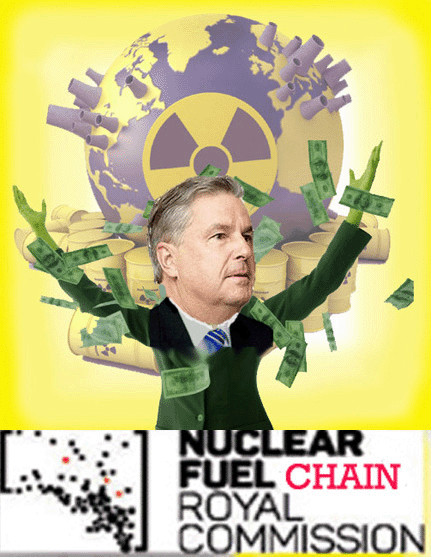
On February 15 the South Australian Nuclear Fuel Chain Royal Commission announced its “tentative findings”
 And guess what – Surprise Surprise!
After many months of such IMPORTANT pro nuclear persons getting paid large amounts of money to trip around the world, getting expert advice from the likes of France’s near bankrupt AREVA, and the crooked Canadian nuclear hierarchy – they came out with the conclusion that they had already decided upon at the beginning:
AUSTRALIA SHOULD BECOME THE WORLD’S RADIOACTIVE TRASH TOILET!
The subservient media and corporate controlled governments of the rest of Australia have just shut up about this for nearly a whole year, in the pretense that “It’s only a South Australian matter”. They left it to the likes of the nuclear lobby’s puppet “The Adelaide Advertiser” to give information on this purely State matter.
 Is it just a State matter? Or is Australia as a whole interested in the Scarce plan for this nation to become the only place in the world to invite in the global nuclear industry’s radioactive poo?
And the only nation foolish enough to think that this will make us prosperous!
February 15, 2016
Posted by Christina Macpherson |
Christina reviews, NUCLEAR ROYAL COMMISSION 2016 |
1 Comment
Given the wildly optimistic price for waste modelled by the mid-scenario, not to mention the 56,000 tonnes of waste left over with no costed solution, and with all the uncertainties in developing the new technologies required, the simple conclusion is that this plan is simply all risk with no reward.
No-one else will line up to take advantage of this “once in a lifetime opportunity”, because the opportunity does not exist. The plan simply cannot succeed.
The impossible dream Free electricity sounds too good to be true. It is. A plan to produce free electricity for South Australia by embracing nuclear waste sounds like a wonderful idea. But it won’t work. THE AUSTRALIA INSTITUTE Dan Gilchrist February 2016
“……NO GOOD OUTCOME The free energy utopia depends on two new, as yet unproven technologies: PRISM reactors, and cheap borehole disposal. The Edwards plan appears to rely on these technologies not only being successfully developed, but remaining entirely in Australian hands. Competition is certainly not addressed in the plan.
It would be more realistic to assume that other countries would act on the same opportunities, if indeed they arose.
To implement the Edwards plan, Australia would need to spend around $10 billion to set up temporary storage, a reprocessing plant, and a pair of PRISMs. We would also need to import and store spent fuel.
Furthermore, the importation of spent fuel would likely require a dedicated port and a fleet of specialised ships, and this is not costed in the plan.
The plan calls for spent fuel to begin to be imported and loaded into the dry-cask facility six years after the commencement of construction. It plans for the first PRISMs to be completed four years later. We could reasonably expect to have good data on the costs and methods of borehole storage well within this ten-year timeframe – as would any potential customers.
Having spent $10 billion (not including the cost of shipping or a new port) and ten years, and with several thousand tonnes of spent fuel in storage,42 there are, broadly speaking, two foreseeable outcomes:
1. If borehole and PRISM technologies, having been piloted commercially by Australia, are found to be as cheap and effective as hoped, other countries will have the opportunity to either use them themselves, or undercut our vast profits. It is not realistic to believe that Australia would continue to be paid five to ten times the cost of permanent storage alone. 43 Even if the hoped-for customers were nations that couldn’t use borehole or PRISM technology, a number of other countries could.
2. If either technology is found to be too expensive for commercial deployment, or to have unforeseen safety problems, Australia will have locked itself into an expensive method of electricity generation with perhaps no longterm solution for the acquired waste.
In short: either the technology works and we face stiff competition, both from other countries and the low costs of the technologies themselves – in which case the numbers in the plan are completely wrong; or the technology doesn’t work as expected – in which case the numbers in the plan are completely wrong.
And in either case, the plan has still failed to cost a permanent solution for 56,000 tons of high-level waste – over 90 percent of the material taken in. The profits from the scheme would be spent in the early decades to subsidise the reactors and lower taxes, leaving future generations with a massive problem, and no plan or money left to deal with it.
There is no good outcome here.
Even if the technology succeeds, the business plan is fatally flawed. It is, in effect, a self-defeating plan. If it works, our customer base and commodity price dries up, killed by the very technologies we would have piloted at our own risk and at great expense.
February 13, 2016
Posted by Christina Macpherson |
AUSTRALIA - NATIONAL, NUCLEAR ROYAL COMMISSION 2016, reference, South Australia, Submissions to Royal Commission S.A., wastes |
7 Comments
 The impossible dream Free electricity sounds too good to be true. It is. A plan to produce free electricity for South Australia by embracing nuclear waste sounds like a wonderful idea. But it won’t work. THE AUSTRALIA INSTITUTE Dan Gilchrist February 2016
 “……..Edward’s plan seems like an excellent deal for South Australia. Who would say no to jobs and free electricity and billions in reduced taxes? But the most cursory scrutiny exposes some serious flaws.
WASTE
The plan is to build a dry-cask storage facility, capable of securing spent fuel on the surface for 100 years. South Australia would be paid to take 60,000 tonnes over a 20 year period.
There would then be a nuclear fuel reprocessing facility, designed to reprocess 100 tonnes of this waste per year. The economic value of this proposition is highly speculative as 100 tonnes per year is far in excess of Australia’s likely needs. However, if our pioneering development of PRISM reactors proved the technology and made it affordable, then other countries might also build PRISMs, which could use the output of the processing plant. 14
However, even assuming Australia finds a use or a buyer for the entire output of the reprocessing plant, over the 40 year life span of the facility South Australia would process just 4,000 tonnes of the imported waste.
What happens to the other 56,000 tonnes of nuclear waste?
It would remain in temporary storage. There is no long term solution costed or even mentioned in Edwards’ plan. It is never discussed again.
It must be kept in mind this would be waste another country paid Australia to take, specifically because paying us was better than developing a permanent solution of their own. As perhaps may be expected, if one country pays another to take on a massive problem, and the second country solves less than 10 percent of that problem, it could make a large short term profit. But in 100 years when the dry cask system reached the end of its rated lifespan, future generations of South Australians would be left to deal with 56,000 tonnes of high-level waste, with no money left, and no plan.
If the plan was funded only by taking the 4,000 tonnes of spent fuel it actually used, then the result would be a spectacular financial loss.15
The Edwards plan makes the point that Australia would not be taking waste, but only ‘spent fuel’. It says: “This submission is not … proposing the simple establishment of waste management or disposal services or the importation of radioactive wastes in any sense.”
This statement is justified in the plan by the definition of radioactive waste as “…waste materials which contain radioactive substances for which no further use is envisaged.”
As long as we intend to use that spent fuel, it is not, strictly speaking, waste. However, the plan provides no use for over 90 percent of the material to be accepted. It would be, in the truest sense of the word, waste. And the proposal simply ignores that waste. If there is a future use envisaged for it, it is not mentioned in the plan, nor has it been costed.
The plan earns all of its money in the first few decades, spending it all on free electricity, tax reductions and other projects over 50 years.16 The remaining 56,000 tonnes is left to future generations to worry about, with no money left to deal with it.
February 13, 2016
Posted by Christina Macpherson |
AUSTRALIA - NATIONAL, NUCLEAR ROYAL COMMISSION 2016, reference, South Australia, Submissions to Royal Commission S.A., wastes |
Leave a comment
not a single PRISM [ (Power Reactor Innovative Small Module] has actually been built…. the commercial viability of these technologies is unproven
Crucially, under the plan, Australia would have been taking spent fuel for 4 years before the first PRISM came online, assuming the reactors were built on time.
if borehole technology works as intended, and at the prices hoped for, why would any country pay another to take their waste for $1,370,000 a tonne, when a solution exists that only costs $216,000 a tonne, less than one sixth of the price?
 The impossible dream Free electricity sounds too good to be true. It is. A plan to produce free electricity for South Australia by embracing nuclear waste sounds like a wonderful idea. But it won’t work. THE AUSTRALIA INSTITUTE Dan Gilchrist February 2016
“……NEW TECHNOLOGY This comprehensively researched submission asserts that a transformative opportunity is to be found in pairing established, mature practices with cuspof-commercialisation technologies to provide an innovative model of service to the global community. (emphasis added) Edwards’ submission to the Royal Commission
Two elements of the plan – transport of waste, and temporary storage in the dry cask facility – are indeed mature. There is a high degree of certainty that these technologies will perform as expected, for the prices expected.
It should be noted, however, that the price estimates used in the Edwards plan for the dry cask storage facility draw on estimates for an internal US facility to be serviced by rail.17 No consideration has been given to the cost of shipping the material from overseas.
Around a dozen ship loads a year would be needed to import spent fuel at the rate called for in the plan.18 It is likely that a dedicated port would also need to be constructed. The 1999 Pangea plan, which proposed a similar construction of a commercial waste repository in Australia, made allowances for “…international transport in a fleet of special purpose ships to a dedicated port in Australia”. 19
Needless to say, building and operating highly specialised ships, or paying others to do so, would not be free. Building and operating a dedicated port would not be free. Yet none of these activities are costed in the plan.
Furthermore, beyond the known elements of transport and temporary storage, the principle technologies depended on – PRISM reactors and borehole disposal – are precisely those which are glossed over as being on the “cusp of commercialisation”.
To put it another way: the commercial viability of these technologies is unproven.
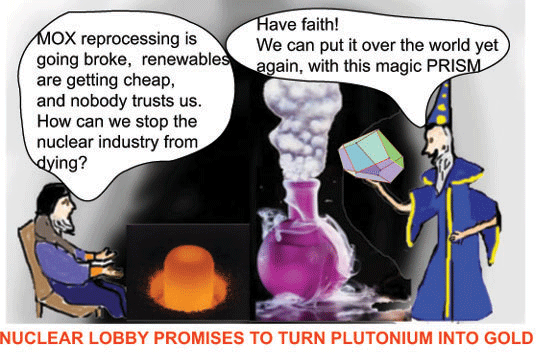
PRISM [Power Reactor Innovative Small Module]The PRISM reactor is based on technology piloted in the US, up until the program was cancelled in 1994. 20 It offers existing nuclear-power nations what appears to be a tremendous deal: turn those massive stockpiles of waste into fuel, and reduce the long-term waste problem from one of millennia to one of mere centuries. It promises to be cheap, too, with the small modular design allowing mass production.
Despite this promise, not a single PRISM reactor has actually been built. Officials at the South Korean Ministry of Science have said that they hope to have advanced reactors – if not the PRISM then something very similar – up and running by 2040.21 The Generation IV International Forum expects the first fourth generation reactors – of which the PRISM is one example – to be commercially deployed in the 2030’s.2
After decades spent developing the technology in the United States, a US Department of Energy report dismissed the use of Advanced Disposition Reactors (ADR), a class which includes the PRISM-type integral fast reactor concept, as a way of drawing down on excess plutonium stocks. It compares it unfavourably to the existing – and expensive – mixed oxide (MOX) method of recycling nuclear fuel.
The ADR option involves a capital investment similar in magnitude to the [MOX Fuel Fabrication Facility] but with all of the risks associated with first of-a kind new reactor construction (e.g., liquid metal fast reactor), and this complex nuclear facility construction has not even been proposed yet for a Critical Decision …. Choosing the ADR option would be akin to choosing to do the MOX approach all over again, but without a directly relevant and easily accessible reference facility/operation (such as exists for MOX in France) to provide a leg up on experience and design.23
Nevertheless, the Edwards plan hopes to have a pair of PRISMs built in 10 years.
Crucially, under the plan, Australia would have been taking spent fuel for 4 years before the first PRISM came online, assuming the reactors were built on time.
The risk is that these integral fast reactors might turn out to be more expensive than anticipated and prove to be uneconomical. This could leave South Australia with expensive electricity and no other plan to deal with any of the spent fuel acquired to fund the reactors in the first place.
For countries that have no long-term solution for their existing waste stockpiles, the business case for constructing a PRISM reactor is much clearer: even if the facility turns out to be uneconomical, it will nevertheless be able to process some spent fuel, thus reducing waste stockpiles. This added benefit makes the financial risk more worthwhile for such countries
Australia, on the other hand, doesn’t have an existing stockpile of high-level nuclear waste. The Edwards plan would see Australia acquire that problem in the hopes of solving it with technology never before deployed on a commercial scale. We would be buying off the plan, with many billions of dollars at stake, in the hopes that we, with little experience and minimal nuclear infrastructure, could solve a problem which has vexed far more experienced nations for decades.
By the time the first PRISM is due to come online it will be too late to turn back, no matter what unexpected problems may be encountered. Australia would have acquired thousands of tonnes of spent fuel with no other planned use.
Counting on the development of other PRISM reactors around the world is another gamble. The proposed reprocessing plant accounts for all of the 4,000 tonne reduction in waste over the life of the plan. Australia will have no use for most of this material – the rest must be used by other PRISMs. If PRISMs are not widely adopted, Australia will have no takers. This could leave Australia with even more than 56,000 tonnes of waste, with no planned or costed solution.
Borehole disposal
The second element of the plan is the long-term disposal of waste from the PRISM reactors in boreholes. However this technology is still being tested.
According to an article in the journal Science, bore-hole technology has significant issues to overcome.
The Nuclear Waste Technical Review Board, an independent panel that advises [the United States Department of Energy] DOE, notes a litany of potential problems: No one has drilled holes this big 5 kilometers into solid rock. If a hole isn’t smooth and straight, a liner could be hard to install, and waste containers could get stuck. It’s tricky to see flaws like fractures in rock 5 kilometers down. Once waste is buried, it would be hard to get it back (an option federal regulations now require). And methods for plugging the holes haven’t been sufficiently tested.
However, if estimates used by the Edwards plan are correct, and boreholes can be made to work as hoped, it would allow high-level nuclear waste to be disposed of for only $216,000 per tonne. The Edwards plan reduces this further for Australia, quoting only $138,000 a tonne, on the understanding that our own waste would be comparatively low level output from a PRISM – disregarding, as discussed above, the 56,000 tonnes left over.
Nevertheless, the figure of $216,000 per tonne is important, because that is the price at which any country with suitable geology could store high level waste. It should be noted that Australia will not have exclusive access to borehole technology. If it is proven to be as effective as hoped there is nothing stopping many other countries from using it.
The International Atomic Energy Agency (IAEA) notes that borehole siting activities have been initiated in Ghana, the Philippines, Malaysia and Iran.26 A pilot program is underway in the US.27 The range of geologies where boreholes may be effective is vast.
This may have serious implications for Australia’s waste disposal industry, given that other countries could build their own low-cost solution, or offer it to potential customers.
However, if boreholes do not work as hoped, Australia will have no costed solution for the final disposal of high-level waste from its PRISM facilities. Australia would find itself in the very situation other countries had paid it to avoid.
PRICE What are countries willing to pay to have their spent fuel taken care of?
This is an open question, as to date there is no international market in the permanent storage of high-level waste.
A figure of US$1,000,000 (A$1,370,000) per tonne is used by the Edwards plan, but this estimate does not appear to have any rigorous basis.
The Edwards plan gives only one real world example of a similar price: a recent plan by Taiwan to pay US$1,500,000 per tonne to send a small amount of its waste overseas for reprocessing. From this, the report concludes that an estimate of US$1,000,000 is entirely reasonable.
However, the report neglects to mention several important facts about Taiwan’s proposal. First, this spent fuel was to be reprocessed, not disposed of, and most of the material was to be reclaimed as usable fuel. 29 This fuel would not be returned, but would continue to be owned by Taiwan, and be available for sale.30 If they could find a buyer, Taiwan might expect to recoup part or all of their costs by selling the reclaimed fuel to a third party.
Second, the 20 percent of material to be converted into vitrified waste by the process was to be returned to Taiwan – no long-term storage would be part of the deal.
Third, and most importantly, the tender was suspended by the Taiwanese government pending parliamentary budget review.31 This occurred in March 2015, several months before the Edwards plan was submitted to the Royal Commission.
Not only was the Taiwanese government proposing a completely different process to the one proposed by the Edwards plan, they weren’t willing to pay for it anyway. So the use of the Taiwanese case as a baseline example for the price Australia might hope to receive to store waste simply does not stand up to scrutiny.
The plan does briefly mention that the US nuclear power industry has set aside US$400,000 a tonne for waste disposal – to cover research, development and final disposal.32 This much lower figure is disregarded for no apparent reason, making the mid-scenario’s assumption of a price more than double this, at US$1,000,000, seem dubious. Even the pessimistic case considers a price of US$500,000 a tonne, higher than the US savings pool.
As will be discussed in the next section, the question remains: if borehole technology works as intended, and at the prices hoped for, why would any country pay another to take their waste for $1,370,000 a tonne, when a solution exists that only costs $216,000 a tonne, less than one sixth of the price?
February 13, 2016
Posted by Christina Macpherson |
AUSTRALIA - NATIONAL, NUCLEAR ROYAL COMMISSION 2016, reference, South Australia, Submissions to Royal Commission S.A., technology |
2 Comments

 The impossible dream Free electricity sounds too good to be true. It is. A plan to produce free electricity for South Australia by embracing nuclear waste sounds like a wonderful idea. But it won’t work. The Australia Institute Briefing paper Dan Gilchrist February 2016
 “……Conclusion There are no magical solutions in the real world. When something sounds too good to be true, it usually is.
Even setting aside the technological and economic problems of the Edwards plan, its impossibility can be deduced by a simple observation: it only works if no-one else does it. It is a Catch-22. If the plan is a technological success it will open up competition, which would make it an economic failure.
There is also the question of popular will: perhaps Australia’s edge would be in a unique willingness to implement such a plan? However, Australia has historically had a great deal of hostility toward the nuclear industry. If Australians could be convinced to embrace PRISMs and boreholes, surely some countries with an existing nuclear industry – countries which have, therefore, shown a much greater willingness to accept it – would also be willing to implement those solutions.
It makes far more economic sense to pay for your own boreholes, or PRISMs, or reprocessing, than it does to pay up to ten times the cost for Australia to do it for you – you would save on shipping and port costs, at least.
Not every country would or could implement this solution, but it would take just one other nation on earth to provide competition. If the deal really is as attractive as Senator Edwards claims, surely at least one other nation would be tempted to take a share of such a wildly profitable business. Assuming that Australia will somehow maintain a monopoly in technologies it does not own is naïve.
Deploying new technologies is inherently risky. PRISMs and boreholes may turn out to be massive white elephants financially, and leave us with thousands of tonnes of nuclear waste to deal with. But even if these technologies worked, some other countries would surely be in a position to implement them, and at a reduced risk, once Australia had piloted its development.
It is a plan which creates its own competition.
In reality, there is no reason to think any country would pay what the Edwards plan assumes they will. With no mature nuclear power or waste industry, holding no monopoly on the technologies needed, and far from potential markets, there is no reason to think that Australia would have a competitive advantage. There is no reason to think that Australians will accept 56,000 tonnes of waste with no costed long-term solution.
February 12, 2016
Posted by Christina Macpherson |
AUSTRALIA - NATIONAL, NUCLEAR ROYAL COMMISSION 2016, South Australia, wastes |
1 Comment
The impossible dream Free electricity sounds too good to be true. It is. A plan to produce free electricity for South Australia by embracing nuclear waste sounds like a wonderful idea. But it won’t work. The Australia Institute Briefing paper Dan Gilchrist February 2016
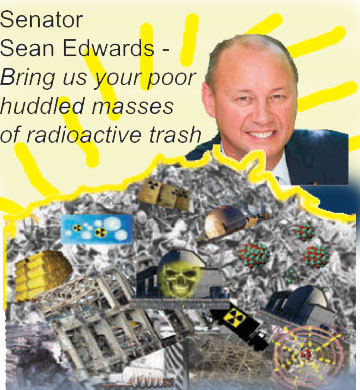
Summary
South Australia’s Nuclear Fuel Cycle Royal Commission was established on 19 March 2015 and is due to report on its findings in May 2016. It is inquiring into the risks and opportunities to the economy, environment and community of the expansion or development of the nuclear fuel cycle.
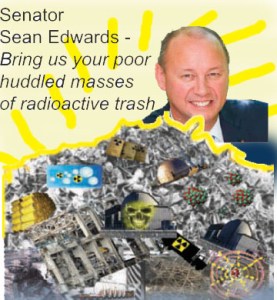
Perhaps the most prominent plan has been the one championed by South Australian Senator Sean Edwards.1 He claims to be able to bring tremendous economic prosperity to South Australia, with the almost incredible by-product of providing free electricity to the state, and with money left over to reduce state taxes.
The plan involves being paid to take spent fuel from other countries and store it in Australia. The state can then use that old fuel to power a new generation of reactors, producing tiny quantities of easily handled waste. With money earned from taking troublesome radioactive materials off the hands of countries struggling with stocks of nuclear waste, South Australia can fund next-generation reactors.
The plan sounds perfect. The reality is far from it.
The Edwards plan ignores the cost of shipping the waste to Australia, and relies on technology that has never before been deployed commercially. It hopes that unjustified and unrealistic amounts of money will be paid for the disposal of waste.
Furthermore, although the plan includes the acceptance of 60,000 tonnes of waste, only 4,000 tonnes, at most, would be reprocessed for fuel. The remaining 56,000 tonnes would remain in temporary storage, with no funds left for future generations to deal with the problem.
Even if the world fell into line just as Senator Edwards hopes, the plan fails to consider the obvious question: if Australia can generate free electricity from this spent fuel, wouldn’t other countries want to do the same? The plan makes no allowances for competition.
Even if the countries of origin chose not to implement the miraculous technology proposed for South Australia, other countries could compete with Australia to provide this service. A plan predicated on monopoly profits of over 400 percent is, therefore, unrealistic.
The idea that an expanded nuclear industry in Australia will produce thousands of jobs and generate so much money that South Australians will be provided with free electricity is a wonderful dream. But like so many dreams, it is an impossible one.
The first section of this report outlines the key elements of the Edwards plan.
The second section of the report provides a reality check. It shows that the plan fails to deal with over 90% of the imported waste, and then exposes the chief technological and economic risks in the scheme.
The third section will consider a world in which the assumptions contained in the Edwards plan come true, and explores the possibility that other countries might go on to use the same technologies as Australia.
This paper will analyse the mid-scenario modelled in the Edwards plan – that is, 60,000 tonnes of spent fuel to be taken by Australia, with payments received of $1,370,000 per tonne – and follow the convention of using Australian dollars at their 2015 value, except where otherwise noted. Similarly, costings and claims are taken directly from the Edwards paper, except where otherwise noted. ………..
February 12, 2016
Posted by Christina Macpherson |
AUSTRALIA - NATIONAL, NUCLEAR ROYAL COMMISSION 2016, South Australia, Submissions to Royal Commission S.A. |
Leave a comment
 “It’s all about the dump”: Greens gear up for nuclear war, IN Daily, 12 Feb 16 The South Australian Greens are preparing for a sustained public relations assault from next week, in the assumption that the Royal Commission into the state’s nuclear fuel cycle will recommend the viability of a nuclear waste dump. The commission, headed by former Governor Kevin Scarce, will detail its “tentative findings” on Monday morning, preceding another round on consultation.
Greens MLC Mark Parnell told InDaily the party had prepared a variety of options for leaflets and online material, with staff “putting out a call to Greens members for volunteers to hand out flyers”.
“What we’re doing is trying to anticipate what the Royal Commission might come up with, so there will be no surprises that the waste dump is front and foremost in our thinking,” Parnell said.
“That’s on the basis that nuclear power is incredibly expensive and slow [so] they might recommend it but I always thought that was less likely. The processing and value-adding stuff – my understanding is economically it doesn’t stack up [and] of all the different things they’re looking at, it keeps coming back to the dump.”
He said insiders he had spoken to insist “it’s all about the dump”.
“That’s the impression that we’ve had since about a week after the Royal Commission was announced, once the terms of reference were announced… but we’re preparing for a few different scenarios so we can respond on Monday,” he said.
“We have several different versions ready to go.”
He said his party’s position on nuclear waste storage “hasn’t really changed over the past many years”, and suggested Labor should maintain the position it took in 2004, when it went to the High Court to kill off a federal proposal to establish a repository at Woomera. Continue reading →
February 12, 2016
Posted by Christina Macpherson |
NUCLEAR ROYAL COMMISSION 2016, politics, South Australia |
Leave a comment

Ahead of Monday’s release of the draft report of the Nuclear Fuel Cycle Royal Commission, SA Traditional Owners are once again voicing strong opposition to proposals for expanded uranium mining and proposals for nuclear waste dumps and other nuclear projects.
Sue Coleman-Haseldine, co-chair of the Aboriginal-led Australian Nuclear Free Alliance, is a Kokatha-Mula woman from Ceduna and winner of the 2007 Premier’s Award for excellence for indigenous leadership in natural resource management. Ms Coleman-Haseldine said: “I was born on Koonibba Aboriginal Mission in 1951. Atomic bomb tests began in the desert areas north of my birthplace in 1953 when I was two years old. First at Emu Fields and then Maralinga. I grew up under the Maralinga nuclear cloud. Do I want to see my state known worldwide as a nuclear waste dump? No. Do I have the right to subject our future generations to a life of nuclear fear? No. Accidents happen, be it at a uranium mine or on a nuclear freeway or at a nuclear reactor or a dump site.”
Kevin Buzzacott, Arabunna elder and President of the Australian Nuclear Free Alliance said: “We will fight this industry across the country, whether it be the expansion of uranium mining or a nuclear waste dump. It is our cultural obligation and responsibility to care for our land. It’s time the government and nuclear industry acknowledge and listen to us. There are and have been so many sick people as a result of this industry. Why has there not been a Royal Commission into the intergenerational health impacts of this industry? How will this Royal Commission measure the risks and impacts on culture and country? You cannot put a number on these things.”
Copied below is a statement from SA Traditional Owners.
 South Australian Traditional Owners say NO!
Statement from a community meeting held in Port Augusta on Saturday 16 May, 2015 to discuss the Royal Commission into the Nuclear Fuel Cycle.
We oppose plans for uranium mining, nuclear reactors and nuclear waste dumps on our land.
We call on the SA Royal Commission to recommend against any uranium mining and nuclear projects on our lands.
We call on the Australian population to support us in our campaign to prevent dirty and dangerous nuclear projects being imposed on our lands and our lives and future generations.
Endorsed by members from the following groups, Kokatha, Kokatha-Mirning, Arabunna, Adnyamathanha, Yankunytjatjara-Pitjanjatjara, Antikirinya-Yunkunytjatjara, Kuyani, Aranda, Western Aranda, Dieri, Larrakia, Wiradjuri
February 12, 2016
Posted by Christina Macpherson |
aboriginal issues, AUSTRALIA - NATIONAL, NUCLEAR ROYAL COMMISSION 2016, South Australia |
Leave a comment
 Possibility of a high level nuclear waste facility in SA Environmental Defenders Office (SA) Inc. The environment’s legal team since 1992 – protecting the public interest – evening the odds 10 Feb 16
As our nuclear industry, insofar as it exists is principally focused on mining and not on the generation of electricity there would have to be a large amount of new legislation that would have to be enacted in order to establish a high level nuclear waste facility in SA. There are issues regarding environmental impacts, workplace safety, the imposition on aboriginal land, the impact on future generations, the potential for technological changes and security concerns.
Some of the major issues.
Continue reading →
February 10, 2016
Posted by Christina Macpherson |
NUCLEAR ROYAL COMMISSION 2016, South Australia, Submissions to Royal Commission S.A. |
Leave a comment
 Premier Jay Weatherill tabled a Statement (9/02/16) outlining the progress and next steps for the South Australian Nuclear Fuel Chain (sorry, they call it “Cycle”) Royal Commission.
Following the release on February 15, of its “tentative findings“, the Commission will hold a five week “comment period”, during which public meetings will be held in:
Adelaide, Port Pirie, Port Augusta, Whyalla, Port Lincoln, Mt Gambier, Ceduna, Renmark, and Aboriginal communities in the Far North and West Coast.
On 6 May, the Commission will present its final report.
Next – community discussion between May and August.
“Once we have the findings, I would anticipate some engagement with the Commonwealth Government about the final report”
Then “a period of decision making where Government will need to assess the evidence gathered by the Commission, and the feedback from the community before outlining its full response to the Royal Commission
I expect to provide a full response to the Royal Commission to the Parliament before the end of sitting this year.”
February 10, 2016
Posted by Christina Macpherson |
NUCLEAR ROYAL COMMISSION 2016, politics, South Australia |
Leave a comment
THE AUSTRALIAN NUCLEAR ASSOCIATION (ANA) put in a submission to #NuclearCommissionSAust devoted only to promoting NUCLEAR ELECTRICITY GENERATION. Of course, they made no attempt to consider renewable energy generation, let alone compare the costs. Heaven forfend, as that would have blown their argument right out of the water!
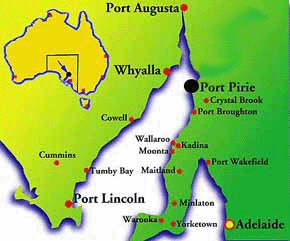
Anyway, they selected recommending Upper Spencer Gulf Area as the site for South Australia to get nuclear reactors:
“The sites are · Site 1 – Fleurieu Peninsula · Site 2 – Upper Spencer Gulf Crag Point · Site 3 – Kadina site, Spencer’s Gulf east coast”
ANA went to great lengths comparing the different types of nuclear reactors – large, small and medium reactor types.
They were hesitant about Generation IV (new nukes) stating that emerging technologies would be available too late to be effective against global warming.
As for Small Modular Nuclear Reactors, ANA sees hurdles, and is not enthusiastic:
“their deployment is highly dependent on: 1. An order book which matches factory scale manufacture to ensure their economic competitiveness 2. A new regulatory regime which enables operations and security personnel to be deployed in reduced numbers to match the scale of power output”
So, ANA wants to put existing types of nuclear reactors on Spencer Gulf coast:
“the Westinghouse AP1000, the Russian VVER1000 and the Enhanced Candu 6”
Their conclusion?
“nuclear power is a realistic option to connect the grid in SA provided the interconnector to Victoria is upgraded.” (Nary a word about how there’s have to be a nuclear waste dump site set up first. )
February 3, 2016
Posted by Christina Macpherson |
Submissions to Royal Commission S.A. |
Leave a comment
This is one of those pro nuclear Submissions that carefully hedges its bets, while coming out as weakly pro nuclear.
It comments on – “future world demand for nuclear fuels. We recognise that this is highly uncertain”
It even warns on the effect on Australia’s uranium industry, if nuclear reprocessing were to be adopted: “would alter the dynamics of the world market for nuclear fuels and potentially reduce the prospects for expanded uranium mining”
Peter Burn’s Submission comes up with that interesting bit of ?logic that I keep meeting. Acknowledging that currently there is a poor market for nuclear electricity, then his argument goes that we’d better get cracking on setting up a nuclear industry in case there’s a big demand later!
“these facts and uncertainties mean that any investment commitments are likely to be many years away – and that now is a good time to start preparing our energy options, including a potential nuclear generation sector.”
Like all the pro nuclear proponents, this AIG Submission calls for “review of the legal context of these developments” – i.e change Australia’s Environmental Laws.
This is not a very enthusiastically pro nuclear Submission. It lists 7 recommendations, all of which come straight from Australia’s pro nuclear front group “Think Climate Consulting”, headed by Barry Brook.
The two major ones are a “cost benefit” study of South Australia importing nuclear waste, and of setting up nuclear recycling. Left to Barry Brook’s nuclear lobby group, we can guess what the outcome of that study would be.
February 2, 2016
Posted by Christina Macpherson |
Submissions to Royal Commission S.A. |
Leave a comment
Energy.Proj.AU presents: C. M. Waite’s CONSOLIDATED PAPER A Submission to SA’s Nuclear Fuel Cycle Royal Commission C. M. Waite, M Sc, B Sc Ed .
Charles Waite’s Submission to the South Australian Nuclear Fuel Chain Royal Commission is a hymn of praise to new nuclear technology.
“South Australia has before it a great opportunity to PIVOT into Nuclear Energy”
“SA Government announced its $20 Billion plan to PIVOT the State to a Nuclear Energy economy”
“Molten Salt Reactors have been proven safe, viable & reliable”
And also a hymn to to those new nuclear companies, – Bill Gates’ Terra Power, Terrestrial Energy, Transatomic Power etc
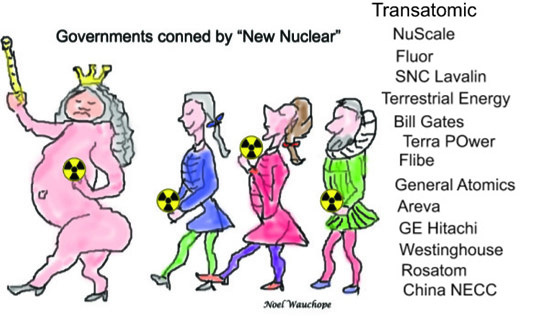
Interestingly, he does not recommend GE-Hitachi’s IFR PRISM reactor as too expensive.
Waite wants the South Australian government, i.e: the taxpayer to buy “new nukes”
“It seems to me “best” for SA to own+run some WAMSR’s, so that it has at least some customers for its processed Fuel Rods.”
“SA should consider owning some MSRs, ie, rather than being dependent on the whims of a private generator; since SA Govt’s announcement of a plan to PIVOT the State to a Nuclear Energy economy”
Waite’s chosen location for these new, untested Molten salt Nuclear Reactors? – near South Australia’s desalination plant ?(Port Stanvac)
February 1, 2016
Posted by Christina Macpherson |
Submissions to Royal Commission S.A. |
Leave a comment
The Australian Government put in a lengthy Submission. For now, I will select just one part – what the Australian government wants, in legislation.
ENVIRONMENTAL LAW In a submission that is in its overall theme, favourable to the nuclear industry, Government wants some legislative changes, quietly giving the nod to to changing Australia’s environmental laws that prohibit Australia’s further involvement in the nuclear fuel chain:
“Whether or not immediate opportunities exist, the Commonwealth considers that any possibilities that do emerge should not be closed off by governments where they have a demonstrated net benefit, and the risks can be managed effectively. We are working with the States and Territories on improving the regulation of nuclear industries, including by responding to technical developments and streamlining or removing unnecessary regulation.”
“Commonwealth legislation prohibits some of the activities under consideration by the Royal Commission, including construction or operation of nuclear reactors for generating electricity or facilities for enriching uranium, fabricating nuclear fuel or reprocessing spent nuclear fuel. The Commonwealth Government looks forward to considering the Royal Commission’s report, the response of the South Australian Government and the implications for Commonwealth policy and regulatory framework.”
LIABILITY LAW Secondly, the Government points to the need for laws covering liability in the case of nuclear accidents:
“Nuclear liability The IAEA and the OECD Nuclear Energy Agency have developed an international regime covering compensation for damage from nuclear activities – civil nuclear liability. Most countries undertaking nuclear activities have developed national legislation consistent with that regime, irrespective of whether they are parties to the relevant international conventions.
Exceptionally, Australia has no special legislation covering civil nuclear liability. There are significant differences between liability under general law and liability under the international nuclear liability regime, particularly in relation to the responsibility of the facility operators and the standard of proof required.
Further involvement in the fuel cycle would require the adoption of nuclear liability legislation to ensure operators are held liable for incidents and are able to provide adequate compensation, and that claims for compensation for an accident in Australia are dealt with in Australia.”
January 31, 2016
Posted by Christina Macpherson |
Submissions to Royal Commission S.A. |
Leave a comment
Christopher Camarsh Submission to South Australia Nuclear Fuel Chain Royal Commission http://nuclearrc.sa.gov.au/app/uploads/2015/11/Christopher-Camarsh-03-08-2015.pdf
Mr Christopher Camarsh is an investment manager and Managing Director of AIXI Investments. His lengthy submission is a detailed promotion for a company selling underwater nuclear reactors.
“The Blue Energy System (BES) is a new production system for global power generation and distribution. It utilises transportable submerged power stations produced at a central facility that can be located off shore from energy consuming centers.”

Like all the company promotions to the RC, this submission sticks to its role, so of course, no attention to comparisons to non nuclear energy systems.
However, Camarsh does give an opinion approving of South Australia as nuclear dump site
” MANAGEMENT, STORAGE AND DISPOSAL OF NUCLEAR AND RADIOACTIVE WASTE We believe that a waste, storage, disposal strategy is ultimately a sovereign matter but have strong convictions that the commission should recommend South Australia engage in this activity as it contains in our view the most suitable locations globally”
January 29, 2016
Posted by Christina Macpherson |
Submissions to Royal Commission S.A. |
1 Comment
 And guess what – Surprise Surprise!
 Is it just a State matter? Or is Australia as a whole interested in the Scarce plan for this nation to become the only place in the world to invite in the global nuclear industry’s radioactive poo?
 The impossible dream Free electricity sounds too good to be true. It is. A plan to produce free electricity for South Australia by embracing nuclear waste sounds like a wonderful idea. But it won’t work. THE AUSTRALIA INSTITUTE Dan Gilchrist February 2016
 The impossible dream Free electricity sounds too good to be true. It is. A plan to produce free electricity for South Australia by embracing nuclear waste sounds like a wonderful idea. But it won’t work. THE AUSTRALIA INSTITUTE Dan Gilchrist February 2016
 “It’s all about the dump”: Greens gear up for nuclear war, IN Daily, 12 Feb 16 The South Australian Greens are preparing for a sustained public relations assault from next week, in the assumption that the Royal Commission into the state’s nuclear fuel cycle will recommend the viability of a nuclear waste dump. The commission, headed by former Governor Kevin Scarce, will detail its “tentative findings” on Monday morning, preceding another round on consultation.
 South Australian Traditional Owners say NO!
 Possibility of a high level nuclear waste facility in SA Environmental Defenders Office (SA) Inc. The environment’s legal team since 1992 – protecting the public interest – evening the odds 10 Feb 16
  Premier Jay Weatherill tabled a Statement (9/02/16) outlining the progress and next steps for the South Australian Nuclear Fuel Chain (sorry, they call it “Cycle”) Royal Commission.


 Antinuclear
