Tom Kenyon MP – the man who sold the radioactive trash idea to South Australia
 Mr Kenyon, now a backbench MP, refused to comment on the report.
The Sunday Mail understands it was not presented to Cabinet but became instrumental in prompting the current Royal Commission into the potential for the nuclear fuel cycle to revive the SA economy.
The report found there needed to be a good public relations campaign to convince people of the safety of the plan, and that money raised should be spent on infrastructure like the SA leg of a high speed rail to Melbourne.
It also proposed a model in which SA generate more money by leasing yellowcake mined here and taking it back as waste, and as a trade off people be guaranteed there will be no nuclear power plants in SA.
 Nuclear waste dump should be first cab off the rank, report finds by: MILES KEMP From: Sunday Mail (SA) Originally published as Nuclear dump could be key to our riches August 01, 2015 Available on The Australian website http://www.theaustralian.com.au/news/nuclear-waste-dump-should-be-first-cab-off-the-rank-report-finds/story-e6frg6n6-1227466384020
A BRIEFING paper delivered to the State Government recommended the state accept Taiwan’s nuclear waste, access that nation’s $10 billion disposal fund and establish an Outback nuclear waste dump to revive the economy.
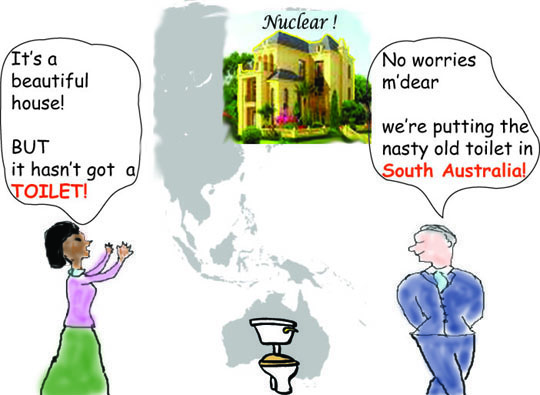
As the Nuclear Fuel Cycle Royal Commission explores the option to help solve SA’s jobs crisis, the Sunday Mail has obtained a copy of a report prepared for former Employment and Science Minister Tom Kenyon which argues the case for a waste dump near Woomera. Continue reading
Short term greed overtakes long term prospects in South Australia’s push for nuclear waste importing
 SA Nuclear royal commission: Waste dump best economic option for state, Business SA says ABC News 3 Aug 15 Establishing an outback nuclear waste dump would be the best economic move for South Australia if the State Government decides to expand its role in the nuclear industry, Business SA says.
It has been revealed Premier Jay Weatherill last year received a report commissioned by former Employment and Science Minister Tom Kenyon, which found setting up a waste dump near Woomera could reap billions for the local economy.
A royal commission headed by Kevin Scarce is in the process of examining the potential for an expansion of the state’s role in the nuclear industry, including whether a nuclear power station or nuclear waste  dump should be built.
Business SA’s chief executive Nigel McBride (above, at left) said countries such as Japan and South Korea would pay handsomely to dump their nuclear waste in the state’s outback.
We know that there are huge potential financial benefits from being able to provide that service, and it’s logical that they’ve identified somewhere in the Woomera region as a potential site because of course it’s very remote,” Mr McBride said.
“There is a huge market out of countries like South Korea who has got a lot of nuclear waste they need to deal with, Japan and other Asian countries and of course countries around the world.”………..
Mr McBride said South Australia was the ideal location for a waste dump, and could store the nuclear fuel safely.
He said the biggest concern would be transportation options……
More than a decade ago, South Australia’s Labor Government fought and won a vigorous battle against the Howard government to stop a low-level nuclear waste dump being located in far north South Australia.
The royal commission is expected to hand down its findings by May 2016. http://www.abc.net.au/news/2015-08-02/nuclear-waste-dump-best-economic-option-business-sa-says/6666212
Answer points to #NuclearCommissionSAust Issues Paper 3 – Electricity Generation – this week’s theme
Submissions on this Issue are due by August 3rd. Check tips on submitting.
3.2 Are there commercial reactor technologies (or emerging technologies which may be commercially available in the next two decades) that can be installed and connected to the NEM?
There are commercial technologies available, such as the General Electric Mark 1 Boiling Water Reactor, that would be available in the next two decades. However, this is the same type of reactor as the ones at Fukushima Daiichi, and has been known to have safety flaws. (1) Then there is the Generation 3+ EPR reactor, currently being built at Olkiluoto, Finland, and at Flamanville, France. However, this might not be available within two decades. The history of its development is one of delays and over-running costs.(2) Recently, cracks in its pressure vessel have caused problems, that shed doubt on its safety. (3)
There are no “emerging” technologies that are at all likely to be available within the next two decades. The Generation IV reactors include : the Gas-cooled Fast Reactor (GFR), the Leadcooled Fast Reactor (LFR), the Molten Salt Reactor (MSR), the Supercritical Water-cooled Reactor (SCWR), the Sodium-cooled Fast Reactor (SFR) and the Very High Temperature Reactor (VHTR). (4)
The French Radiological Protection Agency (IRSN) has carried out a review of these systems from the point of view of safety and radiation protection. On the basis of its examination, IRSN considers the SFR system to be the only one of the six to have reached a degree of maturity compatible with the construction of a Generation IV reactor prototype during the first half of the 21st century.
Even then this will depend on further studies. DECC estimate in their 2013 Nuclear Energy Research and Development Roadmap that the first commercial Generation IV reactors should be operating by 2040. (4)
3.3. Are there commercial reactor technologies (or emerging technologies which may be commercially available in the next two decades) that can be installed and connected in an off-grid setting?
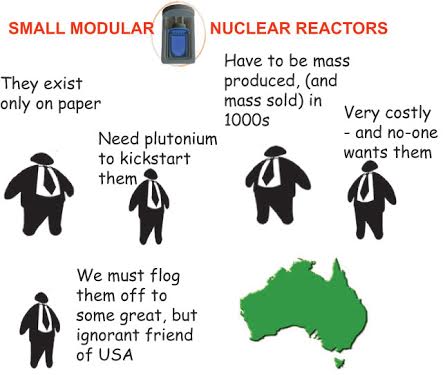
The suggested Small Modular Reactors , including the PRISM reactor have serious disadvantages, especially economiic ones . SMRs are likely to have higher costs per unit of output than conventional reactors. (5) Even if SMRs could eventually be more cost-effective than larger reactors due to mass production, this advantage would only come into play if large numbers of SMRs were ordered. But utilities are unlikely to order an SMR until they are seen to produce competitively priced electricity. This Catch-22 suggests the technology will require significant government financial help to get off the ground.
Even industry executives and regulators believe the SMR technology will have costs that are substantially higher than the failed “nuclear renaissance” technology on a per unit of output. The higher costs result from
- lost economies of scale in containment structures, dedicated systems for control,
management and emergency response, and the cost of licensing and security,
- operating costs between one-fifth and one-quarter higher, and
- decommissioning costs between two and three times as high.(6)
As to these “off-grid” technologies being available within the next two decades, I have been unable to find any credible reference that states that this is the case. I conclude that, even if design and testing of these small reactors were to be completed, it would be many decades before they would be commercially available. For reasons of regulatory processes, but more importantly, of uncertainty over economic viability, commercial availability is decades away, if ever to be achieved. (7)
3.4. What factors affect the assessment of viability for installing any facility to generate electricity in the NEM?
The major factor in assessing the viability of installing nuclear power for electricity generation in South Australia is the increasing practical and economic success of the alternative – truly modern power – renewable energy. (8) Combine that progress with the revolutionary developments in battery storage, and nuclear reactors of any size look like unnecessary and uneconomic dinosaurs in the electricity providing sector.(9)
3.7. What place is there in the generation market, if any, for electricity generated from nuclear fuels to play in the medium or long term?
Referring to my answers to previous questions, I would have to say – No place.
3.8 What issues should be considered in a comparative analysis of the advantages and disadvantages of the generation of electricity from nuclear fuels as opposed to other sources? What are the most important issues?
The most important issues are health, safety and environmental protection. Nuclear power of whatever design loses out on all those counts.(10)
However, that hardly matters in a world where economics is king. Fortunately as nuclear power is widely recognised now to be getting more and more expensive, while renewable energy and energy efficient technologies are getting cheaper, it is indeed economics that provide the killer disadvantage for nuclear power (9)
3.11. How might a comparison of the emission of greenhouse gases from generating electricity in South Australia from nuclear fuels as opposed to other sources be quantified, assessed or modelled?
For one thing, Greenhouse gases are emitted at all stages of the nuclear fuel chain. (10) However, in practical terms, nuclear power as a solution to climate change, is irrelevant – action on climate change is needed now , not in 20 -30 years.(11) Furthermore, climate change itself makes nuclear power an impractical and increasingly dangerous solution. – water shortage, water over-heating, (12) sea level rise (13) Storm surges (14)
3.12 and 313 . What are the wastes (other than greenhouse gases) produced in generating electricity from nuclear and other fuels and technologies?
What risks for health and safety?
Nuclear reactors produce dangerously toxic radioactive isotopes, come previous unknown on the planet, – plutonium – decaying to three types of radiation – alpha, beta, and gamma, caesium 137, iodine 131 , strontium 90 (15) No other technologies produce these toxic, carcinogenic wastes.
(3) http://yle.fi/uutiset/nuclear_watchdog_seeks_re-check_of_olkiluoto_3_reactor/7937448
(4) Generation IV International Forum https://www.gen-4.org/gif/jcms/c_40465/generation-iv-systems 2. IRSN 27th April 2015http://www.irsn.fr/EN/newsroom/News/Pages/20150427_Generation-IVnuclear-energy-systems-safety-potential-overview.aspx.
Nuclear Energy Research and Development Roadmap: Future Pathways, Dec 2013 https://www.gov.uk/government/uploads/system/uploads/attachment_data/file/168043/bis-13-632-nuclearenergy-research-and-development-roadmap-future-pathway.pdf.
Nuclear Engineering International 2013 http://www.neimagazine.com/opinion/opinionwhy-theenvironmental-movement-is-important-for-nuclear-power-4559455
(5) http://www.nuclearpolicy.info/docs/news/NFLA_Small_Nuclear_Reactor_report.pdf
(7) https://www.nirs.org/reactorwatch/newreactors/cooper-smrsaretheproblemnotthesolution.pdf
(8) http://qz.com/456931/half-the-world-already-gets-more-power-from-renewables-than-from-nuclear/(9)https://www.newscientist.com/article/mg22730312-100-the-battery-revolution-that-will-let-us-all-be-power-brokers/
(9) http://reneweconomy.com.au/2015/solar-and-wind-substantially-cheaper-than-nuclear-even-in-uk-10393
(10) http://www.psr.org/resources/nuclear-power-factsheet.html?referrer=https://www.google.com.au/
(11) http://www.counterpunch.org/2015/02/05/why-nuclear-power-is-not-low-carbon/
(12) http://www.nirs.org/factsheets/nukesclimatefact614.pdf
(13) http://www.climatecentral.org/news/sea-level-rise-brings-added-risks-to-coastal-nuclear-plants
(14) http://www.desmogblog.com/2014/01/21/push-nuclear-power-climate-change-concerns-overlooked
(15) https://en.wikipedia.org/wiki/Plutonium#Toxicity
http://www.geigercounter.org/radioactivity/isotopes.htm
#NuclearCommissionSAust’s Issues Paper 3 – designed to please the nuclear corporations!
 I am currently struggling with my Submission to the Commission on the questions in Issues Paper 3 – “Electricity Generation From Nuclear Fuels”. it’s a doozy. They’ve excelled themselves this time – with questions designed to elicit lovely answers from nuclear companies Transatomic, Bill Gates’ Terra Power , SNC Lavalin, NuScale, – anyone but you and me.
Given that the nuclear lobby’s plan is for Australia to be the guinea pigs for new untested (not yet existent) gee whiz reactors, Those companies are gonna love questions like this:
3.2 Are there commercial reactor technologies (or emerging technologies which may be commercially available in the next two decades) that can be installed and connected to the NEM?
3.3. Are there commercial reactor technologies (or emerging technologies which may be commercially available in the next two decades) that can be installed and connected in an off-grid setting?
3.6. What are the specific models and case studies that demonstrate the best practice for the establishment and operation of new facilities for the generation of electricity from nuclear fuels?
Pro Nuclear Royal Commission Pushes on With Determination
|
||||


| AGD 027826 Computational General Equilibrium Modelling Assessments for the Nuclear Fuel Cycle Royal Commission |
24 July 2015 | 10 August 2015 | Link to Tender |
| AGD 027828 Quantitative Analyses and Initial Business Case for establishing a Nuclear Power Plant and Systems in South Australia |
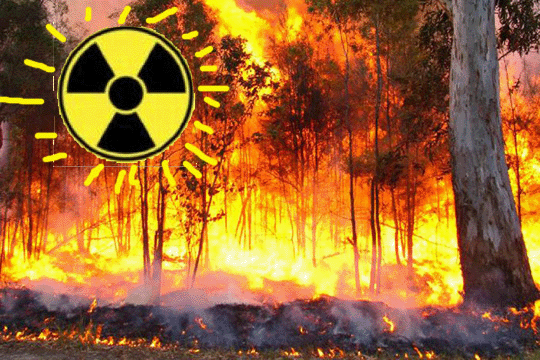
Climate change brings bushfires – a terrible risk to nuclear facilities
If the radiation leak lasts more than a few hours, there is no viable safe plan. If the radiation plume passes, the ground will probably still be contaminated
Wildfires also threaten Nuclear Waste and Nuclear Waste Shipments
Wildfires and Nuclear Don’t Mix: Lessons from San Onofre and Chernobyl to Australia https://wordpress.com/read/post/feed/4410547/762849951 [good  photos] miningawareness 27 July 15 As the deadline looms (3 Aug.) for comments regarding the risks of the nuclear fuel chain for South Australia – whether uranium mining, which is already occurring, or any proposed additions (uranium enrichment, nuclear energy, nuclear waste), foremost in everyone’s minds should be the risk of Bushfires (Wildfires), as well as endangerment to the Great Artesian Basin (GAB) aquifer, upon which so much of Australia is dependent for water, and which is being depleted, and most assuredly contaminated, by uranium and other mining:https://miningawareness.wordpress.com/2015/07/25/nuclearcommissionsaust-have-your-say-for-the-future-of-south-australia-submissions-close-soon-july-theme/ (Australia’s uranium mining “generates less than 0.2 per cent of national export revenue and accounts for less than 0.02 per cent of jobs in Australia.”http://www.conservationsa.org.au/images/Nuclear_Royal_Commission_issues.pdfMeanwhile it is laying waste to the land and provided nuclear fuel for Fukushima)
“The Australian climate is generally hot, dry and prone to drought. At any time of the year, some parts of Australia are prone to bushfires with the widely varied fire seasons reflected in the continent’s different weather patterns. For most of southern Australia, the danger period is summer and autumn.” http://www.ga.gov.au/scientific-topics/hazards/bushfire/basics/where
2015 Wildfires Near Chernobyl http://www.mns.gov.ua/news/40286.html
In April of this year, and again from the end of June into mid July, hundreds of firefighters in the Ukraine bravely battled fires in the area of the Chernobyl nuclear power station. Smoldering peat fires were the hardest to put out.
http://www.mns.gov.ua/news/40286.html
While this represents a serious danger to Europe, it received shockingly little media coverage. Continue reading
Dr Helen Caldicott’s Submission on all 4 Nuclear Royal Commission Issues Papers
 Submission to the Nuclear Fuel Cycle Royal Commission, by Helen Caldicott on July 24, 2015 I begin my submission to the Nuclear Fuel Cycle Royal Commission by posting an article which I wrote for the Australian Medical Student Journal, which outlines in some detail the medical implications of the whole nuclear fuel chain.
The impact of the nuclear crisis on global health
Due to my personal concerns regarding the ignorance of the world’s media and politicians about radiation biology after the dreadful accident at Fukushima in Japan, I organized a 2 day symposium at the NY Academy of Medicine on March 11 and 12, 2013 … [ to read the full text of this article, click on this link: http://www.helencaldicott.com/the-impact-of-the-nuclear-crisis-on-global-health/. The link will open in a new tab or window. Close it to return to this page ]
Now to answer some of the questions posed by the Royal Commission Continue reading
Nuclear Royal Commission back from overseas jaunt
Nuclear commission takes overseas experiences on board as SA considers uranium industry expansion, ABC News By Nicola Gage, 24 July 15, South Australia’s nuclear royal commissioner Kevin Scarce says he is “nowhere near” making a recommendation to government on the potential for an expanded industry in the state after a research trip to Asia, Europe, the United States and Canada…….The commission received 90 submissions from companies and individuals in its first round of public feedback, which has now closed…….[n.b second round of submissions closes on August 3rd]
Public hearings are expected to commence from September, with a final report due in May.http://www.abc.net.au/news/2015-07-24/sa-nuclear-commission-takes-overseas-experiences-on-board/6647018 https://www.youtube.com/watch?v=a6swqTljXeE
Points for #NuclearCommissionSAust Submission to Issues paper 2 – “Further Processing” – theme for this week
Submissions on this Issue are due by August 3rd. Check tips on submitting.
Questions.2.2 and 2.4. – (feasible for South Australia to make more radioactive substances? What will be future demand for conversion, uranium enrichment, nuclear fuel processing?)
It would not be economically, socially or environmentally feasible for South Australia to further manufacture radioactive substances.
On economics, South Australia would be producing a product whose market is declining.
In Canada, Cameco’s failed laser uranium enrichment project added to its losses in 2014.(1).
“The nuclear industry is in decline: The 388 operating reactors are 50 fewer than the peak in 2002, while the total installed capacity peaked in 2010 at 367 GW before declining to the current level, which is comparable to levels last seen two decades ago.” (2)
Socially, people are becoming more aware of the hazards of uranium enrichment plants. Even in China – Jiangmen residents protested against proposed uranium processing plant (3)
Massive amounts of depleted uranium are created by uranium enrichment, causing social concern a social problem as well as an environmental problem.
Most of the byproducts (garbage) “from uranium enrichment (96%) is depleted uranium (DU)… There are vast quantities of depleted uranium in storage. The United States Department of Energy alone has 470,000 tons.[1] About 95% of depleted uranium is stored as uranium hexafluoride (UF6).” (4)
2.5. (South Australia to get involved in emerging nuclear technologies)
As to new and emerging technologies, it is becoming ever clearer that the untested technologies, such as Liquid Fluoride Thorium Reactors, will not be developed for very many years, during which time renewable energy technologies, including battery storage, are racing ahead. By the time the “Generation IV nuclear reactors are developed, (if they ever are), they will have no appeal in the 21st Century modern energy scene. Even now, their cost is astronomic, and they cannot attract investment. Their only hope is tax payer funding. No Generation IV nuclear reactor will be ready before 2050 (5) .
2.6 (What are the specific models for best practice in these activities?)
As to specific models – there is the failed Mixed Oxide Fuel (MOX facility) at USA’s Savannah River site – an environmental and financial disaster (6)
2.11 (What are the security implications?)
From uranium enrichment, and further processing, danger arises not only from the depleted uranium waste produced, but also from the transport of enriched uranium, – the danger of accidents or of terrorist attacks:
“The transportation of UF6 is dangerous, both because of what it is – a hazardous chemical and radioactive substance; and what it is a part of – the production process of nuclear reactor fuel, nuclear bombs, and uranium ammunition. It is documented that a release of UF6 in a populated area could have catastrophic consequences. Cylinders used to transport UF6will result in quantities of uranium and hydrofluoric acid (HF) in the immediate vicinity far exceeding levels dangerous to health (both chemically and radiologically).
Despite the danger, the dominant belief within governments and the nuclear industry is that UF6 transport is safe. This belief, regrettably, is mainly based on two assumptions shown to be false. These assumptions are that UF6 does not present a significant radioactive hazard, and cylinders used to transport UF6 are built strong enough to survive accident conditions. It is noted, however, that deciding whether or not the transportation of UF6 is dangerous involves qualitative moral and ethical decisions as well as analysis of quantitative, technical data.” (7)
2.13. (How to estimate the financial benefit to South Australians?)
This question is a joke. Given the unfathomable costs and the disastrous history of U.S. Enrichment Corporation (USEC) , it is ludicrous to expect any accurate assessment of the costs, let alone the very hypothetical benefits.(8)
2.14.(What impacts on other sectors of the economy?)
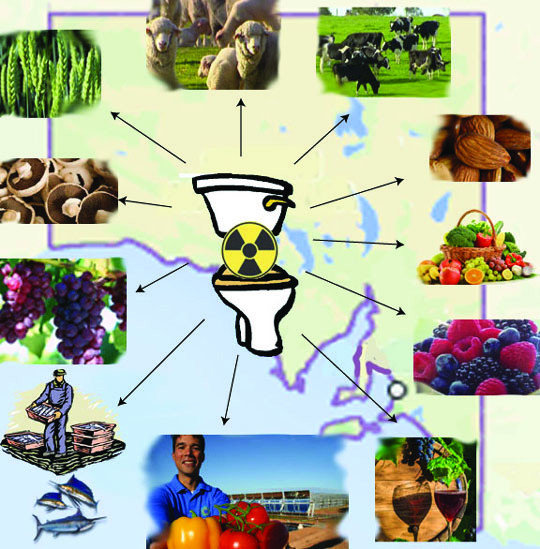 Whereas in the past, countries like France and USA were complacent about setting up nuclear industries, and not worried about the effects on clean industries – farming, vineyards, fisheries, those days are over.
“The increased exposure of contaminants to crops and livestock, and the natural environment and cumulative “food chain” events of unregulated agricultural products, have the potential for significant safety and health risks to consumers. Perhaps more importantly, the public perception of risk or danger from uranium may also result in serious negative repercussions for the marketability of agricultural products from the nearby regions” (9)
“A nuclear facility in Washington State’s prime wine country is leaching radioactive groundwater….the DOE report released last year that indicated trace amounts of the radioisotope tritium were found in wine samples collected”. (10)
Any nuclear facility – from uranium mining through to waste facility poses a real impediment to tourism, as well as to agriculture. In England, the Lake District is currently facing this threat – Tourism, Milk and Cheese or Nuclear? (11)
All uranium/nuclear activities bring the danger of radioactive leakage to groundwater, with impacts on all agricultural industries. (12_)
So far, I have considered only the effects on industries of the normal operations of advanced uranium and fuel fabrication processes. But what if there’s an accident? (13) Chernobyl and Fukushima give an illustration here, of what happens to farming and fishing industries.
Fukushima’s fish industry is yet to recover. (14) Chernobyl: “Agriculture was hardest hit, with 784 320 hectares taken from production. Timber production was halted in 694,200 hectares of forest. Remediation made “clean food” production possible in many areas but led to higher costs in the form of fertilizers, additives and special cultivation processes.
Even where farming is safe, the stigma associated with Chernobyl caused marketing problems and led to falling revenues, declining production and the closure of some facilities. Combined with disruptions due to the collapse of the Soviet Union, recession, and new market mechanisms, the region’s economy suffered, resulting in lower living standards, unemployment and increased poverty. All agricultural areas, whether affected by radiation or not, proved vulnerable”. (15)
- http://www.starnewsonline.com/article/20141103/ARTICLES/141109942/-1/topic24?Title=Uranium-producer-Cameco-reports-a-third-quarter-loss-
- http://www.worldnuclearreport.org/WNISR2014.html
- The Standard July 12, 2013
- http://en.wikipedia.org/wiki/Nuclear_fuel_cycle
- http://www.no2nuclearpower.org.uk/nuclearnews/NuClearNewsNo74.pdf
- http://io9.com/failed-nuclear-weapons-recycling-program-could-put-us-a-1586851270
- Some Problems And Hazards Associated With The Transportation Of Uranium Hexafluoride by Miles Goldstick
- http://ecowatch.com/2013/uranium-titan-tumbles/
- Maggy J. Lewis http://scholarship.law.wm.edu/cgi/viewcontent.cgi?article=1015&context=wmelpr
- http://www.thedailybeast.com/articles/2015/03/28/hanford-nuclear-site-could-be-threatening-washington-state-s-best-vineyards.html
- https://miningawareness.wordpress.com/2015/02/13/tourism-milk-and-cheese-or-nuclear/
- . SLAC Scientists Search for New Ways to Deal with U.S. Uranium Ore Processing Legacy New Field Project Tests Link Between Organic Materials and Persistent Uranium Contamination http://www.newswise.com/articles/slac-scientists-search-for-new-ways-to-deal-with-u-s-uranium-ore-processing-legacy
- Possible Effects of Nuclear Radiation Accidents on Agriculture http://trace.tennessee.edu/cgi/viewcontent.cgiarticle=1439&context=utk_agbulletin?
- http://www.unisdr.org/archive/43503
- http://www.who.int/mediacentre/news/releases/2005/pr38/en/index1.html
Inaccurate information in #NuclearCommissionSAust’s Issues Paper 1
 the public are making submissions based on inaccurate information provided in the Issues Paper. The dismissive response of the Royal Commission undermines any confidence that the Issues Papers are accurate overviews of the nuclear industry.”
PUBLIC CONSULTATIONS BASED ON MISINFORMATION:
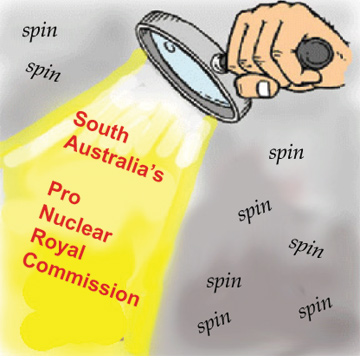 ROYAL COMMISSION ON THE NUCLEAR FUEL CYCLE FAILS TO CORRECT FACTUAL ERROR IN ISSUES PAPER
Friends of the Earth Adelaide have recently informed the Royal Commission into the Nuclear Fuel Cycle of a factual error in Issues Paper 1, concerning the regulation of Aboriginal Heritage matters in South Australia. Issues Paper 1, which deals with the exploration, extraction and milling of uranium, states that Aboriginal sites of significance are protected by the Aboriginal Heritage Act 1988.
“The Royal Commission was informed in writing that this is not the case for BHP Billiton, South Australia’s biggest miner,” said Nectaria Calan of Friends of the Earth Adelaide. “Under the Indenture Act, which applies solely to BHP Billiton, the company’s Olympic Dam mine and some 15, 000 square kilometres of the surrounding Stuart Shelf are exempt from the Aboriginal Heritage Act 1988. This exemption would carry through to any future expansion of uranium mining by BHP Billiton at Olympic Dam or in the surrounding area.”
In his recent response to Friends of the Earth Adelaide Royal Commissioner Kevin Scarce insisted that in the event of an expansion of uranium mining Aboriginal Heritage matters would be regulated by the Aboriginal Heritage Act 1988.
“This is simply not the law throughout the state,” said Ms Calan. “Friends of the Earth Adelaide have supplied the Royal Commission with referenced information regarding the Roxby Downs (Indenture Ratification) (Amendment of Indenture) Amendment Act 2011, which amends the current Indenture Act to apply to any expansion formally announced by the company up until October 2016. If it was an honest mistake to begin with, it is negligent not to correct it.” Continue reading
Labor pro nuclear heavies will keep pushing to overturn Labor’s anti nuclear policy
Gary Gray, the ALP’s shadow resources minister, is very clear on the importance of the Royal 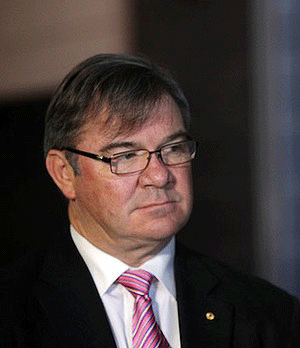 Commission as very much connected to Federal nuclear policy — even though the Commission pretends that it is only about the State of South Australia.
Gray and the other nuclear enthusiasts will continue to push for pro-nuclear changes to policy.
Labor veers towards the nuclear option https://independentaustralia.net/environment/environment-display/labor-veers-towards-the-nuclear-option,7965 21 July 15 The SA Nuclear Royal Commission, the ALP’s postponement of its National Conference nuclear debate and the machinations of the Nuclear For Climate Declaration could herald Australia’s deeper involvement in the nuclear industry, writes Noel Wauchope.
1. July 24: Closing date for Stage One submissions to SA Royal Commission on the Nuclear Fuel Cycle… … on the subject of ‘Storage and Disposal of Nuclear Wastes’ (for South Australia) We can be confident that the global nuclear lobby will have put in wonderful submissions proposing South Australia to lead the world in inviting in nuclear wastes and setting up the (as yet non-existent) “Generation IV” nuclear reactors.
2. July 24: ALP’s National Conference begins in Melbourne There was a plan to hold a vigourous debate on reversing the party’s anti-nuclear policy. Australia is contractually bound to take back the very small amounts of wastes that originated from the Lucas Heights research nuclear reactor. That is being used as a “foot in the door” for expanding our uranium industry and taking back more radioactive wastes, plus getting the promised (geewhiz!) Gen IV reactors.
In a last ditch move to avoid a possible uproar about this, Labor’s pro-nuclear push has pulled back from this plan. For the moment only, one suspects.
3. Signing of the Nuclear For Climate Declaration This was done by Australia’s Rob Parker, President of the Australian Nuclear Association, in Paris. Continue reading
Do not let the Nuclear Industry ruin beautiful South Australia’s Tourist Industry
Wilderness and nature photographer Steve Parish rates South Australian landscape best in country 891 ABC Adelaide By Brett Williamson 22 July 15 Celebrating more than four decades as a freelance nature photographer, Steve Parish rates South Australia as the best place he has ever shot.
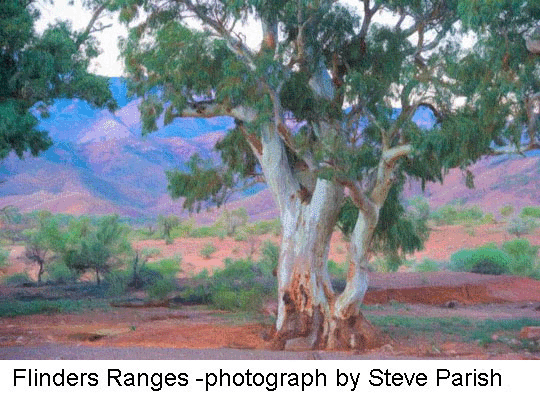
Mr Parish, who grew up in the eastern Adelaide suburbs of Norwood and Burnside, said he found his love of nature when exploring the local coastlines…….
After leaving the Navy at 29, Mr Parish joined the Queensland National Parks and Wildlife Services as a wildlife photographer for five years before working freelance across the country.
“My favourite landscape is northern-central South Australia, [Kati Thanda] Lake Eyre up to Innamincka, that beautiful channel country, the Gibber Desert,” Mr Parish said.
“The most glorious light and aerial photography I have done in my whole life was around [Kati Thanda] Lake Eyre in 2010, the second time the lake filled.”
Mr Parish said South Australians were spoilt by the beautiful, natural light experienced across the state during winter as weather systems rolled across the state……..
“Instead of bland, empty skies that we tend to get more in the north in the different times of the year, you get that wonderful shafting, golden light,” he said.
“You have the wonderful granite coasts, Kangaroo Island, thethe Flinders Ranges– you get that wonderful light, and photography is very much connected to your emotions, feelings and the light that paints the scene.”……http://www.abc.net.au/news/2015-07-21/photographer-steve-parish-rates-south-australia-landscape-best/663423
Some points on #NuclearCommissionSAust Issues paper 3
Roger Sowell , Sowell’s Law Blog 22 July 15 .It is interesting indeed that the questions for Paper 3 did not specifically mention renewable energy as providing supply to the grid. It is perhaps not surprising, given the Commission’s charter to examine the Nuclear Fuel Cycle. However, questions 8, 12, 15, 16, and 17 have wording that is sufficiently broad that one could include renewable energy in the answer.
A more encompassing grid planning study would (and many do) include various forms of energy generation. The advantages and disadvantages of each form are assessed. An excellent example is from the California Energy Commission, at http://www.energy.ca.gov/2009publications/CEC-200-2009-017/CEC-200-2009-017-SF.PDF, Comparative Costs of California Central Station Electricity Generation, published in 2010. However, even this study is confined to a comparison of costs, both initial and operating costs. Safety, impacts on the grid, fuel supply and price volatility, environmental impacts, and reliability are not included.
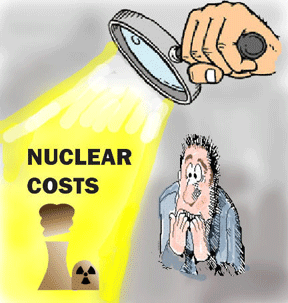 I would not anticipate the nuclear power industry being able to kill renewable energy, in fact, quite the opposite is very likely to occur. Most forms of renewable energy have a decreasing unit cost over time, most especially wind turbines over the past decade. Meanwhile, nuclear-based power has an increasing unit cost. The only examples I can find where nuclear power plants can be built for approximately $4,000 per kW are those countries where labor rates are still very cheap, such as China. But, labor costs increase over time so that small advantage will disappear. Finally, the grid-storage problem has been solved technically, with under-sea storage and hydroelectric power as described by MIT. As offshore wind-turbines decline in installed cost, and the under-sea storage costs also decline with experience, truly sustainable and inexhaustible clean power on demand will finally exist. The electricity may not be too cheap to meter (the big lie of nuclear power), but it will be relatively cheap and not subject to price increases due to fuel availability. http://sowellslawblog.blogspot.com.au/
Nuclear Power Reactors large or small for South Australia Not Justifiable
South Australia Invites Comments on Nuclear Power, Sowells Law Blog,Roger Sowell, 21 july 15 Nuclear Power for South Australia Not Justifiable”………I have been invited to prepare and submit responses to the questions and issues posed in Paper 3 for Civilian nuclear power plants. There are 17 questions, shown below [on original] . I plan to formally submit detailed answers to most, if not all, the questions.
The short, summary answer to the over-arching question of Should South Australia build and operate nuclear power plants, is no. The basis for that conclusion is the facts and particulars of South Australia’s power grid both at present and the foreseeable future. The grid is small, with 5,000 MWe total installed capacity. The demand is low, with typical daily maximum 1,500 MWe although demand peaks on hot summer days at approximately 3,000 MWe. More importantly, minimum demand at night is approximately 700 MWe. Finally, South Australia has access to abundant coal and natural gas for fuel.
Given the small grid loads, and small minimum night demand, a nuclear power plant that is operated at baseload to provide maximum efficiency and minimum power price, must be a small size at perhaps 300 MWe. Small nuclear reactors suffer from reverse economy of scale and are very expensive for the amount of power produced. Conversely, a larger plant would achieve some economy of scale, but the plant must have its output reduced at night to ensure grid stability. A larger plant would be more costly to allow load changes, and the sales price for electricity produced must increase accordingly. (see Truth About Nuclear Power, part 2 for details — see link) The usual safety concerns also apply: operating upsets and radiation releases, evacuation plans, spent fuel storage or reprocessing, and sabotage and terrorist attacks, to name a few. http://sowellslawblog.blogspot.com.au/
Don’t let the nuclear lobby shut you up! Submissions to Royal Commission due by 3rd August
If you’ve been thinking of making a submission, I hope that you have not been intimidated by the Royal Commissions Issues Papers – by either their ambiguous and confusing content, or by their complicated process for submitting. These submission procedures are set up to be easy for AREVA, EDF, Toshiba, Lavalin SNC, Terrestrial Energy, Bill gates’ Terra Power – or any other international nuclear company.
And – hard for the ordinary person.
However,
- you can send in a submission on paper, if the Internet process is not convenient for you.
- You don’t have to make comments on every question on the Issues Paper – just ones that you are interested in.
- You can add your own ideas, outside of their set questions, though the Commission wants them to be at the end, in an Appendix.
Issue Paper 2. FURTHER PROCESSING AND MANUFACTURE. Issue Paper 3. ELECTRICITY GENERATION
Your submission doesn’t have to be long. They want you to download and use a Cover Sheet
They want you to have your signature witnessed, and signed by a JP or a Commissioner for Affidavits. A member of the police force will do. In some States, pharmacists, teachers, and others will qualify. This is a hassle, but not that hard to do.
If you don’t want the hassle of scanning it all into the computer – to send via the internet, to submissions@nuclearrc.sa.gov.au, you can post it to Nuclear Fuel Cycle Royal Commission GPO Box 11043 Adelaide SA 5001. You can even phone them, and arrange a verbal submission o8 8207 1480
More information at the Commission’s website
1 This month

of the week – Australians for War Powers Reform (AWPR)
To see nuclear-related stories in greater depth and intensity
 Antinuclear