Transcript of Nuclear Royal Commission’s second meeting at Coober Pedy
 Jon Bok representing the Royal Commission. Small attendance (5 people)
This is not a perfect transcript, but is largely accurate. Where you see 1. that means a question from the attendees.
Bok: I’m here to help with providing information for the community, and particularly the Aboriginal community, as the Commissioner looks at risks and opportunities for expanding the nuclear industry in South Australia.
- Is there some reason why we are being targeted? We’ve had two Royal Commission community forums, and Roxby Downs hasn’t had one.
Bok: I’m out an about in the region. I’m going back to Port Augusta in the coming weeks.
- You’re not looking at the underground tunnels, are you? – I don’t mean you personally; I mean the government in general.
Bok: It’s a much broader process. It is my opportunity to meet people who are interested.
- AREVA is sending back a shipload of nuclear waste to Australia. What are we going to do with that, when it gets here?
Bok: I simply don’t know. The Commissioner is looking broadly at South Australia. One question is – should we take nuclear waste in, to South Australia?
I’m not aware if Australia has the obligation to take that waste back. The question is: is it viable to take back nuclear waste?. The Terms of Reference ask about the feasibility and viability of the four questions . Continue reading
#NuclearCommissionSAust Have your say for the future of South Australia – submissions close soon – July theme
Submissions for the Royal Commission into the Nuclear Fuel Cycle are closing soon.
This Commission could change our State forever.
Make sure you have a say in it. The Conservation SA team 26 June 15
This is too big an issue not to have your voice heard. Currently, our State government is weighing up a future that could see nuclear power, uranium enrichment and nuclear waste dumping here in South Australia. The window for the public to make comment on these issues closes in a month.
We encourage you to make a submission and draw on our resources to assist you.
In May nuclear expert Dr Jim Green produced some information resources about each of the issues the Royal Commission into the Nuclear Fuel Cycle is investigating. Please see a summary and full report here.
Only last week renewables expert Dr Mark Diesendorf from the University of NSW finished an exciting report showing that South Australia could be run on 100% renewable energy is just 15 years. You can view and download the summary version and Dr Mark Diesendorf’s full report online here.
The issue papers generated by the Royal Commission are available here and submissions are due:
- Issues Paper 1 (Extraction) and/or Issues Paper 4 (Storage and Disposal of Waste) is 24 July, 2015
- Issues Paper 2 (Further Processing) and/or Issues Paper 3 (Electricity Generation) is 3 August, 2015.
If you wish to provide a consolidated written submission addressing all Issues Papers you have until Monday August 3, 2015.
If you wish to make an oral submission call the Royal Commission on 08 8207 1480 to make arrangements.
It’s critical that your voice is heard. This commission could change our State for generations to come.
Now is the time to act.
Kevin Scarce, Nuclear Royal Commission chief, shows up in his true pro nuclear colours
 Dennis Matthews, 26 June 15 It does no credit to the Advertiser, or Kevin Scarce, or the SA inquiry into the nuclear industry when Scarce cites misleading statements like no one was killed by exposure to ionising radiation from the Fukushima disaster (The Advertiser, 25/6/15).
This sort of ignorance was promulgated generations ago by the asbestos industry. Gullible, greedy politicians and newspaper editors became part of the problem and it took many decades before action was taken.
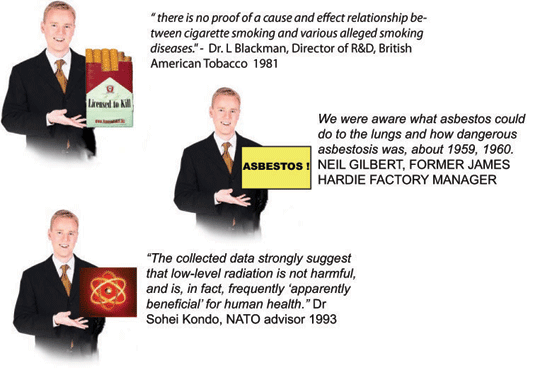
Sure, nobody was killed outright by asbestos, and lots of jobs and wealth were produced, but do we really want to lumber the next generation of South Australians with another expensive medical disaster?
It’s time that editors, politicians, and ex-Governors learnt from the past. Learnt that some medical disasters don’t happen overnight and can take decades to be diagnosed.
As with asbestos, the nuclear industry and its supporters will undoubtedly be condemned by history. It’s a pity that the Scarce’s and Koutsantonis’s of this world won’t be around to try to defend themselves.
Nuclear Royal Commission chief Scarce says “Don’t worry about Fukushima”
Fukushima scarcely a worry Adelaide Advertiser, Adelaide, Paul Starick 25 Jun 2015 FORMER governor Kevin Scarce says the Fukushima disaster doesn’t pose a major barrier to the nuclear industry’s development in SA.
The Nuclear Fuel Cycle Royal Commissioner, who toured the Fukushima exclusion zone during a global study tour, says the 2011 nuclear power plant meltdown was a result of poor design and management. In an exclusive interview with The Advertiser, Rear Admiral (retired) Scarce said the six-country study tour had demonstrated SA was technically capable, with help, of developing a nuclear industry, from the enrichment to spent fuel rod reprocessing, if this was financially viable.
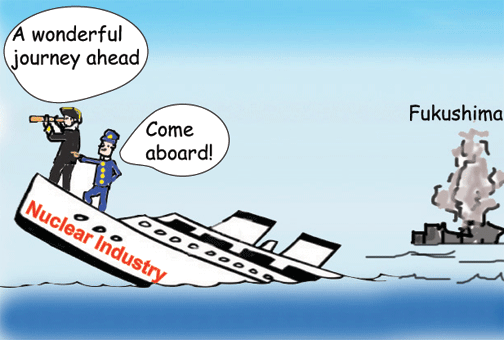
……. Rear Admiral Scarce said the disaster had prompted safety rethinks at other sites the three-person delegation visited during the Asian and European tour, completed this month…..it doesn’t indicate to me that we shouldn’t be looking at this technology. “It means we’ve got to be very careful. We’ve got to be aware of what the consequences are.
“As devastating as Fukushima was, the subsequent improvements made since then enable us to go and look at this technology for our future.”….
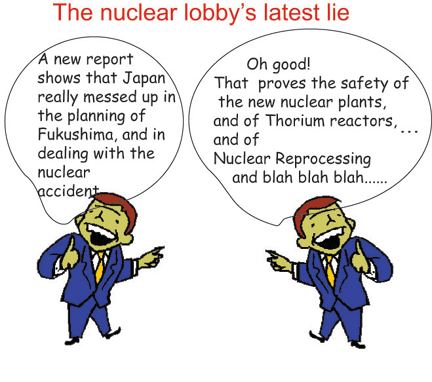
Dr Timothy Stone should not be a Royal Commissioner: has financial interest in a nuclear company
Dr Timothy Stone should be in the same position as any other business or ordinary individual: free to put his opinions to the Royal Commission through the submissions process, but not be a member of the Commission in any form.
Dr Timothy Stone Visiting Professor, International Energy Policy Institute, University College London Adelaide
Current potentially relevant activities:
- Non-executive Director, Horizon Nuclear Power Ltd (UK)
- Visiting Professorship, International Energy Policy Institute, University College London (Adelaide)
- Chairman, Advisory Board of DBD Ltd (UK, nuclear engineering)
Barry Brook should be removed from the South Australian Nuclear Royal Commission
 So that’s the game plan − making absurd claims about Generation IV reactors, pretending that they are near-term prospects, and being less than “abundantly clear” about the truth. Time for these people to be held to account and for Brook to be removed from the South Australian Nuclear Fuel Cycle Royal Commission’s ‘expert panel’.
Royal Commissioner Kevin Scarce was forewarned about Brook’s track record of peddling misinformation but still chose to include Brook in his ‘expert panel’.
On the troubled worldwide history with fast reactors, see the report by the International Panel on Fissile Materials.
Barry Brook being less than “abundantly clear” about Generation IV reactors Jim Green, June 2015, www.foe.org.au/anti-nuclear/issues/oz/barry-brook-bravenewclimate An 18 June 2015 guest post on Barry Brook’s website claims that Generation IV fast neutron reactors will be mass produced and “dominating the market by about 2030.”
Compare that Big Fat Lie with the following:
- The Generation IV International Forum states: “Depending on their respective degree of technical maturity, the FIRST Generation IV systems are expected to be deployed commercially around 2030-2040.” (emphasis added)
- The International Atomic Energy Agency states: “Experts expect that the FIRST Generation IV fast reactor DEMONSTRATION PLANTS AND PROTOTYPES will be in operation by 2030 to 2040.” (emphases added)
- A 2015 report by the French government’s Institute for Radiological Protection and Nuclear Safety (IRSN) states: “There is still much R&D to be done to develop the Generation IV nuclear reactors, as well as for the fuel cycle and the associated waste management which depends on the system chosen.”
IRSN is also sceptical about safety claims: “At the present stage of development, IRSN does not notice evidence that leads to conclude that the systems under review are likely to offer a significantly improved level of safety compared with Generation III reactors, except perhaps for the VHTR …” Moreover the VHTR (very high temperature reactor) system could bring about significant safety improvements “but only by significantly limiting unit power”.
- The World Nuclear Association noted in 2009 that “progress is seen as slow, and several potential [Generation IV] designs have been undergoing evaluation on paper for many years.”
South Australia’s Nuclear Royal Commission unfortunately linked with failed nuclear company AREVA
I would like to think that Kevin Scarce’s Royal Commission was fully investigating nuclear industry issues — not just the geewhiz technology that they would be shown in France by AREVA, which is all too cosy with South Australian pro-nuclear politicians and businessmen.
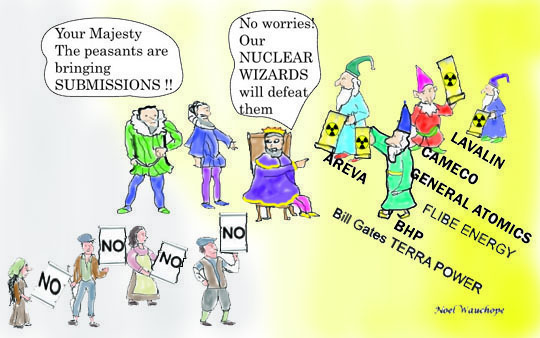
SA’s Nuclear Royal Commission: All too cosy with failed French nuclear giant AREVA? Just how independent is the SA nuclear review and are opponents being side-lined? Independent Australia 12 June 15, Noel Wauchope looks at just who the Royal Commission met on its recent visit to France.
AT ITS South Australian community forums, South Australia’s Nuclear Fuel Cycle Royal Commission head, Kevin Scarce, made a point of the Commission’s independence. He stressed that the Commission would be meeting overseas proponents, and also opponents, of the nuclear industry.
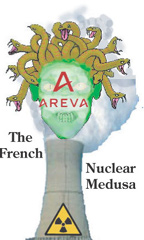 On the Commission’s website, they list the destinations for the Commission’s overseas tour, now about to wind up. I was struck by the amount of time allocated to conferring with the French nuclear energy corporation, AREVA. I had to wonder — in their discussions with AREVA, it would hardly be necessary to talk with nuclear opponents. I wondered how much AREVA would be going to come clean about what really is going on, in France’s nuclear industry.
The AREVA connection with Australia is important. AREVA has an office in Wayville, in Adelaide, and has hosted South Australian parliamentary tours of their nuclear industrial facilities in France. AREVA acquired the Northern Territory Koongarra uranium deposit in 1995, but subsequently, in a David and Goliath battle with Aboriginal traditional owner, Jeffrey Lee, lost this opportunity, as Lee donated his land to Kakadu National Park.
AREVA is in a joint venture with Toro Energy, in uranium exploration in the Northern Territory. The corporation had been exploring for uranium in Queensland’s Karumba and Carpentaria basins since about 2012, but recently pulled out altogether. AREVA will probably be making a submission to the Royal Commission. However, the Commission, in publishing submissions, will not be publishing ones that are deemed “commercially sensitive“.
Without doubt, AREVA has a keen commercial interest in Australia. France’s nuclear industry is somewhat embattled, as its fleet of reactors near the end of their shelf life, and the government is pledged to cut down on nuclear power, and develop renewables. The French nuclear industry (like USA’s) depends for its survival, on selling nuclear technology overseas.
But what of the fortunes of AREVA itself? As the Royal Commission seeks to learn about the commercial viability of the nuclear industry, AREVA is hardly the most reliable authority on that question.
For a start, AREVA now barely exists. Continue reading
A French Farce indeed – South Australia’s Nuclear Royal Commission in Paris – talking to AREVA
It would be funny if it were not so serious. Australians hear little about this secretive Royal Commission. But France’s failed nuclear giant AREVA was invited to put in a submission to the Commission.
The SA Royal Commissioner and some support staff will be in Paris this weekend – at the end of a week that saw the French government confirm that they will take apart the nuclear ‘global leader’ AREVA and give some failed pieces to EDF, which subsequently fell by over 6% on the stock market – let’s hope they read the papers.
The Nuclear Fuel Chain Cost Calculator
 John Mecklin: Introducing the Nuclear Fuel Cycle Cost Calculator http://thebulletin.org/introducing-nuclear-fuel-cycle-cost-calculator8361
… Over the last two years, the Bulletin of the Atomic Scientists and the University of Chicago have created an online tool that will help countries understand the true cost of choosing the reprocessing route—and perhaps also help limit the spread of nuclear reprocessing.

The Nuclear Fuel Cycle Cost Calculator estimates the full cost of electricity produced by three configurations of the nuclear fuel cycle. This calculator is the first generally accessible model to provide a nuanced look at the economic costs of nuclear power, particularly in regard to the reprocessing of spent nuclear fuel. Among many other things, the calculator clearly demonstrates that in most cases, reprocessing results in electricity that is considerably more expensive than other nuclear power, when all costs are added in.
Dr Helen Caldicott dissects the propaganda for South Australia’s Nuclear Chain Royal Commission
This article was posted on Saturday 30 May. I have “upped” it to the top of this page, because it is the clearest and most comprehensive discussion of the very fraught South Australian nuclear fuel chain plan.
Clearly this whole disastrous process is financially beyond the reach of little South Australia. However
Premier Jay Weatherill has been persuaded to establish a flawed royal commission to assess the viability of incorporating the entire nuclear fuel chain in the state.
this is a carcinogenic industry that must be halted immediately in the name of public health. The people advocating a nuclear South Australia have no comprehension of genetics, radiation biology, oncology and medicine. Or they are willing to ignore the risks.
 SA’s short-sighted view of uranium and nuclear options https://www.thesaturdaypaper.com.au/opinion/topic/2015/05/30/sas-short-sighted-view-uranium-and-nuclear-options/14329080001942#.VWjSBtKqpHw Something quite extraordinary is happening in South Australia, the state that initiated the national movement against French atmospheric nuclear tests in 1971-72, and where the movement against uranium mining began in 1975, which ultimately led to a five-year ban by the ACTU on the mining, transport and export of uranium. Forty years later, it is the ultimate irony that the French nuclear industry is interested in becoming involved in South Australian uranium enrichment and nuclear reactors.
 In 2010, the University College London (UCL) established its School of Energy and Resources, Australia, in Adelaide. The school partnered with pro-nuclear and pro-shale gas corporations, including BHP Billiton and Santos. On the surface this may seem harmless enough, but the school and its well-connected backers has had a profound impact on the nuclear debate in South Australia, particularly as the state begins a royal commission into “opportunities and risks” in the “nuclear fuel cycle”.
Professor Stefaan Simons, who is the director of the International Energy Policy Institute and UCL’s  BHP Billiton chairman of energy policy, has been strongly promoting construction of nuclear powered submarines in South Australia, as well as a repository in the state for radioactive “waste streams”. Dr Tim Stone, a businessman and visiting professor to the UCL’s Adelaide campus, was expert chair of the British Office for Nuclear Development and sits on the board of British energy company Horizon Nuclear Power. James Voss, the former managing director of Pangea Resources, the company that originally proposed a nuclear waste dump in Australia in the late 1990s, is also part of the UCL fold, as honorary reader at the International Energy Policy Institute.
Outside of UCL, support has come from the likes of Professor Barry Brook, former professor of climate change at the University of Adelaide, and now professor and chair of environmental sustainability at the University of Tasmania. Brook has vigorously promoted the whole nuclear fuel chain, from uranium mining and enrichment to reactors and storage of radioactive waste in the desert of South Australia. He and Tim Stone have been appointed to the Nuclear Fuel Cycle Royal Commission’s Expert Advisory Committee.
The arguments put for nuclear power are many and specious. As South Australia continues to be seduced by them, it is worth pointing out the flaws that too often go uncorrected. Continue reading
Call to allow clear participation for Royal Commission submissions – Australian Council of Trade Unions (ACTU) Congress
The motion below was passed at Australian Council of Trade Unions (ACTU) Congress yesterday. It was moved by the CEPU (Communications, Electrical and Plumbing Union) and seconded by Unions SA.
Nuclear Fuel Cell Cycle With regards to the Royal Commission into the Nuclear Fuel Cell Cycle currently underway in South Australia, Congress notes with alarm the Commission has decided to require that all public submissions to be typed and sworn under oath in front of a Justice of the Peace before they will be accepted.
Requiring members of the public to take the time and resources to type and swear an oath before they can lodge a submission is an unnecessary and surprising restriction that will serve as a huge barrier to participating in what is supposed to be an open, public, inclusive and democratic process.
To be required to type a submission then swear an oath just to have your say is simply not necessary, and will have a disproportionately large effect on regional and remote communities, a majority of which are Indigenous. Additionally, in many remote communities English is not a first language, so along with the typed and sworn oath requirements means that many Indigenous voices will not be heard in the Royal Commission
The requirements means that if you live in a community that does not have a Justice of the Peace or other authorised witness, you would need to drive (assuming access to car or transport) up to an hour or more to the nearest community that does.
This runs contrary to the spirit of having an open public inquiry and is particularly unacceptable given that it is indigenous communities that will be most impacted should the Commission make recommendations for the establishment of a nuclear waste facility because they will have the facility placed on their land.
Congress calls on the Royal Commission to:
1- Restore and encourage the broadest possible public participation by removing the requirement for public submissions to be sworn under oath.
2- Accept oral and written submissions from members of the public.
3- Ensure that any activities in regional and remote indigenous communities are done in a culturally appropriate manner, including the provision of interpretation services at public meetings and ensuring that written materials are available in local languages.
Examining the nuclear lobby’s hype about “planned construction of reactors
If we had a list of renewable projects that were planned and under construction, it would look like the renewable sector was 1000 per cent of what it actually is. That’s because there are a lot of planned wind farms and even more solar farms.
In fact in interviews of Australian households beyond the 10 per cent who already have solar on their roof (25 per cent in South Australia), more than 75 per cent have a plan to get solar on their roof at some point in time. A similar number believe or are “planning” to get batteries to deliver their solar power as a cheaper alternative to the grid at night.
 So if we put all the planned nuclear reactors that never get built against all the planned solar installs and wind installs around Australia and the rest of the world, the nuclear proposals would be so dwarfed to be completely irrelevant.
 If you’re hearing another one of these countless stories such as those being hawked at the pro-nuclear “Nuclear Fuel Cycle Royal Commission” being held in South Australia, just remember there are people who want their uranium penny stocks to take them from rags to riches or riches to even more riches that are creating most of the hype.
In the west, a second generation nuclear reactor is unacceptable and no third generation reactors have ever successfully been built.
What if we all adopted the nuclear industry’s interpretation of a ‘planned’ project?MATTHEW WRIGHT , HTTP://WWW.BUSINESSSPECTATOR.COM.AU/ARTICLE/2015/5/27/RENEWABLE-ENERGY/WHAT-IF-WE-ALL-ADOPTED-NUCLEAR-INDUSTRYS-INTERPRETATION-PLANNEDIf you search the definitive list of reactors on Wikipedia, you’ll find that reactors are being decommissioned globally at a rate of knots, and many more are set to be decommissioned in the not too distant future. This includes the entire fleet in Germany and a significant portion but unspecified number of reactors in Japan.
If you looked further, you’d find that you could count the total number of reactors built in 2014 and 2015 on just one hand. In that period there was activity predominately in China — with its centralised state control avoiding the scrutiny the technology gets everywhere, outside a lone reactor in Argentina being the exception — but you could hardly get excited as that project was started when first of the Generation Ys were still in nappies in 1981.
So you’ve got a few plants getting built at a much slower pace than planned in China, and a bunch of plants ‘planned’ all over the place. But as is the case with almost all nuclear plans in the last 25 years, they’ve gone nowhere. They are plans (if a dream is a plan), but are not likely to be plants.
So why do we hear about these so called plans over and over? Continue reading
Assessment of Kevin Scarce’s Royal Commission forums
My impression is that the Nuclear Fuel Chain Royal Commission community forums are pretty formulaic. Kevin Scarce has got it all down pat , and does not stray from his agenda of the 4 Issues in the Terms of Reference. A bit of lip service is paid to Renewable Energy, but it is clear that this will not feature in the serious examination of energy technologies. There is complete avoidance of legal issues.
The thing that gets me about Kevin Scarce and the Royal Commission, and the media coverage – is the pretense that this is all just a South Australian affair – despite the fact that these nuclear developments are illegal under national law. Of course this whole idea of making South Australia the world’s nuclear hub and waste dump concerns all of Australia.
The meeting at Coober Pedy (14/5/15) was quite a lively one, and the audience showed a degree of knowledge and sophistication that The Royal Commissioners might not have expected to find, in such a remote location. Concerns aired in questions included the problems of nuclear wastes – problems handed over to future generations, environmental concerns, and support for renewable energy rather than nuclear .
At University of South Australia – Mawson Lakes, (19/5/15) about 50 people attended. I have no report on this, other than that at least one University lecturer was worried that harmful affects of tourism and agriculture and food would not be properly addressed, and small businesses would not put in submissions about the potential harm to their business.
At Adelaide University(22/5/15) around 250 people attended, and pro nuclear people were slightly in the majority – as evidenced by a show of hands when asked for this. David Noonan of Wilderness Society didn’t get to ask his question – that the proposed activities the RC is investigating are currently illegal in Australia!
At Flinders University (20/5/15) – (see report on this page) there was some pretty lively questioning. Kevin Scarce was able to deflect very deftly any difficult questions. His two best techniques – to point out that matters are “not in the Terms of Reference” and to urge the questioner to seek the answer and “put in a submission”.
A concern that showed up in Adelaide meetings was that of bias – questioners wanted to know about the agendas, the interests of the staff and expert advisers on the Commission. They also wanted to know about the companies involved, and their submissions to the Commission – will the Commission be transparent about this?
Report on Royal Commission meeting at Flinders University 20 May 2015
Presentation of Royal Commission to meeting at Flinders University/Tonsley Campus, 20 May 2015
Kevin Scarce outlined purpose of the Royal Commission to examine the 4 issues set out in the Terms of Reference for the Royal Commission.- to look at the opportunities and costs of expanding the nuclear fuel chain in South Australia – for the community, environment and economy.
He discussed each of the 4 Issues :
1 Exploration, Extraction and Milling – should this be expanded? Australia has about 30% known U deposits; SA has about 80% of that.
thorium – will consider sources, possible use of this, too.
- processing/manufacturing
- conversion – uranium oxide to uranium hexafluoride
- enrichment –to concentration suitable for reactors
- enriched conversion to nuclear fuel/rods
- medical/scientific isotopes – ANSTO produces these at reactor in Sydney. 10-15% from cyclotrons – one in SA.
3 nuclear reactors/power generation
- storage/disposal of nuclear wastes
- low/intermediate level waste – radioactive materials (clothing, instruments etc) associated with energy generation – can be treated to assist storage e.g. vitrification; synroc/ceramics;
- to storage – encased steel & concrete
- high level – heat produced so stored in wet storage pool to cool – encased in steel & concrete – intended to go to deep geological storage – Finland –developing only one at present 400m underground – operate from 2022 onwards
- reprocessing of spent fuel rods can recover fuel –large infrastructure & complexity of process
He outlined the process of the Royal Commission. For Any questions needing detailed answer, people can consult the Issues Papers.
There is a Royal Commission team of 15, who will be seeking national & international expertise. At present – framing ways to examine costs & opportunities. The Commission will be getting balance in talking to experts.
- The Commission will examine the issues papers , questions raised on complex processes, and the Submissions in response to the Issues Papers by – early August response date. The Submissions will be made public later in the year.
- not clear here – I think there’s to be release of & consultation about responses to issues papers– Adelaide & regionally to December
- Commission will then develop findings – take back to community Feb
- Final report to SA government – early May 2016
Questions from audience; Commissioner response Continue reading
Australia’s Aboriginals again threatened by nuclear radiation
 Nuclear-hit Aborigines again in radiation danger https://linksunten.indymedia.org/de/node/144304 Verfasst von: Diet Simon, sourcing from beyond nuclear news roundup (Account: Nuclear Worrier). Verfasst am: 25.05.2015
Darren Farmer, a burly middle-aged Martu tribal man, told VICE online magazine that “the Martu people do not want this uranium mine. Everybody has said no.” But that hasn’t stopped the federal environment minister Greg Hunt from givingKintyre the green light.
The VICE article explains how poverty prompts some Martu to agree to mining on their country and how Darren Farmer and others are physically assaulted for opposing it.
Meanwhile four decades after test explosions of atom bombs in the Maralinga desert area of South Australia, which killed and maimed Aboriginal people, Indigenous people face barriers as they try to contribute to a parliamentary inquiry whether the state should start a nuclear fuel cycle industry.
A requirement for all submissions to be sworn in front of a justice of the peace makes it particularly difficult for Aboriginal people, people from remote areas and those with language issues to present their views.
The former Governor [Queen Elizabeth’s representative] of South Australia, Kevin Scarce, who heads the inquiry, is to inspect the Fukushima region of Japan,ravaged by nuclear reactor explosions.
One of the things the inquiry will consider is the storage of nuclear waste from other countries. The federal government is currently looking for a site to dump six cubic metres of nuclear waste that must return to Australia from France for processing this year.
The federal government had previously targeted Aboriginal-owned sites in the Northern Territory, including Muckaty Station, where agreements with Aboriginal governance fell through or stalled. Aboriginal women’s resistance also stopped a 2003 plan by the federal government to dump nuclear waste in South Australia.
The French state-owned nuclear giant Areva is offering to sell its ‘world leading’ nuclear technology to South Australia. “The offer is being reported in the South Australian media without a hint of irony,” comments leading anti-nuclear Australian activist, Jim Green. “A reality check is in order.”
Two former Australian prime ministers, one each from the Liberal [in name only, actually right-of-centre conservative] and Labor [only nominally left] parties have said it would be a good idea for Australia to take in all the world’s nuclear waste. Guess on whose lands.
1 This month

of the week – Australians for War Powers Reform (AWPR)
To see nuclear-related stories in greater depth and intensity
 Antinuclear