Citizens’ Jury effectively exploded South Australian Labor govt’s nuclear plans
 South Australian ‘citizens’ jury’ rejects nuclear dump, Green Left RENFREY CLARKE. Adelaide, November 11, 2016 To the fury of business spokespeople, South Australia’s “Citizens’ Jury on Nuclear Waste” has effectively exploded plans by the state Labor government to host the world’s largest nuclear waste dump.
The jury was intended by Premier Jay Weatherill to lend his scheme a garnish of popular consent. But in their final report on November 6, the jurors instead concluded that the dump plan should not go ahead “under any circumstances”. The vote was overwhelming, with two-thirds of jury members opposing the government’s projections.
Both as science and public policy, the jury’s finding made superb sense. But the verdict was more than that.
From the ordinary working people of South Australia, it was a message to their “betters”: “Be damned. We don’t trust you to defend our interests. Given the chance, we’d send you to hell.”
It was like Brexit. Or the street parties held when Margaret Thatcher died.
To reach their verdict, the jurors — initially numbering 350 and chosen as a representative slice of society — defied an intensive propaganda campaign mounted by the state authorities over several years at a reported cost of $10 million.
The government, Weatherill insisted from the outset, would never go ahead with its dump scheme unless the population, including indigenous people, was shown to be solidly behind the plan. To make the case for the proposal, a Royal Commission on the Nuclear Fuel Cycle was held, headed by former South Australian Governor Rear Admiral Kevin Scarce. The commission’s final report, key sections of it drafted by nuclear industry consultants, was delivered in May.
As anticipated, the commission urged constructing a “deep repository” to house as much as a third of the world’s current stock of high-level reactor wastes. Most of the immense cost, South Australians were promised, would be borne by client countries anxious to rid themselves of a growing mountain of spent nuclear fuel. The eventual net flow of revenues to the South Australian government was put at a dazzling $51 billion.
Nuclear spruikers
Following the royal commission was a “consultation” program dubbed by critics the “nuclear roadshow”. For months, teams of pro-nuclear spruikers toured the state’s urban centres. Supposedly seeking the views of the population on nuclear issues, program staffers mounted slick presentations uncritically promoting the commission’s findings.
Pounding still broader numbers of South Australians into line was a drum-beat of pro-nuclear articles in the Murdoch-owned Adelaide Advertiser.
Within the government’s strategy the role of the Citizens’ Jury, which met for the first time in June, was to produce a report voicing at least conditional assent to the dump plans. Weatherill and his cabinet would then have claimed public support for beginning the process, predicted eventually to cost taxpayers $300–600 million, that would see the sites for interim and final dumps chosen, the location selected for a dedicated port, and prospective clients scouted.
Though strong on the rhetoric of “consultative leadership” and “deliberative democracy”, the Weatherill government clearly did not mean to let in-depth debate get in the way of a suitable jury verdict. Control over the jury process was handed to a team of “facilitators” put together by the firm DemocracyCo. The latter compiled a list of 160 “expert witnesses”, skewed strongly towards nuclear advocates, to address the jurors.
A script drawn up by the facilitators would rush the jurors through hurried workshops, many held simultaneously. Jurors would have little chance to question witnesses at length, or to gain a feel for the broad progress of the discussion.
The government’s ploys seemed watertight. But on November 6, they were shown to have failed completely.
“Multiple threads of concern are present that undermine the confidence of jurors in the Royal Commission report’s validity,” the jury’s final report stated. “These concerns collectively combine to affect a powerful NO response.”
“Green activists kill inquiry”
What had gone wrong? In the view of Nigel McBride, chief executive of the peak association Business SA, the jurors had been got at by “green activists determined to kill further inquiry”.
“They ran an absolutely undiluted campaign of fear and misinformation,” McBride was quoted by the Advertiseras saying: “The people who were going to die in a ditch over this were the naysayers, the rest of us were calling for an informed investigation … It’s disappointing. An extraordinary amount of effort and resources and time has gone into it.”
The truth is less sinister. Chief Executive of the Conservation Council of SA Craig Wilkins pinpointed it in a press release:
“The nuclear industry likes to push a myth that the more people get to understand nuclear issues, the more supportive they are. Well, 350 South Australians have spent over 40 hours hearing about a nuclear dump for SA and the more they heard about it, the less they liked [it].”
The real problem that brought the nuclear dumpsters undone was simple: before a demanding audience that had other sources of information, the pro-nuclear side was incapable of putting forward convincing arguments.
Dissatisfied with the witnesses on offer, the jurors invited experts of their own choice, to talk to them, including Friends of the Earth anti-nuclear campaigner Jim Green, Australia Institute Chief Economist Richard Denniss, and University of South Australia Adjunct Professor Richard Blandy, all incisive public critics of the dump scheme.
The jury’s final report is not a polished document. Those who worked on it, however, obviously took their task with enormous seriousness. Their rejection of the pro-dump case, it is fair to say, rested on two main grounds: the refusal by the dump’s proponents to address the objections of traditional indigenous landowners and the gross flaws in the economic case for the dump as put forward by the royal commission.
As related by the Adelaide Independent, Weatherill in the past had “told a national television audience that a dump would ‘require essentially the explicit consent of traditional owners’ and that ‘if it did not exist, it wouldn’t happen’.”
In a two-hour session before the whole Citizens’ Jury, more than a dozen well-known Indigenous elders made it plain that no consent was being given or ever would be.
“Indigenous, community and social consent is absolutely required,” the jury’s report notes. “Currently not provided and a resounding ‘No’…”
The economic case for the dump, prepared for the royal commission by the nuclear industry consulting firm Jacobs MCM, is savaged in the report. “Many (jurors) have no confidence in the economics of the project. … The assumptions made (as) to potential income are based on assumptions with little support.”
Eighty-two per cent of the jurors, the report notes, were inclined to view the economic risks of the scheme as too great. https://www.greenleft.org.au/content/south-australian-%E2%80%98citizens%E2%80%99-jury%E2%80%99-rejects-nuclear-dump
A blow to nuclear front group “Ecomodernists” -South Australian Citizens Jury verdict
No way! South Australians reject international nuclear waste dump http://www.theecologist.org/News/news_analysis/2988308/no_way_south_australians_reject_international_nuclear_waste_dump.html Jim Green, The Ecologist, 9 November 2016
An officially convened 350-strong Citizens’ Jury has decisively rejected South Australia’s plans to import over half a million tonnes of high and intermediate level nuclear waste for long term storage, writes Jim Green. This has dealt a powerful blow against the project from which it is unlikely to ever recover, and represents a major victory for campaigners, indigenous Australians and economic sanity.
On Sunday November 6, two-thirds of the 350 members of a South Australian government-initiated Citizens’ Jury rejected “under any circumstances” the government’s plan to import 138,000 tonnes of high-level nuclear waste and 390,000 cubic metres of intermediate-level nuclear waste as a money-making venture.
The Jury was a key plank of the government’s attempt to manufacture support for the dump plan, and followed the SA Nuclear Fuel Cycle Royal Commission which released its final report in May 2016.
The Royal Commission had a strong pro-nuclear bias in its composition but still rejected – on economic grounds – almost all of the proposals it considered: uranium conversion and enrichment, nuclear fuel fabrication, conventional and ‘Generation IV’ nuclear power reactors, and spent fuel reprocessing.
Australia’s handful of self-styled ‘ecomodernists’ or ‘pro-nuclear environmentalists’ united behind a push to import spent fuel and to use some of it to fuel ‘integral fast reactors’. They would have expected to persuade the stridently pro-nuclear Royal Commission to endorse their ideas.
But the Royal Commission completely rejected the proposal, noting in its report
- that advanced fast reactors are unlikely to be feasible or viable in the foreseeable future;
- that the development of such a first-of-a-kind project would have high commercial and technical risk;
- that there is no licensed, commercially proven design and development to that point would require substantial capital investment;
- and that electricity generated from such reactors has not been demonstrated to be cost competitive with current light water reactor designs.
The ecomodernists weren’t deterred. They hoped that the nuclear waste import plan would proceed and that it would lay the foundations for the later development of fast reactors in SA. Now it seems that the waste import plan will be abandoned, and the ecomodernists are inconsolable.
The SA government will come under strong pressure to abandon the waste import plan in the wake of the Citizens’ Jury’s vote. Roman Orszanski, climate and energy campaigner with Friends of the Earth Adelaide, said: “Three thousand people protested against the proposed nuclear waste dump outside Parliament House on October 15 and there will be more protests and bigger protests if the SA government attempts to push ahead.”…… http://www.theecologist.org/News/news_analysis/2988308/no_way_south_australians_reject_international_nuclear_waste_dump.html
Premier Weatherill’s nuclear political quagmire (a martyr for the nuclear religion?)
 With citizens dissenting, Labor party members preparing for internal debate and anticipation building among nuclear industrialists, the Weatherill government has waded into a political quagmire, in which it now stands waste-deep.
Simplify Day won’t ease nuclear tension in South Australia, Online opinion, By Dan Monceaux, 9 Nov 16 “……If support for future high-level nuclear waste storage had been demonstrated by the Citizens Jury, or granted by Traditional Owners, repealing legislative barriers would have been the necessary next step before opening the gate for further investment. The Jury’s report recommends against such reforms, casting doubt on the nature and content of the policy announcement expected later this month.
The Jury has also called for the State Government to draw no more from the public purse. To date the State has committed $13 million dollars to the Royal Commission, Citizens’ Jury and ‘Get to Know Nuclear’ public relations campaigns combined.
The jury’s objections have no doubt stolen some wind from the sails of supporters. The Premier now risks compounding the identified problem of a lack of trust in government, if he is to announce any further financial commitment to explore the Commission’s proposal. Meanwhile, dissenting voices within the South Australian Labor party will likely draw confidence from this as the party heads towards a contentious Special Convention on the topic. Continue reading
Citizens Jury clearly examined the economic danger of importing nuclear wastes
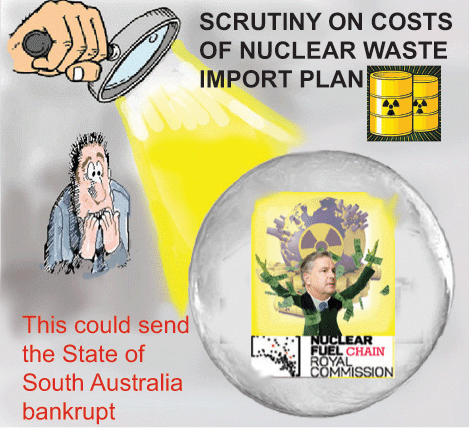 Clear-headed citizens’ jury refused to be dazzled ANALYSIS, InDaily, Richard Blandy, 7 Nov 16 The citizens’ jury’s rejection of a high-level nuclear waste dump for South Australia was based on courage and common sense, writes economics commentator Richard Blandy – one of the expert witnesses called to address the jury. My fellow expert economic witnesses, chosen by a formal voting process by all the members of the citizens’ jury, were Dr Mark Diesendorf , a former Principal Research Scientist in the CSIRO and former Professor of Environmental Science at the University of Technology, Sydney), Dr Richard Dennis, Chief Economist at The Australia Institute, Barbara Pocock, Emeritus Professor of Economics at UniSA and a member of the SA Economic Development Board, and me.
All of these expert witnesses opposed the royal commission’s proposal to establish a high level nuclear waste dump in South Australia.
DemocracyCo, the body running the citizens’ jury process, added to this group Dr Tim Johnson, Project Manager/Consultant at Jacobs Engineering, which undertook the analysis of the nuclear dump for the royal commission. Dr Johnson was the project manager for Jacobs’ work on the cost analysis and business case for the dump.
Naturally enough, Dr Johnson supported the royal commission’s proposal to establish the dump.
Dr Diesendorf, participating in proceedings through a Skype link to Sydney, said the dump proposal painted a scenario of huge financial risk which had not been adequately addressed. South Australia could only proceed if it operated under two delusions – a delusion of grandeur and a delusion of being able to manage large risks that had not been adequately addressed.
I noted that there is no global market for high level nuclear waste at present so the price we could expect to get was a guess. The forecast profitability of the dump rested on highly optimistic assumptions, and the dump could easily lose money (on the Royal Commission’s own analysis in Figure J6) instead of being a bonanza. As Treasurer Tom Koutsantonis said in his recent State Budget: “There is no silver bullet … [including] the nuclear royal commission.”
Richard Dennis pointed out that South Australia had already spent $10 million on the nuclear dump proposal, but still did not have a cost/benefit analysis. The price we would get for storing nuclear fuel was exaggerated and the volumes we would store were exaggerated. Would no other country enter the market if there was a bonanza happening in South Australia? One of the key assumptions of economics is that huge profits will attract competitors. If the project were likely to make so much money, why wouldn’t BHP be wanting to invest in it, or at least spend the next $10 million to explore the project further?
Barbara Pocock noted that all the economists agreed the dump was not a goer. In an earlier session, Dr Johnson had also agreed that the proposal needed a lot more work. It was a complicated project that had never been done before. At a projected cost of $145 billion, it was equivalent in financial size to 70 new Royal Adelaide Hospitals. A cost overrun would be very easy. The SA proposal was 20 times bigger than what the Finns are building. The profits come from holding the waste in inexpensive temporary storage for a very long time – but nothing will go wrong! We should not be dazzled and desperate. We should remember the State Bank – which cost us $3 billion and 20 years of economic confidence.
Tim Johnson summarised and defended the analysis that Jacobs had undertaken for the royal commission, which is contained in accessible reports, including the royal commission report itself. I will not go through this material again, here.
Most questions from the members of the citizens’ jury were directed to Dr Johnson, with other members of the panel commenting from time-to-time.
Late in the afternoon last Sunday, the 350 people of the citizens’ jury reported on their findings, the most important of which is reproduced below (supported by two thirds of the jurors):
No, not an option for the state under any circumstances for reasons of consent, economics, trust and safety.
· Under no circumstances should South Australia pursue opportunity to store and dispose of nuclear waste from other countries for reasons of consent, economics, trust and safety……… http://indaily.com.au/news/business/analysis/2016/11/08/clear-headed-citizens-jury-refused-to-be-dazzled/
Premier Jay Weatherill’s political future on the line?
Where to now, for Premier Weatherill’s nuclear dream? Online Opinion, Noel Wauchope 8 Nov 16 On November 6th, to the surprise of all, South Australia’s Nuclear Citizens Jury came up with a report that overwhelmingly rejected the government’s plan for importing and storing high level nuclear waste. Over four days of witness hearings, and deliberations, the 350 members of the jury were tasked with producing an answer to this question:
Under what circumstances, if any, could South Australia pursue the opportunity to store and dispose of nuclear waste from other countries?
The jury’s answer:
Under no circumstances should South Australia pursue opportunity to store and dispose of nuclear waste from other countries for reasons of consent, economics, trust and safety.
An over-riding consideration was the lack of Aboriginal consent:……..
The Jury strongly recommends that there be no further amendment to the Nuclear Waste Storage Facility (Prohibition) Act at this time.
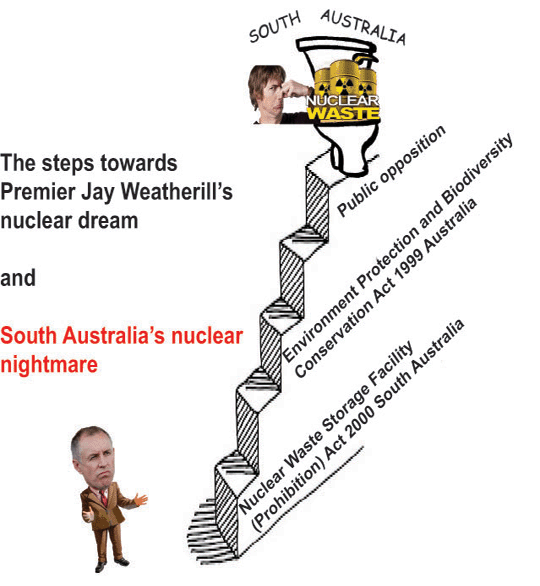
Many in the Jury felt strongly that if the nuclear waste proposal is to go ahead no further public money should be spent at this time. Any further analysis should be conducted and funded by key players within the industry.
Weakening or repealing this law is the first goal in the nuclear lobby’s plan set out in the report by Nuclear Fuel Cycle Royal Commission South Australia.
The jury was critical of the “Perceived lack of objectivity of Royal Commission Report”…….
A “yes” result might have been problematic, drawing national attention to this extraordinary plan to make Australia be the first country on the planet to invite in the world’s radioactive trash.
But a “No” vote – nobody expected that, and you could see by Weatherill’s rather fixed and strained smile on receiving the report, that it is causing some angst in the government. And no doubt, in the nuclear camp in general.
However, one can be sure that they will quickly regroup, and refresh their campaign. Premier Weatherill made it clear that the discussion will continue…….
everyone seems to agree that the Jury’s report is at least a “setback” for the nuclear waste plan, as the Financial Review describes it. It also raises questions about Premier Weatherill’s political future. Weatherill has been praised as an example of political courage. Weatherill prides himself on taking risks.
 He could decide to cut the losses to the State, and pull out from the plan now. Perhaps Weatherill has invested too much energy and involvement with the nuclear lobby, to take such a step. As Macbeth said, when considering stopping his ambitious but dangerous cause – “”I am in blood stepped in so far that should I wade no more, Returning were as tedious as go o’er,” http://www.onlineopinion.com.au/view.asp?article=18640

The SA Government should now dump its plans for a nuclear waste dump.
 The Australia Institute team, 8 Nov 16 Yesterday, 350 ordinary citizens handed the SA Government a “stunning and overwhelming rejection” of its plans to build nuclear waste dump in South Australia.
The citizens’ jury’s task was to consider whether South Australia should import high level nuclear waste from other countries and bury it for money. After hearing about the proposal from various experts, more than two thirds of them said no, not “under any circumstances”.
The Australia Institute’s involvement focused on an area that no one else was challenging: the dodgy economic modelling and heroic estimates of how much money the dump would deliver to the state.
Richard Denniss addressed the citizens’ jury last weekend, highlighting a few key points:
- The economic modelling supporting the claims of hundreds of billion dollars in benefits was deeply flawed.
- The project was risky, involving high level waste being stored in above-ground ‘temporary’ storage for over 100 years.
- That parts of the Nuclear Royal Commission’s report had actually been written by nuclear industry lobbyists.
Richard’s appearance was just the latest part of our involvement in the SA nuclear debate. In July, Rod Campbell had addressed an earlier citizens’ jury, leading to the headline in The Australian: Citizens’ jury questions economics of SA nuclear dump.
Our earlier submission on the economics of the dump and headline appearance on Today Tonightmade a big impact, with the Royal Commissioner, Kevin Scarce, saying he would take our submission “apart piece by piece.” We have also had a number of opinion pieces published on the subject.
Commissioner Scarce never did find anything wrong with our submission. But the citizens of South Australia have taken his work apart, piece by flawed piece. The Citizen’s Jury final report outlined concerns about the lack of consent from Traditional Owners, and showed that while 70% opposed the nuclear waste dump, 82% thought the economic case made was weak. Here’s a quote from the jury’s final report:
“It is impossible to provide an informed response to the issue of Economics because the findings in the RCR are based on unsubstantiated assumptions. This has caused the forecast estimates to provide inaccurate, optimistic, unrealistic economic projections.”
The SA Government should now dump its plans for a nuclear waste dump.
The Australia Institute aims to produce research that matters, and this is a case where we can see how lots of hard work over a long period changes minds. The Citizens’ Jury is to be congratulated for delivering a big win for the South Australian taxpayer, Traditional Owners, the environment, and common sense.
Aboriginal people will never agree to a high level waste dump – Nuclear Citizens Jury Report
 Nuclear citizens’ jury: five surprising things INDaily , 7 Nov 16 “……The State Government is today pondering what to make of the report of the second citizens’ jury which looked at whether South Australia should pursue the establishment of a facility to accept the world’s high level nuclear waste.
Two thirds of the 350 jurors rejected the proposition – under any circumstances.
The report shows not only a lack of faith in the concept outlined in the state’s nuclear industry royal commission, but along the way, the 50-odd pages of the citizen’s jury report has offered an indictment of a whole generation of South Australian politicians.
You wouldn’t know it from much of the media coverage since the report was handed down yesterday, but a key factor in the jury’s decision was the overwhelming Aboriginal opposition to a nuclear waste dump. Continue reading
Overwhelming rejection of nuclear waste import. (article includes reader poll)
 Citizens’ jury overwhelmingly rejects nuclear waste storage facility for South Australia State Political Editor Daniel Wills, The Advertiser November 6, 2016 A CITIZENS’ jury called by Premier Jay Weatherill to consider whether South Australia should develop a nuclear storage industry has rejected the idea by an overwhelming two-thirds majority.
In a deep blow to advocates of nuclear storage, … the jury cited a “lack of trust” as the deal-breaker.
It said it was sceptical of the State Government’s ability to deliver the project safely and on-budget, as well as the sincerity of the jury process they had been asked to take part in.
“The jury generally had a strong conviction in taking a position,” the report of its 350 members states.
“Two-thirds of the jury do not wish to pursue the opportunity under any circumstances.”
Mr Weatherill personally received the report from the citizens’ jury at the Adelaide Convention Centre just after 5pm on Sunday. But he would not concede the proposal was now dead.
The objections to the proposal ranged from the Government’s perceived poor record in managing big projects like construction of the new Royal Adelaide Hospital and the historic State Bank collapse, to the lack of consent from Aboriginal communities.
“No market testing and understanding the appetite with potential customers for the use of, and at what fee, for an Australian repository, is a reason not to undertake further expenditure and investigation,” the report states.
“Continuing the investigation … with evidence of lack of consent and poor economics, demonstrates this as an agenda of the Government.”
Mr Weatherill said the “very clear position” of the jury would be combined with other Government research about the statewide views of the nuclear industry, as Cabinet considers whether to push ahead. http://www.adelaidenow.com.au/news/south-australia/citizens-jury-overwhelmingly-rejects-nuclear-waste-storage-facility-for-south-australia/news-story/8340c103234775fffcf9b88b2aea6906
The verdict is in and the radioactive waste dump plan is out

7 Nov 16 South Australia’s No Dump Alliance has welcomed and congratulated the 350 member Citizens Jury for delivering a firm “No” to any plans to establish a high level international nuclear waste dump in South Australia after two thirds of Jurors voted No to the controversial plan at the final session yesterday in Adelaide.
“Jay’s jury has said No”, said Alliance spokesperson Tauto Sansbury. “The Premier should now listen to the people and respect this clear decision.”
Jurors also highlighted issues around the poor economics, lack of trust in government and public health and safety risks associated with nuclear projects. “This is a strong decision from randomly selected and very diverse group of South Australians who have had the benefit of studying the Royal Commission Report and hearing information from experts in various aspects of the proposal. It was positive to hear the jurors acknowledging the need for Traditional Owner’s voices to be heard. I thank the clear majority of Jurors for this decision”. Said No Dump Alliance spokeswoman Karina Lester.
The announcement represents a significant, indeed ‘near fatal’, blow to any hopes that a social consensus would develop in favour of the proposal. The global waste dump plan is now increasingly mired in controversy with recent revelations of a pro-nuclear bias in the Royal Commission Report as the Report’s sole economic analysis was provided by a pro-nuclear lobby group.
No Dump Alliance member Emeritus Professor Richard Blandy had a message for the Jurors: “I congratulate the Second Citizens’ Jury on their overwhelming decision against the proposed nuclear dump. They have shown courage and common sense. A large majority could see that the bonanza that the dump was supposed to bring to the State was based on very flimsy evidence. They saw that the real path to a better economic future for our State is based on our skills, innovative capabilities and capacity for hard work, not a bizarre gamble based on guesses. I am proud of my fellow South Australians on the Jury – including those who were in the minority. I would like to thank them all for their efforts on behalf of their fellow South Australians.”
Jamie Newlyn, State Secretary for the Maritime Union of Australia, was also pleased with today’s outcome. “The MUA have stood strongly against this proposal. It not only presents unacceptable risks to our members, but also to the economy and environment of our great State. We, along with other unions and the community, will carry on our opposition to this as long as we have to.” Mr Newlyn said.
“The No Dump Alliance is calling on the Weatherill Government to formally end the global waste dump plan and we will continue to build the community campaign to dump the dump – our home is simply too good to waste,” concluded Ms Lester.
The No Dump Alliance is a broad cross-section of South Australian civil society, including Indigenous, public health, trade union, faith and environment groups and academics who are deeply concerned about and opposed to any move to open South Australia up to international high-level nuclear waste importation and dumping: http://www.nodumpalliance.org.au/
Citizen Jury says NO to nuke waste dump plan

The Citizen Jury set up to consider a nuclear waste dump for SA has comprehensively rejected the idea, with a thumping 2/3 majority saying no under any circumstances.
“This is a clear and comprehensive rejection by ordinary South Australians of the Royal Commission’s nuclear waste dump dream,” said Craig Wilkins, Chief Executive of the state’s peak environment body, Conservation SA.
“The nuclear industry likes to push a myth that the more people get to understand nuclear issues, the more supportive they are. Well, 350 South Australians have spent over 40 hours hearing about a nuclear dump for SA and the more they heard about it, the less they liked.
“The Royal Commission has put forward a deeply flawed plan, and the citizen jury has comprehensively rejected it.
“The dollars don’t stack up, the safety concerns are enormous, Traditional Owners have said no, and now a citizen jury made up of randomly selected South Australians from across the state have well and truly rejected it as well.
“The message to Premier Weatherill is clear: it’s time to stop nuclear-wasting our time and money.
“Last month the Premier said: ‘the most powerful force that we have in this state and this nation is the common sense judgment of ordinary, everyday citizens’
“Well, ordinary, everyday citizens have spoken and it’s time for the Premier to listen,” he said.
NO TO NUCLEAR WASTE DUMP ! South Australian Nuclear Citizens’ Jury Special
The South Australian Nuclear Citizens’ Jury has come up with a damning report – damning the Nuclear Fuel Chain Royal Commission South Australia’s (NFCRC’s) plan for importing radioactive trash.
The Nuclear Fuel Chain Royal Commission was a shoddy and biased affair with pro nuclear Commissoner Kevin Scarce. Then came the Citizens’ Juries, who were given loaded questions, with a few biased and ignorant witnesses ( especially in early sessions on the subject of ionising radiation), and some oversight by pro nuclear indiviuals, some from the NFCRC.
It is a tribute to the South Australian firm DemocracyCo that they still managed to run the process in a very fair way.
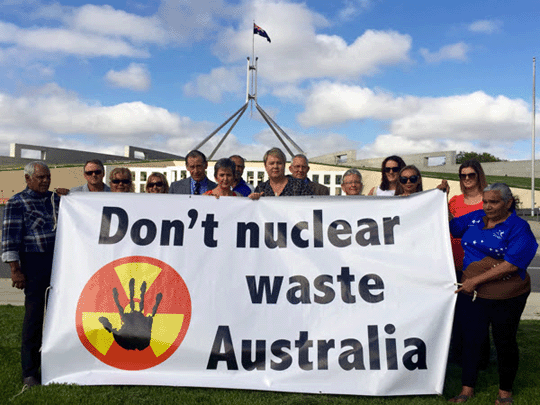
However, despite the jury’s strong rejection of the plan, there was a minority report, calling for more economic modelling delay in the decision.
Premier Weatherill made it clear that the discussion will continue.
We can expect the pro nuclear camp – Labor and Liberal to now trash the whole idea of Citizens’ Juries (though if there had been a “neutral” or “yes” result, they would have praised it!)
And – let’s not forget, that other nuclear waste plan. The Federal government wants to impose a radioactive waste dump at Barndioota in the Flinders Ranges. The pretense is that it is for the (very short-lived medical radioactive wastes). The reality is that it is for the radioactive trash that originated from the Lucas Heights nuclear reactor in Sydney.
A plea for the Nuclear Citizens’ Jury South Australia to be allowed to really act as a JURY
Tim Bickmore Nuclear Citizens Jury Watch South Australia, 6 Nov 16 “What I would like to see happen tomorrow is every juror,at the start of the day, be given a small piece of paper and then asked to put where they stand on the paper, either NO or Yes or Maybe. then hand in the paper to DemCo. Results should be tallied, any vote with more than one word on it should be discarded as informal, and the results then revealed to the jury.
To me this is the only way to gauge the feeling of the entire group.
It will not happen of course.”
Federal government, not South Australia, is responsible for decision on nuclear waste importing
…”While not prohibited under Federal laws, constructing a facility for storage or disposal of radioactive waste, would require approval from …the Nuclear Non-proliferation [Safeguard] Act 1987…. and the Environmental Protection and Biodiversity Conservationa Act 1999…as a ‘nuclear action’ likely to have a significant impact on the environment…and conveys approval authority on the Federal Minister for the Environment. It is not a regime specifically targetted to the regulation of nuclear facilities”Yes, Yes or no, the Federal Minister of the Environment, should now make it public that The Federal Government, is looking into giving advice to the legality of the RC report recommendations, in relationship to environmental and Internatioanl non-poliferation, and is make it public to all Australians. This confirmation will show if SA is wasting time and money, before any other amendment to existing legislation are clearly and transparently put forward in SA, and before any further action is considered. As the tennis balls are all in Federal and International regulatory control. https://www.facebook.com/groups/1172938779440750/
A Citizens’ Juror rejects the Nuclear Fuel Chain South Australia’s recommendations
 Tim Bickmore Nuclear Citizens Jury Watch South Australia, 5 Nov 16, quotes from a juror
“Dear Fellow Jurors
I have read the discussions but have not posted until now. I came to the Jury with an interest in being well informed on this issue and a mildly positive attitude towards the idea. I am now strongly against because
1. I reject the RC financial modelling because there are way too many unknowns.
2. The safety and financial risks for transport and above ground storage of high level waste without knowing if we have a suitable site, have consent from landowners, and can afford to dig the hole is just too great. We could end up being responsible for thousands of tons of high level waste to be managed at our cost and risk. Safety depends on rigorous regulation and I do not trust future governments not to privatise control or reduce funding to the regulator, resulting in accidents ( evidence WIPP for human error and sloppy regulation)
3. The aboriginal community are dead against the idea and will fight it to the high court, causing costs and delays even if they don’t win. Maybe it is time to honour their wishes on this important matter.
4. This scheme does not deliver jobs in great enough numbers or soon enough to be worth the risks. Better to invest in research and development of industries which contribute to employment , the health and wellbeing of the population and the state’s reputation as a clean food producer and a beautiful place to visit.
5. 120 years to completion is way too long. There will be developments that we cannot imagine in that time, including ways to deal with nuclear waste. IAEA will continue to work on that and a solution may well be found that makes this proposal redundant.
JUST TOO RISKY IN MY OPINION” https://www.facebook.com/groups/1172938779440750/
Nuclear Citizens’ Jury to present report to Premier Jay Weatherill
Jury to present report on nuclear dump https://au.news.yahoo.com/sa/a/33112398/jury-to-present-report-on-nuclear-dump/#page1 on November 5, 2016,
The 350-member jury will gather for the last time in Adelaide on Saturday and Sunday as they seek to answer the question of under what circumstances, if any, could SA store and dispose of nuclear waste from other countries.
By Sunday afternoon, the group will present its report to Premier Jay Weatherill which is expected to summarise the key themes and considerations discussed by the jury over their six sitting days.
In its deliberations the jury has heard from experts, has considered the recommendations from the royal commission into the nuclear fuel cycle and has also examined feedback from three months of community consultation.
The state government has pledged to make a decision on the the dump issue by the end of the year but to proceed much further will require a change of Labor Party policy at both a state and federal level.
Last weekend the state Labor conference voted to put the issue to a special convention.
1 This month
Chernobyl: The Lost Tapes – A good documentary on Chernobyl on SBS available On Demand for the next 3 weeks– https://www.sbs.com.au/ondemand/tv-program/chernobyl-the-lost-tapes/2352741955560
15 April – Zoom –Nuclear Power is Not the Solution
Apr 15, 2026 01:00 AM in Canberra, Melbourne, Sydney

Join the International Physicians for the Prevention of Nuclear War (IPPNW) on Tuesday, April 14th for a timely webinar exploring the risks associated with nuclear power and challenging the myth that it offers a simple, safe, carbon-free solution to the climate crisis

21 April Webinar: No Nuclear Weapons in Australia
Start: 2026-04-21 18:00:00 UTC Canberra, Melbourne, Sydney (GMT+10:00)
End: 2026-04-21 19:30:00 UTC Canberra, Melbourne, Sydney (GMT+10:00)
Event Type: Virtual
A virtual link will be communicated before the event.
Host Contact Info: australia@icanw.org

of the week – Australians for War Powers Reform (AWPR)
To see nuclear-related stories in greater depth and intensity
 Antinuclear