Eloquent Submission to #NuclearCommissionSAust – an Aboriginal Perspective
 Submission to: Nuclear Fuel Cycle Royal Commission South Australia Prepared by Breony Carbines on behalf of West Mallee Protection
“West Mallee Protection are a conservation group made up of Aboriginal and non-Aboriginalmembers based in Ceduna on the west coast of South Australia. Our On country work includes cultural maintenance of water rock holes and monitoring of biodiversity in the last stretch of intact stunted mallee country. WMP also works to ensure that this area is protected now and well into the future.”
I found it very hard to select an extract from this submission, because I didn’t want to exclude any of it. This submission is expressed with clear and forceful logic: it contains excellent references and recommendations.
Here’s what they had to say about the Commission’s question onsetting up a nuclear waste dump:
Dr Caldicott’s submission concerning radiation #NuclearCommissionSAust
Dr Helen Caldicott Submission to the Nuclear Fuel Chain Royal Commission http://www.helencaldicott.com/submission-to-the-nuclear-fuel-cycle-royal-commission/
Excerpt – Types of ionizing radiation
- X-rays are electromagnetic, and cause mutations the instant they pass through the body.
- Similarly, gamma radiation is also electromagnetic, being emitted by radioactive materials generated in nuclear reactors and from some naturally occurring radioactive elements in the soil.
- Alpha radiation is particulate and is composed of two protons and two neutrons emitted from uranium atoms and other dangerous elements generated in reactors (such as plutonium, americium, curium, einsteinium, etc – all which are known as alpha emitters and have an atomic weight greater than uranium). Alpha particles travel a very short distance in the human body. They cannot penetrate the layers of dead skin in the epidermis to damage living skin cells. But when these radioactive elements enter the lung, liver, bone or other organs, they transfer a large dose of radiation over a long period of time to a very small volume of cells. Most of these cells are killed; however, some on the edge of the radiation field remain viable to be mutated, and cancer may later develop. Alpha emitters are among the most carcinogenic materials known.
- Beta radiation, like alpha radiation, is also particulate. It is a charged electron emitted from radioactive elements such as strontium 90, cesium 137 and iodine 131. The beta particle is light in mass, travels further than an alpha particle and is also mutagenic.
- Neutron radiation is released during the fission process in a reactor or a bomb. Reactor 1 at Fukushima has been periodically emitting neutron radiation as sections of the molten core become intermittently critical. Neutrons are large radioactive particles that travel many kilometers, and they pass through everything including concrete and steel. There is no way to hide from them and they are extremely mutagenic.
So, let’s describe just five of the radioactive elements that are continually being released into the air and water at Fukushima. Remember, though, there are over 200 such elements each with its own half-life, biological characteristic and pathway in the food chain and the human body. Most have never had their biological pathways examined. They are invisible, tasteless and odourless. When the cancer manifests it is impossible to determine its aetiology, but there is a large body of literature proving that radiation causes cancer, including the data from Hiroshima and Nagasaki. Continue reading
#NuclearCommissionSAust – An Aboriginal group slams its processes
monetary compensation via Native Title is not the solution – don’t insult us by simply hying to buy our consent and silence our concerns
 SUBMISSION TO THE NUCLEAR FUEL CYCLE ROYAL COMMISSION.
FROM: ANGGUMATHANHA CAMP LAW MOB
Extract Why we are not satisfied with the way this Royal Commission has been conducted: Yaiinidlha Udnyu ngawarla wanggaanggu, wanhanga Yura Ngawarla wanggaanggu?
always in English, where’s the Yura Ngawarla (our first language)?
The issues of engagement are many. To date we have found the process of engagement used by
the Royal Conuuission to be very off putting as it’s been run in a real Udnyu (whitefella) way.
The lack of an intelpreter service means we are forced to try and engage using English (or rely on the goodwill of caring community members), and often this means we cannot be part of the engagement process. Even a Plain English summary of the four papers would have been helpful, and more opportunity for people to give oral submissions in their first language with a translator to interpret. We say that govemment and industry have a moral and ethical obligation to include us as citizens of Australia, and as Traditional Owners of our Country. We suspect that many other Australians would have benefited from a Plain English version of the papers and this was suggested by many people who went to the first lot of community meetings held by Kevin Scarce and his team. Not everyone has good English literacy.
Requiring a JP’s signature is a barrier to participation and suggests that ordinary people cannot
be trusted; not everyone has easy access to a JP, and the timeline puts pressure on people to do
this. We feel this is likely to intimidate people and discourage many from participating.We strongly recommend that the Royal Commission do more work on the following issues:
- Provide the public with better understanding of the health, cultural, and social impacts in other
countries of an expanding nuclear industry (including public anxiety, contaminated areas, effects 0n public health); - Provide adequate resources to enable all Australians to be part of an informed process – put
people before profit; - The lack of advertising, and very short notice on several occasions suggests that government and
industry and not serious about wanting to engage with public opinion and don’t value our input. - Many people think this suggests the proposal is ‘a done deal’ and that it will go ahead anyway.
- Timelines are short, information is hard to access, there is no interpreter service available, and
the meetings have been very poorly advertised. - Engagement opportunities need to be fair and equitable (readily available to all people) and the Native Title interest is no more important than the wider community.
- A closed and secretive approach makes engagement difficult for the average person on the street, and near impossible for Aboriginal people to participate.
- Government continue to use an assimilatory process; they ignore us by refusing to translate
information into our first language, and they make no effort to understand our views in our
languages as the First Australians. The lack of a well-thought out engagement strategy tells us that our views are not important, that government and industry will do what they want regardless of public wishes. - Develop a compensation package for the likely economic impacts from the negative associations of nuclear industry on local and regional economy – ego Loss of prices in crops, housing, land, as a result of contamination threats, accidents and breaches of EPA regulations;
- Develop actual measures to counter threats from terrorist organisations re: protection to avoid nuclear site attacks, and local capacity to deal with emergency situations;
- Tell the public what risk management plans need to be developed for communities impacted by transportation along the travel routes – for example, who will respond to a truck accident and are they equipped to deal with it; Informed awareness among communities that live along the designated travel routes so they can make decisions about their future.
- The nuclear industry must find ways to show respect for the rights of Traditional Owners who are concerned about or opposed to the nuclear industry – monetary compensation via Native Title is not the solution – don’t insult us by simply hying to buy our consent and silence our concerns;
 Provide means for ongoing and independent monitoring of dangerous levels of airbome and water-based contaminants in groundwater, along transportation routes, after accidents, and among food sources used by Aboriginal people ego Nguri, urdlu and warratyi varlu, awi. We have a right to measure and monitor levels of radiation like other people do in countries such as the USA. We know from the Kakadu mine in NT that there is a major problem there with water management that is yet to be resolved.
Renewable Energy way ahead of nuclear – Rebecca Keane’s Submission to #NuclearCommissionSAust
http://nuclearrc.sa.gov.au/app/uploads/2015/09/Rebecca-Keane-23-07-2015.pdf I am astonished that South Australia is even being considered as a site for nuclear power plants and/or radioactive waste dumps. Australia’s rapid and widespread progress in the harnessing of our virtually unlimited solar energy resource is evident in the fact that currently 1.4 million households have rooftop solar installations!. The huge potential for expansion in this field negates any need for the pursuit of such a highly dangerous enterprise as nuclear power generation.
Solar thermal energy supply, where solar energy is stored as heat is also highly efficient and offers
tremendous opportunities in this country. Moreover, our nation’s geographical conditions are extremely favourable to the massive development of other renewable sources such as wind, hydro and wave power. Wind energy is emerging as a highly cost-effective resource and vertical axis wind turbines are particularly effective and create no noise issues.
The West Australian coast is subject to the world’s strongest wind system (The Roaring Forties) with the energy released each year from the pounding of the waves influenced by this system, equating to five times Australia’s annual total energy usage2. Over 85% of Australians live in close proximity to the
coast.
A combination of the utilisation ofrenewable intermittent sources such as solar, wind
and wave energy with back-up hydro and gas-driven turbines is recognized by experts throughout the world as being highly comparable in terms of both adequacy and reliability of supply, to existing coal-driven technology. Over 24,000 people are employed in Australia’s renewable energy industries compared to 10,000 in coalmining for the domestic market 3 Continue reading
Electrical trades Union of Australia dispels the hype about Generation IV Nuclear Reactors
Electrical Trades Union, Graham Glover Submission to South Australian Government Nuclear Fuel Cycle Royal Commission http://nuclearrc.sa.gov.au/app/uploads/2015/09/Electrical-Trades-Union-03-08-2015.pdf

Crisis of confidence in the process of #NuclearCommissionSAust
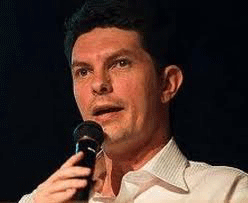 Submission to the South Australian Nuclear Fuel Chain Royal Commission, by Senator Scott Ludlam
Extract The Australian Greens have cautiously welcomed the idea of a Royal Commission to settle the issue of the nuclear industry in Australia once and for all.
For decades there have been the protagonists for and against the industry. There have been reports and case studies, public debates, political debates but nuclear power always comes up as unfeasible and hugely unpopular.
It is disappointing that this opportunity to examine the industry has been designed to exclude so many important issues and many voices on those issues. The process, independence and good fa ith of the Royal Commission has been damaged by narrow terms of reference, an unbalanced expert panel and consultation failures in remote and regional communities.
The terms of reference have been designed to exclude any review of the existing problems with uranium mining and waste management, the ongoing costs and liabilities from closed mines and processing facilities- costs that are left to the tax-payer.
The panel is in no way independent or balanced; it has been dominated by the nuclear industry and their advocates. We note complaints from Aboriginal communities in South Australia about the first round of ·engagement. Many people did not know about hearings or had limited warning about hearings. Others have not been given access to documents and or do not have access to the Internet, or do not speak English. We have had reports that hearings have been held in pubs at 11am – completely inappropriate for working people, and those who wouldn’t set foot in a pub.
There have been significant barriers put up for people in remote and regional communities. Inaccessible meetings and information, language barriers and the added constraint of getting submissions approved by a justice of the Peace all serve to exclude participation in the process. People in remote areas of SA have been most affected by South Australia’s involvement in the nuclear industry, and they are also the ones who are most likely to be affected by any future industrial nuclear activities. We are at a point where is a crisis of confidence in the process…..”
A Submission to #NuclearCommissionSAust raises objections to its whole modus operandi
 Submission to the SA Nuclear Fuel Cycle Royal Commission Ally Fricker & Bob Lamb for ENuFF (Everyone for a Nuclear Free Future)
A few introductory objections about the RC:
* The 4 Issues Papers provided by the RC became available throughout the early part of May 2015, and the RC was still holding information meetings until the 3rd week of May, thereby, limiting the time available in which people could, reasonably, be expected to respond to the complexities of the nuclear fuel cycle
* The highly structured format required in which to respond including the unnecessary requirement for a statutory declaration
* The bias in the “objective” information provided followed by “questions to be answered”; indeed, the questions are so loaded that frequently they, in themselves, determine the answer – or hope to. We noted information only from industry and/or government sources. No authors critical of the industry were cited
* The timing of the federal government’s adverts calling for tenders for long-term disposal for Lucas Height’s waste concurrent to the commencement of the RC
* The likelihood that the mining lobby and other pro-nuclear interests had prior notice – a couple of high-profile conferences were held in Adelaide at the time of the announcement of the RC which gave first Tim Stone (March 12) and shortly after Barry Brook timely and extensive media opportunities to spruik their pro-nuclear arguments and
* The timing of Premier Jay Wetherill’s enthusiastic comments about opportunities for SA which could come from an expansion of the nuclear industry in SA in stark contrast to previous concerns expressed by him and former Premier Mike Rann.
For these and other reasons we consider that there is little likelihood that the RC will come to any conclusion that is not in the interests of the military/civilian nuclear industry in collaboration with SA and federal governments.
The history of this industry leads us to have zero trust in its statements, its modus operandi and its motivation in South Australia, at this time…… http://nuclearrc.sa.gov.au/app/uploads/2015/09/ENUFF-30-07-2015.pdf
Questionable Integrity of #NuclearCommissionSAust scrutinised in 22 questions – Submission by Yurij Poetzl
Submission To The Nuclear Fuel Cycle Royal  Commission Regarding Issues Papers 1 and 4 by Yurij Poetzl http://nuclearrc.sa.gov.au/app/uploads/2015/09/Yuri-Poetzl-24-07-2015.pdf
I’m a private citizen and have no vested interest in the nuclear industry; however the nuclear industry does direct ly impact me, my family and my friends As a member of the public I wish to give evidence and express my concerns in regard to the issues being examined by the Royal Commission.It is valid to examine economics and risks relating to the nuclear industry; however is the Royal Commission a fair and objective examination of the Nuclear Cycle? It has been disclosed that Kevin Scarce Is a shareholder in the Rio Tinto Group,who own and operate uranium mines in Australia and internationally. ls this a conflict of interest for the Royal Commissioner? It is of great concern that the Royal Commissioner has selected predominantly pro-nuclear experts for the R.C’s Advisory Committee (the single exception being Professor lan Lowe). See Appendix 1.
It also seems remiss that there isn’t any health or medical professionals engaged in the R.C’s Expert Advisory Committee or Key Commission staff. It’s well documented that by-products of the nuclear industry can have adverse effects on the health of the global community for many future generations. The omission of health experts makes me question whether the R.C is truly considering what is in my and the general public’s best interest.
The Public Health Association of Australia have made their position clear in regard to the R.C and the Nuclear Industry, see http :1 /www .phaa. net. au/ documents/item/51 0 or http://www .phaa.net.au/documents/item/264 The Royal Commission could prove to be pivotal in South Australia’s future having significant and far reaching consequences, affecting many future generations; however, was the process leading toward the establishment the Royal Commission flawed?
The S.A. public (and wider global communit y) deserve a balanced and unbiased assessment of the issues raised Appendix 2. Contains questions regarding issues papers 1 and 4 Yours sincerely Yurij Poetzl
Appendix. 1 4 of the 5 Royal Commissions Expert Advisory Committee appear to be pro nuclear. They are Professor Barry Brook, Dr Timothy Stone, John Carlson AM and Dr Leanna Read. Below is a brief summary oftheir involvement in the nuclear industry Professor Barry Brook is an active advocate of the Nuclear Industry. The self described”Promethean Environmentalist” is openly critical of people who have concerns regarding the Industry. Professor Brook is the author of, or contributor to several pro nuclear publications such as; Key role for nuclear energy in global biodiversity conservation, Australia’s nuclear options and, An Open Letter to Environmentalists on Nuclear Energy. To name a few.
Dr Timothy Stone is an advocate for nuclear power generation and nuclear industrial expansion in Australia. In the UK Dr Stone has held the position of Expert Chair ofthe Office for Nuclear Development and he is currently on the board of Horizon Nuclear Power as non-executive Director John Carlson AM has been Director General of the Australian Safeguards and Non-Proliferation Office. In part 6 of the introduction to Mr Carlson’s paper “Nuclear power for Australia”- an outline of the key issues he claims “Nuclear has a major advantage over other energy sources”. Later in the same document Mr Carlson states “Currently both major parties say that nuclear power is “offlimits”. While this is disappointing, at least it ensures neither side is making statements tlhat will later be embarrassing to retract” It is clear that Mr Carlson is pro nuclear providing the appropriate safeguards are met
Dr Leanna Read has publicly stated that she “has an open mind” regarding the Nuclear Industry. Dr Read is a Fellow of the Australian Academy ofTechnological Sciences and Engineering, which advocated for nuclear power in Australia in August 2014. This seems to contradict Dr Read’s claims of impartiality toward the nuclear industry Given the information in Appendix 1, can the Royal Commission be considered truly independent?
Appendix 2 Continue reading
Geoff Russell: Falls from solar rooftop a bigger danger than Fukushima?
 Geoff Russell, Extract from Submission to the South Australian Nuclear Fuel Chain Royal Commission “……The Royal Commission is uniquely placed to learn from the past, but it will need to deal with the drivers of nuclear fear in the community. To build confidence in the community, the Commission’s report will need to convince both sides of politics to speak with one voice about the misinformation that drove (and drives) the Fukushima evacuation.
Appeasement, in the form of more and more levels of safeguards and protocols to attempt to say that “it can’t happen here” isn’t the answer. There will always be accidents despite every effort to avoid them. Planes still crash, but people understand the relative risks and board them regardless of personal fear.
They understand that fear is their personal problem and not a function of the objective facts. So it’s time to put nuclear accidents into perspective and stop treating them as something fundamentally different.
The fear and irrationality at Fukushima saw people die to avoid a trivial risk. Governments are supposed to protect people from nutters, not act on their behalf.
All energy sources have risks and in a rational world they’d be compared according to proper measures of suffering and disability; the simple trigger sequence logic (“nuclear -> cancer -> end of civilisation”) of decades past shouldn’t be allowed to influence decision making in 2015.
In Australia in 2010-11 there were 7730 Worker’s45 Compensation claims for serious injury resulting from falls from a height. How many were associated with rooftop solar panels? As far as I can see, nobody is even counting, but a million solar rooftops means more people on ladders; many of them amateurs. This is real danger, the kind that can put you in a wheel chair for the rest of your life. A proper comparison of nuclear risks with those of other energy sources will measure and include such risks along with the considerable risks associated with not avoiding continued climate destabilisation because we acted too slowly. We need safe clean energy and climate scientists say we need it fast. The Royal Commission will need to break with past traditions and confront nuclear fear head on and call it for what it is.
City of Port Adelaide Enfield notes poor prospects for New Nuclear Technology
City of Port Adelaide Enfield Submission Nuclear Fuel Cycle Royal Commission
Extract. “…….Council notes the Issues Paper’s reference to the international research into the development of Generation IV Nuclear power generators. The research is aiming to design smaller capacity generators for potential use in regional areas or high energy demand sites, and with significantly less production of hazardous wastes.
As the Paper notes, however, this technology is still decades away – and is not supported by current markets and strong investment trends toward renewable energy, or recent major international policy commitments to move away from nuclear power generally.”
Adelaide Hills Climate Action Group unanimously opposes all nuclear industries
ADELAIDE HILLS CLIMATE ACTION GROUP -Submission Issues Paper 3 – Further processing and Manufacture
(Extract) The Adelaide Hills Climate Action Group reaffirms its commitment to eliminating the combustion of fossil fuels and our strong endorsement of clean, renewable energy systems.
The committee members of the Adelaide Hills Climate Action Group wish to record their unanimous opposition to all nuclear energy and nuclear weapons related industries – no uranium or thorium mining – no processing – no re-processing – no nuclear power stations – no high level nuclear waste dumps.
There are fundamental moral objections to imposing a burden of risk and the cost of perpetual maintenance, defence and surveillance of high level nuclear waste on to multiple future generations for geological time.
We acknowledge there is a valid role for a properly managed low level nuclear waste dump suitable for the safe long term storage of low level nuclear waste materials used for medical and research activities.
[ I was unable to copy the clear argument put here on the unfeasibility of siting nuclear facilities on the South Australian coast]
“……..There is no northern area suitable for the nuclear industry. Previous nuclear failures such as at Fukushima have demonstrated that when all systems break down, the fall back plan to deal with nuclear accidents is to cool and flush with water, despite this resulting in the spreading of pollution. In northern areas of South Australia, access to water is limited, even where this may be sourced from the Great Artesian Basin.
There is no agricultural region or southern area of South Australia suitable for nuclear power generation as no community would be prepared to tolerate nuclear power. Failures such as the Windscale fire, Chernobyl and Fukushima have shown that impacts on livestock and risk of picking up contamination result in the total shutdown of food and grown product industries in such regions with poor recovery prospects.
It is understood that approximately half of the electricity generated in South Australia is now coming from around $5 Billion of renewable energy investment made in the state since 2002. It is therefore reasonable to assume that further investment of another $5B would enable South Australia to produce towards 100% of its electricity from renewables for much of the time. Periods of shortfall would initially be made up by existing gas infrastructure and the interconnector (as they are now). However, increasing deployment of storage technologies and diversity in renewable sources will also significantly reduce the demand for gas and for electricity from other states.
Given that this is achievable at a cost that is below the cost of nuclear power, and that renewables do not have the inherent risks of contamination that nuclear technologies have, there is no financial place for nuclear power in South Australia.
The previous Uranium Mining Processing and Nuclear Energy Review referred to nonreferenced industry estimates that ”suggest wind could meet up to 20 per cent of demand without undue disruption to the network” (Commonwealth of Australia 2006). However, an example observed in Renew Economy – South Australia hits 100% renewables – for a whole working day (Parkinson, 7 October 2014), shows that South Australia regularly has periods where wind electricity is generating more than 80% of the state’s electricity needs. Contrary to the UMPNER Report, the management of the grid copes with the very high levels of renewables, and the coal fired power plants are not required as there is ample gas generation to meet residual needs. As other storage technologies are deployed, the dependency on gas generation can reduce even further.
The Royal Commission should investigate what level of gas generation would be required to back up renewables in South Australia should there be a doubling of wind capacity plus 100 MW of large scale Concentrated Solar Thermal capacity. The option for localised storage of thermal energy at the CST power plant should also be considered…..”
Danger of nuclear stations to coastal communities, Aboriginal people and to water
The ongoing impact of mass dispossession of Anangu people because of nuclear testing on their traditional homelands has very real consequences today, for many residing on the Far Coast of SA
Maralinga is also raised because of the interest it attracts as a potential nuclear waste dump location. The logic appears to be that it is already contaminated, so it perfect for more radioactive waste. CBAA dismiss this logic outright.
Clean Bight Alliance Australia Submission to: Nuclear Fuel Cycle Royal Commission SA
Clean Bight Alliance Australia is a local community group based in Ceduna on the far west coast of SA. Members have a strong interest in the ongoing health of the marine and coastal areas of the Great Australian Bight and the Eyre Peninsular. CBAA advocate for appropriate use of the region’s natural marine resources and educate the community on the risks associated with industrialization of the marine environment.
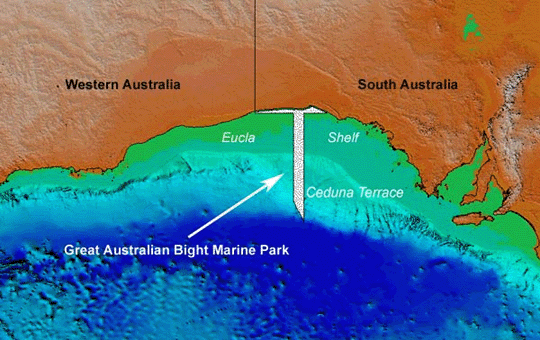
Extract “……CBAA take the position that there are no suitable areas in South Australia for a nuclear reactor. Currently our position is supported by legislation as Nuclear Power generation in South Australia is prohibited by the Environment Protection and Biodiversity Conservation Act 1999 Act and the Australian Radiation Protection and Nuclear Safety Act 1998. CBAA strongly encourages the Royal Commission to appreciate the background to these important pieces of legislation and implications if these were to be further altered or weakened.
Furthermore Nuclear power generation requires large quantities of water for cooling – typically 36.3 to 65.4 million liters per reactor per day. 1 South Australia is known as one of the driest states on one of the driest continents. No inland areas are suitable for the establishment of a nuclear reactor for generating electricity. The amount of water needed can definitely not be sourced with current reservoirs and transportation of the large amounts of sea water required would be unfeasible and costly. Locating a Nuclear Reactor in South Australia is restricted to coastal areas.
However this is also highly unsuitable as siting a nuclear reactor would conflict with other key industries Continue reading
No place for nuclear power in Australia – economist warns
Nuclear power is an expensive, inferior resource that has no place in Australia’s future energy mix, a US economist has warned.http://www.theaustralian.com.au/national-affairs/state-politics/nuclear-power-a-costly-relic-us-economist-warns-commission/story-e6frgczx-1227500265740?sv=f70611a9445ad64e9d33b11dcffd7050 27 Aug 15
Vermont Law School senior fellow for economic analysis Mark Cooper has called on South Australia’s Nuclear Fuel Cycle Royal Commission to reject nuclear power on the grounds that natural gas-fired generation is more cost-competitive.
The former Fulbright fellow’s submission to the royal commission argues that the rapid development of renewable energy technology renders nuclear power a 20th-century “relic” that will be outdated before a reactor can be built in Australia.
“Nuclear power is an inferior resource that has no place in a least-cost portfolio to meet the need for electricity in a low-carbon environment,” he says. “Before a new nuclear reactor could be brought online, efficiency, renewables, other distributed resources and the deployment of the physical and institutional infrastructure to build an intelligent electricity system should well be on their way towards creating a new 21st-century system.”
Nuclear reactors can take up to 15 years to build before becoming operational. Dr Cooper said the huge capital investment required over a long period of time to build a nuclear power plant meant investors would be exposed to “significant risk”.
Royal commissioner Kevin Scarce has acknowledged the rapid development of renewable energy technology could quickly change the goalposts for assessing the economic viability of nuclear energy. Because of this, “heavy assumptions” were being built into the royal commission’s report to government, he said.
#Nuclear waste will be NO bonanza for South Australia
CHRISTINE ANDERSON SUBMISSION TO THE NUCLEAR FUEL CYCLE ROYAL COMMISSION HEALTH EFFECTS OF IONISING RADIATION
“……..The economic costs of nuclear reactor decommissioning are a negligible component of lifetime nuclear reactor costs when a decision is made to build a nuclear reactor, largely because these costs are so far into the future and have been heavily discounted to net present values.
When it comes to actually decommissioning a nuclear plant, the experience of the UK Nuclear Decommissioning Authority at Sellafield is costs are rapidly escalating with actual experience at the site – from 25.1 billion pounds in 2009-2010 to 47.9 billion pounds in 2013-2014 according to the UK Audit Office report at http://www.nao.org.uk/report/progress-on-the-sellafield-site-an-update/ .
WASTE STORAGE
Payments for waste storage might well be in the billions, but nowhere in the world have payments ever come close to meeting the full costs of storage so far, let alone for half a million years. It is definitely not a bonanza when the costs are higher than any income. I think it highly unlikely that any company or country will pay South Australia the money needed to identify a site, design and construct the storage facilities , and presumably operate it for many years and maintain it securely until it is full, and presumably totally closed off for at least 250,000 years. Even if any waste storage facility was restricted to Australia’s own nuclear waste, this will include reprocessed fuel rods from Lucas Heights , including small amounts of plutonium.
These wastes are from Australian government facilities, and although the federal government might pay some upfront design and construction costs, I can’t see them paying SA for the full costs, let alone a bonanza.. The Advertiser published an article on 11 April 2015 about Yucca Mountain, Nevada which was intended to be permanent storage for 70,000 tonnes of hazardous waste in casks in 8 kilometres of tunnels 305 metres underground. Funding was cut off in 2007 because Nevadans oppose the site. The US government has already spent somewhere between $15 billion and $100 billion in drilling and testing this site so far. A federal court ordered the US Nuclear Regulatory Commission to resume the licensing process for the site, and it seems likely Congress will support it again in the next few years.
Australia has already been through at least 4 series of processes over the last 30 years for identifying and building a waste storage site for its own wastes, mainly for Lucas Heights fuel. I doubt if anyone has attempted to calculate the public cost to date. Most of the likely sites will be aboriginal land or pastoral lease or Crown land subject to native title claims, and I believe most aboriginal groups will oppose further and effectively permanent loss of control and poisoning of their lands.
If we receive the waste, we are not going to be able to get rid of it. Continue reading
No “Nuke State” for South Australia – say Josephite SA Reconciliation Circle

Josephite SA Reconciliation Circle
Royal Commission into the Nuclear Fuel Cycle
SUBMISSION TO ISSUES PAPERS 1 – 4
The Josephite SA Reconciliation Circle is a group of concerned citizens with a deep and
abiding interest in the health and well-being of Aboriginal peoples who have already been particularly impacted by the nuclear industry in Australia. We have seen great suffering in Aboriginal communities in the name of progress. The very fact that State funds are being invested in this Royal Commission is deeply disturbing.
We see investment in the nuclear cycle is a backward step and are alarmed by the prospect of
any form of nuclear proliferation. Like many in our community we are shocked that the South
Australian Government could consider going down the path under consideration by the Royal
Commission into the Nuclear Fuel Cycle. We want to continue to be proud to be South
Australian, not ashamed. We do not want South Australia to become ‘The Nuke State’.
There is a need for continued social and economic development of South Australia. We
welcome positive change and development and are excited by the potential energy
opportunities for our State. Most recently, we have been buoyed by reports that renewables
expert Dr. Mark Diesendorf from the University of NSW has completed a report showing that
South Australia could be run on 100% renewable energy is just 15 years! There is a way
forward.
We offer the following responses to questions posed in the Issues Papers………
1 This month
To see nuclear-related stories in greater depth and intensity
– go to https://nuclearinformation.wordpress.com/


 Antinuclear