Property Council of South Australia’s Nathan Paine,Theo Maras, Chris Burns push for importing nuclear waste
 Christina Macpherson, 15 June 13, In 1980, Senator Jean Melzer warned about Australia becoming “the quarry and waste dump of the world” . The Australian Labor Party soon got rid of her. In 2007 Kevin Rudd came into power as Labor appeared to be opposing a nuclear waste dumping industry in Australia.
You might think that this nuclear waste importing idea has gone away. But it never did. And Australia has a global agreement that could swing it into action faster than you can swing a cat – the International Framework for Nuclear Energy Cooperation(IFNEC)
You might think that this noxious idea is not getting any support from the Australian public.
If so – you thought wrong.
In South Australia, the Property Council of SA, and several businessmen with more dollars in their eyes, than brains in their heads, are now pushing that same old nuclear barrow.
Here’s how they were reported in Adelaide Now today: “Some also call for the development of a domestic nuclear power sector that Property Council of SA executive director Nathan Paine predicts could turn us into the “Dubai of Asia”….

He said: “You’d almost be able to give every South Australian … when they turn 18, a cheque for $50,000 and a house.”……
, Mr Burns said SA should develop a nuclear sector. He said: “What we’ve got unique resources for in this state are for nuclear energy. We have the resources in the ground; we should be digging it up and processing it. Never sell it, only lease it and bring it back here to bury it. I think that’s the industry for the state.”
SA has 40 per cent of the world’s known uranium reserves. Mr Maras said if the government championed a nuclear industry, business would soon come on board…..
They even want South Australia’s “mums and dads” to invest in developing such ideas in the We’re for Jobs in SA campaign
Labor and Liberal in happy agreement pro uranium mining
 States sign agreement on uranium ABC News, Jun 12, 2013 The New South Wales and South Australian governments have signed an agreement to encourage mining and exploration along the border of the two states.
The memorandum of understanding was signed at a uranium mining conference in Darwin yesterday.
Uranium exploration has only recently been allowed in NSW, while it is already being mined at Honeymoon and Beverley over the border…… “They want to see politicians whether they’re Liberal, Labor or National all working together and we are.”
Mr Hartcher says the agreement does not open the door to uranium mining in NSW….. http://www.abc.net.au/news/2013-06-12/states-sign-agreement-on-uranium/4748452
South Australian wave energy project is progressing
 Port MacDonnell wave energy project ‘on track’ ABD News 12 June 13, Wave energy company Oceanlinx says the construction site of its $7 million Port MacDonnell development is being prepared this week. A 20-square metre offshore concrete unit is expected to be connected
to the power grid by the end of the year and will power 1,000 homes in Port MacDonnell. CEO Ali Baghaei says equipment has started arriving at the site and construction workers have begun setting up.
He says people will soon see the development taking shape….. “We are very much keen to ensure it stays on track and thankfully it has beenon track and I’m very pleased with the progress we have made,” he said. “I must say we have received quite a lot of support from the local communities and I want to thank them all for it.” http://www.abc.net.au/news/2013-06-12/wave-energy-firms-port-macdonnell-project-on-track/4748830
Financial benefits of solar power leading South Australians to make the switch
 Households in South Australia are increasingly turning to solar power to alleviate or even obliterate energy bill woes. National solar energy provider Energy Matters estimates a good quality solar power system installed in Adelaide can return a financial benefit of between $1,502 – $1,711 annually.
South Australian Electricity Prices Biting Hard http://www.energymatters.com.au/index.php?main_page=news_article&article_id=3784, 10 June 13 The last 6 months of 2012 saw a substantial increase in the number of SA households turning to electricity instalment plans and joining electricity retailer hardship programs says the Essential Services Commission of South Australia. Continue reading
The radioactive poisoning of Maralinga
 Historic records of Radiation Monitoring at Australian Nuclear Test Sites, Paul Langley’s Nuclear History Blog 3 June 13“……..RETURN TO MARALINGA, Australia Bomb Test Site On 24 May 1984 a special VIP flight to the RAAF left Adelaide for Maralinga. On board were the Minister of Resources and Energy, Senator Walsh, and the south Australian Premier, John Bannon, accompanied by scientists of the Australian Radiation Laboratory. The tour of the bomb sites took no more than four hours and the politicians learned little more than they already knew from their briefings in Canberra and Adelaide. But the importance of the trip was symbolic. The representatives of the Federal and South Australian Government were there jointly to express their regret that the atomic test series had ever been allowed to take place in Australia and to pledge their support for all investigations into the possible harm done to servicemen, Aborigines and the environment…….
Military and Mining to rule Woomera – an area larger than England

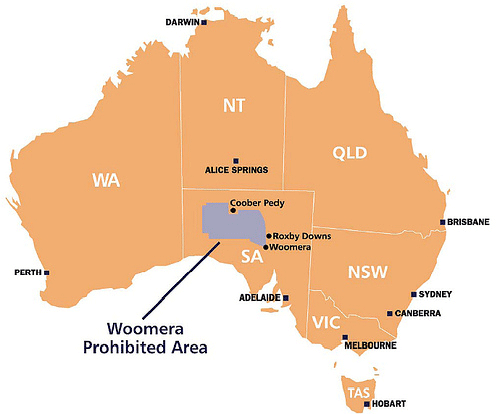
 Australia eases access to world’s biggest weapon range, SMH, 30 May 13 , Australia will ease access restrictions on the world’s largest weapons test range in the remote outback – an area larger than England – to unlock an estimated $35 billion in untapped mineral resources, with legislation for the change unveiled on Thursday.
Australia will ease access restrictions on the world’s largest weapons test range in the remote outback – an area larger than England – to unlock an estimated $35 billion in untapped mineral resources, with legislation for the change unveiled on Thursday.
The Woomera Prohibited Area covers 127,000 square km of mostly barren desert and has been closed to the public since 1947, when it was used for Cold War rocket and nuclear tests by Britain, Australia and the United States.
The sprawling site, which is almost free from electronic signal interference, was also chosen this year as test site for the joint British-French unmanned supersonic stealth drone Taranis, under development by BAE Systems Plc. Defence Minister Stephen Smith told MPs that new legislation would allow miners and some members of the public with reason to be there to share access to the land with the military, to better balance national security and economic concerns………
Parts of Woomera, which hosted British nuclear weapons tests between 1955 and 1963, also lie adjacent to the Olympic Dam site, which BHP Billiton decided not to expand last year as Australia’s mining boom stalled. A small number of mines already exist in the area, including Prominent Hill and Kingsgate Consolidated Ltd’s Challenger gold mine.
Under the new access arrangements, the military would remain in charge of the area, but a permit system would give civilians the right to enter Woomera. As well as miners, indigenous Aboriginal residents can also enter the zone, and environmental or other researchers.The legislation sets up a series of zones, some of which would be zoned red for “continuous defence use” and others which would exclude mining and exploration for between 14 and 70 days a year, in a timeshare arrangement with the military.
“It allows users to make commercial decisions with some assurance as to when they will be required to leave the Area because of defence activity,” Smith said……Smith said the legislation would be passed as a priority before parliament was dissolved for September elections.: http://www.smh.com.au/business/australia-eases-access-to-worlds-biggest-weapon-range-20130530-2ne3a.html#ixzz2Uuz6nLoX
Australian Government’s mock “consultation” about opening Woomera to miners
 Government’s “consultation” on mining in Woomera more like a ram raid Australian Greens nuclear policy spokesperson Senator Scott Ludlam. 17 May 2013. The Federal Government made a mockery of public consultation by allowing three working days for initial submissions on opening up the Woomera Prohibited Area to miners, Greens Senator Scott Ludlam said today.
“On Wednesday 8 May Defence Minister Stephen Smith and resources Minister Gary Gray released the draft exposure of legislation to increase access to Woomera Prohibited Area to miners, and three working days later on 13 May the submission period closed. It’s not good enough,” said Senator Ludlam.
 “Lawyers representing the Maralinga people, who in addition to being the Traditional Owners own approximately 40,000sqkm of freehold land in the area, advise that they have not been consulted on this legislation despite approaching the Defence Minister on the issue in July 2011.
“It is a relatively short amendment at nine pages but it is high-impact legislation. This area has an estimated 78 per cent of Australia’s known uranium reserves. The implications are massive.
“After years of review and the production of an 82 page report, we do not want to see a long process brought to an abrupt and shallow end.”
Australian Uranium Association’s Paydirt Conference shortened to one day, in gloomy economic prospects
 PAYDIRT URANIUM CONFERENCE IN ADELAIDE THIS MONDAY Uranium industry boosters will gather this Monday April 29 at the Adelaide Hilton for the annual Paydirt Uranium Conference. This year’s conference has been downgraded to a one-day event, reflecting industry stagnation in the wake of the Fukushima disaster.
Friends of the Earth national nuclear campaigner Dr Jim Green, co-author of a new report exposing the economic myths of the uranium industry, said: “The Australian Uranium Association’s Executive Director Michael Angwin claims that Australia “has enough reserves to be to uranium what Saudi Arabia is to oil”. However Australia’s uranium export revenue in 2011 was 466 times lower than Saudi oil revenue in the same year. Others to draw asinine comparisons between Australian uranium and Saudi oil include former SA politicians Mike Rann and Kevin Foley, and Adelaide-based academics Ian Plimer and Haydon Manning.”
“For decades the uranium industry has promised great economic benefits but it never delivers. Uranium accounted for just 0.29 per cent of Australia’s export revenue in the 10 years from 2002−2011. In the last financial year, uranium revenue was four times lower than Australia’s 20th biggest export earner, eight times lower than Australia’s 10th biggest export earner and 103 times lower than the biggest earner, iron ore. Even milk and cream generate nearly twice as much export revenue as uranium − and can’t be turned into Weapons of Mass Destruction. Uranium mining and exploration accounts for just 0.015% of all jobs in Australia.”
“Last year, BHP Billiton cancelled its planned expansion of Olympic Dam, disbanded its Uranium Division, and sold the Yeelirrie uranium lease in Western Australia for about 11% of the nominal value of the resource. Just months after first production at the Honeymoon mine in north-east SA in September 2011, project partner Mitsui announced its decision to withdraw as it ‘could not foresee sufficient economic return from the project.'”
“An independent inquiry is long overdue to objectively weigh the uranium industry’s economic benefits against its effects on environmental and public health, safety and security, particularly in the shadow of the unfolding Fukushima tragedy − a tragedy directly fuelled by Australian uranium,” Dr Green concluded.
‘Yellowcake Fever: Exposing the Uranium Industry’s Economic Myths’, a report released by the Australian Conservation Foundation last Friday, is posted at:
Now Tony Abbott is over- hyping Olympic Dam uranium mine expansion
 Tony Abbott vows the Coalition would give Olympic Dam a chance to succeed BRAD CROUCH :adelaidenow April 27, 2013 FEDERAL Opposition Leader Tony Abbott today vowed to create economic conditions to help the stalled Olympic Dam mine proceed after blaming the State and Federal governments for it being put it on hold by BHP Billiton.
However, Mineral Resources Minister Tom Koutsantonis accused Mr Abbott of “over-spruiking” by suggesting the Coalition could get Olympic Dam expanded, saying Mr Abbott would have to change international conditions.
Mr Abbott said he could not guarantee the project would proceed under the Coalition but said: “I can promise there will be no obstacles from government that will impede its progress.”
“I want to give the Olympic Dam expansion a chance,” Mr Abbott said. “It is not on hold because of the quality of the ore body, lack of dynamism in South Australia or a lack of work ethic, it is on hold essentially because State and Commonwealth Labor governments have not created a climate in which this kind of investment can go ahead.”He also repeated promises to dump the carbon and mining taxes, put the budget “back in the black” and restore border security in a speech heavy on hope but light on specifics, such as how to fund the changes.
Mr Koutsantonis responded, saying: “He needs to change business conditions internationally, not just in Australia – what will get Olympic Dam over the line is not conditions in Australia or South Australia, it is the price of copper and uranium and the development of new technology to reach one of the most difficult ore bodies in the world.
“Who is over-spruiking now?”…… http://www.theaustralian.com.au/news/tony-abbott-vows-the-coalition-would-give-olympic-dam-a-chance-to-succeed/story-e6frg6n6-1226630615659
South Australian Premier admits mistake in over promoting uranium and rare earths projects
 VIDEO Mining promises too bold, concedes SA Premier http://www.abc.net.au/news/2013-04-23/mining-promises-too-bold-concedes-sa-premier/4645662 Apr 23, 2013 South Australian Premier Jay Weatherill has conceded the Government needs to be more cautious about spruiking mining opportunities in the state. Rare earths company Arafura Resources is to scrap a minerals processing plant planned for Whyalla and keep more of its operations close to the mine site north of Alice Springs.
Mr Weatherill said he agreed with the Opposition the Government had a track record of overselling mining projects but underdelivering.
“I think this was a bit over-spruiked. It was always a speculative project but at the time it was always one that was a realistic project,” he said.”We did no more or less than back up what the company was saying about what they proposed to do, but I think we should be a little more cautious about that and obviously cases like this indicate that.”
Mr Weatherill said with both the shelved BHP Billiton Olympic Dam mine expansion and now Arafura’s project, the Government only backed up what the companies had told it.
“We did the thing we could do which was to provide speedy approvals, now to the extent to which we jump up and down and say this is going to happen is something we can control and we have to take a bit of care about that,” he said.
“It’s difficult to underestimate the significance of these projects, because they are significant.”
Dave Sweeney from the Australian Conservation Foundation said the loss of hundreds of potential jobs was a disappointment for Whyalla, but the decision against shipping material south for processing was a win for the environment.
“There are real concerns with this sort of processing and rare earth processing – you’re dealing with radioactive materials including uranium,” he said.”You would have radioactive exposures and elevated radiation levels in the area, you’d be left with a waste stream that would include a range of radioactive materials that pose a long-term human and environmental problem.”
South Australia may cut its a Solar Feed In Tariff
South Australia Solar Feed In Tariff Threatened, by Energy Matters, 23 April 13, Households and businesses in South Australia considering going solar may want to do so soon. The Essential Services Commission of South Australia (ESCoSA) has proposed that from 1 July 2014, the amount paid to South Australian owners of solar panel systems for surplus electricity exported to the mains grid should be slashed from 25.8 cents down to 9.8 cents.
Under current arrangements and according to information from solar systems provider Energy Matters, a 5kW solar panel system installed in Adelaide can provide a financial benefit exceeding $2,000 a year.
The CEC says ESCoSA has “used the narrowest definition of a feed-in tariff, based on the financial benefit that a solar PV owner provides to his or her electricity retailer.”….
ESCoSA has invited public submissions to its draft determination and a copy of CEC’s submission can be viewed here (PDF). http://www.energymatters.com.au/index.php?main_page=news_article&article_id=3703
Anti nuclear group at Olympic Dam, challenges BHP on uranium mining
Activists check in on Olympic Dam http://www.roxbydownssun.com.au/story/1408767/activists-check-in-on-olympic-dam/?cs=1503 By Ifereimi Nadore April 4, 2013, BHP Billiton has been told to take some responsibility by stopping the sale of uranium to other countries, especially those that have nuclear energy plants.
The message was relayed to a management team based at the Olympic Dam mine this week by a 30 member anti-nuclear resistance movement group, the Friends of the Earth (Australia) which had been touring all of the uranium mines in South Australia.
The group, which is represented by various nationalities from India, Vietnam, Europe and Australia shared its concerns to the BHP Billiton management team and requested it to discontinue selling uranium to safeguard the environment and its population.
A particular case of interest which the group highlighted was the Fukushima disaster in Japan, which the group said was plagued by safety breaches, scandals, cover-ups and inadequate regulations.
Group leader and national nuclear campaigner Doctor Jim Green said the educational trip also gave the group the chance to see the uranium deposits at Olympic Dam and other uranium mines in South Australia. He said BHP Billiton had maintained that the selling of uranium had received the approval of the federal government.
“We are asking [BHP] to stop selling it and take some responsibilities,” he said. He said the group’s request to also visit the tailing dams had been turned down. Dr Green said the trip also provided the members the opportunity to talk to the indigenous landowners about the effect of uranium mining and what it could do to the environment.
The group’s next stop will the uranium mine in Beverly South, Australia.
Toro Energy’s uranium to be moved through Northern Territory and South Australia
New mine to ship uranium through NT, SAhttp://www.skynews.com.au/businessnews/article.aspx?id=860386 April 4, 2013 A new West Australian mine will likely ship uranium concentrate through two other states.
The federal government on Tuesday approved Toro Energy’s $269 million Wiluna uranium project, 30km south of the Wiluna township and about 960km northeast of Perth.
Toro managing director Vanessa Guthrie says shipping is likely to start from 2015 using existing rail lines between South Australia and the Northern Territory.
‘We would take it to Port Adelaide then rail through to Darwin as currently happens with the other co-shippers,’ she told ABC Radio.
The Wiluna mine will become Australia’s sixth producer of uranium and the first in Western Australia.
An Indian’s message to South Australia – leave uranium in the ground!
 “Please leave the uranium underground” , Roxby Downs Sun April 4, 2013, Indian national Bhargavi Dilipkumar has a message for BHP Billiton; to leave uranium underground for it has done more than enough damage to the environment.
Bhargavi visited Roxby Downs this week with Friends of the Earth Australia to receive a first hand experience of what uranium mining was all about and be the voice of India protesting the uranium trade between the two countries.
She said she had been part of the people’s movement that is strongly opposing the building of an atomic power plant to be built at the southern part of India.
Bhargavi is an anti nuclear activitist from India who strongly believes that BHP Billiton should shelve its uranium export program and be responsible for the safety of the environment and million of lives back home.
She visited the Olympic Dam mine and tried to persuade BHP Billiton management to have a heart for the people of India who will suffer long term consequences if the atomic power plant was allowed to go ahead.
“Please leave the uranium underground,” she said.
“Don’t mine it because its destroying lives.”
Similar sentiments were expressed by German nationals Danda Petter and Miriam Ribbeck who had been part of a nation-wide protest to stop the construction of a nuclear plant at Freiburg.
Vietnamese national Hai Levan said having seen the damage caused in Japan he would “fight to the death” to stop the building of a nuclear energy plant in South Central Vietnam.
“We can’t continue chopping down trees because it will cause flooding and harm our environment,” he said .http://www.roxbydownssun.com.au/story/1408776/please-leave-the-uranium-underground/?cs=1503
Commercial solar panel leasing takes off in South Australia
 Energy Matters’ Australian First For Commercial Solar Leasing http://www.energymatters.com.au/index.php?main_page=news_article&article_id=3657 28 March 13 National solar solutions provider Energy Matter has announced a commercial solar leasing program offering South Australian businesses the opportunity to install a solar power system with zero up front costs.
The announcement was made at the recent formal unveiling of Ullrich Aluminium’s latest solar installation; a 30kW commercial system at their Pooraka, South Australia facility. Continue reading
1 This month


Help Aunty Sue Protect Her Land and Sacred Sites From Destructive Rocket Testing.
.

Australians deserve the truth
about
AUKUS – https://aukuspublicinquiry.com/

PETITION – To: Prime Minister Anthony Albanese and the Australian Labor Government

of the week – Australians for War Powers Reform (AWPR)
To see nuclear-related stories in greater depth and intensity

